mirror of
https://github.com/huggingface/diffusers.git
synced 2026-04-05 15:21:48 +08:00
Compare commits
3 Commits
unet-refac
...
improve_va
| Author | SHA1 | Date | |
|---|---|---|---|

|
0ecc19fdd1 | ||
|
|
b9b53198b8 | ||
|
|
c25967ce2e |
4
.github/ISSUE_TEMPLATE/config.yml
vendored
4
.github/ISSUE_TEMPLATE/config.yml
vendored
@@ -1,4 +1,4 @@
|
||||
contact_links:
|
||||
- name: Questions / Discussions
|
||||
url: https://github.com/huggingface/diffusers/discussions
|
||||
- name: Forum
|
||||
url: https://discuss.huggingface.co/c/discussion-related-to-httpsgithubcomhuggingfacediffusers/63
|
||||
about: General usage questions and community discussions
|
||||
|
||||
2
.github/PULL_REQUEST_TEMPLATE.md
vendored
2
.github/PULL_REQUEST_TEMPLATE.md
vendored
@@ -38,7 +38,7 @@ members/contributors who may be interested in your PR.
|
||||
|
||||
Core library:
|
||||
|
||||
- Schedulers: @yiyixuxu and @patrickvonplaten
|
||||
- Schedulers: @williamberman and @patrickvonplaten
|
||||
- Pipelines: @patrickvonplaten and @sayakpaul
|
||||
- Training examples: @sayakpaul and @patrickvonplaten
|
||||
- Docs: @stevhliu and @yiyixuxu
|
||||
|
||||
52
.github/workflows/benchmark.yml
vendored
52
.github/workflows/benchmark.yml
vendored
@@ -1,52 +0,0 @@
|
||||
name: Benchmarking tests
|
||||
|
||||
on:
|
||||
schedule:
|
||||
- cron: "30 1 1,15 * *" # every 2 weeks on the 1st and the 15th of every month at 1:30 AM
|
||||
|
||||
env:
|
||||
DIFFUSERS_IS_CI: yes
|
||||
HF_HOME: /mnt/cache
|
||||
OMP_NUM_THREADS: 8
|
||||
MKL_NUM_THREADS: 8
|
||||
|
||||
jobs:
|
||||
torch_pipelines_cuda_benchmark_tests:
|
||||
name: Torch Core Pipelines CUDA Benchmarking Tests
|
||||
strategy:
|
||||
fail-fast: false
|
||||
max-parallel: 1
|
||||
runs-on: [single-gpu, nvidia-gpu, a10, ci]
|
||||
container:
|
||||
image: diffusers/diffusers-pytorch-cuda
|
||||
options: --shm-size "16gb" --ipc host -v /mnt/hf_cache:/mnt/cache/ --gpus 0
|
||||
steps:
|
||||
- name: Checkout diffusers
|
||||
uses: actions/checkout@v3
|
||||
with:
|
||||
fetch-depth: 2
|
||||
- name: NVIDIA-SMI
|
||||
run: |
|
||||
nvidia-smi
|
||||
- name: Install dependencies
|
||||
run: |
|
||||
apt-get update && apt-get install libsndfile1-dev libgl1 -y
|
||||
python -m pip install -e .[quality,test]
|
||||
python -m pip install pandas
|
||||
- name: Environment
|
||||
run: |
|
||||
python utils/print_env.py
|
||||
- name: Diffusers Benchmarking
|
||||
env:
|
||||
HUGGING_FACE_HUB_TOKEN: ${{ secrets.DIFFUSERS_BOT_TOKEN }}
|
||||
BASE_PATH: benchmark_outputs
|
||||
run: |
|
||||
export TOTAL_GPU_MEMORY=$(python -c "import torch; print(torch.cuda.get_device_properties(0).total_memory / (1024**3))")
|
||||
cd benchmarks && mkdir ${BASE_PATH} && python run_all.py && python push_results.py
|
||||
|
||||
- name: Test suite reports artifacts
|
||||
if: ${{ always() }}
|
||||
uses: actions/upload-artifact@v2
|
||||
with:
|
||||
name: benchmark_test_reports
|
||||
path: benchmarks/benchmark_outputs
|
||||
14
.github/workflows/delete_doc_comment.yml
vendored
Normal file
14
.github/workflows/delete_doc_comment.yml
vendored
Normal file
@@ -0,0 +1,14 @@
|
||||
name: Delete doc comment
|
||||
|
||||
on:
|
||||
workflow_run:
|
||||
workflows: ["Delete doc comment trigger"]
|
||||
types:
|
||||
- completed
|
||||
|
||||
|
||||
jobs:
|
||||
delete:
|
||||
uses: huggingface/doc-builder/.github/workflows/delete_doc_comment.yml@main
|
||||
secrets:
|
||||
comment_bot_token: ${{ secrets.COMMENT_BOT_TOKEN }}
|
||||
12
.github/workflows/delete_doc_comment_trigger.yml
vendored
Normal file
12
.github/workflows/delete_doc_comment_trigger.yml
vendored
Normal file
@@ -0,0 +1,12 @@
|
||||
name: Delete doc comment trigger
|
||||
|
||||
on:
|
||||
pull_request:
|
||||
types: [ closed ]
|
||||
|
||||
|
||||
jobs:
|
||||
delete:
|
||||
uses: huggingface/doc-builder/.github/workflows/delete_doc_comment_trigger.yml@main
|
||||
with:
|
||||
pr_number: ${{ github.event.number }}
|
||||
170
.github/workflows/pr_test_fetcher.yml
vendored
170
.github/workflows/pr_test_fetcher.yml
vendored
@@ -1,170 +0,0 @@
|
||||
name: Fast tests for PRs - Test Fetcher
|
||||
|
||||
on: workflow_dispatch
|
||||
|
||||
env:
|
||||
DIFFUSERS_IS_CI: yes
|
||||
OMP_NUM_THREADS: 4
|
||||
MKL_NUM_THREADS: 4
|
||||
PYTEST_TIMEOUT: 60
|
||||
|
||||
concurrency:
|
||||
group: ${{ github.workflow }}-${{ github.head_ref || github.run_id }}
|
||||
cancel-in-progress: true
|
||||
|
||||
jobs:
|
||||
setup_pr_tests:
|
||||
name: Setup PR Tests
|
||||
runs-on: docker-cpu
|
||||
container:
|
||||
image: diffusers/diffusers-pytorch-cpu
|
||||
options: --shm-size "16gb" --ipc host -v /mnt/hf_cache:/mnt/cache/
|
||||
defaults:
|
||||
run:
|
||||
shell: bash
|
||||
outputs:
|
||||
matrix: ${{ steps.set_matrix.outputs.matrix }}
|
||||
test_map: ${{ steps.set_matrix.outputs.test_map }}
|
||||
steps:
|
||||
- name: Checkout diffusers
|
||||
uses: actions/checkout@v3
|
||||
with:
|
||||
fetch-depth: 0
|
||||
- name: Install dependencies
|
||||
run: |
|
||||
apt-get update && apt-get install libsndfile1-dev libgl1 -y
|
||||
python -m pip install -e .[quality,test]
|
||||
- name: Environment
|
||||
run: |
|
||||
python utils/print_env.py
|
||||
echo $(git --version)
|
||||
- name: Fetch Tests
|
||||
run: |
|
||||
python utils/tests_fetcher.py | tee test_preparation.txt
|
||||
- name: Report fetched tests
|
||||
uses: actions/upload-artifact@v3
|
||||
with:
|
||||
name: test_fetched
|
||||
path: test_preparation.txt
|
||||
- id: set_matrix
|
||||
name: Create Test Matrix
|
||||
# The `keys` is used as GitHub actions matrix for jobs, i.e. `models`, `pipelines`, etc.
|
||||
# The `test_map` is used to get the actual identified test files under each key.
|
||||
# If no test to run (so no `test_map.json` file), create a dummy map (empty matrix will fail)
|
||||
run: |
|
||||
if [ -f test_map.json ]; then
|
||||
keys=$(python3 -c 'import json; fp = open("test_map.json"); test_map = json.load(fp); fp.close(); d = list(test_map.keys()); print(json.dumps(d))')
|
||||
test_map=$(python3 -c 'import json; fp = open("test_map.json"); test_map = json.load(fp); fp.close(); print(json.dumps(test_map))')
|
||||
else
|
||||
keys=$(python3 -c 'keys = ["dummy"]; print(keys)')
|
||||
test_map=$(python3 -c 'test_map = {"dummy": []}; print(test_map)')
|
||||
fi
|
||||
echo $keys
|
||||
echo $test_map
|
||||
echo "matrix=$keys" >> $GITHUB_OUTPUT
|
||||
echo "test_map=$test_map" >> $GITHUB_OUTPUT
|
||||
|
||||
run_pr_tests:
|
||||
name: Run PR Tests
|
||||
needs: setup_pr_tests
|
||||
if: contains(fromJson(needs.setup_pr_tests.outputs.matrix), 'dummy') != true
|
||||
strategy:
|
||||
fail-fast: false
|
||||
max-parallel: 2
|
||||
matrix:
|
||||
modules: ${{ fromJson(needs.setup_pr_tests.outputs.matrix) }}
|
||||
runs-on: docker-cpu
|
||||
container:
|
||||
image: diffusers/diffusers-pytorch-cpu
|
||||
options: --shm-size "16gb" --ipc host -v /mnt/hf_cache:/mnt/cache/
|
||||
defaults:
|
||||
run:
|
||||
shell: bash
|
||||
steps:
|
||||
- name: Checkout diffusers
|
||||
uses: actions/checkout@v3
|
||||
with:
|
||||
fetch-depth: 2
|
||||
|
||||
- name: Install dependencies
|
||||
run: |
|
||||
apt-get update && apt-get install libsndfile1-dev libgl1 -y
|
||||
python -m pip install -e .[quality,test]
|
||||
python -m pip install accelerate
|
||||
|
||||
- name: Environment
|
||||
run: |
|
||||
python utils/print_env.py
|
||||
|
||||
- name: Run all selected tests on CPU
|
||||
run: |
|
||||
python -m pytest -n 2 --dist=loadfile -v --make-reports=${{ matrix.modules }}_tests_cpu ${{ fromJson(needs.setup_pr_tests.outputs.test_map)[matrix.modules] }}
|
||||
|
||||
- name: Failure short reports
|
||||
if: ${{ failure() }}
|
||||
continue-on-error: true
|
||||
run: |
|
||||
cat reports/${{ matrix.modules }}_tests_cpu_stats.txt
|
||||
cat reports/${{ matrix.modules }}_tests_cpu_failures_short.txt
|
||||
|
||||
- name: Test suite reports artifacts
|
||||
if: ${{ always() }}
|
||||
uses: actions/upload-artifact@v3
|
||||
with:
|
||||
name: ${{ matrix.modules }}_test_reports
|
||||
path: reports
|
||||
|
||||
run_staging_tests:
|
||||
strategy:
|
||||
fail-fast: false
|
||||
matrix:
|
||||
config:
|
||||
- name: Hub tests for models, schedulers, and pipelines
|
||||
framework: hub_tests_pytorch
|
||||
runner: docker-cpu
|
||||
image: diffusers/diffusers-pytorch-cpu
|
||||
report: torch_hub
|
||||
|
||||
name: ${{ matrix.config.name }}
|
||||
runs-on: ${{ matrix.config.runner }}
|
||||
container:
|
||||
image: ${{ matrix.config.image }}
|
||||
options: --shm-size "16gb" --ipc host -v /mnt/hf_cache:/mnt/cache/
|
||||
|
||||
defaults:
|
||||
run:
|
||||
shell: bash
|
||||
|
||||
steps:
|
||||
- name: Checkout diffusers
|
||||
uses: actions/checkout@v3
|
||||
with:
|
||||
fetch-depth: 2
|
||||
|
||||
- name: Install dependencies
|
||||
run: |
|
||||
apt-get update && apt-get install libsndfile1-dev libgl1 -y
|
||||
python -m pip install -e .[quality,test]
|
||||
|
||||
- name: Environment
|
||||
run: |
|
||||
python utils/print_env.py
|
||||
|
||||
- name: Run Hub tests for models, schedulers, and pipelines on a staging env
|
||||
if: ${{ matrix.config.framework == 'hub_tests_pytorch' }}
|
||||
run: |
|
||||
HUGGINGFACE_CO_STAGING=true python -m pytest \
|
||||
-m "is_staging_test" \
|
||||
--make-reports=tests_${{ matrix.config.report }} \
|
||||
tests
|
||||
|
||||
- name: Failure short reports
|
||||
if: ${{ failure() }}
|
||||
run: cat reports/tests_${{ matrix.config.report }}_failures_short.txt
|
||||
|
||||
- name: Test suite reports artifacts
|
||||
if: ${{ always() }}
|
||||
uses: actions/upload-artifact@v2
|
||||
with:
|
||||
name: pr_${{ matrix.config.report }}_test_reports
|
||||
path: reports
|
||||
2
.github/workflows/pr_test_peft_backend.yml
vendored
2
.github/workflows/pr_test_peft_backend.yml
vendored
@@ -59,7 +59,7 @@ jobs:
|
||||
|
||||
- name: Run fast PyTorch LoRA CPU tests with PEFT backend
|
||||
run: |
|
||||
python -m pytest -n 1 --max-worker-restart=0 --dist=loadfile \
|
||||
python -m pytest -n 2 --max-worker-restart=0 --dist=loadfile \
|
||||
-s -v \
|
||||
--make-reports=tests_${{ matrix.config.report }} \
|
||||
tests/lora/test_lora_layers_peft.py
|
||||
|
||||
3
.github/workflows/pr_tests.yml
vendored
3
.github/workflows/pr_tests.yml
vendored
@@ -113,10 +113,9 @@ jobs:
|
||||
- name: Run example PyTorch CPU tests
|
||||
if: ${{ matrix.config.framework == 'pytorch_examples' }}
|
||||
run: |
|
||||
python -m pip install peft
|
||||
python -m pytest -n 2 --max-worker-restart=0 --dist=loadfile \
|
||||
--make-reports=tests_${{ matrix.config.report }} \
|
||||
examples
|
||||
examples/test_examples.py
|
||||
|
||||
- name: Failure short reports
|
||||
if: ${{ failure() }}
|
||||
|
||||
2
.github/workflows/push_tests.yml
vendored
2
.github/workflows/push_tests.yml
vendored
@@ -189,7 +189,7 @@ jobs:
|
||||
CUBLAS_WORKSPACE_CONFIG: :16:8
|
||||
run: |
|
||||
python -m pytest -n 1 --max-worker-restart=0 --dist=loadfile \
|
||||
-s -v -k "not Flax and not Onnx and not PEFTLoRALoading" \
|
||||
-s -v -k "not Flax and not Onnx" \
|
||||
--make-reports=tests_peft_cuda \
|
||||
tests/lora/
|
||||
|
||||
|
||||
7
.github/workflows/push_tests_fast.yml
vendored
7
.github/workflows/push_tests_fast.yml
vendored
@@ -5,10 +5,6 @@ on:
|
||||
branches:
|
||||
- main
|
||||
|
||||
concurrency:
|
||||
group: ${{ github.workflow }}-${{ github.head_ref || github.run_id }}
|
||||
cancel-in-progress: true
|
||||
|
||||
env:
|
||||
DIFFUSERS_IS_CI: yes
|
||||
HF_HOME: /mnt/cache
|
||||
@@ -98,10 +94,9 @@ jobs:
|
||||
- name: Run example PyTorch CPU tests
|
||||
if: ${{ matrix.config.framework == 'pytorch_examples' }}
|
||||
run: |
|
||||
python -m pip install peft
|
||||
python -m pytest -n 2 --max-worker-restart=0 --dist=loadfile \
|
||||
--make-reports=tests_${{ matrix.config.report }} \
|
||||
examples
|
||||
examples/test_examples.py
|
||||
|
||||
- name: Failure short reports
|
||||
if: ${{ failure() }}
|
||||
|
||||
4
.github/workflows/push_tests_mps.yml
vendored
4
.github/workflows/push_tests_mps.yml
vendored
@@ -13,10 +13,6 @@ env:
|
||||
PYTEST_TIMEOUT: 600
|
||||
RUN_SLOW: no
|
||||
|
||||
concurrency:
|
||||
group: ${{ github.workflow }}-${{ github.head_ref || github.run_id }}
|
||||
cancel-in-progress: true
|
||||
|
||||
jobs:
|
||||
run_fast_tests_apple_m1:
|
||||
name: Fast PyTorch MPS tests on MacOS
|
||||
|
||||
@@ -355,7 +355,7 @@ You will need basic `git` proficiency to be able to contribute to
|
||||
manual. Type `git --help` in a shell and enjoy. If you prefer books, [Pro
|
||||
Git](https://git-scm.com/book/en/v2) is a very good reference.
|
||||
|
||||
Follow these steps to start contributing ([supported Python versions](https://github.com/huggingface/diffusers/blob/main/setup.py#L265)):
|
||||
Follow these steps to start contributing ([supported Python versions](https://github.com/huggingface/diffusers/blob/main/setup.py#L244)):
|
||||
|
||||
1. Fork the [repository](https://github.com/huggingface/diffusers) by
|
||||
clicking on the 'Fork' button on the repository's page. This creates a copy of the code
|
||||
|
||||
4
Makefile
4
Makefile
@@ -3,7 +3,7 @@
|
||||
# make sure to test the local checkout in scripts and not the pre-installed one (don't use quotes!)
|
||||
export PYTHONPATH = src
|
||||
|
||||
check_dirs := examples scripts src tests utils benchmarks
|
||||
check_dirs := examples scripts src tests utils
|
||||
|
||||
modified_only_fixup:
|
||||
$(eval modified_py_files := $(shell python utils/get_modified_files.py $(check_dirs)))
|
||||
@@ -41,7 +41,7 @@ repo-consistency:
|
||||
|
||||
quality:
|
||||
ruff check $(check_dirs) setup.py
|
||||
ruff format --check $(check_dirs) setup.py
|
||||
ruff format --check $(check_dirs) setup.py
|
||||
python utils/check_doc_toc.py
|
||||
|
||||
# Format source code automatically and check is there are any problems left that need manual fixing
|
||||
|
||||
@@ -82,7 +82,7 @@ Models are designed as configurable toolboxes that are natural extensions of [Py
|
||||
The following design principles are followed:
|
||||
- Models correspond to **a type of model architecture**. *E.g.* the [`UNet2DConditionModel`] class is used for all UNet variations that expect 2D image inputs and are conditioned on some context.
|
||||
- All models can be found in [`src/diffusers/models`](https://github.com/huggingface/diffusers/tree/main/src/diffusers/models) and every model architecture shall be defined in its file, e.g. [`unet_2d_condition.py`](https://github.com/huggingface/diffusers/blob/main/src/diffusers/models/unet_2d_condition.py), [`transformer_2d.py`](https://github.com/huggingface/diffusers/blob/main/src/diffusers/models/transformer_2d.py), etc...
|
||||
- Models **do not** follow the single-file policy and should make use of smaller model building blocks, such as [`attention.py`](https://github.com/huggingface/diffusers/blob/main/src/diffusers/models/attention.py), [`resnet.py`](https://github.com/huggingface/diffusers/blob/main/src/diffusers/models/resnet.py), [`embeddings.py`](https://github.com/huggingface/diffusers/blob/main/src/diffusers/models/embeddings.py), etc... **Note**: This is in stark contrast to Transformers' modeling files and shows that models do not really follow the single-file policy.
|
||||
- Models **do not** follow the single-file policy and should make use of smaller model building blocks, such as [`attention.py`](https://github.com/huggingface/diffusers/blob/main/src/diffusers/models/attention.py), [`resnet.py`](https://github.com/huggingface/diffusers/blob/main/src/diffusers/models/resnet.py), [`embeddings.py`](https://github.com/huggingface/diffusers/blob/main/src/diffusers/models/embeddings.py), etc... **Note**: This is in stark contrast to Transformers' modelling files and shows that models do not really follow the single-file policy.
|
||||
- Models intend to expose complexity, just like PyTorch's `Module` class, and give clear error messages.
|
||||
- Models all inherit from `ModelMixin` and `ConfigMixin`.
|
||||
- Models can be optimized for performance when it doesn’t demand major code changes, keep backward compatibility, and give significant memory or compute gain.
|
||||
|
||||
@@ -77,7 +77,7 @@ Please refer to the [How to use Stable Diffusion in Apple Silicon](https://huggi
|
||||
|
||||
## Quickstart
|
||||
|
||||
Generating outputs is super easy with 🤗 Diffusers. To generate an image from text, use the `from_pretrained` method to load any pretrained diffusion model (browse the [Hub](https://huggingface.co/models?library=diffusers&sort=downloads) for 19000+ checkpoints):
|
||||
Generating outputs is super easy with 🤗 Diffusers. To generate an image from text, use the `from_pretrained` method to load any pretrained diffusion model (browse the [Hub](https://huggingface.co/models?library=diffusers&sort=downloads) for 15000+ checkpoints):
|
||||
|
||||
```python
|
||||
from diffusers import DiffusionPipeline
|
||||
@@ -219,7 +219,7 @@ Also, say 👋 in our public Discord channel <a href="https://discord.gg/G7tWnz9
|
||||
- https://github.com/deep-floyd/IF
|
||||
- https://github.com/bentoml/BentoML
|
||||
- https://github.com/bmaltais/kohya_ss
|
||||
- +8000 other amazing GitHub repositories 💪
|
||||
- +6000 other amazing GitHub repositories 💪
|
||||
|
||||
Thank you for using us ❤️.
|
||||
|
||||
|
||||
@@ -1,316 +0,0 @@
|
||||
import os
|
||||
import sys
|
||||
|
||||
import torch
|
||||
|
||||
from diffusers import (
|
||||
AutoPipelineForImage2Image,
|
||||
AutoPipelineForInpainting,
|
||||
AutoPipelineForText2Image,
|
||||
ControlNetModel,
|
||||
LCMScheduler,
|
||||
StableDiffusionAdapterPipeline,
|
||||
StableDiffusionControlNetPipeline,
|
||||
StableDiffusionXLAdapterPipeline,
|
||||
StableDiffusionXLControlNetPipeline,
|
||||
T2IAdapter,
|
||||
WuerstchenCombinedPipeline,
|
||||
)
|
||||
from diffusers.utils import load_image
|
||||
|
||||
|
||||
sys.path.append(".")
|
||||
|
||||
from utils import ( # noqa: E402
|
||||
BASE_PATH,
|
||||
PROMPT,
|
||||
BenchmarkInfo,
|
||||
benchmark_fn,
|
||||
bytes_to_giga_bytes,
|
||||
flush,
|
||||
generate_csv_dict,
|
||||
write_to_csv,
|
||||
)
|
||||
|
||||
|
||||
RESOLUTION_MAPPING = {
|
||||
"runwayml/stable-diffusion-v1-5": (512, 512),
|
||||
"lllyasviel/sd-controlnet-canny": (512, 512),
|
||||
"diffusers/controlnet-canny-sdxl-1.0": (1024, 1024),
|
||||
"TencentARC/t2iadapter_canny_sd14v1": (512, 512),
|
||||
"TencentARC/t2i-adapter-canny-sdxl-1.0": (1024, 1024),
|
||||
"stabilityai/stable-diffusion-2-1": (768, 768),
|
||||
"stabilityai/stable-diffusion-xl-base-1.0": (1024, 1024),
|
||||
"stabilityai/stable-diffusion-xl-refiner-1.0": (1024, 1024),
|
||||
"stabilityai/sdxl-turbo": (512, 512),
|
||||
}
|
||||
|
||||
|
||||
class BaseBenchmak:
|
||||
pipeline_class = None
|
||||
|
||||
def __init__(self, args):
|
||||
super().__init__()
|
||||
|
||||
def run_inference(self, args):
|
||||
raise NotImplementedError
|
||||
|
||||
def benchmark(self, args):
|
||||
raise NotImplementedError
|
||||
|
||||
def get_result_filepath(self, args):
|
||||
pipeline_class_name = str(self.pipe.__class__.__name__)
|
||||
name = (
|
||||
args.ckpt.replace("/", "_")
|
||||
+ "_"
|
||||
+ pipeline_class_name
|
||||
+ f"-bs@{args.batch_size}-steps@{args.num_inference_steps}-mco@{args.model_cpu_offload}-compile@{args.run_compile}.csv"
|
||||
)
|
||||
filepath = os.path.join(BASE_PATH, name)
|
||||
return filepath
|
||||
|
||||
|
||||
class TextToImageBenchmark(BaseBenchmak):
|
||||
pipeline_class = AutoPipelineForText2Image
|
||||
|
||||
def __init__(self, args):
|
||||
pipe = self.pipeline_class.from_pretrained(args.ckpt, torch_dtype=torch.float16)
|
||||
pipe = pipe.to("cuda")
|
||||
|
||||
if args.run_compile:
|
||||
if not isinstance(pipe, WuerstchenCombinedPipeline):
|
||||
pipe.unet.to(memory_format=torch.channels_last)
|
||||
print("Run torch compile")
|
||||
pipe.unet = torch.compile(pipe.unet, mode="reduce-overhead", fullgraph=True)
|
||||
|
||||
if hasattr(pipe, "movq") and getattr(pipe, "movq", None) is not None:
|
||||
pipe.movq.to(memory_format=torch.channels_last)
|
||||
pipe.movq = torch.compile(pipe.movq, mode="reduce-overhead", fullgraph=True)
|
||||
else:
|
||||
print("Run torch compile")
|
||||
pipe.decoder = torch.compile(pipe.decoder, mode="reduce-overhead", fullgraph=True)
|
||||
pipe.vqgan = torch.compile(pipe.vqgan, mode="reduce-overhead", fullgraph=True)
|
||||
|
||||
pipe.set_progress_bar_config(disable=True)
|
||||
self.pipe = pipe
|
||||
|
||||
def run_inference(self, pipe, args):
|
||||
_ = pipe(
|
||||
prompt=PROMPT,
|
||||
num_inference_steps=args.num_inference_steps,
|
||||
num_images_per_prompt=args.batch_size,
|
||||
)
|
||||
|
||||
def benchmark(self, args):
|
||||
flush()
|
||||
|
||||
print(f"[INFO] {self.pipe.__class__.__name__}: Running benchmark with: {vars(args)}\n")
|
||||
|
||||
time = benchmark_fn(self.run_inference, self.pipe, args) # in seconds.
|
||||
memory = bytes_to_giga_bytes(torch.cuda.max_memory_allocated()) # in GBs.
|
||||
benchmark_info = BenchmarkInfo(time=time, memory=memory)
|
||||
|
||||
pipeline_class_name = str(self.pipe.__class__.__name__)
|
||||
flush()
|
||||
csv_dict = generate_csv_dict(
|
||||
pipeline_cls=pipeline_class_name, ckpt=args.ckpt, args=args, benchmark_info=benchmark_info
|
||||
)
|
||||
filepath = self.get_result_filepath(args)
|
||||
write_to_csv(filepath, csv_dict)
|
||||
print(f"Logs written to: {filepath}")
|
||||
flush()
|
||||
|
||||
|
||||
class TurboTextToImageBenchmark(TextToImageBenchmark):
|
||||
def __init__(self, args):
|
||||
super().__init__(args)
|
||||
|
||||
def run_inference(self, pipe, args):
|
||||
_ = pipe(
|
||||
prompt=PROMPT,
|
||||
num_inference_steps=args.num_inference_steps,
|
||||
num_images_per_prompt=args.batch_size,
|
||||
guidance_scale=0.0,
|
||||
)
|
||||
|
||||
|
||||
class LCMLoRATextToImageBenchmark(TextToImageBenchmark):
|
||||
lora_id = "latent-consistency/lcm-lora-sdxl"
|
||||
|
||||
def __init__(self, args):
|
||||
super().__init__(args)
|
||||
self.pipe.load_lora_weights(self.lora_id)
|
||||
self.pipe.fuse_lora()
|
||||
self.pipe.scheduler = LCMScheduler.from_config(self.pipe.scheduler.config)
|
||||
|
||||
def get_result_filepath(self, args):
|
||||
pipeline_class_name = str(self.pipe.__class__.__name__)
|
||||
name = (
|
||||
self.lora_id.replace("/", "_")
|
||||
+ "_"
|
||||
+ pipeline_class_name
|
||||
+ f"-bs@{args.batch_size}-steps@{args.num_inference_steps}-mco@{args.model_cpu_offload}-compile@{args.run_compile}.csv"
|
||||
)
|
||||
filepath = os.path.join(BASE_PATH, name)
|
||||
return filepath
|
||||
|
||||
def run_inference(self, pipe, args):
|
||||
_ = pipe(
|
||||
prompt=PROMPT,
|
||||
num_inference_steps=args.num_inference_steps,
|
||||
num_images_per_prompt=args.batch_size,
|
||||
guidance_scale=1.0,
|
||||
)
|
||||
|
||||
def benchmark(self, args):
|
||||
flush()
|
||||
|
||||
print(f"[INFO] {self.pipe.__class__.__name__}: Running benchmark with: {vars(args)}\n")
|
||||
|
||||
time = benchmark_fn(self.run_inference, self.pipe, args) # in seconds.
|
||||
memory = bytes_to_giga_bytes(torch.cuda.max_memory_allocated()) # in GBs.
|
||||
benchmark_info = BenchmarkInfo(time=time, memory=memory)
|
||||
|
||||
pipeline_class_name = str(self.pipe.__class__.__name__)
|
||||
flush()
|
||||
csv_dict = generate_csv_dict(
|
||||
pipeline_cls=pipeline_class_name, ckpt=self.lora_id, args=args, benchmark_info=benchmark_info
|
||||
)
|
||||
filepath = self.get_result_filepath(args)
|
||||
write_to_csv(filepath, csv_dict)
|
||||
print(f"Logs written to: {filepath}")
|
||||
flush()
|
||||
|
||||
|
||||
class ImageToImageBenchmark(TextToImageBenchmark):
|
||||
pipeline_class = AutoPipelineForImage2Image
|
||||
url = "https://huggingface.co/datasets/diffusers/docs-images/resolve/main/benchmarking/1665_Girl_with_a_Pearl_Earring.jpg"
|
||||
image = load_image(url).convert("RGB")
|
||||
|
||||
def __init__(self, args):
|
||||
super().__init__(args)
|
||||
self.image = self.image.resize(RESOLUTION_MAPPING[args.ckpt])
|
||||
|
||||
def run_inference(self, pipe, args):
|
||||
_ = pipe(
|
||||
prompt=PROMPT,
|
||||
image=self.image,
|
||||
num_inference_steps=args.num_inference_steps,
|
||||
num_images_per_prompt=args.batch_size,
|
||||
)
|
||||
|
||||
|
||||
class TurboImageToImageBenchmark(ImageToImageBenchmark):
|
||||
def __init__(self, args):
|
||||
super().__init__(args)
|
||||
|
||||
def run_inference(self, pipe, args):
|
||||
_ = pipe(
|
||||
prompt=PROMPT,
|
||||
image=self.image,
|
||||
num_inference_steps=args.num_inference_steps,
|
||||
num_images_per_prompt=args.batch_size,
|
||||
guidance_scale=0.0,
|
||||
strength=0.5,
|
||||
)
|
||||
|
||||
|
||||
class InpaintingBenchmark(ImageToImageBenchmark):
|
||||
pipeline_class = AutoPipelineForInpainting
|
||||
mask_url = "https://huggingface.co/datasets/diffusers/docs-images/resolve/main/benchmarking/overture-creations-5sI6fQgYIuo_mask.png"
|
||||
mask = load_image(mask_url).convert("RGB")
|
||||
|
||||
def __init__(self, args):
|
||||
super().__init__(args)
|
||||
self.image = self.image.resize(RESOLUTION_MAPPING[args.ckpt])
|
||||
self.mask = self.mask.resize(RESOLUTION_MAPPING[args.ckpt])
|
||||
|
||||
def run_inference(self, pipe, args):
|
||||
_ = pipe(
|
||||
prompt=PROMPT,
|
||||
image=self.image,
|
||||
mask_image=self.mask,
|
||||
num_inference_steps=args.num_inference_steps,
|
||||
num_images_per_prompt=args.batch_size,
|
||||
)
|
||||
|
||||
|
||||
class ControlNetBenchmark(TextToImageBenchmark):
|
||||
pipeline_class = StableDiffusionControlNetPipeline
|
||||
aux_network_class = ControlNetModel
|
||||
root_ckpt = "runwayml/stable-diffusion-v1-5"
|
||||
|
||||
url = "https://huggingface.co/datasets/diffusers/docs-images/resolve/main/benchmarking/canny_image_condition.png"
|
||||
image = load_image(url).convert("RGB")
|
||||
|
||||
def __init__(self, args):
|
||||
aux_network = self.aux_network_class.from_pretrained(args.ckpt, torch_dtype=torch.float16)
|
||||
pipe = self.pipeline_class.from_pretrained(self.root_ckpt, controlnet=aux_network, torch_dtype=torch.float16)
|
||||
pipe = pipe.to("cuda")
|
||||
|
||||
pipe.set_progress_bar_config(disable=True)
|
||||
self.pipe = pipe
|
||||
|
||||
if args.run_compile:
|
||||
pipe.unet.to(memory_format=torch.channels_last)
|
||||
pipe.controlnet.to(memory_format=torch.channels_last)
|
||||
|
||||
print("Run torch compile")
|
||||
pipe.unet = torch.compile(pipe.unet, mode="reduce-overhead", fullgraph=True)
|
||||
pipe.controlnet = torch.compile(pipe.controlnet, mode="reduce-overhead", fullgraph=True)
|
||||
|
||||
self.image = self.image.resize(RESOLUTION_MAPPING[args.ckpt])
|
||||
|
||||
def run_inference(self, pipe, args):
|
||||
_ = pipe(
|
||||
prompt=PROMPT,
|
||||
image=self.image,
|
||||
num_inference_steps=args.num_inference_steps,
|
||||
num_images_per_prompt=args.batch_size,
|
||||
)
|
||||
|
||||
|
||||
class ControlNetSDXLBenchmark(ControlNetBenchmark):
|
||||
pipeline_class = StableDiffusionXLControlNetPipeline
|
||||
root_ckpt = "stabilityai/stable-diffusion-xl-base-1.0"
|
||||
|
||||
def __init__(self, args):
|
||||
super().__init__(args)
|
||||
|
||||
|
||||
class T2IAdapterBenchmark(ControlNetBenchmark):
|
||||
pipeline_class = StableDiffusionAdapterPipeline
|
||||
aux_network_class = T2IAdapter
|
||||
root_ckpt = "CompVis/stable-diffusion-v1-4"
|
||||
|
||||
url = "https://huggingface.co/datasets/diffusers/docs-images/resolve/main/benchmarking/canny_for_adapter.png"
|
||||
image = load_image(url).convert("L")
|
||||
|
||||
def __init__(self, args):
|
||||
aux_network = self.aux_network_class.from_pretrained(args.ckpt, torch_dtype=torch.float16)
|
||||
pipe = self.pipeline_class.from_pretrained(self.root_ckpt, adapter=aux_network, torch_dtype=torch.float16)
|
||||
pipe = pipe.to("cuda")
|
||||
|
||||
pipe.set_progress_bar_config(disable=True)
|
||||
self.pipe = pipe
|
||||
|
||||
if args.run_compile:
|
||||
pipe.unet.to(memory_format=torch.channels_last)
|
||||
pipe.adapter.to(memory_format=torch.channels_last)
|
||||
|
||||
print("Run torch compile")
|
||||
pipe.unet = torch.compile(pipe.unet, mode="reduce-overhead", fullgraph=True)
|
||||
pipe.adapter = torch.compile(pipe.adapter, mode="reduce-overhead", fullgraph=True)
|
||||
|
||||
self.image = self.image.resize(RESOLUTION_MAPPING[args.ckpt])
|
||||
|
||||
|
||||
class T2IAdapterSDXLBenchmark(T2IAdapterBenchmark):
|
||||
pipeline_class = StableDiffusionXLAdapterPipeline
|
||||
root_ckpt = "stabilityai/stable-diffusion-xl-base-1.0"
|
||||
|
||||
url = "https://huggingface.co/datasets/diffusers/docs-images/resolve/main/benchmarking/canny_for_adapter_sdxl.png"
|
||||
image = load_image(url)
|
||||
|
||||
def __init__(self, args):
|
||||
super().__init__(args)
|
||||
@@ -1,26 +0,0 @@
|
||||
import argparse
|
||||
import sys
|
||||
|
||||
|
||||
sys.path.append(".")
|
||||
from base_classes import ControlNetBenchmark, ControlNetSDXLBenchmark # noqa: E402
|
||||
|
||||
|
||||
if __name__ == "__main__":
|
||||
parser = argparse.ArgumentParser()
|
||||
parser.add_argument(
|
||||
"--ckpt",
|
||||
type=str,
|
||||
default="lllyasviel/sd-controlnet-canny",
|
||||
choices=["lllyasviel/sd-controlnet-canny", "diffusers/controlnet-canny-sdxl-1.0"],
|
||||
)
|
||||
parser.add_argument("--batch_size", type=int, default=1)
|
||||
parser.add_argument("--num_inference_steps", type=int, default=50)
|
||||
parser.add_argument("--model_cpu_offload", action="store_true")
|
||||
parser.add_argument("--run_compile", action="store_true")
|
||||
args = parser.parse_args()
|
||||
|
||||
benchmark_pipe = (
|
||||
ControlNetBenchmark(args) if args.ckpt == "lllyasviel/sd-controlnet-canny" else ControlNetSDXLBenchmark(args)
|
||||
)
|
||||
benchmark_pipe.benchmark(args)
|
||||
@@ -1,29 +0,0 @@
|
||||
import argparse
|
||||
import sys
|
||||
|
||||
|
||||
sys.path.append(".")
|
||||
from base_classes import ImageToImageBenchmark, TurboImageToImageBenchmark # noqa: E402
|
||||
|
||||
|
||||
if __name__ == "__main__":
|
||||
parser = argparse.ArgumentParser()
|
||||
parser.add_argument(
|
||||
"--ckpt",
|
||||
type=str,
|
||||
default="runwayml/stable-diffusion-v1-5",
|
||||
choices=[
|
||||
"runwayml/stable-diffusion-v1-5",
|
||||
"stabilityai/stable-diffusion-2-1",
|
||||
"stabilityai/stable-diffusion-xl-refiner-1.0",
|
||||
"stabilityai/sdxl-turbo",
|
||||
],
|
||||
)
|
||||
parser.add_argument("--batch_size", type=int, default=1)
|
||||
parser.add_argument("--num_inference_steps", type=int, default=50)
|
||||
parser.add_argument("--model_cpu_offload", action="store_true")
|
||||
parser.add_argument("--run_compile", action="store_true")
|
||||
args = parser.parse_args()
|
||||
|
||||
benchmark_pipe = ImageToImageBenchmark(args) if "turbo" not in args.ckpt else TurboImageToImageBenchmark(args)
|
||||
benchmark_pipe.benchmark(args)
|
||||
@@ -1,28 +0,0 @@
|
||||
import argparse
|
||||
import sys
|
||||
|
||||
|
||||
sys.path.append(".")
|
||||
from base_classes import InpaintingBenchmark # noqa: E402
|
||||
|
||||
|
||||
if __name__ == "__main__":
|
||||
parser = argparse.ArgumentParser()
|
||||
parser.add_argument(
|
||||
"--ckpt",
|
||||
type=str,
|
||||
default="runwayml/stable-diffusion-v1-5",
|
||||
choices=[
|
||||
"runwayml/stable-diffusion-v1-5",
|
||||
"stabilityai/stable-diffusion-2-1",
|
||||
"stabilityai/stable-diffusion-xl-base-1.0",
|
||||
],
|
||||
)
|
||||
parser.add_argument("--batch_size", type=int, default=1)
|
||||
parser.add_argument("--num_inference_steps", type=int, default=50)
|
||||
parser.add_argument("--model_cpu_offload", action="store_true")
|
||||
parser.add_argument("--run_compile", action="store_true")
|
||||
args = parser.parse_args()
|
||||
|
||||
benchmark_pipe = InpaintingBenchmark(args)
|
||||
benchmark_pipe.benchmark(args)
|
||||
@@ -1,28 +0,0 @@
|
||||
import argparse
|
||||
import sys
|
||||
|
||||
|
||||
sys.path.append(".")
|
||||
from base_classes import T2IAdapterBenchmark, T2IAdapterSDXLBenchmark # noqa: E402
|
||||
|
||||
|
||||
if __name__ == "__main__":
|
||||
parser = argparse.ArgumentParser()
|
||||
parser.add_argument(
|
||||
"--ckpt",
|
||||
type=str,
|
||||
default="TencentARC/t2iadapter_canny_sd14v1",
|
||||
choices=["TencentARC/t2iadapter_canny_sd14v1", "TencentARC/t2i-adapter-canny-sdxl-1.0"],
|
||||
)
|
||||
parser.add_argument("--batch_size", type=int, default=1)
|
||||
parser.add_argument("--num_inference_steps", type=int, default=50)
|
||||
parser.add_argument("--model_cpu_offload", action="store_true")
|
||||
parser.add_argument("--run_compile", action="store_true")
|
||||
args = parser.parse_args()
|
||||
|
||||
benchmark_pipe = (
|
||||
T2IAdapterBenchmark(args)
|
||||
if args.ckpt == "TencentARC/t2iadapter_canny_sd14v1"
|
||||
else T2IAdapterSDXLBenchmark(args)
|
||||
)
|
||||
benchmark_pipe.benchmark(args)
|
||||
@@ -1,23 +0,0 @@
|
||||
import argparse
|
||||
import sys
|
||||
|
||||
|
||||
sys.path.append(".")
|
||||
from base_classes import LCMLoRATextToImageBenchmark # noqa: E402
|
||||
|
||||
|
||||
if __name__ == "__main__":
|
||||
parser = argparse.ArgumentParser()
|
||||
parser.add_argument(
|
||||
"--ckpt",
|
||||
type=str,
|
||||
default="stabilityai/stable-diffusion-xl-base-1.0",
|
||||
)
|
||||
parser.add_argument("--batch_size", type=int, default=1)
|
||||
parser.add_argument("--num_inference_steps", type=int, default=4)
|
||||
parser.add_argument("--model_cpu_offload", action="store_true")
|
||||
parser.add_argument("--run_compile", action="store_true")
|
||||
args = parser.parse_args()
|
||||
|
||||
benchmark_pipe = LCMLoRATextToImageBenchmark(args)
|
||||
benchmark_pipe.benchmark(args)
|
||||
@@ -1,40 +0,0 @@
|
||||
import argparse
|
||||
import sys
|
||||
|
||||
|
||||
sys.path.append(".")
|
||||
from base_classes import TextToImageBenchmark, TurboTextToImageBenchmark # noqa: E402
|
||||
|
||||
|
||||
ALL_T2I_CKPTS = [
|
||||
"runwayml/stable-diffusion-v1-5",
|
||||
"segmind/SSD-1B",
|
||||
"stabilityai/stable-diffusion-xl-base-1.0",
|
||||
"kandinsky-community/kandinsky-2-2-decoder",
|
||||
"warp-ai/wuerstchen",
|
||||
"stabilityai/sdxl-turbo",
|
||||
]
|
||||
|
||||
|
||||
if __name__ == "__main__":
|
||||
parser = argparse.ArgumentParser()
|
||||
parser.add_argument(
|
||||
"--ckpt",
|
||||
type=str,
|
||||
default="runwayml/stable-diffusion-v1-5",
|
||||
choices=ALL_T2I_CKPTS,
|
||||
)
|
||||
parser.add_argument("--batch_size", type=int, default=1)
|
||||
parser.add_argument("--num_inference_steps", type=int, default=50)
|
||||
parser.add_argument("--model_cpu_offload", action="store_true")
|
||||
parser.add_argument("--run_compile", action="store_true")
|
||||
args = parser.parse_args()
|
||||
|
||||
benchmark_cls = None
|
||||
if "turbo" in args.ckpt:
|
||||
benchmark_cls = TurboTextToImageBenchmark
|
||||
else:
|
||||
benchmark_cls = TextToImageBenchmark
|
||||
|
||||
benchmark_pipe = benchmark_cls(args)
|
||||
benchmark_pipe.benchmark(args)
|
||||
@@ -1,72 +0,0 @@
|
||||
import glob
|
||||
import sys
|
||||
|
||||
import pandas as pd
|
||||
from huggingface_hub import hf_hub_download, upload_file
|
||||
from huggingface_hub.utils._errors import EntryNotFoundError
|
||||
|
||||
|
||||
sys.path.append(".")
|
||||
from utils import BASE_PATH, FINAL_CSV_FILE, GITHUB_SHA, REPO_ID, collate_csv # noqa: E402
|
||||
|
||||
|
||||
def has_previous_benchmark() -> str:
|
||||
csv_path = None
|
||||
try:
|
||||
csv_path = hf_hub_download(repo_id=REPO_ID, repo_type="dataset", filename=FINAL_CSV_FILE)
|
||||
except EntryNotFoundError:
|
||||
csv_path = None
|
||||
return csv_path
|
||||
|
||||
|
||||
def filter_float(value):
|
||||
if isinstance(value, str):
|
||||
return float(value.split()[0])
|
||||
return value
|
||||
|
||||
|
||||
def push_to_hf_dataset():
|
||||
all_csvs = sorted(glob.glob(f"{BASE_PATH}/*.csv"))
|
||||
collate_csv(all_csvs, FINAL_CSV_FILE)
|
||||
|
||||
# If there's an existing benchmark file, we should report the changes.
|
||||
csv_path = has_previous_benchmark()
|
||||
if csv_path is not None:
|
||||
current_results = pd.read_csv(FINAL_CSV_FILE)
|
||||
previous_results = pd.read_csv(csv_path)
|
||||
|
||||
numeric_columns = current_results.select_dtypes(include=["float64", "int64"]).columns
|
||||
numeric_columns = [
|
||||
c for c in numeric_columns if c not in ["batch_size", "num_inference_steps", "actual_gpu_memory (gbs)"]
|
||||
]
|
||||
|
||||
for column in numeric_columns:
|
||||
previous_results[column] = previous_results[column].map(lambda x: filter_float(x))
|
||||
|
||||
# Calculate the percentage change
|
||||
current_results[column] = current_results[column].astype(float)
|
||||
previous_results[column] = previous_results[column].astype(float)
|
||||
percent_change = ((current_results[column] - previous_results[column]) / previous_results[column]) * 100
|
||||
|
||||
# Format the values with '+' or '-' sign and append to original values
|
||||
current_results[column] = current_results[column].map(str) + percent_change.map(
|
||||
lambda x: f" ({'+' if x > 0 else ''}{x:.2f}%)"
|
||||
)
|
||||
# There might be newly added rows. So, filter out the NaNs.
|
||||
current_results[column] = current_results[column].map(lambda x: x.replace(" (nan%)", ""))
|
||||
|
||||
# Overwrite the current result file.
|
||||
current_results.to_csv(FINAL_CSV_FILE, index=False)
|
||||
|
||||
commit_message = f"upload from sha: {GITHUB_SHA}" if GITHUB_SHA is not None else "upload benchmark results"
|
||||
upload_file(
|
||||
repo_id=REPO_ID,
|
||||
path_in_repo=FINAL_CSV_FILE,
|
||||
path_or_fileobj=FINAL_CSV_FILE,
|
||||
repo_type="dataset",
|
||||
commit_message=commit_message,
|
||||
)
|
||||
|
||||
|
||||
if __name__ == "__main__":
|
||||
push_to_hf_dataset()
|
||||
@@ -1,97 +0,0 @@
|
||||
import glob
|
||||
import subprocess
|
||||
import sys
|
||||
from typing import List
|
||||
|
||||
|
||||
sys.path.append(".")
|
||||
from benchmark_text_to_image import ALL_T2I_CKPTS # noqa: E402
|
||||
|
||||
|
||||
PATTERN = "benchmark_*.py"
|
||||
|
||||
|
||||
class SubprocessCallException(Exception):
|
||||
pass
|
||||
|
||||
|
||||
# Taken from `test_examples_utils.py`
|
||||
def run_command(command: List[str], return_stdout=False):
|
||||
"""
|
||||
Runs `command` with `subprocess.check_output` and will potentially return the `stdout`. Will also properly capture
|
||||
if an error occurred while running `command`
|
||||
"""
|
||||
try:
|
||||
output = subprocess.check_output(command, stderr=subprocess.STDOUT)
|
||||
if return_stdout:
|
||||
if hasattr(output, "decode"):
|
||||
output = output.decode("utf-8")
|
||||
return output
|
||||
except subprocess.CalledProcessError as e:
|
||||
raise SubprocessCallException(
|
||||
f"Command `{' '.join(command)}` failed with the following error:\n\n{e.output.decode()}"
|
||||
) from e
|
||||
|
||||
|
||||
def main():
|
||||
python_files = glob.glob(PATTERN)
|
||||
|
||||
for file in python_files:
|
||||
print(f"****** Running file: {file} ******")
|
||||
|
||||
# Run with canonical settings.
|
||||
if file != "benchmark_text_to_image.py":
|
||||
command = f"python {file}"
|
||||
run_command(command.split())
|
||||
|
||||
command += " --run_compile"
|
||||
run_command(command.split())
|
||||
|
||||
# Run variants.
|
||||
for file in python_files:
|
||||
if file == "benchmark_text_to_image.py":
|
||||
for ckpt in ALL_T2I_CKPTS:
|
||||
command = f"python {file} --ckpt {ckpt}"
|
||||
|
||||
if "turbo" in ckpt:
|
||||
command += " --num_inference_steps 1"
|
||||
|
||||
run_command(command.split())
|
||||
|
||||
command += " --run_compile"
|
||||
run_command(command.split())
|
||||
|
||||
elif file == "benchmark_sd_img.py":
|
||||
for ckpt in ["stabilityai/stable-diffusion-xl-refiner-1.0", "stabilityai/sdxl-turbo"]:
|
||||
command = f"python {file} --ckpt {ckpt}"
|
||||
|
||||
if ckpt == "stabilityai/sdxl-turbo":
|
||||
command += " --num_inference_steps 2"
|
||||
|
||||
run_command(command.split())
|
||||
command += " --run_compile"
|
||||
run_command(command.split())
|
||||
|
||||
elif file == "benchmark_sd_inpainting.py":
|
||||
sdxl_ckpt = "stabilityai/stable-diffusion-xl-base-1.0"
|
||||
command = f"python {file} --ckpt {sdxl_ckpt}"
|
||||
run_command(command.split())
|
||||
|
||||
command += " --run_compile"
|
||||
run_command(command.split())
|
||||
|
||||
elif file in ["benchmark_controlnet.py", "benchmark_t2i_adapter.py"]:
|
||||
sdxl_ckpt = (
|
||||
"diffusers/controlnet-canny-sdxl-1.0"
|
||||
if "controlnet" in file
|
||||
else "TencentARC/t2i-adapter-canny-sdxl-1.0"
|
||||
)
|
||||
command = f"python {file} --ckpt {sdxl_ckpt}"
|
||||
run_command(command.split())
|
||||
|
||||
command += " --run_compile"
|
||||
run_command(command.split())
|
||||
|
||||
|
||||
if __name__ == "__main__":
|
||||
main()
|
||||
@@ -1,98 +0,0 @@
|
||||
import argparse
|
||||
import csv
|
||||
import gc
|
||||
import os
|
||||
from dataclasses import dataclass
|
||||
from typing import Dict, List, Union
|
||||
|
||||
import torch
|
||||
import torch.utils.benchmark as benchmark
|
||||
|
||||
|
||||
GITHUB_SHA = os.getenv("GITHUB_SHA", None)
|
||||
BENCHMARK_FIELDS = [
|
||||
"pipeline_cls",
|
||||
"ckpt_id",
|
||||
"batch_size",
|
||||
"num_inference_steps",
|
||||
"model_cpu_offload",
|
||||
"run_compile",
|
||||
"time (secs)",
|
||||
"memory (gbs)",
|
||||
"actual_gpu_memory (gbs)",
|
||||
"github_sha",
|
||||
]
|
||||
|
||||
PROMPT = "ghibli style, a fantasy landscape with castles"
|
||||
BASE_PATH = os.getenv("BASE_PATH", ".")
|
||||
TOTAL_GPU_MEMORY = float(os.getenv("TOTAL_GPU_MEMORY", torch.cuda.get_device_properties(0).total_memory / (1024**3)))
|
||||
|
||||
REPO_ID = "diffusers/benchmarks"
|
||||
FINAL_CSV_FILE = "collated_results.csv"
|
||||
|
||||
|
||||
@dataclass
|
||||
class BenchmarkInfo:
|
||||
time: float
|
||||
memory: float
|
||||
|
||||
|
||||
def flush():
|
||||
"""Wipes off memory."""
|
||||
gc.collect()
|
||||
torch.cuda.empty_cache()
|
||||
torch.cuda.reset_max_memory_allocated()
|
||||
torch.cuda.reset_peak_memory_stats()
|
||||
|
||||
|
||||
def bytes_to_giga_bytes(bytes):
|
||||
return f"{(bytes / 1024 / 1024 / 1024):.3f}"
|
||||
|
||||
|
||||
def benchmark_fn(f, *args, **kwargs):
|
||||
t0 = benchmark.Timer(
|
||||
stmt="f(*args, **kwargs)",
|
||||
globals={"args": args, "kwargs": kwargs, "f": f},
|
||||
num_threads=torch.get_num_threads(),
|
||||
)
|
||||
return f"{(t0.blocked_autorange().mean):.3f}"
|
||||
|
||||
|
||||
def generate_csv_dict(
|
||||
pipeline_cls: str, ckpt: str, args: argparse.Namespace, benchmark_info: BenchmarkInfo
|
||||
) -> Dict[str, Union[str, bool, float]]:
|
||||
"""Packs benchmarking data into a dictionary for latter serialization."""
|
||||
data_dict = {
|
||||
"pipeline_cls": pipeline_cls,
|
||||
"ckpt_id": ckpt,
|
||||
"batch_size": args.batch_size,
|
||||
"num_inference_steps": args.num_inference_steps,
|
||||
"model_cpu_offload": args.model_cpu_offload,
|
||||
"run_compile": args.run_compile,
|
||||
"time (secs)": benchmark_info.time,
|
||||
"memory (gbs)": benchmark_info.memory,
|
||||
"actual_gpu_memory (gbs)": f"{(TOTAL_GPU_MEMORY):.3f}",
|
||||
"github_sha": GITHUB_SHA,
|
||||
}
|
||||
return data_dict
|
||||
|
||||
|
||||
def write_to_csv(file_name: str, data_dict: Dict[str, Union[str, bool, float]]):
|
||||
"""Serializes a dictionary into a CSV file."""
|
||||
with open(file_name, mode="w", newline="") as csvfile:
|
||||
writer = csv.DictWriter(csvfile, fieldnames=BENCHMARK_FIELDS)
|
||||
writer.writeheader()
|
||||
writer.writerow(data_dict)
|
||||
|
||||
|
||||
def collate_csv(input_files: List[str], output_file: str):
|
||||
"""Collates multiple identically structured CSVs into a single CSV file."""
|
||||
with open(output_file, mode="w", newline="") as outfile:
|
||||
writer = csv.DictWriter(outfile, fieldnames=BENCHMARK_FIELDS)
|
||||
writer.writeheader()
|
||||
|
||||
for file in input_files:
|
||||
with open(file, mode="r") as infile:
|
||||
reader = csv.DictReader(infile)
|
||||
for row in reader:
|
||||
writer.writerow(row)
|
||||
@@ -24,9 +24,9 @@ ENV PATH="/opt/venv/bin:$PATH"
|
||||
# pre-install the heavy dependencies (these can later be overridden by the deps from setup.py)
|
||||
RUN python3 -m pip install --no-cache-dir --upgrade pip && \
|
||||
python3 -m pip install --no-cache-dir \
|
||||
torch==2.1.2 \
|
||||
torchvision==0.16.2 \
|
||||
torchaudio==2.1.2 \
|
||||
torch \
|
||||
torchvision \
|
||||
torchaudio \
|
||||
onnxruntime \
|
||||
--extra-index-url https://download.pytorch.org/whl/cpu && \
|
||||
python3 -m pip install --no-cache-dir \
|
||||
|
||||
@@ -24,9 +24,9 @@ ENV PATH="/opt/venv/bin:$PATH"
|
||||
# pre-install the heavy dependencies (these can later be overridden by the deps from setup.py)
|
||||
RUN python3 -m pip install --no-cache-dir --upgrade pip && \
|
||||
python3 -m pip install --no-cache-dir \
|
||||
torch==2.1.2 \
|
||||
torchvision==0.16.2 \
|
||||
torchaudio==2.1.2 \
|
||||
torch \
|
||||
torchvision \
|
||||
torchaudio \
|
||||
"onnxruntime-gpu>=1.13.1" \
|
||||
--extra-index-url https://download.pytorch.org/whl/cu117 && \
|
||||
python3 -m pip install --no-cache-dir \
|
||||
|
||||
@@ -26,9 +26,9 @@ ENV PATH="/opt/venv/bin:$PATH"
|
||||
# pre-install the heavy dependencies (these can later be overridden by the deps from setup.py)
|
||||
RUN python3.9 -m pip install --no-cache-dir --upgrade pip && \
|
||||
python3.9 -m pip install --no-cache-dir \
|
||||
torch==2.1.2 \
|
||||
torchvision==0.16.2 \
|
||||
torchaudio==2.1.2 \
|
||||
torch \
|
||||
torchvision \
|
||||
torchaudio \
|
||||
invisible_watermark && \
|
||||
python3.9 -m pip install --no-cache-dir \
|
||||
accelerate \
|
||||
@@ -40,6 +40,7 @@ RUN python3.9 -m pip install --no-cache-dir --upgrade pip && \
|
||||
numpy \
|
||||
scipy \
|
||||
tensorboard \
|
||||
transformers
|
||||
transformers \
|
||||
omegaconf
|
||||
|
||||
CMD ["/bin/bash"]
|
||||
|
||||
@@ -25,9 +25,9 @@ ENV PATH="/opt/venv/bin:$PATH"
|
||||
# pre-install the heavy dependencies (these can later be overridden by the deps from setup.py)
|
||||
RUN python3 -m pip install --no-cache-dir --upgrade pip && \
|
||||
python3 -m pip install --no-cache-dir \
|
||||
torch==2.1.2 \
|
||||
torchvision==0.16.2 \
|
||||
torchaudio==2.1.2 \
|
||||
torch \
|
||||
torchvision \
|
||||
torchaudio \
|
||||
invisible_watermark \
|
||||
--extra-index-url https://download.pytorch.org/whl/cpu && \
|
||||
python3 -m pip install --no-cache-dir \
|
||||
|
||||
@@ -25,9 +25,9 @@ ENV PATH="/opt/venv/bin:$PATH"
|
||||
# pre-install the heavy dependencies (these can later be overridden by the deps from setup.py)
|
||||
RUN python3 -m pip install --no-cache-dir --upgrade pip && \
|
||||
python3 -m pip install --no-cache-dir \
|
||||
torch==2.1.2 \
|
||||
torchvision==0.16.2 \
|
||||
torchaudio==2.1.2 \
|
||||
torch \
|
||||
torchvision \
|
||||
torchaudio \
|
||||
invisible_watermark && \
|
||||
python3 -m pip install --no-cache-dir \
|
||||
accelerate \
|
||||
@@ -40,6 +40,7 @@ RUN python3 -m pip install --no-cache-dir --upgrade pip && \
|
||||
scipy \
|
||||
tensorboard \
|
||||
transformers \
|
||||
omegaconf \
|
||||
pytorch-lightning
|
||||
|
||||
CMD ["/bin/bash"]
|
||||
|
||||
@@ -25,9 +25,9 @@ ENV PATH="/opt/venv/bin:$PATH"
|
||||
# pre-install the heavy dependencies (these can later be overridden by the deps from setup.py)
|
||||
RUN python3 -m pip install --no-cache-dir --upgrade pip && \
|
||||
python3 -m pip install --no-cache-dir \
|
||||
torch==2.1.2 \
|
||||
torchvision==0.16.2 \
|
||||
torchaudio==2.1.2 \
|
||||
torch \
|
||||
torchvision \
|
||||
torchaudio \
|
||||
invisible_watermark && \
|
||||
python3 -m pip install --no-cache-dir \
|
||||
accelerate \
|
||||
@@ -40,6 +40,7 @@ RUN python3 -m pip install --no-cache-dir --upgrade pip && \
|
||||
scipy \
|
||||
tensorboard \
|
||||
transformers \
|
||||
omegaconf \
|
||||
xformers
|
||||
|
||||
CMD ["/bin/bash"]
|
||||
|
||||
@@ -19,8 +19,6 @@
|
||||
title: Train a diffusion model
|
||||
- local: tutorials/using_peft_for_inference
|
||||
title: Inference with PEFT
|
||||
- local: tutorials/fast_diffusion
|
||||
title: Accelerate inference of text-to-image diffusion models
|
||||
title: Tutorials
|
||||
- sections:
|
||||
- sections:
|
||||
@@ -74,8 +72,6 @@
|
||||
title: Overview
|
||||
- local: using-diffusers/sdxl
|
||||
title: Stable Diffusion XL
|
||||
- local: using-diffusers/sdxl_turbo
|
||||
title: SDXL Turbo
|
||||
- local: using-diffusers/kandinsky
|
||||
title: Kandinsky
|
||||
- local: using-diffusers/controlnet
|
||||
@@ -98,8 +94,6 @@
|
||||
title: Latent Consistency Model-LoRA
|
||||
- local: using-diffusers/inference_with_lcm
|
||||
title: Latent Consistency Model
|
||||
- local: using-diffusers/svd
|
||||
title: Stable Video Diffusion
|
||||
title: Specific pipeline examples
|
||||
- sections:
|
||||
- local: training/overview
|
||||
@@ -135,8 +129,6 @@
|
||||
title: LoRA
|
||||
- local: training/custom_diffusion
|
||||
title: Custom Diffusion
|
||||
- local: training/lcm_distill
|
||||
title: Latent Consistency Distillation
|
||||
- local: training/ddpo
|
||||
title: Reinforcement learning training with DDPO
|
||||
title: Methods
|
||||
@@ -160,8 +152,6 @@
|
||||
title: xFormers
|
||||
- local: optimization/tome
|
||||
title: Token merging
|
||||
- local: optimization/deepcache
|
||||
title: DeepCache
|
||||
title: General optimizations
|
||||
- sections:
|
||||
- local: using-diffusers/stable_diffusion_jax_how_to
|
||||
@@ -202,8 +192,6 @@
|
||||
title: Outputs
|
||||
title: Main Classes
|
||||
- sections:
|
||||
- local: api/loaders/ip_adapter
|
||||
title: IP-Adapter
|
||||
- local: api/loaders/lora
|
||||
title: LoRA
|
||||
- local: api/loaders/single_file
|
||||
@@ -212,8 +200,6 @@
|
||||
title: Textual Inversion
|
||||
- local: api/loaders/unet
|
||||
title: UNet
|
||||
- local: api/loaders/peft
|
||||
title: PEFT
|
||||
title: Loaders
|
||||
- sections:
|
||||
- local: api/models/overview
|
||||
@@ -228,8 +214,6 @@
|
||||
title: UNet3DConditionModel
|
||||
- local: api/models/unet-motion
|
||||
title: UNetMotionModel
|
||||
- local: api/models/uvit2d
|
||||
title: UViT2DModel
|
||||
- local: api/models/vq
|
||||
title: VQModel
|
||||
- local: api/models/autoencoderkl
|
||||
@@ -252,12 +236,14 @@
|
||||
- sections:
|
||||
- local: api/pipelines/overview
|
||||
title: Overview
|
||||
- local: api/pipelines/amused
|
||||
title: aMUSEd
|
||||
- local: api/pipelines/alt_diffusion
|
||||
title: AltDiffusion
|
||||
- local: api/pipelines/animatediff
|
||||
title: AnimateDiff
|
||||
- local: api/pipelines/attend_and_excite
|
||||
title: Attend-and-Excite
|
||||
- local: api/pipelines/audio_diffusion
|
||||
title: Audio Diffusion
|
||||
- local: api/pipelines/audioldm
|
||||
title: AudioLDM
|
||||
- local: api/pipelines/audioldm2
|
||||
@@ -272,6 +258,8 @@
|
||||
title: ControlNet
|
||||
- local: api/pipelines/controlnet_sdxl
|
||||
title: ControlNet with Stable Diffusion XL
|
||||
- local: api/pipelines/cycle_diffusion
|
||||
title: Cycle Diffusion
|
||||
- local: api/pipelines/dance_diffusion
|
||||
title: Dance Diffusion
|
||||
- local: api/pipelines/ddim
|
||||
@@ -284,16 +272,12 @@
|
||||
title: DiffEdit
|
||||
- local: api/pipelines/dit
|
||||
title: DiT
|
||||
- local: api/pipelines/i2vgenxl
|
||||
title: I2VGen-XL
|
||||
- local: api/pipelines/pix2pix
|
||||
title: InstructPix2Pix
|
||||
- local: api/pipelines/kandinsky
|
||||
title: Kandinsky 2.1
|
||||
- local: api/pipelines/kandinsky_v22
|
||||
title: Kandinsky 2.2
|
||||
- local: api/pipelines/kandinsky3
|
||||
title: Kandinsky 3
|
||||
- local: api/pipelines/latent_consistency_models
|
||||
title: Latent Consistency Models
|
||||
- local: api/pipelines/latent_diffusion
|
||||
@@ -304,16 +288,26 @@
|
||||
title: MusicLDM
|
||||
- local: api/pipelines/paint_by_example
|
||||
title: Paint by Example
|
||||
- local: api/pipelines/pia
|
||||
title: Personalized Image Animator (PIA)
|
||||
- local: api/pipelines/paradigms
|
||||
title: Parallel Sampling of Diffusion Models
|
||||
- local: api/pipelines/pix2pix_zero
|
||||
title: Pix2Pix Zero
|
||||
- local: api/pipelines/pixart
|
||||
title: PixArt-α
|
||||
- local: api/pipelines/pndm
|
||||
title: PNDM
|
||||
- local: api/pipelines/repaint
|
||||
title: RePaint
|
||||
- local: api/pipelines/score_sde_ve
|
||||
title: Score SDE VE
|
||||
- local: api/pipelines/self_attention_guidance
|
||||
title: Self-Attention Guidance
|
||||
- local: api/pipelines/semantic_stable_diffusion
|
||||
title: Semantic Guidance
|
||||
- local: api/pipelines/shap_e
|
||||
title: Shap-E
|
||||
- local: api/pipelines/spectrogram_diffusion
|
||||
title: Spectrogram Diffusion
|
||||
- sections:
|
||||
- local: api/pipelines/stable_diffusion/overview
|
||||
title: Overview
|
||||
@@ -333,16 +327,12 @@
|
||||
title: Stable Diffusion 2
|
||||
- local: api/pipelines/stable_diffusion/stable_diffusion_xl
|
||||
title: Stable Diffusion XL
|
||||
- local: api/pipelines/stable_diffusion/sdxl_turbo
|
||||
title: SDXL Turbo
|
||||
- local: api/pipelines/stable_diffusion/latent_upscale
|
||||
title: Latent upscaler
|
||||
- local: api/pipelines/stable_diffusion/upscale
|
||||
title: Super-resolution
|
||||
- local: api/pipelines/stable_diffusion/k_diffusion
|
||||
title: K-Diffusion
|
||||
- local: api/pipelines/stable_diffusion/ldm3d_diffusion
|
||||
title: LDM3D Text-to-(RGB, Depth), Text-to-(RGB-pano, Depth-pano), LDM3D Upscaler
|
||||
title: LDM3D Text-to-(RGB, Depth)
|
||||
- local: api/pipelines/stable_diffusion/adapter
|
||||
title: Stable Diffusion T2I-Adapter
|
||||
- local: api/pipelines/stable_diffusion/gligen
|
||||
@@ -350,16 +340,26 @@
|
||||
title: Stable Diffusion
|
||||
- local: api/pipelines/stable_unclip
|
||||
title: Stable unCLIP
|
||||
- local: api/pipelines/stochastic_karras_ve
|
||||
title: Stochastic Karras VE
|
||||
- local: api/pipelines/model_editing
|
||||
title: Text-to-image model editing
|
||||
- local: api/pipelines/text_to_video
|
||||
title: Text-to-video
|
||||
- local: api/pipelines/text_to_video_zero
|
||||
title: Text2Video-Zero
|
||||
- local: api/pipelines/unclip
|
||||
title: unCLIP
|
||||
- local: api/pipelines/latent_diffusion_uncond
|
||||
title: Unconditional Latent Diffusion
|
||||
- local: api/pipelines/unidiffuser
|
||||
title: UniDiffuser
|
||||
- local: api/pipelines/value_guided_sampling
|
||||
title: Value-guided sampling
|
||||
- local: api/pipelines/versatile_diffusion
|
||||
title: Versatile Diffusion
|
||||
- local: api/pipelines/vq_diffusion
|
||||
title: VQ Diffusion
|
||||
- local: api/pipelines/wuerstchen
|
||||
title: Wuerstchen
|
||||
title: Pipelines
|
||||
|
||||
@@ -20,9 +20,6 @@ An attention processor is a class for applying different types of attention mech
|
||||
## AttnProcessor2_0
|
||||
[[autodoc]] models.attention_processor.AttnProcessor2_0
|
||||
|
||||
## FusedAttnProcessor2_0
|
||||
[[autodoc]] models.attention_processor.FusedAttnProcessor2_0
|
||||
|
||||
## LoRAAttnProcessor
|
||||
[[autodoc]] models.attention_processor.LoRAAttnProcessor
|
||||
|
||||
|
||||
@@ -1,25 +0,0 @@
|
||||
<!--Copyright 2023 The HuggingFace Team. All rights reserved.
|
||||
|
||||
Licensed under the Apache License, Version 2.0 (the "License"); you may not use this file except in compliance with
|
||||
the License. You may obtain a copy of the License at
|
||||
|
||||
http://www.apache.org/licenses/LICENSE-2.0
|
||||
|
||||
Unless required by applicable law or agreed to in writing, software distributed under the License is distributed on
|
||||
an "AS IS" BASIS, WITHOUT WARRANTIES OR CONDITIONS OF ANY KIND, either express or implied. See the License for the
|
||||
specific language governing permissions and limitations under the License.
|
||||
-->
|
||||
|
||||
# IP-Adapter
|
||||
|
||||
[IP-Adapter](https://hf.co/papers/2308.06721) is a lightweight adapter that enables prompting a diffusion model with an image. This method decouples the cross-attention layers of the image and text features. The image features are generated from an image encoder. Files generated from IP-Adapter are only ~100MBs.
|
||||
|
||||
<Tip>
|
||||
|
||||
Learn how to load an IP-Adapter checkpoint and image in the [IP-Adapter](../../using-diffusers/loading_adapters#ip-adapter) loading guide.
|
||||
|
||||
</Tip>
|
||||
|
||||
## IPAdapterMixin
|
||||
|
||||
[[autodoc]] loaders.ip_adapter.IPAdapterMixin
|
||||
@@ -1,25 +0,0 @@
|
||||
<!--Copyright 2023 The HuggingFace Team. All rights reserved.
|
||||
|
||||
Licensed under the Apache License, Version 2.0 (the "License"); you may not use this file except in compliance with
|
||||
the License. You may obtain a copy of the License at
|
||||
|
||||
http://www.apache.org/licenses/LICENSE-2.0
|
||||
|
||||
Unless required by applicable law or agreed to in writing, software distributed under the License is distributed on
|
||||
an "AS IS" BASIS, WITHOUT WARRANTIES OR CONDITIONS OF ANY KIND, either express or implied. See the License for the
|
||||
specific language governing permissions and limitations under the License.
|
||||
-->
|
||||
|
||||
# PEFT
|
||||
|
||||
Diffusers supports loading adapters such as [LoRA](../../using-diffusers/loading_adapters) with the [PEFT](https://huggingface.co/docs/peft/index) library with the [`~loaders.peft.PeftAdapterMixin`] class. This allows modeling classes in Diffusers like [`UNet2DConditionModel`] to load an adapter.
|
||||
|
||||
<Tip>
|
||||
|
||||
Refer to the [Inference with PEFT](../../tutorials/using_peft_for_inference.md) tutorial for an overview of how to use PEFT in Diffusers for inference.
|
||||
|
||||
</Tip>
|
||||
|
||||
## PeftAdapterMixin
|
||||
|
||||
[[autodoc]] loaders.peft.PeftAdapterMixin
|
||||
@@ -30,8 +30,8 @@ To learn more about how to load single file weights, see the [Load different Sta
|
||||
|
||||
## FromOriginalVAEMixin
|
||||
|
||||
[[autodoc]] loaders.autoencoder.FromOriginalVAEMixin
|
||||
[[autodoc]] loaders.single_file.FromOriginalVAEMixin
|
||||
|
||||
## FromOriginalControlnetMixin
|
||||
|
||||
[[autodoc]] loaders.controlnet.FromOriginalControlNetMixin
|
||||
[[autodoc]] loaders.single_file.FromOriginalControlnetMixin
|
||||
@@ -49,12 +49,12 @@ make_image_grid([original_image, mask_image, image], rows=1, cols=3)
|
||||
|
||||
## AsymmetricAutoencoderKL
|
||||
|
||||
[[autodoc]] models.autoencoders.autoencoder_asym_kl.AsymmetricAutoencoderKL
|
||||
[[autodoc]] models.autoencoder_asym_kl.AsymmetricAutoencoderKL
|
||||
|
||||
## AutoencoderKLOutput
|
||||
|
||||
[[autodoc]] models.autoencoders.autoencoder_kl.AutoencoderKLOutput
|
||||
[[autodoc]] models.autoencoder_kl.AutoencoderKLOutput
|
||||
|
||||
## DecoderOutput
|
||||
|
||||
[[autodoc]] models.autoencoders.vae.DecoderOutput
|
||||
[[autodoc]] models.vae.DecoderOutput
|
||||
|
||||
@@ -54,4 +54,4 @@ image
|
||||
|
||||
## AutoencoderTinyOutput
|
||||
|
||||
[[autodoc]] models.autoencoders.autoencoder_tiny.AutoencoderTinyOutput
|
||||
[[autodoc]] models.autoencoder_tiny.AutoencoderTinyOutput
|
||||
|
||||
@@ -33,17 +33,14 @@ model = AutoencoderKL.from_single_file(url)
|
||||
## AutoencoderKL
|
||||
|
||||
[[autodoc]] AutoencoderKL
|
||||
- decode
|
||||
- encode
|
||||
- all
|
||||
|
||||
## AutoencoderKLOutput
|
||||
|
||||
[[autodoc]] models.autoencoders.autoencoder_kl.AutoencoderKLOutput
|
||||
[[autodoc]] models.autoencoder_kl.AutoencoderKLOutput
|
||||
|
||||
## DecoderOutput
|
||||
|
||||
[[autodoc]] models.autoencoders.vae.DecoderOutput
|
||||
[[autodoc]] models.vae.DecoderOutput
|
||||
|
||||
## FlaxAutoencoderKL
|
||||
|
||||
|
||||
@@ -24,4 +24,4 @@ The abstract from the paper is:
|
||||
|
||||
## PriorTransformerOutput
|
||||
|
||||
[[autodoc]] models.transformers.prior_transformer.PriorTransformerOutput
|
||||
[[autodoc]] models.prior_transformer.PriorTransformerOutput
|
||||
|
||||
@@ -38,4 +38,4 @@ It is assumed one of the input classes is the masked latent pixel. The predicted
|
||||
|
||||
## Transformer2DModelOutput
|
||||
|
||||
[[autodoc]] models.transformers.transformer_2d.Transformer2DModelOutput
|
||||
[[autodoc]] models.transformer_2d.Transformer2DModelOutput
|
||||
|
||||
@@ -16,8 +16,8 @@ A Transformer model for video-like data.
|
||||
|
||||
## TransformerTemporalModel
|
||||
|
||||
[[autodoc]] models.transformers.transformer_temporal.TransformerTemporalModel
|
||||
[[autodoc]] models.transformer_temporal.TransformerTemporalModel
|
||||
|
||||
## TransformerTemporalModelOutput
|
||||
|
||||
[[autodoc]] models.transformers.transformer_temporal.TransformerTemporalModelOutput
|
||||
[[autodoc]] models.transformer_temporal.TransformerTemporalModelOutput
|
||||
|
||||
@@ -22,4 +22,4 @@ The abstract from the paper is:
|
||||
[[autodoc]] UNetMotionModel
|
||||
|
||||
## UNet3DConditionOutput
|
||||
[[autodoc]] models.unets.unet_3d_condition.UNet3DConditionOutput
|
||||
[[autodoc]] models.unet_3d_condition.UNet3DConditionOutput
|
||||
|
||||
@@ -22,4 +22,4 @@ The abstract from the paper is:
|
||||
[[autodoc]] UNet1DModel
|
||||
|
||||
## UNet1DOutput
|
||||
[[autodoc]] models.unets.unet_1d.UNet1DOutput
|
||||
[[autodoc]] models.unet_1d.UNet1DOutput
|
||||
|
||||
@@ -22,10 +22,10 @@ The abstract from the paper is:
|
||||
[[autodoc]] UNet2DConditionModel
|
||||
|
||||
## UNet2DConditionOutput
|
||||
[[autodoc]] models.unets.unet_2d_condition.UNet2DConditionOutput
|
||||
[[autodoc]] models.unet_2d_condition.UNet2DConditionOutput
|
||||
|
||||
## FlaxUNet2DConditionModel
|
||||
[[autodoc]] models.unets.unet_2d_condition_flax.FlaxUNet2DConditionModel
|
||||
[[autodoc]] models.unet_2d_condition_flax.FlaxUNet2DConditionModel
|
||||
|
||||
## FlaxUNet2DConditionOutput
|
||||
[[autodoc]] models.unets.unet_2d_condition_flax.FlaxUNet2DConditionOutput
|
||||
[[autodoc]] models.unet_2d_condition_flax.FlaxUNet2DConditionOutput
|
||||
|
||||
@@ -22,4 +22,4 @@ The abstract from the paper is:
|
||||
[[autodoc]] UNet2DModel
|
||||
|
||||
## UNet2DOutput
|
||||
[[autodoc]] models.unets.unet_2d.UNet2DOutput
|
||||
[[autodoc]] models.unet_2d.UNet2DOutput
|
||||
|
||||
@@ -22,4 +22,4 @@ The abstract from the paper is:
|
||||
[[autodoc]] UNet3DConditionModel
|
||||
|
||||
## UNet3DConditionOutput
|
||||
[[autodoc]] models.unets.unet_3d_condition.UNet3DConditionOutput
|
||||
[[autodoc]] models.unet_3d_condition.UNet3DConditionOutput
|
||||
|
||||
@@ -1,39 +0,0 @@
|
||||
<!--Copyright 2024 The HuggingFace Team. All rights reserved.
|
||||
|
||||
Licensed under the Apache License, Version 2.0 (the "License"); you may not use this file except in compliance with
|
||||
the License. You may obtain a copy of the License at
|
||||
|
||||
http://www.apache.org/licenses/LICENSE-2.0
|
||||
|
||||
Unless required by applicable law or agreed to in writing, software distributed under the License is distributed on
|
||||
an "AS IS" BASIS, WITHOUT WARRANTIES OR CONDITIONS OF ANY KIND, either express or implied. See the License for the
|
||||
specific language governing permissions and limitations under the License.
|
||||
-->
|
||||
|
||||
# UVit2DModel
|
||||
|
||||
The [U-ViT](https://hf.co/papers/2301.11093) model is a vision transformer (ViT) based UNet. This model incorporates elements from ViT (considers all inputs such as time, conditions and noisy image patches as tokens) and a UNet (long skip connections between the shallow and deep layers). The skip connection is important for predicting pixel-level features. An additional 3x3 convolutional block is applied prior to the final output to improve image quality.
|
||||
|
||||
The abstract from the paper is:
|
||||
|
||||
*Currently, applying diffusion models in pixel space of high resolution images is difficult. Instead, existing approaches focus on diffusion in lower dimensional spaces (latent diffusion), or have multiple super-resolution levels of generation referred to as cascades. The downside is that these approaches add additional complexity to the diffusion framework. This paper aims to improve denoising diffusion for high resolution images while keeping the model as simple as possible. The paper is centered around the research question: How can one train a standard denoising diffusion models on high resolution images, and still obtain performance comparable to these alternate approaches? The four main findings are: 1) the noise schedule should be adjusted for high resolution images, 2) It is sufficient to scale only a particular part of the architecture, 3) dropout should be added at specific locations in the architecture, and 4) downsampling is an effective strategy to avoid high resolution feature maps. Combining these simple yet effective techniques, we achieve state-of-the-art on image generation among diffusion models without sampling modifiers on ImageNet.*
|
||||
|
||||
## UVit2DModel
|
||||
|
||||
[[autodoc]] UVit2DModel
|
||||
|
||||
## UVit2DConvEmbed
|
||||
|
||||
[[autodoc]] models.unets.uvit_2d.UVit2DConvEmbed
|
||||
|
||||
## UVitBlock
|
||||
|
||||
[[autodoc]] models.unets.uvit_2d.UVitBlock
|
||||
|
||||
## ConvNextBlock
|
||||
|
||||
[[autodoc]] models.unets.uvit_2d.ConvNextBlock
|
||||
|
||||
## ConvMlmLayer
|
||||
|
||||
[[autodoc]] models.unets.uvit_2d.ConvMlmLayer
|
||||
47
docs/source/en/api/pipelines/alt_diffusion.md
Normal file
47
docs/source/en/api/pipelines/alt_diffusion.md
Normal file
@@ -0,0 +1,47 @@
|
||||
<!--Copyright 2023 The HuggingFace Team. All rights reserved.
|
||||
|
||||
Licensed under the Apache License, Version 2.0 (the "License"); you may not use this file except in compliance with
|
||||
the License. You may obtain a copy of the License at
|
||||
|
||||
http://www.apache.org/licenses/LICENSE-2.0
|
||||
|
||||
Unless required by applicable law or agreed to in writing, software distributed under the License is distributed on
|
||||
an "AS IS" BASIS, WITHOUT WARRANTIES OR CONDITIONS OF ANY KIND, either express or implied. See the License for the
|
||||
specific language governing permissions and limitations under the License.
|
||||
-->
|
||||
|
||||
# AltDiffusion
|
||||
|
||||
AltDiffusion was proposed in [AltCLIP: Altering the Language Encoder in CLIP for Extended Language Capabilities](https://huggingface.co/papers/2211.06679) by Zhongzhi Chen, Guang Liu, Bo-Wen Zhang, Fulong Ye, Qinghong Yang, Ledell Wu.
|
||||
|
||||
The abstract from the paper is:
|
||||
|
||||
*In this work, we present a conceptually simple and effective method to train a strong bilingual/multilingual multimodal representation model. Starting from the pre-trained multimodal representation model CLIP released by OpenAI, we altered its text encoder with a pre-trained multilingual text encoder XLM-R, and aligned both languages and image representations by a two-stage training schema consisting of teacher learning and contrastive learning. We validate our method through evaluations of a wide range of tasks. We set new state-of-the-art performances on a bunch of tasks including ImageNet-CN, Flicker30k-CN, COCO-CN and XTD. Further, we obtain very close performances with CLIP on almost all tasks, suggesting that one can simply alter the text encoder in CLIP for extended capabilities such as multilingual understanding. Our models and code are available at [this https URL](https://github.com/FlagAI-Open/FlagAI).*
|
||||
|
||||
## Tips
|
||||
|
||||
`AltDiffusion` is conceptually the same as [Stable Diffusion](./stable_diffusion/overview).
|
||||
|
||||
<Tip>
|
||||
|
||||
Make sure to check out the Schedulers [guide](../../using-diffusers/schedulers) to learn how to explore the tradeoff between scheduler speed and quality, and see the [reuse components across pipelines](../../using-diffusers/loading#reuse-components-across-pipelines) section to learn how to efficiently load the same components into multiple pipelines.
|
||||
|
||||
</Tip>
|
||||
|
||||
## AltDiffusionPipeline
|
||||
|
||||
[[autodoc]] AltDiffusionPipeline
|
||||
- all
|
||||
- __call__
|
||||
|
||||
## AltDiffusionImg2ImgPipeline
|
||||
|
||||
[[autodoc]] AltDiffusionImg2ImgPipeline
|
||||
- all
|
||||
- __call__
|
||||
|
||||
## AltDiffusionPipelineOutput
|
||||
|
||||
[[autodoc]] pipelines.alt_diffusion.AltDiffusionPipelineOutput
|
||||
- all
|
||||
- __call__
|
||||
@@ -1,48 +0,0 @@
|
||||
<!--Copyright 2023 The HuggingFace Team. All rights reserved.
|
||||
|
||||
Licensed under the Apache License, Version 2.0 (the "License"); you may not use this file except in compliance with
|
||||
the License. You may obtain a copy of the License at
|
||||
|
||||
http://www.apache.org/licenses/LICENSE-2.0
|
||||
|
||||
Unless required by applicable law or agreed to in writing, software distributed under the License is distributed on
|
||||
an "AS IS" BASIS, WITHOUT WARRANTIES OR CONDITIONS OF ANY KIND, either express or implied. See the License for the
|
||||
specific language governing permissions and limitations under the License.
|
||||
-->
|
||||
|
||||
# aMUSEd
|
||||
|
||||
aMUSEd was introduced in [aMUSEd: An Open MUSE Reproduction](https://huggingface.co/papers/2401.01808) by Suraj Patil, William Berman, Robin Rombach, and Patrick von Platen.
|
||||
|
||||
Amused is a lightweight text to image model based off of the [MUSE](https://arxiv.org/abs/2301.00704) architecture. Amused is particularly useful in applications that require a lightweight and fast model such as generating many images quickly at once.
|
||||
|
||||
Amused is a vqvae token based transformer that can generate an image in fewer forward passes than many diffusion models. In contrast with muse, it uses the smaller text encoder CLIP-L/14 instead of t5-xxl. Due to its small parameter count and few forward pass generation process, amused can generate many images quickly. This benefit is seen particularly at larger batch sizes.
|
||||
|
||||
The abstract from the paper is:
|
||||
|
||||
*We present aMUSEd, an open-source, lightweight masked image model (MIM) for text-to-image generation based on MUSE. With 10 percent of MUSE's parameters, aMUSEd is focused on fast image generation. We believe MIM is under-explored compared to latent diffusion, the prevailing approach for text-to-image generation. Compared to latent diffusion, MIM requires fewer inference steps and is more interpretable. Additionally, MIM can be fine-tuned to learn additional styles with only a single image. We hope to encourage further exploration of MIM by demonstrating its effectiveness on large-scale text-to-image generation and releasing reproducible training code. We also release checkpoints for two models which directly produce images at 256x256 and 512x512 resolutions.*
|
||||
|
||||
| Model | Params |
|
||||
|-------|--------|
|
||||
| [amused-256](https://huggingface.co/amused/amused-256) | 603M |
|
||||
| [amused-512](https://huggingface.co/amused/amused-512) | 608M |
|
||||
|
||||
## AmusedPipeline
|
||||
|
||||
[[autodoc]] AmusedPipeline
|
||||
- __call__
|
||||
- all
|
||||
- enable_xformers_memory_efficient_attention
|
||||
- disable_xformers_memory_efficient_attention
|
||||
|
||||
[[autodoc]] AmusedImg2ImgPipeline
|
||||
- __call__
|
||||
- all
|
||||
- enable_xformers_memory_efficient_attention
|
||||
- disable_xformers_memory_efficient_attention
|
||||
|
||||
[[autodoc]] AmusedInpaintPipeline
|
||||
- __call__
|
||||
- all
|
||||
- enable_xformers_memory_efficient_attention
|
||||
- disable_xformers_memory_efficient_attention
|
||||
@@ -25,7 +25,6 @@ The abstract of the paper is the following:
|
||||
| Pipeline | Tasks | Demo
|
||||
|---|---|:---:|
|
||||
| [AnimateDiffPipeline](https://github.com/huggingface/diffusers/blob/main/src/diffusers/pipelines/animatediff/pipeline_animatediff.py) | *Text-to-Video Generation with AnimateDiff* |
|
||||
| [AnimateDiffVideoToVideoPipeline](https://github.com/huggingface/diffusers/blob/main/src/diffusers/pipelines/animatediff/pipeline_animatediff_video2video.py) | *Video-to-Video Generation with AnimateDiff* |
|
||||
|
||||
## Available checkpoints
|
||||
|
||||
@@ -33,29 +32,22 @@ Motion Adapter checkpoints can be found under [guoyww](https://huggingface.co/gu
|
||||
|
||||
## Usage example
|
||||
|
||||
### AnimateDiffPipeline
|
||||
|
||||
AnimateDiff works with a MotionAdapter checkpoint and a Stable Diffusion model checkpoint. The MotionAdapter is a collection of Motion Modules that are responsible for adding coherent motion across image frames. These modules are applied after the Resnet and Attention blocks in Stable Diffusion UNet.
|
||||
|
||||
The following example demonstrates how to use a *MotionAdapter* checkpoint with Diffusers for inference based on StableDiffusion-1.4/1.5.
|
||||
|
||||
```python
|
||||
import torch
|
||||
from diffusers import AnimateDiffPipeline, DDIMScheduler, MotionAdapter
|
||||
from diffusers import MotionAdapter, AnimateDiffPipeline, DDIMScheduler
|
||||
from diffusers.utils import export_to_gif
|
||||
|
||||
# Load the motion adapter
|
||||
adapter = MotionAdapter.from_pretrained("guoyww/animatediff-motion-adapter-v1-5-2", torch_dtype=torch.float16)
|
||||
adapter = MotionAdapter.from_pretrained("guoyww/animatediff-motion-adapter-v1-5-2")
|
||||
# load SD 1.5 based finetuned model
|
||||
model_id = "SG161222/Realistic_Vision_V5.1_noVAE"
|
||||
pipe = AnimateDiffPipeline.from_pretrained(model_id, motion_adapter=adapter, torch_dtype=torch.float16)
|
||||
pipe = AnimateDiffPipeline.from_pretrained(model_id, motion_adapter=adapter)
|
||||
scheduler = DDIMScheduler.from_pretrained(
|
||||
model_id,
|
||||
subfolder="scheduler",
|
||||
clip_sample=False,
|
||||
timestep_spacing="linspace",
|
||||
beta_schedule="linear",
|
||||
steps_offset=1,
|
||||
model_id, subfolder="scheduler", clip_sample=False, timestep_spacing="linspace", steps_offset=1
|
||||
)
|
||||
pipe.scheduler = scheduler
|
||||
|
||||
@@ -78,7 +70,6 @@ output = pipe(
|
||||
)
|
||||
frames = output.frames[0]
|
||||
export_to_gif(frames, "animation.gif")
|
||||
|
||||
```
|
||||
|
||||
Here are some sample outputs:
|
||||
@@ -97,143 +88,28 @@ Here are some sample outputs:
|
||||
|
||||
<Tip>
|
||||
|
||||
AnimateDiff tends to work better with finetuned Stable Diffusion models. If you plan on using a scheduler that can clip samples, make sure to disable it by setting `clip_sample=False` in the scheduler as this can also have an adverse effect on generated samples. Additionally, the AnimateDiff checkpoints can be sensitive to the beta schedule of the scheduler. We recommend setting this to `linear`.
|
||||
AnimateDiff tends to work better with finetuned Stable Diffusion models. If you plan on using a scheduler that can clip samples, make sure to disable it by setting `clip_sample=False` in the scheduler as this can also have an adverse effect on generated samples.
|
||||
|
||||
</Tip>
|
||||
|
||||
### AnimateDiffVideoToVideoPipeline
|
||||
|
||||
AnimateDiff can also be used to generate visually similar videos or enable style/character/background or other edits starting from an initial video, allowing you to seamlessly explore creative possibilities.
|
||||
|
||||
```python
|
||||
import imageio
|
||||
import requests
|
||||
import torch
|
||||
from diffusers import AnimateDiffVideoToVideoPipeline, DDIMScheduler, MotionAdapter
|
||||
from diffusers.utils import export_to_gif
|
||||
from io import BytesIO
|
||||
from PIL import Image
|
||||
|
||||
# Load the motion adapter
|
||||
adapter = MotionAdapter.from_pretrained("guoyww/animatediff-motion-adapter-v1-5-2", torch_dtype=torch.float16)
|
||||
# load SD 1.5 based finetuned model
|
||||
model_id = "SG161222/Realistic_Vision_V5.1_noVAE"
|
||||
pipe = AnimateDiffVideoToVideoPipeline.from_pretrained(model_id, motion_adapter=adapter, torch_dtype=torch.float16).to("cuda")
|
||||
scheduler = DDIMScheduler.from_pretrained(
|
||||
model_id,
|
||||
subfolder="scheduler",
|
||||
clip_sample=False,
|
||||
timestep_spacing="linspace",
|
||||
beta_schedule="linear",
|
||||
steps_offset=1,
|
||||
)
|
||||
pipe.scheduler = scheduler
|
||||
|
||||
# enable memory savings
|
||||
pipe.enable_vae_slicing()
|
||||
pipe.enable_model_cpu_offload()
|
||||
|
||||
# helper function to load videos
|
||||
def load_video(file_path: str):
|
||||
images = []
|
||||
|
||||
if file_path.startswith(('http://', 'https://')):
|
||||
# If the file_path is a URL
|
||||
response = requests.get(file_path)
|
||||
response.raise_for_status()
|
||||
content = BytesIO(response.content)
|
||||
vid = imageio.get_reader(content)
|
||||
else:
|
||||
# Assuming it's a local file path
|
||||
vid = imageio.get_reader(file_path)
|
||||
|
||||
for frame in vid:
|
||||
pil_image = Image.fromarray(frame)
|
||||
images.append(pil_image)
|
||||
|
||||
return images
|
||||
|
||||
video = load_video("https://huggingface.co/datasets/huggingface/documentation-images/resolve/main/diffusers/animatediff-vid2vid-input-1.gif")
|
||||
|
||||
output = pipe(
|
||||
video = video,
|
||||
prompt="panda playing a guitar, on a boat, in the ocean, high quality",
|
||||
negative_prompt="bad quality, worse quality",
|
||||
guidance_scale=7.5,
|
||||
num_inference_steps=25,
|
||||
strength=0.5,
|
||||
generator=torch.Generator("cpu").manual_seed(42),
|
||||
)
|
||||
frames = output.frames[0]
|
||||
export_to_gif(frames, "animation.gif")
|
||||
```
|
||||
|
||||
Here are some sample outputs:
|
||||
|
||||
<table>
|
||||
<tr>
|
||||
<th align=center>Source Video</th>
|
||||
<th align=center>Output Video</th>
|
||||
</tr>
|
||||
<tr>
|
||||
<td align=center>
|
||||
raccoon playing a guitar
|
||||
<br />
|
||||
<img src="https://huggingface.co/datasets/huggingface/documentation-images/resolve/main/diffusers/animatediff-vid2vid-input-1.gif"
|
||||
alt="racoon playing a guitar"
|
||||
style="width: 300px;" />
|
||||
</td>
|
||||
<td align=center>
|
||||
panda playing a guitar
|
||||
<br/>
|
||||
<img src="https://huggingface.co/datasets/huggingface/documentation-images/resolve/main/diffusers/animatediff-vid2vid-output-1.gif"
|
||||
alt="panda playing a guitar"
|
||||
style="width: 300px;" />
|
||||
</td>
|
||||
</tr>
|
||||
<tr>
|
||||
<td align=center>
|
||||
closeup of margot robbie, fireworks in the background, high quality
|
||||
<br />
|
||||
<img src="https://huggingface.co/datasets/huggingface/documentation-images/resolve/main/diffusers/animatediff-vid2vid-input-2.gif"
|
||||
alt="closeup of margot robbie, fireworks in the background, high quality"
|
||||
style="width: 300px;" />
|
||||
</td>
|
||||
<td align=center>
|
||||
closeup of tony stark, robert downey jr, fireworks
|
||||
<br/>
|
||||
<img src="https://huggingface.co/datasets/huggingface/documentation-images/resolve/main/diffusers/animatediff-vid2vid-output-2.gif"
|
||||
alt="closeup of tony stark, robert downey jr, fireworks"
|
||||
style="width: 300px;" />
|
||||
</td>
|
||||
</tr>
|
||||
</table>
|
||||
|
||||
## Using Motion LoRAs
|
||||
|
||||
Motion LoRAs are a collection of LoRAs that work with the `guoyww/animatediff-motion-adapter-v1-5-2` checkpoint. These LoRAs are responsible for adding specific types of motion to the animations.
|
||||
|
||||
```python
|
||||
import torch
|
||||
from diffusers import AnimateDiffPipeline, DDIMScheduler, MotionAdapter
|
||||
from diffusers import MotionAdapter, AnimateDiffPipeline, DDIMScheduler
|
||||
from diffusers.utils import export_to_gif
|
||||
|
||||
# Load the motion adapter
|
||||
adapter = MotionAdapter.from_pretrained("guoyww/animatediff-motion-adapter-v1-5-2", torch_dtype=torch.float16)
|
||||
adapter = MotionAdapter.from_pretrained("guoyww/animatediff-motion-adapter-v1-5-2")
|
||||
# load SD 1.5 based finetuned model
|
||||
model_id = "SG161222/Realistic_Vision_V5.1_noVAE"
|
||||
pipe = AnimateDiffPipeline.from_pretrained(model_id, motion_adapter=adapter, torch_dtype=torch.float16)
|
||||
pipe.load_lora_weights(
|
||||
"guoyww/animatediff-motion-lora-zoom-out", adapter_name="zoom-out"
|
||||
)
|
||||
pipe = AnimateDiffPipeline.from_pretrained(model_id, motion_adapter=adapter)
|
||||
pipe.load_lora_weights("guoyww/animatediff-motion-lora-zoom-out", adapter_name="zoom-out")
|
||||
|
||||
scheduler = DDIMScheduler.from_pretrained(
|
||||
model_id,
|
||||
subfolder="scheduler",
|
||||
clip_sample=False,
|
||||
beta_schedule="linear",
|
||||
timestep_spacing="linspace",
|
||||
steps_offset=1,
|
||||
model_id, subfolder="scheduler", clip_sample=False, timestep_spacing="linspace", steps_offset=1
|
||||
)
|
||||
pipe.scheduler = scheduler
|
||||
|
||||
@@ -256,7 +132,6 @@ output = pipe(
|
||||
)
|
||||
frames = output.frames[0]
|
||||
export_to_gif(frames, "animation.gif")
|
||||
|
||||
```
|
||||
|
||||
<table>
|
||||
@@ -285,30 +160,21 @@ Then you can use the following code to combine Motion LoRAs.
|
||||
|
||||
```python
|
||||
import torch
|
||||
from diffusers import AnimateDiffPipeline, DDIMScheduler, MotionAdapter
|
||||
from diffusers import MotionAdapter, AnimateDiffPipeline, DDIMScheduler
|
||||
from diffusers.utils import export_to_gif
|
||||
|
||||
# Load the motion adapter
|
||||
adapter = MotionAdapter.from_pretrained("guoyww/animatediff-motion-adapter-v1-5-2", torch_dtype=torch.float16)
|
||||
adapter = MotionAdapter.from_pretrained("guoyww/animatediff-motion-adapter-v1-5-2")
|
||||
# load SD 1.5 based finetuned model
|
||||
model_id = "SG161222/Realistic_Vision_V5.1_noVAE"
|
||||
pipe = AnimateDiffPipeline.from_pretrained(model_id, motion_adapter=adapter, torch_dtype=torch.float16)
|
||||
pipe = AnimateDiffPipeline.from_pretrained(model_id, motion_adapter=adapter)
|
||||
|
||||
pipe.load_lora_weights(
|
||||
"diffusers/animatediff-motion-lora-zoom-out", adapter_name="zoom-out",
|
||||
)
|
||||
pipe.load_lora_weights(
|
||||
"diffusers/animatediff-motion-lora-pan-left", adapter_name="pan-left",
|
||||
)
|
||||
pipe.load_lora_weights("diffusers/animatediff-motion-lora-zoom-out", adapter_name="zoom-out")
|
||||
pipe.load_lora_weights("diffusers/animatediff-motion-lora-pan-left", adapter_name="pan-left")
|
||||
pipe.set_adapters(["zoom-out", "pan-left"], adapter_weights=[1.0, 1.0])
|
||||
|
||||
scheduler = DDIMScheduler.from_pretrained(
|
||||
model_id,
|
||||
subfolder="scheduler",
|
||||
clip_sample=False,
|
||||
timestep_spacing="linspace",
|
||||
beta_schedule="linear",
|
||||
steps_offset=1,
|
||||
model_id, subfolder="scheduler", clip_sample=False, timestep_spacing="linspace", steps_offset=1
|
||||
)
|
||||
pipe.scheduler = scheduler
|
||||
|
||||
@@ -331,7 +197,6 @@ output = pipe(
|
||||
)
|
||||
frames = output.frames[0]
|
||||
export_to_gif(frames, "animation.gif")
|
||||
|
||||
```
|
||||
|
||||
<table>
|
||||
@@ -346,62 +211,6 @@ export_to_gif(frames, "animation.gif")
|
||||
</tr>
|
||||
</table>
|
||||
|
||||
## Using FreeInit
|
||||
|
||||
[FreeInit: Bridging Initialization Gap in Video Diffusion Models](https://arxiv.org/abs/2312.07537) by Tianxing Wu, Chenyang Si, Yuming Jiang, Ziqi Huang, Ziwei Liu.
|
||||
|
||||
FreeInit is an effective method that improves temporal consistency and overall quality of videos generated using video-diffusion-models without any addition training. It can be applied to AnimateDiff, ModelScope, VideoCrafter and various other video generation models seamlessly at inference time, and works by iteratively refining the latent-initialization noise. More details can be found it the paper.
|
||||
|
||||
The following example demonstrates the usage of FreeInit.
|
||||
|
||||
```python
|
||||
import torch
|
||||
from diffusers import MotionAdapter, AnimateDiffPipeline, DDIMScheduler
|
||||
from diffusers.utils import export_to_gif
|
||||
|
||||
adapter = MotionAdapter.from_pretrained("guoyww/animatediff-motion-adapter-v1-5-2")
|
||||
model_id = "SG161222/Realistic_Vision_V5.1_noVAE"
|
||||
pipe = AnimateDiffPipeline.from_pretrained(model_id, motion_adapter=adapter, torch_dtype=torch.float16).to("cuda")
|
||||
pipe.scheduler = DDIMScheduler.from_pretrained(
|
||||
model_id,
|
||||
subfolder="scheduler",
|
||||
beta_schedule="linear",
|
||||
clip_sample=False,
|
||||
timestep_spacing="linspace",
|
||||
steps_offset=1
|
||||
)
|
||||
|
||||
# enable memory savings
|
||||
pipe.enable_vae_slicing()
|
||||
pipe.enable_vae_tiling()
|
||||
|
||||
# enable FreeInit
|
||||
# Refer to the enable_free_init documentation for a full list of configurable parameters
|
||||
pipe.enable_free_init(method="butterworth", use_fast_sampling=True)
|
||||
|
||||
# run inference
|
||||
output = pipe(
|
||||
prompt="a panda playing a guitar, on a boat, in the ocean, high quality",
|
||||
negative_prompt="bad quality, worse quality",
|
||||
num_frames=16,
|
||||
guidance_scale=7.5,
|
||||
num_inference_steps=20,
|
||||
generator=torch.Generator("cpu").manual_seed(666),
|
||||
)
|
||||
|
||||
# disable FreeInit
|
||||
pipe.disable_free_init()
|
||||
|
||||
frames = output.frames[0]
|
||||
export_to_gif(frames, "animation.gif")
|
||||
```
|
||||
|
||||
<Tip warning={true}>
|
||||
|
||||
FreeInit is not really free - the improved quality comes at the cost of extra computation. It requires sampling a few extra times depending on the `num_iters` parameter that is set when enabling it. Setting the `use_fast_sampling` parameter to `True` can improve the overall performance (at the cost of lower quality compared to when `use_fast_sampling=False` but still better results than vanilla video generation models).
|
||||
|
||||
</Tip>
|
||||
|
||||
<Tip>
|
||||
|
||||
Make sure to check out the Schedulers [guide](../../using-diffusers/schedulers) to learn how to explore the tradeoff between scheduler speed and quality, and see the [reuse components across pipelines](../../using-diffusers/loading#reuse-components-across-pipelines) section to learn how to efficiently load the same components into multiple pipelines.
|
||||
@@ -411,14 +220,14 @@ Make sure to check out the Schedulers [guide](../../using-diffusers/schedulers)
|
||||
## AnimateDiffPipeline
|
||||
|
||||
[[autodoc]] AnimateDiffPipeline
|
||||
- all
|
||||
- __call__
|
||||
|
||||
## AnimateDiffVideoToVideoPipeline
|
||||
|
||||
[[autodoc]] AnimateDiffVideoToVideoPipeline
|
||||
- all
|
||||
- __call__
|
||||
- all
|
||||
- __call__
|
||||
- enable_freeu
|
||||
- disable_freeu
|
||||
- enable_vae_slicing
|
||||
- disable_vae_slicing
|
||||
- enable_vae_tiling
|
||||
- disable_vae_tiling
|
||||
|
||||
## AnimateDiffPipelineOutput
|
||||
|
||||
|
||||
35
docs/source/en/api/pipelines/audio_diffusion.md
Normal file
35
docs/source/en/api/pipelines/audio_diffusion.md
Normal file
@@ -0,0 +1,35 @@
|
||||
<!--Copyright 2023 The HuggingFace Team. All rights reserved.
|
||||
|
||||
Licensed under the Apache License, Version 2.0 (the "License"); you may not use this file except in compliance with
|
||||
the License. You may obtain a copy of the License at
|
||||
|
||||
http://www.apache.org/licenses/LICENSE-2.0
|
||||
|
||||
Unless required by applicable law or agreed to in writing, software distributed under the License is distributed on
|
||||
an "AS IS" BASIS, WITHOUT WARRANTIES OR CONDITIONS OF ANY KIND, either express or implied. See the License for the
|
||||
specific language governing permissions and limitations under the License.
|
||||
-->
|
||||
|
||||
# Audio Diffusion
|
||||
|
||||
[Audio Diffusion](https://github.com/teticio/audio-diffusion) is by Robert Dargavel Smith, and it leverages the recent advances in image generation from diffusion models by converting audio samples to and from Mel spectrogram images.
|
||||
|
||||
<Tip>
|
||||
|
||||
Make sure to check out the Schedulers [guide](../../using-diffusers/schedulers) to learn how to explore the tradeoff between scheduler speed and quality, and see the [reuse components across pipelines](../../using-diffusers/loading#reuse-components-across-pipelines) section to learn how to efficiently load the same components into multiple pipelines.
|
||||
|
||||
</Tip>
|
||||
|
||||
## AudioDiffusionPipeline
|
||||
[[autodoc]] AudioDiffusionPipeline
|
||||
- all
|
||||
- __call__
|
||||
|
||||
## AudioPipelineOutput
|
||||
[[autodoc]] pipelines.AudioPipelineOutput
|
||||
|
||||
## ImagePipelineOutput
|
||||
[[autodoc]] pipelines.ImagePipelineOutput
|
||||
|
||||
## Mel
|
||||
[[autodoc]] Mel
|
||||
33
docs/source/en/api/pipelines/cycle_diffusion.md
Normal file
33
docs/source/en/api/pipelines/cycle_diffusion.md
Normal file
@@ -0,0 +1,33 @@
|
||||
<!--Copyright 2023 The HuggingFace Team. All rights reserved.
|
||||
|
||||
Licensed under the Apache License, Version 2.0 (the "License"); you may not use this file except in compliance with
|
||||
the License. You may obtain a copy of the License at
|
||||
|
||||
http://www.apache.org/licenses/LICENSE-2.0
|
||||
|
||||
Unless required by applicable law or agreed to in writing, software distributed under the License is distributed on
|
||||
an "AS IS" BASIS, WITHOUT WARRANTIES OR CONDITIONS OF ANY KIND, either express or implied. See the License for the
|
||||
specific language governing permissions and limitations under the License.
|
||||
-->
|
||||
|
||||
# Cycle Diffusion
|
||||
|
||||
Cycle Diffusion is a text guided image-to-image generation model proposed in [Unifying Diffusion Models' Latent Space, with Applications to CycleDiffusion and Guidance](https://huggingface.co/papers/2210.05559) by Chen Henry Wu, Fernando De la Torre.
|
||||
|
||||
The abstract from the paper is:
|
||||
|
||||
*Diffusion models have achieved unprecedented performance in generative modeling. The commonly-adopted formulation of the latent code of diffusion models is a sequence of gradually denoised samples, as opposed to the simpler (e.g., Gaussian) latent space of GANs, VAEs, and normalizing flows. This paper provides an alternative, Gaussian formulation of the latent space of various diffusion models, as well as an invertible DPM-Encoder that maps images into the latent space. While our formulation is purely based on the definition of diffusion models, we demonstrate several intriguing consequences. (1) Empirically, we observe that a common latent space emerges from two diffusion models trained independently on related domains. In light of this finding, we propose CycleDiffusion, which uses DPM-Encoder for unpaired image-to-image translation. Furthermore, applying CycleDiffusion to text-to-image diffusion models, we show that large-scale text-to-image diffusion models can be used as zero-shot image-to-image editors. (2) One can guide pre-trained diffusion models and GANs by controlling the latent codes in a unified, plug-and-play formulation based on energy-based models. Using the CLIP model and a face recognition model as guidance, we demonstrate that diffusion models have better coverage of low-density sub-populations and individuals than GANs. The code is publicly available at [this https URL](https://github.com/ChenWu98/cycle-diffusion).*
|
||||
|
||||
<Tip>
|
||||
|
||||
Make sure to check out the Schedulers [guide](../../using-diffusers/schedulers) to learn how to explore the tradeoff between scheduler speed and quality, and see the [reuse components across pipelines](../../using-diffusers/loading#reuse-components-across-pipelines) section to learn how to efficiently load the same components into multiple pipelines.
|
||||
|
||||
</Tip>
|
||||
|
||||
## CycleDiffusionPipeline
|
||||
[[autodoc]] CycleDiffusionPipeline
|
||||
- all
|
||||
- __call__
|
||||
|
||||
## StableDiffusionPiplineOutput
|
||||
[[autodoc]] pipelines.stable_diffusion.StableDiffusionPipelineOutput
|
||||
@@ -1,57 +0,0 @@
|
||||
<!--Copyright 2023 The HuggingFace Team. All rights reserved.
|
||||
|
||||
Licensed under the Apache License, Version 2.0 (the "License"); you may not use this file except in compliance with
|
||||
the License. You may obtain a copy of the License at
|
||||
|
||||
http://www.apache.org/licenses/LICENSE-2.0
|
||||
|
||||
Unless required by applicable law or agreed to in writing, software distributed under the License is distributed on
|
||||
an "AS IS" BASIS, WITHOUT WARRANTIES OR CONDITIONS OF ANY KIND, either express or implied. See the License for the
|
||||
specific language governing permissions and limitations under the License.
|
||||
-->
|
||||
|
||||
# I2VGen-XL
|
||||
|
||||
[I2VGen-XL: High-Quality Image-to-Video Synthesis via Cascaded Diffusion Models](https://hf.co/papers/2311.04145.pdf) by Shiwei Zhang, Jiayu Wang, Yingya Zhang, Kang Zhao, Hangjie Yuan, Zhiwu Qin, Xiang Wang, Deli Zhao, and Jingren Zhou.
|
||||
|
||||
The abstract from the paper is:
|
||||
|
||||
*Video synthesis has recently made remarkable strides benefiting from the rapid development of diffusion models. However, it still encounters challenges in terms of semantic accuracy, clarity and spatio-temporal continuity. They primarily arise from the scarcity of well-aligned text-video data and the complex inherent structure of videos, making it difficult for the model to simultaneously ensure semantic and qualitative excellence. In this report, we propose a cascaded I2VGen-XL approach that enhances model performance by decoupling these two factors and ensures the alignment of the input data by utilizing static images as a form of crucial guidance. I2VGen-XL consists of two stages: i) the base stage guarantees coherent semantics and preserves content from input images by using two hierarchical encoders, and ii) the refinement stage enhances the video's details by incorporating an additional brief text and improves the resolution to 1280×720. To improve the diversity, we collect around 35 million single-shot text-video pairs and 6 billion text-image pairs to optimize the model. By this means, I2VGen-XL can simultaneously enhance the semantic accuracy, continuity of details and clarity of generated videos. Through extensive experiments, we have investigated the underlying principles of I2VGen-XL and compared it with current top methods, which can demonstrate its effectiveness on diverse data. The source code and models will be publicly available at [this https URL](https://i2vgen-xl.github.io/).*
|
||||
|
||||
The original codebase can be found [here](https://github.com/ali-vilab/i2vgen-xl/). The model checkpoints can be found [here](https://huggingface.co/ali-vilab/).
|
||||
|
||||
<Tip>
|
||||
|
||||
Make sure to check out the Schedulers [guide](../../using-diffusers/schedulers) to learn how to explore the tradeoff between scheduler speed and quality, and see the [reuse components across pipelines](../../using-diffusers/loading#reuse-components-across-pipelines) section to learn how to efficiently load the same components into multiple pipelines. Also, to know more about reducing the memory usage of this pipeline, refer to the ["Reduce memory usage"] section [here](../../using-diffusers/svd#reduce-memory-usage).
|
||||
|
||||
</Tip>
|
||||
|
||||
Sample output with I2VGenXL:
|
||||
|
||||
<table>
|
||||
<tr>
|
||||
<td><center>
|
||||
library.
|
||||
<br>
|
||||
<img src="https://huggingface.co/datasets/huggingface/documentation-images/resolve/main/diffusers/i2vgen-xl-example.gif"
|
||||
alt="library"
|
||||
style="width: 300px;" />
|
||||
</center></td>
|
||||
</tr>
|
||||
</table>
|
||||
|
||||
## Notes
|
||||
|
||||
* I2VGenXL always uses a `clip_skip` value of 1. This means it leverages the penultimate layer representations from the text encoder of CLIP.
|
||||
* It can generate videos of quality that is often on par with [Stable Video Diffusion](../../using-diffusers/svd) (SVD).
|
||||
* Unlike SVD, it additionally accepts text prompts as inputs.
|
||||
* It can generate higher resolution videos.
|
||||
* When using the [`DDIMScheduler`] (which is default for this pipeline), less than 50 steps for inference leads to bad results.
|
||||
|
||||
## I2VGenXLPipeline
|
||||
[[autodoc]] I2VGenXLPipeline
|
||||
- all
|
||||
- __call__
|
||||
|
||||
## I2VGenXLPipelineOutput
|
||||
[[autodoc]] pipelines.i2vgen_xl.pipeline_i2vgen_xl.I2VGenXLPipelineOutput
|
||||
@@ -1,49 +0,0 @@
|
||||
<!--Copyright 2023 The HuggingFace Team. All rights reserved.
|
||||
Licensed under the Apache License, Version 2.0 (the "License"); you may not use this file except in compliance with
|
||||
the License. You may obtain a copy of the License at
|
||||
http://www.apache.org/licenses/LICENSE-2.0
|
||||
Unless required by applicable law or agreed to in writing, software distributed under the License is distributed on
|
||||
an "AS IS" BASIS, WITHOUT WARRANTIES OR CONDITIONS OF ANY KIND, either express or implied. See the License for the
|
||||
specific language governing permissions and limitations under the License.
|
||||
-->
|
||||
|
||||
# Kandinsky 3
|
||||
|
||||
Kandinsky 3 is created by [Vladimir Arkhipkin](https://github.com/oriBetelgeuse),[Anastasia Maltseva](https://github.com/NastyaMittseva),[Igor Pavlov](https://github.com/boomb0om),[Andrei Filatov](https://github.com/anvilarth),[Arseniy Shakhmatov](https://github.com/cene555),[Andrey Kuznetsov](https://github.com/kuznetsoffandrey),[Denis Dimitrov](https://github.com/denndimitrov), [Zein Shaheen](https://github.com/zeinsh)
|
||||
|
||||
The description from it's Github page:
|
||||
|
||||
*Kandinsky 3.0 is an open-source text-to-image diffusion model built upon the Kandinsky2-x model family. In comparison to its predecessors, enhancements have been made to the text understanding and visual quality of the model, achieved by increasing the size of the text encoder and Diffusion U-Net models, respectively.*
|
||||
|
||||
Its architecture includes 3 main components:
|
||||
1. [FLAN-UL2](https://huggingface.co/google/flan-ul2), which is an encoder decoder model based on the T5 architecture.
|
||||
2. New U-Net architecture featuring BigGAN-deep blocks doubles depth while maintaining the same number of parameters.
|
||||
3. Sber-MoVQGAN is a decoder proven to have superior results in image restoration.
|
||||
|
||||
|
||||
|
||||
The original codebase can be found at [ai-forever/Kandinsky-3](https://github.com/ai-forever/Kandinsky-3).
|
||||
|
||||
<Tip>
|
||||
|
||||
Check out the [Kandinsky Community](https://huggingface.co/kandinsky-community) organization on the Hub for the official model checkpoints for tasks like text-to-image, image-to-image, and inpainting.
|
||||
|
||||
</Tip>
|
||||
|
||||
<Tip>
|
||||
|
||||
Make sure to check out the schedulers [guide](../../using-diffusers/schedulers) to learn how to explore the tradeoff between scheduler speed and quality, and see the [reuse components across pipelines](../../using-diffusers/loading#reuse-components-across-pipelines) section to learn how to efficiently load the same components into multiple pipelines.
|
||||
|
||||
</Tip>
|
||||
|
||||
## Kandinsky3Pipeline
|
||||
|
||||
[[autodoc]] Kandinsky3Pipeline
|
||||
- all
|
||||
- __call__
|
||||
|
||||
## Kandinsky3Img2ImgPipeline
|
||||
|
||||
[[autodoc]] Kandinsky3Img2ImgPipeline
|
||||
- all
|
||||
- __call__
|
||||
35
docs/source/en/api/pipelines/latent_diffusion_uncond.md
Normal file
35
docs/source/en/api/pipelines/latent_diffusion_uncond.md
Normal file
@@ -0,0 +1,35 @@
|
||||
<!--Copyright 2023 The HuggingFace Team. All rights reserved.
|
||||
|
||||
Licensed under the Apache License, Version 2.0 (the "License"); you may not use this file except in compliance with
|
||||
the License. You may obtain a copy of the License at
|
||||
|
||||
http://www.apache.org/licenses/LICENSE-2.0
|
||||
|
||||
Unless required by applicable law or agreed to in writing, software distributed under the License is distributed on
|
||||
an "AS IS" BASIS, WITHOUT WARRANTIES OR CONDITIONS OF ANY KIND, either express or implied. See the License for the
|
||||
specific language governing permissions and limitations under the License.
|
||||
-->
|
||||
|
||||
# Unconditional Latent Diffusion
|
||||
|
||||
Unconditional Latent Diffusion was proposed in [High-Resolution Image Synthesis with Latent Diffusion Models](https://huggingface.co/papers/2112.10752) by Robin Rombach, Andreas Blattmann, Dominik Lorenz, Patrick Esser, Björn Ommer.
|
||||
|
||||
The abstract from the paper is:
|
||||
|
||||
*By decomposing the image formation process into a sequential application of denoising autoencoders, diffusion models (DMs) achieve state-of-the-art synthesis results on image data and beyond. Additionally, their formulation allows for a guiding mechanism to control the image generation process without retraining. However, since these models typically operate directly in pixel space, optimization of powerful DMs often consumes hundreds of GPU days and inference is expensive due to sequential evaluations. To enable DM training on limited computational resources while retaining their quality and flexibility, we apply them in the latent space of powerful pretrained autoencoders. In contrast to previous work, training diffusion models on such a representation allows for the first time to reach a near-optimal point between complexity reduction and detail preservation, greatly boosting visual fidelity. By introducing cross-attention layers into the model architecture, we turn diffusion models into powerful and flexible generators for general conditioning inputs such as text or bounding boxes and high-resolution synthesis becomes possible in a convolutional manner. Our latent diffusion models (LDMs) achieve a new state of the art for image inpainting and highly competitive performance on various tasks, including unconditional image generation, semantic scene synthesis, and super-resolution, while significantly reducing computational requirements compared to pixel-based DMs.*
|
||||
|
||||
The original codebase can be found at [CompVis/latent-diffusion](https://github.com/CompVis/latent-diffusion).
|
||||
|
||||
<Tip>
|
||||
|
||||
Make sure to check out the Schedulers [guide](../../using-diffusers/schedulers) to learn how to explore the tradeoff between scheduler speed and quality, and see the [reuse components across pipelines](../../using-diffusers/loading#reuse-components-across-pipelines) section to learn how to efficiently load the same components into multiple pipelines.
|
||||
|
||||
</Tip>
|
||||
|
||||
## LDMPipeline
|
||||
[[autodoc]] LDMPipeline
|
||||
- all
|
||||
- __call__
|
||||
|
||||
## ImagePipelineOutput
|
||||
[[autodoc]] pipelines.ImagePipelineOutput
|
||||
35
docs/source/en/api/pipelines/model_editing.md
Normal file
35
docs/source/en/api/pipelines/model_editing.md
Normal file
@@ -0,0 +1,35 @@
|
||||
<!--Copyright 2023 The HuggingFace Team. All rights reserved.
|
||||
|
||||
Licensed under the Apache License, Version 2.0 (the "License"); you may not use this file except in compliance with
|
||||
the License. You may obtain a copy of the License at
|
||||
|
||||
http://www.apache.org/licenses/LICENSE-2.0
|
||||
|
||||
Unless required by applicable law or agreed to in writing, software distributed under the License is distributed on
|
||||
an "AS IS" BASIS, WITHOUT WARRANTIES OR CONDITIONS OF ANY KIND, either express or implied. See the License for the
|
||||
specific language governing permissions and limitations under the License.
|
||||
-->
|
||||
|
||||
# Text-to-image model editing
|
||||
|
||||
[Editing Implicit Assumptions in Text-to-Image Diffusion Models](https://huggingface.co/papers/2303.08084) is by Hadas Orgad, Bahjat Kawar, and Yonatan Belinkov. This pipeline enables editing diffusion model weights, such that its assumptions of a given concept are changed. The resulting change is expected to take effect in all prompt generations related to the edited concept.
|
||||
|
||||
The abstract from the paper is:
|
||||
|
||||
*Text-to-image diffusion models often make implicit assumptions about the world when generating images. While some assumptions are useful (e.g., the sky is blue), they can also be outdated, incorrect, or reflective of social biases present in the training data. Thus, there is a need to control these assumptions without requiring explicit user input or costly re-training. In this work, we aim to edit a given implicit assumption in a pre-trained diffusion model. Our Text-to-Image Model Editing method, TIME for short, receives a pair of inputs: a "source" under-specified prompt for which the model makes an implicit assumption (e.g., "a pack of roses"), and a "destination" prompt that describes the same setting, but with a specified desired attribute (e.g., "a pack of blue roses"). TIME then updates the model's cross-attention layers, as these layers assign visual meaning to textual tokens. We edit the projection matrices in these layers such that the source prompt is projected close to the destination prompt. Our method is highly efficient, as it modifies a mere 2.2% of the model's parameters in under one second. To evaluate model editing approaches, we introduce TIMED (TIME Dataset), containing 147 source and destination prompt pairs from various domains. Our experiments (using Stable Diffusion) show that TIME is successful in model editing, generalizes well for related prompts unseen during editing, and imposes minimal effect on unrelated generations.*
|
||||
|
||||
You can find additional information about model editing on the [project page](https://time-diffusion.github.io/), [original codebase](https://github.com/bahjat-kawar/time-diffusion), and try it out in a [demo](https://huggingface.co/spaces/bahjat-kawar/time-diffusion).
|
||||
|
||||
<Tip>
|
||||
|
||||
Make sure to check out the Schedulers [guide](../../using-diffusers/schedulers) to learn how to explore the tradeoff between scheduler speed and quality, and see the [reuse components across pipelines](../../using-diffusers/loading#reuse-components-across-pipelines) section to learn how to efficiently load the same components into multiple pipelines.
|
||||
|
||||
</Tip>
|
||||
|
||||
## StableDiffusionModelEditingPipeline
|
||||
[[autodoc]] StableDiffusionModelEditingPipeline
|
||||
- __call__
|
||||
- all
|
||||
|
||||
## StableDiffusionPipelineOutput
|
||||
[[autodoc]] pipelines.stable_diffusion.StableDiffusionPipelineOutput
|
||||
@@ -40,8 +40,6 @@ The table below lists all the pipelines currently available in 🤗 Diffusers an
|
||||
| [Consistency Models](consistency_models) | unconditional image generation |
|
||||
| [ControlNet](controlnet) | text2image, image2image, inpainting |
|
||||
| [ControlNet with Stable Diffusion XL](controlnet_sdxl) | text2image |
|
||||
| [ControlNet-XS](controlnetxs) | text2image |
|
||||
| [ControlNet-XS with Stable Diffusion XL](controlnetxs_sdxl) | text2image |
|
||||
| [Cycle Diffusion](cycle_diffusion) | image2image |
|
||||
| [Dance Diffusion](dance_diffusion) | unconditional audio generation |
|
||||
| [DDIM](ddim) | unconditional image generation |
|
||||
@@ -53,10 +51,9 @@ The table below lists all the pipelines currently available in 🤗 Diffusers an
|
||||
| [InstructPix2Pix](pix2pix) | image editing |
|
||||
| [Kandinsky 2.1](kandinsky) | text2image, image2image, inpainting, interpolation |
|
||||
| [Kandinsky 2.2](kandinsky_v22) | text2image, image2image, inpainting |
|
||||
| [Kandinsky 3](kandinsky3) | text2image, image2image |
|
||||
| [Latent Consistency Models](latent_consistency_models) | text2image |
|
||||
| [Latent Diffusion](latent_diffusion) | text2image, super-resolution |
|
||||
| [LDM3D](stable_diffusion/ldm3d_diffusion) | text2image, text-to-3D, text-to-pano, upscaling |
|
||||
| [LDM3D](stable_diffusion/ldm3d_diffusion) | text2image, text-to-3D |
|
||||
| [MultiDiffusion](panorama) | text2image |
|
||||
| [MusicLDM](musicldm) | text2audio |
|
||||
| [Paint by Example](paint_by_example) | inpainting |
|
||||
@@ -73,7 +70,6 @@ The table below lists all the pipelines currently available in 🤗 Diffusers an
|
||||
| [Stable Diffusion](stable_diffusion/overview) | text2image, image2image, depth2image, inpainting, image variation, latent upscaler, super-resolution |
|
||||
| [Stable Diffusion Model Editing](model_editing) | model editing |
|
||||
| [Stable Diffusion XL](stable_diffusion/stable_diffusion_xl) | text2image, image2image, inpainting |
|
||||
| [Stable Diffusion XL Turbo](stable_diffusion/sdxl_turbo) | text2image, image2image, inpainting |
|
||||
| [Stable unCLIP](stable_unclip) | text2image, image variation |
|
||||
| [Stochastic Karras VE](stochastic_karras_ve) | unconditional image generation |
|
||||
| [T2I-Adapter](stable_diffusion/adapter) | text2image |
|
||||
|
||||
51
docs/source/en/api/pipelines/paradigms.md
Normal file
51
docs/source/en/api/pipelines/paradigms.md
Normal file
@@ -0,0 +1,51 @@
|
||||
<!--Copyright 2023 ParaDiGMS authors and The HuggingFace Team. All rights reserved.
|
||||
|
||||
Licensed under the Apache License, Version 2.0 (the "License"); you may not use this file except in compliance with
|
||||
the License. You may obtain a copy of the License at
|
||||
|
||||
http://www.apache.org/licenses/LICENSE-2.0
|
||||
|
||||
Unless required by applicable law or agreed to in writing, software distributed under the License is distributed on
|
||||
an "AS IS" BASIS, WITHOUT WARRANTIES OR CONDITIONS OF ANY KIND, either express or implied. See the License for the
|
||||
specific language governing permissions and limitations under the License.
|
||||
-->
|
||||
|
||||
# Parallel Sampling of Diffusion Models
|
||||
|
||||
[Parallel Sampling of Diffusion Models](https://huggingface.co/papers/2305.16317) is by Andy Shih, Suneel Belkhale, Stefano Ermon, Dorsa Sadigh, Nima Anari.
|
||||
|
||||
The abstract from the paper is:
|
||||
|
||||
*Diffusion models are powerful generative models but suffer from slow sampling, often taking 1000 sequential denoising steps for one sample. As a result, considerable efforts have been directed toward reducing the number of denoising steps, but these methods hurt sample quality. Instead of reducing the number of denoising steps (trading quality for speed), in this paper we explore an orthogonal approach: can we run the denoising steps in parallel (trading compute for speed)? In spite of the sequential nature of the denoising steps, we show that surprisingly it is possible to parallelize sampling via Picard iterations, by guessing the solution of future denoising steps and iteratively refining until convergence. With this insight, we present ParaDiGMS, a novel method to accelerate the sampling of pretrained diffusion models by denoising multiple steps in parallel. ParaDiGMS is the first diffusion sampling method that enables trading compute for speed and is even compatible with existing fast sampling techniques such as DDIM and DPMSolver. Using ParaDiGMS, we improve sampling speed by 2-4x across a range of robotics and image generation models, giving state-of-the-art sampling speeds of 0.2s on 100-step DiffusionPolicy and 14.6s on 1000-step StableDiffusion-v2 with no measurable degradation of task reward, FID score, or CLIP score.*
|
||||
|
||||
The original codebase can be found at [AndyShih12/paradigms](https://github.com/AndyShih12/paradigms), and the pipeline was contributed by [AndyShih12](https://github.com/AndyShih12). ❤️
|
||||
|
||||
## Tips
|
||||
|
||||
This pipeline improves sampling speed by running denoising steps in parallel, at the cost of increased total FLOPs.
|
||||
Therefore, it is better to call this pipeline when running on multiple GPUs. Otherwise, without enough GPU bandwidth
|
||||
sampling may be even slower than sequential sampling.
|
||||
|
||||
The two parameters to play with are `parallel` (batch size) and `tolerance`.
|
||||
- If it fits in memory, for a 1000-step DDPM you can aim for a batch size of around 100 (for example, 8 GPUs and `batch_per_device=12` to get `parallel=96`). A higher batch size may not fit in memory, and lower batch size gives less parallelism.
|
||||
- For tolerance, using a higher tolerance may get better speedups but can risk sample quality degradation. If there is quality degradation with the default tolerance, then use a lower tolerance like `0.001`.
|
||||
|
||||
For a 1000-step DDPM on 8 A100 GPUs, you can expect around a 3x speedup from [`StableDiffusionParadigmsPipeline`] compared to the [`StableDiffusionPipeline`]
|
||||
by setting `parallel=80` and `tolerance=0.1`.
|
||||
|
||||
🤗 Diffusers offers [distributed inference support](../../training/distributed_inference) for generating multiple prompts
|
||||
in parallel on multiple GPUs. But [`StableDiffusionParadigmsPipeline`] is designed for speeding up sampling of a single prompt by using multiple GPUs.
|
||||
|
||||
<Tip>
|
||||
|
||||
Make sure to check out the Schedulers [guide](../../using-diffusers/schedulers) to learn how to explore the tradeoff between scheduler speed and quality, and see the [reuse components across pipelines](../../using-diffusers/loading#reuse-components-across-pipelines) section to learn how to efficiently load the same components into multiple pipelines.
|
||||
|
||||
</Tip>
|
||||
|
||||
## StableDiffusionParadigmsPipeline
|
||||
[[autodoc]] StableDiffusionParadigmsPipeline
|
||||
- __call__
|
||||
- all
|
||||
|
||||
## StableDiffusionPipelineOutput
|
||||
[[autodoc]] pipelines.stable_diffusion.StableDiffusionPipelineOutput
|
||||
@@ -1,167 +0,0 @@
|
||||
<!--Copyright 2023 The HuggingFace Team. All rights reserved.
|
||||
|
||||
Licensed under the Apache License, Version 2.0 (the "License"); you may not use this file except in compliance with
|
||||
the License. You may obtain a copy of the License at
|
||||
|
||||
http://www.apache.org/licenses/LICENSE-2.0
|
||||
|
||||
Unless required by applicable law or agreed to in writing, software distributed under the License is distributed on
|
||||
an "AS IS" BASIS, WITHOUT WARRANTIES OR CONDITIONS OF ANY KIND, either express or implied. See the License for the
|
||||
specific language governing permissions and limitations under the License.
|
||||
-->
|
||||
|
||||
# Image-to-Video Generation with PIA (Personalized Image Animator)
|
||||
|
||||
## Overview
|
||||
|
||||
[PIA: Your Personalized Image Animator via Plug-and-Play Modules in Text-to-Image Models](https://arxiv.org/abs/2312.13964) by Yiming Zhang, Zhening Xing, Yanhong Zeng, Youqing Fang, Kai Chen
|
||||
|
||||
Recent advancements in personalized text-to-image (T2I) models have revolutionized content creation, empowering non-experts to generate stunning images with unique styles. While promising, adding realistic motions into these personalized images by text poses significant challenges in preserving distinct styles, high-fidelity details, and achieving motion controllability by text. In this paper, we present PIA, a Personalized Image Animator that excels in aligning with condition images, achieving motion controllability by text, and the compatibility with various personalized T2I models without specific tuning. To achieve these goals, PIA builds upon a base T2I model with well-trained temporal alignment layers, allowing for the seamless transformation of any personalized T2I model into an image animation model. A key component of PIA is the introduction of the condition module, which utilizes the condition frame and inter-frame affinity as input to transfer appearance information guided by the affinity hint for individual frame synthesis in the latent space. This design mitigates the challenges of appearance-related image alignment within and allows for a stronger focus on aligning with motion-related guidance.
|
||||
|
||||
[Project page](https://pi-animator.github.io/)
|
||||
|
||||
## Available Pipelines
|
||||
|
||||
| Pipeline | Tasks | Demo
|
||||
|---|---|:---:|
|
||||
| [PIAPipeline](https://github.com/huggingface/diffusers/blob/main/src/diffusers/pipelines/pia/pipeline_pia.py) | *Image-to-Video Generation with PIA* |
|
||||
|
||||
## Available checkpoints
|
||||
|
||||
Motion Adapter checkpoints for PIA can be found under the [OpenMMLab org](https://huggingface.co/openmmlab/PIA-condition-adapter). These checkpoints are meant to work with any model based on Stable Diffusion 1.5
|
||||
|
||||
## Usage example
|
||||
|
||||
PIA works with a MotionAdapter checkpoint and a Stable Diffusion 1.5 model checkpoint. The MotionAdapter is a collection of Motion Modules that are responsible for adding coherent motion across image frames. These modules are applied after the Resnet and Attention blocks in the Stable Diffusion UNet. In addition to the motion modules, PIA also replaces the input convolution layer of the SD 1.5 UNet model with a 9 channel input convolution layer.
|
||||
|
||||
The following example demonstrates how to use PIA to generate a video from a single image.
|
||||
|
||||
```python
|
||||
import torch
|
||||
from diffusers import (
|
||||
EulerDiscreteScheduler,
|
||||
MotionAdapter,
|
||||
PIAPipeline,
|
||||
)
|
||||
from diffusers.utils import export_to_gif, load_image
|
||||
|
||||
adapter = MotionAdapter.from_pretrained("openmmlab/PIA-condition-adapter")
|
||||
pipe = PIAPipeline.from_pretrained("SG161222/Realistic_Vision_V6.0_B1_noVAE", motion_adapter=adapter, torch_dtype=torch.float16)
|
||||
|
||||
pipe.scheduler = EulerDiscreteScheduler.from_config(pipe.scheduler.config)
|
||||
pipe.enable_model_cpu_offload()
|
||||
pipe.enable_vae_slicing()
|
||||
|
||||
image = load_image(
|
||||
"https://huggingface.co/datasets/hf-internal-testing/diffusers-images/resolve/main/pix2pix/cat_6.png?download=true"
|
||||
)
|
||||
image = image.resize((512, 512))
|
||||
prompt = "cat in a field"
|
||||
negative_prompt = "wrong white balance, dark, sketches,worst quality,low quality"
|
||||
|
||||
generator = torch.Generator("cpu").manual_seed(0)
|
||||
output = pipe(image=image, prompt=prompt, generator=generator)
|
||||
frames = output.frames[0]
|
||||
export_to_gif(frames, "pia-animation.gif")
|
||||
```
|
||||
|
||||
Here are some sample outputs:
|
||||
|
||||
<table>
|
||||
<tr>
|
||||
<td><center>
|
||||
cat in a field.
|
||||
<br>
|
||||
<img src="https://huggingface.co/datasets/huggingface/documentation-images/resolve/main/diffusers/pia-default-output.gif"
|
||||
alt="cat in a field"
|
||||
style="width: 300px;" />
|
||||
</center></td>
|
||||
</tr>
|
||||
</table>
|
||||
|
||||
|
||||
<Tip>
|
||||
|
||||
If you plan on using a scheduler that can clip samples, make sure to disable it by setting `clip_sample=False` in the scheduler as this can also have an adverse effect on generated samples. Additionally, the PIA checkpoints can be sensitive to the beta schedule of the scheduler. We recommend setting this to `linear`.
|
||||
|
||||
</Tip>
|
||||
|
||||
## Using FreeInit
|
||||
|
||||
[FreeInit: Bridging Initialization Gap in Video Diffusion Models](https://arxiv.org/abs/2312.07537) by Tianxing Wu, Chenyang Si, Yuming Jiang, Ziqi Huang, Ziwei Liu.
|
||||
|
||||
FreeInit is an effective method that improves temporal consistency and overall quality of videos generated using video-diffusion-models without any addition training. It can be applied to PIA, AnimateDiff, ModelScope, VideoCrafter and various other video generation models seamlessly at inference time, and works by iteratively refining the latent-initialization noise. More details can be found it the paper.
|
||||
|
||||
The following example demonstrates the usage of FreeInit.
|
||||
|
||||
```python
|
||||
import torch
|
||||
from diffusers import (
|
||||
DDIMScheduler,
|
||||
MotionAdapter,
|
||||
PIAPipeline,
|
||||
)
|
||||
from diffusers.utils import export_to_gif, load_image
|
||||
|
||||
adapter = MotionAdapter.from_pretrained("openmmlab/PIA-condition-adapter")
|
||||
pipe = PIAPipeline.from_pretrained("SG161222/Realistic_Vision_V6.0_B1_noVAE", motion_adapter=adapter)
|
||||
|
||||
# enable FreeInit
|
||||
# Refer to the enable_free_init documentation for a full list of configurable parameters
|
||||
pipe.enable_free_init(method="butterworth", use_fast_sampling=True)
|
||||
|
||||
# Memory saving options
|
||||
pipe.enable_model_cpu_offload()
|
||||
pipe.enable_vae_slicing()
|
||||
|
||||
pipe.scheduler = DDIMScheduler.from_config(pipe.scheduler.config)
|
||||
image = load_image(
|
||||
"https://huggingface.co/datasets/hf-internal-testing/diffusers-images/resolve/main/pix2pix/cat_6.png?download=true"
|
||||
)
|
||||
image = image.resize((512, 512))
|
||||
prompt = "cat in a field"
|
||||
negative_prompt = "wrong white balance, dark, sketches,worst quality,low quality"
|
||||
|
||||
generator = torch.Generator("cpu").manual_seed(0)
|
||||
|
||||
output = pipe(image=image, prompt=prompt, generator=generator)
|
||||
frames = output.frames[0]
|
||||
export_to_gif(frames, "pia-freeinit-animation.gif")
|
||||
```
|
||||
|
||||
<table>
|
||||
<tr>
|
||||
<td><center>
|
||||
cat in a field.
|
||||
<br>
|
||||
<img src="https://huggingface.co/datasets/huggingface/documentation-images/resolve/main/diffusers/pia-freeinit-output-cat.gif"
|
||||
alt="cat in a field"
|
||||
style="width: 300px;" />
|
||||
</center></td>
|
||||
</tr>
|
||||
</table>
|
||||
|
||||
|
||||
<Tip warning={true}>
|
||||
|
||||
FreeInit is not really free - the improved quality comes at the cost of extra computation. It requires sampling a few extra times depending on the `num_iters` parameter that is set when enabling it. Setting the `use_fast_sampling` parameter to `True` can improve the overall performance (at the cost of lower quality compared to when `use_fast_sampling=False` but still better results than vanilla video generation models).
|
||||
|
||||
</Tip>
|
||||
|
||||
## PIAPipeline
|
||||
|
||||
[[autodoc]] PIAPipeline
|
||||
- all
|
||||
- __call__
|
||||
- enable_freeu
|
||||
- disable_freeu
|
||||
- enable_free_init
|
||||
- disable_free_init
|
||||
- enable_vae_slicing
|
||||
- disable_vae_slicing
|
||||
- enable_vae_tiling
|
||||
- disable_vae_tiling
|
||||
|
||||
## PIAPipelineOutput
|
||||
|
||||
[[autodoc]] pipelines.pia.PIAPipelineOutput
|
||||
289
docs/source/en/api/pipelines/pix2pix_zero.md
Normal file
289
docs/source/en/api/pipelines/pix2pix_zero.md
Normal file
@@ -0,0 +1,289 @@
|
||||
<!--Copyright 2023 The HuggingFace Team. All rights reserved.
|
||||
|
||||
Licensed under the Apache License, Version 2.0 (the "License"); you may not use this file except in compliance with
|
||||
the License. You may obtain a copy of the License at
|
||||
|
||||
http://www.apache.org/licenses/LICENSE-2.0
|
||||
|
||||
Unless required by applicable law or agreed to in writing, software distributed under the License is distributed on
|
||||
an "AS IS" BASIS, WITHOUT WARRANTIES OR CONDITIONS OF ANY KIND, either express or implied. See the License for the
|
||||
specific language governing permissions and limitations under the License.
|
||||
-->
|
||||
|
||||
# Pix2Pix Zero
|
||||
|
||||
[Zero-shot Image-to-Image Translation](https://huggingface.co/papers/2302.03027) is by Gaurav Parmar, Krishna Kumar Singh, Richard Zhang, Yijun Li, Jingwan Lu, and Jun-Yan Zhu.
|
||||
|
||||
The abstract from the paper is:
|
||||
|
||||
*Large-scale text-to-image generative models have shown their remarkable ability to synthesize diverse and high-quality images. However, it is still challenging to directly apply these models for editing real images for two reasons. First, it is hard for users to come up with a perfect text prompt that accurately describes every visual detail in the input image. Second, while existing models can introduce desirable changes in certain regions, they often dramatically alter the input content and introduce unexpected changes in unwanted regions. In this work, we propose pix2pix-zero, an image-to-image translation method that can preserve the content of the original image without manual prompting. We first automatically discover editing directions that reflect desired edits in the text embedding space. To preserve the general content structure after editing, we further propose cross-attention guidance, which aims to retain the cross-attention maps of the input image throughout the diffusion process. In addition, our method does not need additional training for these edits and can directly use the existing pre-trained text-to-image diffusion model. We conduct extensive experiments and show that our method outperforms existing and concurrent works for both real and synthetic image editing.*
|
||||
|
||||
You can find additional information about Pix2Pix Zero on the [project page](https://pix2pixzero.github.io/), [original codebase](https://github.com/pix2pixzero/pix2pix-zero), and try it out in a [demo](https://huggingface.co/spaces/pix2pix-zero-library/pix2pix-zero-demo).
|
||||
|
||||
## Tips
|
||||
|
||||
* The pipeline can be conditioned on real input images. Check out the code examples below to know more.
|
||||
* The pipeline exposes two arguments namely `source_embeds` and `target_embeds`
|
||||
that let you control the direction of the semantic edits in the final image to be generated. Let's say,
|
||||
you wanted to translate from "cat" to "dog". In this case, the edit direction will be "cat -> dog". To reflect
|
||||
this in the pipeline, you simply have to set the embeddings related to the phrases including "cat" to
|
||||
`source_embeds` and "dog" to `target_embeds`. Refer to the code example below for more details.
|
||||
* When you're using this pipeline from a prompt, specify the _source_ concept in the prompt. Taking
|
||||
the above example, a valid input prompt would be: "a high resolution painting of a **cat** in the style of van gogh".
|
||||
* If you wanted to reverse the direction in the example above, i.e., "dog -> cat", then it's recommended to:
|
||||
* Swap the `source_embeds` and `target_embeds`.
|
||||
* Change the input prompt to include "dog".
|
||||
* To learn more about how the source and target embeddings are generated, refer to the [original paper](https://arxiv.org/abs/2302.03027). Below, we also provide some directions on how to generate the embeddings.
|
||||
* Note that the quality of the outputs generated with this pipeline is dependent on how good the `source_embeds` and `target_embeds` are. Please, refer to [this discussion](#generating-source-and-target-embeddings) for some suggestions on the topic.
|
||||
|
||||
## Available Pipelines:
|
||||
|
||||
| Pipeline | Tasks | Demo
|
||||
|---|---|:---:|
|
||||
| [StableDiffusionPix2PixZeroPipeline](https://github.com/huggingface/diffusers/blob/main/src/diffusers/pipelines/stable_diffusion/pipeline_stable_diffusion_pix2pix_zero.py) | *Text-Based Image Editing* | [🤗 Space](https://huggingface.co/spaces/pix2pix-zero-library/pix2pix-zero-demo) |
|
||||
|
||||
<!-- TODO: add Colab -->
|
||||
|
||||
## Usage example
|
||||
|
||||
### Based on an image generated with the input prompt
|
||||
|
||||
```python
|
||||
import requests
|
||||
import torch
|
||||
|
||||
from diffusers import DDIMScheduler, StableDiffusionPix2PixZeroPipeline
|
||||
|
||||
|
||||
def download(embedding_url, local_filepath):
|
||||
r = requests.get(embedding_url)
|
||||
with open(local_filepath, "wb") as f:
|
||||
f.write(r.content)
|
||||
|
||||
|
||||
model_ckpt = "CompVis/stable-diffusion-v1-4"
|
||||
pipeline = StableDiffusionPix2PixZeroPipeline.from_pretrained(
|
||||
model_ckpt, conditions_input_image=False, torch_dtype=torch.float16
|
||||
)
|
||||
pipeline.scheduler = DDIMScheduler.from_config(pipeline.scheduler.config)
|
||||
pipeline.to("cuda")
|
||||
|
||||
prompt = "a high resolution painting of a cat in the style of van gogh"
|
||||
src_embs_url = "https://github.com/pix2pixzero/pix2pix-zero/raw/main/assets/embeddings_sd_1.4/cat.pt"
|
||||
target_embs_url = "https://github.com/pix2pixzero/pix2pix-zero/raw/main/assets/embeddings_sd_1.4/dog.pt"
|
||||
|
||||
for url in [src_embs_url, target_embs_url]:
|
||||
download(url, url.split("/")[-1])
|
||||
|
||||
src_embeds = torch.load(src_embs_url.split("/")[-1])
|
||||
target_embeds = torch.load(target_embs_url.split("/")[-1])
|
||||
|
||||
image = pipeline(
|
||||
prompt,
|
||||
source_embeds=src_embeds,
|
||||
target_embeds=target_embeds,
|
||||
num_inference_steps=50,
|
||||
cross_attention_guidance_amount=0.15,
|
||||
).images[0]
|
||||
image
|
||||
```
|
||||
|
||||
### Based on an input image
|
||||
|
||||
When the pipeline is conditioned on an input image, we first obtain an inverted
|
||||
noise from it using a `DDIMInverseScheduler` with the help of a generated caption. Then the inverted noise is used to start the generation process.
|
||||
|
||||
First, let's load our pipeline:
|
||||
|
||||
```py
|
||||
import torch
|
||||
from transformers import BlipForConditionalGeneration, BlipProcessor
|
||||
from diffusers import DDIMScheduler, DDIMInverseScheduler, StableDiffusionPix2PixZeroPipeline
|
||||
|
||||
captioner_id = "Salesforce/blip-image-captioning-base"
|
||||
processor = BlipProcessor.from_pretrained(captioner_id)
|
||||
model = BlipForConditionalGeneration.from_pretrained(captioner_id, torch_dtype=torch.float16, low_cpu_mem_usage=True)
|
||||
|
||||
sd_model_ckpt = "CompVis/stable-diffusion-v1-4"
|
||||
pipeline = StableDiffusionPix2PixZeroPipeline.from_pretrained(
|
||||
sd_model_ckpt,
|
||||
caption_generator=model,
|
||||
caption_processor=processor,
|
||||
torch_dtype=torch.float16,
|
||||
safety_checker=None,
|
||||
)
|
||||
pipeline.scheduler = DDIMScheduler.from_config(pipeline.scheduler.config)
|
||||
pipeline.inverse_scheduler = DDIMInverseScheduler.from_config(pipeline.scheduler.config)
|
||||
pipeline.enable_model_cpu_offload()
|
||||
```
|
||||
|
||||
Then, we load an input image for conditioning and obtain a suitable caption for it:
|
||||
|
||||
```py
|
||||
from diffusers.utils import load_image
|
||||
|
||||
img_url = "https://github.com/pix2pixzero/pix2pix-zero/raw/main/assets/test_images/cats/cat_6.png"
|
||||
raw_image = load_image(url).resize((512, 512))
|
||||
caption = pipeline.generate_caption(raw_image)
|
||||
caption
|
||||
```
|
||||
|
||||
Then we employ the generated caption and the input image to get the inverted noise:
|
||||
|
||||
```py
|
||||
generator = torch.manual_seed(0)
|
||||
inv_latents = pipeline.invert(caption, image=raw_image, generator=generator).latents
|
||||
```
|
||||
|
||||
Now, generate the image with edit directions:
|
||||
|
||||
```py
|
||||
# See the "Generating source and target embeddings" section below to
|
||||
# automate the generation of these captions with a pre-trained model like Flan-T5 as explained below.
|
||||
source_prompts = ["a cat sitting on the street", "a cat playing in the field", "a face of a cat"]
|
||||
target_prompts = ["a dog sitting on the street", "a dog playing in the field", "a face of a dog"]
|
||||
|
||||
source_embeds = pipeline.get_embeds(source_prompts, batch_size=2)
|
||||
target_embeds = pipeline.get_embeds(target_prompts, batch_size=2)
|
||||
|
||||
|
||||
image = pipeline(
|
||||
caption,
|
||||
source_embeds=source_embeds,
|
||||
target_embeds=target_embeds,
|
||||
num_inference_steps=50,
|
||||
cross_attention_guidance_amount=0.15,
|
||||
generator=generator,
|
||||
latents=inv_latents,
|
||||
negative_prompt=caption,
|
||||
).images[0]
|
||||
image
|
||||
```
|
||||
|
||||
## Generating source and target embeddings
|
||||
|
||||
The authors originally used the [GPT-3 API](https://openai.com/api/) to generate the source and target captions for discovering
|
||||
edit directions. However, we can also leverage open source and public models for the same purpose.
|
||||
Below, we provide an end-to-end example with the [Flan-T5](https://huggingface.co/docs/transformers/model_doc/flan-t5) model
|
||||
for generating captions and [CLIP](https://huggingface.co/docs/transformers/model_doc/clip) for
|
||||
computing embeddings on the generated captions.
|
||||
|
||||
**1. Load the generation model**:
|
||||
|
||||
```py
|
||||
import torch
|
||||
from transformers import AutoTokenizer, T5ForConditionalGeneration
|
||||
|
||||
tokenizer = AutoTokenizer.from_pretrained("google/flan-t5-xl")
|
||||
model = T5ForConditionalGeneration.from_pretrained("google/flan-t5-xl", device_map="auto", torch_dtype=torch.float16)
|
||||
```
|
||||
|
||||
**2. Construct a starting prompt**:
|
||||
|
||||
```py
|
||||
source_concept = "cat"
|
||||
target_concept = "dog"
|
||||
|
||||
source_text = f"Provide a caption for images containing a {source_concept}. "
|
||||
"The captions should be in English and should be no longer than 150 characters."
|
||||
|
||||
target_text = f"Provide a caption for images containing a {target_concept}. "
|
||||
"The captions should be in English and should be no longer than 150 characters."
|
||||
```
|
||||
|
||||
Here, we're interested in the "cat -> dog" direction.
|
||||
|
||||
**3. Generate captions**:
|
||||
|
||||
We can use a utility like so for this purpose.
|
||||
|
||||
```py
|
||||
def generate_captions(input_prompt):
|
||||
input_ids = tokenizer(input_prompt, return_tensors="pt").input_ids.to("cuda")
|
||||
|
||||
outputs = model.generate(
|
||||
input_ids, temperature=0.8, num_return_sequences=16, do_sample=True, max_new_tokens=128, top_k=10
|
||||
)
|
||||
return tokenizer.batch_decode(outputs, skip_special_tokens=True)
|
||||
```
|
||||
|
||||
And then we just call it to generate our captions:
|
||||
|
||||
```py
|
||||
source_captions = generate_captions(source_text)
|
||||
target_captions = generate_captions(target_concept)
|
||||
print(source_captions, target_captions, sep='\n')
|
||||
```
|
||||
|
||||
We encourage you to play around with the different parameters supported by the
|
||||
`generate()` method ([documentation](https://huggingface.co/docs/transformers/main/en/main_classes/text_generation#transformers.generation_tf_utils.TFGenerationMixin.generate)) for the generation quality you are looking for.
|
||||
|
||||
**4. Load the embedding model**:
|
||||
|
||||
Here, we need to use the same text encoder model used by the subsequent Stable Diffusion model.
|
||||
|
||||
```py
|
||||
from diffusers import StableDiffusionPix2PixZeroPipeline
|
||||
|
||||
pipeline = StableDiffusionPix2PixZeroPipeline.from_pretrained(
|
||||
"CompVis/stable-diffusion-v1-4", torch_dtype=torch.float16
|
||||
)
|
||||
pipeline = pipeline.to("cuda")
|
||||
tokenizer = pipeline.tokenizer
|
||||
text_encoder = pipeline.text_encoder
|
||||
```
|
||||
|
||||
**5. Compute embeddings**:
|
||||
|
||||
```py
|
||||
import torch
|
||||
|
||||
def embed_captions(sentences, tokenizer, text_encoder, device="cuda"):
|
||||
with torch.no_grad():
|
||||
embeddings = []
|
||||
for sent in sentences:
|
||||
text_inputs = tokenizer(
|
||||
sent,
|
||||
padding="max_length",
|
||||
max_length=tokenizer.model_max_length,
|
||||
truncation=True,
|
||||
return_tensors="pt",
|
||||
)
|
||||
text_input_ids = text_inputs.input_ids
|
||||
prompt_embeds = text_encoder(text_input_ids.to(device), attention_mask=None)[0]
|
||||
embeddings.append(prompt_embeds)
|
||||
return torch.concatenate(embeddings, dim=0).mean(dim=0).unsqueeze(0)
|
||||
|
||||
source_embeddings = embed_captions(source_captions, tokenizer, text_encoder)
|
||||
target_embeddings = embed_captions(target_captions, tokenizer, text_encoder)
|
||||
```
|
||||
|
||||
And you're done! [Here](https://colab.research.google.com/drive/1tz2C1EdfZYAPlzXXbTnf-5PRBiR8_R1F?usp=sharing) is a Colab Notebook that you can use to interact with the entire process.
|
||||
|
||||
Now, you can use these embeddings directly while calling the pipeline:
|
||||
|
||||
```py
|
||||
from diffusers import DDIMScheduler
|
||||
|
||||
pipeline.scheduler = DDIMScheduler.from_config(pipeline.scheduler.config)
|
||||
|
||||
image = pipeline(
|
||||
prompt,
|
||||
source_embeds=source_embeddings,
|
||||
target_embeds=target_embeddings,
|
||||
num_inference_steps=50,
|
||||
cross_attention_guidance_amount=0.15,
|
||||
).images[0]
|
||||
image
|
||||
```
|
||||
|
||||
<Tip>
|
||||
|
||||
Make sure to check out the Schedulers [guide](../../using-diffusers/schedulers) to learn how to explore the tradeoff between scheduler speed and quality, and see the [reuse components across pipelines](../../using-diffusers/loading#reuse-components-across-pipelines) section to learn how to efficiently load the same components into multiple pipelines.
|
||||
|
||||
</Tip>
|
||||
|
||||
## StableDiffusionPix2PixZeroPipeline
|
||||
[[autodoc]] StableDiffusionPix2PixZeroPipeline
|
||||
- __call__
|
||||
- all
|
||||
@@ -35,112 +35,6 @@ Make sure to check out the Schedulers [guide](../../using-diffusers/schedulers)
|
||||
|
||||
</Tip>
|
||||
|
||||
## Inference with under 8GB GPU VRAM
|
||||
|
||||
Run the [`PixArtAlphaPipeline`] with under 8GB GPU VRAM by loading the text encoder in 8-bit precision. Let's walk through a full-fledged example.
|
||||
|
||||
First, install the [bitsandbytes](https://github.com/TimDettmers/bitsandbytes) library:
|
||||
|
||||
```bash
|
||||
pip install -U bitsandbytes
|
||||
```
|
||||
|
||||
Then load the text encoder in 8-bit:
|
||||
|
||||
```python
|
||||
from transformers import T5EncoderModel
|
||||
from diffusers import PixArtAlphaPipeline
|
||||
import torch
|
||||
|
||||
text_encoder = T5EncoderModel.from_pretrained(
|
||||
"PixArt-alpha/PixArt-XL-2-1024-MS",
|
||||
subfolder="text_encoder",
|
||||
load_in_8bit=True,
|
||||
device_map="auto",
|
||||
|
||||
)
|
||||
pipe = PixArtAlphaPipeline.from_pretrained(
|
||||
"PixArt-alpha/PixArt-XL-2-1024-MS",
|
||||
text_encoder=text_encoder,
|
||||
transformer=None,
|
||||
device_map="auto"
|
||||
)
|
||||
```
|
||||
|
||||
Now, use the `pipe` to encode a prompt:
|
||||
|
||||
```python
|
||||
with torch.no_grad():
|
||||
prompt = "cute cat"
|
||||
prompt_embeds, prompt_attention_mask, negative_embeds, negative_prompt_attention_mask = pipe.encode_prompt(prompt)
|
||||
```
|
||||
|
||||
Since text embeddings have been computed, remove the `text_encoder` and `pipe` from the memory, and free up som GPU VRAM:
|
||||
|
||||
```python
|
||||
import gc
|
||||
|
||||
def flush():
|
||||
gc.collect()
|
||||
torch.cuda.empty_cache()
|
||||
|
||||
del text_encoder
|
||||
del pipe
|
||||
flush()
|
||||
```
|
||||
|
||||
Then compute the latents with the prompt embeddings as inputs:
|
||||
|
||||
```python
|
||||
pipe = PixArtAlphaPipeline.from_pretrained(
|
||||
"PixArt-alpha/PixArt-XL-2-1024-MS",
|
||||
text_encoder=None,
|
||||
torch_dtype=torch.float16,
|
||||
).to("cuda")
|
||||
|
||||
latents = pipe(
|
||||
negative_prompt=None,
|
||||
prompt_embeds=prompt_embeds,
|
||||
negative_prompt_embeds=negative_embeds,
|
||||
prompt_attention_mask=prompt_attention_mask,
|
||||
negative_prompt_attention_mask=negative_prompt_attention_mask,
|
||||
num_images_per_prompt=1,
|
||||
output_type="latent",
|
||||
).images
|
||||
|
||||
del pipe.transformer
|
||||
flush()
|
||||
```
|
||||
|
||||
<Tip>
|
||||
|
||||
Notice that while initializing `pipe`, you're setting `text_encoder` to `None` so that it's not loaded.
|
||||
|
||||
</Tip>
|
||||
|
||||
Once the latents are computed, pass it off to the VAE to decode into a real image:
|
||||
|
||||
```python
|
||||
with torch.no_grad():
|
||||
image = pipe.vae.decode(latents / pipe.vae.config.scaling_factor, return_dict=False)[0]
|
||||
image = pipe.image_processor.postprocess(image, output_type="pil")[0]
|
||||
image.save("cat.png")
|
||||
```
|
||||
|
||||
By deleting components you aren't using and flushing the GPU VRAM, you should be able to run [`PixArtAlphaPipeline`] with under 8GB GPU VRAM.
|
||||
|
||||

|
||||
|
||||
If you want a report of your memory-usage, run this [script](https://gist.github.com/sayakpaul/3ae0f847001d342af27018a96f467e4e).
|
||||
|
||||
<Tip warning={true}>
|
||||
|
||||
Text embeddings computed in 8-bit can impact the quality of the generated images because of the information loss in the representation space caused by the reduced precision. It's recommended to compare the outputs with and without 8-bit.
|
||||
|
||||
</Tip>
|
||||
|
||||
While loading the `text_encoder`, you set `load_in_8bit` to `True`. You could also specify `load_in_4bit` to bring your memory requirements down even further to under 7GB.
|
||||
|
||||
## PixArtAlphaPipeline
|
||||
|
||||
[[autodoc]] PixArtAlphaPipeline
|
||||
|
||||
35
docs/source/en/api/pipelines/pndm.md
Normal file
35
docs/source/en/api/pipelines/pndm.md
Normal file
@@ -0,0 +1,35 @@
|
||||
<!--Copyright 2023 The HuggingFace Team. All rights reserved.
|
||||
|
||||
Licensed under the Apache License, Version 2.0 (the "License"); you may not use this file except in compliance with
|
||||
the License. You may obtain a copy of the License at
|
||||
|
||||
http://www.apache.org/licenses/LICENSE-2.0
|
||||
|
||||
Unless required by applicable law or agreed to in writing, software distributed under the License is distributed on
|
||||
an "AS IS" BASIS, WITHOUT WARRANTIES OR CONDITIONS OF ANY KIND, either express or implied. See the License for the
|
||||
specific language governing permissions and limitations under the License.
|
||||
-->
|
||||
|
||||
# PNDM
|
||||
|
||||
[Pseudo Numerical Methods for Diffusion Models on Manifolds](https://huggingface.co/papers/2202.09778) (PNDM) is by Luping Liu, Yi Ren, Zhijie Lin and Zhou Zhao.
|
||||
|
||||
The abstract from the paper is:
|
||||
|
||||
*Denoising Diffusion Probabilistic Models (DDPMs) can generate high-quality samples such as image and audio samples. However, DDPMs require hundreds to thousands of iterations to produce final samples. Several prior works have successfully accelerated DDPMs through adjusting the variance schedule (e.g., Improved Denoising Diffusion Probabilistic Models) or the denoising equation (e.g., Denoising Diffusion Implicit Models (DDIMs)). However, these acceleration methods cannot maintain the quality of samples and even introduce new noise at a high speedup rate, which limit their practicability. To accelerate the inference process while keeping the sample quality, we provide a fresh perspective that DDPMs should be treated as solving differential equations on manifolds. Under such a perspective, we propose pseudo numerical methods for diffusion models (PNDMs). Specifically, we figure out how to solve differential equations on manifolds and show that DDIMs are simple cases of pseudo numerical methods. We change several classical numerical methods to corresponding pseudo numerical methods and find that the pseudo linear multi-step method is the best in most situations. According to our experiments, by directly using pre-trained models on Cifar10, CelebA and LSUN, PNDMs can generate higher quality synthetic images with only 50 steps compared with 1000-step DDIMs (20x speedup), significantly outperform DDIMs with 250 steps (by around 0.4 in FID) and have good generalization on different variance schedules.*
|
||||
|
||||
The original codebase can be found at [luping-liu/PNDM](https://github.com/luping-liu/PNDM).
|
||||
|
||||
<Tip>
|
||||
|
||||
Make sure to check out the Schedulers [guide](../../using-diffusers/schedulers) to learn how to explore the tradeoff between scheduler speed and quality, and see the [reuse components across pipelines](../../using-diffusers/loading#reuse-components-across-pipelines) section to learn how to efficiently load the same components into multiple pipelines.
|
||||
|
||||
</Tip>
|
||||
|
||||
## PNDMPipeline
|
||||
[[autodoc]] PNDMPipeline
|
||||
- all
|
||||
- __call__
|
||||
|
||||
## ImagePipelineOutput
|
||||
[[autodoc]] pipelines.ImagePipelineOutput
|
||||
37
docs/source/en/api/pipelines/repaint.md
Normal file
37
docs/source/en/api/pipelines/repaint.md
Normal file
@@ -0,0 +1,37 @@
|
||||
<!--Copyright 2023 The HuggingFace Team. All rights reserved.
|
||||
|
||||
Licensed under the Apache License, Version 2.0 (the "License"); you may not use this file except in compliance with
|
||||
the License. You may obtain a copy of the License at
|
||||
|
||||
http://www.apache.org/licenses/LICENSE-2.0
|
||||
|
||||
Unless required by applicable law or agreed to in writing, software distributed under the License is distributed on
|
||||
an "AS IS" BASIS, WITHOUT WARRANTIES OR CONDITIONS OF ANY KIND, either express or implied. See the License for the
|
||||
specific language governing permissions and limitations under the License.
|
||||
-->
|
||||
|
||||
# RePaint
|
||||
|
||||
[RePaint: Inpainting using Denoising Diffusion Probabilistic Models](https://huggingface.co/papers/2201.09865) is by Andreas Lugmayr, Martin Danelljan, Andres Romero, Fisher Yu, Radu Timofte, Luc Van Gool.
|
||||
|
||||
The abstract from the paper is:
|
||||
|
||||
*Free-form inpainting is the task of adding new content to an image in the regions specified by an arbitrary binary mask. Most existing approaches train for a certain distribution of masks, which limits their generalization capabilities to unseen mask types. Furthermore, training with pixel-wise and perceptual losses often leads to simple textural extensions towards the missing areas instead of semantically meaningful generation. In this work, we propose RePaint: A Denoising Diffusion Probabilistic Model (DDPM) based inpainting approach that is applicable to even extreme masks. We employ a pretrained unconditional DDPM as the generative prior. To condition the generation process, we only alter the reverse diffusion iterations by sampling the unmasked regions using the given image information. Since this technique does not modify or condition the original DDPM network itself, the model produces high-quality and diverse output images for any inpainting form. We validate our method for both faces and general-purpose image inpainting using standard and extreme masks.
|
||||
RePaint outperforms state-of-the-art Autoregressive, and GAN approaches for at least five out of six mask distributions.*
|
||||
|
||||
The original codebase can be found at [andreas128/RePaint](https://github.com/andreas128/RePaint).
|
||||
|
||||
<Tip>
|
||||
|
||||
Make sure to check out the Schedulers [guide](../../using-diffusers/schedulers) to learn how to explore the tradeoff between scheduler speed and quality, and see the [reuse components across pipelines](../../using-diffusers/loading#reuse-components-across-pipelines) section to learn how to efficiently load the same components into multiple pipelines.
|
||||
|
||||
</Tip>
|
||||
|
||||
|
||||
## RePaintPipeline
|
||||
[[autodoc]] RePaintPipeline
|
||||
- all
|
||||
- __call__
|
||||
|
||||
## ImagePipelineOutput
|
||||
[[autodoc]] pipelines.ImagePipelineOutput
|
||||
35
docs/source/en/api/pipelines/score_sde_ve.md
Normal file
35
docs/source/en/api/pipelines/score_sde_ve.md
Normal file
@@ -0,0 +1,35 @@
|
||||
<!--Copyright 2023 The HuggingFace Team. All rights reserved.
|
||||
|
||||
Licensed under the Apache License, Version 2.0 (the "License"); you may not use this file except in compliance with
|
||||
the License. You may obtain a copy of the License at
|
||||
|
||||
http://www.apache.org/licenses/LICENSE-2.0
|
||||
|
||||
Unless required by applicable law or agreed to in writing, software distributed under the License is distributed on
|
||||
an "AS IS" BASIS, WITHOUT WARRANTIES OR CONDITIONS OF ANY KIND, either express or implied. See the License for the
|
||||
specific language governing permissions and limitations under the License.
|
||||
-->
|
||||
|
||||
# Score SDE VE
|
||||
|
||||
[Score-Based Generative Modeling through Stochastic Differential Equations](https://huggingface.co/papers/2011.13456) (Score SDE) is by Yang Song, Jascha Sohl-Dickstein, Diederik P. Kingma, Abhishek Kumar, Stefano Ermon and Ben Poole. This pipeline implements the variance expanding (VE) variant of the stochastic differential equation method.
|
||||
|
||||
The abstract from the paper is:
|
||||
|
||||
*Creating noise from data is easy; creating data from noise is generative modeling. We present a stochastic differential equation (SDE) that smoothly transforms a complex data distribution to a known prior distribution by slowly injecting noise, and a corresponding reverse-time SDE that transforms the prior distribution back into the data distribution by slowly removing the noise. Crucially, the reverse-time SDE depends only on the time-dependent gradient field (\aka, score) of the perturbed data distribution. By leveraging advances in score-based generative modeling, we can accurately estimate these scores with neural networks, and use numerical SDE solvers to generate samples. We show that this framework encapsulates previous approaches in score-based generative modeling and diffusion probabilistic modeling, allowing for new sampling procedures and new modeling capabilities. In particular, we introduce a predictor-corrector framework to correct errors in the evolution of the discretized reverse-time SDE. We also derive an equivalent neural ODE that samples from the same distribution as the SDE, but additionally enables exact likelihood computation, and improved sampling efficiency. In addition, we provide a new way to solve inverse problems with score-based models, as demonstrated with experiments on class-conditional generation, image inpainting, and colorization. Combined with multiple architectural improvements, we achieve record-breaking performance for unconditional image generation on CIFAR-10 with an Inception score of 9.89 and FID of 2.20, a competitive likelihood of 2.99 bits/dim, and demonstrate high fidelity generation of 1024 x 1024 images for the first time from a score-based generative model.*
|
||||
|
||||
The original codebase can be found at [yang-song/score_sde_pytorch](https://github.com/yang-song/score_sde_pytorch).
|
||||
|
||||
<Tip>
|
||||
|
||||
Make sure to check out the Schedulers [guide](../../using-diffusers/schedulers) to learn how to explore the tradeoff between scheduler speed and quality, and see the [reuse components across pipelines](../../using-diffusers/loading#reuse-components-across-pipelines) section to learn how to efficiently load the same components into multiple pipelines.
|
||||
|
||||
</Tip>
|
||||
|
||||
## ScoreSdeVePipeline
|
||||
[[autodoc]] ScoreSdeVePipeline
|
||||
- all
|
||||
- __call__
|
||||
|
||||
## ImagePipelineOutput
|
||||
[[autodoc]] pipelines.ImagePipelineOutput
|
||||
37
docs/source/en/api/pipelines/spectrogram_diffusion.md
Normal file
37
docs/source/en/api/pipelines/spectrogram_diffusion.md
Normal file
@@ -0,0 +1,37 @@
|
||||
<!--Copyright 2023 The HuggingFace Team. All rights reserved.
|
||||
|
||||
Licensed under the Apache License, Version 2.0 (the "License"); you may not use this file except in compliance with
|
||||
the License. You may obtain a copy of the License at
|
||||
|
||||
http://www.apache.org/licenses/LICENSE-2.0
|
||||
|
||||
Unless required by applicable law or agreed to in writing, software distributed under the License is distributed on
|
||||
an "AS IS" BASIS, WITHOUT WARRANTIES OR CONDITIONS OF ANY KIND, either express or implied. See the License for the
|
||||
specific language governing permissions and limitations under the License.
|
||||
-->
|
||||
|
||||
# Spectrogram Diffusion
|
||||
|
||||
[Spectrogram Diffusion](https://huggingface.co/papers/2206.05408) is by Curtis Hawthorne, Ian Simon, Adam Roberts, Neil Zeghidour, Josh Gardner, Ethan Manilow, and Jesse Engel.
|
||||
|
||||
*An ideal music synthesizer should be both interactive and expressive, generating high-fidelity audio in realtime for arbitrary combinations of instruments and notes. Recent neural synthesizers have exhibited a tradeoff between domain-specific models that offer detailed control of only specific instruments, or raw waveform models that can train on any music but with minimal control and slow generation. In this work, we focus on a middle ground of neural synthesizers that can generate audio from MIDI sequences with arbitrary combinations of instruments in realtime. This enables training on a wide range of transcription datasets with a single model, which in turn offers note-level control of composition and instrumentation across a wide range of instruments. We use a simple two-stage process: MIDI to spectrograms with an encoder-decoder Transformer, then spectrograms to audio with a generative adversarial network (GAN) spectrogram inverter. We compare training the decoder as an autoregressive model and as a Denoising Diffusion Probabilistic Model (DDPM) and find that the DDPM approach is superior both qualitatively and as measured by audio reconstruction and Fréchet distance metrics. Given the interactivity and generality of this approach, we find this to be a promising first step towards interactive and expressive neural synthesis for arbitrary combinations of instruments and notes.*
|
||||
|
||||
The original codebase can be found at [magenta/music-spectrogram-diffusion](https://github.com/magenta/music-spectrogram-diffusion).
|
||||
|
||||
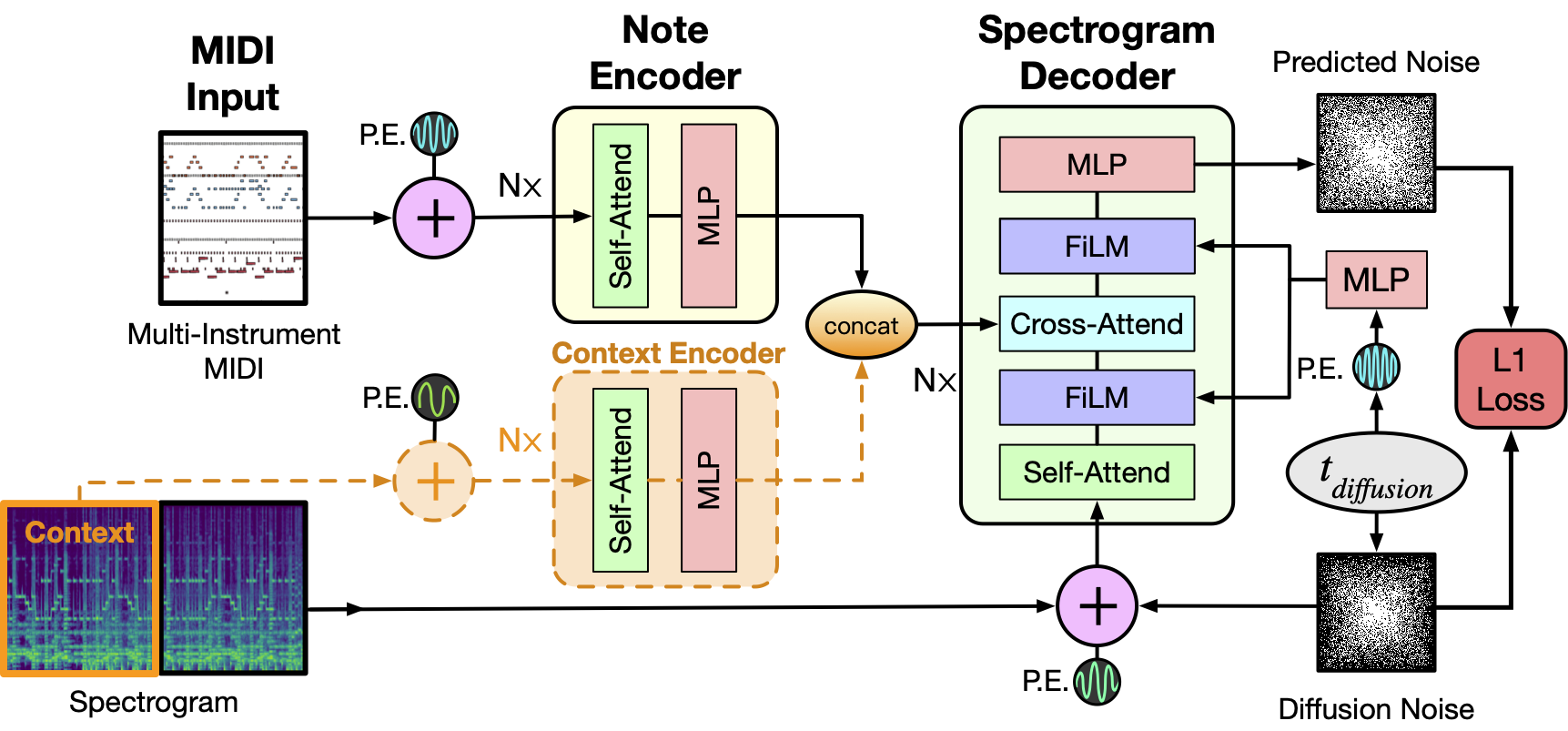
|
||||
|
||||
As depicted above the model takes as input a MIDI file and tokenizes it into a sequence of 5 second intervals. Each tokenized interval then together with positional encodings is passed through the Note Encoder and its representation is concatenated with the previous window's generated spectrogram representation obtained via the Context Encoder. For the initial 5 second window this is set to zero. The resulting context is then used as conditioning to sample the denoised Spectrogram from the MIDI window and we concatenate this spectrogram to the final output as well as use it for the context of the next MIDI window. The process repeats till we have gone over all the MIDI inputs. Finally a MelGAN decoder converts the potentially long spectrogram to audio which is the final result of this pipeline.
|
||||
|
||||
<Tip>
|
||||
|
||||
Make sure to check out the Schedulers [guide](../../using-diffusers/schedulers) to learn how to explore the tradeoff between scheduler speed and quality, and see the [reuse components across pipelines](../../using-diffusers/loading#reuse-components-across-pipelines) section to learn how to efficiently load the same components into multiple pipelines.
|
||||
|
||||
</Tip>
|
||||
|
||||
## SpectrogramDiffusionPipeline
|
||||
[[autodoc]] SpectrogramDiffusionPipeline
|
||||
- all
|
||||
- __call__
|
||||
|
||||
## AudioPipelineOutput
|
||||
[[autodoc]] pipelines.AudioPipelineOutput
|
||||
@@ -1,27 +0,0 @@
|
||||
<!--Copyright 2023 The HuggingFace Team. All rights reserved.
|
||||
|
||||
Licensed under the Apache License, Version 2.0 (the "License"); you may not use this file except in compliance with
|
||||
the License. You may obtain a copy of the License at
|
||||
|
||||
http://www.apache.org/licenses/LICENSE-2.0
|
||||
|
||||
Unless required by applicable law or agreed to in writing, software distributed under the License is distributed on
|
||||
an "AS IS" BASIS, WITHOUT WARRANTIES OR CONDITIONS OF ANY KIND, either express or implied. See the License for the
|
||||
specific language governing permissions and limitations under the License.
|
||||
-->
|
||||
|
||||
# K-Diffusion
|
||||
|
||||
[k-diffusion](https://github.com/crowsonkb/k-diffusion) is a popular library created by [Katherine Crowson](https://github.com/crowsonkb/). We provide `StableDiffusionKDiffusionPipeline` and `StableDiffusionXLKDiffusionPipeline` that allow you to run Stable DIffusion with samplers from k-diffusion.
|
||||
|
||||
Note that most the samplers from k-diffusion are implemented in Diffusers and we recommend using existing schedulers. You can find a mapping between k-diffusion samplers and schedulers in Diffusers [here](https://huggingface.co/docs/diffusers/api/schedulers/overview)
|
||||
|
||||
|
||||
## StableDiffusionKDiffusionPipeline
|
||||
|
||||
[[autodoc]] StableDiffusionKDiffusionPipeline
|
||||
|
||||
|
||||
## StableDiffusionXLKDiffusionPipeline
|
||||
|
||||
[[autodoc]] StableDiffusionXLKDiffusionPipeline
|
||||
@@ -14,11 +14,6 @@ specific language governing permissions and limitations under the License.
|
||||
|
||||
LDM3D was proposed in [LDM3D: Latent Diffusion Model for 3D](https://huggingface.co/papers/2305.10853) by Gabriela Ben Melech Stan, Diana Wofk, Scottie Fox, Alex Redden, Will Saxton, Jean Yu, Estelle Aflalo, Shao-Yen Tseng, Fabio Nonato, Matthias Muller, and Vasudev Lal. LDM3D generates an image and a depth map from a given text prompt unlike the existing text-to-image diffusion models such as [Stable Diffusion](./overview) which only generates an image. With almost the same number of parameters, LDM3D achieves to create a latent space that can compress both the RGB images and the depth maps.
|
||||
|
||||
Two checkpoints are available for use:
|
||||
- [ldm3d-original](https://huggingface.co/Intel/ldm3d). The original checkpoint used in the [paper](https://arxiv.org/pdf/2305.10853.pdf)
|
||||
- [ldm3d-4c](https://huggingface.co/Intel/ldm3d-4c). The new version of LDM3D using 4 channels inputs instead of 6-channels inputs and finetuned on higher resolution images.
|
||||
|
||||
|
||||
The abstract from the paper is:
|
||||
|
||||
*This research paper proposes a Latent Diffusion Model for 3D (LDM3D) that generates both image and depth map data from a given text prompt, allowing users to generate RGBD images from text prompts. The LDM3D model is fine-tuned on a dataset of tuples containing an RGB image, depth map and caption, and validated through extensive experiments. We also develop an application called DepthFusion, which uses the generated RGB images and depth maps to create immersive and interactive 360-degree-view experiences using TouchDesigner. This technology has the potential to transform a wide range of industries, from entertainment and gaming to architecture and design. Overall, this paper presents a significant contribution to the field of generative AI and computer vision, and showcases the potential of LDM3D and DepthFusion to revolutionize content creation and digital experiences. A short video summarizing the approach can be found at [this url](https://t.ly/tdi2).*
|
||||
@@ -31,25 +26,12 @@ Make sure to check out the Stable Diffusion [Tips](overview#tips) section to lea
|
||||
|
||||
## StableDiffusionLDM3DPipeline
|
||||
|
||||
[[autodoc]] pipelines.stable_diffusion_ldm3d.pipeline_stable_diffusion_ldm3d.StableDiffusionLDM3DPipeline
|
||||
[[autodoc]] StableDiffusionLDM3DPipeline
|
||||
- all
|
||||
- __call__
|
||||
|
||||
|
||||
## LDM3DPipelineOutput
|
||||
|
||||
[[autodoc]] pipelines.stable_diffusion_ldm3d.pipeline_stable_diffusion_ldm3d.LDM3DPipelineOutput
|
||||
[[autodoc]] pipelines.stable_diffusion.pipeline_stable_diffusion_ldm3d.LDM3DPipelineOutput
|
||||
- all
|
||||
- __call__
|
||||
|
||||
# Upscaler
|
||||
|
||||
[LDM3D-VR](https://arxiv.org/pdf/2311.03226.pdf) is an extended version of LDM3D.
|
||||
|
||||
The abstract from the paper is:
|
||||
*Latent diffusion models have proven to be state-of-the-art in the creation and manipulation of visual outputs. However, as far as we know, the generation of depth maps jointly with RGB is still limited. We introduce LDM3D-VR, a suite of diffusion models targeting virtual reality development that includes LDM3D-pano and LDM3D-SR. These models enable the generation of panoramic RGBD based on textual prompts and the upscaling of low-resolution inputs to high-resolution RGBD, respectively. Our models are fine-tuned from existing pretrained models on datasets containing panoramic/high-resolution RGB images, depth maps and captions. Both models are evaluated in comparison to existing related methods*
|
||||
|
||||
Two checkpoints are available for use:
|
||||
- [ldm3d-pano](https://huggingface.co/Intel/ldm3d-pano). This checkpoint enables the generation of panoramic images and requires the StableDiffusionLDM3DPipeline pipeline to be used.
|
||||
- [ldm3d-sr](https://huggingface.co/Intel/ldm3d-sr). This checkpoint enables the upscaling of RGB and depth images. Can be used in cascade after the original LDM3D pipeline using the StableDiffusionUpscaleLDM3DPipeline from communauty pipeline.
|
||||
|
||||
|
||||
@@ -121,16 +121,10 @@ The table below summarizes the available Stable Diffusion pipelines, their suppo
|
||||
<td class="px-4 py-2 text-gray-700">
|
||||
<a href="./ldm3d_diffusion">StableDiffusionLDM3D</a>
|
||||
</td>
|
||||
<td class="px-4 py-2 text-gray-700">text-to-rgb, text-to-depth, text-to-pano</td>
|
||||
<td class="px-4 py-2 text-gray-700">text-to-rgb, text-to-depth</td>
|
||||
<td class="px-4 py-2"><a href="https://huggingface.co/spaces/r23/ldm3d-space"><img src="https://img.shields.io/badge/%F0%9F%A4%97%20Hugging%20Face-Spaces-blue"/></a>
|
||||
</td>
|
||||
</tr>
|
||||
<tr>
|
||||
<td class="px-4 py-2 text-gray-700">
|
||||
<a href="./ldm3d_diffusion">StableDiffusionUpscaleLDM3D</a>
|
||||
</td>
|
||||
<td class="px-4 py-2 text-gray-700">ldm3d super-resolution</td>
|
||||
</tr>
|
||||
</tbody>
|
||||
</table>
|
||||
</div>
|
||||
|
||||
@@ -1,35 +0,0 @@
|
||||
<!--Copyright 2023 The HuggingFace Team. All rights reserved.
|
||||
|
||||
Licensed under the Apache License, Version 2.0 (the "License"); you may not use this file except in compliance with
|
||||
the License. You may obtain a copy of the License at
|
||||
|
||||
http://www.apache.org/licenses/LICENSE-2.0
|
||||
|
||||
Unless required by applicable law or agreed to in writing, software distributed under the License is distributed on
|
||||
an "AS IS" BASIS, WITHOUT WARRANTIES OR CONDITIONS OF ANY KIND, either express or implied. See the License for the
|
||||
specific language governing permissions and limitations under the License.
|
||||
-->
|
||||
|
||||
# SDXL Turbo
|
||||
|
||||
Stable Diffusion XL (SDXL) Turbo was proposed in [Adversarial Diffusion Distillation](https://stability.ai/research/adversarial-diffusion-distillation) by Axel Sauer, Dominik Lorenz, Andreas Blattmann, and Robin Rombach.
|
||||
|
||||
The abstract from the paper is:
|
||||
|
||||
*We introduce Adversarial Diffusion Distillation (ADD), a novel training approach that efficiently samples large-scale foundational image diffusion models in just 1–4 steps while maintaining high image quality. We use score distillation to leverage large-scale off-the-shelf image diffusion models as a teacher signal in combination with an adversarial loss to ensure high image fidelity even in the low-step regime of one or two sampling steps. Our analyses show that our model clearly outperforms existing few-step methods (GANs,Latent Consistency Models) in a single step and reaches the performance of state-of-the-art diffusion models (SDXL) in only four steps. ADD is the first method to unlock single-step, real-time image synthesis with foundation models.*
|
||||
|
||||
## Tips
|
||||
|
||||
- SDXL Turbo uses the exact same architecture as [SDXL](./stable_diffusion_xl), which means it also has the same API. Please refer to the [SDXL](./stable_diffusion_xl) API reference for more details.
|
||||
- SDXL Turbo should disable guidance scale by setting `guidance_scale=0.0`
|
||||
- SDXL Turbo should use `timestep_spacing='trailing'` for the scheduler and use between 1 and 4 steps.
|
||||
- SDXL Turbo has been trained to generate images of size 512x512.
|
||||
- SDXL Turbo is open-access, but not open-source meaning that one might have to buy a model license in order to use it for commercial applications. Make sure to read the [official model card](https://huggingface.co/stabilityai/sdxl-turbo) to learn more.
|
||||
|
||||
<Tip>
|
||||
|
||||
To learn how to use SDXL Turbo for various tasks, how to optimize performance, and other usage examples, take a look at the [SDXL Turbo](../../../using-diffusers/sdxl_turbo) guide.
|
||||
|
||||
Check out the [Stability AI](https://huggingface.co/stabilityai) Hub organization for the official base and refiner model checkpoints!
|
||||
|
||||
</Tip>
|
||||
33
docs/source/en/api/pipelines/stochastic_karras_ve.md
Normal file
33
docs/source/en/api/pipelines/stochastic_karras_ve.md
Normal file
@@ -0,0 +1,33 @@
|
||||
<!--Copyright 2023 The HuggingFace Team. All rights reserved.
|
||||
|
||||
Licensed under the Apache License, Version 2.0 (the "License"); you may not use this file except in compliance with
|
||||
the License. You may obtain a copy of the License at
|
||||
|
||||
http://www.apache.org/licenses/LICENSE-2.0
|
||||
|
||||
Unless required by applicable law or agreed to in writing, software distributed under the License is distributed on
|
||||
an "AS IS" BASIS, WITHOUT WARRANTIES OR CONDITIONS OF ANY KIND, either express or implied. See the License for the
|
||||
specific language governing permissions and limitations under the License.
|
||||
-->
|
||||
|
||||
# Stochastic Karras VE
|
||||
|
||||
[Elucidating the Design Space of Diffusion-Based Generative Models](https://huggingface.co/papers/2206.00364) is by Tero Karras, Miika Aittala, Timo Aila and Samuli Laine. This pipeline implements the stochastic sampling tailored to variance expanding (VE) models.
|
||||
|
||||
The abstract from the paper:
|
||||
|
||||
*We argue that the theory and practice of diffusion-based generative models are currently unnecessarily convoluted and seek to remedy the situation by presenting a design space that clearly separates the concrete design choices. This lets us identify several changes to both the sampling and training processes, as well as preconditioning of the score networks. Together, our improvements yield new state-of-the-art FID of 1.79 for CIFAR-10 in a class-conditional setting and 1.97 in an unconditional setting, with much faster sampling (35 network evaluations per image) than prior designs. To further demonstrate their modular nature, we show that our design changes dramatically improve both the efficiency and quality obtainable with pre-trained score networks from previous work, including improving the FID of a previously trained ImageNet-64 model from 2.07 to near-SOTA 1.55, and after re-training with our proposed improvements to a new SOTA of 1.36.*
|
||||
|
||||
<Tip>
|
||||
|
||||
Make sure to check out the Schedulers [guide](../../using-diffusers/schedulers) to learn how to explore the tradeoff between scheduler speed and quality, and see the [reuse components across pipelines](../../using-diffusers/loading#reuse-components-across-pipelines) section to learn how to efficiently load the same components into multiple pipelines.
|
||||
|
||||
</Tip>
|
||||
|
||||
## KarrasVePipeline
|
||||
[[autodoc]] KarrasVePipeline
|
||||
- all
|
||||
- __call__
|
||||
|
||||
## ImagePipelineOutput
|
||||
[[autodoc]] pipelines.ImagePipelineOutput
|
||||
@@ -41,7 +41,7 @@ pipe = DiffusionPipeline.from_pretrained("damo-vilab/text-to-video-ms-1.7b", tor
|
||||
pipe = pipe.to("cuda")
|
||||
|
||||
prompt = "Spiderman is surfing"
|
||||
video_frames = pipe(prompt).frames[0]
|
||||
video_frames = pipe(prompt).frames
|
||||
video_path = export_to_video(video_frames)
|
||||
video_path
|
||||
```
|
||||
@@ -64,7 +64,7 @@ pipe.enable_model_cpu_offload()
|
||||
pipe.enable_vae_slicing()
|
||||
|
||||
prompt = "Darth Vader surfing a wave"
|
||||
video_frames = pipe(prompt, num_frames=64).frames[0]
|
||||
video_frames = pipe(prompt, num_frames=64).frames
|
||||
video_path = export_to_video(video_frames)
|
||||
video_path
|
||||
```
|
||||
@@ -83,7 +83,7 @@ pipe.scheduler = DPMSolverMultistepScheduler.from_config(pipe.scheduler.config)
|
||||
pipe.enable_model_cpu_offload()
|
||||
|
||||
prompt = "Spiderman is surfing"
|
||||
video_frames = pipe(prompt, num_inference_steps=25).frames[0]
|
||||
video_frames = pipe(prompt, num_inference_steps=25).frames
|
||||
video_path = export_to_video(video_frames)
|
||||
video_path
|
||||
```
|
||||
@@ -130,7 +130,7 @@ pipe.unet.enable_forward_chunking(chunk_size=1, dim=1)
|
||||
pipe.enable_vae_slicing()
|
||||
|
||||
prompt = "Darth Vader surfing a wave"
|
||||
video_frames = pipe(prompt, num_frames=24).frames[0]
|
||||
video_frames = pipe(prompt, num_frames=24).frames
|
||||
video_path = export_to_video(video_frames)
|
||||
video_path
|
||||
```
|
||||
@@ -148,7 +148,7 @@ pipe.enable_vae_slicing()
|
||||
|
||||
video = [Image.fromarray(frame).resize((1024, 576)) for frame in video_frames]
|
||||
|
||||
video_frames = pipe(prompt, video=video, strength=0.6).frames[0]
|
||||
video_frames = pipe(prompt, video=video, strength=0.6).frames
|
||||
video_path = export_to_video(video_frames)
|
||||
video_path
|
||||
```
|
||||
|
||||
@@ -92,19 +92,6 @@ imageio.mimsave("video.mp4", result, fps=4)
|
||||
```
|
||||
|
||||
|
||||
- #### SDXL Support
|
||||
In order to use the SDXL model when generating a video from prompt, use the `TextToVideoZeroSDXLPipeline` pipeline:
|
||||
|
||||
```python
|
||||
import torch
|
||||
from diffusers import TextToVideoZeroSDXLPipeline
|
||||
|
||||
model_id = "stabilityai/stable-diffusion-xl-base-1.0"
|
||||
pipe = TextToVideoZeroSDXLPipeline.from_pretrained(
|
||||
model_id, torch_dtype=torch.float16, variant="fp16", use_safetensors=True
|
||||
).to("cuda")
|
||||
```
|
||||
|
||||
### Text-To-Video with Pose Control
|
||||
To generate a video from prompt with additional pose control
|
||||
|
||||
@@ -154,33 +141,7 @@ To generate a video from prompt with additional pose control
|
||||
result = pipe(prompt=[prompt] * len(pose_images), image=pose_images, latents=latents).images
|
||||
imageio.mimsave("video.mp4", result, fps=4)
|
||||
```
|
||||
- #### SDXL Support
|
||||
|
||||
Since our attention processor also works with SDXL, it can be utilized to generate a video from prompt using ControlNet models powered by SDXL:
|
||||
```python
|
||||
import torch
|
||||
from diffusers import StableDiffusionXLControlNetPipeline, ControlNetModel
|
||||
from diffusers.pipelines.text_to_video_synthesis.pipeline_text_to_video_zero import CrossFrameAttnProcessor
|
||||
|
||||
controlnet_model_id = 'thibaud/controlnet-openpose-sdxl-1.0'
|
||||
model_id = 'stabilityai/stable-diffusion-xl-base-1.0'
|
||||
|
||||
controlnet = ControlNetModel.from_pretrained(controlnet_model_id, torch_dtype=torch.float16)
|
||||
pipe = StableDiffusionControlNetPipeline.from_pretrained(
|
||||
model_id, controlnet=controlnet, torch_dtype=torch.float16
|
||||
).to('cuda')
|
||||
|
||||
# Set the attention processor
|
||||
pipe.unet.set_attn_processor(CrossFrameAttnProcessor(batch_size=2))
|
||||
pipe.controlnet.set_attn_processor(CrossFrameAttnProcessor(batch_size=2))
|
||||
|
||||
# fix latents for all frames
|
||||
latents = torch.randn((1, 4, 128, 128), device="cuda", dtype=torch.float16).repeat(len(pose_images), 1, 1, 1)
|
||||
|
||||
prompt = "Darth Vader dancing in a desert"
|
||||
result = pipe(prompt=[prompt] * len(pose_images), image=pose_images, latents=latents).images
|
||||
imageio.mimsave("video.mp4", result, fps=4)
|
||||
```
|
||||
|
||||
|
||||
### Text-To-Video with Edge Control
|
||||
|
||||
@@ -292,10 +253,5 @@ Make sure to check out the Schedulers [guide](../../using-diffusers/schedulers)
|
||||
- all
|
||||
- __call__
|
||||
|
||||
## TextToVideoZeroSDXLPipeline
|
||||
[[autodoc]] TextToVideoZeroSDXLPipeline
|
||||
- all
|
||||
- __call__
|
||||
|
||||
## TextToVideoPipelineOutput
|
||||
[[autodoc]] pipelines.text_to_video_synthesis.pipeline_text_to_video_zero.TextToVideoPipelineOutput
|
||||
|
||||
@@ -24,7 +24,7 @@ The abstract from the paper is:
|
||||
|
||||
*Model-based reinforcement learning methods often use learning only for the purpose of estimating an approximate dynamics model, offloading the rest of the decision-making work to classical trajectory optimizers. While conceptually simple, this combination has a number of empirical shortcomings, suggesting that learned models may not be well-suited to standard trajectory optimization. In this paper, we consider what it would look like to fold as much of the trajectory optimization pipeline as possible into the modeling problem, such that sampling from the model and planning with it become nearly identical. The core of our technical approach lies in a diffusion probabilistic model that plans by iteratively denoising trajectories. We show how classifier-guided sampling and image inpainting can be reinterpreted as coherent planning strategies, explore the unusual and useful properties of diffusion-based planning methods, and demonstrate the effectiveness of our framework in control settings that emphasize long-horizon decision-making and test-time flexibility.*
|
||||
|
||||
You can find additional information about the model on the [project page](https://diffusion-planning.github.io/), the [original codebase](https://github.com/jannerm/diffuser), or try it out in a demo [notebook](https://colab.research.google.com/drive/1rXm8CX4ZdN5qivjJ2lhwhkOmt_m0CvU0#scrollTo=6HXJvhyqcITc&uniqifier=1).
|
||||
You can find additional information about the model on the [project page](https://diffusion-planning.github.io/), the [original codebase](https://github.com/jannerm/diffuser), or try it out in a demo [notebook](https://colab.research.google.com/github/huggingface/notebooks/blob/main/diffusers/reinforcement_learning_with_diffusers.ipynb).
|
||||
|
||||
The script to run the model is available [here](https://github.com/huggingface/diffusers/tree/main/examples/reinforcement_learning).
|
||||
|
||||
|
||||
54
docs/source/en/api/pipelines/versatile_diffusion.md
Normal file
54
docs/source/en/api/pipelines/versatile_diffusion.md
Normal file
@@ -0,0 +1,54 @@
|
||||
<!--Copyright 2023 The HuggingFace Team. All rights reserved.
|
||||
|
||||
Licensed under the Apache License, Version 2.0 (the "License"); you may not use this file except in compliance with
|
||||
the License. You may obtain a copy of the License at
|
||||
|
||||
http://www.apache.org/licenses/LICENSE-2.0
|
||||
|
||||
Unless required by applicable law or agreed to in writing, software distributed under the License is distributed on
|
||||
an "AS IS" BASIS, WITHOUT WARRANTIES OR CONDITIONS OF ANY KIND, either express or implied. See the License for the
|
||||
specific language governing permissions and limitations under the License.
|
||||
-->
|
||||
|
||||
# Versatile Diffusion
|
||||
|
||||
Versatile Diffusion was proposed in [Versatile Diffusion: Text, Images and Variations All in One Diffusion Model](https://huggingface.co/papers/2211.08332) by Xingqian Xu, Zhangyang Wang, Eric Zhang, Kai Wang, Humphrey Shi.
|
||||
|
||||
The abstract from the paper is:
|
||||
|
||||
*Recent advances in diffusion models have set an impressive milestone in many generation tasks, and trending works such as DALL-E2, Imagen, and Stable Diffusion have attracted great interest. Despite the rapid landscape changes, recent new approaches focus on extensions and performance rather than capacity, thus requiring separate models for separate tasks. In this work, we expand the existing single-flow diffusion pipeline into a multi-task multimodal network, dubbed Versatile Diffusion (VD), that handles multiple flows of text-to-image, image-to-text, and variations in one unified model. The pipeline design of VD instantiates a unified multi-flow diffusion framework, consisting of sharable and swappable layer modules that enable the crossmodal generality beyond images and text. Through extensive experiments, we demonstrate that VD successfully achieves the following: a) VD outperforms the baseline approaches and handles all its base tasks with competitive quality; b) VD enables novel extensions such as disentanglement of style and semantics, dual- and multi-context blending, etc.; c) The success of our multi-flow multimodal framework over images and text may inspire further diffusion-based universal AI research.*
|
||||
|
||||
## Tips
|
||||
|
||||
You can load the more memory intensive "all-in-one" [`VersatileDiffusionPipeline`] that supports all the tasks or use the individual pipelines which are more memory efficient.
|
||||
|
||||
| **Pipeline** | **Supported tasks** |
|
||||
|------------------------------------------------------|-----------------------------------|
|
||||
| [`VersatileDiffusionPipeline`] | all of the below |
|
||||
| [`VersatileDiffusionTextToImagePipeline`] | text-to-image |
|
||||
| [`VersatileDiffusionImageVariationPipeline`] | image variation |
|
||||
| [`VersatileDiffusionDualGuidedPipeline`] | image-text dual guided generation |
|
||||
|
||||
<Tip>
|
||||
|
||||
Make sure to check out the Schedulers [guide](../../using-diffusers/schedulers) to learn how to explore the tradeoff between scheduler speed and quality, and see the [reuse components across pipelines](../../using-diffusers/loading#reuse-components-across-pipelines) section to learn how to efficiently load the same components into multiple pipelines.
|
||||
|
||||
</Tip>
|
||||
|
||||
## VersatileDiffusionPipeline
|
||||
[[autodoc]] VersatileDiffusionPipeline
|
||||
|
||||
## VersatileDiffusionTextToImagePipeline
|
||||
[[autodoc]] VersatileDiffusionTextToImagePipeline
|
||||
- all
|
||||
- __call__
|
||||
|
||||
## VersatileDiffusionImageVariationPipeline
|
||||
[[autodoc]] VersatileDiffusionImageVariationPipeline
|
||||
- all
|
||||
- __call__
|
||||
|
||||
## VersatileDiffusionDualGuidedPipeline
|
||||
[[autodoc]] VersatileDiffusionDualGuidedPipeline
|
||||
- all
|
||||
- __call__
|
||||
35
docs/source/en/api/pipelines/vq_diffusion.md
Normal file
35
docs/source/en/api/pipelines/vq_diffusion.md
Normal file
@@ -0,0 +1,35 @@
|
||||
<!--Copyright 2023 The HuggingFace Team. All rights reserved.
|
||||
|
||||
Licensed under the Apache License, Version 2.0 (the "License"); you may not use this file except in compliance with
|
||||
the License. You may obtain a copy of the License at
|
||||
|
||||
http://www.apache.org/licenses/LICENSE-2.0
|
||||
|
||||
Unless required by applicable law or agreed to in writing, software distributed under the License is distributed on
|
||||
an "AS IS" BASIS, WITHOUT WARRANTIES OR CONDITIONS OF ANY KIND, either express or implied. See the License for the
|
||||
specific language governing permissions and limitations under the License.
|
||||
-->
|
||||
|
||||
# VQ Diffusion
|
||||
|
||||
[Vector Quantized Diffusion Model for Text-to-Image Synthesis](https://huggingface.co/papers/2111.14822) is by Shuyang Gu, Dong Chen, Jianmin Bao, Fang Wen, Bo Zhang, Dongdong Chen, Lu Yuan, Baining Guo.
|
||||
|
||||
The abstract from the paper is:
|
||||
|
||||
*We present the vector quantized diffusion (VQ-Diffusion) model for text-to-image generation. This method is based on a vector quantized variational autoencoder (VQ-VAE) whose latent space is modeled by a conditional variant of the recently developed Denoising Diffusion Probabilistic Model (DDPM). We find that this latent-space method is well-suited for text-to-image generation tasks because it not only eliminates the unidirectional bias with existing methods but also allows us to incorporate a mask-and-replace diffusion strategy to avoid the accumulation of errors, which is a serious problem with existing methods. Our experiments show that the VQ-Diffusion produces significantly better text-to-image generation results when compared with conventional autoregressive (AR) models with similar numbers of parameters. Compared with previous GAN-based text-to-image methods, our VQ-Diffusion can handle more complex scenes and improve the synthesized image quality by a large margin. Finally, we show that the image generation computation in our method can be made highly efficient by reparameterization. With traditional AR methods, the text-to-image generation time increases linearly with the output image resolution and hence is quite time consuming even for normal size images. The VQ-Diffusion allows us to achieve a better trade-off between quality and speed. Our experiments indicate that the VQ-Diffusion model with the reparameterization is fifteen times faster than traditional AR methods while achieving a better image quality.*
|
||||
|
||||
The original codebase can be found at [microsoft/VQ-Diffusion](https://github.com/microsoft/VQ-Diffusion).
|
||||
|
||||
<Tip>
|
||||
|
||||
Make sure to check out the Schedulers [guide](../../using-diffusers/schedulers) to learn how to explore the tradeoff between scheduler speed and quality, and see the [reuse components across pipelines](../../using-diffusers/loading#reuse-components-across-pipelines) section to learn how to efficiently load the same components into multiple pipelines.
|
||||
|
||||
</Tip>
|
||||
|
||||
## VQDiffusionPipeline
|
||||
[[autodoc]] VQDiffusionPipeline
|
||||
- all
|
||||
- __call__
|
||||
|
||||
## ImagePipelineOutput
|
||||
[[autodoc]] pipelines.ImagePipelineOutput
|
||||
@@ -25,4 +25,4 @@ The abstract from the paper is:
|
||||
</Tip>
|
||||
|
||||
## ScoreSdeVpScheduler
|
||||
[[autodoc]] schedulers.deprecated.scheduling_sde_vp.ScoreSdeVpScheduler
|
||||
[[autodoc]] schedulers.scheduling_sde_vp.ScoreSdeVpScheduler
|
||||
|
||||
@@ -18,4 +18,4 @@ specific language governing permissions and limitations under the License.
|
||||
[[autodoc]] KarrasVeScheduler
|
||||
|
||||
## KarrasVeOutput
|
||||
[[autodoc]] schedulers.deprecated.scheduling_karras_ve.KarrasVeOutput
|
||||
[[autodoc]] schedulers.scheduling_karras_ve.KarrasVeOutput
|
||||
|
||||
@@ -297,37 +297,17 @@ if you don't know yet what specific component you would like to add:
|
||||
- [Model or pipeline](https://github.com/huggingface/diffusers/issues?q=is%3Aopen+is%3Aissue+label%3A%22New+pipeline%2Fmodel%22)
|
||||
- [Scheduler](https://github.com/huggingface/diffusers/issues?q=is%3Aopen+is%3Aissue+label%3A%22New+scheduler%22)
|
||||
|
||||
Before adding any of the three components, it is strongly recommended that you give the [Philosophy guide](philosophy) a read to better understand the design of any of the three components. Please be aware that we cannot merge model, scheduler, or pipeline additions that strongly diverge from our design philosophy
|
||||
as it will lead to API inconsistencies. If you fundamentally disagree with a design choice, please open a [Feedback issue](https://github.com/huggingface/diffusers/issues/new?assignees=&labels=&template=feedback.md&title=) instead so that it can be discussed whether a certain design pattern/design choice shall be changed everywhere in the library and whether we shall update our design philosophy. Consistency across the library is very important for us.
|
||||
Before adding any of the three components, it is strongly recommended that you give the [Philosophy guide](philosophy) a read to better understand the design of any of the three components. Please be aware that
|
||||
we cannot merge model, scheduler, or pipeline additions that strongly diverge from our design philosophy
|
||||
as it will lead to API inconsistencies. If you fundamentally disagree with a design choice, please
|
||||
open a [Feedback issue](https://github.com/huggingface/diffusers/issues/new?assignees=&labels=&template=feedback.md&title=) instead so that it can be discussed whether a certain design
|
||||
pattern/design choice shall be changed everywhere in the library and whether we shall update our design philosophy. Consistency across the library is very important for us.
|
||||
|
||||
Please make sure to add links to the original codebase/paper to the PR and ideally also ping the original author directly on the PR so that they can follow the progress and potentially help with questions.
|
||||
Please make sure to add links to the original codebase/paper to the PR and ideally also ping the
|
||||
original author directly on the PR so that they can follow the progress and potentially help with questions.
|
||||
|
||||
If you are unsure or stuck in the PR, don't hesitate to leave a message to ask for a first review or help.
|
||||
|
||||
#### Copied from mechanism
|
||||
|
||||
A unique and important feature to understand when adding any pipeline, model or scheduler code is the `# Copied from` mechanism. You'll see this all over the Diffusers codebase, and the reason we use it is to keep the codebase easy to understand and maintain. Marking code with the `# Copied from` mechanism forces the marked code to be identical to the code it was copied from. This makes it easy to update and propagate changes across many files whenever you run `make fix-copies`.
|
||||
|
||||
For example, in the code example below, [`~diffusers.pipelines.stable_diffusion.StableDiffusionPipelineOutput`] is the original code and `AltDiffusionPipelineOutput` uses the `# Copied from` mechanism to copy it. The only difference is changing the class prefix from `Stable` to `Alt`.
|
||||
|
||||
```py
|
||||
# Copied from diffusers.pipelines.stable_diffusion.pipeline_output.StableDiffusionPipelineOutput with Stable->Alt
|
||||
class AltDiffusionPipelineOutput(BaseOutput):
|
||||
"""
|
||||
Output class for Alt Diffusion pipelines.
|
||||
|
||||
Args:
|
||||
images (`List[PIL.Image.Image]` or `np.ndarray`)
|
||||
List of denoised PIL images of length `batch_size` or NumPy array of shape `(batch_size, height, width,
|
||||
num_channels)`.
|
||||
nsfw_content_detected (`List[bool]`)
|
||||
List indicating whether the corresponding generated image contains "not-safe-for-work" (nsfw) content or
|
||||
`None` if safety checking could not be performed.
|
||||
"""
|
||||
```
|
||||
|
||||
To learn more, read this section of the [~Don't~ Repeat Yourself*](https://huggingface.co/blog/transformers-design-philosophy#4-machine-learning-models-are-static) blog post.
|
||||
|
||||
## How to write a good issue
|
||||
|
||||
**The better your issue is written, the higher the chances that it will be quickly resolved.**
|
||||
|
||||
@@ -37,10 +37,8 @@ source .env/bin/activate
|
||||
|
||||
You should also install 🤗 Transformers because 🤗 Diffusers relies on its models:
|
||||
|
||||
|
||||
<frameworkcontent>
|
||||
<pt>
|
||||
Note - PyTorch only supports Python 3.8 - 3.11 on Windows.
|
||||
```bash
|
||||
pip install diffusers["torch"] transformers
|
||||
```
|
||||
|
||||
@@ -1,62 +0,0 @@
|
||||
<!--Copyright 2023 The HuggingFace Team. All rights reserved.
|
||||
|
||||
Licensed under the Apache License, Version 2.0 (the "License"); you may not use this file except in compliance with
|
||||
the License. You may obtain a copy of the License at
|
||||
|
||||
http://www.apache.org/licenses/LICENSE-2.0
|
||||
|
||||
Unless required by applicable law or agreed to in writing, software distributed under the License is distributed on
|
||||
an "AS IS" BASIS, WITHOUT WARRANTIES OR CONDITIONS OF ANY KIND, either express or implied. See the License for the
|
||||
specific language governing permissions and limitations under the License.
|
||||
-->
|
||||
|
||||
# DeepCache
|
||||
[DeepCache](https://huggingface.co/papers/2312.00858) accelerates [`StableDiffusionPipeline`] and [`StableDiffusionXLPipeline`] by strategically caching and reusing high-level features while efficiently updating low-level features by taking advantage of the U-Net architecture.
|
||||
|
||||
Start by installing [DeepCache](https://github.com/horseee/DeepCache):
|
||||
```bash
|
||||
pip install DeepCache
|
||||
```
|
||||
|
||||
Then load and enable the [`DeepCacheSDHelper`](https://github.com/horseee/DeepCache#usage):
|
||||
|
||||
```diff
|
||||
import torch
|
||||
from diffusers import StableDiffusionPipeline
|
||||
pipe = StableDiffusionPipeline.from_pretrained('runwayml/stable-diffusion-v1-5', torch_dtype=torch.float16).to("cuda")
|
||||
|
||||
+ from DeepCache import DeepCacheSDHelper
|
||||
+ helper = DeepCacheSDHelper(pipe=pipe)
|
||||
+ helper.set_params(
|
||||
+ cache_interval=3,
|
||||
+ cache_branch_id=0,
|
||||
+ )
|
||||
+ helper.enable()
|
||||
|
||||
image = pipe("a photo of an astronaut on a moon").images[0]
|
||||
```
|
||||
|
||||
The `set_params` method accepts two arguments: `cache_interval` and `cache_branch_id`. `cache_interval` means the frequency of feature caching, specified as the number of steps between each cache operation. `cache_branch_id` identifies which branch of the network (ordered from the shallowest to the deepest layer) is responsible for executing the caching processes.
|
||||
Opting for a lower `cache_branch_id` or a larger `cache_interval` can lead to faster inference speed at the expense of reduced image quality (ablation experiments of these two hyperparameters can be found in the [paper](https://arxiv.org/abs/2312.00858)). Once those arguments are set, use the `enable` or `disable` methods to activate or deactivate the `DeepCacheSDHelper`.
|
||||
|
||||
<div class="flex justify-center">
|
||||
<img src="https://github.com/horseee/Diffusion_DeepCache/raw/master/static/images/example.png">
|
||||
</div>
|
||||
|
||||
You can find more generated samples (original pipeline vs DeepCache) and the corresponding inference latency in the [WandB report](https://wandb.ai/horseee/DeepCache/runs/jwlsqqgt?workspace=user-horseee). The prompts are randomly selected from the [MS-COCO 2017](https://cocodataset.org/#home) dataset.
|
||||
|
||||
## Benchmark
|
||||
|
||||
We tested how much faster DeepCache accelerates [Stable Diffusion v2.1](https://huggingface.co/stabilityai/stable-diffusion-2-1) with 50 inference steps on an NVIDIA RTX A5000, using different configurations for resolution, batch size, cache interval (I), and cache branch (B).
|
||||
|
||||
| **Resolution** | **Batch size** | **Original** | **DeepCache(I=3, B=0)** | **DeepCache(I=5, B=0)** | **DeepCache(I=5, B=1)** |
|
||||
|----------------|----------------|--------------|-------------------------|-------------------------|-------------------------|
|
||||
| 512| 8| 15.96| 6.88(2.32x)| 5.03(3.18x)| 7.27(2.20x)|
|
||||
| | 4| 8.39| 3.60(2.33x)| 2.62(3.21x)| 3.75(2.24x)|
|
||||
| | 1| 2.61| 1.12(2.33x)| 0.81(3.24x)| 1.11(2.35x)|
|
||||
| 768| 8| 43.58| 18.99(2.29x)| 13.96(3.12x)| 21.27(2.05x)|
|
||||
| | 4| 22.24| 9.67(2.30x)| 7.10(3.13x)| 10.74(2.07x)|
|
||||
| | 1| 6.33| 2.72(2.33x)| 1.97(3.21x)| 2.98(2.12x)|
|
||||
| 1024| 8| 101.95| 45.57(2.24x)| 33.72(3.02x)| 53.00(1.92x)|
|
||||
| | 4| 49.25| 21.86(2.25x)| 16.19(3.04x)| 25.78(1.91x)|
|
||||
| | 1| 13.83| 6.07(2.28x)| 4.43(3.12x)| 7.15(1.93x)|
|
||||
@@ -1,255 +0,0 @@
|
||||
<!--Copyright 2023 The HuggingFace Team. All rights reserved.
|
||||
|
||||
Licensed under the Apache License, Version 2.0 (the "License"); you may not use this file except in compliance with
|
||||
the License. You may obtain a copy of the License at
|
||||
|
||||
http://www.apache.org/licenses/LICENSE-2.0
|
||||
|
||||
Unless required by applicable law or agreed to in writing, software distributed under the License is distributed on
|
||||
an "AS IS" BASIS, WITHOUT WARRANTIES OR CONDITIONS OF ANY KIND, either express or implied. See the License for the
|
||||
specific language governing permissions and limitations under the License.
|
||||
-->
|
||||
|
||||
# Latent Consistency Distillation
|
||||
|
||||
[Latent Consistency Models (LCMs)](https://hf.co/papers/2310.04378) are able to generate high-quality images in just a few steps, representing a big leap forward because many pipelines require at least 25+ steps. LCMs are produced by applying the latent consistency distillation method to any Stable Diffusion model. This method works by applying *one-stage guided distillation* to the latent space, and incorporating a *skipping-step* method to consistently skip timesteps to accelerate the distillation process (refer to section 4.1, 4.2, and 4.3 of the paper for more details).
|
||||
|
||||
If you're training on a GPU with limited vRAM, try enabling `gradient_checkpointing`, `gradient_accumulation_steps`, and `mixed_precision` to reduce memory-usage and speedup training. You can reduce your memory-usage even more by enabling memory-efficient attention with [xFormers](../optimization/xformers) and [bitsandbytes'](https://github.com/TimDettmers/bitsandbytes) 8-bit optimizer.
|
||||
|
||||
This guide will explore the [train_lcm_distill_sd_wds.py](https://github.com/huggingface/diffusers/blob/main/examples/consistency_distillation/train_lcm_distill_sd_wds.py) script to help you become more familiar with it, and how you can adapt it for your own use-case.
|
||||
|
||||
Before running the script, make sure you install the library from source:
|
||||
|
||||
```bash
|
||||
git clone https://github.com/huggingface/diffusers
|
||||
cd diffusers
|
||||
pip install .
|
||||
```
|
||||
|
||||
Then navigate to the example folder containing the training script and install the required dependencies for the script you're using:
|
||||
|
||||
```bash
|
||||
cd examples/consistency_distillation
|
||||
pip install -r requirements.txt
|
||||
```
|
||||
|
||||
<Tip>
|
||||
|
||||
🤗 Accelerate is a library for helping you train on multiple GPUs/TPUs or with mixed-precision. It'll automatically configure your training setup based on your hardware and environment. Take a look at the 🤗 Accelerate [Quick tour](https://huggingface.co/docs/accelerate/quicktour) to learn more.
|
||||
|
||||
</Tip>
|
||||
|
||||
Initialize an 🤗 Accelerate environment (try enabling `torch.compile` to significantly speedup training):
|
||||
|
||||
```bash
|
||||
accelerate config
|
||||
```
|
||||
|
||||
To setup a default 🤗 Accelerate environment without choosing any configurations:
|
||||
|
||||
```bash
|
||||
accelerate config default
|
||||
```
|
||||
|
||||
Or if your environment doesn't support an interactive shell, like a notebook, you can use:
|
||||
|
||||
```bash
|
||||
from accelerate.utils import write_basic_config
|
||||
|
||||
write_basic_config()
|
||||
```
|
||||
|
||||
Lastly, if you want to train a model on your own dataset, take a look at the [Create a dataset for training](create_dataset) guide to learn how to create a dataset that works with the training script.
|
||||
|
||||
## Script parameters
|
||||
|
||||
<Tip>
|
||||
|
||||
The following sections highlight parts of the training script that are important for understanding how to modify it, but it doesn't cover every aspect of the script in detail. If you're interested in learning more, feel free to read through the [script](https://github.com/huggingface/diffusers/blob/main/examples/consistency_distillation/train_lcm_distill_sd_wds.py) and let us know if you have any questions or concerns.
|
||||
|
||||
</Tip>
|
||||
|
||||
The training script provides many parameters to help you customize your training run. All of the parameters and their descriptions are found in the [`parse_args()`](https://github.com/huggingface/diffusers/blob/3b37488fa3280aed6a95de044d7a42ffdcb565ef/examples/consistency_distillation/train_lcm_distill_sd_wds.py#L419) function. This function provides default values for each parameter, such as the training batch size and learning rate, but you can also set your own values in the training command if you'd like.
|
||||
|
||||
For example, to speedup training with mixed precision using the fp16 format, add the `--mixed_precision` parameter to the training command:
|
||||
|
||||
```bash
|
||||
accelerate launch train_lcm_distill_sd_wds.py \
|
||||
--mixed_precision="fp16"
|
||||
```
|
||||
|
||||
Most of the parameters are identical to the parameters in the [Text-to-image](text2image#script-parameters) training guide, so you'll focus on the parameters that are relevant to latent consistency distillation in this guide.
|
||||
|
||||
- `--pretrained_teacher_model`: the path to a pretrained latent diffusion model to use as the teacher model
|
||||
- `--pretrained_vae_model_name_or_path`: path to a pretrained VAE; the SDXL VAE is known to suffer from numerical instability, so this parameter allows you to specify an alternative VAE (like this [VAE]((https://huggingface.co/madebyollin/sdxl-vae-fp16-fix)) by madebyollin which works in fp16)
|
||||
- `--w_min` and `--w_max`: the minimum and maximum guidance scale values for guidance scale sampling
|
||||
- `--num_ddim_timesteps`: the number of timesteps for DDIM sampling
|
||||
- `--loss_type`: the type of loss (L2 or Huber) to calculate for latent consistency distillation; Huber loss is generally preferred because it's more robust to outliers
|
||||
- `--huber_c`: the Huber loss parameter
|
||||
|
||||
## Training script
|
||||
|
||||
The training script starts by creating a dataset class - [`Text2ImageDataset`](https://github.com/huggingface/diffusers/blob/3b37488fa3280aed6a95de044d7a42ffdcb565ef/examples/consistency_distillation/train_lcm_distill_sd_wds.py#L141) - for preprocessing the images and creating a training dataset.
|
||||
|
||||
```py
|
||||
def transform(example):
|
||||
image = example["image"]
|
||||
image = TF.resize(image, resolution, interpolation=transforms.InterpolationMode.BILINEAR)
|
||||
|
||||
c_top, c_left, _, _ = transforms.RandomCrop.get_params(image, output_size=(resolution, resolution))
|
||||
image = TF.crop(image, c_top, c_left, resolution, resolution)
|
||||
image = TF.to_tensor(image)
|
||||
image = TF.normalize(image, [0.5], [0.5])
|
||||
|
||||
example["image"] = image
|
||||
return example
|
||||
```
|
||||
|
||||
For improved performance on reading and writing large datasets stored in the cloud, this script uses the [WebDataset](https://github.com/webdataset/webdataset) format to create a preprocessing pipeline to apply transforms and create a dataset and dataloader for training. Images are processed and fed to the training loop without having to download the full dataset first.
|
||||
|
||||
```py
|
||||
processing_pipeline = [
|
||||
wds.decode("pil", handler=wds.ignore_and_continue),
|
||||
wds.rename(image="jpg;png;jpeg;webp", text="text;txt;caption", handler=wds.warn_and_continue),
|
||||
wds.map(filter_keys({"image", "text"})),
|
||||
wds.map(transform),
|
||||
wds.to_tuple("image", "text"),
|
||||
]
|
||||
```
|
||||
|
||||
In the [`main()`](https://github.com/huggingface/diffusers/blob/3b37488fa3280aed6a95de044d7a42ffdcb565ef/examples/consistency_distillation/train_lcm_distill_sd_wds.py#L768) function, all the necessary components like the noise scheduler, tokenizers, text encoders, and VAE are loaded. The teacher UNet is also loaded here and then you can create a student UNet from the teacher UNet. The student UNet is updated by the optimizer during training.
|
||||
|
||||
```py
|
||||
teacher_unet = UNet2DConditionModel.from_pretrained(
|
||||
args.pretrained_teacher_model, subfolder="unet", revision=args.teacher_revision
|
||||
)
|
||||
|
||||
unet = UNet2DConditionModel(**teacher_unet.config)
|
||||
unet.load_state_dict(teacher_unet.state_dict(), strict=False)
|
||||
unet.train()
|
||||
```
|
||||
|
||||
Now you can create the [optimizer](https://github.com/huggingface/diffusers/blob/3b37488fa3280aed6a95de044d7a42ffdcb565ef/examples/consistency_distillation/train_lcm_distill_sd_wds.py#L979) to update the UNet parameters:
|
||||
|
||||
```py
|
||||
optimizer = optimizer_class(
|
||||
unet.parameters(),
|
||||
lr=args.learning_rate,
|
||||
betas=(args.adam_beta1, args.adam_beta2),
|
||||
weight_decay=args.adam_weight_decay,
|
||||
eps=args.adam_epsilon,
|
||||
)
|
||||
```
|
||||
|
||||
Create the [dataset](https://github.com/huggingface/diffusers/blob/3b37488fa3280aed6a95de044d7a42ffdcb565ef/examples/consistency_distillation/train_lcm_distill_sd_wds.py#L994):
|
||||
|
||||
```py
|
||||
dataset = Text2ImageDataset(
|
||||
train_shards_path_or_url=args.train_shards_path_or_url,
|
||||
num_train_examples=args.max_train_samples,
|
||||
per_gpu_batch_size=args.train_batch_size,
|
||||
global_batch_size=args.train_batch_size * accelerator.num_processes,
|
||||
num_workers=args.dataloader_num_workers,
|
||||
resolution=args.resolution,
|
||||
shuffle_buffer_size=1000,
|
||||
pin_memory=True,
|
||||
persistent_workers=True,
|
||||
)
|
||||
train_dataloader = dataset.train_dataloader
|
||||
```
|
||||
|
||||
Next, you're ready to setup the [training loop](https://github.com/huggingface/diffusers/blob/3b37488fa3280aed6a95de044d7a42ffdcb565ef/examples/consistency_distillation/train_lcm_distill_sd_wds.py#L1049) and implement the latent consistency distillation method (see Algorithm 1 in the paper for more details). This section of the script takes care of adding noise to the latents, sampling and creating a guidance scale embedding, and predicting the original image from the noise.
|
||||
|
||||
```py
|
||||
pred_x_0 = predicted_origin(
|
||||
noise_pred,
|
||||
start_timesteps,
|
||||
noisy_model_input,
|
||||
noise_scheduler.config.prediction_type,
|
||||
alpha_schedule,
|
||||
sigma_schedule,
|
||||
)
|
||||
|
||||
model_pred = c_skip_start * noisy_model_input + c_out_start * pred_x_0
|
||||
```
|
||||
|
||||
It gets the [teacher model predictions](https://github.com/huggingface/diffusers/blob/3b37488fa3280aed6a95de044d7a42ffdcb565ef/examples/consistency_distillation/train_lcm_distill_sd_wds.py#L1172) and the [LCM predictions](https://github.com/huggingface/diffusers/blob/3b37488fa3280aed6a95de044d7a42ffdcb565ef/examples/consistency_distillation/train_lcm_distill_sd_wds.py#L1209) next, calculates the loss, and then backpropagates it to the LCM.
|
||||
|
||||
```py
|
||||
if args.loss_type == "l2":
|
||||
loss = F.mse_loss(model_pred.float(), target.float(), reduction="mean")
|
||||
elif args.loss_type == "huber":
|
||||
loss = torch.mean(
|
||||
torch.sqrt((model_pred.float() - target.float()) ** 2 + args.huber_c**2) - args.huber_c
|
||||
)
|
||||
```
|
||||
|
||||
If you want to learn more about how the training loop works, check out the [Understanding pipelines, models and schedulers tutorial](../using-diffusers/write_own_pipeline) which breaks down the basic pattern of the denoising process.
|
||||
|
||||
## Launch the script
|
||||
|
||||
Now you're ready to launch the training script and start distilling!
|
||||
|
||||
For this guide, you'll use the `--train_shards_path_or_url` to specify the path to the [Conceptual Captions 12M](https://github.com/google-research-datasets/conceptual-12m) dataset stored on the Hub [here](https://huggingface.co/datasets/laion/conceptual-captions-12m-webdataset). Set the `MODEL_DIR` environment variable to the name of the teacher model and `OUTPUT_DIR` to where you want to save the model.
|
||||
|
||||
```bash
|
||||
export MODEL_DIR="runwayml/stable-diffusion-v1-5"
|
||||
export OUTPUT_DIR="path/to/saved/model"
|
||||
|
||||
accelerate launch train_lcm_distill_sd_wds.py \
|
||||
--pretrained_teacher_model=$MODEL_DIR \
|
||||
--output_dir=$OUTPUT_DIR \
|
||||
--mixed_precision=fp16 \
|
||||
--resolution=512 \
|
||||
--learning_rate=1e-6 --loss_type="huber" --ema_decay=0.95 --adam_weight_decay=0.0 \
|
||||
--max_train_steps=1000 \
|
||||
--max_train_samples=4000000 \
|
||||
--dataloader_num_workers=8 \
|
||||
--train_shards_path_or_url="pipe:curl -L -s https://huggingface.co/datasets/laion/conceptual-captions-12m-webdataset/resolve/main/data/{00000..01099}.tar?download=true" \
|
||||
--validation_steps=200 \
|
||||
--checkpointing_steps=200 --checkpoints_total_limit=10 \
|
||||
--train_batch_size=12 \
|
||||
--gradient_checkpointing --enable_xformers_memory_efficient_attention \
|
||||
--gradient_accumulation_steps=1 \
|
||||
--use_8bit_adam \
|
||||
--resume_from_checkpoint=latest \
|
||||
--report_to=wandb \
|
||||
--seed=453645634 \
|
||||
--push_to_hub
|
||||
```
|
||||
|
||||
Once training is complete, you can use your new LCM for inference.
|
||||
|
||||
```py
|
||||
from diffusers import UNet2DConditionModel, DiffusionPipeline, LCMScheduler
|
||||
import torch
|
||||
|
||||
unet = UNet2DConditionModel.from_pretrained("your-username/your-model", torch_dtype=torch.float16, variant="fp16")
|
||||
pipeline = DiffusionPipeline.from_pretrained("runwayml/stable-diffusion-v1-5", unet=unet, torch_dtype=torch.float16, variant="fp16")
|
||||
|
||||
pipeline.scheduler = LCMScheduler.from_config(pipe.scheduler.config)
|
||||
pipeline.to("cuda")
|
||||
|
||||
prompt = "sushi rolls in the form of panda heads, sushi platter"
|
||||
|
||||
image = pipeline(prompt, num_inference_steps=4, guidance_scale=1.0).images[0]
|
||||
```
|
||||
|
||||
## LoRA
|
||||
|
||||
LoRA is a training technique for significantly reducing the number of trainable parameters. As a result, training is faster and it is easier to store the resulting weights because they are a lot smaller (~100MBs). Use the [train_lcm_distill_lora_sd_wds.py](https://github.com/huggingface/diffusers/blob/main/examples/consistency_distillation/train_lcm_distill_lora_sd_wds.py) or [train_lcm_distill_lora_sdxl.wds.py](https://github.com/huggingface/diffusers/blob/main/examples/consistency_distillation/train_lcm_distill_lora_sdxl_wds.py) script to train with LoRA.
|
||||
|
||||
The LoRA training script is discussed in more detail in the [LoRA training](lora) guide.
|
||||
|
||||
## Stable Diffusion XL
|
||||
|
||||
Stable Diffusion XL (SDXL) is a powerful text-to-image model that generates high-resolution images, and it adds a second text-encoder to its architecture. Use the [train_lcm_distill_sdxl_wds.py](https://github.com/huggingface/diffusers/blob/main/examples/consistency_distillation/train_lcm_distill_sdxl_wds.py) script to train a SDXL model with LoRA.
|
||||
|
||||
The SDXL training script is discussed in more detail in the [SDXL training](sdxl) guide.
|
||||
|
||||
## Next steps
|
||||
|
||||
Congratulations on distilling a LCM model! To learn more about LCM, the following may be helpful:
|
||||
|
||||
- Learn how to use [LCMs for inference](../using-diffusers/lcm) for text-to-image, image-to-image, and with LoRA checkpoints.
|
||||
- Read the [SDXL in 4 steps with Latent Consistency LoRAs](https://huggingface.co/blog/lcm_lora) blog post to learn more about SDXL LCM-LoRA's for super fast inference, quality comparisons, benchmarks, and more.
|
||||
@@ -104,7 +104,7 @@ accelerate launch train_text_to_image_lora.py \
|
||||
|
||||
Many of the basic and important parameters are described in the [Text-to-image](text2image#script-parameters) training guide, so this guide just focuses on the LoRA relevant parameters:
|
||||
|
||||
- `--rank`: the inner dimension of the low-rank matrices to train; a higher rank means more trainable parameters
|
||||
- `--rank`: the number of low-rank matrices to train
|
||||
- `--learning_rate`: the default learning rate is 1e-4, but with LoRA, you can use a higher learning rate
|
||||
|
||||
## Training script
|
||||
@@ -179,7 +179,7 @@ accelerate launch --mixed_precision="fp16" train_text_to_image_lora.py \
|
||||
--pretrained_model_name_or_path=$MODEL_NAME \
|
||||
--dataset_name=$DATASET_NAME \
|
||||
--dataloader_num_workers=8 \
|
||||
--resolution=512 \
|
||||
--resolution=512
|
||||
--center_crop \
|
||||
--random_flip \
|
||||
--train_batch_size=1 \
|
||||
@@ -214,4 +214,4 @@ image = pipeline("A pokemon with blue eyes").images[0]
|
||||
Congratulations on training a new model with LoRA! To learn more about how to use your new model, the following guides may be helpful:
|
||||
|
||||
- Learn how to [load different LoRA formats](../using-diffusers/loading_adapters#LoRA) trained using community trainers like Kohya and TheLastBen.
|
||||
- Learn how to use and [combine multiple LoRA's](../tutorials/using_peft_for_inference) with PEFT for inference.
|
||||
- Learn how to use and [combine multiple LoRA's](../tutorials/using_peft_for_inference) with PEFT for inference.
|
||||
@@ -12,7 +12,7 @@ specific language governing permissions and limitations under the License.
|
||||
|
||||
# T2I-Adapter
|
||||
|
||||
[T2I-Adapter](https://hf.co/papers/2302.08453) is a lightweight adapter model that provides an additional conditioning input image (line art, canny, sketch, depth, pose) to better control image generation. It is similar to a ControlNet, but it is a lot smaller (~77M parameters and ~300MB file size) because its only inserts weights into the UNet instead of copying and training it.
|
||||
[T2I-Adapter]((https://hf.co/papers/2302.08453)) is a lightweight adapter model that provides an additional conditioning input image (line art, canny, sketch, depth, pose) to better control image generation. It is similar to a ControlNet, but it is a lot smaller (~77M parameters and ~300MB file size) because its only inserts weights into the UNet instead of copying and training it.
|
||||
|
||||
The T2I-Adapter is only available for training with the Stable Diffusion XL (SDXL) model.
|
||||
|
||||
@@ -224,4 +224,4 @@ image.save("./output.png")
|
||||
|
||||
Congratulations on training a T2I-Adapter model! 🎉 To learn more:
|
||||
|
||||
- Read the [Efficient Controllable Generation for SDXL with T2I-Adapters](https://huggingface.co/blog/t2i-sdxl-adapters) blog post to learn more details about the experimental results from the T2I-Adapter team.
|
||||
- Read the [Efficient Controllable Generation for SDXL with T2I-Adapters](https://www.cs.cmu.edu/~custom-diffusion/) blog post to learn more details about the experimental results from the T2I-Adapter team.
|
||||
|
||||
@@ -186,7 +186,7 @@ accelerate launch train_unconditional.py \
|
||||
If you're training with more than one GPU, add the `--multi_gpu` parameter to the training command:
|
||||
|
||||
```bash
|
||||
accelerate launch --multi_gpu train_unconditional.py \
|
||||
accelerate launch --mixed_precision="fp16" --multi_gpu train_unconditional.py \
|
||||
--dataset_name="huggan/flowers-102-categories" \
|
||||
--output_dir="ddpm-ema-flowers-64" \
|
||||
--mixed_precision="fp16" \
|
||||
|
||||
@@ -1,322 +0,0 @@
|
||||
<!--Copyright 2023 The HuggingFace Team. All rights reserved.
|
||||
|
||||
Licensed under the Apache License, Version 2.0 (the "License"); you may not use this file except in compliance with
|
||||
the License. You may obtain a copy of the License at
|
||||
|
||||
http://www.apache.org/licenses/LICENSE-2.0
|
||||
|
||||
Unless required by applicable law or agreed to in writing, software distributed under the License is distributed on
|
||||
an "AS IS" BASIS, WITHOUT WARRANTIES OR CONDITIONS OF ANY KIND, either express or implied. See the License for the
|
||||
specific language governing permissions and limitations under the License.
|
||||
-->
|
||||
|
||||
# Accelerate inference of text-to-image diffusion models
|
||||
|
||||
Diffusion models are slower than their GAN counterparts because of the iterative and sequential reverse diffusion process. There are several techniques that can address this limitation such as progressive timestep distillation ([LCM LoRA](../using-diffusers/inference_with_lcm_lora)), model compression ([SSD-1B](https://huggingface.co/segmind/SSD-1B)), and reusing adjacent features of the denoiser ([DeepCache](../optimization/deepcache)).
|
||||
|
||||
However, you don't necessarily need to use these techniques to speed up inference. With PyTorch 2 alone, you can accelerate the inference latency of text-to-image diffusion pipelines by up to 3x. This tutorial will show you how to progressively apply the optimizations found in PyTorch 2 to reduce inference latency. You'll use the [Stable Diffusion XL (SDXL)](../using-diffusers/sdxl) pipeline in this tutorial, but these techniques are applicable to other text-to-image diffusion pipelines too.
|
||||
|
||||
Make sure you're using the latest version of Diffusers:
|
||||
|
||||
```bash
|
||||
pip install -U diffusers
|
||||
```
|
||||
|
||||
Then upgrade the other required libraries too:
|
||||
|
||||
```bash
|
||||
pip install -U transformers accelerate peft
|
||||
```
|
||||
|
||||
Install [PyTorch nightly](https://pytorch.org/) to benefit from the latest and fastest kernels:
|
||||
|
||||
```bash
|
||||
pip3 install --pre torch --index-url https://download.pytorch.org/whl/nightly/cu121
|
||||
```
|
||||
|
||||
<Tip>
|
||||
|
||||
The results reported below are from a 80GB 400W A100 with its clock rate set to the maximum. <br>
|
||||
|
||||
If you're interested in the full benchmarking code, take a look at [huggingface/diffusion-fast](https://github.com/huggingface/diffusion-fast).
|
||||
|
||||
</Tip>
|
||||
|
||||
## Baseline
|
||||
|
||||
Let's start with a baseline. Disable reduced precision and the [`scaled_dot_product_attention` (SDPA)](../optimization/torch2.0#scaled-dot-product-attention) function which is automatically used by Diffusers:
|
||||
|
||||
```python
|
||||
from diffusers import StableDiffusionXLPipeline
|
||||
|
||||
# Load the pipeline in full-precision and place its model components on CUDA.
|
||||
pipe = StableDiffusionXLPipeline.from_pretrained(
|
||||
"stabilityai/stable-diffusion-xl-base-1.0"
|
||||
).to("cuda")
|
||||
|
||||
# Run the attention ops without SDPA.
|
||||
pipe.unet.set_default_attn_processor()
|
||||
pipe.vae.set_default_attn_processor()
|
||||
|
||||
prompt = "Astronaut in a jungle, cold color palette, muted colors, detailed, 8k"
|
||||
image = pipe(prompt, num_inference_steps=30).images[0]
|
||||
```
|
||||
|
||||
This default setup takes 7.36 seconds.
|
||||
|
||||
<div class="flex justify-center">
|
||||
<img src="https://huggingface.co/datasets/sayakpaul/sample-datasets/resolve/main/progressive-acceleration-sdxl/SDXL%2C_Batch_Size%3A_1%2C_Steps%3A_30_0.png" width=500>
|
||||
</div>
|
||||
|
||||
## bfloat16
|
||||
|
||||
Enable the first optimization, reduced precision or more specifically bfloat16. There are several benefits of using reduced precision:
|
||||
|
||||
* Using a reduced numerical precision (such as float16 or bfloat16) for inference doesn’t affect the generation quality but significantly improves latency.
|
||||
* The benefits of using bfloat16 compared to float16 are hardware dependent, but modern GPUs tend to favor bfloat16.
|
||||
* bfloat16 is much more resilient when used with quantization compared to float16, but more recent versions of the quantization library ([torchao](https://github.com/pytorch-labs/ao)) we used don't have numerical issues with float16.
|
||||
|
||||
```python
|
||||
from diffusers import StableDiffusionXLPipeline
|
||||
import torch
|
||||
|
||||
pipe = StableDiffusionXLPipeline.from_pretrained(
|
||||
"stabilityai/stable-diffusion-xl-base-1.0", torch_dtype=torch.bfloat16
|
||||
).to("cuda")
|
||||
|
||||
# Run the attention ops without SDPA.
|
||||
pipe.unet.set_default_attn_processor()
|
||||
pipe.vae.set_default_attn_processor()
|
||||
|
||||
prompt = "Astronaut in a jungle, cold color palette, muted colors, detailed, 8k"
|
||||
image = pipe(prompt, num_inference_steps=30).images[0]
|
||||
```
|
||||
|
||||
bfloat16 reduces the latency from 7.36 seconds to 4.63 seconds.
|
||||
|
||||
<div class="flex justify-center">
|
||||
<img src="https://huggingface.co/datasets/sayakpaul/sample-datasets/resolve/main/progressive-acceleration-sdxl/SDXL%2C_Batch_Size%3A_1%2C_Steps%3A_30_1.png" width=500>
|
||||
</div>
|
||||
|
||||
<Tip>
|
||||
|
||||
In our later experiments with float16, recent versions of torchao do not incur numerical problems from float16.
|
||||
|
||||
</Tip>
|
||||
|
||||
Take a look at the [Speed up inference](../optimization/fp16) guide to learn more about running inference with reduced precision.
|
||||
|
||||
## SDPA
|
||||
|
||||
Attention blocks are intensive to run. But with PyTorch's [`scaled_dot_product_attention`](../optimization/torch2.0#scaled-dot-product-attention) function, it is a lot more efficient. This function is used by default in Diffusers so you don't need to make any changes to the code.
|
||||
|
||||
```python
|
||||
from diffusers import StableDiffusionXLPipeline
|
||||
import torch
|
||||
|
||||
pipe = StableDiffusionXLPipeline.from_pretrained(
|
||||
"stabilityai/stable-diffusion-xl-base-1.0", torch_dtype=torch.bfloat16
|
||||
).to("cuda")
|
||||
|
||||
prompt = "Astronaut in a jungle, cold color palette, muted colors, detailed, 8k"
|
||||
image = pipe(prompt, num_inference_steps=30).images[0]
|
||||
```
|
||||
|
||||
Scaled dot product attention improves the latency from 4.63 seconds to 3.31 seconds.
|
||||
|
||||
<div class="flex justify-center">
|
||||
<img src="https://huggingface.co/datasets/sayakpaul/sample-datasets/resolve/main/progressive-acceleration-sdxl/SDXL%2C_Batch_Size%3A_1%2C_Steps%3A_30_2.png" width=500>
|
||||
</div>
|
||||
|
||||
## torch.compile
|
||||
|
||||
PyTorch 2 includes `torch.compile` which uses fast and optimized kernels. In Diffusers, the UNet and VAE are usually compiled because these are the most compute-intensive modules. First, configure a few compiler flags (refer to the [full list](https://github.com/pytorch/pytorch/blob/main/torch/_inductor/config.py) for more options):
|
||||
|
||||
```python
|
||||
from diffusers import StableDiffusionXLPipeline
|
||||
import torch
|
||||
|
||||
torch._inductor.config.conv_1x1_as_mm = True
|
||||
torch._inductor.config.coordinate_descent_tuning = True
|
||||
torch._inductor.config.epilogue_fusion = False
|
||||
torch._inductor.config.coordinate_descent_check_all_directions = True
|
||||
```
|
||||
|
||||
It is also important to change the UNet and VAE's memory layout to "channels_last" when compiling them to ensure maximum speed.
|
||||
|
||||
```python
|
||||
pipe.unet.to(memory_format=torch.channels_last)
|
||||
pipe.vae.to(memory_format=torch.channels_last)
|
||||
```
|
||||
|
||||
Now compile and perform inference:
|
||||
|
||||
```python
|
||||
# Compile the UNet and VAE.
|
||||
pipe.unet = torch.compile(pipe.unet, mode="max-autotune", fullgraph=True)
|
||||
pipe.vae.decode = torch.compile(pipe.vae.decode, mode="max-autotune", fullgraph=True)
|
||||
|
||||
prompt = "Astronaut in a jungle, cold color palette, muted colors, detailed, 8k"
|
||||
|
||||
# First call to `pipe` is slow, subsequent ones are faster.
|
||||
image = pipe(prompt, num_inference_steps=30).images[0]
|
||||
```
|
||||
|
||||
`torch.compile` offers different backends and modes. For maximum inference speed, use "max-autotune" for the inductor backend. “max-autotune” uses CUDA graphs and optimizes the compilation graph specifically for latency. CUDA graphs greatly reduces the overhead of launching GPU operations by using a mechanism to launch multiple GPU operations through a single CPU operation.
|
||||
|
||||
Using SDPA attention and compiling both the UNet and VAE cuts the latency from 3.31 seconds to 2.54 seconds.
|
||||
|
||||
<div class="flex justify-center">
|
||||
<img src="https://huggingface.co/datasets/sayakpaul/sample-datasets/resolve/main/progressive-acceleration-sdxl/SDXL%2C_Batch_Size%3A_1%2C_Steps%3A_30_3.png" width=500>
|
||||
</div>
|
||||
|
||||
### Prevent graph breaks
|
||||
|
||||
Specifying `fullgraph=True` ensures there are no graph breaks in the underlying model to take full advantage of `torch.compile` without any performance degradation. For the UNet and VAE, this means changing how you access the return variables.
|
||||
|
||||
```diff
|
||||
- latents = unet(
|
||||
- latents, timestep=timestep, encoder_hidden_states=prompt_embeds
|
||||
-).sample
|
||||
|
||||
+ latents = unet(
|
||||
+ latents, timestep=timestep, encoder_hidden_states=prompt_embeds, return_dict=False
|
||||
+)[0]
|
||||
```
|
||||
|
||||
### Remove GPU sync after compilation
|
||||
|
||||
During the iterative reverse diffusion process, the `step()` function is [called](https://github.com/huggingface/diffusers/blob/1d686bac8146037e97f3fd8c56e4063230f71751/src/diffusers/pipelines/stable_diffusion_xl/pipeline_stable_diffusion_xl.py#L1228) on the scheduler each time after the denoiser predicts the less noisy latent embeddings. Inside `step()`, the `sigmas` variable is [indexed](https://github.com/huggingface/diffusers/blob/1d686bac8146037e97f3fd8c56e4063230f71751/src/diffusers/schedulers/scheduling_euler_discrete.py#L476) which when placed on the GPU, causes a communication sync between the CPU and GPU. This introduces latency and it becomes more evident when the denoiser has already been compiled.
|
||||
|
||||
But if the `sigmas` array always [stays on the CPU](https://github.com/huggingface/diffusers/blob/35a969d297cba69110d175ee79c59312b9f49e1e/src/diffusers/schedulers/scheduling_euler_discrete.py#L240), the CPU and GPU sync doesn’t occur and you don't get any latency. In general, any CPU and GPU communication sync should be none or be kept to a bare minimum because it can impact inference latency.
|
||||
|
||||
## Combine the attention block's projection matrices
|
||||
|
||||
The UNet and VAE in SDXL use Transformer-like blocks which consists of attention blocks and feed-forward blocks.
|
||||
|
||||
In an attention block, the input is projected into three sub-spaces using three different projection matrices – Q, K, and V. These projections are performed separately on the input. But we can horizontally combine the projection matrices into a single matrix and perform the projection in one step. This increases the size of the matrix multiplications of the input projections and improves the impact of quantization.
|
||||
|
||||
You can combine the projection matrices with just a single line of code:
|
||||
|
||||
```python
|
||||
pipe.fuse_qkv_projections()
|
||||
```
|
||||
|
||||
This provides a minor improvement from 2.54 seconds to 2.52 seconds.
|
||||
|
||||
<div class="flex justify-center">
|
||||
<img src="https://huggingface.co/datasets/sayakpaul/sample-datasets/resolve/main/progressive-acceleration-sdxl/SDXL%2C_Batch_Size%3A_1%2C_Steps%3A_30_4.png" width=500>
|
||||
</div>
|
||||
|
||||
<Tip warning={true}>
|
||||
|
||||
Support for [`~StableDiffusionXLPipeline.fuse_qkv_projections`] is limited and experimental. It's not available for many non-Stable Diffusion pipelines such as [Kandinsky](../using-diffusers/kandinsky). You can refer to this [PR](https://github.com/huggingface/diffusers/pull/6179) to get an idea about how to enable this for the other pipelines.
|
||||
|
||||
</Tip>
|
||||
|
||||
## Dynamic quantization
|
||||
|
||||
You can also use the ultra-lightweight PyTorch quantization library, [torchao](https://github.com/pytorch-labs/ao) (commit SHA `54bcd5a10d0abbe7b0c045052029257099f83fd9`), to apply [dynamic int8 quantization](https://pytorch.org/tutorials/recipes/recipes/dynamic_quantization.html) to the UNet and VAE. Quantization adds additional conversion overhead to the model that is hopefully made up for by faster matmuls (dynamic quantization). If the matmuls are too small, these techniques may degrade performance.
|
||||
|
||||
First, configure all the compiler tags:
|
||||
|
||||
```python
|
||||
from diffusers import StableDiffusionXLPipeline
|
||||
import torch
|
||||
|
||||
# Notice the two new flags at the end.
|
||||
torch._inductor.config.conv_1x1_as_mm = True
|
||||
torch._inductor.config.coordinate_descent_tuning = True
|
||||
torch._inductor.config.epilogue_fusion = False
|
||||
torch._inductor.config.coordinate_descent_check_all_directions = True
|
||||
torch._inductor.config.force_fuse_int_mm_with_mul = True
|
||||
torch._inductor.config.use_mixed_mm = True
|
||||
```
|
||||
|
||||
Certain linear layers in the UNet and VAE don’t benefit from dynamic int8 quantization. You can filter out those layers with the [`dynamic_quant_filter_fn`](https://github.com/huggingface/diffusion-fast/blob/0f169640b1db106fe6a479f78c1ed3bfaeba3386/utils/pipeline_utils.py#L16) shown below.
|
||||
|
||||
```python
|
||||
def dynamic_quant_filter_fn(mod, *args):
|
||||
return (
|
||||
isinstance(mod, torch.nn.Linear)
|
||||
and mod.in_features > 16
|
||||
and (mod.in_features, mod.out_features)
|
||||
not in [
|
||||
(1280, 640),
|
||||
(1920, 1280),
|
||||
(1920, 640),
|
||||
(2048, 1280),
|
||||
(2048, 2560),
|
||||
(2560, 1280),
|
||||
(256, 128),
|
||||
(2816, 1280),
|
||||
(320, 640),
|
||||
(512, 1536),
|
||||
(512, 256),
|
||||
(512, 512),
|
||||
(640, 1280),
|
||||
(640, 1920),
|
||||
(640, 320),
|
||||
(640, 5120),
|
||||
(640, 640),
|
||||
(960, 320),
|
||||
(960, 640),
|
||||
]
|
||||
)
|
||||
|
||||
|
||||
def conv_filter_fn(mod, *args):
|
||||
return (
|
||||
isinstance(mod, torch.nn.Conv2d) and mod.kernel_size == (1, 1) and 128 in [mod.in_channels, mod.out_channels]
|
||||
)
|
||||
```
|
||||
|
||||
Finally, apply all the optimizations discussed so far:
|
||||
|
||||
```python
|
||||
# SDPA + bfloat16.
|
||||
pipe = StableDiffusionXLPipeline.from_pretrained(
|
||||
"stabilityai/stable-diffusion-xl-base-1.0", torch_dtype=torch.bfloat16
|
||||
).to("cuda")
|
||||
|
||||
# Combine attention projection matrices.
|
||||
pipe.fuse_qkv_projections()
|
||||
|
||||
# Change the memory layout.
|
||||
pipe.unet.to(memory_format=torch.channels_last)
|
||||
pipe.vae.to(memory_format=torch.channels_last)
|
||||
```
|
||||
|
||||
Since dynamic quantization is only limited to the linear layers, convert the appropriate pointwise convolution layers into linear layers to maximize its benefit.
|
||||
|
||||
```python
|
||||
from torchao import swap_conv2d_1x1_to_linear
|
||||
|
||||
swap_conv2d_1x1_to_linear(pipe.unet, conv_filter_fn)
|
||||
swap_conv2d_1x1_to_linear(pipe.vae, conv_filter_fn)
|
||||
```
|
||||
|
||||
Apply dynamic quantization:
|
||||
|
||||
```python
|
||||
from torchao import apply_dynamic_quant
|
||||
|
||||
apply_dynamic_quant(pipe.unet, dynamic_quant_filter_fn)
|
||||
apply_dynamic_quant(pipe.vae, dynamic_quant_filter_fn)
|
||||
```
|
||||
|
||||
Finally, compile and perform inference:
|
||||
|
||||
```python
|
||||
pipe.unet = torch.compile(pipe.unet, mode="max-autotune", fullgraph=True)
|
||||
pipe.vae.decode = torch.compile(pipe.vae.decode, mode="max-autotune", fullgraph=True)
|
||||
|
||||
prompt = "Astronaut in a jungle, cold color palette, muted colors, detailed, 8k"
|
||||
image = pipe(prompt, num_inference_steps=30).images[0]
|
||||
```
|
||||
|
||||
Applying dynamic quantization improves the latency from 2.52 seconds to 2.43 seconds.
|
||||
|
||||
<div class="flex justify-center">
|
||||
<img src="https://huggingface.co/datasets/sayakpaul/sample-datasets/resolve/main/progressive-acceleration-sdxl/SDXL%2C_Batch_Size%3A_1%2C_Steps%3A_30_5.png" width=500>
|
||||
</div>
|
||||
@@ -183,36 +183,3 @@ image = pipe(prompt, num_inference_steps=30, generator=torch.manual_seed(0)).ima
|
||||
# Gets the Unet back to the original state
|
||||
pipe.unfuse_lora()
|
||||
```
|
||||
|
||||
You can also fuse some adapters using `adapter_names` for faster generation:
|
||||
|
||||
```py
|
||||
pipe.load_lora_weights("nerijs/pixel-art-xl", weight_name="pixel-art-xl.safetensors", adapter_name="pixel")
|
||||
pipe.load_lora_weights("CiroN2022/toy-face", weight_name="toy_face_sdxl.safetensors", adapter_name="toy")
|
||||
|
||||
pipe.set_adapters(["pixel"], adapter_weights=[0.5, 1.0])
|
||||
# Fuses the LoRAs into the Unet
|
||||
pipe.fuse_lora(adapter_names=["pixel"])
|
||||
|
||||
prompt = "a hacker with a hoodie, pixel art"
|
||||
image = pipe(prompt, num_inference_steps=30, generator=torch.manual_seed(0)).images[0]
|
||||
|
||||
# Gets the Unet back to the original state
|
||||
pipe.unfuse_lora()
|
||||
|
||||
# Fuse all adapters
|
||||
pipe.fuse_lora(adapter_names=["pixel", "toy"])
|
||||
|
||||
prompt = "toy_face of a hacker with a hoodie, pixel art"
|
||||
image = pipe(prompt, num_inference_steps=30, generator=torch.manual_seed(0)).images[0]
|
||||
```
|
||||
|
||||
## Saving a pipeline after fusing the adapters
|
||||
|
||||
To properly save a pipeline after it's been loaded with the adapters, it should be serialized like so:
|
||||
|
||||
```python
|
||||
pipe.fuse_lora(lora_scale=1.0)
|
||||
pipe.unload_lora_weights()
|
||||
pipe.save_pretrained("path-to-pipeline")
|
||||
```
|
||||
|
||||
@@ -63,38 +63,3 @@ With callbacks, you can implement features such as dynamic CFG without having to
|
||||
🤗 Diffusers currently only supports `callback_on_step_end`, but feel free to open a [feature request](https://github.com/huggingface/diffusers/issues/new/choose) if you have a cool use-case and require a callback function with a different execution point!
|
||||
|
||||
</Tip>
|
||||
|
||||
## Interrupt the diffusion process
|
||||
|
||||
Interrupting the diffusion process is particularly useful when building UIs that work with Diffusers because it allows users to stop the generation process if they're unhappy with the intermediate results. You can incorporate this into your pipeline with a callback.
|
||||
|
||||
<Tip>
|
||||
|
||||
The interruption callback is supported for text-to-image, image-to-image, and inpainting for the [StableDiffusionPipeline](../api/pipelines/stable_diffusion/overview) and [StableDiffusionXLPipeline](../api/pipelines/stable_diffusion/stable_diffusion_xl).
|
||||
|
||||
</Tip>
|
||||
|
||||
This callback function should take the following arguments: `pipe`, `i`, `t`, and `callback_kwargs` (this must be returned). Set the pipeline's `_interrupt` attribute to `True` to stop the diffusion process after a certain number of steps. You are also free to implement your own custom stopping logic inside the callback.
|
||||
|
||||
In this example, the diffusion process is stopped after 10 steps even though `num_inference_steps` is set to 50.
|
||||
|
||||
```python
|
||||
from diffusers import StableDiffusionPipeline
|
||||
|
||||
pipe = StableDiffusionPipeline.from_pretrained("runwayml/stable-diffusion-v1-5")
|
||||
pipe.enable_model_cpu_offload()
|
||||
num_inference_steps = 50
|
||||
|
||||
def interrupt_callback(pipe, i, t, callback_kwargs):
|
||||
stop_idx = 10
|
||||
if i == stop_idx:
|
||||
pipe._interrupt = True
|
||||
|
||||
return callback_kwargs
|
||||
|
||||
pipe(
|
||||
"A photo of a cat",
|
||||
num_inference_steps=num_inference_steps,
|
||||
callback_on_step_end=interrupt_callback,
|
||||
)
|
||||
```
|
||||
|
||||
@@ -203,7 +203,7 @@ def make_inpaint_condition(image, image_mask):
|
||||
image_mask = np.array(image_mask.convert("L")).astype(np.float32) / 255.0
|
||||
|
||||
assert image.shape[0:1] == image_mask.shape[0:1]
|
||||
image[image_mask > 0.5] = -1.0 # set as masked pixel
|
||||
image[image_mask > 0.5] = 1.0 # set as masked pixel
|
||||
image = np.expand_dims(image, 0).transpose(0, 3, 1, 2)
|
||||
image = torch.from_numpy(image)
|
||||
return image
|
||||
@@ -429,7 +429,7 @@ image = pipe(
|
||||
make_image_grid([original_image, canny_image, image], rows=1, cols=3)
|
||||
```
|
||||
|
||||
## MultiControlNet
|
||||
### MultiControlNet
|
||||
|
||||
<Tip>
|
||||
|
||||
|
||||
@@ -77,42 +77,12 @@ Throughout this guide, the mask image is provided in all of the code examples fo
|
||||
Upload a base image to inpaint on and use the sketch tool to draw a mask. Once you're done, click **Run** to generate and download the mask image.
|
||||
|
||||
<iframe
|
||||
src="https://stevhliu-inpaint-mask-maker.hf.space"
|
||||
frameborder="0"
|
||||
width="850"
|
||||
height="450"
|
||||
src="https://stevhliu-inpaint-mask-maker.hf.space"
|
||||
frameborder="0"
|
||||
width="850"
|
||||
height="450"
|
||||
></iframe>
|
||||
|
||||
### Mask blur
|
||||
|
||||
The [`~VaeImageProcessor.blur`] method provides an option for how to blend the original image and inpaint area. The amount of blur is determined by the `blur_factor` parameter. Increasing the `blur_factor` increases the amount of blur applied to the mask edges, softening the transition between the original image and inpaint area. A low or zero `blur_factor` preserves the sharper edges of the mask.
|
||||
|
||||
To use this, create a blurred mask with the image processor.
|
||||
|
||||
```py
|
||||
import torch
|
||||
from diffusers import AutoPipelineForInpainting
|
||||
from diffusers.utils import load_image
|
||||
from PIL import Image
|
||||
|
||||
pipeline = AutoPipelineForInpainting.from_pretrained("runwayml/stable-diffusion-v1-5", torch_dtype=torch.float16).to('cuda')
|
||||
|
||||
mask = load_image("https://huggingface.co/datasets/YiYiXu/testing-images/resolve/main/seashore_mask.png")
|
||||
blurred_mask = pipeline.mask_processor.blur(mask, blur_factor=33)
|
||||
blurred_mask
|
||||
```
|
||||
|
||||
<div class="flex gap-4">
|
||||
<div>
|
||||
<img class="rounded-xl" src="https://huggingface.co/datasets/YiYiXu/testing-images/resolve/main/seashore_mask.png"/>
|
||||
<figcaption class="mt-2 text-center text-sm text-gray-500">mask with no blur</figcaption>
|
||||
</div>
|
||||
<div>
|
||||
<img class="rounded-xl" src="https://huggingface.co/datasets/huggingface/documentation-images/resolve/main/diffusers/mask_blurred.png"/>
|
||||
<figcaption class="mt-2 text-center text-sm text-gray-500">mask with blur applied</figcaption>
|
||||
</div>
|
||||
</div>
|
||||
|
||||
## Popular models
|
||||
|
||||
[Stable Diffusion Inpainting](https://huggingface.co/runwayml/stable-diffusion-inpainting), [Stable Diffusion XL (SDXL) Inpainting](https://huggingface.co/diffusers/stable-diffusion-xl-1.0-inpainting-0.1), and [Kandinsky 2.2 Inpainting](https://huggingface.co/kandinsky-community/kandinsky-2-2-decoder-inpaint) are among the most popular models for inpainting. SDXL typically produces higher resolution images than Stable Diffusion v1.5, and Kandinsky 2.2 is also capable of generating high-quality images.
|
||||
@@ -348,7 +318,7 @@ make_image_grid([init_image, image], rows=1, cols=2)
|
||||
|
||||
The trade-off of using a non-inpaint specific checkpoint is the overall image quality may be lower, but it generally tends to preserve the mask area (that is why you can see the mask outline). The inpaint specific checkpoints are intentionally trained to generate higher quality inpainted images, and that includes creating a more natural transition between the masked and unmasked areas. As a result, these checkpoints are more likely to change your unmasked area.
|
||||
|
||||
If preserving the unmasked area is important for your task, you can use the [`VaeImageProcessor.apply_overlay`] method to force the unmasked area of an image to remain the same at the expense of some more unnatural transitions between the masked and unmasked areas.
|
||||
If preserving the unmasked area is important for your task, you can use the code below to force the unmasked area of an image to remain the same at the expense of some more unnatural transitions between the masked and unmasked areas.
|
||||
|
||||
```py
|
||||
import PIL
|
||||
@@ -375,7 +345,18 @@ prompt = "Face of a yellow cat, high resolution, sitting on a park bench"
|
||||
repainted_image = pipeline(prompt=prompt, image=init_image, mask_image=mask_image).images[0]
|
||||
repainted_image.save("repainted_image.png")
|
||||
|
||||
unmasked_unchanged_image = pipeline.image_processor.apply_overlay(mask_image, init_image, repainted_image)
|
||||
# Convert mask to grayscale NumPy array
|
||||
mask_image_arr = np.array(mask_image.convert("L"))
|
||||
# Add a channel dimension to the end of the grayscale mask
|
||||
mask_image_arr = mask_image_arr[:, :, None]
|
||||
# Binarize the mask: 1s correspond to the pixels which are repainted
|
||||
mask_image_arr = mask_image_arr.astype(np.float32) / 255.0
|
||||
mask_image_arr[mask_image_arr < 0.5] = 0
|
||||
mask_image_arr[mask_image_arr >= 0.5] = 1
|
||||
|
||||
# Take the masked pixels from the repainted image and the unmasked pixels from the initial image
|
||||
unmasked_unchanged_image_arr = (1 - mask_image_arr) * init_image + mask_image_arr * repainted_image
|
||||
unmasked_unchanged_image = PIL.Image.fromarray(unmasked_unchanged_image_arr.round().astype("uint8"))
|
||||
unmasked_unchanged_image.save("force_unmasked_unchanged.png")
|
||||
make_image_grid([init_image, mask_image, repainted_image, unmasked_unchanged_image], rows=2, cols=2)
|
||||
```
|
||||
@@ -505,39 +486,6 @@ make_image_grid([init_image, mask_image, image], rows=1, cols=3)
|
||||
</figure>
|
||||
</div>
|
||||
|
||||
### Padding mask crop
|
||||
|
||||
A method for increasing the inpainting image quality is to use the [`padding_mask_crop`](https://huggingface.co/docs/diffusers/v0.25.0/en/api/pipelines/stable_diffusion/inpaint#diffusers.StableDiffusionInpaintPipeline.__call__.padding_mask_crop) parameter. When enabled, this option crops the masked area with some user-specified padding and it'll also crop the same area from the original image. Both the image and mask are upscaled to a higher resolution for inpainting, and then overlaid on the original image. This is a quick and easy way to improve image quality without using a separate pipeline like [`StableDiffusionUpscalePipeline`].
|
||||
|
||||
Add the `padding_mask_crop` parameter to the pipeline call and set it to the desired padding value.
|
||||
|
||||
```py
|
||||
import torch
|
||||
from diffusers import AutoPipelineForInpainting
|
||||
from diffusers.utils import load_image
|
||||
from PIL import Image
|
||||
|
||||
generator = torch.Generator(device='cuda').manual_seed(0)
|
||||
pipeline = AutoPipelineForInpainting.from_pretrained("runwayml/stable-diffusion-v1-5", torch_dtype=torch.float16).to('cuda')
|
||||
|
||||
base = load_image("https://huggingface.co/datasets/YiYiXu/testing-images/resolve/main/seashore.png")
|
||||
mask = load_image("https://huggingface.co/datasets/YiYiXu/testing-images/resolve/main/seashore_mask.png")
|
||||
|
||||
image = pipeline("boat", image=base, mask_image=mask, strength=0.75, generator=generator, padding_mask_crop=32).images[0]
|
||||
image
|
||||
```
|
||||
|
||||
<div class="flex gap-4">
|
||||
<div>
|
||||
<img class="rounded-xl" src="https://huggingface.co/datasets/huggingface/documentation-images/resolve/main/diffusers/baseline_inpaint.png"/>
|
||||
<figcaption class="mt-2 text-center text-sm text-gray-500">default inpaint image</figcaption>
|
||||
</div>
|
||||
<div>
|
||||
<img class="rounded-xl" src="https://huggingface.co/datasets/huggingface/documentation-images/resolve/main/diffusers/padding_mask_crop_inpaint.png"/>
|
||||
<figcaption class="mt-2 text-center text-sm text-gray-500">inpaint image with `padding_mask_crop` enabled</figcaption>
|
||||
</div>
|
||||
</div>
|
||||
|
||||
## Chained inpainting pipelines
|
||||
|
||||
[`AutoPipelineForInpainting`] can be chained with other 🤗 Diffusers pipelines to edit their outputs. This is often useful for improving the output quality from your other diffusion pipelines, and if you're using multiple pipelines, it can be more memory-efficient to chain them together to keep the outputs in latent space and reuse the same pipeline components.
|
||||
|
||||
@@ -20,8 +20,6 @@ The Kandinsky models are a series of multilingual text-to-image generation model
|
||||
|
||||
[Kandinsky 2.2](../api/pipelines/kandinsky_v22) improves on the previous model by replacing the image encoder of the image prior model with a larger CLIP-ViT-G model to improve quality. The image prior model was also retrained on images with different resolutions and aspect ratios to generate higher-resolution images and different image sizes.
|
||||
|
||||
[Kandinsky 3](../api/pipelines/kandinsky3) simplifies the architecture and shifts away from the two-stage generation process involving the prior model and diffusion model. Instead, Kandinsky 3 uses [Flan-UL2](https://huggingface.co/google/flan-ul2) to encode text, a UNet with [BigGan-deep](https://hf.co/papers/1809.11096) blocks, and [Sber-MoVQGAN](https://github.com/ai-forever/MoVQGAN) to decode the latents into images. Text understanding and generated image quality are primarily achieved by using a larger text encoder and UNet.
|
||||
|
||||
This guide will show you how to use the Kandinsky models for text-to-image, image-to-image, inpainting, interpolation, and more.
|
||||
|
||||
Before you begin, make sure you have the following libraries installed:
|
||||
@@ -35,10 +33,6 @@ Before you begin, make sure you have the following libraries installed:
|
||||
|
||||
Kandinsky 2.1 and 2.2 usage is very similar! The only difference is Kandinsky 2.2 doesn't accept `prompt` as an input when decoding the latents. Instead, Kandinsky 2.2 only accepts `image_embeds` during decoding.
|
||||
|
||||
<br>
|
||||
|
||||
Kandinsky 3 has a more concise architecture and it doesn't require a prior model. This means it's usage is identical to other diffusion models like [Stable Diffusion XL](sdxl).
|
||||
|
||||
</Tip>
|
||||
|
||||
## Text-to-image
|
||||
@@ -97,23 +91,6 @@ image
|
||||
<img class="rounded-xl" src="https://huggingface.co/datasets/huggingface/documentation-images/resolve/main/diffusers/kandinsky-text-to-image.png"/>
|
||||
</div>
|
||||
|
||||
</hfoption>
|
||||
<hfoption id="Kandinsky 3">
|
||||
|
||||
Kandinsky 3 doesn't require a prior model so you can directly load the [`Kandinsky3Pipeline`] and pass a prompt to generate an image:
|
||||
|
||||
```py
|
||||
from diffusers import Kandinsky3Pipeline
|
||||
import torch
|
||||
|
||||
pipeline = Kandinsky3Pipeline.from_pretrained("kandinsky-community/kandinsky-3", variant="fp16", torch_dtype=torch.float16)
|
||||
pipeline.enable_model_cpu_offload()
|
||||
|
||||
prompt = "A alien cheeseburger creature eating itself, claymation, cinematic, moody lighting"
|
||||
image = pipeline(prompt).images[0]
|
||||
image
|
||||
```
|
||||
|
||||
</hfoption>
|
||||
</hfoptions>
|
||||
|
||||
@@ -184,20 +161,6 @@ prior_pipeline = KandinskyPriorPipeline.from_pretrained("kandinsky-community/kan
|
||||
pipeline = KandinskyV22Img2ImgPipeline.from_pretrained("kandinsky-community/kandinsky-2-2-decoder", torch_dtype=torch.float16, use_safetensors=True).to("cuda")
|
||||
```
|
||||
|
||||
</hfoption>
|
||||
<hfoption id="Kandinsky 3">
|
||||
|
||||
Kandinsky 3 doesn't require a prior model so you can directly load the image-to-image pipeline:
|
||||
|
||||
```py
|
||||
from diffusers import Kandinsky3Img2ImgPipeline
|
||||
from diffusers.utils import load_image
|
||||
import torch
|
||||
|
||||
pipeline = Kandinsky3Img2ImgPipeline.from_pretrained("kandinsky-community/kandinsky-3", variant="fp16", torch_dtype=torch.float16)
|
||||
pipeline.enable_model_cpu_offload()
|
||||
```
|
||||
|
||||
</hfoption>
|
||||
</hfoptions>
|
||||
|
||||
@@ -255,14 +218,6 @@ make_image_grid([original_image.resize((512, 512)), image.resize((512, 512))], r
|
||||
<img class="rounded-xl" src="https://huggingface.co/datasets/huggingface/documentation-images/resolve/main/diffusers/kandinsky-image-to-image.png"/>
|
||||
</div>
|
||||
|
||||
</hfoption>
|
||||
<hfoption id="Kandinsky 3">
|
||||
|
||||
```py
|
||||
image = pipeline(prompt, negative_prompt=negative_prompt, image=image, strength=0.75, num_inference_steps=25).images[0]
|
||||
image
|
||||
```
|
||||
|
||||
</hfoption>
|
||||
</hfoptions>
|
||||
|
||||
|
||||
@@ -307,444 +307,3 @@ prompt = "a house by william eggleston, sunrays, beautiful, sunlight, sunrays, b
|
||||
image = pipeline(prompt=prompt).images[0]
|
||||
image
|
||||
```
|
||||
|
||||
## IP-Adapter
|
||||
|
||||
[IP-Adapter](https://ip-adapter.github.io/) is an effective and lightweight adapter that adds image prompting capabilities to a diffusion model. This adapter works by decoupling the cross-attention layers of the image and text features. All the other model components are frozen and only the embedded image features in the UNet are trained. As a result, IP-Adapter files are typically only ~100MBs.
|
||||
|
||||
IP-Adapter works with most of our pipelines, including Stable Diffusion, Stable Diffusion XL (SDXL), ControlNet, T2I-Adapter, AnimateDiff. And you can use any custom models finetuned from the same base models. It also works with LCM-Lora out of box.
|
||||
|
||||
|
||||
<Tip>
|
||||
|
||||
You can find official IP-Adapter checkpoints in [h94/IP-Adapter](https://huggingface.co/h94/IP-Adapter).
|
||||
|
||||
IP-Adapter was contributed by [okotaku](https://github.com/okotaku).
|
||||
|
||||
</Tip>
|
||||
|
||||
Let's first create a Stable Diffusion Pipeline.
|
||||
|
||||
```py
|
||||
from diffusers import AutoPipelineForText2Image
|
||||
import torch
|
||||
from diffusers.utils import load_image
|
||||
|
||||
|
||||
pipeline = AutoPipelineForText2Image.from_pretrained("runwayml/stable-diffusion-v1-5", torch_dtype=torch.float16).to("cuda")
|
||||
```
|
||||
|
||||
Now load the [h94/IP-Adapter](https://huggingface.co/h94/IP-Adapter) weights with the [`~loaders.IPAdapterMixin.load_ip_adapter`] method.
|
||||
|
||||
```py
|
||||
pipeline.load_ip_adapter("h94/IP-Adapter", subfolder="models", weight_name="ip-adapter_sd15.bin")
|
||||
```
|
||||
|
||||
<Tip>
|
||||
IP-Adapter relies on an image encoder to generate the image features, if your IP-Adapter weights folder contains a "image_encoder" subfolder, the image encoder will be automatically loaded and registered to the pipeline. Otherwise you can so load a [`~transformers.CLIPVisionModelWithProjection`] model and pass it to a Stable Diffusion pipeline when you create it.
|
||||
|
||||
```py
|
||||
from diffusers import AutoPipelineForText2Image
|
||||
from transformers import CLIPVisionModelWithProjection
|
||||
import torch
|
||||
|
||||
image_encoder = CLIPVisionModelWithProjection.from_pretrained(
|
||||
"h94/IP-Adapter",
|
||||
subfolder="models/image_encoder",
|
||||
torch_dtype=torch.float16,
|
||||
).to("cuda")
|
||||
|
||||
pipeline = AutoPipelineForText2Image.from_pretrained("runwayml/stable-diffusion-v1-5", image_encoder=image_encoder, torch_dtype=torch.float16).to("cuda")
|
||||
```
|
||||
</Tip>
|
||||
|
||||
IP-Adapter allows you to use both image and text to condition the image generation process. For example, let's use the bear image from the [Textual Inversion](#textual-inversion) section as the image prompt (`ip_adapter_image`) along with a text prompt to add "sunglasses". 😎
|
||||
|
||||
```py
|
||||
pipeline.set_ip_adapter_scale(0.6)
|
||||
image = load_image("https://huggingface.co/datasets/huggingface/documentation-images/resolve/main/diffusers/load_neg_embed.png")
|
||||
generator = torch.Generator(device="cpu").manual_seed(33)
|
||||
images = pipeline(
|
||||
prompt='best quality, high quality, wearing sunglasses',
|
||||
ip_adapter_image=image,
|
||||
negative_prompt="monochrome, lowres, bad anatomy, worst quality, low quality",
|
||||
num_inference_steps=50,
|
||||
generator=generator,
|
||||
).images
|
||||
images[0]
|
||||
```
|
||||
|
||||
<div class="flex justify-center">
|
||||
<img src="https://huggingface.co/datasets/YiYiXu/testing-images/resolve/main/ip-bear.png" />
|
||||
</div>
|
||||
|
||||
<Tip>
|
||||
|
||||
You can use the [`~loaders.IPAdapterMixin.set_ip_adapter_scale`] method to adjust the text prompt and image prompt condition ratio. If you're only using the image prompt, you should set the scale to `1.0`. You can lower the scale to get more generation diversity, but it'll be less aligned with the prompt.
|
||||
`scale=0.5` can achieve good results in most cases when you use both text and image prompts.
|
||||
</Tip>
|
||||
|
||||
IP-Adapter also works great with Image-to-Image and Inpainting pipelines. See below examples of how you can use it with Image-to-Image and Inpaint.
|
||||
|
||||
<hfoptions id="tasks">
|
||||
<hfoption id="image-to-image">
|
||||
|
||||
```py
|
||||
from diffusers import AutoPipelineForImage2Image
|
||||
import torch
|
||||
from diffusers.utils import load_image
|
||||
|
||||
pipeline = AutoPipelineForImage2Image.from_pretrained("runwayml/stable-diffusion-v1-5", torch_dtype=torch.float16).to("cuda")
|
||||
|
||||
image = load_image("https://huggingface.co/datasets/YiYiXu/testing-images/resolve/main/vermeer.jpg")
|
||||
ip_image = load_image("https://huggingface.co/datasets/YiYiXu/testing-images/resolve/main/river.png")
|
||||
|
||||
pipeline.load_ip_adapter("h94/IP-Adapter", subfolder="models", weight_name="ip-adapter_sd15.bin")
|
||||
generator = torch.Generator(device="cpu").manual_seed(33)
|
||||
images = pipeline(
|
||||
prompt='best quality, high quality',
|
||||
image = image,
|
||||
ip_adapter_image=ip_image,
|
||||
num_inference_steps=50,
|
||||
generator=generator,
|
||||
strength=0.6,
|
||||
).images
|
||||
images[0]
|
||||
```
|
||||
|
||||
</hfoption>
|
||||
<hfoption id="inpaint">
|
||||
|
||||
```py
|
||||
from diffusers import AutoPipelineForInpaint
|
||||
import torch
|
||||
from diffusers.utils import load_image
|
||||
|
||||
pipeline = AutoPipelineForInpaint.from_pretrained("runwayml/stable-diffusion-v1-5", torch_dtype=torch.float).to("cuda")
|
||||
|
||||
image = load_image("https://huggingface.co/datasets/YiYiXu/testing-images/resolve/main/inpaint_image.png")
|
||||
mask = load_image("https://huggingface.co/datasets/YiYiXu/testing-images/resolve/main/mask.png")
|
||||
ip_image = load_image("https://huggingface.co/datasets/YiYiXu/testing-images/resolve/main/girl.png")
|
||||
|
||||
image = image.resize((512, 768))
|
||||
mask = mask.resize((512, 768))
|
||||
|
||||
pipeline.load_ip_adapter("h94/IP-Adapter", subfolder="models", weight_name="ip-adapter_sd15.bin")
|
||||
|
||||
generator = torch.Generator(device="cpu").manual_seed(33)
|
||||
images = pipeline(
|
||||
prompt='best quality, high quality',
|
||||
image = image,
|
||||
mask_image = mask,
|
||||
ip_adapter_image=ip_image,
|
||||
negative_prompt="monochrome, lowres, bad anatomy, worst quality, low quality",
|
||||
num_inference_steps=50,
|
||||
generator=generator,
|
||||
strength=0.5,
|
||||
).images
|
||||
images[0]
|
||||
```
|
||||
</hfoption>
|
||||
</hfoptions>
|
||||
|
||||
|
||||
IP-Adapters can also be used with [SDXL](../api/pipelines/stable_diffusion/stable_diffusion_xl.md)
|
||||
|
||||
```python
|
||||
from diffusers import AutoPipelineForText2Image
|
||||
from diffusers.utils import load_image
|
||||
import torch
|
||||
|
||||
pipeline = AutoPipelineForText2Image.from_pretrained(
|
||||
"stabilityai/stable-diffusion-xl-base-1.0",
|
||||
torch_dtype=torch.float16
|
||||
).to("cuda")
|
||||
|
||||
image = load_image("https://huggingface.co/datasets/sayakpaul/sample-datasets/resolve/main/watercolor_painting.jpeg")
|
||||
|
||||
pipeline.load_ip_adapter("h94/IP-Adapter", subfolder="sdxl_models", weight_name="ip-adapter_sdxl.bin")
|
||||
|
||||
generator = torch.Generator(device="cpu").manual_seed(33)
|
||||
image = pipeline(
|
||||
prompt="best quality, high quality",
|
||||
ip_adapter_image=image,
|
||||
negative_prompt="monochrome, lowres, bad anatomy, worst quality, low quality",
|
||||
num_inference_steps=25,
|
||||
generator=generator,
|
||||
).images[0]
|
||||
image.save("sdxl_t2i.png")
|
||||
```
|
||||
|
||||
<div class="flex flex-row gap-4">
|
||||
<div class="flex-1">
|
||||
<img class="rounded-xl" src="https://huggingface.co/datasets/sayakpaul/sample-datasets/resolve/main/watercolor_painting.jpeg"/>
|
||||
<figcaption class="mt-2 text-center text-sm text-gray-500">input image</figcaption>
|
||||
</div>
|
||||
<div class="flex-1">
|
||||
<img class="rounded-xl" src="https://huggingface.co/datasets/sayakpaul/sample-datasets/resolve/main/sdxl_t2i.png"/>
|
||||
<figcaption class="mt-2 text-center text-sm text-gray-500">adapted image</figcaption>
|
||||
</div>
|
||||
</div>
|
||||
|
||||
You can use the IP-Adapter face model to apply specific faces to your images. It is an effective way to maintain consistent characters in your image generations.
|
||||
Weights are loaded with the same method used for the other IP-Adapters.
|
||||
|
||||
```python
|
||||
# Load ip-adapter-full-face_sd15.bin
|
||||
pipeline.load_ip_adapter("h94/IP-Adapter", subfolder="models", weight_name="ip-adapter-full-face_sd15.bin")
|
||||
```
|
||||
|
||||
<Tip>
|
||||
|
||||
It is recommended to use `DDIMScheduler` and `EulerDiscreteScheduler` for face model.
|
||||
|
||||
|
||||
</Tip>
|
||||
|
||||
```python
|
||||
import torch
|
||||
from diffusers import StableDiffusionPipeline, DDIMScheduler
|
||||
from diffusers.utils import load_image
|
||||
|
||||
pipeline = StableDiffusionPipeline.from_pretrained(
|
||||
"runwayml/stable-diffusion-v1-5",
|
||||
torch_dtype=torch.float16,
|
||||
).to("cuda")
|
||||
pipeline.scheduler = DDIMScheduler.from_config(pipeline.scheduler.config)
|
||||
pipeline.load_ip_adapter("h94/IP-Adapter", subfolder="models", weight_name="ip-adapter-full-face_sd15.bin")
|
||||
|
||||
pipeline.set_ip_adapter_scale(0.7)
|
||||
|
||||
image = load_image("https://huggingface.co/datasets/YiYiXu/testing-images/resolve/main/ai_face2.png")
|
||||
|
||||
generator = torch.Generator(device="cpu").manual_seed(33)
|
||||
|
||||
image = pipeline(
|
||||
prompt="A photo of a girl wearing a black dress, holding red roses in hand, upper body, behind is the Eiffel Tower",
|
||||
ip_adapter_image=image,
|
||||
negative_prompt="monochrome, lowres, bad anatomy, worst quality, low quality",
|
||||
num_inference_steps=50, num_images_per_prompt=1, width=512, height=704,
|
||||
generator=generator,
|
||||
).images[0]
|
||||
```
|
||||
|
||||
<div class="flex flex-row gap-4">
|
||||
<div class="flex-1">
|
||||
<img class="rounded-xl" src="https://huggingface.co/datasets/YiYiXu/testing-images/resolve/main/ai_face2.png"/>
|
||||
<figcaption class="mt-2 text-center text-sm text-gray-500">input image</figcaption>
|
||||
</div>
|
||||
<div class="flex-1">
|
||||
<img class="rounded-xl" src="https://huggingface.co/datasets/huggingface/documentation-images/resolve/main/diffusers/ipadapter_full_face_output.png"/>
|
||||
<figcaption class="mt-2 text-center text-sm text-gray-500">output image</figcaption>
|
||||
</div>
|
||||
</div>
|
||||
|
||||
|
||||
You can load multiple IP-Adapter models and use multiple reference images at the same time. In this example we use IP-Adapter-Plus face model to create a consistent character and also use IP-Adapter-Plus model along with 10 images to create a coherent style in the image we generate.
|
||||
|
||||
```python
|
||||
import torch
|
||||
from diffusers import AutoPipelineForText2Image, DDIMScheduler
|
||||
from transformers import CLIPVisionModelWithProjection
|
||||
from diffusers.utils import load_image
|
||||
|
||||
image_encoder = CLIPVisionModelWithProjection.from_pretrained(
|
||||
"h94/IP-Adapter",
|
||||
subfolder="models/image_encoder",
|
||||
torch_dtype=torch.float16,
|
||||
)
|
||||
|
||||
pipeline = AutoPipelineForText2Image.from_pretrained(
|
||||
"stabilityai/stable-diffusion-xl-base-1.0",
|
||||
torch_dtype=torch.float16,
|
||||
image_encoder=image_encoder,
|
||||
)
|
||||
pipeline.scheduler = DDIMScheduler.from_config(pipeline.scheduler.config)
|
||||
pipeline.load_ip_adapter(
|
||||
"h94/IP-Adapter",
|
||||
subfolder="sdxl_models",
|
||||
weight_name=["ip-adapter-plus_sdxl_vit-h.safetensors", "ip-adapter-plus-face_sdxl_vit-h.safetensors"]
|
||||
)
|
||||
pipeline.set_ip_adapter_scale([0.7, 0.3])
|
||||
pipeline.enable_model_cpu_offload()
|
||||
|
||||
face_image = load_image("https://huggingface.co/datasets/YiYiXu/testing-images/resolve/main/women_input.png")
|
||||
style_folder = "https://huggingface.co/datasets/YiYiXu/testing-images/resolve/main/style_ziggy"
|
||||
style_images = [load_image(f"{style_folder}/img{i}.png") for i in range(10)]
|
||||
|
||||
generator = torch.Generator(device="cpu").manual_seed(0)
|
||||
|
||||
image = pipeline(
|
||||
prompt="wonderwoman",
|
||||
ip_adapter_image=[style_images, face_image],
|
||||
negative_prompt="monochrome, lowres, bad anatomy, worst quality, low quality",
|
||||
num_inference_steps=50, num_images_per_prompt=1,
|
||||
generator=generator,
|
||||
).images[0]
|
||||
```
|
||||
<div class="flex justify-center">
|
||||
<img src="https://huggingface.co/datasets/YiYiXu/testing-images/resolve/main/ip_style_grid.png" />
|
||||
<figcaption class="mt-2 text-center text-sm text-gray-500">style input image</figcaption>
|
||||
</div>
|
||||
|
||||
<div class="flex flex-row gap-4">
|
||||
<div class="flex-1">
|
||||
<img class="rounded-xl" src="https://huggingface.co/datasets/YiYiXu/testing-images/resolve/main/women_input.png"/>
|
||||
<figcaption class="mt-2 text-center text-sm text-gray-500">face input image</figcaption>
|
||||
</div>
|
||||
<div class="flex-1">
|
||||
<img class="rounded-xl" src="https://huggingface.co/datasets/YiYiXu/testing-images/resolve/main/ip_multi_out.png"/>
|
||||
<figcaption class="mt-2 text-center text-sm text-gray-500">output image</figcaption>
|
||||
</div>
|
||||
</div>
|
||||
|
||||
|
||||
### LCM-Lora
|
||||
|
||||
You can use IP-Adapter with LCM-Lora to achieve "instant fine-tune" with custom images. Note that you need to load IP-Adapter weights before loading the LCM-Lora weights.
|
||||
|
||||
```py
|
||||
from diffusers import DiffusionPipeline, LCMScheduler
|
||||
import torch
|
||||
from diffusers.utils import load_image
|
||||
|
||||
model_id = "sd-dreambooth-library/herge-style"
|
||||
lcm_lora_id = "latent-consistency/lcm-lora-sdv1-5"
|
||||
|
||||
pipe = DiffusionPipeline.from_pretrained(model_id, torch_dtype=torch.float16)
|
||||
|
||||
pipe.load_ip_adapter("h94/IP-Adapter", subfolder="models", weight_name="ip-adapter_sd15.bin")
|
||||
pipe.load_lora_weights(lcm_lora_id)
|
||||
pipe.scheduler = LCMScheduler.from_config(pipe.scheduler.config)
|
||||
pipe.enable_model_cpu_offload()
|
||||
|
||||
prompt = "best quality, high quality"
|
||||
image = load_image("https://user-images.githubusercontent.com/24734142/266492875-2d50d223-8475-44f0-a7c6-08b51cb53572.png")
|
||||
images = pipe(
|
||||
prompt=prompt,
|
||||
ip_adapter_image=image,
|
||||
num_inference_steps=4,
|
||||
guidance_scale=1,
|
||||
).images[0]
|
||||
```
|
||||
|
||||
### Other pipelines
|
||||
|
||||
IP-Adapter is compatible with any pipeline that (1) uses a text prompt and (2) uses Stable Diffusion or Stable Diffusion XL checkpoint. To use IP-Adapter with a different pipeline, all you need to do is to run `load_ip_adapter()` method after you create the pipeline, and then pass your image to the pipeline as `ip_adapter_image`
|
||||
|
||||
<Tip>
|
||||
|
||||
🤗 Diffusers currently only supports using IP-Adapter with some of the most popular pipelines, feel free to open a [feature request](https://github.com/huggingface/diffusers/issues/new/choose) if you have a cool use-case and require integrating IP-adapters with a pipeline that does not support it yet!
|
||||
|
||||
</Tip>
|
||||
|
||||
You can find below examples on how to use IP-Adapter with ControlNet and AnimateDiff.
|
||||
|
||||
<hfoptions id="model">
|
||||
<hfoption id="ControlNet">
|
||||
|
||||
```
|
||||
from diffusers import StableDiffusionControlNetPipeline, ControlNetModel
|
||||
import torch
|
||||
from diffusers.utils import load_image
|
||||
|
||||
controlnet_model_path = "lllyasviel/control_v11f1p_sd15_depth"
|
||||
controlnet = ControlNetModel.from_pretrained(controlnet_model_path, torch_dtype=torch.float16)
|
||||
|
||||
pipeline = StableDiffusionControlNetPipeline.from_pretrained(
|
||||
"runwayml/stable-diffusion-v1-5", controlnet=controlnet, torch_dtype=torch.float16)
|
||||
pipeline.to("cuda")
|
||||
|
||||
image = load_image("https://huggingface.co/datasets/YiYiXu/testing-images/resolve/main/statue.png")
|
||||
depth_map = load_image("https://huggingface.co/datasets/YiYiXu/testing-images/resolve/main/depth.png")
|
||||
|
||||
pipeline.load_ip_adapter("h94/IP-Adapter", subfolder="models", weight_name="ip-adapter_sd15.bin")
|
||||
|
||||
generator = torch.Generator(device="cpu").manual_seed(33)
|
||||
images = pipeline(
|
||||
prompt='best quality, high quality',
|
||||
image=depth_map,
|
||||
ip_adapter_image=image,
|
||||
negative_prompt="monochrome, lowres, bad anatomy, worst quality, low quality",
|
||||
num_inference_steps=50,
|
||||
generator=generator,
|
||||
).images
|
||||
images[0]
|
||||
```
|
||||
<div class="flex flex-row gap-4">
|
||||
<div class="flex-1">
|
||||
<img class="rounded-xl" src="https://huggingface.co/datasets/YiYiXu/testing-images/resolve/main/statue.png"/>
|
||||
<figcaption class="mt-2 text-center text-sm text-gray-500">input image</figcaption>
|
||||
</div>
|
||||
<div class="flex-1">
|
||||
<img class="rounded-xl" src="https://huggingface.co/datasets/YiYiXu/testing-images/resolve/main/ipa-controlnet-out.png"/>
|
||||
<figcaption class="mt-2 text-center text-sm text-gray-500">adapted image</figcaption>
|
||||
</div>
|
||||
</div>
|
||||
|
||||
</hfoption>
|
||||
<hfoption id="AnimateDiff">
|
||||
|
||||
```py
|
||||
# animate diff + ip adapter
|
||||
import torch
|
||||
from diffusers import MotionAdapter, AnimateDiffPipeline, DDIMScheduler
|
||||
from diffusers.utils import export_to_gif, load_image
|
||||
|
||||
# Load the motion adapter
|
||||
adapter = MotionAdapter.from_pretrained("guoyww/animatediff-motion-adapter-v1-5-2", torch_dtype=torch.float16)
|
||||
# load SD 1.5 based finetuned model
|
||||
model_id = "Lykon/DreamShaper"
|
||||
pipe = AnimateDiffPipeline.from_pretrained(model_id, motion_adapter=adapter, torch_dtype=torch.float16)
|
||||
|
||||
# scheduler
|
||||
scheduler = DDIMScheduler(
|
||||
clip_sample=False,
|
||||
beta_start=0.00085,
|
||||
beta_end=0.012,
|
||||
beta_schedule="linear",
|
||||
timestep_spacing="trailing",
|
||||
steps_offset=1
|
||||
)
|
||||
pipe.scheduler = scheduler
|
||||
|
||||
# enable memory savings
|
||||
pipe.enable_vae_slicing()
|
||||
pipe.enable_model_cpu_offload()
|
||||
|
||||
# load ip_adapter
|
||||
pipe.load_ip_adapter("h94/IP-Adapter", subfolder="models", weight_name="ip-adapter_sd15.bin")
|
||||
|
||||
# load motion adapters
|
||||
pipe.load_lora_weights("guoyww/animatediff-motion-lora-zoom-out", adapter_name="zoom-out")
|
||||
pipe.load_lora_weights("guoyww/animatediff-motion-lora-tilt-up", adapter_name="tilt-up")
|
||||
pipe.load_lora_weights("guoyww/animatediff-motion-lora-pan-left", adapter_name="pan-left")
|
||||
|
||||
seed = 42
|
||||
image = load_image("https://user-images.githubusercontent.com/24734142/266492875-2d50d223-8475-44f0-a7c6-08b51cb53572.png")
|
||||
images = [image] * 3
|
||||
prompts = ["best quality, high quality"] * 3
|
||||
negative_prompt = "bad quality, worst quality"
|
||||
adapter_weights = [[0.75, 0.0, 0.0], [0.0, 0.0, 0.75], [0.0, 0.75, 0.75]]
|
||||
|
||||
# generate
|
||||
output_frames = []
|
||||
for prompt, image, adapter_weight in zip(prompts, images, adapter_weights):
|
||||
pipe.set_adapters(["zoom-out", "tilt-up", "pan-left"], adapter_weights=adapter_weight)
|
||||
output = pipe(
|
||||
prompt= prompt,
|
||||
num_frames=16,
|
||||
guidance_scale=7.5,
|
||||
num_inference_steps=30,
|
||||
ip_adapter_image = image,
|
||||
generator=torch.Generator("cpu").manual_seed(seed),
|
||||
)
|
||||
frames = output.frames[0]
|
||||
output_frames.extend(frames)
|
||||
|
||||
export_to_gif(output_frames, "test_out_animation.gif")
|
||||
```
|
||||
|
||||
</hfoption>
|
||||
</hfoptions>
|
||||
|
||||
|
||||
@@ -174,4 +174,10 @@ Set `private=True` in the [`~diffusers.utils.PushToHubMixin.push_to_hub`] functi
|
||||
controlnet.push_to_hub("my-controlnet-model-private", private=True)
|
||||
```
|
||||
|
||||
Private repositories are only visible to you, and other users won't be able to clone the repository and your repository won't appear in search results. Even if a user has the URL to your private repository, they'll receive a `404 - Sorry, we can't find the page you are looking for`. You must be [logged in](https://huggingface.co/docs/huggingface_hub/quick-start#login) to load a model from a private repository.
|
||||
Private repositories are only visible to you, and other users won't be able to clone the repository and your repository won't appear in search results. Even if a user has the URL to your private repository, they'll receive a `404 - Sorry, we can't find the page you are looking for.`
|
||||
|
||||
To load a model, scheduler, or pipeline from private or gated repositories, set `use_auth_token=True`:
|
||||
|
||||
```py
|
||||
model = ControlNetModel.from_pretrained("your-namespace/my-controlnet-model-private", use_auth_token=True)
|
||||
```
|
||||
|
||||
@@ -41,20 +41,6 @@ Now, define four different `Generator`s and assign each `Generator` a seed (`0`
|
||||
generator = [torch.Generator(device="cuda").manual_seed(i) for i in range(4)]
|
||||
```
|
||||
|
||||
<Tip warning={true}>
|
||||
|
||||
To create a batched seed, you should use a list comprehension that iterates over the length specified in `range()`. This creates a unique `Generator` object for each image in the batch. If you only multiply the `Generator` by the batch size, this only creates one `Generator` object that is used sequentially for each image in the batch.
|
||||
|
||||
For example, if you want to use the same seed to create 4 identical images:
|
||||
|
||||
```py
|
||||
❌ [torch.Generator().manual_seed(seed)] * 4
|
||||
|
||||
✅ [torch.Generator().manual_seed(seed) for _ in range(4)]
|
||||
```
|
||||
|
||||
</Tip>
|
||||
|
||||
Generate the images and have a look:
|
||||
|
||||
```python
|
||||
|
||||
@@ -26,7 +26,7 @@ Before you begin, make sure you have the following libraries installed:
|
||||
|
||||
```py
|
||||
# uncomment to install the necessary libraries in Colab
|
||||
#!pip install -q diffusers transformers accelerate invisible-watermark>=0.2.0
|
||||
#!pip install -q diffusers transformers accelerate omegaconf invisible-watermark>=0.2.0
|
||||
```
|
||||
|
||||
<Tip warning={true}>
|
||||
|
||||
@@ -1,116 +0,0 @@
|
||||
<!--Copyright 2023 The HuggingFace Team. All rights reserved.
|
||||
|
||||
Licensed under the Apache License, Version 2.0 (the "License"); you may not use this file except in compliance with
|
||||
the License. You may obtain a copy of the License at
|
||||
|
||||
http://www.apache.org/licenses/LICENSE-2.0
|
||||
|
||||
Unless required by applicable law or agreed to in writing, software distributed under the License is distributed on
|
||||
an "AS IS" BASIS, WITHOUT WARRANTIES OR CONDITIONS OF ANY KIND, either express or implied. See the License for the
|
||||
specific language governing permissions and limitations under the License.
|
||||
-->
|
||||
|
||||
# Stable Diffusion XL Turbo
|
||||
|
||||
[[open-in-colab]]
|
||||
|
||||
SDXL Turbo is an adversarial time-distilled [Stable Diffusion XL](https://huggingface.co/papers/2307.01952) (SDXL) model capable
|
||||
of running inference in as little as 1 step.
|
||||
|
||||
This guide will show you how to use SDXL-Turbo for text-to-image and image-to-image.
|
||||
|
||||
Before you begin, make sure you have the following libraries installed:
|
||||
|
||||
```py
|
||||
# uncomment to install the necessary libraries in Colab
|
||||
#!pip install -q diffusers transformers accelerate
|
||||
```
|
||||
|
||||
## Load model checkpoints
|
||||
|
||||
Model weights may be stored in separate subfolders on the Hub or locally, in which case, you should use the [`~StableDiffusionXLPipeline.from_pretrained`] method:
|
||||
|
||||
```py
|
||||
from diffusers import AutoPipelineForText2Image, AutoPipelineForImage2Image
|
||||
import torch
|
||||
|
||||
pipeline = AutoPipelineForText2Image.from_pretrained("stabilityai/sdxl-turbo", torch_dtype=torch.float16, variant="fp16")
|
||||
pipeline = pipeline.to("cuda")
|
||||
```
|
||||
|
||||
You can also use the [`~StableDiffusionXLPipeline.from_single_file`] method to load a model checkpoint stored in a single file format (`.ckpt` or `.safetensors`) from the Hub or locally:
|
||||
|
||||
```py
|
||||
from diffusers import StableDiffusionXLPipeline
|
||||
import torch
|
||||
|
||||
pipeline = StableDiffusionXLPipeline.from_single_file(
|
||||
"https://huggingface.co/stabilityai/sdxl-turbo/blob/main/sd_xl_turbo_1.0_fp16.safetensors", torch_dtype=torch.float16)
|
||||
pipeline = pipeline.to("cuda")
|
||||
```
|
||||
|
||||
## Text-to-image
|
||||
|
||||
For text-to-image, pass a text prompt. By default, SDXL Turbo generates a 512x512 image, and that resolution gives the best results. You can try setting the `height` and `width` parameters to 768x768 or 1024x1024, but you should expect quality degradations when doing so.
|
||||
|
||||
Make sure to set `guidance_scale` to 0.0 to disable, as the model was trained without it. A single inference step is enough to generate high quality images.
|
||||
Increasing the number of steps to 2, 3 or 4 should improve image quality.
|
||||
|
||||
```py
|
||||
from diffusers import AutoPipelineForText2Image
|
||||
import torch
|
||||
|
||||
pipeline_text2image = AutoPipelineForText2Image.from_pretrained("stabilityai/sdxl-turbo", torch_dtype=torch.float16, variant="fp16")
|
||||
pipeline_text2image = pipeline_text2image.to("cuda")
|
||||
|
||||
prompt = "A cinematic shot of a baby racoon wearing an intricate italian priest robe."
|
||||
|
||||
image = pipeline_text2image(prompt=prompt, guidance_scale=0.0, num_inference_steps=1).images[0]
|
||||
image
|
||||
```
|
||||
|
||||
<div class="flex justify-center">
|
||||
<img src="https://huggingface.co/datasets/huggingface/documentation-images/resolve/main/sdxl-turbo-text2img.png" alt="generated image of a racoon in a robe"/>
|
||||
</div>
|
||||
|
||||
## Image-to-image
|
||||
|
||||
For image-to-image generation, make sure that `num_inference_steps * strength` is larger or equal to 1.
|
||||
The image-to-image pipeline will run for `int(num_inference_steps * strength)` steps, e.g. `0.5 * 2.0 = 1` step in
|
||||
our example below.
|
||||
|
||||
```py
|
||||
from diffusers import AutoPipelineForImage2Image
|
||||
from diffusers.utils import load_image, make_image_grid
|
||||
|
||||
# use from_pipe to avoid consuming additional memory when loading a checkpoint
|
||||
pipeline = AutoPipelineForImage2Image.from_pipe(pipeline_text2image).to("cuda")
|
||||
|
||||
init_image = load_image("https://huggingface.co/datasets/huggingface/documentation-images/resolve/main/diffusers/cat.png")
|
||||
init_image = init_image.resize((512, 512))
|
||||
|
||||
prompt = "cat wizard, gandalf, lord of the rings, detailed, fantasy, cute, adorable, Pixar, Disney, 8k"
|
||||
|
||||
image = pipeline(prompt, image=init_image, strength=0.5, guidance_scale=0.0, num_inference_steps=2).images[0]
|
||||
make_image_grid([init_image, image], rows=1, cols=2)
|
||||
```
|
||||
|
||||
<div class="flex justify-center">
|
||||
<img src="https://huggingface.co/datasets/huggingface/documentation-images/resolve/main/sdxl-turbo-img2img.png" alt="Image-to-image generation sample using SDXL Turbo"/>
|
||||
</div>
|
||||
|
||||
## Speed-up SDXL Turbo even more
|
||||
|
||||
- Compile the UNet if you are using PyTorch version 2 or better. The first inference run will be very slow, but subsequent ones will be much faster.
|
||||
|
||||
```py
|
||||
pipe.unet = torch.compile(pipe.unet, mode="reduce-overhead", fullgraph=True)
|
||||
```
|
||||
|
||||
- When using the default VAE, keep it in `float32` to avoid costly `dtype` conversions before and after each generation. You only need to do this one before your first generation:
|
||||
|
||||
```py
|
||||
pipe.upcast_vae()
|
||||
```
|
||||
|
||||
As an alternative, you can also use a [16-bit VAE](https://huggingface.co/madebyollin/sdxl-vae-fp16-fix) created by community member [`@madebyollin`](https://huggingface.co/madebyollin) that does not need to be upcasted to `float32`.
|
||||
@@ -1,121 +0,0 @@
|
||||
<!--Copyright 2023 The HuggingFace Team. All rights reserved.
|
||||
|
||||
Licensed under the Apache License, Version 2.0 (the "License"); you may not use this file except in compliance with
|
||||
the License. You may obtain a copy of the License at
|
||||
|
||||
http://www.apache.org/licenses/LICENSE-2.0
|
||||
|
||||
Unless required by applicable law or agreed to in writing, software distributed under the License is distributed on
|
||||
an "AS IS" BASIS, WITHOUT WARRANTIES OR CONDITIONS OF ANY KIND, either express or implied. See the License for the
|
||||
specific language governing permissions and limitations under the License.
|
||||
-->
|
||||
|
||||
# Stable Video Diffusion
|
||||
|
||||
[[open-in-colab]]
|
||||
|
||||
[Stable Video Diffusion (SVD)](https://huggingface.co/papers/2311.15127) is a powerful image-to-video generation model that can generate 2-4 second high resolution (576x1024) videos conditioned on an input image.
|
||||
|
||||
This guide will show you how to use SVD to generate short videos from images.
|
||||
|
||||
Before you begin, make sure you have the following libraries installed:
|
||||
|
||||
```py
|
||||
!pip install -q -U diffusers transformers accelerate
|
||||
```
|
||||
|
||||
The are two variants of this model, [SVD](https://huggingface.co/stabilityai/stable-video-diffusion-img2vid) and [SVD-XT](https://huggingface.co/stabilityai/stable-video-diffusion-img2vid-xt). The SVD checkpoint is trained to generate 14 frames and the SVD-XT checkpoint is further finetuned to generate 25 frames.
|
||||
|
||||
You'll use the SVD-XT checkpoint for this guide.
|
||||
|
||||
```python
|
||||
import torch
|
||||
|
||||
from diffusers import StableVideoDiffusionPipeline
|
||||
from diffusers.utils import load_image, export_to_video
|
||||
|
||||
pipe = StableVideoDiffusionPipeline.from_pretrained(
|
||||
"stabilityai/stable-video-diffusion-img2vid-xt", torch_dtype=torch.float16, variant="fp16"
|
||||
)
|
||||
pipe.enable_model_cpu_offload()
|
||||
|
||||
# Load the conditioning image
|
||||
image = load_image("https://huggingface.co/datasets/huggingface/documentation-images/resolve/main/diffusers/svd/rocket.png")
|
||||
image = image.resize((1024, 576))
|
||||
|
||||
generator = torch.manual_seed(42)
|
||||
frames = pipe(image, decode_chunk_size=8, generator=generator).frames[0]
|
||||
|
||||
export_to_video(frames, "generated.mp4", fps=7)
|
||||
```
|
||||
|
||||
<div class="flex gap-4">
|
||||
<div>
|
||||
<img class="rounded-xl" src="https://huggingface.co/datasets/huggingface/documentation-images/resolve/main/diffusers/svd/rocket.png"/>
|
||||
<figcaption class="mt-2 text-center text-sm text-gray-500">"source image of a rocket"</figcaption>
|
||||
</div>
|
||||
<div>
|
||||
<img class="rounded-xl" src="https://huggingface.co/datasets/huggingface/documentation-images/resolve/main/diffusers/svd/output_rocket.gif"/>
|
||||
<figcaption class="mt-2 text-center text-sm text-gray-500">"generated video from source image"</figcaption>
|
||||
</div>
|
||||
</div>
|
||||
|
||||
## torch.compile
|
||||
|
||||
You can gain a 20-25% speedup at the expense of slightly increased memory by [compiling](../optimization/torch2.0#torchcompile) the UNet.
|
||||
|
||||
```diff
|
||||
- pipe.enable_model_cpu_offload()
|
||||
+ pipe.to("cuda")
|
||||
+ pipe.unet = torch.compile(pipe.unet, mode="reduce-overhead", fullgraph=True)
|
||||
```
|
||||
|
||||
## Reduce memory usage
|
||||
|
||||
Video generation is very memory intensive because you're essentially generating `num_frames` all at once, similar to text-to-image generation with a high batch size. To reduce the memory requirement, there are multiple options that trade-off inference speed for lower memory requirement:
|
||||
|
||||
- enable model offloading: each component of the pipeline is offloaded to the CPU once it's not needed anymore.
|
||||
- enable feed-forward chunking: the feed-forward layer runs in a loop instead of running a single feed-forward with a huge batch size.
|
||||
- reduce `decode_chunk_size`: the VAE decodes frames in chunks instead of decoding them all together. Setting `decode_chunk_size=1` decodes one frame at a time and uses the least amount of memory (we recommend adjusting this value based on your GPU memory) but the video might have some flickering.
|
||||
|
||||
```diff
|
||||
- pipe.enable_model_cpu_offload()
|
||||
- frames = pipe(image, decode_chunk_size=8, generator=generator).frames[0]
|
||||
+ pipe.enable_model_cpu_offload()
|
||||
+ pipe.unet.enable_forward_chunking()
|
||||
+ frames = pipe(image, decode_chunk_size=2, generator=generator, num_frames=25).frames[0]
|
||||
```
|
||||
|
||||
Using all these tricks togethere should lower the memory requirement to less than 8GB VRAM.
|
||||
|
||||
## Micro-conditioning
|
||||
|
||||
Stable Diffusion Video also accepts micro-conditioning, in addition to the conditioning image, which allows more control over the generated video:
|
||||
|
||||
- `fps`: the frames per second of the generated video.
|
||||
- `motion_bucket_id`: the motion bucket id to use for the generated video. This can be used to control the motion of the generated video. Increasing the motion bucket id increases the motion of the generated video.
|
||||
- `noise_aug_strength`: the amount of noise added to the conditioning image. The higher the values the less the video resembles the conditioning image. Increasing this value also increases the motion of the generated video.
|
||||
|
||||
For example, to generate a video with more motion, use the `motion_bucket_id` and `noise_aug_strength` micro-conditioning parameters:
|
||||
|
||||
```python
|
||||
import torch
|
||||
|
||||
from diffusers import StableVideoDiffusionPipeline
|
||||
from diffusers.utils import load_image, export_to_video
|
||||
|
||||
pipe = StableVideoDiffusionPipeline.from_pretrained(
|
||||
"stabilityai/stable-video-diffusion-img2vid-xt", torch_dtype=torch.float16, variant="fp16"
|
||||
)
|
||||
pipe.enable_model_cpu_offload()
|
||||
|
||||
# Load the conditioning image
|
||||
image = load_image("https://huggingface.co/datasets/huggingface/documentation-images/resolve/main/diffusers/svd/rocket.png")
|
||||
image = image.resize((1024, 576))
|
||||
|
||||
generator = torch.manual_seed(42)
|
||||
frames = pipe(image, decode_chunk_size=8, generator=generator, motion_bucket_id=180, noise_aug_strength=0.1).frames[0]
|
||||
export_to_video(frames, "generated.mp4", fps=7)
|
||||
```
|
||||
|
||||
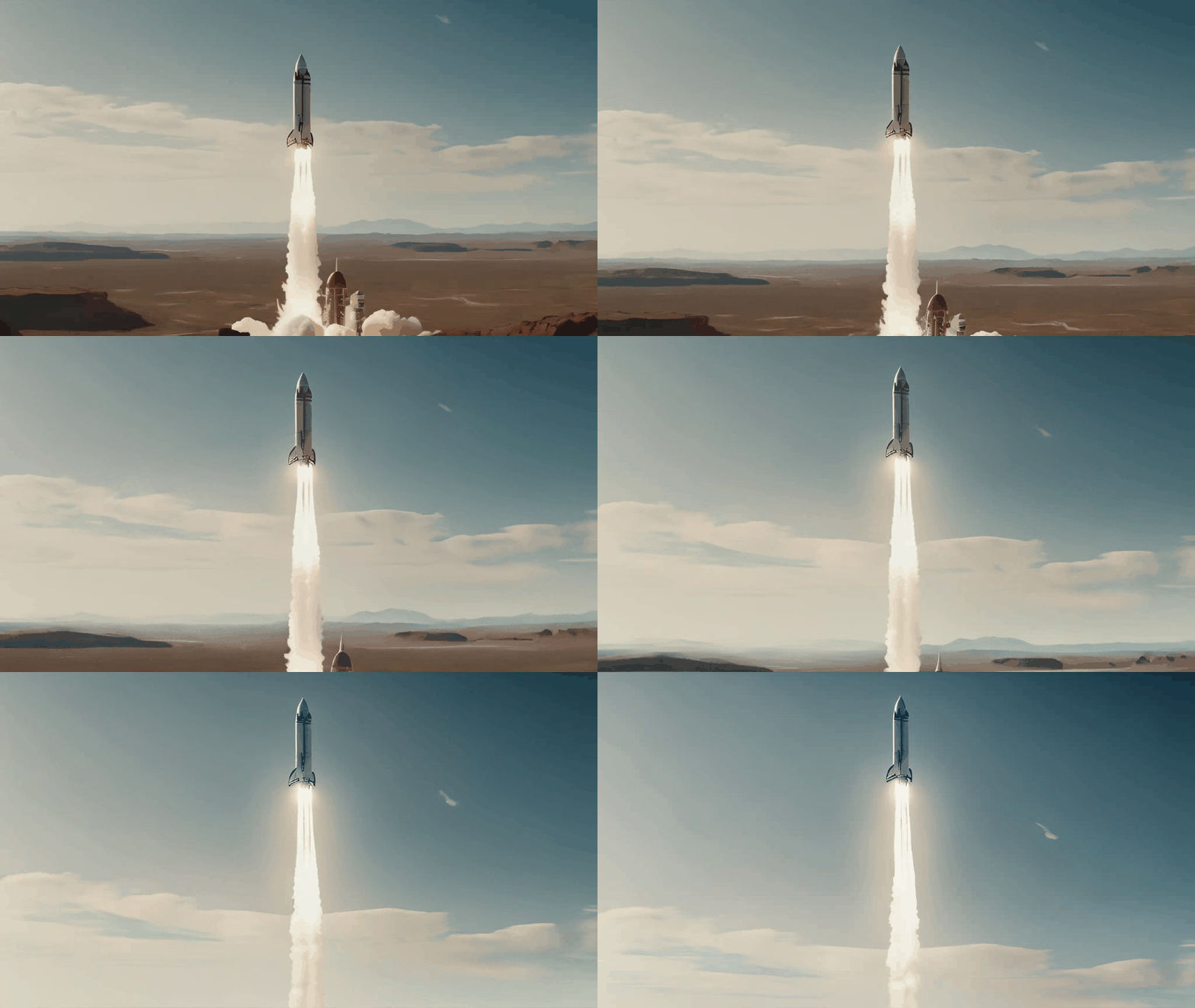
|
||||
@@ -14,41 +14,54 @@ specific language governing permissions and limitations under the License.
|
||||
|
||||
[[open-in-colab]]
|
||||
|
||||
Unconditional image generation generates images that look like a random sample from the training data the model was trained on because the denoising process is not guided by any additional context like text or image.
|
||||
Unconditional image generation is a relatively straightforward task. The model only generates images - without any additional context like text or an image - resembling the training data it was trained on.
|
||||
|
||||
To get started, use the [`DiffusionPipeline`] to load the [anton-l/ddpm-butterflies-128](https://huggingface.co/anton-l/ddpm-butterflies-128) checkpoint to generate images of butterflies. The [`DiffusionPipeline`] downloads and caches all the model components required to generate an image.
|
||||
The [`DiffusionPipeline`] is the easiest way to use a pre-trained diffusion system for inference.
|
||||
|
||||
```py
|
||||
Start by creating an instance of [`DiffusionPipeline`] and specify which pipeline checkpoint you would like to download.
|
||||
You can use any of the 🧨 Diffusers [checkpoints](https://huggingface.co/models?library=diffusers&sort=downloads) from the Hub (the checkpoint you'll use generates images of butterflies).
|
||||
|
||||
<Tip>
|
||||
|
||||
💡 Want to train your own unconditional image generation model? Take a look at the training [guide](../training/unconditional_training) to learn how to generate your own images.
|
||||
|
||||
</Tip>
|
||||
|
||||
In this guide, you'll use [`DiffusionPipeline`] for unconditional image generation with [DDPM](https://arxiv.org/abs/2006.11239):
|
||||
|
||||
```python
|
||||
from diffusers import DiffusionPipeline
|
||||
|
||||
generator = DiffusionPipeline.from_pretrained("anton-l/ddpm-butterflies-128").to("cuda")
|
||||
generator = DiffusionPipeline.from_pretrained("anton-l/ddpm-butterflies-128", use_safetensors=True)
|
||||
```
|
||||
|
||||
The [`DiffusionPipeline`] downloads and caches all modeling, tokenization, and scheduling components.
|
||||
Because the model consists of roughly 1.4 billion parameters, we strongly recommend running it on a GPU.
|
||||
You can move the generator object to a GPU, just like you would in PyTorch:
|
||||
|
||||
```python
|
||||
generator.to("cuda")
|
||||
```
|
||||
|
||||
Now you can use the `generator` to generate an image:
|
||||
|
||||
```python
|
||||
image = generator().images[0]
|
||||
image
|
||||
```
|
||||
|
||||
<Tip>
|
||||
The output is by default wrapped into a [`PIL.Image`](https://pillow.readthedocs.io/en/stable/reference/Image.html?highlight=image#the-image-class) object.
|
||||
|
||||
Want to generate images of something else? Take a look at the training [guide](../training/unconditional_training) to learn how to train a model to generate your own images.
|
||||
You can save the image by calling:
|
||||
|
||||
</Tip>
|
||||
|
||||
The output image is a [`PIL.Image`](https://pillow.readthedocs.io/en/stable/reference/Image.html?highlight=image#the-image-class) object that can be saved:
|
||||
|
||||
```py
|
||||
```python
|
||||
image.save("generated_image.png")
|
||||
```
|
||||
|
||||
You can also try experimenting with the `num_inference_steps` parameter, which controls the number of denoising steps. More denoising steps typically produce higher quality images, but it'll take longer to generate. Feel free to play around with this parameter to see how it affects the image quality.
|
||||
|
||||
```py
|
||||
image = generator(num_inference_steps=100).images[0]
|
||||
image
|
||||
```
|
||||
|
||||
Try out the Space below to generate an image of a butterfly!
|
||||
Try out the Spaces below, and feel free to play around with the inference steps parameter to see how it affects the image quality!
|
||||
|
||||
<iframe
|
||||
src="https://stevhliu-unconditional-image-generation.hf.space"
|
||||
src="https://stevhliu-ddpm-butterflies-128.hf.space"
|
||||
frameborder="0"
|
||||
width="850"
|
||||
height="500"
|
||||
|
||||
@@ -2,15 +2,9 @@
|
||||
- local: index
|
||||
title: 🧨 Diffusers
|
||||
- local: quicktour
|
||||
title: クイックツアー
|
||||
title: 簡単な案内
|
||||
- local: stable_diffusion
|
||||
title: 有効で効率の良い拡散モデル
|
||||
title: 効果的で効率的な拡散モデル
|
||||
- local: installation
|
||||
title: インストール
|
||||
title: はじめに
|
||||
- sections:
|
||||
- local: tutorials/tutorial_overview
|
||||
title: 概要
|
||||
- local: tutorials/autopipeline
|
||||
title: AutoPipeline
|
||||
title: チュートリアル
|
||||
title: はじめに
|
||||
@@ -18,31 +18,81 @@ specific language governing permissions and limitations under the License.
|
||||
|
||||
# Diffusers
|
||||
|
||||
🤗 Diffusers は、画像や音声、さらには分子の3D構造を生成するための、最先端の事前学習済みDiffusion Model(拡散モデル)を提供するライブラリです。シンプルな生成ソリューションをお探しの場合でも、独自の拡散モデルをトレーニングしたい場合でも、🤗 Diffusers はその両方をサポートするモジュール式のツールボックスです。私たちのライブラリは、[性能より使いやすさ](conceptual/philosophy#usability-over-performance)、[簡単よりシンプル](conceptual/philosophy#simple-over-easy)、[抽象化よりカスタマイズ性](conceptual/philosophy#tweakable-contributorfriendly-over-abstraction)に重点を置いて設計されています。
|
||||
🤗 Diffusers は、画像や音声、さらには分子の3D構造を生成するための、最先端の事前学習済みDiffusion Model(拡散モデル)を提供するライブラリです。シンプルな生成ソリューションをお探しの場合でも、独自の拡散モデルをトレーニングしたい場合でも、🤗 Diffusers はその両方をサポートするモジュール式のツールボックスです。我々のライブラリは、[性能より使いやすさ](conceptual/philosophy#usability-over-performance)、[簡単よりシンプル](conceptual/philosophy#simple-over-easy)、[抽象化よりカスタマイズ性](conceptual/philosophy#tweakable-contributorfriendly-over-abstraction)に重点を置いて設計されています。
|
||||
|
||||
このライブラリには3つの主要コンポーネントがあります:
|
||||
|
||||
- 数行のコードで推論可能な最先端の[拡散パイプライン](api/pipelines/overview)。Diffusersには多くのパイプラインがあります。利用可能なパイプラインを網羅したリストと、それらが解決するタスクについては、パイプラインの[概要](https://huggingface.co/docs/diffusers/api/pipelines/overview)の表をご覧ください。
|
||||
- 生成速度と品質のトレードオフのバランスを取る交換可能な[ノイズスケジューラ](api/schedulers/overview)
|
||||
- ビルディングブロックとして使用することができ、スケジューラと組み合わせることで、エンドツーエンドの拡散モデルを構築可能な事前学習済み[モデル](api/models)
|
||||
- 最先端の[拡散パイプライン](api/pipelines/overview)で数行のコードで生成が可能です。
|
||||
- 交換可能な[ノイズスケジューラ](api/schedulers/overview)で生成速度と品質のトレードオフのバランスをとれます。
|
||||
- 事前に訓練された[モデル](api/models)は、ビルディングブロックとして使用することができ、スケジューラと組み合わせることで、独自のエンドツーエンドの拡散システムを作成することができます。
|
||||
|
||||
<div class="mt-10">
|
||||
<div class="w-full flex flex-col space-y-4 md:space-y-0 md:grid md:grid-cols-2 md:gap-y-4 md:gap-x-5">
|
||||
<a class="!no-underline border dark:border-gray-700 p-5 rounded-lg shadow hover:shadow-lg" href="./tutorials/tutorial_overview"
|
||||
><div class="w-full text-center bg-gradient-to-br from-blue-400 to-blue-500 rounded-lg py-1.5 font-semibold mb-5 text-white text-lg leading-relaxed">チュートリアル</div>
|
||||
<p class="text-gray-700">出力の生成、独自の拡散システムの構築、拡散モデルのトレーニングを開始するために必要な基本的なスキルを学ぶことができます。初めて 🤗Diffusersを使用する場合は、ここから始めることをおすすめします!</p>
|
||||
<p class="text-gray-700">出力の生成、独自の拡散システムの構築、拡散モデルのトレーニングを開始するために必要な基本的なスキルを学ぶことができます。初めて🤗Diffusersを使用する場合は、ここから始めることをお勧めします!</p>
|
||||
</a>
|
||||
<a class="!no-underline border dark:border-gray-700 p-5 rounded-lg shadow hover:shadow-lg" href="./using-diffusers/loading_overview"
|
||||
><div class="w-full text-center bg-gradient-to-br from-indigo-400 to-indigo-500 rounded-lg py-1.5 font-semibold mb-5 text-white text-lg leading-relaxed">ガイド</div>
|
||||
<p class="text-gray-700">パイプライン、モデル、スケジューラの読み込みに役立つ実践的なガイドです。また、特定のタスクにパイプラインを使用する方法、出力の生成方法を制御する方法、生成速度を最適化する方法、さまざまなトレーニング手法についても学ぶことができます。</p>
|
||||
<p class="text-gray-700">パイプライン、モデル、スケジューラのロードに役立つ実践的なガイドです。また、特定のタスクにパイプラインを使用する方法、出力の生成方法を制御する方法、生成速度を最適化する方法、さまざまなトレーニング手法についても学ぶことができます。</p>
|
||||
</a>
|
||||
<a class="!no-underline border dark:border-gray-700 p-5 rounded-lg shadow hover:shadow-lg" href="./conceptual/philosophy"
|
||||
><div class="w-full text-center bg-gradient-to-br from-pink-400 to-pink-500 rounded-lg py-1.5 font-semibold mb-5 text-white text-lg leading-relaxed">Conceptual guides</div>
|
||||
<p class="text-gray-700">ライブラリがなぜこのように設計されたのかを理解し、ライブラリを利用する際の倫理的ガイドラインや安全対策について詳しく学べます。</p>
|
||||
</a>
|
||||
<a class="!no-underline border dark:border-gray-700 p-5 rounded-lg shadow hover:shadow-lg" href="./api/models/overview"
|
||||
><div class="w-full text-center bg-gradient-to-br from-purple-400 to-purple-500 rounded-lg py-1.5 font-semibold mb-5 text-white text-lg leading-relaxed">リファレンス</div>
|
||||
><div class="w-full text-center bg-gradient-to-br from-purple-400 to-purple-500 rounded-lg py-1.5 font-semibold mb-5 text-white text-lg leading-relaxed">Reference</div>
|
||||
<p class="text-gray-700">🤗 Diffusersのクラスとメソッドがどのように機能するかについての技術的な説明です。</p>
|
||||
</a>
|
||||
</div>
|
||||
</div>
|
||||
</div>
|
||||
|
||||
## Supported pipelines
|
||||
|
||||
| Pipeline | Paper/Repository | Tasks |
|
||||
|---|---|:---:|
|
||||
| [alt_diffusion](./api/pipelines/alt_diffusion) | [AltCLIP: Altering the Language Encoder in CLIP for Extended Language Capabilities](https://arxiv.org/abs/2211.06679) | Image-to-Image Text-Guided Generation |
|
||||
| [audio_diffusion](./api/pipelines/audio_diffusion) | [Audio Diffusion](https://github.com/teticio/audio-diffusion.git) | Unconditional Audio Generation |
|
||||
| [controlnet](./api/pipelines/controlnet) | [Adding Conditional Control to Text-to-Image Diffusion Models](https://arxiv.org/abs/2302.05543) | Image-to-Image Text-Guided Generation |
|
||||
| [cycle_diffusion](./api/pipelines/cycle_diffusion) | [Unifying Diffusion Models' Latent Space, with Applications to CycleDiffusion and Guidance](https://arxiv.org/abs/2210.05559) | Image-to-Image Text-Guided Generation |
|
||||
| [dance_diffusion](./api/pipelines/dance_diffusion) | [Dance Diffusion](https://github.com/williamberman/diffusers.git) | Unconditional Audio Generation |
|
||||
| [ddpm](./api/pipelines/ddpm) | [Denoising Diffusion Probabilistic Models](https://arxiv.org/abs/2006.11239) | Unconditional Image Generation |
|
||||
| [ddim](./api/pipelines/ddim) | [Denoising Diffusion Implicit Models](https://arxiv.org/abs/2010.02502) | Unconditional Image Generation |
|
||||
| [if](./if) | [**IF**](./api/pipelines/if) | Image Generation |
|
||||
| [if_img2img](./if) | [**IF**](./api/pipelines/if) | Image-to-Image Generation |
|
||||
| [if_inpainting](./if) | [**IF**](./api/pipelines/if) | Image-to-Image Generation |
|
||||
| [latent_diffusion](./api/pipelines/latent_diffusion) | [High-Resolution Image Synthesis with Latent Diffusion Models](https://arxiv.org/abs/2112.10752)| Text-to-Image Generation |
|
||||
| [latent_diffusion](./api/pipelines/latent_diffusion) | [High-Resolution Image Synthesis with Latent Diffusion Models](https://arxiv.org/abs/2112.10752)| Super Resolution Image-to-Image |
|
||||
| [latent_diffusion_uncond](./api/pipelines/latent_diffusion_uncond) | [High-Resolution Image Synthesis with Latent Diffusion Models](https://arxiv.org/abs/2112.10752) | Unconditional Image Generation |
|
||||
| [paint_by_example](./api/pipelines/paint_by_example) | [Paint by Example: Exemplar-based Image Editing with Diffusion Models](https://arxiv.org/abs/2211.13227) | Image-Guided Image Inpainting |
|
||||
| [pndm](./api/pipelines/pndm) | [Pseudo Numerical Methods for Diffusion Models on Manifolds](https://arxiv.org/abs/2202.09778) | Unconditional Image Generation |
|
||||
| [score_sde_ve](./api/pipelines/score_sde_ve) | [Score-Based Generative Modeling through Stochastic Differential Equations](https://openreview.net/forum?id=PxTIG12RRHS) | Unconditional Image Generation |
|
||||
| [score_sde_vp](./api/pipelines/score_sde_vp) | [Score-Based Generative Modeling through Stochastic Differential Equations](https://openreview.net/forum?id=PxTIG12RRHS) | Unconditional Image Generation |
|
||||
| [semantic_stable_diffusion](./api/pipelines/semantic_stable_diffusion) | [Semantic Guidance](https://arxiv.org/abs/2301.12247) | Text-Guided Generation |
|
||||
| [stable_diffusion_adapter](./api/pipelines/stable_diffusion/adapter) | [**T2I-Adapter**](https://arxiv.org/abs/2302.08453) | Image-to-Image Text-Guided Generation | -
|
||||
| [stable_diffusion_text2img](./api/pipelines/stable_diffusion/text2img) | [Stable Diffusion](https://stability.ai/blog/stable-diffusion-public-release) | Text-to-Image Generation |
|
||||
| [stable_diffusion_img2img](./api/pipelines/stable_diffusion/img2img) | [Stable Diffusion](https://stability.ai/blog/stable-diffusion-public-release) | Image-to-Image Text-Guided Generation |
|
||||
| [stable_diffusion_inpaint](./api/pipelines/stable_diffusion/inpaint) | [Stable Diffusion](https://stability.ai/blog/stable-diffusion-public-release) | Text-Guided Image Inpainting |
|
||||
| [stable_diffusion_panorama](./api/pipelines/stable_diffusion/panorama) | [MultiDiffusion](https://multidiffusion.github.io/) | Text-to-Panorama Generation |
|
||||
| [stable_diffusion_pix2pix](./api/pipelines/stable_diffusion/pix2pix) | [InstructPix2Pix: Learning to Follow Image Editing Instructions](https://arxiv.org/abs/2211.09800) | Text-Guided Image Editing|
|
||||
| [stable_diffusion_pix2pix_zero](./api/pipelines/stable_diffusion/pix2pix_zero) | [Zero-shot Image-to-Image Translation](https://pix2pixzero.github.io/) | Text-Guided Image Editing |
|
||||
| [stable_diffusion_attend_and_excite](./api/pipelines/stable_diffusion/attend_and_excite) | [Attend-and-Excite: Attention-Based Semantic Guidance for Text-to-Image Diffusion Models](https://arxiv.org/abs/2301.13826) | Text-to-Image Generation |
|
||||
| [stable_diffusion_self_attention_guidance](./api/pipelines/stable_diffusion/self_attention_guidance) | [Improving Sample Quality of Diffusion Models Using Self-Attention Guidance](https://arxiv.org/abs/2210.00939) | Text-to-Image Generation Unconditional Image Generation |
|
||||
| [stable_diffusion_image_variation](./stable_diffusion/image_variation) | [Stable Diffusion Image Variations](https://github.com/LambdaLabsML/lambda-diffusers#stable-diffusion-image-variations) | Image-to-Image Generation |
|
||||
| [stable_diffusion_latent_upscale](./stable_diffusion/latent_upscale) | [Stable Diffusion Latent Upscaler](https://twitter.com/StabilityAI/status/1590531958815064065) | Text-Guided Super Resolution Image-to-Image |
|
||||
| [stable_diffusion_model_editing](./api/pipelines/stable_diffusion/model_editing) | [Editing Implicit Assumptions in Text-to-Image Diffusion Models](https://time-diffusion.github.io/) | Text-to-Image Model Editing |
|
||||
| [stable_diffusion_2](./api/pipelines/stable_diffusion_2) | [Stable Diffusion 2](https://stability.ai/blog/stable-diffusion-v2-release) | Text-to-Image Generation |
|
||||
| [stable_diffusion_2](./api/pipelines/stable_diffusion_2) | [Stable Diffusion 2](https://stability.ai/blog/stable-diffusion-v2-release) | Text-Guided Image Inpainting |
|
||||
| [stable_diffusion_2](./api/pipelines/stable_diffusion_2) | [Depth-Conditional Stable Diffusion](https://github.com/Stability-AI/stablediffusion#depth-conditional-stable-diffusion) | Depth-to-Image Generation |
|
||||
| [stable_diffusion_2](./api/pipelines/stable_diffusion_2) | [Stable Diffusion 2](https://stability.ai/blog/stable-diffusion-v2-release) | Text-Guided Super Resolution Image-to-Image |
|
||||
| [stable_diffusion_safe](./api/pipelines/stable_diffusion_safe) | [Safe Stable Diffusion](https://arxiv.org/abs/2211.05105) | Text-Guided Generation |
|
||||
| [stable_unclip](./stable_unclip) | Stable unCLIP | Text-to-Image Generation |
|
||||
| [stable_unclip](./stable_unclip) | Stable unCLIP | Image-to-Image Text-Guided Generation |
|
||||
| [stochastic_karras_ve](./api/pipelines/stochastic_karras_ve) | [Elucidating the Design Space of Diffusion-Based Generative Models](https://arxiv.org/abs/2206.00364) | Unconditional Image Generation |
|
||||
| [text_to_video_sd](./api/pipelines/text_to_video) | [Modelscope's Text-to-video-synthesis Model in Open Domain](https://modelscope.cn/models/damo/text-to-video-synthesis/summary) | Text-to-Video Generation |
|
||||
| [unclip](./api/pipelines/unclip) | [Hierarchical Text-Conditional Image Generation with CLIP Latents](https://arxiv.org/abs/2204.06125)(implementation by [kakaobrain](https://github.com/kakaobrain/karlo)) | Text-to-Image Generation |
|
||||
| [versatile_diffusion](./api/pipelines/versatile_diffusion) | [Versatile Diffusion: Text, Images and Variations All in One Diffusion Model](https://arxiv.org/abs/2211.08332) | Text-to-Image Generation |
|
||||
| [versatile_diffusion](./api/pipelines/versatile_diffusion) | [Versatile Diffusion: Text, Images and Variations All in One Diffusion Model](https://arxiv.org/abs/2211.08332) | Image Variations Generation |
|
||||
| [versatile_diffusion](./api/pipelines/versatile_diffusion) | [Versatile Diffusion: Text, Images and Variations All in One Diffusion Model](https://arxiv.org/abs/2211.08332) | Dual Image and Text Guided Generation |
|
||||
| [vq_diffusion](./api/pipelines/vq_diffusion) | [Vector Quantized Diffusion Model for Text-to-Image Synthesis](https://arxiv.org/abs/2111.14822) | Text-to-Image Generation |
|
||||
| [stable_diffusion_ldm3d](./api/pipelines/stable_diffusion/ldm3d_diffusion) | [LDM3D: Latent Diffusion Model for 3D](https://arxiv.org/abs/2305.10853) | Text to Image and Depth Generation |
|
||||
|
||||
Some files were not shown because too many files have changed in this diff Show More
Reference in New Issue
Block a user