mirror of
https://github.com/huggingface/diffusers.git
synced 2026-03-07 01:01:45 +08:00
Compare commits
64 Commits
group-offl
...
gpu-pr-tes
| Author | SHA1 | Date | |
|---|---|---|---|

|
e72648a311 | ||
|
|
0454fbb30b | ||
|
|
3e3c0fcc1c | ||
|
|
cbc8ced20f | ||
|
|
01240fecb0 | ||
|
|
ce338d4e4a | ||
|
|
bc55b631fd | ||
|
|
15d50f16f2 | ||
|
|
2c30287958 | ||
|
|
425a715e35 | ||
|
|
2527917528 | ||
|
|
e6639fef70 | ||
|
|
8c938fb410 | ||
|
|
f864a9a352 | ||
|
|
d6fa3298fa | ||
|
|
6f1d6694df | ||
|
|
0e95aa853e | ||
|
|
5ef74fd5f6 | ||
|
|
64a9210315 | ||
|
|
d31b8cea3e | ||
|
|
62e847db5f | ||
|
|
470458623e | ||
|
|
a79c3af6bb | ||
|
|
3f3f0c16a6 | ||
|
|
f3e1310469 | ||
|
|
87f83d3dd9 | ||
|
|
f064b3bf73 | ||
|
|
3b079ec3fa | ||
|
|
bc34fa8386 | ||
|
|
05e7a854d0 | ||
|
|
76ec3d1fee | ||
|
|
cdaf84a708 | ||
|
|
e8e44a510c | ||
|
|
21543de571 | ||
|
|
d7dd924ece | ||
|
|
00f95b9755 | ||
|
|
eea76892e8 | ||
|
|
27bf7fcd0e | ||
|
|
a185e1ab91 | ||
|
|
d93381cd41 | ||
|
|
3649d7b903 | ||
|
|
10c36e0b78 | ||
|
|
8846635873 | ||
|
|
dd285099eb | ||
|
|
80f27d7e8d | ||
|
|
d3e27e05f0 | ||
|
|
5df02fc171 | ||
|
|
7392c8ff5a | ||
|
|
474a248f10 | ||
|
|
7bc0a07b19 | ||
|
|
92542719ed | ||
|
|
6760300202 | ||
|
|
798265f2b6 | ||
|
|
cd813499be | ||
|
|
fbddf02807 | ||
|
|
f20b83a04f | ||
|
|
ee40088fe5 | ||
|
|
7fc53b5d66 | ||
|
|
0874dd04dc | ||
|
|
6184d8a433 | ||
|
|
5a6e386464 | ||
|
|
42077e6c73 | ||
|
|
3d8d8485fc | ||
|
|
195926bbdc |
41
.github/workflows/benchmark.yml
vendored
41
.github/workflows/benchmark.yml
vendored
@@ -11,17 +11,18 @@ env:
|
||||
HF_HOME: /mnt/cache
|
||||
OMP_NUM_THREADS: 8
|
||||
MKL_NUM_THREADS: 8
|
||||
BASE_PATH: benchmark_outputs
|
||||
|
||||
jobs:
|
||||
torch_pipelines_cuda_benchmark_tests:
|
||||
torch_models_cuda_benchmark_tests:
|
||||
env:
|
||||
SLACK_WEBHOOK_URL: ${{ secrets.SLACK_WEBHOOK_URL_BENCHMARK }}
|
||||
name: Torch Core Pipelines CUDA Benchmarking Tests
|
||||
name: Torch Core Models CUDA Benchmarking Tests
|
||||
strategy:
|
||||
fail-fast: false
|
||||
max-parallel: 1
|
||||
runs-on:
|
||||
group: aws-g6-4xlarge-plus
|
||||
group: aws-g6e-4xlarge
|
||||
container:
|
||||
image: diffusers/diffusers-pytorch-cuda
|
||||
options: --shm-size "16gb" --ipc host --gpus 0
|
||||
@@ -35,27 +36,47 @@ jobs:
|
||||
nvidia-smi
|
||||
- name: Install dependencies
|
||||
run: |
|
||||
apt update
|
||||
apt install -y libpq-dev postgresql-client
|
||||
python -m venv /opt/venv && export PATH="/opt/venv/bin:$PATH"
|
||||
python -m uv pip install -e [quality,test]
|
||||
python -m uv pip install pandas peft
|
||||
python -m uv pip uninstall transformers && python -m uv pip install transformers==4.48.0
|
||||
python -m uv pip install -r benchmarks/requirements.txt
|
||||
- name: Environment
|
||||
run: |
|
||||
python utils/print_env.py
|
||||
- name: Diffusers Benchmarking
|
||||
env:
|
||||
HF_TOKEN: ${{ secrets.DIFFUSERS_BOT_TOKEN }}
|
||||
BASE_PATH: benchmark_outputs
|
||||
HF_TOKEN: ${{ secrets.DIFFUSERS_HF_HUB_READ_TOKEN }}
|
||||
run: |
|
||||
export TOTAL_GPU_MEMORY=$(python -c "import torch; print(torch.cuda.get_device_properties(0).total_memory / (1024**3))")
|
||||
cd benchmarks && mkdir ${BASE_PATH} && python run_all.py && python push_results.py
|
||||
cd benchmarks && python run_all.py
|
||||
|
||||
- name: Push results to the Hub
|
||||
env:
|
||||
HF_TOKEN: ${{ secrets.DIFFUSERS_BOT_TOKEN }}
|
||||
run: |
|
||||
cd benchmarks && python push_results.py
|
||||
mkdir $BASE_PATH && cp *.csv $BASE_PATH
|
||||
|
||||
- name: Test suite reports artifacts
|
||||
if: ${{ always() }}
|
||||
uses: actions/upload-artifact@v4
|
||||
with:
|
||||
name: benchmark_test_reports
|
||||
path: benchmarks/benchmark_outputs
|
||||
path: benchmarks/${{ env.BASE_PATH }}
|
||||
|
||||
# TODO: enable this once the connection problem has been resolved.
|
||||
- name: Update benchmarking results to DB
|
||||
env:
|
||||
PGDATABASE: metrics
|
||||
PGHOST: ${{ secrets.DIFFUSERS_BENCHMARKS_PGHOST }}
|
||||
PGUSER: transformers_benchmarks
|
||||
PGPASSWORD: ${{ secrets.DIFFUSERS_BENCHMARKS_PGPASSWORD }}
|
||||
BRANCH_NAME: ${{ github.head_ref || github.ref_name }}
|
||||
run: |
|
||||
git config --global --add safe.directory /__w/diffusers/diffusers
|
||||
commit_id=$GITHUB_SHA
|
||||
commit_msg=$(git show -s --format=%s "$commit_id" | cut -c1-70)
|
||||
cd benchmarks && python populate_into_db.py "$BRANCH_NAME" "$commit_id" "$commit_msg"
|
||||
|
||||
- name: Report success status
|
||||
if: ${{ success() }}
|
||||
|
||||
4
.github/workflows/build_docker_images.yml
vendored
4
.github/workflows/build_docker_images.yml
vendored
@@ -75,10 +75,6 @@ jobs:
|
||||
- diffusers-pytorch-cuda
|
||||
- diffusers-pytorch-xformers-cuda
|
||||
- diffusers-pytorch-minimum-cuda
|
||||
- diffusers-flax-cpu
|
||||
- diffusers-flax-tpu
|
||||
- diffusers-onnxruntime-cpu
|
||||
- diffusers-onnxruntime-cuda
|
||||
- diffusers-doc-builder
|
||||
|
||||
steps:
|
||||
|
||||
106
.github/workflows/nightly_tests.yml
vendored
106
.github/workflows/nightly_tests.yml
vendored
@@ -248,7 +248,7 @@ jobs:
|
||||
BIG_GPU_MEMORY: 40
|
||||
run: |
|
||||
python -m pytest -n 1 --max-worker-restart=0 --dist=loadfile \
|
||||
-m "big_gpu_with_torch_cuda" \
|
||||
-m "big_accelerator" \
|
||||
--make-reports=tests_big_gpu_torch_cuda \
|
||||
--report-log=tests_big_gpu_torch_cuda.log \
|
||||
tests/
|
||||
@@ -321,55 +321,6 @@ jobs:
|
||||
name: torch_minimum_version_cuda_test_reports
|
||||
path: reports
|
||||
|
||||
run_nightly_onnx_tests:
|
||||
name: Nightly ONNXRuntime CUDA tests on Ubuntu
|
||||
runs-on:
|
||||
group: aws-g4dn-2xlarge
|
||||
container:
|
||||
image: diffusers/diffusers-onnxruntime-cuda
|
||||
options: --gpus 0 --shm-size "16gb" --ipc host
|
||||
|
||||
steps:
|
||||
- name: Checkout diffusers
|
||||
uses: actions/checkout@v3
|
||||
with:
|
||||
fetch-depth: 2
|
||||
|
||||
- name: NVIDIA-SMI
|
||||
run: nvidia-smi
|
||||
|
||||
- name: Install dependencies
|
||||
run: |
|
||||
python -m venv /opt/venv && export PATH="/opt/venv/bin:$PATH"
|
||||
python -m uv pip install -e [quality,test]
|
||||
pip uninstall accelerate -y && python -m uv pip install -U accelerate@git+https://github.com/huggingface/accelerate.git
|
||||
python -m uv pip install pytest-reportlog
|
||||
- name: Environment
|
||||
run: python utils/print_env.py
|
||||
|
||||
- name: Run Nightly ONNXRuntime CUDA tests
|
||||
env:
|
||||
HF_TOKEN: ${{ secrets.DIFFUSERS_HF_HUB_READ_TOKEN }}
|
||||
run: |
|
||||
python -m pytest -n 1 --max-worker-restart=0 --dist=loadfile \
|
||||
-s -v -k "Onnx" \
|
||||
--make-reports=tests_onnx_cuda \
|
||||
--report-log=tests_onnx_cuda.log \
|
||||
tests/
|
||||
|
||||
- name: Failure short reports
|
||||
if: ${{ failure() }}
|
||||
run: |
|
||||
cat reports/tests_onnx_cuda_stats.txt
|
||||
cat reports/tests_onnx_cuda_failures_short.txt
|
||||
|
||||
- name: Test suite reports artifacts
|
||||
if: ${{ always() }}
|
||||
uses: actions/upload-artifact@v4
|
||||
with:
|
||||
name: tests_onnx_cuda_reports
|
||||
path: reports
|
||||
|
||||
run_nightly_quantization_tests:
|
||||
name: Torch quantization nightly tests
|
||||
strategy:
|
||||
@@ -485,57 +436,6 @@ jobs:
|
||||
name: torch_cuda_pipeline_level_quant_reports
|
||||
path: reports
|
||||
|
||||
run_flax_tpu_tests:
|
||||
name: Nightly Flax TPU Tests
|
||||
runs-on:
|
||||
group: gcp-ct5lp-hightpu-8t
|
||||
if: github.event_name == 'schedule'
|
||||
|
||||
container:
|
||||
image: diffusers/diffusers-flax-tpu
|
||||
options: --shm-size "16gb" --ipc host --privileged ${{ vars.V5_LITEPOD_8_ENV}} -v /mnt/hf_cache:/mnt/hf_cache
|
||||
defaults:
|
||||
run:
|
||||
shell: bash
|
||||
steps:
|
||||
- name: Checkout diffusers
|
||||
uses: actions/checkout@v3
|
||||
with:
|
||||
fetch-depth: 2
|
||||
|
||||
- name: Install dependencies
|
||||
run: |
|
||||
python -m venv /opt/venv && export PATH="/opt/venv/bin:$PATH"
|
||||
python -m uv pip install -e [quality,test]
|
||||
pip uninstall accelerate -y && python -m uv pip install -U accelerate@git+https://github.com/huggingface/accelerate.git
|
||||
python -m uv pip install pytest-reportlog
|
||||
|
||||
- name: Environment
|
||||
run: python utils/print_env.py
|
||||
|
||||
- name: Run nightly Flax TPU tests
|
||||
env:
|
||||
HF_TOKEN: ${{ secrets.DIFFUSERS_HF_HUB_READ_TOKEN }}
|
||||
run: |
|
||||
python -m pytest -n 0 \
|
||||
-s -v -k "Flax" \
|
||||
--make-reports=tests_flax_tpu \
|
||||
--report-log=tests_flax_tpu.log \
|
||||
tests/
|
||||
|
||||
- name: Failure short reports
|
||||
if: ${{ failure() }}
|
||||
run: |
|
||||
cat reports/tests_flax_tpu_stats.txt
|
||||
cat reports/tests_flax_tpu_failures_short.txt
|
||||
|
||||
- name: Test suite reports artifacts
|
||||
if: ${{ always() }}
|
||||
uses: actions/upload-artifact@v4
|
||||
with:
|
||||
name: flax_tpu_test_reports
|
||||
path: reports
|
||||
|
||||
generate_consolidated_report:
|
||||
name: Generate Consolidated Test Report
|
||||
needs: [
|
||||
@@ -545,9 +445,9 @@ jobs:
|
||||
run_big_gpu_torch_tests,
|
||||
run_nightly_quantization_tests,
|
||||
run_nightly_pipeline_level_quantization_tests,
|
||||
run_nightly_onnx_tests,
|
||||
# run_nightly_onnx_tests,
|
||||
torch_minimum_version_cuda_tests,
|
||||
run_flax_tpu_tests
|
||||
# run_flax_tpu_tests
|
||||
]
|
||||
if: always()
|
||||
runs-on:
|
||||
|
||||
14
.github/workflows/pr_tests.yml
vendored
14
.github/workflows/pr_tests.yml
vendored
@@ -87,11 +87,6 @@ jobs:
|
||||
runner: aws-general-8-plus
|
||||
image: diffusers/diffusers-pytorch-cpu
|
||||
report: torch_cpu_models_schedulers
|
||||
- name: Fast Flax CPU tests
|
||||
framework: flax
|
||||
runner: aws-general-8-plus
|
||||
image: diffusers/diffusers-flax-cpu
|
||||
report: flax_cpu
|
||||
- name: PyTorch Example CPU tests
|
||||
framework: pytorch_examples
|
||||
runner: aws-general-8-plus
|
||||
@@ -147,15 +142,6 @@ jobs:
|
||||
--make-reports=tests_${{ matrix.config.report }} \
|
||||
tests/models tests/schedulers tests/others
|
||||
|
||||
- name: Run fast Flax TPU tests
|
||||
if: ${{ matrix.config.framework == 'flax' }}
|
||||
run: |
|
||||
python -m venv /opt/venv && export PATH="/opt/venv/bin:$PATH"
|
||||
python -m pytest -n 4 --max-worker-restart=0 --dist=loadfile \
|
||||
-s -v -k "Flax" \
|
||||
--make-reports=tests_${{ matrix.config.report }} \
|
||||
tests
|
||||
|
||||
- name: Run example PyTorch CPU tests
|
||||
if: ${{ matrix.config.framework == 'pytorch_examples' }}
|
||||
run: |
|
||||
|
||||
2
.github/workflows/pr_tests_gpu.yml
vendored
2
.github/workflows/pr_tests_gpu.yml
vendored
@@ -188,7 +188,7 @@ jobs:
|
||||
shell: bash
|
||||
strategy:
|
||||
fail-fast: false
|
||||
max-parallel: 2
|
||||
max-parallel: 4
|
||||
matrix:
|
||||
module: [models, schedulers, lora, others]
|
||||
steps:
|
||||
|
||||
96
.github/workflows/push_tests.yml
vendored
96
.github/workflows/push_tests.yml
vendored
@@ -159,102 +159,6 @@ jobs:
|
||||
name: torch_cuda_test_reports_${{ matrix.module }}
|
||||
path: reports
|
||||
|
||||
flax_tpu_tests:
|
||||
name: Flax TPU Tests
|
||||
runs-on:
|
||||
group: gcp-ct5lp-hightpu-8t
|
||||
container:
|
||||
image: diffusers/diffusers-flax-tpu
|
||||
options: --shm-size "16gb" --ipc host --privileged ${{ vars.V5_LITEPOD_8_ENV}} -v /mnt/hf_cache:/mnt/hf_cache
|
||||
defaults:
|
||||
run:
|
||||
shell: bash
|
||||
steps:
|
||||
- name: Checkout diffusers
|
||||
uses: actions/checkout@v3
|
||||
with:
|
||||
fetch-depth: 2
|
||||
|
||||
- name: Install dependencies
|
||||
run: |
|
||||
python -m venv /opt/venv && export PATH="/opt/venv/bin:$PATH"
|
||||
python -m uv pip install -e [quality,test]
|
||||
pip uninstall accelerate -y && python -m uv pip install -U accelerate@git+https://github.com/huggingface/accelerate.git
|
||||
|
||||
- name: Environment
|
||||
run: |
|
||||
python utils/print_env.py
|
||||
|
||||
- name: Run Flax TPU tests
|
||||
env:
|
||||
HF_TOKEN: ${{ secrets.DIFFUSERS_HF_HUB_READ_TOKEN }}
|
||||
run: |
|
||||
python -m pytest -n 0 \
|
||||
-s -v -k "Flax" \
|
||||
--make-reports=tests_flax_tpu \
|
||||
tests/
|
||||
|
||||
- name: Failure short reports
|
||||
if: ${{ failure() }}
|
||||
run: |
|
||||
cat reports/tests_flax_tpu_stats.txt
|
||||
cat reports/tests_flax_tpu_failures_short.txt
|
||||
|
||||
- name: Test suite reports artifacts
|
||||
if: ${{ always() }}
|
||||
uses: actions/upload-artifact@v4
|
||||
with:
|
||||
name: flax_tpu_test_reports
|
||||
path: reports
|
||||
|
||||
onnx_cuda_tests:
|
||||
name: ONNX CUDA Tests
|
||||
runs-on:
|
||||
group: aws-g4dn-2xlarge
|
||||
container:
|
||||
image: diffusers/diffusers-onnxruntime-cuda
|
||||
options: --shm-size "16gb" --ipc host -v /mnt/cache/.cache/huggingface:/mnt/cache/ --gpus 0
|
||||
defaults:
|
||||
run:
|
||||
shell: bash
|
||||
steps:
|
||||
- name: Checkout diffusers
|
||||
uses: actions/checkout@v3
|
||||
with:
|
||||
fetch-depth: 2
|
||||
|
||||
- name: Install dependencies
|
||||
run: |
|
||||
python -m venv /opt/venv && export PATH="/opt/venv/bin:$PATH"
|
||||
python -m uv pip install -e [quality,test]
|
||||
pip uninstall accelerate -y && python -m uv pip install -U accelerate@git+https://github.com/huggingface/accelerate.git
|
||||
|
||||
- name: Environment
|
||||
run: |
|
||||
python utils/print_env.py
|
||||
|
||||
- name: Run ONNXRuntime CUDA tests
|
||||
env:
|
||||
HF_TOKEN: ${{ secrets.DIFFUSERS_HF_HUB_READ_TOKEN }}
|
||||
run: |
|
||||
python -m pytest -n 1 --max-worker-restart=0 --dist=loadfile \
|
||||
-s -v -k "Onnx" \
|
||||
--make-reports=tests_onnx_cuda \
|
||||
tests/
|
||||
|
||||
- name: Failure short reports
|
||||
if: ${{ failure() }}
|
||||
run: |
|
||||
cat reports/tests_onnx_cuda_stats.txt
|
||||
cat reports/tests_onnx_cuda_failures_short.txt
|
||||
|
||||
- name: Test suite reports artifacts
|
||||
if: ${{ always() }}
|
||||
uses: actions/upload-artifact@v4
|
||||
with:
|
||||
name: onnx_cuda_test_reports
|
||||
path: reports
|
||||
|
||||
run_torch_compile_tests:
|
||||
name: PyTorch Compile CUDA tests
|
||||
|
||||
|
||||
28
.github/workflows/push_tests_fast.yml
vendored
28
.github/workflows/push_tests_fast.yml
vendored
@@ -33,16 +33,6 @@ jobs:
|
||||
runner: aws-general-8-plus
|
||||
image: diffusers/diffusers-pytorch-cpu
|
||||
report: torch_cpu
|
||||
- name: Fast Flax CPU tests on Ubuntu
|
||||
framework: flax
|
||||
runner: aws-general-8-plus
|
||||
image: diffusers/diffusers-flax-cpu
|
||||
report: flax_cpu
|
||||
- name: Fast ONNXRuntime CPU tests on Ubuntu
|
||||
framework: onnxruntime
|
||||
runner: aws-general-8-plus
|
||||
image: diffusers/diffusers-onnxruntime-cpu
|
||||
report: onnx_cpu
|
||||
- name: PyTorch Example CPU tests on Ubuntu
|
||||
framework: pytorch_examples
|
||||
runner: aws-general-8-plus
|
||||
@@ -87,24 +77,6 @@ jobs:
|
||||
--make-reports=tests_${{ matrix.config.report }} \
|
||||
tests/
|
||||
|
||||
- name: Run fast Flax TPU tests
|
||||
if: ${{ matrix.config.framework == 'flax' }}
|
||||
run: |
|
||||
python -m venv /opt/venv && export PATH="/opt/venv/bin:$PATH"
|
||||
python -m pytest -n 4 --max-worker-restart=0 --dist=loadfile \
|
||||
-s -v -k "Flax" \
|
||||
--make-reports=tests_${{ matrix.config.report }} \
|
||||
tests/
|
||||
|
||||
- name: Run fast ONNXRuntime CPU tests
|
||||
if: ${{ matrix.config.framework == 'onnxruntime' }}
|
||||
run: |
|
||||
python -m venv /opt/venv && export PATH="/opt/venv/bin:$PATH"
|
||||
python -m pytest -n 4 --max-worker-restart=0 --dist=loadfile \
|
||||
-s -v -k "Onnx" \
|
||||
--make-reports=tests_${{ matrix.config.report }} \
|
||||
tests/
|
||||
|
||||
- name: Run example PyTorch CPU tests
|
||||
if: ${{ matrix.config.framework == 'pytorch_examples' }}
|
||||
run: |
|
||||
|
||||
7
.github/workflows/push_tests_mps.yml
vendored
7
.github/workflows/push_tests_mps.yml
vendored
@@ -1,12 +1,7 @@
|
||||
name: Fast mps tests on main
|
||||
|
||||
on:
|
||||
push:
|
||||
branches:
|
||||
- main
|
||||
paths:
|
||||
- "src/diffusers/**.py"
|
||||
- "tests/**.py"
|
||||
workflow_dispatch:
|
||||
|
||||
env:
|
||||
DIFFUSERS_IS_CI: yes
|
||||
|
||||
95
.github/workflows/release_tests_fast.yml
vendored
95
.github/workflows/release_tests_fast.yml
vendored
@@ -213,101 +213,6 @@ jobs:
|
||||
with:
|
||||
name: torch_minimum_version_cuda_test_reports
|
||||
path: reports
|
||||
|
||||
flax_tpu_tests:
|
||||
name: Flax TPU Tests
|
||||
runs-on: docker-tpu
|
||||
container:
|
||||
image: diffusers/diffusers-flax-tpu
|
||||
options: --shm-size "16gb" --ipc host -v /mnt/cache/.cache/huggingface:/mnt/cache/ --privileged
|
||||
defaults:
|
||||
run:
|
||||
shell: bash
|
||||
steps:
|
||||
- name: Checkout diffusers
|
||||
uses: actions/checkout@v3
|
||||
with:
|
||||
fetch-depth: 2
|
||||
|
||||
- name: Install dependencies
|
||||
run: |
|
||||
python -m venv /opt/venv && export PATH="/opt/venv/bin:$PATH"
|
||||
python -m uv pip install -e [quality,test]
|
||||
pip uninstall accelerate -y && python -m uv pip install -U accelerate@git+https://github.com/huggingface/accelerate.git
|
||||
|
||||
- name: Environment
|
||||
run: |
|
||||
python utils/print_env.py
|
||||
|
||||
- name: Run slow Flax TPU tests
|
||||
env:
|
||||
HF_TOKEN: ${{ secrets.DIFFUSERS_HF_HUB_READ_TOKEN }}
|
||||
run: |
|
||||
python -m pytest -n 0 \
|
||||
-s -v -k "Flax" \
|
||||
--make-reports=tests_flax_tpu \
|
||||
tests/
|
||||
|
||||
- name: Failure short reports
|
||||
if: ${{ failure() }}
|
||||
run: |
|
||||
cat reports/tests_flax_tpu_stats.txt
|
||||
cat reports/tests_flax_tpu_failures_short.txt
|
||||
|
||||
- name: Test suite reports artifacts
|
||||
if: ${{ always() }}
|
||||
uses: actions/upload-artifact@v4
|
||||
with:
|
||||
name: flax_tpu_test_reports
|
||||
path: reports
|
||||
|
||||
onnx_cuda_tests:
|
||||
name: ONNX CUDA Tests
|
||||
runs-on:
|
||||
group: aws-g4dn-2xlarge
|
||||
container:
|
||||
image: diffusers/diffusers-onnxruntime-cuda
|
||||
options: --shm-size "16gb" --ipc host -v /mnt/cache/.cache/huggingface:/mnt/cache/ --gpus 0
|
||||
defaults:
|
||||
run:
|
||||
shell: bash
|
||||
steps:
|
||||
- name: Checkout diffusers
|
||||
uses: actions/checkout@v3
|
||||
with:
|
||||
fetch-depth: 2
|
||||
|
||||
- name: Install dependencies
|
||||
run: |
|
||||
python -m venv /opt/venv && export PATH="/opt/venv/bin:$PATH"
|
||||
python -m uv pip install -e [quality,test]
|
||||
pip uninstall accelerate -y && python -m uv pip install -U accelerate@git+https://github.com/huggingface/accelerate.git
|
||||
|
||||
- name: Environment
|
||||
run: |
|
||||
python utils/print_env.py
|
||||
|
||||
- name: Run slow ONNXRuntime CUDA tests
|
||||
env:
|
||||
HF_TOKEN: ${{ secrets.DIFFUSERS_HF_HUB_READ_TOKEN }}
|
||||
run: |
|
||||
python -m pytest -n 1 --max-worker-restart=0 --dist=loadfile \
|
||||
-s -v -k "Onnx" \
|
||||
--make-reports=tests_onnx_cuda \
|
||||
tests/
|
||||
|
||||
- name: Failure short reports
|
||||
if: ${{ failure() }}
|
||||
run: |
|
||||
cat reports/tests_onnx_cuda_stats.txt
|
||||
cat reports/tests_onnx_cuda_failures_short.txt
|
||||
|
||||
- name: Test suite reports artifacts
|
||||
if: ${{ always() }}
|
||||
uses: actions/upload-artifact@v4
|
||||
with:
|
||||
name: onnx_cuda_test_reports
|
||||
path: reports
|
||||
|
||||
run_torch_compile_tests:
|
||||
name: PyTorch Compile CUDA tests
|
||||
|
||||
69
benchmarks/README.md
Normal file
69
benchmarks/README.md
Normal file
@@ -0,0 +1,69 @@
|
||||
# Diffusers Benchmarks
|
||||
|
||||
Welcome to Diffusers Benchmarks. These benchmarks are use to obtain latency and memory information of the most popular models across different scenarios such as:
|
||||
|
||||
* Base case i.e., when using `torch.bfloat16` and `torch.nn.functional.scaled_dot_product_attention`.
|
||||
* Base + `torch.compile()`
|
||||
* NF4 quantization
|
||||
* Layerwise upcasting
|
||||
|
||||
Instead of full diffusion pipelines, only the forward pass of the respective model classes (such as `FluxTransformer2DModel`) is tested with the real checkpoints (such as `"black-forest-labs/FLUX.1-dev"`).
|
||||
|
||||
The entrypoint to running all the currently available benchmarks is in `run_all.py`. However, one can run the individual benchmarks, too, e.g., `python benchmarking_flux.py`. It should produce a CSV file containing various information about the benchmarks run.
|
||||
|
||||
The benchmarks are run on a weekly basis and the CI is defined in [benchmark.yml](../.github/workflows/benchmark.yml).
|
||||
|
||||
## Running the benchmarks manually
|
||||
|
||||
First set up `torch` and install `diffusers` from the root of the directory:
|
||||
|
||||
```py
|
||||
pip install -e ".[quality,test]"
|
||||
```
|
||||
|
||||
Then make sure the other dependencies are installed:
|
||||
|
||||
```sh
|
||||
cd benchmarks/
|
||||
pip install -r requirements.txt
|
||||
```
|
||||
|
||||
We need to be authenticated to access some of the checkpoints used during benchmarking:
|
||||
|
||||
```sh
|
||||
huggingface-cli login
|
||||
```
|
||||
|
||||
We use an L40 GPU with 128GB RAM to run the benchmark CI. As such, the benchmarks are configured to run on NVIDIA GPUs. So, make sure you have access to a similar machine (or modify the benchmarking scripts accordingly).
|
||||
|
||||
Then you can either launch the entire benchmarking suite by running:
|
||||
|
||||
```sh
|
||||
python run_all.py
|
||||
```
|
||||
|
||||
Or, you can run the individual benchmarks.
|
||||
|
||||
## Customizing the benchmarks
|
||||
|
||||
We define "scenarios" to cover the most common ways in which these models are used. You can
|
||||
define a new scenario, modifying an existing benchmark file:
|
||||
|
||||
```py
|
||||
BenchmarkScenario(
|
||||
name=f"{CKPT_ID}-bnb-8bit",
|
||||
model_cls=FluxTransformer2DModel,
|
||||
model_init_kwargs={
|
||||
"pretrained_model_name_or_path": CKPT_ID,
|
||||
"torch_dtype": torch.bfloat16,
|
||||
"subfolder": "transformer",
|
||||
"quantization_config": BitsAndBytesConfig(load_in_8bit=True),
|
||||
},
|
||||
get_model_input_dict=partial(get_input_dict, device=torch_device, dtype=torch.bfloat16),
|
||||
model_init_fn=model_init_fn,
|
||||
)
|
||||
```
|
||||
|
||||
You can also configure a new model-level benchmark and add it to the existing suite. To do so, just defining a valid benchmarking file like `benchmarking_flux.py` should be enough.
|
||||
|
||||
Happy benchmarking 🧨
|
||||
@@ -1,346 +0,0 @@
|
||||
import os
|
||||
import sys
|
||||
|
||||
import torch
|
||||
|
||||
from diffusers import (
|
||||
AutoPipelineForImage2Image,
|
||||
AutoPipelineForInpainting,
|
||||
AutoPipelineForText2Image,
|
||||
ControlNetModel,
|
||||
LCMScheduler,
|
||||
StableDiffusionAdapterPipeline,
|
||||
StableDiffusionControlNetPipeline,
|
||||
StableDiffusionXLAdapterPipeline,
|
||||
StableDiffusionXLControlNetPipeline,
|
||||
T2IAdapter,
|
||||
WuerstchenCombinedPipeline,
|
||||
)
|
||||
from diffusers.utils import load_image
|
||||
|
||||
|
||||
sys.path.append(".")
|
||||
|
||||
from utils import ( # noqa: E402
|
||||
BASE_PATH,
|
||||
PROMPT,
|
||||
BenchmarkInfo,
|
||||
benchmark_fn,
|
||||
bytes_to_giga_bytes,
|
||||
flush,
|
||||
generate_csv_dict,
|
||||
write_to_csv,
|
||||
)
|
||||
|
||||
|
||||
RESOLUTION_MAPPING = {
|
||||
"Lykon/DreamShaper": (512, 512),
|
||||
"lllyasviel/sd-controlnet-canny": (512, 512),
|
||||
"diffusers/controlnet-canny-sdxl-1.0": (1024, 1024),
|
||||
"TencentARC/t2iadapter_canny_sd14v1": (512, 512),
|
||||
"TencentARC/t2i-adapter-canny-sdxl-1.0": (1024, 1024),
|
||||
"stabilityai/stable-diffusion-2-1": (768, 768),
|
||||
"stabilityai/stable-diffusion-xl-base-1.0": (1024, 1024),
|
||||
"stabilityai/stable-diffusion-xl-refiner-1.0": (1024, 1024),
|
||||
"stabilityai/sdxl-turbo": (512, 512),
|
||||
}
|
||||
|
||||
|
||||
class BaseBenchmak:
|
||||
pipeline_class = None
|
||||
|
||||
def __init__(self, args):
|
||||
super().__init__()
|
||||
|
||||
def run_inference(self, args):
|
||||
raise NotImplementedError
|
||||
|
||||
def benchmark(self, args):
|
||||
raise NotImplementedError
|
||||
|
||||
def get_result_filepath(self, args):
|
||||
pipeline_class_name = str(self.pipe.__class__.__name__)
|
||||
name = (
|
||||
args.ckpt.replace("/", "_")
|
||||
+ "_"
|
||||
+ pipeline_class_name
|
||||
+ f"-bs@{args.batch_size}-steps@{args.num_inference_steps}-mco@{args.model_cpu_offload}-compile@{args.run_compile}.csv"
|
||||
)
|
||||
filepath = os.path.join(BASE_PATH, name)
|
||||
return filepath
|
||||
|
||||
|
||||
class TextToImageBenchmark(BaseBenchmak):
|
||||
pipeline_class = AutoPipelineForText2Image
|
||||
|
||||
def __init__(self, args):
|
||||
pipe = self.pipeline_class.from_pretrained(args.ckpt, torch_dtype=torch.float16)
|
||||
pipe = pipe.to("cuda")
|
||||
|
||||
if args.run_compile:
|
||||
if not isinstance(pipe, WuerstchenCombinedPipeline):
|
||||
pipe.unet.to(memory_format=torch.channels_last)
|
||||
print("Run torch compile")
|
||||
pipe.unet = torch.compile(pipe.unet, mode="reduce-overhead", fullgraph=True)
|
||||
|
||||
if hasattr(pipe, "movq") and getattr(pipe, "movq", None) is not None:
|
||||
pipe.movq.to(memory_format=torch.channels_last)
|
||||
pipe.movq = torch.compile(pipe.movq, mode="reduce-overhead", fullgraph=True)
|
||||
else:
|
||||
print("Run torch compile")
|
||||
pipe.decoder = torch.compile(pipe.decoder, mode="reduce-overhead", fullgraph=True)
|
||||
pipe.vqgan = torch.compile(pipe.vqgan, mode="reduce-overhead", fullgraph=True)
|
||||
|
||||
pipe.set_progress_bar_config(disable=True)
|
||||
self.pipe = pipe
|
||||
|
||||
def run_inference(self, pipe, args):
|
||||
_ = pipe(
|
||||
prompt=PROMPT,
|
||||
num_inference_steps=args.num_inference_steps,
|
||||
num_images_per_prompt=args.batch_size,
|
||||
)
|
||||
|
||||
def benchmark(self, args):
|
||||
flush()
|
||||
|
||||
print(f"[INFO] {self.pipe.__class__.__name__}: Running benchmark with: {vars(args)}\n")
|
||||
|
||||
time = benchmark_fn(self.run_inference, self.pipe, args) # in seconds.
|
||||
memory = bytes_to_giga_bytes(torch.cuda.max_memory_allocated()) # in GBs.
|
||||
benchmark_info = BenchmarkInfo(time=time, memory=memory)
|
||||
|
||||
pipeline_class_name = str(self.pipe.__class__.__name__)
|
||||
flush()
|
||||
csv_dict = generate_csv_dict(
|
||||
pipeline_cls=pipeline_class_name, ckpt=args.ckpt, args=args, benchmark_info=benchmark_info
|
||||
)
|
||||
filepath = self.get_result_filepath(args)
|
||||
write_to_csv(filepath, csv_dict)
|
||||
print(f"Logs written to: {filepath}")
|
||||
flush()
|
||||
|
||||
|
||||
class TurboTextToImageBenchmark(TextToImageBenchmark):
|
||||
def __init__(self, args):
|
||||
super().__init__(args)
|
||||
|
||||
def run_inference(self, pipe, args):
|
||||
_ = pipe(
|
||||
prompt=PROMPT,
|
||||
num_inference_steps=args.num_inference_steps,
|
||||
num_images_per_prompt=args.batch_size,
|
||||
guidance_scale=0.0,
|
||||
)
|
||||
|
||||
|
||||
class LCMLoRATextToImageBenchmark(TextToImageBenchmark):
|
||||
lora_id = "latent-consistency/lcm-lora-sdxl"
|
||||
|
||||
def __init__(self, args):
|
||||
super().__init__(args)
|
||||
self.pipe.load_lora_weights(self.lora_id)
|
||||
self.pipe.fuse_lora()
|
||||
self.pipe.unload_lora_weights()
|
||||
self.pipe.scheduler = LCMScheduler.from_config(self.pipe.scheduler.config)
|
||||
|
||||
def get_result_filepath(self, args):
|
||||
pipeline_class_name = str(self.pipe.__class__.__name__)
|
||||
name = (
|
||||
self.lora_id.replace("/", "_")
|
||||
+ "_"
|
||||
+ pipeline_class_name
|
||||
+ f"-bs@{args.batch_size}-steps@{args.num_inference_steps}-mco@{args.model_cpu_offload}-compile@{args.run_compile}.csv"
|
||||
)
|
||||
filepath = os.path.join(BASE_PATH, name)
|
||||
return filepath
|
||||
|
||||
def run_inference(self, pipe, args):
|
||||
_ = pipe(
|
||||
prompt=PROMPT,
|
||||
num_inference_steps=args.num_inference_steps,
|
||||
num_images_per_prompt=args.batch_size,
|
||||
guidance_scale=1.0,
|
||||
)
|
||||
|
||||
def benchmark(self, args):
|
||||
flush()
|
||||
|
||||
print(f"[INFO] {self.pipe.__class__.__name__}: Running benchmark with: {vars(args)}\n")
|
||||
|
||||
time = benchmark_fn(self.run_inference, self.pipe, args) # in seconds.
|
||||
memory = bytes_to_giga_bytes(torch.cuda.max_memory_allocated()) # in GBs.
|
||||
benchmark_info = BenchmarkInfo(time=time, memory=memory)
|
||||
|
||||
pipeline_class_name = str(self.pipe.__class__.__name__)
|
||||
flush()
|
||||
csv_dict = generate_csv_dict(
|
||||
pipeline_cls=pipeline_class_name, ckpt=self.lora_id, args=args, benchmark_info=benchmark_info
|
||||
)
|
||||
filepath = self.get_result_filepath(args)
|
||||
write_to_csv(filepath, csv_dict)
|
||||
print(f"Logs written to: {filepath}")
|
||||
flush()
|
||||
|
||||
|
||||
class ImageToImageBenchmark(TextToImageBenchmark):
|
||||
pipeline_class = AutoPipelineForImage2Image
|
||||
url = "https://huggingface.co/datasets/diffusers/docs-images/resolve/main/benchmarking/1665_Girl_with_a_Pearl_Earring.jpg"
|
||||
image = load_image(url).convert("RGB")
|
||||
|
||||
def __init__(self, args):
|
||||
super().__init__(args)
|
||||
self.image = self.image.resize(RESOLUTION_MAPPING[args.ckpt])
|
||||
|
||||
def run_inference(self, pipe, args):
|
||||
_ = pipe(
|
||||
prompt=PROMPT,
|
||||
image=self.image,
|
||||
num_inference_steps=args.num_inference_steps,
|
||||
num_images_per_prompt=args.batch_size,
|
||||
)
|
||||
|
||||
|
||||
class TurboImageToImageBenchmark(ImageToImageBenchmark):
|
||||
def __init__(self, args):
|
||||
super().__init__(args)
|
||||
|
||||
def run_inference(self, pipe, args):
|
||||
_ = pipe(
|
||||
prompt=PROMPT,
|
||||
image=self.image,
|
||||
num_inference_steps=args.num_inference_steps,
|
||||
num_images_per_prompt=args.batch_size,
|
||||
guidance_scale=0.0,
|
||||
strength=0.5,
|
||||
)
|
||||
|
||||
|
||||
class InpaintingBenchmark(ImageToImageBenchmark):
|
||||
pipeline_class = AutoPipelineForInpainting
|
||||
mask_url = "https://huggingface.co/datasets/diffusers/docs-images/resolve/main/benchmarking/overture-creations-5sI6fQgYIuo_mask.png"
|
||||
mask = load_image(mask_url).convert("RGB")
|
||||
|
||||
def __init__(self, args):
|
||||
super().__init__(args)
|
||||
self.image = self.image.resize(RESOLUTION_MAPPING[args.ckpt])
|
||||
self.mask = self.mask.resize(RESOLUTION_MAPPING[args.ckpt])
|
||||
|
||||
def run_inference(self, pipe, args):
|
||||
_ = pipe(
|
||||
prompt=PROMPT,
|
||||
image=self.image,
|
||||
mask_image=self.mask,
|
||||
num_inference_steps=args.num_inference_steps,
|
||||
num_images_per_prompt=args.batch_size,
|
||||
)
|
||||
|
||||
|
||||
class IPAdapterTextToImageBenchmark(TextToImageBenchmark):
|
||||
url = "https://huggingface.co/datasets/huggingface/documentation-images/resolve/main/diffusers/load_neg_embed.png"
|
||||
image = load_image(url)
|
||||
|
||||
def __init__(self, args):
|
||||
pipe = self.pipeline_class.from_pretrained(args.ckpt, torch_dtype=torch.float16).to("cuda")
|
||||
pipe.load_ip_adapter(
|
||||
args.ip_adapter_id[0],
|
||||
subfolder="models" if "sdxl" not in args.ip_adapter_id[1] else "sdxl_models",
|
||||
weight_name=args.ip_adapter_id[1],
|
||||
)
|
||||
|
||||
if args.run_compile:
|
||||
pipe.unet.to(memory_format=torch.channels_last)
|
||||
print("Run torch compile")
|
||||
pipe.unet = torch.compile(pipe.unet, mode="reduce-overhead", fullgraph=True)
|
||||
|
||||
pipe.set_progress_bar_config(disable=True)
|
||||
self.pipe = pipe
|
||||
|
||||
def run_inference(self, pipe, args):
|
||||
_ = pipe(
|
||||
prompt=PROMPT,
|
||||
ip_adapter_image=self.image,
|
||||
num_inference_steps=args.num_inference_steps,
|
||||
num_images_per_prompt=args.batch_size,
|
||||
)
|
||||
|
||||
|
||||
class ControlNetBenchmark(TextToImageBenchmark):
|
||||
pipeline_class = StableDiffusionControlNetPipeline
|
||||
aux_network_class = ControlNetModel
|
||||
root_ckpt = "Lykon/DreamShaper"
|
||||
|
||||
url = "https://huggingface.co/datasets/diffusers/docs-images/resolve/main/benchmarking/canny_image_condition.png"
|
||||
image = load_image(url).convert("RGB")
|
||||
|
||||
def __init__(self, args):
|
||||
aux_network = self.aux_network_class.from_pretrained(args.ckpt, torch_dtype=torch.float16)
|
||||
pipe = self.pipeline_class.from_pretrained(self.root_ckpt, controlnet=aux_network, torch_dtype=torch.float16)
|
||||
pipe = pipe.to("cuda")
|
||||
|
||||
pipe.set_progress_bar_config(disable=True)
|
||||
self.pipe = pipe
|
||||
|
||||
if args.run_compile:
|
||||
pipe.unet.to(memory_format=torch.channels_last)
|
||||
pipe.controlnet.to(memory_format=torch.channels_last)
|
||||
|
||||
print("Run torch compile")
|
||||
pipe.unet = torch.compile(pipe.unet, mode="reduce-overhead", fullgraph=True)
|
||||
pipe.controlnet = torch.compile(pipe.controlnet, mode="reduce-overhead", fullgraph=True)
|
||||
|
||||
self.image = self.image.resize(RESOLUTION_MAPPING[args.ckpt])
|
||||
|
||||
def run_inference(self, pipe, args):
|
||||
_ = pipe(
|
||||
prompt=PROMPT,
|
||||
image=self.image,
|
||||
num_inference_steps=args.num_inference_steps,
|
||||
num_images_per_prompt=args.batch_size,
|
||||
)
|
||||
|
||||
|
||||
class ControlNetSDXLBenchmark(ControlNetBenchmark):
|
||||
pipeline_class = StableDiffusionXLControlNetPipeline
|
||||
root_ckpt = "stabilityai/stable-diffusion-xl-base-1.0"
|
||||
|
||||
def __init__(self, args):
|
||||
super().__init__(args)
|
||||
|
||||
|
||||
class T2IAdapterBenchmark(ControlNetBenchmark):
|
||||
pipeline_class = StableDiffusionAdapterPipeline
|
||||
aux_network_class = T2IAdapter
|
||||
root_ckpt = "Lykon/DreamShaper"
|
||||
|
||||
url = "https://huggingface.co/datasets/diffusers/docs-images/resolve/main/benchmarking/canny_for_adapter.png"
|
||||
image = load_image(url).convert("L")
|
||||
|
||||
def __init__(self, args):
|
||||
aux_network = self.aux_network_class.from_pretrained(args.ckpt, torch_dtype=torch.float16)
|
||||
pipe = self.pipeline_class.from_pretrained(self.root_ckpt, adapter=aux_network, torch_dtype=torch.float16)
|
||||
pipe = pipe.to("cuda")
|
||||
|
||||
pipe.set_progress_bar_config(disable=True)
|
||||
self.pipe = pipe
|
||||
|
||||
if args.run_compile:
|
||||
pipe.unet.to(memory_format=torch.channels_last)
|
||||
pipe.adapter.to(memory_format=torch.channels_last)
|
||||
|
||||
print("Run torch compile")
|
||||
pipe.unet = torch.compile(pipe.unet, mode="reduce-overhead", fullgraph=True)
|
||||
pipe.adapter = torch.compile(pipe.adapter, mode="reduce-overhead", fullgraph=True)
|
||||
|
||||
self.image = self.image.resize(RESOLUTION_MAPPING[args.ckpt])
|
||||
|
||||
|
||||
class T2IAdapterSDXLBenchmark(T2IAdapterBenchmark):
|
||||
pipeline_class = StableDiffusionXLAdapterPipeline
|
||||
root_ckpt = "stabilityai/stable-diffusion-xl-base-1.0"
|
||||
|
||||
url = "https://huggingface.co/datasets/diffusers/docs-images/resolve/main/benchmarking/canny_for_adapter_sdxl.png"
|
||||
image = load_image(url)
|
||||
|
||||
def __init__(self, args):
|
||||
super().__init__(args)
|
||||
@@ -1,26 +0,0 @@
|
||||
import argparse
|
||||
import sys
|
||||
|
||||
|
||||
sys.path.append(".")
|
||||
from base_classes import ControlNetBenchmark, ControlNetSDXLBenchmark # noqa: E402
|
||||
|
||||
|
||||
if __name__ == "__main__":
|
||||
parser = argparse.ArgumentParser()
|
||||
parser.add_argument(
|
||||
"--ckpt",
|
||||
type=str,
|
||||
default="lllyasviel/sd-controlnet-canny",
|
||||
choices=["lllyasviel/sd-controlnet-canny", "diffusers/controlnet-canny-sdxl-1.0"],
|
||||
)
|
||||
parser.add_argument("--batch_size", type=int, default=1)
|
||||
parser.add_argument("--num_inference_steps", type=int, default=50)
|
||||
parser.add_argument("--model_cpu_offload", action="store_true")
|
||||
parser.add_argument("--run_compile", action="store_true")
|
||||
args = parser.parse_args()
|
||||
|
||||
benchmark_pipe = (
|
||||
ControlNetBenchmark(args) if args.ckpt == "lllyasviel/sd-controlnet-canny" else ControlNetSDXLBenchmark(args)
|
||||
)
|
||||
benchmark_pipe.benchmark(args)
|
||||
@@ -1,33 +0,0 @@
|
||||
import argparse
|
||||
import sys
|
||||
|
||||
|
||||
sys.path.append(".")
|
||||
from base_classes import IPAdapterTextToImageBenchmark # noqa: E402
|
||||
|
||||
|
||||
IP_ADAPTER_CKPTS = {
|
||||
# because original SD v1.5 has been taken down.
|
||||
"Lykon/DreamShaper": ("h94/IP-Adapter", "ip-adapter_sd15.bin"),
|
||||
"stabilityai/stable-diffusion-xl-base-1.0": ("h94/IP-Adapter", "ip-adapter_sdxl.bin"),
|
||||
}
|
||||
|
||||
|
||||
if __name__ == "__main__":
|
||||
parser = argparse.ArgumentParser()
|
||||
parser.add_argument(
|
||||
"--ckpt",
|
||||
type=str,
|
||||
default="rstabilityai/stable-diffusion-xl-base-1.0",
|
||||
choices=list(IP_ADAPTER_CKPTS.keys()),
|
||||
)
|
||||
parser.add_argument("--batch_size", type=int, default=1)
|
||||
parser.add_argument("--num_inference_steps", type=int, default=50)
|
||||
parser.add_argument("--model_cpu_offload", action="store_true")
|
||||
parser.add_argument("--run_compile", action="store_true")
|
||||
args = parser.parse_args()
|
||||
|
||||
args.ip_adapter_id = IP_ADAPTER_CKPTS[args.ckpt]
|
||||
benchmark_pipe = IPAdapterTextToImageBenchmark(args)
|
||||
args.ckpt = f"{args.ckpt} (IP-Adapter)"
|
||||
benchmark_pipe.benchmark(args)
|
||||
@@ -1,29 +0,0 @@
|
||||
import argparse
|
||||
import sys
|
||||
|
||||
|
||||
sys.path.append(".")
|
||||
from base_classes import ImageToImageBenchmark, TurboImageToImageBenchmark # noqa: E402
|
||||
|
||||
|
||||
if __name__ == "__main__":
|
||||
parser = argparse.ArgumentParser()
|
||||
parser.add_argument(
|
||||
"--ckpt",
|
||||
type=str,
|
||||
default="Lykon/DreamShaper",
|
||||
choices=[
|
||||
"Lykon/DreamShaper",
|
||||
"stabilityai/stable-diffusion-2-1",
|
||||
"stabilityai/stable-diffusion-xl-refiner-1.0",
|
||||
"stabilityai/sdxl-turbo",
|
||||
],
|
||||
)
|
||||
parser.add_argument("--batch_size", type=int, default=1)
|
||||
parser.add_argument("--num_inference_steps", type=int, default=50)
|
||||
parser.add_argument("--model_cpu_offload", action="store_true")
|
||||
parser.add_argument("--run_compile", action="store_true")
|
||||
args = parser.parse_args()
|
||||
|
||||
benchmark_pipe = ImageToImageBenchmark(args) if "turbo" not in args.ckpt else TurboImageToImageBenchmark(args)
|
||||
benchmark_pipe.benchmark(args)
|
||||
@@ -1,28 +0,0 @@
|
||||
import argparse
|
||||
import sys
|
||||
|
||||
|
||||
sys.path.append(".")
|
||||
from base_classes import InpaintingBenchmark # noqa: E402
|
||||
|
||||
|
||||
if __name__ == "__main__":
|
||||
parser = argparse.ArgumentParser()
|
||||
parser.add_argument(
|
||||
"--ckpt",
|
||||
type=str,
|
||||
default="Lykon/DreamShaper",
|
||||
choices=[
|
||||
"Lykon/DreamShaper",
|
||||
"stabilityai/stable-diffusion-2-1",
|
||||
"stabilityai/stable-diffusion-xl-base-1.0",
|
||||
],
|
||||
)
|
||||
parser.add_argument("--batch_size", type=int, default=1)
|
||||
parser.add_argument("--num_inference_steps", type=int, default=50)
|
||||
parser.add_argument("--model_cpu_offload", action="store_true")
|
||||
parser.add_argument("--run_compile", action="store_true")
|
||||
args = parser.parse_args()
|
||||
|
||||
benchmark_pipe = InpaintingBenchmark(args)
|
||||
benchmark_pipe.benchmark(args)
|
||||
@@ -1,28 +0,0 @@
|
||||
import argparse
|
||||
import sys
|
||||
|
||||
|
||||
sys.path.append(".")
|
||||
from base_classes import T2IAdapterBenchmark, T2IAdapterSDXLBenchmark # noqa: E402
|
||||
|
||||
|
||||
if __name__ == "__main__":
|
||||
parser = argparse.ArgumentParser()
|
||||
parser.add_argument(
|
||||
"--ckpt",
|
||||
type=str,
|
||||
default="TencentARC/t2iadapter_canny_sd14v1",
|
||||
choices=["TencentARC/t2iadapter_canny_sd14v1", "TencentARC/t2i-adapter-canny-sdxl-1.0"],
|
||||
)
|
||||
parser.add_argument("--batch_size", type=int, default=1)
|
||||
parser.add_argument("--num_inference_steps", type=int, default=50)
|
||||
parser.add_argument("--model_cpu_offload", action="store_true")
|
||||
parser.add_argument("--run_compile", action="store_true")
|
||||
args = parser.parse_args()
|
||||
|
||||
benchmark_pipe = (
|
||||
T2IAdapterBenchmark(args)
|
||||
if args.ckpt == "TencentARC/t2iadapter_canny_sd14v1"
|
||||
else T2IAdapterSDXLBenchmark(args)
|
||||
)
|
||||
benchmark_pipe.benchmark(args)
|
||||
@@ -1,23 +0,0 @@
|
||||
import argparse
|
||||
import sys
|
||||
|
||||
|
||||
sys.path.append(".")
|
||||
from base_classes import LCMLoRATextToImageBenchmark # noqa: E402
|
||||
|
||||
|
||||
if __name__ == "__main__":
|
||||
parser = argparse.ArgumentParser()
|
||||
parser.add_argument(
|
||||
"--ckpt",
|
||||
type=str,
|
||||
default="stabilityai/stable-diffusion-xl-base-1.0",
|
||||
)
|
||||
parser.add_argument("--batch_size", type=int, default=1)
|
||||
parser.add_argument("--num_inference_steps", type=int, default=4)
|
||||
parser.add_argument("--model_cpu_offload", action="store_true")
|
||||
parser.add_argument("--run_compile", action="store_true")
|
||||
args = parser.parse_args()
|
||||
|
||||
benchmark_pipe = LCMLoRATextToImageBenchmark(args)
|
||||
benchmark_pipe.benchmark(args)
|
||||
@@ -1,40 +0,0 @@
|
||||
import argparse
|
||||
import sys
|
||||
|
||||
|
||||
sys.path.append(".")
|
||||
from base_classes import TextToImageBenchmark, TurboTextToImageBenchmark # noqa: E402
|
||||
|
||||
|
||||
ALL_T2I_CKPTS = [
|
||||
"Lykon/DreamShaper",
|
||||
"segmind/SSD-1B",
|
||||
"stabilityai/stable-diffusion-xl-base-1.0",
|
||||
"kandinsky-community/kandinsky-2-2-decoder",
|
||||
"warp-ai/wuerstchen",
|
||||
"stabilityai/sdxl-turbo",
|
||||
]
|
||||
|
||||
|
||||
if __name__ == "__main__":
|
||||
parser = argparse.ArgumentParser()
|
||||
parser.add_argument(
|
||||
"--ckpt",
|
||||
type=str,
|
||||
default="Lykon/DreamShaper",
|
||||
choices=ALL_T2I_CKPTS,
|
||||
)
|
||||
parser.add_argument("--batch_size", type=int, default=1)
|
||||
parser.add_argument("--num_inference_steps", type=int, default=50)
|
||||
parser.add_argument("--model_cpu_offload", action="store_true")
|
||||
parser.add_argument("--run_compile", action="store_true")
|
||||
args = parser.parse_args()
|
||||
|
||||
benchmark_cls = None
|
||||
if "turbo" in args.ckpt:
|
||||
benchmark_cls = TurboTextToImageBenchmark
|
||||
else:
|
||||
benchmark_cls = TextToImageBenchmark
|
||||
|
||||
benchmark_pipe = benchmark_cls(args)
|
||||
benchmark_pipe.benchmark(args)
|
||||
98
benchmarks/benchmarking_flux.py
Normal file
98
benchmarks/benchmarking_flux.py
Normal file
@@ -0,0 +1,98 @@
|
||||
from functools import partial
|
||||
|
||||
import torch
|
||||
from benchmarking_utils import BenchmarkMixin, BenchmarkScenario, model_init_fn
|
||||
|
||||
from diffusers import BitsAndBytesConfig, FluxTransformer2DModel
|
||||
from diffusers.utils.testing_utils import torch_device
|
||||
|
||||
|
||||
CKPT_ID = "black-forest-labs/FLUX.1-dev"
|
||||
RESULT_FILENAME = "flux.csv"
|
||||
|
||||
|
||||
def get_input_dict(**device_dtype_kwargs):
|
||||
# resolution: 1024x1024
|
||||
# maximum sequence length 512
|
||||
hidden_states = torch.randn(1, 4096, 64, **device_dtype_kwargs)
|
||||
encoder_hidden_states = torch.randn(1, 512, 4096, **device_dtype_kwargs)
|
||||
pooled_prompt_embeds = torch.randn(1, 768, **device_dtype_kwargs)
|
||||
image_ids = torch.ones(512, 3, **device_dtype_kwargs)
|
||||
text_ids = torch.ones(4096, 3, **device_dtype_kwargs)
|
||||
timestep = torch.tensor([1.0], **device_dtype_kwargs)
|
||||
guidance = torch.tensor([1.0], **device_dtype_kwargs)
|
||||
|
||||
return {
|
||||
"hidden_states": hidden_states,
|
||||
"encoder_hidden_states": encoder_hidden_states,
|
||||
"img_ids": image_ids,
|
||||
"txt_ids": text_ids,
|
||||
"pooled_projections": pooled_prompt_embeds,
|
||||
"timestep": timestep,
|
||||
"guidance": guidance,
|
||||
}
|
||||
|
||||
|
||||
if __name__ == "__main__":
|
||||
scenarios = [
|
||||
BenchmarkScenario(
|
||||
name=f"{CKPT_ID}-bf16",
|
||||
model_cls=FluxTransformer2DModel,
|
||||
model_init_kwargs={
|
||||
"pretrained_model_name_or_path": CKPT_ID,
|
||||
"torch_dtype": torch.bfloat16,
|
||||
"subfolder": "transformer",
|
||||
},
|
||||
get_model_input_dict=partial(get_input_dict, device=torch_device, dtype=torch.bfloat16),
|
||||
model_init_fn=model_init_fn,
|
||||
compile_kwargs={"fullgraph": True},
|
||||
),
|
||||
BenchmarkScenario(
|
||||
name=f"{CKPT_ID}-bnb-nf4",
|
||||
model_cls=FluxTransformer2DModel,
|
||||
model_init_kwargs={
|
||||
"pretrained_model_name_or_path": CKPT_ID,
|
||||
"torch_dtype": torch.bfloat16,
|
||||
"subfolder": "transformer",
|
||||
"quantization_config": BitsAndBytesConfig(
|
||||
load_in_4bit=True, bnb_4bit_compute_dtype=torch.bfloat16, bnb_4bit_quant_type="nf4"
|
||||
),
|
||||
},
|
||||
get_model_input_dict=partial(get_input_dict, device=torch_device, dtype=torch.bfloat16),
|
||||
model_init_fn=model_init_fn,
|
||||
),
|
||||
BenchmarkScenario(
|
||||
name=f"{CKPT_ID}-layerwise-upcasting",
|
||||
model_cls=FluxTransformer2DModel,
|
||||
model_init_kwargs={
|
||||
"pretrained_model_name_or_path": CKPT_ID,
|
||||
"torch_dtype": torch.bfloat16,
|
||||
"subfolder": "transformer",
|
||||
},
|
||||
get_model_input_dict=partial(get_input_dict, device=torch_device, dtype=torch.bfloat16),
|
||||
model_init_fn=partial(model_init_fn, layerwise_upcasting=True),
|
||||
),
|
||||
BenchmarkScenario(
|
||||
name=f"{CKPT_ID}-group-offload-leaf",
|
||||
model_cls=FluxTransformer2DModel,
|
||||
model_init_kwargs={
|
||||
"pretrained_model_name_or_path": CKPT_ID,
|
||||
"torch_dtype": torch.bfloat16,
|
||||
"subfolder": "transformer",
|
||||
},
|
||||
get_model_input_dict=partial(get_input_dict, device=torch_device, dtype=torch.bfloat16),
|
||||
model_init_fn=partial(
|
||||
model_init_fn,
|
||||
group_offload_kwargs={
|
||||
"onload_device": torch_device,
|
||||
"offload_device": torch.device("cpu"),
|
||||
"offload_type": "leaf_level",
|
||||
"use_stream": True,
|
||||
"non_blocking": True,
|
||||
},
|
||||
),
|
||||
),
|
||||
]
|
||||
|
||||
runner = BenchmarkMixin()
|
||||
runner.run_bencmarks_and_collate(scenarios, filename=RESULT_FILENAME)
|
||||
80
benchmarks/benchmarking_ltx.py
Normal file
80
benchmarks/benchmarking_ltx.py
Normal file
@@ -0,0 +1,80 @@
|
||||
from functools import partial
|
||||
|
||||
import torch
|
||||
from benchmarking_utils import BenchmarkMixin, BenchmarkScenario, model_init_fn
|
||||
|
||||
from diffusers import LTXVideoTransformer3DModel
|
||||
from diffusers.utils.testing_utils import torch_device
|
||||
|
||||
|
||||
CKPT_ID = "Lightricks/LTX-Video-0.9.7-dev"
|
||||
RESULT_FILENAME = "ltx.csv"
|
||||
|
||||
|
||||
def get_input_dict(**device_dtype_kwargs):
|
||||
# 512x704 (161 frames)
|
||||
# `max_sequence_length`: 256
|
||||
hidden_states = torch.randn(1, 7392, 128, **device_dtype_kwargs)
|
||||
encoder_hidden_states = torch.randn(1, 256, 4096, **device_dtype_kwargs)
|
||||
encoder_attention_mask = torch.ones(1, 256, **device_dtype_kwargs)
|
||||
timestep = torch.tensor([1.0], **device_dtype_kwargs)
|
||||
video_coords = torch.randn(1, 3, 7392, **device_dtype_kwargs)
|
||||
|
||||
return {
|
||||
"hidden_states": hidden_states,
|
||||
"encoder_hidden_states": encoder_hidden_states,
|
||||
"encoder_attention_mask": encoder_attention_mask,
|
||||
"timestep": timestep,
|
||||
"video_coords": video_coords,
|
||||
}
|
||||
|
||||
|
||||
if __name__ == "__main__":
|
||||
scenarios = [
|
||||
BenchmarkScenario(
|
||||
name=f"{CKPT_ID}-bf16",
|
||||
model_cls=LTXVideoTransformer3DModel,
|
||||
model_init_kwargs={
|
||||
"pretrained_model_name_or_path": CKPT_ID,
|
||||
"torch_dtype": torch.bfloat16,
|
||||
"subfolder": "transformer",
|
||||
},
|
||||
get_model_input_dict=partial(get_input_dict, device=torch_device, dtype=torch.bfloat16),
|
||||
model_init_fn=model_init_fn,
|
||||
compile_kwargs={"fullgraph": True},
|
||||
),
|
||||
BenchmarkScenario(
|
||||
name=f"{CKPT_ID}-layerwise-upcasting",
|
||||
model_cls=LTXVideoTransformer3DModel,
|
||||
model_init_kwargs={
|
||||
"pretrained_model_name_or_path": CKPT_ID,
|
||||
"torch_dtype": torch.bfloat16,
|
||||
"subfolder": "transformer",
|
||||
},
|
||||
get_model_input_dict=partial(get_input_dict, device=torch_device, dtype=torch.bfloat16),
|
||||
model_init_fn=partial(model_init_fn, layerwise_upcasting=True),
|
||||
),
|
||||
BenchmarkScenario(
|
||||
name=f"{CKPT_ID}-group-offload-leaf",
|
||||
model_cls=LTXVideoTransformer3DModel,
|
||||
model_init_kwargs={
|
||||
"pretrained_model_name_or_path": CKPT_ID,
|
||||
"torch_dtype": torch.bfloat16,
|
||||
"subfolder": "transformer",
|
||||
},
|
||||
get_model_input_dict=partial(get_input_dict, device=torch_device, dtype=torch.bfloat16),
|
||||
model_init_fn=partial(
|
||||
model_init_fn,
|
||||
group_offload_kwargs={
|
||||
"onload_device": torch_device,
|
||||
"offload_device": torch.device("cpu"),
|
||||
"offload_type": "leaf_level",
|
||||
"use_stream": True,
|
||||
"non_blocking": True,
|
||||
},
|
||||
),
|
||||
),
|
||||
]
|
||||
|
||||
runner = BenchmarkMixin()
|
||||
runner.run_bencmarks_and_collate(scenarios, filename=RESULT_FILENAME)
|
||||
82
benchmarks/benchmarking_sdxl.py
Normal file
82
benchmarks/benchmarking_sdxl.py
Normal file
@@ -0,0 +1,82 @@
|
||||
from functools import partial
|
||||
|
||||
import torch
|
||||
from benchmarking_utils import BenchmarkMixin, BenchmarkScenario, model_init_fn
|
||||
|
||||
from diffusers import UNet2DConditionModel
|
||||
from diffusers.utils.testing_utils import torch_device
|
||||
|
||||
|
||||
CKPT_ID = "stabilityai/stable-diffusion-xl-base-1.0"
|
||||
RESULT_FILENAME = "sdxl.csv"
|
||||
|
||||
|
||||
def get_input_dict(**device_dtype_kwargs):
|
||||
# height: 1024
|
||||
# width: 1024
|
||||
# max_sequence_length: 77
|
||||
hidden_states = torch.randn(1, 4, 128, 128, **device_dtype_kwargs)
|
||||
encoder_hidden_states = torch.randn(1, 77, 2048, **device_dtype_kwargs)
|
||||
timestep = torch.tensor([1.0], **device_dtype_kwargs)
|
||||
added_cond_kwargs = {
|
||||
"text_embeds": torch.randn(1, 1280, **device_dtype_kwargs),
|
||||
"time_ids": torch.ones(1, 6, **device_dtype_kwargs),
|
||||
}
|
||||
|
||||
return {
|
||||
"sample": hidden_states,
|
||||
"encoder_hidden_states": encoder_hidden_states,
|
||||
"timestep": timestep,
|
||||
"added_cond_kwargs": added_cond_kwargs,
|
||||
}
|
||||
|
||||
|
||||
if __name__ == "__main__":
|
||||
scenarios = [
|
||||
BenchmarkScenario(
|
||||
name=f"{CKPT_ID}-bf16",
|
||||
model_cls=UNet2DConditionModel,
|
||||
model_init_kwargs={
|
||||
"pretrained_model_name_or_path": CKPT_ID,
|
||||
"torch_dtype": torch.bfloat16,
|
||||
"subfolder": "unet",
|
||||
},
|
||||
get_model_input_dict=partial(get_input_dict, device=torch_device, dtype=torch.bfloat16),
|
||||
model_init_fn=model_init_fn,
|
||||
compile_kwargs={"fullgraph": True},
|
||||
),
|
||||
BenchmarkScenario(
|
||||
name=f"{CKPT_ID}-layerwise-upcasting",
|
||||
model_cls=UNet2DConditionModel,
|
||||
model_init_kwargs={
|
||||
"pretrained_model_name_or_path": CKPT_ID,
|
||||
"torch_dtype": torch.bfloat16,
|
||||
"subfolder": "unet",
|
||||
},
|
||||
get_model_input_dict=partial(get_input_dict, device=torch_device, dtype=torch.bfloat16),
|
||||
model_init_fn=partial(model_init_fn, layerwise_upcasting=True),
|
||||
),
|
||||
BenchmarkScenario(
|
||||
name=f"{CKPT_ID}-group-offload-leaf",
|
||||
model_cls=UNet2DConditionModel,
|
||||
model_init_kwargs={
|
||||
"pretrained_model_name_or_path": CKPT_ID,
|
||||
"torch_dtype": torch.bfloat16,
|
||||
"subfolder": "unet",
|
||||
},
|
||||
get_model_input_dict=partial(get_input_dict, device=torch_device, dtype=torch.bfloat16),
|
||||
model_init_fn=partial(
|
||||
model_init_fn,
|
||||
group_offload_kwargs={
|
||||
"onload_device": torch_device,
|
||||
"offload_device": torch.device("cpu"),
|
||||
"offload_type": "leaf_level",
|
||||
"use_stream": True,
|
||||
"non_blocking": True,
|
||||
},
|
||||
),
|
||||
),
|
||||
]
|
||||
|
||||
runner = BenchmarkMixin()
|
||||
runner.run_bencmarks_and_collate(scenarios, filename=RESULT_FILENAME)
|
||||
244
benchmarks/benchmarking_utils.py
Normal file
244
benchmarks/benchmarking_utils.py
Normal file
@@ -0,0 +1,244 @@
|
||||
import gc
|
||||
import inspect
|
||||
import logging
|
||||
import os
|
||||
import queue
|
||||
import threading
|
||||
from contextlib import nullcontext
|
||||
from dataclasses import dataclass
|
||||
from typing import Any, Callable, Dict, Optional, Union
|
||||
|
||||
import pandas as pd
|
||||
import torch
|
||||
import torch.utils.benchmark as benchmark
|
||||
|
||||
from diffusers.models.modeling_utils import ModelMixin
|
||||
from diffusers.utils.testing_utils import require_torch_gpu, torch_device
|
||||
|
||||
|
||||
logging.basicConfig(level=logging.INFO, format="%(asctime)s %(levelname)s %(name)s: %(message)s")
|
||||
logger = logging.getLogger(__name__)
|
||||
|
||||
NUM_WARMUP_ROUNDS = 5
|
||||
|
||||
|
||||
def benchmark_fn(f, *args, **kwargs):
|
||||
t0 = benchmark.Timer(
|
||||
stmt="f(*args, **kwargs)",
|
||||
globals={"args": args, "kwargs": kwargs, "f": f},
|
||||
num_threads=1,
|
||||
)
|
||||
return float(f"{(t0.blocked_autorange().mean):.3f}")
|
||||
|
||||
|
||||
def flush():
|
||||
gc.collect()
|
||||
torch.cuda.empty_cache()
|
||||
torch.cuda.reset_max_memory_allocated()
|
||||
torch.cuda.reset_peak_memory_stats()
|
||||
|
||||
|
||||
# Adapted from https://github.com/lucasb-eyer/cnn_vit_benchmarks/blob/15b665ff758e8062131353076153905cae00a71f/main.py
|
||||
def calculate_flops(model, input_dict):
|
||||
try:
|
||||
from torchprofile import profile_macs
|
||||
except ModuleNotFoundError:
|
||||
raise
|
||||
|
||||
# This is a hacky way to convert the kwargs to args as `profile_macs` cries about kwargs.
|
||||
sig = inspect.signature(model.forward)
|
||||
param_names = [
|
||||
p.name
|
||||
for p in sig.parameters.values()
|
||||
if p.kind
|
||||
in (
|
||||
inspect.Parameter.POSITIONAL_ONLY,
|
||||
inspect.Parameter.POSITIONAL_OR_KEYWORD,
|
||||
)
|
||||
and p.name != "self"
|
||||
]
|
||||
bound = sig.bind_partial(**input_dict)
|
||||
bound.apply_defaults()
|
||||
args = tuple(bound.arguments[name] for name in param_names)
|
||||
|
||||
model.eval()
|
||||
with torch.no_grad():
|
||||
macs = profile_macs(model, args)
|
||||
flops = 2 * macs # 1 MAC operation = 2 FLOPs (1 multiplication + 1 addition)
|
||||
return flops
|
||||
|
||||
|
||||
def calculate_params(model):
|
||||
return sum(p.numel() for p in model.parameters())
|
||||
|
||||
|
||||
# Users can define their own in case this doesn't suffice. For most cases,
|
||||
# it should be sufficient.
|
||||
def model_init_fn(model_cls, group_offload_kwargs=None, layerwise_upcasting=False, **init_kwargs):
|
||||
model = model_cls.from_pretrained(**init_kwargs).eval()
|
||||
if group_offload_kwargs and isinstance(group_offload_kwargs, dict):
|
||||
model.enable_group_offload(**group_offload_kwargs)
|
||||
else:
|
||||
model.to(torch_device)
|
||||
if layerwise_upcasting:
|
||||
model.enable_layerwise_casting(
|
||||
storage_dtype=torch.float8_e4m3fn, compute_dtype=init_kwargs.get("torch_dtype", torch.bfloat16)
|
||||
)
|
||||
return model
|
||||
|
||||
|
||||
@dataclass
|
||||
class BenchmarkScenario:
|
||||
name: str
|
||||
model_cls: ModelMixin
|
||||
model_init_kwargs: Dict[str, Any]
|
||||
model_init_fn: Callable
|
||||
get_model_input_dict: Callable
|
||||
compile_kwargs: Optional[Dict[str, Any]] = None
|
||||
|
||||
|
||||
@require_torch_gpu
|
||||
class BenchmarkMixin:
|
||||
def pre_benchmark(self):
|
||||
flush()
|
||||
torch.compiler.reset()
|
||||
|
||||
def post_benchmark(self, model):
|
||||
model.cpu()
|
||||
flush()
|
||||
torch.compiler.reset()
|
||||
|
||||
@torch.no_grad()
|
||||
def run_benchmark(self, scenario: BenchmarkScenario):
|
||||
# 0) Basic stats
|
||||
logger.info(f"Running scenario: {scenario.name}.")
|
||||
try:
|
||||
model = model_init_fn(scenario.model_cls, **scenario.model_init_kwargs)
|
||||
num_params = round(calculate_params(model) / 1e9, 2)
|
||||
try:
|
||||
flops = round(calculate_flops(model, input_dict=scenario.get_model_input_dict()) / 1e9, 2)
|
||||
except Exception as e:
|
||||
logger.info(f"Problem in calculating FLOPs:\n{e}")
|
||||
flops = None
|
||||
model.cpu()
|
||||
del model
|
||||
except Exception as e:
|
||||
logger.info(f"Error while initializing the model and calculating FLOPs:\n{e}")
|
||||
return {}
|
||||
self.pre_benchmark()
|
||||
|
||||
# 1) plain stats
|
||||
results = {}
|
||||
plain = None
|
||||
try:
|
||||
plain = self._run_phase(
|
||||
model_cls=scenario.model_cls,
|
||||
init_fn=scenario.model_init_fn,
|
||||
init_kwargs=scenario.model_init_kwargs,
|
||||
get_input_fn=scenario.get_model_input_dict,
|
||||
compile_kwargs=None,
|
||||
)
|
||||
except Exception as e:
|
||||
logger.info(f"Benchmark could not be run with the following error:\n{e}")
|
||||
return results
|
||||
|
||||
# 2) compiled stats (if any)
|
||||
compiled = {"time": None, "memory": None}
|
||||
if scenario.compile_kwargs:
|
||||
try:
|
||||
compiled = self._run_phase(
|
||||
model_cls=scenario.model_cls,
|
||||
init_fn=scenario.model_init_fn,
|
||||
init_kwargs=scenario.model_init_kwargs,
|
||||
get_input_fn=scenario.get_model_input_dict,
|
||||
compile_kwargs=scenario.compile_kwargs,
|
||||
)
|
||||
except Exception as e:
|
||||
logger.info(f"Compilation benchmark could not be run with the following error\n: {e}")
|
||||
if plain is None:
|
||||
return results
|
||||
|
||||
# 3) merge
|
||||
result = {
|
||||
"scenario": scenario.name,
|
||||
"model_cls": scenario.model_cls.__name__,
|
||||
"num_params_B": num_params,
|
||||
"flops_G": flops,
|
||||
"time_plain_s": plain["time"],
|
||||
"mem_plain_GB": plain["memory"],
|
||||
"time_compile_s": compiled["time"],
|
||||
"mem_compile_GB": compiled["memory"],
|
||||
}
|
||||
if scenario.compile_kwargs:
|
||||
result["fullgraph"] = scenario.compile_kwargs.get("fullgraph", False)
|
||||
result["mode"] = scenario.compile_kwargs.get("mode", "default")
|
||||
else:
|
||||
result["fullgraph"], result["mode"] = None, None
|
||||
return result
|
||||
|
||||
def run_bencmarks_and_collate(self, scenarios: Union[BenchmarkScenario, list[BenchmarkScenario]], filename: str):
|
||||
if not isinstance(scenarios, list):
|
||||
scenarios = [scenarios]
|
||||
record_queue = queue.Queue()
|
||||
stop_signal = object()
|
||||
|
||||
def _writer_thread():
|
||||
while True:
|
||||
item = record_queue.get()
|
||||
if item is stop_signal:
|
||||
break
|
||||
df_row = pd.DataFrame([item])
|
||||
write_header = not os.path.exists(filename)
|
||||
df_row.to_csv(filename, mode="a", header=write_header, index=False)
|
||||
record_queue.task_done()
|
||||
|
||||
record_queue.task_done()
|
||||
|
||||
writer = threading.Thread(target=_writer_thread, daemon=True)
|
||||
writer.start()
|
||||
|
||||
for s in scenarios:
|
||||
try:
|
||||
record = self.run_benchmark(s)
|
||||
if record:
|
||||
record_queue.put(record)
|
||||
else:
|
||||
logger.info(f"Record empty from scenario: {s.name}.")
|
||||
except Exception as e:
|
||||
logger.info(f"Running scenario ({s.name}) led to error:\n{e}")
|
||||
record_queue.put(stop_signal)
|
||||
logger.info(f"Results serialized to {filename=}.")
|
||||
|
||||
def _run_phase(
|
||||
self,
|
||||
*,
|
||||
model_cls: ModelMixin,
|
||||
init_fn: Callable,
|
||||
init_kwargs: Dict[str, Any],
|
||||
get_input_fn: Callable,
|
||||
compile_kwargs: Optional[Dict[str, Any]],
|
||||
) -> Dict[str, float]:
|
||||
# setup
|
||||
self.pre_benchmark()
|
||||
|
||||
# init & (optional) compile
|
||||
model = init_fn(model_cls, **init_kwargs)
|
||||
if compile_kwargs:
|
||||
model.compile(**compile_kwargs)
|
||||
|
||||
# build inputs
|
||||
inp = get_input_fn()
|
||||
|
||||
# measure
|
||||
run_ctx = torch._inductor.utils.fresh_inductor_cache() if compile_kwargs else nullcontext()
|
||||
with run_ctx:
|
||||
for _ in range(NUM_WARMUP_ROUNDS):
|
||||
_ = model(**inp)
|
||||
time_s = benchmark_fn(lambda m, d: m(**d), model, inp)
|
||||
mem_gb = torch.cuda.max_memory_allocated() / (1024**3)
|
||||
mem_gb = round(mem_gb, 2)
|
||||
|
||||
# teardown
|
||||
self.post_benchmark(model)
|
||||
del model
|
||||
return {"time": time_s, "memory": mem_gb}
|
||||
74
benchmarks/benchmarking_wan.py
Normal file
74
benchmarks/benchmarking_wan.py
Normal file
@@ -0,0 +1,74 @@
|
||||
from functools import partial
|
||||
|
||||
import torch
|
||||
from benchmarking_utils import BenchmarkMixin, BenchmarkScenario, model_init_fn
|
||||
|
||||
from diffusers import WanTransformer3DModel
|
||||
from diffusers.utils.testing_utils import torch_device
|
||||
|
||||
|
||||
CKPT_ID = "Wan-AI/Wan2.1-T2V-14B-Diffusers"
|
||||
RESULT_FILENAME = "wan.csv"
|
||||
|
||||
|
||||
def get_input_dict(**device_dtype_kwargs):
|
||||
# height: 480
|
||||
# width: 832
|
||||
# num_frames: 81
|
||||
# max_sequence_length: 512
|
||||
hidden_states = torch.randn(1, 16, 21, 60, 104, **device_dtype_kwargs)
|
||||
encoder_hidden_states = torch.randn(1, 512, 4096, **device_dtype_kwargs)
|
||||
timestep = torch.tensor([1.0], **device_dtype_kwargs)
|
||||
|
||||
return {"hidden_states": hidden_states, "encoder_hidden_states": encoder_hidden_states, "timestep": timestep}
|
||||
|
||||
|
||||
if __name__ == "__main__":
|
||||
scenarios = [
|
||||
BenchmarkScenario(
|
||||
name=f"{CKPT_ID}-bf16",
|
||||
model_cls=WanTransformer3DModel,
|
||||
model_init_kwargs={
|
||||
"pretrained_model_name_or_path": CKPT_ID,
|
||||
"torch_dtype": torch.bfloat16,
|
||||
"subfolder": "transformer",
|
||||
},
|
||||
get_model_input_dict=partial(get_input_dict, device=torch_device, dtype=torch.bfloat16),
|
||||
model_init_fn=model_init_fn,
|
||||
compile_kwargs={"fullgraph": True},
|
||||
),
|
||||
BenchmarkScenario(
|
||||
name=f"{CKPT_ID}-layerwise-upcasting",
|
||||
model_cls=WanTransformer3DModel,
|
||||
model_init_kwargs={
|
||||
"pretrained_model_name_or_path": CKPT_ID,
|
||||
"torch_dtype": torch.bfloat16,
|
||||
"subfolder": "transformer",
|
||||
},
|
||||
get_model_input_dict=partial(get_input_dict, device=torch_device, dtype=torch.bfloat16),
|
||||
model_init_fn=partial(model_init_fn, layerwise_upcasting=True),
|
||||
),
|
||||
BenchmarkScenario(
|
||||
name=f"{CKPT_ID}-group-offload-leaf",
|
||||
model_cls=WanTransformer3DModel,
|
||||
model_init_kwargs={
|
||||
"pretrained_model_name_or_path": CKPT_ID,
|
||||
"torch_dtype": torch.bfloat16,
|
||||
"subfolder": "transformer",
|
||||
},
|
||||
get_model_input_dict=partial(get_input_dict, device=torch_device, dtype=torch.bfloat16),
|
||||
model_init_fn=partial(
|
||||
model_init_fn,
|
||||
group_offload_kwargs={
|
||||
"onload_device": torch_device,
|
||||
"offload_device": torch.device("cpu"),
|
||||
"offload_type": "leaf_level",
|
||||
"use_stream": True,
|
||||
"non_blocking": True,
|
||||
},
|
||||
),
|
||||
),
|
||||
]
|
||||
|
||||
runner = BenchmarkMixin()
|
||||
runner.run_bencmarks_and_collate(scenarios, filename=RESULT_FILENAME)
|
||||
166
benchmarks/populate_into_db.py
Normal file
166
benchmarks/populate_into_db.py
Normal file
@@ -0,0 +1,166 @@
|
||||
import argparse
|
||||
import os
|
||||
import sys
|
||||
|
||||
import gpustat
|
||||
import pandas as pd
|
||||
import psycopg2
|
||||
import psycopg2.extras
|
||||
from psycopg2.extensions import register_adapter
|
||||
from psycopg2.extras import Json
|
||||
|
||||
|
||||
register_adapter(dict, Json)
|
||||
|
||||
FINAL_CSV_FILENAME = "collated_results.csv"
|
||||
# https://github.com/huggingface/transformers/blob/593e29c5e2a9b17baec010e8dc7c1431fed6e841/benchmark/init_db.sql#L27
|
||||
BENCHMARKS_TABLE_NAME = "benchmarks"
|
||||
MEASUREMENTS_TABLE_NAME = "model_measurements"
|
||||
|
||||
|
||||
def _init_benchmark(conn, branch, commit_id, commit_msg):
|
||||
gpu_stats = gpustat.GPUStatCollection.new_query()
|
||||
metadata = {"gpu_name": gpu_stats[0]["name"]}
|
||||
repository = "huggingface/diffusers"
|
||||
with conn.cursor() as cur:
|
||||
cur.execute(
|
||||
f"INSERT INTO {BENCHMARKS_TABLE_NAME} (repository, branch, commit_id, commit_message, metadata) VALUES (%s, %s, %s, %s, %s) RETURNING benchmark_id",
|
||||
(repository, branch, commit_id, commit_msg, metadata),
|
||||
)
|
||||
benchmark_id = cur.fetchone()[0]
|
||||
print(f"Initialised benchmark #{benchmark_id}")
|
||||
return benchmark_id
|
||||
|
||||
|
||||
def parse_args():
|
||||
parser = argparse.ArgumentParser()
|
||||
parser.add_argument(
|
||||
"branch",
|
||||
type=str,
|
||||
help="The branch name on which the benchmarking is performed.",
|
||||
)
|
||||
|
||||
parser.add_argument(
|
||||
"commit_id",
|
||||
type=str,
|
||||
help="The commit hash on which the benchmarking is performed.",
|
||||
)
|
||||
|
||||
parser.add_argument(
|
||||
"commit_msg",
|
||||
type=str,
|
||||
help="The commit message associated with the commit, truncated to 70 characters.",
|
||||
)
|
||||
args = parser.parse_args()
|
||||
return args
|
||||
|
||||
|
||||
if __name__ == "__main__":
|
||||
args = parse_args()
|
||||
try:
|
||||
conn = psycopg2.connect(
|
||||
host=os.getenv("PGHOST"),
|
||||
database=os.getenv("PGDATABASE"),
|
||||
user=os.getenv("PGUSER"),
|
||||
password=os.getenv("PGPASSWORD"),
|
||||
)
|
||||
print("DB connection established successfully.")
|
||||
except Exception as e:
|
||||
print(f"Problem during DB init: {e}")
|
||||
sys.exit(1)
|
||||
|
||||
try:
|
||||
benchmark_id = _init_benchmark(
|
||||
conn=conn,
|
||||
branch=args.branch,
|
||||
commit_id=args.commit_id,
|
||||
commit_msg=args.commit_msg,
|
||||
)
|
||||
except Exception as e:
|
||||
print(f"Problem during initializing benchmark: {e}")
|
||||
sys.exit(1)
|
||||
|
||||
cur = conn.cursor()
|
||||
|
||||
df = pd.read_csv(FINAL_CSV_FILENAME)
|
||||
|
||||
# Helper to cast values (or None) given a dtype
|
||||
def _cast_value(val, dtype: str):
|
||||
if pd.isna(val):
|
||||
return None
|
||||
|
||||
if dtype == "text":
|
||||
return str(val).strip()
|
||||
|
||||
if dtype == "float":
|
||||
try:
|
||||
return float(val)
|
||||
except ValueError:
|
||||
return None
|
||||
|
||||
if dtype == "bool":
|
||||
s = str(val).strip().lower()
|
||||
if s in ("true", "t", "yes", "1"):
|
||||
return True
|
||||
if s in ("false", "f", "no", "0"):
|
||||
return False
|
||||
if val in (1, 1.0):
|
||||
return True
|
||||
if val in (0, 0.0):
|
||||
return False
|
||||
return None
|
||||
|
||||
return val
|
||||
|
||||
try:
|
||||
rows_to_insert = []
|
||||
for _, row in df.iterrows():
|
||||
scenario = _cast_value(row.get("scenario"), "text")
|
||||
model_cls = _cast_value(row.get("model_cls"), "text")
|
||||
num_params_B = _cast_value(row.get("num_params_B"), "float")
|
||||
flops_G = _cast_value(row.get("flops_G"), "float")
|
||||
time_plain_s = _cast_value(row.get("time_plain_s"), "float")
|
||||
mem_plain_GB = _cast_value(row.get("mem_plain_GB"), "float")
|
||||
time_compile_s = _cast_value(row.get("time_compile_s"), "float")
|
||||
mem_compile_GB = _cast_value(row.get("mem_compile_GB"), "float")
|
||||
fullgraph = _cast_value(row.get("fullgraph"), "bool")
|
||||
mode = _cast_value(row.get("mode"), "text")
|
||||
|
||||
# If "github_sha" column exists in the CSV, cast it; else default to None
|
||||
if "github_sha" in df.columns:
|
||||
github_sha = _cast_value(row.get("github_sha"), "text")
|
||||
else:
|
||||
github_sha = None
|
||||
|
||||
measurements = {
|
||||
"scenario": scenario,
|
||||
"model_cls": model_cls,
|
||||
"num_params_B": num_params_B,
|
||||
"flops_G": flops_G,
|
||||
"time_plain_s": time_plain_s,
|
||||
"mem_plain_GB": mem_plain_GB,
|
||||
"time_compile_s": time_compile_s,
|
||||
"mem_compile_GB": mem_compile_GB,
|
||||
"fullgraph": fullgraph,
|
||||
"mode": mode,
|
||||
"github_sha": github_sha,
|
||||
}
|
||||
rows_to_insert.append((benchmark_id, measurements))
|
||||
|
||||
# Batch-insert all rows
|
||||
insert_sql = f"""
|
||||
INSERT INTO {MEASUREMENTS_TABLE_NAME} (
|
||||
benchmark_id,
|
||||
measurements
|
||||
)
|
||||
VALUES (%s, %s);
|
||||
"""
|
||||
|
||||
psycopg2.extras.execute_batch(cur, insert_sql, rows_to_insert)
|
||||
conn.commit()
|
||||
|
||||
cur.close()
|
||||
conn.close()
|
||||
except Exception as e:
|
||||
print(f"Exception: {e}")
|
||||
sys.exit(1)
|
||||
@@ -1,19 +1,19 @@
|
||||
import glob
|
||||
import sys
|
||||
import os
|
||||
|
||||
import pandas as pd
|
||||
from huggingface_hub import hf_hub_download, upload_file
|
||||
from huggingface_hub.utils import EntryNotFoundError
|
||||
|
||||
|
||||
sys.path.append(".")
|
||||
from utils import BASE_PATH, FINAL_CSV_FILE, GITHUB_SHA, REPO_ID, collate_csv # noqa: E402
|
||||
REPO_ID = "diffusers/benchmarks"
|
||||
|
||||
|
||||
def has_previous_benchmark() -> str:
|
||||
from run_all import FINAL_CSV_FILENAME
|
||||
|
||||
csv_path = None
|
||||
try:
|
||||
csv_path = hf_hub_download(repo_id=REPO_ID, repo_type="dataset", filename=FINAL_CSV_FILE)
|
||||
csv_path = hf_hub_download(repo_id=REPO_ID, repo_type="dataset", filename=FINAL_CSV_FILENAME)
|
||||
except EntryNotFoundError:
|
||||
csv_path = None
|
||||
return csv_path
|
||||
@@ -26,46 +26,50 @@ def filter_float(value):
|
||||
|
||||
|
||||
def push_to_hf_dataset():
|
||||
all_csvs = sorted(glob.glob(f"{BASE_PATH}/*.csv"))
|
||||
collate_csv(all_csvs, FINAL_CSV_FILE)
|
||||
from run_all import FINAL_CSV_FILENAME, GITHUB_SHA
|
||||
|
||||
# If there's an existing benchmark file, we should report the changes.
|
||||
csv_path = has_previous_benchmark()
|
||||
if csv_path is not None:
|
||||
current_results = pd.read_csv(FINAL_CSV_FILE)
|
||||
current_results = pd.read_csv(FINAL_CSV_FILENAME)
|
||||
previous_results = pd.read_csv(csv_path)
|
||||
|
||||
numeric_columns = current_results.select_dtypes(include=["float64", "int64"]).columns
|
||||
numeric_columns = [
|
||||
c for c in numeric_columns if c not in ["batch_size", "num_inference_steps", "actual_gpu_memory (gbs)"]
|
||||
]
|
||||
|
||||
for column in numeric_columns:
|
||||
previous_results[column] = previous_results[column].map(lambda x: filter_float(x))
|
||||
# get previous values as floats, aligned to current index
|
||||
prev_vals = previous_results[column].map(filter_float).reindex(current_results.index)
|
||||
|
||||
# Calculate the percentage change
|
||||
current_results[column] = current_results[column].astype(float)
|
||||
previous_results[column] = previous_results[column].astype(float)
|
||||
percent_change = ((current_results[column] - previous_results[column]) / previous_results[column]) * 100
|
||||
# get current values as floats
|
||||
curr_vals = current_results[column].astype(float)
|
||||
|
||||
# Format the values with '+' or '-' sign and append to original values
|
||||
current_results[column] = current_results[column].map(str) + percent_change.map(
|
||||
lambda x: f" ({'+' if x > 0 else ''}{x:.2f}%)"
|
||||
# stringify the current values
|
||||
curr_str = curr_vals.map(str)
|
||||
|
||||
# build an appendage only when prev exists and differs
|
||||
append_str = prev_vals.where(prev_vals.notnull() & (prev_vals != curr_vals), other=pd.NA).map(
|
||||
lambda x: f" ({x})" if pd.notnull(x) else ""
|
||||
)
|
||||
# There might be newly added rows. So, filter out the NaNs.
|
||||
current_results[column] = current_results[column].map(lambda x: x.replace(" (nan%)", ""))
|
||||
|
||||
# Overwrite the current result file.
|
||||
current_results.to_csv(FINAL_CSV_FILE, index=False)
|
||||
# combine
|
||||
current_results[column] = curr_str + append_str
|
||||
os.remove(FINAL_CSV_FILENAME)
|
||||
current_results.to_csv(FINAL_CSV_FILENAME, index=False)
|
||||
|
||||
commit_message = f"upload from sha: {GITHUB_SHA}" if GITHUB_SHA is not None else "upload benchmark results"
|
||||
upload_file(
|
||||
repo_id=REPO_ID,
|
||||
path_in_repo=FINAL_CSV_FILE,
|
||||
path_or_fileobj=FINAL_CSV_FILE,
|
||||
path_in_repo=FINAL_CSV_FILENAME,
|
||||
path_or_fileobj=FINAL_CSV_FILENAME,
|
||||
repo_type="dataset",
|
||||
commit_message=commit_message,
|
||||
)
|
||||
upload_file(
|
||||
repo_id="diffusers/benchmark-analyzer",
|
||||
path_in_repo=FINAL_CSV_FILENAME,
|
||||
path_or_fileobj=FINAL_CSV_FILENAME,
|
||||
repo_type="space",
|
||||
commit_message=commit_message,
|
||||
)
|
||||
|
||||
|
||||
if __name__ == "__main__":
|
||||
|
||||
6
benchmarks/requirements.txt
Normal file
6
benchmarks/requirements.txt
Normal file
@@ -0,0 +1,6 @@
|
||||
pandas
|
||||
psutil
|
||||
gpustat
|
||||
torchprofile
|
||||
bitsandbytes
|
||||
psycopg2==2.9.9
|
||||
@@ -1,101 +1,84 @@
|
||||
import glob
|
||||
import logging
|
||||
import os
|
||||
import subprocess
|
||||
import sys
|
||||
from typing import List
|
||||
|
||||
import pandas as pd
|
||||
|
||||
|
||||
sys.path.append(".")
|
||||
from benchmark_text_to_image import ALL_T2I_CKPTS # noqa: E402
|
||||
logging.basicConfig(level=logging.INFO, format="%(asctime)s %(levelname)s %(name)s: %(message)s")
|
||||
logger = logging.getLogger(__name__)
|
||||
|
||||
|
||||
PATTERN = "benchmark_*.py"
|
||||
PATTERN = "benchmarking_*.py"
|
||||
FINAL_CSV_FILENAME = "collated_results.csv"
|
||||
GITHUB_SHA = os.getenv("GITHUB_SHA", None)
|
||||
|
||||
|
||||
class SubprocessCallException(Exception):
|
||||
pass
|
||||
|
||||
|
||||
# Taken from `test_examples_utils.py`
|
||||
def run_command(command: List[str], return_stdout=False):
|
||||
"""
|
||||
Runs `command` with `subprocess.check_output` and will potentially return the `stdout`. Will also properly capture
|
||||
if an error occurred while running `command`
|
||||
"""
|
||||
def run_command(command: list[str], return_stdout=False):
|
||||
try:
|
||||
output = subprocess.check_output(command, stderr=subprocess.STDOUT)
|
||||
if return_stdout:
|
||||
if hasattr(output, "decode"):
|
||||
output = output.decode("utf-8")
|
||||
return output
|
||||
if return_stdout and hasattr(output, "decode"):
|
||||
return output.decode("utf-8")
|
||||
except subprocess.CalledProcessError as e:
|
||||
raise SubprocessCallException(
|
||||
f"Command `{' '.join(command)}` failed with the following error:\n\n{e.output.decode()}"
|
||||
) from e
|
||||
raise SubprocessCallException(f"Command `{' '.join(command)}` failed with:\n{e.output.decode()}") from e
|
||||
|
||||
|
||||
def main():
|
||||
python_files = glob.glob(PATTERN)
|
||||
def merge_csvs(final_csv: str = "collated_results.csv"):
|
||||
all_csvs = glob.glob("*.csv")
|
||||
all_csvs = [f for f in all_csvs if f != final_csv]
|
||||
if not all_csvs:
|
||||
logger.info("No result CSVs found to merge.")
|
||||
return
|
||||
|
||||
for file in python_files:
|
||||
print(f"****** Running file: {file} ******")
|
||||
|
||||
# Run with canonical settings.
|
||||
if file != "benchmark_text_to_image.py" and file != "benchmark_ip_adapters.py":
|
||||
command = f"python {file}"
|
||||
run_command(command.split())
|
||||
|
||||
command += " --run_compile"
|
||||
run_command(command.split())
|
||||
|
||||
# Run variants.
|
||||
for file in python_files:
|
||||
# See: https://github.com/pytorch/pytorch/issues/129637
|
||||
if file == "benchmark_ip_adapters.py":
|
||||
df_list = []
|
||||
for f in all_csvs:
|
||||
try:
|
||||
d = pd.read_csv(f)
|
||||
except pd.errors.EmptyDataError:
|
||||
# If a file existed but was zero‐bytes or corrupted, skip it
|
||||
continue
|
||||
df_list.append(d)
|
||||
|
||||
if file == "benchmark_text_to_image.py":
|
||||
for ckpt in ALL_T2I_CKPTS:
|
||||
command = f"python {file} --ckpt {ckpt}"
|
||||
if not df_list:
|
||||
logger.info("All result CSVs were empty or invalid; nothing to merge.")
|
||||
return
|
||||
|
||||
if "turbo" in ckpt:
|
||||
command += " --num_inference_steps 1"
|
||||
final_df = pd.concat(df_list, ignore_index=True)
|
||||
if GITHUB_SHA is not None:
|
||||
final_df["github_sha"] = GITHUB_SHA
|
||||
final_df.to_csv(final_csv, index=False)
|
||||
logger.info(f"Merged {len(all_csvs)} partial CSVs → {final_csv}.")
|
||||
|
||||
run_command(command.split())
|
||||
|
||||
command += " --run_compile"
|
||||
run_command(command.split())
|
||||
def run_scripts():
|
||||
python_files = sorted(glob.glob(PATTERN))
|
||||
python_files = [f for f in python_files if f != "benchmarking_utils.py"]
|
||||
|
||||
elif file == "benchmark_sd_img.py":
|
||||
for ckpt in ["stabilityai/stable-diffusion-xl-refiner-1.0", "stabilityai/sdxl-turbo"]:
|
||||
command = f"python {file} --ckpt {ckpt}"
|
||||
for file in python_files:
|
||||
script_name = file.split(".py")[0].split("_")[-1] # example: benchmarking_foo.py -> foo
|
||||
logger.info(f"\n****** Running file: {file} ******")
|
||||
|
||||
if ckpt == "stabilityai/sdxl-turbo":
|
||||
command += " --num_inference_steps 2"
|
||||
partial_csv = f"{script_name}.csv"
|
||||
if os.path.exists(partial_csv):
|
||||
logger.info(f"Found {partial_csv}. Removing for safer numbers and duplication.")
|
||||
os.remove(partial_csv)
|
||||
|
||||
run_command(command.split())
|
||||
command += " --run_compile"
|
||||
run_command(command.split())
|
||||
command = ["python", file]
|
||||
try:
|
||||
run_command(command)
|
||||
logger.info(f"→ {file} finished normally.")
|
||||
except SubprocessCallException as e:
|
||||
logger.info(f"Error running {file}:\n{e}")
|
||||
finally:
|
||||
logger.info(f"→ Merging partial CSVs after {file} …")
|
||||
merge_csvs(final_csv=FINAL_CSV_FILENAME)
|
||||
|
||||
elif file in ["benchmark_sd_inpainting.py", "benchmark_ip_adapters.py"]:
|
||||
sdxl_ckpt = "stabilityai/stable-diffusion-xl-base-1.0"
|
||||
command = f"python {file} --ckpt {sdxl_ckpt}"
|
||||
run_command(command.split())
|
||||
|
||||
command += " --run_compile"
|
||||
run_command(command.split())
|
||||
|
||||
elif file in ["benchmark_controlnet.py", "benchmark_t2i_adapter.py"]:
|
||||
sdxl_ckpt = (
|
||||
"diffusers/controlnet-canny-sdxl-1.0"
|
||||
if "controlnet" in file
|
||||
else "TencentARC/t2i-adapter-canny-sdxl-1.0"
|
||||
)
|
||||
command = f"python {file} --ckpt {sdxl_ckpt}"
|
||||
run_command(command.split())
|
||||
|
||||
command += " --run_compile"
|
||||
run_command(command.split())
|
||||
logger.info(f"\nAll scripts attempted. Final collated CSV: {FINAL_CSV_FILENAME}")
|
||||
|
||||
|
||||
if __name__ == "__main__":
|
||||
main()
|
||||
run_scripts()
|
||||
|
||||
@@ -1,98 +0,0 @@
|
||||
import argparse
|
||||
import csv
|
||||
import gc
|
||||
import os
|
||||
from dataclasses import dataclass
|
||||
from typing import Dict, List, Union
|
||||
|
||||
import torch
|
||||
import torch.utils.benchmark as benchmark
|
||||
|
||||
|
||||
GITHUB_SHA = os.getenv("GITHUB_SHA", None)
|
||||
BENCHMARK_FIELDS = [
|
||||
"pipeline_cls",
|
||||
"ckpt_id",
|
||||
"batch_size",
|
||||
"num_inference_steps",
|
||||
"model_cpu_offload",
|
||||
"run_compile",
|
||||
"time (secs)",
|
||||
"memory (gbs)",
|
||||
"actual_gpu_memory (gbs)",
|
||||
"github_sha",
|
||||
]
|
||||
|
||||
PROMPT = "ghibli style, a fantasy landscape with castles"
|
||||
BASE_PATH = os.getenv("BASE_PATH", ".")
|
||||
TOTAL_GPU_MEMORY = float(os.getenv("TOTAL_GPU_MEMORY", torch.cuda.get_device_properties(0).total_memory / (1024**3)))
|
||||
|
||||
REPO_ID = "diffusers/benchmarks"
|
||||
FINAL_CSV_FILE = "collated_results.csv"
|
||||
|
||||
|
||||
@dataclass
|
||||
class BenchmarkInfo:
|
||||
time: float
|
||||
memory: float
|
||||
|
||||
|
||||
def flush():
|
||||
"""Wipes off memory."""
|
||||
gc.collect()
|
||||
torch.cuda.empty_cache()
|
||||
torch.cuda.reset_max_memory_allocated()
|
||||
torch.cuda.reset_peak_memory_stats()
|
||||
|
||||
|
||||
def bytes_to_giga_bytes(bytes):
|
||||
return f"{(bytes / 1024 / 1024 / 1024):.3f}"
|
||||
|
||||
|
||||
def benchmark_fn(f, *args, **kwargs):
|
||||
t0 = benchmark.Timer(
|
||||
stmt="f(*args, **kwargs)",
|
||||
globals={"args": args, "kwargs": kwargs, "f": f},
|
||||
num_threads=torch.get_num_threads(),
|
||||
)
|
||||
return f"{(t0.blocked_autorange().mean):.3f}"
|
||||
|
||||
|
||||
def generate_csv_dict(
|
||||
pipeline_cls: str, ckpt: str, args: argparse.Namespace, benchmark_info: BenchmarkInfo
|
||||
) -> Dict[str, Union[str, bool, float]]:
|
||||
"""Packs benchmarking data into a dictionary for latter serialization."""
|
||||
data_dict = {
|
||||
"pipeline_cls": pipeline_cls,
|
||||
"ckpt_id": ckpt,
|
||||
"batch_size": args.batch_size,
|
||||
"num_inference_steps": args.num_inference_steps,
|
||||
"model_cpu_offload": args.model_cpu_offload,
|
||||
"run_compile": args.run_compile,
|
||||
"time (secs)": benchmark_info.time,
|
||||
"memory (gbs)": benchmark_info.memory,
|
||||
"actual_gpu_memory (gbs)": f"{(TOTAL_GPU_MEMORY):.3f}",
|
||||
"github_sha": GITHUB_SHA,
|
||||
}
|
||||
return data_dict
|
||||
|
||||
|
||||
def write_to_csv(file_name: str, data_dict: Dict[str, Union[str, bool, float]]):
|
||||
"""Serializes a dictionary into a CSV file."""
|
||||
with open(file_name, mode="w", newline="") as csvfile:
|
||||
writer = csv.DictWriter(csvfile, fieldnames=BENCHMARK_FIELDS)
|
||||
writer.writeheader()
|
||||
writer.writerow(data_dict)
|
||||
|
||||
|
||||
def collate_csv(input_files: List[str], output_file: str):
|
||||
"""Collates multiple identically structured CSVs into a single CSV file."""
|
||||
with open(output_file, mode="w", newline="") as outfile:
|
||||
writer = csv.DictWriter(outfile, fieldnames=BENCHMARK_FIELDS)
|
||||
writer.writeheader()
|
||||
|
||||
for file in input_files:
|
||||
with open(file, mode="r") as infile:
|
||||
reader = csv.DictReader(infile)
|
||||
for row in reader:
|
||||
writer.writerow(row)
|
||||
@@ -1,50 +0,0 @@
|
||||
FROM nvidia/cuda:12.1.0-runtime-ubuntu20.04
|
||||
LABEL maintainer="Hugging Face"
|
||||
LABEL repository="diffusers"
|
||||
|
||||
ENV DEBIAN_FRONTEND=noninteractive
|
||||
|
||||
RUN apt-get -y update \
|
||||
&& apt-get install -y software-properties-common \
|
||||
&& add-apt-repository ppa:deadsnakes/ppa
|
||||
|
||||
RUN apt install -y bash \
|
||||
build-essential \
|
||||
git \
|
||||
git-lfs \
|
||||
curl \
|
||||
ca-certificates \
|
||||
libsndfile1-dev \
|
||||
libgl1 \
|
||||
python3.10 \
|
||||
python3.10-dev \
|
||||
python3-pip \
|
||||
python3.10-venv && \
|
||||
rm -rf /var/lib/apt/lists
|
||||
|
||||
# make sure to use venv
|
||||
RUN python3.10 -m venv /opt/venv
|
||||
ENV PATH="/opt/venv/bin:$PATH"
|
||||
|
||||
# pre-install the heavy dependencies (these can later be overridden by the deps from setup.py)
|
||||
RUN python3.10 -m pip install --no-cache-dir --upgrade pip uv==0.1.11 && \
|
||||
python3.10 -m uv pip install --no-cache-dir \
|
||||
torch \
|
||||
torchvision \
|
||||
torchaudio \
|
||||
invisible_watermark && \
|
||||
python3.10 -m pip install --no-cache-dir \
|
||||
accelerate \
|
||||
datasets \
|
||||
hf-doc-builder \
|
||||
huggingface-hub \
|
||||
hf_transfer \
|
||||
Jinja2 \
|
||||
librosa \
|
||||
numpy==1.26.4 \
|
||||
scipy \
|
||||
tensorboard \
|
||||
transformers \
|
||||
hf_transfer
|
||||
|
||||
CMD ["/bin/bash"]
|
||||
@@ -64,6 +64,8 @@
|
||||
title: Overview
|
||||
- local: using-diffusers/create_a_server
|
||||
title: Create a server
|
||||
- local: using-diffusers/batched_inference
|
||||
title: Batch inference
|
||||
- local: training/distributed_inference
|
||||
title: Distributed inference
|
||||
- local: using-diffusers/scheduler_features
|
||||
@@ -180,6 +182,8 @@
|
||||
title: Caching
|
||||
- local: optimization/memory
|
||||
title: Reduce memory usage
|
||||
- local: optimization/speed-memory-optims
|
||||
title: Compile and offloading quantized models
|
||||
- local: optimization/pruna
|
||||
title: Pruna
|
||||
- local: optimization/xformers
|
||||
|
||||
@@ -28,3 +28,9 @@ Cache methods speedup diffusion transformers by storing and reusing intermediate
|
||||
[[autodoc]] FasterCacheConfig
|
||||
|
||||
[[autodoc]] apply_faster_cache
|
||||
|
||||
### FirstBlockCacheConfig
|
||||
|
||||
[[autodoc]] FirstBlockCacheConfig
|
||||
|
||||
[[autodoc]] apply_first_block_cache
|
||||
|
||||
@@ -37,6 +37,10 @@ To learn more about how to load LoRA weights, see the [LoRA](../../using-diffuse
|
||||
|
||||
</Tip>
|
||||
|
||||
## LoraBaseMixin
|
||||
|
||||
[[autodoc]] loaders.lora_base.LoraBaseMixin
|
||||
|
||||
## StableDiffusionLoraLoaderMixin
|
||||
|
||||
[[autodoc]] loaders.lora_pipeline.StableDiffusionLoraLoaderMixin
|
||||
@@ -96,10 +100,6 @@ To learn more about how to load LoRA weights, see the [LoRA](../../using-diffuse
|
||||
|
||||
[[autodoc]] loaders.lora_pipeline.HiDreamImageLoraLoaderMixin
|
||||
|
||||
## LoraBaseMixin
|
||||
|
||||
[[autodoc]] loaders.lora_base.LoraBaseMixin
|
||||
|
||||
## WanLoraLoaderMixin
|
||||
|
||||
[[autodoc]] loaders.lora_pipeline.WanLoraLoaderMixin
|
||||
@@ -10,6 +10,9 @@ an "AS IS" BASIS, WITHOUT WARRANTIES OR CONDITIONS OF ANY KIND, either express o
|
||||
specific language governing permissions and limitations under the License.
|
||||
-->
|
||||
|
||||
> [!WARNING]
|
||||
> This pipeline is deprecated but it can still be used. However, we won't test the pipeline anymore and won't accept any changes to it. If you run into any issues, reinstall the last Diffusers version that supported this model.
|
||||
|
||||
# aMUSEd
|
||||
|
||||
aMUSEd was introduced in [aMUSEd: An Open MUSE Reproduction](https://huggingface.co/papers/2401.01808) by Suraj Patil, William Berman, Robin Rombach, and Patrick von Platen.
|
||||
|
||||
@@ -10,6 +10,9 @@ an "AS IS" BASIS, WITHOUT WARRANTIES OR CONDITIONS OF ANY KIND, either express o
|
||||
specific language governing permissions and limitations under the License.
|
||||
-->
|
||||
|
||||
> [!WARNING]
|
||||
> This pipeline is deprecated but it can still be used. However, we won't test the pipeline anymore and won't accept any changes to it. If you run into any issues, reinstall the last Diffusers version that supported this model.
|
||||
|
||||
# Attend-and-Excite
|
||||
|
||||
Attend-and-Excite for Stable Diffusion was proposed in [Attend-and-Excite: Attention-Based Semantic Guidance for Text-to-Image Diffusion Models](https://attendandexcite.github.io/Attend-and-Excite/) and provides textual attention control over image generation.
|
||||
|
||||
@@ -10,6 +10,9 @@ an "AS IS" BASIS, WITHOUT WARRANTIES OR CONDITIONS OF ANY KIND, either express o
|
||||
specific language governing permissions and limitations under the License.
|
||||
-->
|
||||
|
||||
> [!WARNING]
|
||||
> This pipeline is deprecated but it can still be used. However, we won't test the pipeline anymore and won't accept any changes to it. If you run into any issues, reinstall the last Diffusers version that supported this model.
|
||||
|
||||
# AudioLDM
|
||||
|
||||
AudioLDM was proposed in [AudioLDM: Text-to-Audio Generation with Latent Diffusion Models](https://huggingface.co/papers/2301.12503) by Haohe Liu et al. Inspired by [Stable Diffusion](https://huggingface.co/docs/diffusers/api/pipelines/stable_diffusion/overview), AudioLDM
|
||||
|
||||
@@ -10,6 +10,9 @@ an "AS IS" BASIS, WITHOUT WARRANTIES OR CONDITIONS OF ANY KIND, either express o
|
||||
specific language governing permissions and limitations under the License.
|
||||
-->
|
||||
|
||||
> [!WARNING]
|
||||
> This pipeline is deprecated but it can still be used. However, we won't test the pipeline anymore and won't accept any changes to it. If you run into any issues, reinstall the last Diffusers version that supported this model.
|
||||
|
||||
# BLIP-Diffusion
|
||||
|
||||
BLIP-Diffusion was proposed in [BLIP-Diffusion: Pre-trained Subject Representation for Controllable Text-to-Image Generation and Editing](https://huggingface.co/papers/2305.14720). It enables zero-shot subject-driven generation and control-guided zero-shot generation.
|
||||
|
||||
@@ -27,9 +27,36 @@ Chroma can use all the same optimizations as Flux.
|
||||
|
||||
</Tip>
|
||||
|
||||
## Inference (Single File)
|
||||
## Inference
|
||||
|
||||
The `ChromaTransformer2DModel` supports loading checkpoints in the original format. This is also useful when trying to load finetunes or quantized versions of the models that have been published by the community.
|
||||
The Diffusers version of Chroma is based on the [`unlocked-v37`](https://huggingface.co/lodestones/Chroma/blob/main/chroma-unlocked-v37.safetensors) version of the original model, which is available in the [Chroma repository](https://huggingface.co/lodestones/Chroma).
|
||||
|
||||
```python
|
||||
import torch
|
||||
from diffusers import ChromaPipeline
|
||||
|
||||
pipe = ChromaPipeline.from_pretrained("lodestones/Chroma", torch_dtype=torch.bfloat16)
|
||||
pipe.enabe_model_cpu_offload()
|
||||
|
||||
prompt = [
|
||||
"A high-fashion close-up portrait of a blonde woman in clear sunglasses. The image uses a bold teal and red color split for dramatic lighting. The background is a simple teal-green. The photo is sharp and well-composed, and is designed for viewing with anaglyph 3D glasses for optimal effect. It looks professionally done."
|
||||
]
|
||||
negative_prompt = ["low quality, ugly, unfinished, out of focus, deformed, disfigure, blurry, smudged, restricted palette, flat colors"]
|
||||
|
||||
image = pipe(
|
||||
prompt=prompt,
|
||||
negative_prompt=negative_prompt,
|
||||
generator=torch.Generator("cpu").manual_seed(433),
|
||||
num_inference_steps=40,
|
||||
guidance_scale=3.0,
|
||||
num_images_per_prompt=1,
|
||||
).images[0]
|
||||
image.save("chroma.png")
|
||||
```
|
||||
|
||||
## Loading from a single file
|
||||
|
||||
To use updated model checkpoints that are not in the Diffusers format, you can use the `ChromaTransformer2DModel` class to load the model from a single file in the original format. This is also useful when trying to load finetunes or quantized versions of the models that have been published by the community.
|
||||
|
||||
The following example demonstrates how to run Chroma from a single file.
|
||||
|
||||
@@ -38,30 +65,29 @@ Then run the following example
|
||||
```python
|
||||
import torch
|
||||
from diffusers import ChromaTransformer2DModel, ChromaPipeline
|
||||
from transformers import T5EncoderModel
|
||||
|
||||
bfl_repo = "black-forest-labs/FLUX.1-dev"
|
||||
model_id = "lodestones/Chroma"
|
||||
dtype = torch.bfloat16
|
||||
|
||||
transformer = ChromaTransformer2DModel.from_single_file("https://huggingface.co/lodestones/Chroma/blob/main/chroma-unlocked-v35.safetensors", torch_dtype=dtype)
|
||||
|
||||
text_encoder = T5EncoderModel.from_pretrained(bfl_repo, subfolder="text_encoder_2", torch_dtype=dtype)
|
||||
tokenizer = T5Tokenizer.from_pretrained(bfl_repo, subfolder="tokenizer_2", torch_dtype=dtype)
|
||||
|
||||
pipe = ChromaPipeline.from_pretrained(bfl_repo, transformer=transformer, text_encoder=text_encoder, tokenizer=tokenizer, torch_dtype=dtype)
|
||||
transformer = ChromaTransformer2DModel.from_single_file("https://huggingface.co/lodestones/Chroma/blob/main/chroma-unlocked-v37.safetensors", torch_dtype=dtype)
|
||||
|
||||
pipe = ChromaPipeline.from_pretrained(model_id, transformer=transformer, torch_dtype=dtype)
|
||||
pipe.enable_model_cpu_offload()
|
||||
|
||||
prompt = "A cat holding a sign that says hello world"
|
||||
prompt = [
|
||||
"A high-fashion close-up portrait of a blonde woman in clear sunglasses. The image uses a bold teal and red color split for dramatic lighting. The background is a simple teal-green. The photo is sharp and well-composed, and is designed for viewing with anaglyph 3D glasses for optimal effect. It looks professionally done."
|
||||
]
|
||||
negative_prompt = ["low quality, ugly, unfinished, out of focus, deformed, disfigure, blurry, smudged, restricted palette, flat colors"]
|
||||
|
||||
image = pipe(
|
||||
prompt,
|
||||
guidance_scale=4.0,
|
||||
output_type="pil",
|
||||
num_inference_steps=26,
|
||||
generator=torch.Generator("cpu").manual_seed(0)
|
||||
prompt=prompt,
|
||||
negative_prompt=negative_prompt,
|
||||
generator=torch.Generator("cpu").manual_seed(433),
|
||||
num_inference_steps=40,
|
||||
guidance_scale=3.0,
|
||||
).images[0]
|
||||
|
||||
image.save("image.png")
|
||||
image.save("chroma-single-file.png")
|
||||
```
|
||||
|
||||
## ChromaPipeline
|
||||
@@ -69,3 +95,9 @@ image.save("image.png")
|
||||
[[autodoc]] ChromaPipeline
|
||||
- all
|
||||
- __call__
|
||||
|
||||
## ChromaImg2ImgPipeline
|
||||
|
||||
[[autodoc]] ChromaImg2ImgPipeline
|
||||
- all
|
||||
- __call__
|
||||
|
||||
@@ -10,6 +10,9 @@ an "AS IS" BASIS, WITHOUT WARRANTIES OR CONDITIONS OF ANY KIND, either express o
|
||||
specific language governing permissions and limitations under the License.
|
||||
-->
|
||||
|
||||
> [!WARNING]
|
||||
> This pipeline is deprecated but it can still be used. However, we won't test the pipeline anymore and won't accept any changes to it. If you run into any issues, reinstall the last Diffusers version that supported this model.
|
||||
|
||||
# ControlNet-XS
|
||||
|
||||
<div class="flex flex-wrap space-x-1">
|
||||
|
||||
@@ -10,6 +10,9 @@ an "AS IS" BASIS, WITHOUT WARRANTIES OR CONDITIONS OF ANY KIND, either express o
|
||||
specific language governing permissions and limitations under the License.
|
||||
-->
|
||||
|
||||
> [!WARNING]
|
||||
> This pipeline is deprecated but it can still be used. However, we won't test the pipeline anymore and won't accept any changes to it. If you run into any issues, reinstall the last Diffusers version that supported this model.
|
||||
|
||||
# ControlNet-XS with Stable Diffusion XL
|
||||
|
||||
ControlNet-XS was introduced in [ControlNet-XS](https://vislearn.github.io/ControlNet-XS/) by Denis Zavadski and Carsten Rother. It is based on the observation that the control model in the [original ControlNet](https://huggingface.co/papers/2302.05543) can be made much smaller and still produce good results.
|
||||
|
||||
@@ -24,6 +24,31 @@ Make sure to check out the Schedulers [guide](../../using-diffusers/schedulers)
|
||||
|
||||
</Tip>
|
||||
|
||||
## Loading original format checkpoints
|
||||
|
||||
Original format checkpoints that have not been converted to diffusers-expected format can be loaded using the `from_single_file` method.
|
||||
|
||||
```python
|
||||
import torch
|
||||
from diffusers import Cosmos2TextToImagePipeline, CosmosTransformer3DModel
|
||||
|
||||
model_id = "nvidia/Cosmos-Predict2-2B-Text2Image"
|
||||
transformer = CosmosTransformer3DModel.from_single_file(
|
||||
"https://huggingface.co/nvidia/Cosmos-Predict2-2B-Text2Image/blob/main/model.pt",
|
||||
torch_dtype=torch.bfloat16,
|
||||
).to("cuda")
|
||||
pipe = Cosmos2TextToImagePipeline.from_pretrained(model_id, transformer=transformer, torch_dtype=torch.bfloat16)
|
||||
pipe.to("cuda")
|
||||
|
||||
prompt = "A close-up shot captures a vibrant yellow scrubber vigorously working on a grimy plate, its bristles moving in circular motions to lift stubborn grease and food residue. The dish, once covered in remnants of a hearty meal, gradually reveals its original glossy surface. Suds form and bubble around the scrubber, creating a satisfying visual of cleanliness in progress. The sound of scrubbing fills the air, accompanied by the gentle clinking of the dish against the sink. As the scrubber continues its task, the dish transforms, gleaming under the bright kitchen lights, symbolizing the triumph of cleanliness over mess."
|
||||
negative_prompt = "The video captures a series of frames showing ugly scenes, static with no motion, motion blur, over-saturation, shaky footage, low resolution, grainy texture, pixelated images, poorly lit areas, underexposed and overexposed scenes, poor color balance, washed out colors, choppy sequences, jerky movements, low frame rate, artifacting, color banding, unnatural transitions, outdated special effects, fake elements, unconvincing visuals, poorly edited content, jump cuts, visual noise, and flickering. Overall, the video is of poor quality."
|
||||
|
||||
output = pipe(
|
||||
prompt=prompt, negative_prompt=negative_prompt, generator=torch.Generator().manual_seed(1)
|
||||
).images[0]
|
||||
output.save("output.png")
|
||||
```
|
||||
|
||||
## CosmosTextToWorldPipeline
|
||||
|
||||
[[autodoc]] CosmosTextToWorldPipeline
|
||||
|
||||
@@ -10,6 +10,9 @@ an "AS IS" BASIS, WITHOUT WARRANTIES OR CONDITIONS OF ANY KIND, either express o
|
||||
specific language governing permissions and limitations under the License.
|
||||
-->
|
||||
|
||||
> [!WARNING]
|
||||
> This pipeline is deprecated but it can still be used. However, we won't test the pipeline anymore and won't accept any changes to it. If you run into any issues, reinstall the last Diffusers version that supported this model.
|
||||
|
||||
# Dance Diffusion
|
||||
|
||||
[Dance Diffusion](https://github.com/Harmonai-org/sample-generator) is by Zach Evans.
|
||||
|
||||
@@ -10,6 +10,9 @@ an "AS IS" BASIS, WITHOUT WARRANTIES OR CONDITIONS OF ANY KIND, either express o
|
||||
specific language governing permissions and limitations under the License.
|
||||
-->
|
||||
|
||||
> [!WARNING]
|
||||
> This pipeline is deprecated but it can still be used. However, we won't test the pipeline anymore and won't accept any changes to it. If you run into any issues, reinstall the last Diffusers version that supported this model.
|
||||
|
||||
# DiffEdit
|
||||
|
||||
[DiffEdit: Diffusion-based semantic image editing with mask guidance](https://huggingface.co/papers/2210.11427) is by Guillaume Couairon, Jakob Verbeek, Holger Schwenk, and Matthieu Cord.
|
||||
|
||||
@@ -39,6 +39,7 @@ Flux comes in the following variants:
|
||||
| Canny Control (LoRA) | [`black-forest-labs/FLUX.1-Canny-dev-lora`](https://huggingface.co/black-forest-labs/FLUX.1-Canny-dev-lora) |
|
||||
| Depth Control (LoRA) | [`black-forest-labs/FLUX.1-Depth-dev-lora`](https://huggingface.co/black-forest-labs/FLUX.1-Depth-dev-lora) |
|
||||
| Redux (Adapter) | [`black-forest-labs/FLUX.1-Redux-dev`](https://huggingface.co/black-forest-labs/FLUX.1-Redux-dev) |
|
||||
| Kontext | [`black-forest-labs/FLUX.1-kontext`](https://huggingface.co/black-forest-labs/FLUX.1-Kontext-dev) |
|
||||
|
||||
All checkpoints have different usage which we detail below.
|
||||
|
||||
@@ -273,6 +274,46 @@ images = pipe(
|
||||
images[0].save("flux-redux.png")
|
||||
```
|
||||
|
||||
### Kontext
|
||||
|
||||
Flux Kontext is a model that allows in-context control of the image generation process, allowing for editing, refinement, relighting, style transfer, character customization, and more.
|
||||
|
||||
```python
|
||||
import torch
|
||||
from diffusers import FluxKontextPipeline
|
||||
from diffusers.utils import load_image
|
||||
|
||||
pipe = FluxKontextPipeline.from_pretrained(
|
||||
"black-forest-labs/FLUX.1-Kontext-dev", torch_dtype=torch.bfloat16
|
||||
)
|
||||
pipe.to("cuda")
|
||||
|
||||
image = load_image("https://huggingface.co/datasets/huggingface/documentation-images/resolve/main/diffusers/yarn-art-pikachu.png").convert("RGB")
|
||||
prompt = "Make Pikachu hold a sign that says 'Black Forest Labs is awesome', yarn art style, detailed, vibrant colors"
|
||||
image = pipe(
|
||||
image=image,
|
||||
prompt=prompt,
|
||||
guidance_scale=2.5,
|
||||
generator=torch.Generator().manual_seed(42),
|
||||
).images[0]
|
||||
image.save("flux-kontext.png")
|
||||
```
|
||||
|
||||
Flux Kontext comes with an integrity safety checker, which should be run after the image generation step. To run the safety checker, install the official repository from [black-forest-labs/flux](https://github.com/black-forest-labs/flux) and add the following code:
|
||||
|
||||
```python
|
||||
from flux.content_filters import PixtralContentFilter
|
||||
|
||||
# ... pipeline invocation to generate images
|
||||
|
||||
integrity_checker = PixtralContentFilter(torch.device("cuda"))
|
||||
image_ = np.array(image) / 255.0
|
||||
image_ = 2 * image_ - 1
|
||||
image_ = torch.from_numpy(image_).to("cuda", dtype=torch.float32).unsqueeze(0).permute(0, 3, 1, 2)
|
||||
if integrity_checker.test_image(image_):
|
||||
raise ValueError("Your image has been flagged. Choose another prompt/image or try again.")
|
||||
```
|
||||
|
||||
## Combining Flux Turbo LoRAs with Flux Control, Fill, and Redux
|
||||
|
||||
We can combine Flux Turbo LoRAs with Flux Control and other pipelines like Fill and Redux to enable few-steps' inference. The example below shows how to do that for Flux Control LoRA for depth and turbo LoRA from [`ByteDance/Hyper-SD`](https://hf.co/ByteDance/Hyper-SD).
|
||||
|
||||
@@ -10,6 +10,9 @@ an "AS IS" BASIS, WITHOUT WARRANTIES OR CONDITIONS OF ANY KIND, either express o
|
||||
specific language governing permissions and limitations under the License.
|
||||
-->
|
||||
|
||||
> [!WARNING]
|
||||
> This pipeline is deprecated but it can still be used. However, we won't test the pipeline anymore and won't accept any changes to it. If you run into any issues, reinstall the last Diffusers version that supported this model.
|
||||
|
||||
# I2VGen-XL
|
||||
|
||||
[I2VGen-XL: High-Quality Image-to-Video Synthesis via Cascaded Diffusion Models](https://hf.co/papers/2311.04145.pdf) by Shiwei Zhang, Jiayu Wang, Yingya Zhang, Kang Zhao, Hangjie Yuan, Zhiwu Qin, Xiang Wang, Deli Zhao, and Jingren Zhou.
|
||||
|
||||
@@ -10,6 +10,9 @@ an "AS IS" BASIS, WITHOUT WARRANTIES OR CONDITIONS OF ANY KIND, either express o
|
||||
specific language governing permissions and limitations under the License.
|
||||
-->
|
||||
|
||||
> [!WARNING]
|
||||
> This pipeline is deprecated but it can still be used. However, we won't test the pipeline anymore and won't accept any changes to it. If you run into any issues, reinstall the last Diffusers version that supported this model.
|
||||
|
||||
# MusicLDM
|
||||
|
||||
MusicLDM was proposed in [MusicLDM: Enhancing Novelty in Text-to-Music Generation Using Beat-Synchronous Mixup Strategies](https://huggingface.co/papers/2308.01546) by Ke Chen, Yusong Wu, Haohe Liu, Marianna Nezhurina, Taylor Berg-Kirkpatrick, Shlomo Dubnov.
|
||||
|
||||
@@ -10,6 +10,9 @@ an "AS IS" BASIS, WITHOUT WARRANTIES OR CONDITIONS OF ANY KIND, either express o
|
||||
specific language governing permissions and limitations under the License.
|
||||
-->
|
||||
|
||||
> [!WARNING]
|
||||
> This pipeline is deprecated but it can still be used. However, we won't test the pipeline anymore and won't accept any changes to it. If you run into any issues, reinstall the last Diffusers version that supported this model.
|
||||
|
||||
# Paint by Example
|
||||
|
||||
[Paint by Example: Exemplar-based Image Editing with Diffusion Models](https://huggingface.co/papers/2211.13227) is by Binxin Yang, Shuyang Gu, Bo Zhang, Ting Zhang, Xuejin Chen, Xiaoyan Sun, Dong Chen, Fang Wen.
|
||||
|
||||
@@ -10,6 +10,9 @@ an "AS IS" BASIS, WITHOUT WARRANTIES OR CONDITIONS OF ANY KIND, either express o
|
||||
specific language governing permissions and limitations under the License.
|
||||
-->
|
||||
|
||||
> [!WARNING]
|
||||
> This pipeline is deprecated but it can still be used. However, we won't test the pipeline anymore and won't accept any changes to it. If you run into any issues, reinstall the last Diffusers version that supported this model.
|
||||
|
||||
# MultiDiffusion
|
||||
|
||||
<div class="flex flex-wrap space-x-1">
|
||||
|
||||
@@ -10,6 +10,9 @@ an "AS IS" BASIS, WITHOUT WARRANTIES OR CONDITIONS OF ANY KIND, either express o
|
||||
specific language governing permissions and limitations under the License.
|
||||
-->
|
||||
|
||||
> [!WARNING]
|
||||
> This pipeline is deprecated but it can still be used. However, we won't test the pipeline anymore and won't accept any changes to it. If you run into any issues, reinstall the last Diffusers version that supported this model.
|
||||
|
||||
# Image-to-Video Generation with PIA (Personalized Image Animator)
|
||||
|
||||
<div class="flex flex-wrap space-x-1">
|
||||
|
||||
@@ -10,6 +10,9 @@ an "AS IS" BASIS, WITHOUT WARRANTIES OR CONDITIONS OF ANY KIND, either express o
|
||||
specific language governing permissions and limitations under the License.
|
||||
-->
|
||||
|
||||
> [!WARNING]
|
||||
> This pipeline is deprecated but it can still be used. However, we won't test the pipeline anymore and won't accept any changes to it. If you run into any issues, reinstall the last Diffusers version that supported this model.
|
||||
|
||||
# Self-Attention Guidance
|
||||
|
||||
[Improving Sample Quality of Diffusion Models Using Self-Attention Guidance](https://huggingface.co/papers/2210.00939) is by Susung Hong et al.
|
||||
|
||||
@@ -10,6 +10,9 @@ an "AS IS" BASIS, WITHOUT WARRANTIES OR CONDITIONS OF ANY KIND, either express o
|
||||
specific language governing permissions and limitations under the License.
|
||||
-->
|
||||
|
||||
> [!WARNING]
|
||||
> This pipeline is deprecated but it can still be used. However, we won't test the pipeline anymore and won't accept any changes to it. If you run into any issues, reinstall the last Diffusers version that supported this model.
|
||||
|
||||
# Semantic Guidance
|
||||
|
||||
Semantic Guidance for Diffusion Models was proposed in [SEGA: Instructing Text-to-Image Models using Semantic Guidance](https://huggingface.co/papers/2301.12247) and provides strong semantic control over image generation.
|
||||
|
||||
@@ -10,6 +10,9 @@ an "AS IS" BASIS, WITHOUT WARRANTIES OR CONDITIONS OF ANY KIND, either express o
|
||||
specific language governing permissions and limitations under the License.
|
||||
-->
|
||||
|
||||
> [!WARNING]
|
||||
> This pipeline is deprecated but it can still be used. However, we won't test the pipeline anymore and won't accept any changes to it. If you run into any issues, reinstall the last Diffusers version that supported this model.
|
||||
|
||||
# GLIGEN (Grounded Language-to-Image Generation)
|
||||
|
||||
The GLIGEN model was created by researchers and engineers from [University of Wisconsin-Madison, Columbia University, and Microsoft](https://github.com/gligen/GLIGEN). The [`StableDiffusionGLIGENPipeline`] and [`StableDiffusionGLIGENTextImagePipeline`] can generate photorealistic images conditioned on grounding inputs. Along with text and bounding boxes with [`StableDiffusionGLIGENPipeline`], if input images are given, [`StableDiffusionGLIGENTextImagePipeline`] can insert objects described by text at the region defined by bounding boxes. Otherwise, it'll generate an image described by the caption/prompt and insert objects described by text at the region defined by bounding boxes. It's trained on COCO2014D and COCO2014CD datasets, and the model uses a frozen CLIP ViT-L/14 text encoder to condition itself on grounding inputs.
|
||||
|
||||
@@ -10,6 +10,9 @@ an "AS IS" BASIS, WITHOUT WARRANTIES OR CONDITIONS OF ANY KIND, either express o
|
||||
specific language governing permissions and limitations under the License.
|
||||
-->
|
||||
|
||||
> [!WARNING]
|
||||
> This pipeline is deprecated but it can still be used. However, we won't test the pipeline anymore and won't accept any changes to it. If you run into any issues, reinstall the last Diffusers version that supported this model.
|
||||
|
||||
# K-Diffusion
|
||||
|
||||
[k-diffusion](https://github.com/crowsonkb/k-diffusion) is a popular library created by [Katherine Crowson](https://github.com/crowsonkb/). We provide `StableDiffusionKDiffusionPipeline` and `StableDiffusionXLKDiffusionPipeline` that allow you to run Stable DIffusion with samplers from k-diffusion.
|
||||
|
||||
@@ -10,6 +10,9 @@ an "AS IS" BASIS, WITHOUT WARRANTIES OR CONDITIONS OF ANY KIND, either express o
|
||||
specific language governing permissions and limitations under the License.
|
||||
-->
|
||||
|
||||
> [!WARNING]
|
||||
> This pipeline is deprecated but it can still be used. However, we won't test the pipeline anymore and won't accept any changes to it. If you run into any issues, reinstall the last Diffusers version that supported this model.
|
||||
|
||||
# Text-to-(RGB, depth)
|
||||
|
||||
<div class="flex flex-wrap space-x-1">
|
||||
|
||||
@@ -10,6 +10,9 @@ an "AS IS" BASIS, WITHOUT WARRANTIES OR CONDITIONS OF ANY KIND, either express o
|
||||
specific language governing permissions and limitations under the License.
|
||||
-->
|
||||
|
||||
> [!WARNING]
|
||||
> This pipeline is deprecated but it can still be used. However, we won't test the pipeline anymore and won't accept any changes to it. If you run into any issues, reinstall the last Diffusers version that supported this model.
|
||||
|
||||
# Safe Stable Diffusion
|
||||
|
||||
Safe Stable Diffusion was proposed in [Safe Latent Diffusion: Mitigating Inappropriate Degeneration in Diffusion Models](https://huggingface.co/papers/2211.05105) and mitigates inappropriate degeneration from Stable Diffusion models because they're trained on unfiltered web-crawled datasets. For instance Stable Diffusion may unexpectedly generate nudity, violence, images depicting self-harm, and otherwise offensive content. Safe Stable Diffusion is an extension of Stable Diffusion that drastically reduces this type of content.
|
||||
|
||||
@@ -10,11 +10,8 @@ an "AS IS" BASIS, WITHOUT WARRANTIES OR CONDITIONS OF ANY KIND, either express o
|
||||
specific language governing permissions and limitations under the License.
|
||||
-->
|
||||
|
||||
<Tip warning={true}>
|
||||
|
||||
🧪 This pipeline is for research purposes only.
|
||||
|
||||
</Tip>
|
||||
> [!WARNING]
|
||||
> This pipeline is deprecated but it can still be used. However, we won't test the pipeline anymore and won't accept any changes to it. If you run into any issues, reinstall the last Diffusers version that supported this model.
|
||||
|
||||
# Text-to-video
|
||||
|
||||
|
||||
@@ -10,6 +10,9 @@ an "AS IS" BASIS, WITHOUT WARRANTIES OR CONDITIONS OF ANY KIND, either express o
|
||||
specific language governing permissions and limitations under the License.
|
||||
-->
|
||||
|
||||
> [!WARNING]
|
||||
> This pipeline is deprecated but it can still be used. However, we won't test the pipeline anymore and won't accept any changes to it. If you run into any issues, reinstall the last Diffusers version that supported this model.
|
||||
|
||||
# Text2Video-Zero
|
||||
|
||||
<div class="flex flex-wrap space-x-1">
|
||||
|
||||
@@ -7,6 +7,9 @@ an "AS IS" BASIS, WITHOUT WARRANTIES OR CONDITIONS OF ANY KIND, either express o
|
||||
specific language governing permissions and limitations under the License.
|
||||
-->
|
||||
|
||||
> [!WARNING]
|
||||
> This pipeline is deprecated but it can still be used. However, we won't test the pipeline anymore and won't accept any changes to it. If you run into any issues, reinstall the last Diffusers version that supported this model.
|
||||
|
||||
# unCLIP
|
||||
|
||||
[Hierarchical Text-Conditional Image Generation with CLIP Latents](https://huggingface.co/papers/2204.06125) is by Aditya Ramesh, Prafulla Dhariwal, Alex Nichol, Casey Chu, Mark Chen. The unCLIP model in 🤗 Diffusers comes from kakaobrain's [karlo](https://github.com/kakaobrain/karlo).
|
||||
|
||||
@@ -10,6 +10,9 @@ an "AS IS" BASIS, WITHOUT WARRANTIES OR CONDITIONS OF ANY KIND, either express o
|
||||
specific language governing permissions and limitations under the License.
|
||||
-->
|
||||
|
||||
> [!WARNING]
|
||||
> This pipeline is deprecated but it can still be used. However, we won't test the pipeline anymore and won't accept any changes to it. If you run into any issues, reinstall the last Diffusers version that supported this model.
|
||||
|
||||
# UniDiffuser
|
||||
|
||||
<div class="flex flex-wrap space-x-1">
|
||||
|
||||
@@ -302,12 +302,12 @@ The general rule of thumb to keep in mind when preparing inputs for the VACE pip
|
||||
```py
|
||||
# pip install ftfy
|
||||
import torch
|
||||
from diffusers import WanPipeline, AutoModel
|
||||
from diffusers import WanPipeline, WanTransformer3DModel, AutoencoderKLWan
|
||||
|
||||
vae = AutoModel.from_single_file(
|
||||
vae = AutoencoderKLWan.from_single_file(
|
||||
"https://huggingface.co/Comfy-Org/Wan_2.1_ComfyUI_repackaged/blob/main/split_files/vae/wan_2.1_vae.safetensors"
|
||||
)
|
||||
transformer = AutoModel.from_single_file(
|
||||
transformer = WanTransformer3DModel.from_single_file(
|
||||
"https://huggingface.co/Comfy-Org/Wan_2.1_ComfyUI_repackaged/blob/main/split_files/diffusion_models/wan2.1_t2v_1.3B_bf16.safetensors",
|
||||
torch_dtype=torch.bfloat16
|
||||
)
|
||||
|
||||
@@ -12,6 +12,9 @@ specific language governing permissions and limitations under the License.
|
||||
|
||||
# Würstchen
|
||||
|
||||
> [!WARNING]
|
||||
> This pipeline is deprecated but it can still be used. However, we won't test the pipeline anymore and won't accept any changes to it. If you run into any issues, reinstall the last Diffusers version that supported this model.
|
||||
|
||||
<div class="flex flex-wrap space-x-1">
|
||||
<img alt="LoRA" src="https://img.shields.io/badge/LoRA-d8b4fe?style=flat"/>
|
||||
</div>
|
||||
|
||||
@@ -150,11 +150,63 @@ pipeline(prompt, num_inference_steps=30).images[0]
|
||||
|
||||
Compilation is slow the first time, but once compiled, it is significantly faster. Try to only use the compiled pipeline on the same type of inference operations. Calling the compiled pipeline on a different image size retriggers compilation which is slow and inefficient.
|
||||
|
||||
### Dynamic shape compilation
|
||||
|
||||
> [!TIP]
|
||||
> Make sure to always use the nightly version of PyTorch for better support.
|
||||
|
||||
`torch.compile` keeps track of input shapes and conditions, and if these are different, it recompiles the model. For example, if a model is compiled on a 1024x1024 resolution image and used on an image with a different resolution, it triggers recompilation.
|
||||
|
||||
To avoid recompilation, add `dynamic=True` to try and generate a more dynamic kernel to avoid recompilation when conditions change.
|
||||
|
||||
```diff
|
||||
+ torch.fx.experimental._config.use_duck_shape = False
|
||||
+ pipeline.unet = torch.compile(
|
||||
pipeline.unet, fullgraph=True, dynamic=True
|
||||
)
|
||||
```
|
||||
|
||||
Specifying `use_duck_shape=False` instructs the compiler if it should use the same symbolic variable to represent input sizes that are the same. For more details, check out this [comment](https://github.com/huggingface/diffusers/pull/11327#discussion_r2047659790).
|
||||
|
||||
Not all models may benefit from dynamic compilation out of the box and may require changes. Refer to this [PR](https://github.com/huggingface/diffusers/pull/11297/) that improved the [`AuraFlowPipeline`] implementation to benefit from dynamic compilation.
|
||||
|
||||
Feel free to open an issue if dynamic compilation doesn't work as expected for a Diffusers model.
|
||||
|
||||
### Regional compilation
|
||||
|
||||
[Regional compilation](https://docs.pytorch.org/tutorials/recipes/regional_compilation.html) reduces the cold start compilation time by only compiling a specific repeated region (or block) of the model instead of the entire model. The compiler reuses the cached and compiled code for the other blocks.
|
||||
|
||||
[Accelerate](https://huggingface.co/docs/accelerate/index) provides the [compile_regions](https://github.com/huggingface/accelerate/blob/273799c85d849a1954a4f2e65767216eb37fa089/src/accelerate/utils/other.py#L78) method for automatically compiling the repeated blocks of a `nn.Module` sequentially. The rest of the model is compiled separately.
|
||||
[Regional compilation](https://docs.pytorch.org/tutorials/recipes/regional_compilation.html) trims cold-start latency by compiling **only the small, frequently-repeated block(s)** of a model, typically a Transformer layer, enabling reuse of compiled artifacts for every subsequent occurrence.
|
||||
For many diffusion architectures this delivers the *same* runtime speed-ups as full-graph compilation yet cuts compile time by **8–10 ×**.
|
||||
|
||||
To make this effortless, [`ModelMixin`] exposes [`ModelMixin.compile_repeated_blocks`] API, a helper that wraps `torch.compile` around any sub-modules you designate as repeatable:
|
||||
|
||||
```py
|
||||
# pip install -U diffusers
|
||||
import torch
|
||||
from diffusers import StableDiffusionXLPipeline
|
||||
|
||||
pipe = StableDiffusionXLPipeline.from_pretrained(
|
||||
"stabilityai/stable-diffusion-xl-base-1.0",
|
||||
torch_dtype=torch.float16,
|
||||
).to("cuda")
|
||||
|
||||
# Compile only the repeated Transformer layers inside the UNet
|
||||
pipe.unet.compile_repeated_blocks(fullgraph=True)
|
||||
```
|
||||
|
||||
To enable a new model with regional compilation, add a `_repeated_blocks` attribute to your model class containing the class names (as strings) of the blocks you want compiled:
|
||||
|
||||
|
||||
```py
|
||||
class MyUNet(ModelMixin):
|
||||
_repeated_blocks = ("Transformer2DModel",) # ← compiled by default
|
||||
```
|
||||
|
||||
For more examples, see the reference [PR](https://github.com/huggingface/diffusers/pull/11705).
|
||||
|
||||
**Relation to Accelerate compile_regions** There is also a separate API in [accelerate](https://huggingface.co/docs/accelerate/index) - [compile_regions](https://github.com/huggingface/accelerate/blob/273799c85d849a1954a4f2e65767216eb37fa089/src/accelerate/utils/other.py#L78). It takes a fully automatic approach: it walks the module, picks candidate blocks, then compiles the remaining graph separately. That hands-off experience is handy for quick experiments, but it also leaves fewer knobs when you want to fine-tune which blocks are compiled or adjust compilation flags.
|
||||
|
||||
|
||||
|
||||
```py
|
||||
# pip install -U accelerate
|
||||
@@ -167,6 +219,8 @@ pipeline = StableDiffusionXLPipeline.from_pretrained(
|
||||
).to("cuda")
|
||||
pipeline.unet = compile_regions(pipeline.unet, mode="reduce-overhead", fullgraph=True)
|
||||
```
|
||||
`compile_repeated_blocks`, by contrast, is intentionally explicit. You list the repeated blocks once (via `_repeated_blocks`) and the helper compiles exactly those, nothing more. In practice this small dose of control hits a sweet spot for diffusion models: predictable behavior, easy reasoning about cache reuse, and still a one-liner for users.
|
||||
|
||||
|
||||
### Graph breaks
|
||||
|
||||
@@ -241,4 +295,4 @@ An input is projected into three subspaces, represented by the projection matric
|
||||
|
||||
```py
|
||||
pipeline.fuse_qkv_projections()
|
||||
```
|
||||
```
|
||||
|
||||
@@ -17,7 +17,7 @@ Modern diffusion models like [Flux](../api/pipelines/flux) and [Wan](../api/pipe
|
||||
This guide will show you how to reduce your memory usage.
|
||||
|
||||
> [!TIP]
|
||||
> Keep in mind these techniques may need to be adjusted depending on the model! For example, a transformer-based diffusion model may not benefit equally from these inference speed optimizations as a UNet-based model.
|
||||
> Keep in mind these techniques may need to be adjusted depending on the model. For example, a transformer-based diffusion model may not benefit equally from these memory optimizations as a UNet-based model.
|
||||
|
||||
## Multiple GPUs
|
||||
|
||||
@@ -63,7 +63,12 @@ pipeline = StableDiffusionXLPipeline.from_pretrained(
|
||||
> [!WARNING]
|
||||
> Device placement is an experimental feature and the API may change. Only the `balanced` strategy is supported at the moment. We plan to support additional mapping strategies in the future.
|
||||
|
||||
The `device_map` parameter controls how the model components in a pipeline are distributed across devices. The `balanced` device placement strategy evenly splits the pipeline across all available devices.
|
||||
The `device_map` parameter controls how the model components in a pipeline or the layers in an individual model are distributed across devices.
|
||||
|
||||
<hfoptions id="device-map">
|
||||
<hfoption id="pipeline level">
|
||||
|
||||
The `balanced` device placement strategy evenly splits the pipeline across all available devices.
|
||||
|
||||
```py
|
||||
import torch
|
||||
@@ -83,7 +88,10 @@ print(pipeline.hf_device_map)
|
||||
{'unet': 1, 'vae': 1, 'safety_checker': 0, 'text_encoder': 0}
|
||||
```
|
||||
|
||||
The `device_map` parameter also works on the model-level. This is useful for loading large models, such as the Flux diffusion transformer which has 12.5B parameters. Instead of `balanced`, set it to `"auto"` to automatically distribute a model across the fastest device first before moving to slower devices. Refer to the [Model sharding](../training/distributed_inference#model-sharding) docs for more details.
|
||||
</hfoption>
|
||||
<hfoption id="model level">
|
||||
|
||||
The `device_map` is useful for loading large models, such as the Flux diffusion transformer which has 12.5B parameters. Set it to `"auto"` to automatically distribute a model across the fastest device first before moving to slower devices. Refer to the [Model sharding](../training/distributed_inference#model-sharding) docs for more details.
|
||||
|
||||
```py
|
||||
import torch
|
||||
@@ -97,7 +105,43 @@ transformer = AutoModel.from_pretrained(
|
||||
)
|
||||
```
|
||||
|
||||
For more fine-grained control, pass a dictionary to enforce the maximum GPU memory to use on each device. If a device is not in `max_memory`, it is ignored and pipeline components won't be distributed to it.
|
||||
You can inspect a model's device map with `hf_device_map`.
|
||||
|
||||
```py
|
||||
print(transformer.hf_device_map)
|
||||
```
|
||||
|
||||
</hfoption>
|
||||
</hfoptions>
|
||||
|
||||
When designing your own `device_map`, it should be a dictionary of a model's specific module name or layer and a device identifier (an integer for GPUs, `cpu` for CPUs, and `disk` for disk).
|
||||
|
||||
Call `hf_device_map` on a model to see how model layers are distributed and then design your own.
|
||||
|
||||
```py
|
||||
print(transformer.hf_device_map)
|
||||
{'pos_embed': 0, 'time_text_embed': 0, 'context_embedder': 0, 'x_embedder': 0, 'transformer_blocks': 0, 'single_transformer_blocks.0': 0, 'single_transformer_blocks.1': 0, 'single_transformer_blocks.2': 0, 'single_transformer_blocks.3': 0, 'single_transformer_blocks.4': 0, 'single_transformer_blocks.5': 0, 'single_transformer_blocks.6': 0, 'single_transformer_blocks.7': 0, 'single_transformer_blocks.8': 0, 'single_transformer_blocks.9': 0, 'single_transformer_blocks.10': 'cpu', 'single_transformer_blocks.11': 'cpu', 'single_transformer_blocks.12': 'cpu', 'single_transformer_blocks.13': 'cpu', 'single_transformer_blocks.14': 'cpu', 'single_transformer_blocks.15': 'cpu', 'single_transformer_blocks.16': 'cpu', 'single_transformer_blocks.17': 'cpu', 'single_transformer_blocks.18': 'cpu', 'single_transformer_blocks.19': 'cpu', 'single_transformer_blocks.20': 'cpu', 'single_transformer_blocks.21': 'cpu', 'single_transformer_blocks.22': 'cpu', 'single_transformer_blocks.23': 'cpu', 'single_transformer_blocks.24': 'cpu', 'single_transformer_blocks.25': 'cpu', 'single_transformer_blocks.26': 'cpu', 'single_transformer_blocks.27': 'cpu', 'single_transformer_blocks.28': 'cpu', 'single_transformer_blocks.29': 'cpu', 'single_transformer_blocks.30': 'cpu', 'single_transformer_blocks.31': 'cpu', 'single_transformer_blocks.32': 'cpu', 'single_transformer_blocks.33': 'cpu', 'single_transformer_blocks.34': 'cpu', 'single_transformer_blocks.35': 'cpu', 'single_transformer_blocks.36': 'cpu', 'single_transformer_blocks.37': 'cpu', 'norm_out': 'cpu', 'proj_out': 'cpu'}
|
||||
```
|
||||
|
||||
For example, the `device_map` below places `single_transformer_blocks.10` through `single_transformer_blocks.20` on a second GPU (`1`).
|
||||
|
||||
```py
|
||||
import torch
|
||||
from diffusers import AutoModel
|
||||
|
||||
device_map = {
|
||||
'pos_embed': 0, 'time_text_embed': 0, 'context_embedder': 0, 'x_embedder': 0, 'transformer_blocks': 0, 'single_transformer_blocks.0': 0, 'single_transformer_blocks.1': 0, 'single_transformer_blocks.2': 0, 'single_transformer_blocks.3': 0, 'single_transformer_blocks.4': 0, 'single_transformer_blocks.5': 0, 'single_transformer_blocks.6': 0, 'single_transformer_blocks.7': 0, 'single_transformer_blocks.8': 0, 'single_transformer_blocks.9': 0, 'single_transformer_blocks.10': 1, 'single_transformer_blocks.11': 1, 'single_transformer_blocks.12': 1, 'single_transformer_blocks.13': 1, 'single_transformer_blocks.14': 1, 'single_transformer_blocks.15': 1, 'single_transformer_blocks.16': 1, 'single_transformer_blocks.17': 1, 'single_transformer_blocks.18': 1, 'single_transformer_blocks.19': 1, 'single_transformer_blocks.20': 1, 'single_transformer_blocks.21': 'cpu', 'single_transformer_blocks.22': 'cpu', 'single_transformer_blocks.23': 'cpu', 'single_transformer_blocks.24': 'cpu', 'single_transformer_blocks.25': 'cpu', 'single_transformer_blocks.26': 'cpu', 'single_transformer_blocks.27': 'cpu', 'single_transformer_blocks.28': 'cpu', 'single_transformer_blocks.29': 'cpu', 'single_transformer_blocks.30': 'cpu', 'single_transformer_blocks.31': 'cpu', 'single_transformer_blocks.32': 'cpu', 'single_transformer_blocks.33': 'cpu', 'single_transformer_blocks.34': 'cpu', 'single_transformer_blocks.35': 'cpu', 'single_transformer_blocks.36': 'cpu', 'single_transformer_blocks.37': 'cpu', 'norm_out': 'cpu', 'proj_out': 'cpu'
|
||||
}
|
||||
|
||||
transformer = AutoModel.from_pretrained(
|
||||
"black-forest-labs/FLUX.1-dev",
|
||||
subfolder="transformer",
|
||||
device_map=device_map,
|
||||
torch_dtype=torch.bfloat16
|
||||
)
|
||||
```
|
||||
|
||||
Pass a dictionary mapping maximum memory usage to each device to enforce a limit. If a device is not in `max_memory`, it is ignored and pipeline components won't be distributed to it.
|
||||
|
||||
```py
|
||||
import torch
|
||||
@@ -145,7 +189,7 @@ print(f"Max memory reserved: {torch.cuda.max_memory_allocated() / 1024**3:.2f} G
|
||||
```
|
||||
|
||||
> [!WARNING]
|
||||
> [`AutoencoderKLWan`] and [`AsymmetricAutoencoderKL`] don't support slicing.
|
||||
> The [`AutoencoderKLWan`] and [`AsymmetricAutoencoderKL`] classes don't support slicing.
|
||||
|
||||
## VAE tiling
|
||||
|
||||
@@ -172,7 +216,13 @@ print(f"Max memory reserved: {torch.cuda.max_memory_allocated() / 1024**3:.2f} G
|
||||
> [!WARNING]
|
||||
> [`AutoencoderKLWan`] and [`AsymmetricAutoencoderKL`] don't support tiling.
|
||||
|
||||
## CPU offloading
|
||||
## Offloading
|
||||
|
||||
Offloading strategies move not currently active layers or models to the CPU to avoid increasing GPU memory. These strategies can be combined with quantization and torch.compile to balance inference speed and memory usage.
|
||||
|
||||
Refer to the [Compile and offloading quantized models](./speed-memory-optims) guide for more details.
|
||||
|
||||
### CPU offloading
|
||||
|
||||
CPU offloading selectively moves weights from the GPU to the CPU. When a component is required, it is transferred to the GPU and when it isn't required, it is moved to the CPU. This method works on submodules rather than whole models. It saves memory by avoiding storing the entire model on the GPU.
|
||||
|
||||
@@ -203,7 +253,7 @@ pipeline(
|
||||
print(f"Max memory reserved: {torch.cuda.max_memory_allocated() / 1024**3:.2f} GB")
|
||||
```
|
||||
|
||||
## Model offloading
|
||||
### Model offloading
|
||||
|
||||
Model offloading moves entire models to the GPU instead of selectively moving *some* layers or model components. One of the main pipeline models, usually the text encoder, UNet, and VAE, is placed on the GPU while the other components are held on the CPU. Components like the UNet that run multiple times stays on the GPU until its completely finished and no longer needed. This eliminates the communication overhead of [CPU offloading](#cpu-offloading) and makes model offloading a faster alternative. The tradeoff is memory savings won't be as large.
|
||||
|
||||
@@ -219,7 +269,7 @@ from diffusers import DiffusionPipeline
|
||||
pipeline = DiffusionPipeline.from_pretrained(
|
||||
"black-forest-labs/FLUX.1-schnell", torch_dtype=torch.bfloat16
|
||||
)
|
||||
pipline.enable_model_cpu_offload()
|
||||
pipeline.enable_model_cpu_offload()
|
||||
|
||||
pipeline(
|
||||
prompt="An astronaut riding a horse on Mars",
|
||||
@@ -234,7 +284,7 @@ print(f"Max memory reserved: {torch.cuda.max_memory_allocated() / 1024**3:.2f} G
|
||||
|
||||
[`~DiffusionPipeline.enable_model_cpu_offload`] also helps when you're using the [`~StableDiffusionXLPipeline.encode_prompt`] method on its own to generate the text encoders hidden state.
|
||||
|
||||
## Group offloading
|
||||
### Group offloading
|
||||
|
||||
Group offloading moves groups of internal layers ([torch.nn.ModuleList](https://pytorch.org/docs/stable/generated/torch.nn.ModuleList.html) or [torch.nn.Sequential](https://pytorch.org/docs/stable/generated/torch.nn.Sequential.html)) to the CPU. It uses less memory than [model offloading](#model-offloading) and it is faster than [CPU offloading](#cpu-offloading) because it reduces communication overhead.
|
||||
|
||||
@@ -278,7 +328,7 @@ print(f"Max memory reserved: {torch.cuda.max_memory_allocated() / 1024**3:.2f} G
|
||||
export_to_video(video, "output.mp4", fps=8)
|
||||
```
|
||||
|
||||
### CUDA stream
|
||||
#### CUDA stream
|
||||
|
||||
The `use_stream` parameter can be activated for CUDA devices that support asynchronous data transfer streams to reduce overall execution time compared to [CPU offloading](#cpu-offloading). It overlaps data transfer and computation by using layer prefetching. The next layer to be executed is loaded onto the GPU while the current layer is still being executed. It can increase CPU memory significantly so ensure you have 2x the amount of memory as the model size.
|
||||
|
||||
@@ -295,22 +345,25 @@ pipeline.transformer.enable_group_offload(onload_device=onload_device, offload_d
|
||||
|
||||
The `low_cpu_mem_usage` parameter can be set to `True` to reduce CPU memory usage when using streams during group offloading. It is best for `leaf_level` offloading and when CPU memory is bottlenecked. Memory is saved by creating pinned tensors on the fly instead of pre-pinning them. However, this may increase overall execution time.
|
||||
|
||||
<Tip>
|
||||
#### Offloading to disk
|
||||
|
||||
The offloading strategies can be combined with [quantization](../quantization/overview.md) to enable further memory savings. For image generation, combining [quantization and model offloading](#model-offloading) can often give the best trade-off between quality, speed, and memory. However, for video generation, as the models are more
|
||||
compute-bound, [group-offloading](#group-offloading) tends to be better. Group offloading provides considerable benefits when weight transfers can be overlapped with computation (must use streams). When applying group offloading with quantization on image generation models at typical resolutions (1024x1024, for example), it is usually not possible to *fully* overlap weight transfers if the compute kernel finishes faster, making it communication bound between CPU/GPU (due to device synchronizations).
|
||||
Group offloading can consume significant system memory depending on the model size. On systems with limited memory, try group offloading onto the disk as a secondary memory.
|
||||
|
||||
</Tip>
|
||||
Set the `offload_to_disk_path` argument in either [`~ModelMixin.enable_group_offload`] or [`~hooks.apply_group_offloading`] to offload the model to the disk.
|
||||
|
||||
### Offloading to disk
|
||||
```py
|
||||
pipeline.transformer.enable_group_offload(onload_device=onload_device, offload_device=offload_device, offload_type="leaf_level", offload_to_disk_path="path/to/disk")
|
||||
|
||||
Group offloading can consume significant system RAM depending on the model size. In limited RAM environments,
|
||||
it can be useful to offload to the second memory, instead. You can do this by setting the `offload_to_disk_path`
|
||||
argument in either of [`~ModelMixin.enable_group_offload`] or [`~hooks.apply_group_offloading`]. Refer [here](https://github.com/huggingface/diffusers/pull/11682#issue-3129365363) and
|
||||
[here](https://github.com/huggingface/diffusers/pull/11682#issuecomment-2955715126) for the expected speed-memory trade-offs with this option enabled.
|
||||
apply_group_offloading(pipeline.text_encoder, onload_device=onload_device, offload_type="block_level", num_blocks_per_group=2, offload_to_disk_path="path/to/disk")
|
||||
```
|
||||
|
||||
Refer to these [two](https://github.com/huggingface/diffusers/pull/11682#issue-3129365363) [tables](https://github.com/huggingface/diffusers/pull/11682#issuecomment-2955715126) to compare the speed and memory trade-offs.
|
||||
|
||||
## Layerwise casting
|
||||
|
||||
> [!TIP]
|
||||
> Combine layerwise casting with [group offloading](#group-offloading) for even more memory savings.
|
||||
|
||||
Layerwise casting stores weights in a smaller data format (for example, `torch.float8_e4m3fn` and `torch.float8_e5m2`) to use less memory and upcasts those weights to a higher precision like `torch.float16` or `torch.bfloat16` for computation. Certain layers (normalization and modulation related weights) are skipped because storing them in fp8 can degrade generation quality.
|
||||
|
||||
> [!WARNING]
|
||||
@@ -500,7 +553,7 @@ with torch.inference_mode():
|
||||
## Memory-efficient attention
|
||||
|
||||
> [!TIP]
|
||||
> Memory-efficient attention optimizes for memory usage *and* [inference speed](./fp16#scaled-dot-product-attention!
|
||||
> Memory-efficient attention optimizes for memory usage *and* [inference speed](./fp16#scaled-dot-product-attention)!
|
||||
|
||||
The Transformers attention mechanism is memory-intensive, especially for long sequences, so you can try using different and more memory-efficient attention types.
|
||||
|
||||
|
||||
199
docs/source/en/optimization/speed-memory-optims.md
Normal file
199
docs/source/en/optimization/speed-memory-optims.md
Normal file
@@ -0,0 +1,199 @@
|
||||
<!--Copyright 2024 The HuggingFace Team. All rights reserved.
|
||||
|
||||
Licensed under the Apache License, Version 2.0 (the "License"); you may not use this file except in compliance with
|
||||
the License. You may obtain a copy of the License at
|
||||
|
||||
http://www.apache.org/licenses/LICENSE-2.0
|
||||
|
||||
Unless required by applicable law or agreed to in writing, software distributed under the License is distributed on
|
||||
an "AS IS" BASIS, WITHOUT WARRANTIES OR CONDITIONS OF ANY KIND, either express or implied. See the License for the
|
||||
specific language governing permissions and limitations under the License.
|
||||
-->
|
||||
|
||||
# Compile and offloading quantized models
|
||||
|
||||
Optimizing models often involves trade-offs between [inference speed](./fp16) and [memory-usage](./memory). For instance, while [caching](./cache) can boost inference speed, it also increases memory consumption since it needs to store the outputs of intermediate attention layers. A more balanced optimization strategy combines quantizing a model, [torch.compile](./fp16#torchcompile) and various [offloading methods](./memory#offloading).
|
||||
|
||||
For image generation, combining quantization and [model offloading](./memory#model-offloading) can often give the best trade-off between quality, speed, and memory. Group offloading is not as effective for image generation because it is usually not possible to *fully* overlap data transfer if the compute kernel finishes faster. This results in some communication overhead between the CPU and GPU.
|
||||
|
||||
For video generation, combining quantization and [group-offloading](./memory#group-offloading) tends to be better because video models are more compute-bound.
|
||||
|
||||
The table below provides a comparison of optimization strategy combinations and their impact on latency and memory-usage for Flux.
|
||||
|
||||
| combination | latency (s) | memory-usage (GB) |
|
||||
|---|---|---|
|
||||
| quantization | 32.602 | 14.9453 |
|
||||
| quantization, torch.compile | 25.847 | 14.9448 |
|
||||
| quantization, torch.compile, model CPU offloading | 32.312 | 12.2369 |
|
||||
<small>These results are benchmarked on Flux with a RTX 4090. The transformer and text_encoder components are quantized. Refer to the <a href="https://gist.github.com/sayakpaul/0db9d8eeeb3d2a0e5ed7cf0d9ca19b7d" benchmarking script</a> if you're interested in evaluating your own model.</small>
|
||||
|
||||
This guide will show you how to compile and offload a quantized model with [bitsandbytes](../quantization/bitsandbytes#torchcompile). Make sure you are using [PyTorch nightly](https://pytorch.org/get-started/locally/) and the latest version of bitsandbytes.
|
||||
|
||||
```bash
|
||||
pip install -U bitsandbytes
|
||||
```
|
||||
|
||||
## Quantization and torch.compile
|
||||
|
||||
Start by [quantizing](../quantization/overview) a model to reduce the memory required for storage and [compiling](./fp16#torchcompile) it to accelerate inference.
|
||||
|
||||
Configure the [Dynamo](https://docs.pytorch.org/docs/stable/torch.compiler_dynamo_overview.html) `capture_dynamic_output_shape_ops = True` to handle dynamic outputs when compiling bitsandbytes models.
|
||||
|
||||
```py
|
||||
import torch
|
||||
from diffusers import DiffusionPipeline
|
||||
from diffusers.quantizers import PipelineQuantizationConfig
|
||||
|
||||
torch._dynamo.config.capture_dynamic_output_shape_ops = True
|
||||
|
||||
# quantize
|
||||
pipeline_quant_config = PipelineQuantizationConfig(
|
||||
quant_backend="bitsandbytes_4bit",
|
||||
quant_kwargs={"load_in_4bit": True, "bnb_4bit_quant_type": "nf4", "bnb_4bit_compute_dtype": torch.bfloat16},
|
||||
components_to_quantize=["transformer", "text_encoder_2"],
|
||||
)
|
||||
pipeline = DiffusionPipeline.from_pretrained(
|
||||
"black-forest-labs/FLUX.1-dev",
|
||||
quantization_config=pipeline_quant_config,
|
||||
torch_dtype=torch.bfloat16,
|
||||
).to("cuda")
|
||||
|
||||
# compile
|
||||
pipeline.transformer.to(memory_format=torch.channels_last)
|
||||
pipeline.transformer.compile(mode="max-autotune", fullgraph=True)
|
||||
pipeline("""
|
||||
cinematic film still of a cat sipping a margarita in a pool in Palm Springs, California
|
||||
highly detailed, high budget hollywood movie, cinemascope, moody, epic, gorgeous, film grain
|
||||
"""
|
||||
).images[0]
|
||||
```
|
||||
|
||||
## Quantization, torch.compile, and offloading
|
||||
|
||||
In addition to quantization and torch.compile, try offloading if you need to reduce memory-usage further. Offloading moves various layers or model components from the CPU to the GPU as needed for computations.
|
||||
|
||||
Configure the [Dynamo](https://docs.pytorch.org/docs/stable/torch.compiler_dynamo_overview.html) `cache_size_limit` during offloading to avoid excessive recompilation and set `capture_dynamic_output_shape_ops = True` to handle dynamic outputs when compiling bitsandbytes models.
|
||||
|
||||
<hfoptions id="offloading">
|
||||
<hfoption id="model CPU offloading">
|
||||
|
||||
[Model CPU offloading](./memory#model-offloading) moves an individual pipeline component, like the transformer model, to the GPU when it is needed for computation. Otherwise, it is offloaded to the CPU.
|
||||
|
||||
```py
|
||||
import torch
|
||||
from diffusers import DiffusionPipeline
|
||||
from diffusers.quantizers import PipelineQuantizationConfig
|
||||
|
||||
torch._dynamo.config.cache_size_limit = 1000
|
||||
torch._dynamo.config.capture_dynamic_output_shape_ops = True
|
||||
|
||||
# quantize
|
||||
pipeline_quant_config = PipelineQuantizationConfig(
|
||||
quant_backend="bitsandbytes_4bit",
|
||||
quant_kwargs={"load_in_4bit": True, "bnb_4bit_quant_type": "nf4", "bnb_4bit_compute_dtype": torch.bfloat16},
|
||||
components_to_quantize=["transformer", "text_encoder_2"],
|
||||
)
|
||||
pipeline = DiffusionPipeline.from_pretrained(
|
||||
"black-forest-labs/FLUX.1-dev",
|
||||
quantization_config=pipeline_quant_config,
|
||||
torch_dtype=torch.bfloat16,
|
||||
).to("cuda")
|
||||
|
||||
# model CPU offloading
|
||||
pipeline.enable_model_cpu_offload()
|
||||
|
||||
# compile
|
||||
pipeline.transformer.compile()
|
||||
pipeline(
|
||||
"cinematic film still of a cat sipping a margarita in a pool in Palm Springs, California, highly detailed, high budget hollywood movie, cinemascope, moody, epic, gorgeous, film grain"
|
||||
).images[0]
|
||||
```
|
||||
|
||||
</hfoption>
|
||||
<hfoption id="group offloading">
|
||||
|
||||
[Group offloading](./memory#group-offloading) moves the internal layers of an individual pipeline component, like the transformer model, to the GPU for computation and offloads it when it's not required. At the same time, it uses the [CUDA stream](./memory#cuda-stream) feature to prefetch the next layer for execution.
|
||||
|
||||
By overlapping computation and data transfer, it is faster than model CPU offloading while also saving memory.
|
||||
|
||||
```py
|
||||
# pip install ftfy
|
||||
import torch
|
||||
from diffusers import AutoModel, DiffusionPipeline
|
||||
from diffusers.hooks import apply_group_offloading
|
||||
from diffusers.utils import export_to_video
|
||||
from diffusers.quantizers import PipelineQuantizationConfig
|
||||
from transformers import UMT5EncoderModel
|
||||
|
||||
torch._dynamo.config.cache_size_limit = 1000
|
||||
torch._dynamo.config.capture_dynamic_output_shape_ops = True
|
||||
|
||||
# quantize
|
||||
pipeline_quant_config = PipelineQuantizationConfig(
|
||||
quant_backend="bitsandbytes_4bit",
|
||||
quant_kwargs={"load_in_4bit": True, "bnb_4bit_quant_type": "nf4", "bnb_4bit_compute_dtype": torch.bfloat16},
|
||||
components_to_quantize=["transformer", "text_encoder"],
|
||||
)
|
||||
|
||||
text_encoder = UMT5EncoderModel.from_pretrained(
|
||||
"Wan-AI/Wan2.1-T2V-14B-Diffusers", subfolder="text_encoder", torch_dtype=torch.bfloat16
|
||||
)
|
||||
pipeline = DiffusionPipeline.from_pretrained(
|
||||
"Wan-AI/Wan2.1-T2V-14B-Diffusers",
|
||||
quantization_config=pipeline_quant_config,
|
||||
torch_dtype=torch.bfloat16,
|
||||
).to("cuda")
|
||||
|
||||
# group offloading
|
||||
onload_device = torch.device("cuda")
|
||||
offload_device = torch.device("cpu")
|
||||
|
||||
pipeline.transformer.enable_group_offload(
|
||||
onload_device=onload_device,
|
||||
offload_device=offload_device,
|
||||
offload_type="leaf_level",
|
||||
use_stream=True,
|
||||
non_blocking=True
|
||||
)
|
||||
pipeline.vae.enable_group_offload(
|
||||
onload_device=onload_device,
|
||||
offload_device=offload_device,
|
||||
offload_type="leaf_level",
|
||||
use_stream=True,
|
||||
non_blocking=True
|
||||
)
|
||||
apply_group_offloading(
|
||||
pipeline.text_encoder,
|
||||
onload_device=onload_device,
|
||||
offload_type="leaf_level",
|
||||
use_stream=True,
|
||||
non_blocking=True
|
||||
)
|
||||
|
||||
# compile
|
||||
pipeline.transformer.compile()
|
||||
|
||||
prompt = """
|
||||
The camera rushes from far to near in a low-angle shot,
|
||||
revealing a white ferret on a log. It plays, leaps into the water, and emerges, as the camera zooms in
|
||||
for a close-up. Water splashes berry bushes nearby, while moss, snow, and leaves blanket the ground.
|
||||
Birch trees and a light blue sky frame the scene, with ferns in the foreground. Side lighting casts dynamic
|
||||
shadows and warm highlights. Medium composition, front view, low angle, with depth of field.
|
||||
"""
|
||||
negative_prompt = """
|
||||
Bright tones, overexposed, static, blurred details, subtitles, style, works, paintings, images, static, overall gray, worst quality,
|
||||
low quality, JPEG compression residue, ugly, incomplete, extra fingers, poorly drawn hands, poorly drawn faces, deformed, disfigured,
|
||||
misshapen limbs, fused fingers, still picture, messy background, three legs, many people in the background, walking backwards
|
||||
"""
|
||||
|
||||
output = pipeline(
|
||||
prompt=prompt,
|
||||
negative_prompt=negative_prompt,
|
||||
num_frames=81,
|
||||
guidance_scale=5.0,
|
||||
).frames[0]
|
||||
export_to_video(output, "output.mp4", fps=16)
|
||||
```
|
||||
|
||||
</hfoption>
|
||||
</hfoptions>
|
||||
@@ -1,421 +0,0 @@
|
||||
<!--Copyright 2024 The HuggingFace Team. All rights reserved.
|
||||
|
||||
Licensed under the Apache License, Version 2.0 (the "License"); you may not use this file except in compliance with
|
||||
the License. You may obtain a copy of the License at
|
||||
|
||||
http://www.apache.org/licenses/LICENSE-2.0
|
||||
|
||||
Unless required by applicable law or agreed to in writing, software distributed under the License is distributed on
|
||||
an "AS IS" BASIS, WITHOUT WARRANTIES OR CONDITIONS OF ANY KIND, either express or implied. See the License for the
|
||||
specific language governing permissions and limitations under the License.
|
||||
-->
|
||||
|
||||
# PyTorch 2.0
|
||||
|
||||
🤗 Diffusers supports the latest optimizations from [PyTorch 2.0](https://pytorch.org/get-started/pytorch-2.0/) which include:
|
||||
|
||||
1. A memory-efficient attention implementation, scaled dot product attention, without requiring any extra dependencies such as xFormers.
|
||||
2. [`torch.compile`](https://pytorch.org/tutorials/intermediate/torch_compile_tutorial.html), a just-in-time (JIT) compiler to provide an extra performance boost when individual models are compiled.
|
||||
|
||||
Both of these optimizations require PyTorch 2.0 or later and 🤗 Diffusers > 0.13.0.
|
||||
|
||||
```bash
|
||||
pip install --upgrade torch diffusers
|
||||
```
|
||||
|
||||
## Scaled dot product attention
|
||||
|
||||
[`torch.nn.functional.scaled_dot_product_attention`](https://pytorch.org/docs/master/generated/torch.nn.functional.scaled_dot_product_attention) (SDPA) is an optimized and memory-efficient attention (similar to xFormers) that automatically enables several other optimizations depending on the model inputs and GPU type. SDPA is enabled by default if you're using PyTorch 2.0 and the latest version of 🤗 Diffusers, so you don't need to add anything to your code.
|
||||
|
||||
However, if you want to explicitly enable it, you can set a [`DiffusionPipeline`] to use [`~models.attention_processor.AttnProcessor2_0`]:
|
||||
|
||||
```diff
|
||||
import torch
|
||||
from diffusers import DiffusionPipeline
|
||||
+ from diffusers.models.attention_processor import AttnProcessor2_0
|
||||
|
||||
pipe = DiffusionPipeline.from_pretrained("stable-diffusion-v1-5/stable-diffusion-v1-5", torch_dtype=torch.float16, use_safetensors=True).to("cuda")
|
||||
+ pipe.unet.set_attn_processor(AttnProcessor2_0())
|
||||
|
||||
prompt = "a photo of an astronaut riding a horse on mars"
|
||||
image = pipe(prompt).images[0]
|
||||
```
|
||||
|
||||
SDPA should be as fast and memory efficient as `xFormers`; check the [benchmark](#benchmark) for more details.
|
||||
|
||||
In some cases - such as making the pipeline more deterministic or converting it to other formats - it may be helpful to use the vanilla attention processor, [`~models.attention_processor.AttnProcessor`]. To revert to [`~models.attention_processor.AttnProcessor`], call the [`~UNet2DConditionModel.set_default_attn_processor`] function on the pipeline:
|
||||
|
||||
```diff
|
||||
import torch
|
||||
from diffusers import DiffusionPipeline
|
||||
|
||||
pipe = DiffusionPipeline.from_pretrained("stable-diffusion-v1-5/stable-diffusion-v1-5", torch_dtype=torch.float16, use_safetensors=True).to("cuda")
|
||||
+ pipe.unet.set_default_attn_processor()
|
||||
|
||||
prompt = "a photo of an astronaut riding a horse on mars"
|
||||
image = pipe(prompt).images[0]
|
||||
```
|
||||
|
||||
## torch.compile
|
||||
|
||||
The `torch.compile` function can often provide an additional speed-up to your PyTorch code. In 🤗 Diffusers, it is usually best to wrap the UNet with `torch.compile` because it does most of the heavy lifting in the pipeline.
|
||||
|
||||
```python
|
||||
from diffusers import DiffusionPipeline
|
||||
import torch
|
||||
|
||||
pipe = DiffusionPipeline.from_pretrained("stable-diffusion-v1-5/stable-diffusion-v1-5", torch_dtype=torch.float16, use_safetensors=True).to("cuda")
|
||||
pipe.unet = torch.compile(pipe.unet, mode="reduce-overhead", fullgraph=True)
|
||||
images = pipe(prompt, num_inference_steps=steps, num_images_per_prompt=batch_size).images[0]
|
||||
```
|
||||
|
||||
Depending on GPU type, `torch.compile` can provide an *additional speed-up* of **5-300x** on top of SDPA! If you're using more recent GPU architectures such as Ampere (A100, 3090), Ada (4090), and Hopper (H100), `torch.compile` is able to squeeze even more performance out of these GPUs.
|
||||
|
||||
Compilation requires some time to complete, so it is best suited for situations where you prepare your pipeline once and then perform the same type of inference operations multiple times. For example, calling the compiled pipeline on a different image size triggers compilation again which can be expensive.
|
||||
|
||||
For more information and different options about `torch.compile`, refer to the [`torch_compile`](https://pytorch.org/tutorials/intermediate/torch_compile_tutorial.html) tutorial.
|
||||
|
||||
> [!TIP]
|
||||
> Learn more about other ways PyTorch 2.0 can help optimize your model in the [Accelerate inference of text-to-image diffusion models](../tutorials/fast_diffusion) tutorial.
|
||||
|
||||
## Benchmark
|
||||
|
||||
We conducted a comprehensive benchmark with PyTorch 2.0's efficient attention implementation and `torch.compile` across different GPUs and batch sizes for five of our most used pipelines. The code is benchmarked on 🤗 Diffusers v0.17.0.dev0 to optimize `torch.compile` usage (see [here](https://github.com/huggingface/diffusers/pull/3313) for more details).
|
||||
|
||||
Expand the dropdown below to find the code used to benchmark each pipeline:
|
||||
|
||||
<details>
|
||||
|
||||
### Stable Diffusion text-to-image
|
||||
|
||||
```python
|
||||
from diffusers import DiffusionPipeline
|
||||
import torch
|
||||
|
||||
path = "stable-diffusion-v1-5/stable-diffusion-v1-5"
|
||||
|
||||
run_compile = True # Set True / False
|
||||
|
||||
pipe = DiffusionPipeline.from_pretrained(path, torch_dtype=torch.float16, use_safetensors=True)
|
||||
pipe = pipe.to("cuda")
|
||||
pipe.unet.to(memory_format=torch.channels_last)
|
||||
|
||||
if run_compile:
|
||||
print("Run torch compile")
|
||||
pipe.unet = torch.compile(pipe.unet, mode="reduce-overhead", fullgraph=True)
|
||||
|
||||
prompt = "ghibli style, a fantasy landscape with castles"
|
||||
|
||||
for _ in range(3):
|
||||
images = pipe(prompt=prompt).images
|
||||
```
|
||||
|
||||
### Stable Diffusion image-to-image
|
||||
|
||||
```python
|
||||
from diffusers import StableDiffusionImg2ImgPipeline
|
||||
from diffusers.utils import load_image
|
||||
import torch
|
||||
|
||||
url = "https://raw.githubusercontent.com/CompVis/stable-diffusion/main/assets/stable-samples/img2img/sketch-mountains-input.jpg"
|
||||
|
||||
init_image = load_image(url)
|
||||
init_image = init_image.resize((512, 512))
|
||||
|
||||
path = "stable-diffusion-v1-5/stable-diffusion-v1-5"
|
||||
|
||||
run_compile = True # Set True / False
|
||||
|
||||
pipe = StableDiffusionImg2ImgPipeline.from_pretrained(path, torch_dtype=torch.float16, use_safetensors=True)
|
||||
pipe = pipe.to("cuda")
|
||||
pipe.unet.to(memory_format=torch.channels_last)
|
||||
|
||||
if run_compile:
|
||||
print("Run torch compile")
|
||||
pipe.unet = torch.compile(pipe.unet, mode="reduce-overhead", fullgraph=True)
|
||||
|
||||
prompt = "ghibli style, a fantasy landscape with castles"
|
||||
|
||||
for _ in range(3):
|
||||
image = pipe(prompt=prompt, image=init_image).images[0]
|
||||
```
|
||||
|
||||
### Stable Diffusion inpainting
|
||||
|
||||
```python
|
||||
from diffusers import StableDiffusionInpaintPipeline
|
||||
from diffusers.utils import load_image
|
||||
import torch
|
||||
|
||||
img_url = "https://raw.githubusercontent.com/CompVis/latent-diffusion/main/data/inpainting_examples/overture-creations-5sI6fQgYIuo.png"
|
||||
mask_url = "https://raw.githubusercontent.com/CompVis/latent-diffusion/main/data/inpainting_examples/overture-creations-5sI6fQgYIuo_mask.png"
|
||||
|
||||
init_image = load_image(img_url).resize((512, 512))
|
||||
mask_image = load_image(mask_url).resize((512, 512))
|
||||
|
||||
path = "runwayml/stable-diffusion-inpainting"
|
||||
|
||||
run_compile = True # Set True / False
|
||||
|
||||
pipe = StableDiffusionInpaintPipeline.from_pretrained(path, torch_dtype=torch.float16, use_safetensors=True)
|
||||
pipe = pipe.to("cuda")
|
||||
pipe.unet.to(memory_format=torch.channels_last)
|
||||
|
||||
if run_compile:
|
||||
print("Run torch compile")
|
||||
pipe.unet = torch.compile(pipe.unet, mode="reduce-overhead", fullgraph=True)
|
||||
|
||||
prompt = "ghibli style, a fantasy landscape with castles"
|
||||
|
||||
for _ in range(3):
|
||||
image = pipe(prompt=prompt, image=init_image, mask_image=mask_image).images[0]
|
||||
```
|
||||
|
||||
### ControlNet
|
||||
|
||||
```python
|
||||
from diffusers import StableDiffusionControlNetPipeline, ControlNetModel
|
||||
from diffusers.utils import load_image
|
||||
import torch
|
||||
|
||||
url = "https://raw.githubusercontent.com/CompVis/stable-diffusion/main/assets/stable-samples/img2img/sketch-mountains-input.jpg"
|
||||
|
||||
init_image = load_image(url)
|
||||
init_image = init_image.resize((512, 512))
|
||||
|
||||
path = "stable-diffusion-v1-5/stable-diffusion-v1-5"
|
||||
|
||||
run_compile = True # Set True / False
|
||||
controlnet = ControlNetModel.from_pretrained("lllyasviel/sd-controlnet-canny", torch_dtype=torch.float16, use_safetensors=True)
|
||||
pipe = StableDiffusionControlNetPipeline.from_pretrained(
|
||||
path, controlnet=controlnet, torch_dtype=torch.float16, use_safetensors=True
|
||||
)
|
||||
|
||||
pipe = pipe.to("cuda")
|
||||
pipe.unet.to(memory_format=torch.channels_last)
|
||||
pipe.controlnet.to(memory_format=torch.channels_last)
|
||||
|
||||
if run_compile:
|
||||
print("Run torch compile")
|
||||
pipe.unet = torch.compile(pipe.unet, mode="reduce-overhead", fullgraph=True)
|
||||
pipe.controlnet = torch.compile(pipe.controlnet, mode="reduce-overhead", fullgraph=True)
|
||||
|
||||
prompt = "ghibli style, a fantasy landscape with castles"
|
||||
|
||||
for _ in range(3):
|
||||
image = pipe(prompt=prompt, image=init_image).images[0]
|
||||
```
|
||||
|
||||
### DeepFloyd IF text-to-image + upscaling
|
||||
|
||||
```python
|
||||
from diffusers import DiffusionPipeline
|
||||
import torch
|
||||
|
||||
run_compile = True # Set True / False
|
||||
|
||||
pipe_1 = DiffusionPipeline.from_pretrained("DeepFloyd/IF-I-M-v1.0", variant="fp16", text_encoder=None, torch_dtype=torch.float16, use_safetensors=True)
|
||||
pipe_1.to("cuda")
|
||||
pipe_2 = DiffusionPipeline.from_pretrained("DeepFloyd/IF-II-M-v1.0", variant="fp16", text_encoder=None, torch_dtype=torch.float16, use_safetensors=True)
|
||||
pipe_2.to("cuda")
|
||||
pipe_3 = DiffusionPipeline.from_pretrained("stabilityai/stable-diffusion-x4-upscaler", torch_dtype=torch.float16, use_safetensors=True)
|
||||
pipe_3.to("cuda")
|
||||
|
||||
|
||||
pipe_1.unet.to(memory_format=torch.channels_last)
|
||||
pipe_2.unet.to(memory_format=torch.channels_last)
|
||||
pipe_3.unet.to(memory_format=torch.channels_last)
|
||||
|
||||
if run_compile:
|
||||
pipe_1.unet = torch.compile(pipe_1.unet, mode="reduce-overhead", fullgraph=True)
|
||||
pipe_2.unet = torch.compile(pipe_2.unet, mode="reduce-overhead", fullgraph=True)
|
||||
pipe_3.unet = torch.compile(pipe_3.unet, mode="reduce-overhead", fullgraph=True)
|
||||
|
||||
prompt = "the blue hulk"
|
||||
|
||||
prompt_embeds = torch.randn((1, 2, 4096), dtype=torch.float16)
|
||||
neg_prompt_embeds = torch.randn((1, 2, 4096), dtype=torch.float16)
|
||||
|
||||
for _ in range(3):
|
||||
image_1 = pipe_1(prompt_embeds=prompt_embeds, negative_prompt_embeds=neg_prompt_embeds, output_type="pt").images
|
||||
image_2 = pipe_2(image=image_1, prompt_embeds=prompt_embeds, negative_prompt_embeds=neg_prompt_embeds, output_type="pt").images
|
||||
image_3 = pipe_3(prompt=prompt, image=image_1, noise_level=100).images
|
||||
```
|
||||
</details>
|
||||
|
||||
The graph below highlights the relative speed-ups for the [`StableDiffusionPipeline`] across five GPU families with PyTorch 2.0 and `torch.compile` enabled. The benchmarks for the following graphs are measured in *number of iterations/second*.
|
||||
|
||||
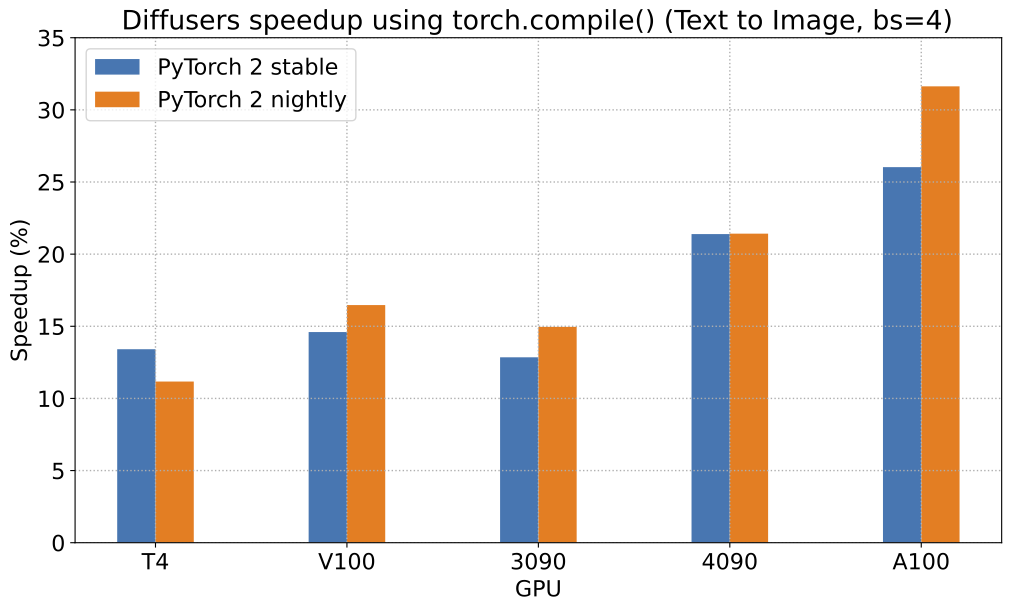
|
||||
|
||||
To give you an even better idea of how this speed-up holds for the other pipelines, consider the following
|
||||
graph for an A100 with PyTorch 2.0 and `torch.compile`:
|
||||
|
||||
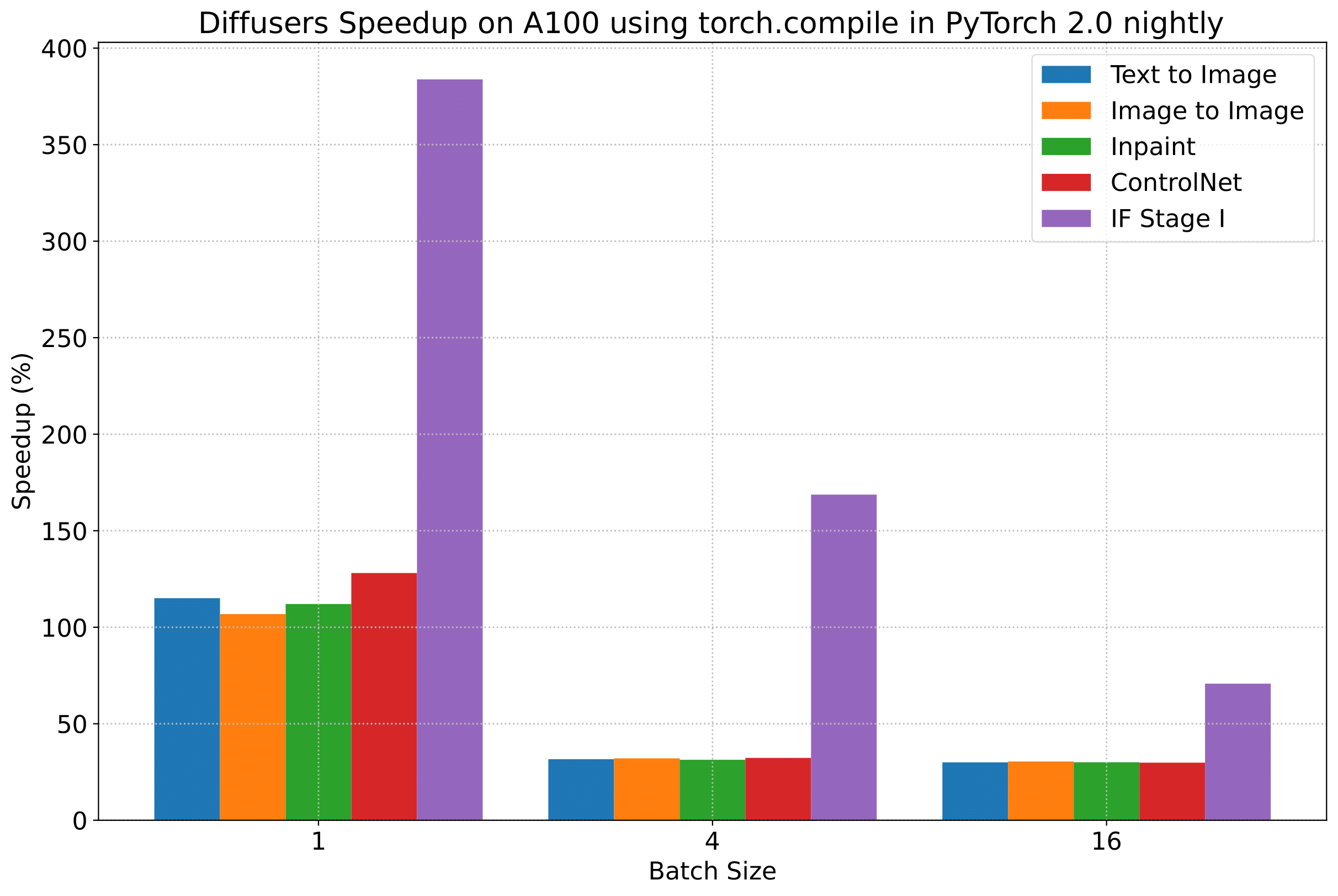
|
||||
|
||||
In the following tables, we report our findings in terms of the *number of iterations/second*.
|
||||
|
||||
### A100 (batch size: 1)
|
||||
|
||||
| **Pipeline** | **torch 2.0 - <br>no compile** | **torch nightly - <br>no compile** | **torch 2.0 - <br>compile** | **torch nightly - <br>compile** |
|
||||
|:---:|:---:|:---:|:---:|:---:|
|
||||
| SD - txt2img | 21.66 | 23.13 | 44.03 | 49.74 |
|
||||
| SD - img2img | 21.81 | 22.40 | 43.92 | 46.32 |
|
||||
| SD - inpaint | 22.24 | 23.23 | 43.76 | 49.25 |
|
||||
| SD - controlnet | 15.02 | 15.82 | 32.13 | 36.08 |
|
||||
| IF | 20.21 / <br>13.84 / <br>24.00 | 20.12 / <br>13.70 / <br>24.03 | ❌ | 97.34 / <br>27.23 / <br>111.66 |
|
||||
| SDXL - txt2img | 8.64 | 9.9 | - | - |
|
||||
|
||||
### A100 (batch size: 4)
|
||||
|
||||
| **Pipeline** | **torch 2.0 - <br>no compile** | **torch nightly - <br>no compile** | **torch 2.0 - <br>compile** | **torch nightly - <br>compile** |
|
||||
|:---:|:---:|:---:|:---:|:---:|
|
||||
| SD - txt2img | 11.6 | 13.12 | 14.62 | 17.27 |
|
||||
| SD - img2img | 11.47 | 13.06 | 14.66 | 17.25 |
|
||||
| SD - inpaint | 11.67 | 13.31 | 14.88 | 17.48 |
|
||||
| SD - controlnet | 8.28 | 9.38 | 10.51 | 12.41 |
|
||||
| IF | 25.02 | 18.04 | ❌ | 48.47 |
|
||||
| SDXL - txt2img | 2.44 | 2.74 | - | - |
|
||||
|
||||
### A100 (batch size: 16)
|
||||
|
||||
| **Pipeline** | **torch 2.0 - <br>no compile** | **torch nightly - <br>no compile** | **torch 2.0 - <br>compile** | **torch nightly - <br>compile** |
|
||||
|:---:|:---:|:---:|:---:|:---:|
|
||||
| SD - txt2img | 3.04 | 3.6 | 3.83 | 4.68 |
|
||||
| SD - img2img | 2.98 | 3.58 | 3.83 | 4.67 |
|
||||
| SD - inpaint | 3.04 | 3.66 | 3.9 | 4.76 |
|
||||
| SD - controlnet | 2.15 | 2.58 | 2.74 | 3.35 |
|
||||
| IF | 8.78 | 9.82 | ❌ | 16.77 |
|
||||
| SDXL - txt2img | 0.64 | 0.72 | - | - |
|
||||
|
||||
### V100 (batch size: 1)
|
||||
|
||||
| **Pipeline** | **torch 2.0 - <br>no compile** | **torch nightly - <br>no compile** | **torch 2.0 - <br>compile** | **torch nightly - <br>compile** |
|
||||
|:---:|:---:|:---:|:---:|:---:|
|
||||
| SD - txt2img | 18.99 | 19.14 | 20.95 | 22.17 |
|
||||
| SD - img2img | 18.56 | 19.18 | 20.95 | 22.11 |
|
||||
| SD - inpaint | 19.14 | 19.06 | 21.08 | 22.20 |
|
||||
| SD - controlnet | 13.48 | 13.93 | 15.18 | 15.88 |
|
||||
| IF | 20.01 / <br>9.08 / <br>23.34 | 19.79 / <br>8.98 / <br>24.10 | ❌ | 55.75 / <br>11.57 / <br>57.67 |
|
||||
|
||||
### V100 (batch size: 4)
|
||||
|
||||
| **Pipeline** | **torch 2.0 - <br>no compile** | **torch nightly - <br>no compile** | **torch 2.0 - <br>compile** | **torch nightly - <br>compile** |
|
||||
|:---:|:---:|:---:|:---:|:---:|
|
||||
| SD - txt2img | 5.96 | 5.89 | 6.83 | 6.86 |
|
||||
| SD - img2img | 5.90 | 5.91 | 6.81 | 6.82 |
|
||||
| SD - inpaint | 5.99 | 6.03 | 6.93 | 6.95 |
|
||||
| SD - controlnet | 4.26 | 4.29 | 4.92 | 4.93 |
|
||||
| IF | 15.41 | 14.76 | ❌ | 22.95 |
|
||||
|
||||
### V100 (batch size: 16)
|
||||
|
||||
| **Pipeline** | **torch 2.0 - <br>no compile** | **torch nightly - <br>no compile** | **torch 2.0 - <br>compile** | **torch nightly - <br>compile** |
|
||||
|:---:|:---:|:---:|:---:|:---:|
|
||||
| SD - txt2img | 1.66 | 1.66 | 1.92 | 1.90 |
|
||||
| SD - img2img | 1.65 | 1.65 | 1.91 | 1.89 |
|
||||
| SD - inpaint | 1.69 | 1.69 | 1.95 | 1.93 |
|
||||
| SD - controlnet | 1.19 | 1.19 | OOM after warmup | 1.36 |
|
||||
| IF | 5.43 | 5.29 | ❌ | 7.06 |
|
||||
|
||||
### T4 (batch size: 1)
|
||||
|
||||
| **Pipeline** | **torch 2.0 - <br>no compile** | **torch nightly - <br>no compile** | **torch 2.0 - <br>compile** | **torch nightly - <br>compile** |
|
||||
|:---:|:---:|:---:|:---:|:---:|
|
||||
| SD - txt2img | 6.9 | 6.95 | 7.3 | 7.56 |
|
||||
| SD - img2img | 6.84 | 6.99 | 7.04 | 7.55 |
|
||||
| SD - inpaint | 6.91 | 6.7 | 7.01 | 7.37 |
|
||||
| SD - controlnet | 4.89 | 4.86 | 5.35 | 5.48 |
|
||||
| IF | 17.42 / <br>2.47 / <br>18.52 | 16.96 / <br>2.45 / <br>18.69 | ❌ | 24.63 / <br>2.47 / <br>23.39 |
|
||||
| SDXL - txt2img | 1.15 | 1.16 | - | - |
|
||||
|
||||
### T4 (batch size: 4)
|
||||
|
||||
| **Pipeline** | **torch 2.0 - <br>no compile** | **torch nightly - <br>no compile** | **torch 2.0 - <br>compile** | **torch nightly - <br>compile** |
|
||||
|:---:|:---:|:---:|:---:|:---:|
|
||||
| SD - txt2img | 1.79 | 1.79 | 2.03 | 1.99 |
|
||||
| SD - img2img | 1.77 | 1.77 | 2.05 | 2.04 |
|
||||
| SD - inpaint | 1.81 | 1.82 | 2.09 | 2.09 |
|
||||
| SD - controlnet | 1.34 | 1.27 | 1.47 | 1.46 |
|
||||
| IF | 5.79 | 5.61 | ❌ | 7.39 |
|
||||
| SDXL - txt2img | 0.288 | 0.289 | - | - |
|
||||
|
||||
### T4 (batch size: 16)
|
||||
|
||||
| **Pipeline** | **torch 2.0 - <br>no compile** | **torch nightly - <br>no compile** | **torch 2.0 - <br>compile** | **torch nightly - <br>compile** |
|
||||
|:---:|:---:|:---:|:---:|:---:|
|
||||
| SD - txt2img | 2.34s | 2.30s | OOM after 2nd iteration | 1.99s |
|
||||
| SD - img2img | 2.35s | 2.31s | OOM after warmup | 2.00s |
|
||||
| SD - inpaint | 2.30s | 2.26s | OOM after 2nd iteration | 1.95s |
|
||||
| SD - controlnet | OOM after 2nd iteration | OOM after 2nd iteration | OOM after warmup | OOM after warmup |
|
||||
| IF * | 1.44 | 1.44 | ❌ | 1.94 |
|
||||
| SDXL - txt2img | OOM | OOM | - | - |
|
||||
|
||||
### RTX 3090 (batch size: 1)
|
||||
|
||||
| **Pipeline** | **torch 2.0 - <br>no compile** | **torch nightly - <br>no compile** | **torch 2.0 - <br>compile** | **torch nightly - <br>compile** |
|
||||
|:---:|:---:|:---:|:---:|:---:|
|
||||
| SD - txt2img | 22.56 | 22.84 | 23.84 | 25.69 |
|
||||
| SD - img2img | 22.25 | 22.61 | 24.1 | 25.83 |
|
||||
| SD - inpaint | 22.22 | 22.54 | 24.26 | 26.02 |
|
||||
| SD - controlnet | 16.03 | 16.33 | 17.38 | 18.56 |
|
||||
| IF | 27.08 / <br>9.07 / <br>31.23 | 26.75 / <br>8.92 / <br>31.47 | ❌ | 68.08 / <br>11.16 / <br>65.29 |
|
||||
|
||||
### RTX 3090 (batch size: 4)
|
||||
|
||||
| **Pipeline** | **torch 2.0 - <br>no compile** | **torch nightly - <br>no compile** | **torch 2.0 - <br>compile** | **torch nightly - <br>compile** |
|
||||
|:---:|:---:|:---:|:---:|:---:|
|
||||
| SD - txt2img | 6.46 | 6.35 | 7.29 | 7.3 |
|
||||
| SD - img2img | 6.33 | 6.27 | 7.31 | 7.26 |
|
||||
| SD - inpaint | 6.47 | 6.4 | 7.44 | 7.39 |
|
||||
| SD - controlnet | 4.59 | 4.54 | 5.27 | 5.26 |
|
||||
| IF | 16.81 | 16.62 | ❌ | 21.57 |
|
||||
|
||||
### RTX 3090 (batch size: 16)
|
||||
|
||||
| **Pipeline** | **torch 2.0 - <br>no compile** | **torch nightly - <br>no compile** | **torch 2.0 - <br>compile** | **torch nightly - <br>compile** |
|
||||
|:---:|:---:|:---:|:---:|:---:|
|
||||
| SD - txt2img | 1.7 | 1.69 | 1.93 | 1.91 |
|
||||
| SD - img2img | 1.68 | 1.67 | 1.93 | 1.9 |
|
||||
| SD - inpaint | 1.72 | 1.71 | 1.97 | 1.94 |
|
||||
| SD - controlnet | 1.23 | 1.22 | 1.4 | 1.38 |
|
||||
| IF | 5.01 | 5.00 | ❌ | 6.33 |
|
||||
|
||||
### RTX 4090 (batch size: 1)
|
||||
|
||||
| **Pipeline** | **torch 2.0 - <br>no compile** | **torch nightly - <br>no compile** | **torch 2.0 - <br>compile** | **torch nightly - <br>compile** |
|
||||
|:---:|:---:|:---:|:---:|:---:|
|
||||
| SD - txt2img | 40.5 | 41.89 | 44.65 | 49.81 |
|
||||
| SD - img2img | 40.39 | 41.95 | 44.46 | 49.8 |
|
||||
| SD - inpaint | 40.51 | 41.88 | 44.58 | 49.72 |
|
||||
| SD - controlnet | 29.27 | 30.29 | 32.26 | 36.03 |
|
||||
| IF | 69.71 / <br>18.78 / <br>85.49 | 69.13 / <br>18.80 / <br>85.56 | ❌ | 124.60 / <br>26.37 / <br>138.79 |
|
||||
| SDXL - txt2img | 6.8 | 8.18 | - | - |
|
||||
|
||||
### RTX 4090 (batch size: 4)
|
||||
|
||||
| **Pipeline** | **torch 2.0 - <br>no compile** | **torch nightly - <br>no compile** | **torch 2.0 - <br>compile** | **torch nightly - <br>compile** |
|
||||
|:---:|:---:|:---:|:---:|:---:|
|
||||
| SD - txt2img | 12.62 | 12.84 | 15.32 | 15.59 |
|
||||
| SD - img2img | 12.61 | 12,.79 | 15.35 | 15.66 |
|
||||
| SD - inpaint | 12.65 | 12.81 | 15.3 | 15.58 |
|
||||
| SD - controlnet | 9.1 | 9.25 | 11.03 | 11.22 |
|
||||
| IF | 31.88 | 31.14 | ❌ | 43.92 |
|
||||
| SDXL - txt2img | 2.19 | 2.35 | - | - |
|
||||
|
||||
### RTX 4090 (batch size: 16)
|
||||
|
||||
| **Pipeline** | **torch 2.0 - <br>no compile** | **torch nightly - <br>no compile** | **torch 2.0 - <br>compile** | **torch nightly - <br>compile** |
|
||||
|:---:|:---:|:---:|:---:|:---:|
|
||||
| SD - txt2img | 3.17 | 3.2 | 3.84 | 3.85 |
|
||||
| SD - img2img | 3.16 | 3.2 | 3.84 | 3.85 |
|
||||
| SD - inpaint | 3.17 | 3.2 | 3.85 | 3.85 |
|
||||
| SD - controlnet | 2.23 | 2.3 | 2.7 | 2.75 |
|
||||
| IF | 9.26 | 9.2 | ❌ | 13.31 |
|
||||
| SDXL - txt2img | 0.52 | 0.53 | - | - |
|
||||
|
||||
## Notes
|
||||
|
||||
* Follow this [PR](https://github.com/huggingface/diffusers/pull/3313) for more details on the environment used for conducting the benchmarks.
|
||||
* For the DeepFloyd IF pipeline where batch sizes > 1, we only used a batch size of > 1 in the first IF pipeline for text-to-image generation and NOT for upscaling. That means the two upscaling pipelines received a batch size of 1.
|
||||
|
||||
*Thanks to [Horace He](https://github.com/Chillee) from the PyTorch team for their support in improving our support of `torch.compile()` in Diffusers.*
|
||||
@@ -1,322 +0,0 @@
|
||||
<!--Copyright 2024 The HuggingFace Team. All rights reserved.
|
||||
|
||||
Licensed under the Apache License, Version 2.0 (the "License"); you may not use this file except in compliance with
|
||||
the License. You may obtain a copy of the License at
|
||||
|
||||
http://www.apache.org/licenses/LICENSE-2.0
|
||||
|
||||
Unless required by applicable law or agreed to in writing, software distributed under the License is distributed on
|
||||
an "AS IS" BASIS, WITHOUT WARRANTIES OR CONDITIONS OF ANY KIND, either express or implied. See the License for the
|
||||
specific language governing permissions and limitations under the License.
|
||||
-->
|
||||
|
||||
# Accelerate inference of text-to-image diffusion models
|
||||
|
||||
Diffusion models are slower than their GAN counterparts because of the iterative and sequential reverse diffusion process. There are several techniques that can address this limitation such as progressive timestep distillation ([LCM LoRA](../using-diffusers/inference_with_lcm_lora)), model compression ([SSD-1B](https://huggingface.co/segmind/SSD-1B)), and reusing adjacent features of the denoiser ([DeepCache](../optimization/deepcache)).
|
||||
|
||||
However, you don't necessarily need to use these techniques to speed up inference. With PyTorch 2 alone, you can accelerate the inference latency of text-to-image diffusion pipelines by up to 3x. This tutorial will show you how to progressively apply the optimizations found in PyTorch 2 to reduce inference latency. You'll use the [Stable Diffusion XL (SDXL)](../using-diffusers/sdxl) pipeline in this tutorial, but these techniques are applicable to other text-to-image diffusion pipelines too.
|
||||
|
||||
Make sure you're using the latest version of Diffusers:
|
||||
|
||||
```bash
|
||||
pip install -U diffusers
|
||||
```
|
||||
|
||||
Then upgrade the other required libraries too:
|
||||
|
||||
```bash
|
||||
pip install -U transformers accelerate peft
|
||||
```
|
||||
|
||||
Install [PyTorch nightly](https://pytorch.org/) to benefit from the latest and fastest kernels:
|
||||
|
||||
```bash
|
||||
pip3 install --pre torch --index-url https://download.pytorch.org/whl/nightly/cu121
|
||||
```
|
||||
|
||||
> [!TIP]
|
||||
> The results reported below are from a 80GB 400W A100 with its clock rate set to the maximum.
|
||||
> If you're interested in the full benchmarking code, take a look at [huggingface/diffusion-fast](https://github.com/huggingface/diffusion-fast).
|
||||
|
||||
|
||||
## Baseline
|
||||
|
||||
Let's start with a baseline. Disable reduced precision and the [`scaled_dot_product_attention` (SDPA)](../optimization/torch2.0#scaled-dot-product-attention) function which is automatically used by Diffusers:
|
||||
|
||||
```python
|
||||
from diffusers import StableDiffusionXLPipeline
|
||||
|
||||
# Load the pipeline in full-precision and place its model components on CUDA.
|
||||
pipe = StableDiffusionXLPipeline.from_pretrained(
|
||||
"stabilityai/stable-diffusion-xl-base-1.0"
|
||||
).to("cuda")
|
||||
|
||||
# Run the attention ops without SDPA.
|
||||
pipe.unet.set_default_attn_processor()
|
||||
pipe.vae.set_default_attn_processor()
|
||||
|
||||
prompt = "Astronaut in a jungle, cold color palette, muted colors, detailed, 8k"
|
||||
image = pipe(prompt, num_inference_steps=30).images[0]
|
||||
```
|
||||
|
||||
This default setup takes 7.36 seconds.
|
||||
|
||||
<div class="flex justify-center">
|
||||
<img src="https://huggingface.co/datasets/sayakpaul/sample-datasets/resolve/main/progressive-acceleration-sdxl/SDXL%2C_Batch_Size%3A_1%2C_Steps%3A_30_0.png" width=500>
|
||||
</div>
|
||||
|
||||
## bfloat16
|
||||
|
||||
Enable the first optimization, reduced precision or more specifically bfloat16. There are several benefits of using reduced precision:
|
||||
|
||||
* Using a reduced numerical precision (such as float16 or bfloat16) for inference doesn’t affect the generation quality but significantly improves latency.
|
||||
* The benefits of using bfloat16 compared to float16 are hardware dependent, but modern GPUs tend to favor bfloat16.
|
||||
* bfloat16 is much more resilient when used with quantization compared to float16, but more recent versions of the quantization library ([torchao](https://github.com/pytorch-labs/ao)) we used don't have numerical issues with float16.
|
||||
|
||||
```python
|
||||
from diffusers import StableDiffusionXLPipeline
|
||||
import torch
|
||||
|
||||
pipe = StableDiffusionXLPipeline.from_pretrained(
|
||||
"stabilityai/stable-diffusion-xl-base-1.0", torch_dtype=torch.bfloat16
|
||||
).to("cuda")
|
||||
|
||||
# Run the attention ops without SDPA.
|
||||
pipe.unet.set_default_attn_processor()
|
||||
pipe.vae.set_default_attn_processor()
|
||||
|
||||
prompt = "Astronaut in a jungle, cold color palette, muted colors, detailed, 8k"
|
||||
image = pipe(prompt, num_inference_steps=30).images[0]
|
||||
```
|
||||
|
||||
bfloat16 reduces the latency from 7.36 seconds to 4.63 seconds.
|
||||
|
||||
<div class="flex justify-center">
|
||||
<img src="https://huggingface.co/datasets/sayakpaul/sample-datasets/resolve/main/progressive-acceleration-sdxl/SDXL%2C_Batch_Size%3A_1%2C_Steps%3A_30_1.png" width=500>
|
||||
</div>
|
||||
|
||||
<Tip>
|
||||
|
||||
In our later experiments with float16, recent versions of torchao do not incur numerical problems from float16.
|
||||
|
||||
</Tip>
|
||||
|
||||
Take a look at the [Speed up inference](../optimization/fp16) guide to learn more about running inference with reduced precision.
|
||||
|
||||
## SDPA
|
||||
|
||||
Attention blocks are intensive to run. But with PyTorch's [`scaled_dot_product_attention`](../optimization/torch2.0#scaled-dot-product-attention) function, it is a lot more efficient. This function is used by default in Diffusers so you don't need to make any changes to the code.
|
||||
|
||||
```python
|
||||
from diffusers import StableDiffusionXLPipeline
|
||||
import torch
|
||||
|
||||
pipe = StableDiffusionXLPipeline.from_pretrained(
|
||||
"stabilityai/stable-diffusion-xl-base-1.0", torch_dtype=torch.bfloat16
|
||||
).to("cuda")
|
||||
|
||||
prompt = "Astronaut in a jungle, cold color palette, muted colors, detailed, 8k"
|
||||
image = pipe(prompt, num_inference_steps=30).images[0]
|
||||
```
|
||||
|
||||
Scaled dot product attention improves the latency from 4.63 seconds to 3.31 seconds.
|
||||
|
||||
<div class="flex justify-center">
|
||||
<img src="https://huggingface.co/datasets/sayakpaul/sample-datasets/resolve/main/progressive-acceleration-sdxl/SDXL%2C_Batch_Size%3A_1%2C_Steps%3A_30_2.png" width=500>
|
||||
</div>
|
||||
|
||||
## torch.compile
|
||||
|
||||
PyTorch 2 includes `torch.compile` which uses fast and optimized kernels. In Diffusers, the UNet and VAE are usually compiled because these are the most compute-intensive modules. First, configure a few compiler flags (refer to the [full list](https://github.com/pytorch/pytorch/blob/main/torch/_inductor/config.py) for more options):
|
||||
|
||||
```python
|
||||
from diffusers import StableDiffusionXLPipeline
|
||||
import torch
|
||||
|
||||
torch._inductor.config.conv_1x1_as_mm = True
|
||||
torch._inductor.config.coordinate_descent_tuning = True
|
||||
torch._inductor.config.epilogue_fusion = False
|
||||
torch._inductor.config.coordinate_descent_check_all_directions = True
|
||||
```
|
||||
|
||||
It is also important to change the UNet and VAE's memory layout to "channels_last" when compiling them to ensure maximum speed.
|
||||
|
||||
```python
|
||||
pipe.unet.to(memory_format=torch.channels_last)
|
||||
pipe.vae.to(memory_format=torch.channels_last)
|
||||
```
|
||||
|
||||
Now compile and perform inference:
|
||||
|
||||
```python
|
||||
# Compile the UNet and VAE.
|
||||
pipe.unet = torch.compile(pipe.unet, mode="max-autotune", fullgraph=True)
|
||||
pipe.vae.decode = torch.compile(pipe.vae.decode, mode="max-autotune", fullgraph=True)
|
||||
|
||||
prompt = "Astronaut in a jungle, cold color palette, muted colors, detailed, 8k"
|
||||
|
||||
# First call to `pipe` is slow, subsequent ones are faster.
|
||||
image = pipe(prompt, num_inference_steps=30).images[0]
|
||||
```
|
||||
|
||||
`torch.compile` offers different backends and modes. For maximum inference speed, use "max-autotune" for the inductor backend. “max-autotune” uses CUDA graphs and optimizes the compilation graph specifically for latency. CUDA graphs greatly reduces the overhead of launching GPU operations by using a mechanism to launch multiple GPU operations through a single CPU operation.
|
||||
|
||||
Using SDPA attention and compiling both the UNet and VAE cuts the latency from 3.31 seconds to 2.54 seconds.
|
||||
|
||||
<div class="flex justify-center">
|
||||
<img src="https://huggingface.co/datasets/sayakpaul/sample-datasets/resolve/main/progressive-acceleration-sdxl/SDXL%2C_Batch_Size%3A_1%2C_Steps%3A_30_3.png" width=500>
|
||||
</div>
|
||||
|
||||
> [!TIP]
|
||||
> From PyTorch 2.3.1, you can control the caching behavior of `torch.compile()`. This is particularly beneficial for compilation modes like `"max-autotune"` which performs a grid-search over several compilation flags to find the optimal configuration. Learn more in the [Compile Time Caching in torch.compile](https://pytorch.org/tutorials/recipes/torch_compile_caching_tutorial.html) tutorial.
|
||||
|
||||
### Prevent graph breaks
|
||||
|
||||
Specifying `fullgraph=True` ensures there are no graph breaks in the underlying model to take full advantage of `torch.compile` without any performance degradation. For the UNet and VAE, this means changing how you access the return variables.
|
||||
|
||||
```diff
|
||||
- latents = unet(
|
||||
- latents, timestep=timestep, encoder_hidden_states=prompt_embeds
|
||||
-).sample
|
||||
|
||||
+ latents = unet(
|
||||
+ latents, timestep=timestep, encoder_hidden_states=prompt_embeds, return_dict=False
|
||||
+)[0]
|
||||
```
|
||||
|
||||
### Remove GPU sync after compilation
|
||||
|
||||
During the iterative reverse diffusion process, the `step()` function is [called](https://github.com/huggingface/diffusers/blob/1d686bac8146037e97f3fd8c56e4063230f71751/src/diffusers/pipelines/stable_diffusion_xl/pipeline_stable_diffusion_xl.py#L1228) on the scheduler each time after the denoiser predicts the less noisy latent embeddings. Inside `step()`, the `sigmas` variable is [indexed](https://github.com/huggingface/diffusers/blob/1d686bac8146037e97f3fd8c56e4063230f71751/src/diffusers/schedulers/scheduling_euler_discrete.py#L476) which when placed on the GPU, causes a communication sync between the CPU and GPU. This introduces latency and it becomes more evident when the denoiser has already been compiled.
|
||||
|
||||
But if the `sigmas` array always [stays on the CPU](https://github.com/huggingface/diffusers/blob/35a969d297cba69110d175ee79c59312b9f49e1e/src/diffusers/schedulers/scheduling_euler_discrete.py#L240), the CPU and GPU sync doesn’t occur and you don't get any latency. In general, any CPU and GPU communication sync should be none or be kept to a bare minimum because it can impact inference latency.
|
||||
|
||||
## Combine the attention block's projection matrices
|
||||
|
||||
The UNet and VAE in SDXL use Transformer-like blocks which consists of attention blocks and feed-forward blocks.
|
||||
|
||||
In an attention block, the input is projected into three sub-spaces using three different projection matrices – Q, K, and V. These projections are performed separately on the input. But we can horizontally combine the projection matrices into a single matrix and perform the projection in one step. This increases the size of the matrix multiplications of the input projections and improves the impact of quantization.
|
||||
|
||||
You can combine the projection matrices with just a single line of code:
|
||||
|
||||
```python
|
||||
pipe.fuse_qkv_projections()
|
||||
```
|
||||
|
||||
This provides a minor improvement from 2.54 seconds to 2.52 seconds.
|
||||
|
||||
<div class="flex justify-center">
|
||||
<img src="https://huggingface.co/datasets/sayakpaul/sample-datasets/resolve/main/progressive-acceleration-sdxl/SDXL%2C_Batch_Size%3A_1%2C_Steps%3A_30_4.png" width=500>
|
||||
</div>
|
||||
|
||||
<Tip warning={true}>
|
||||
|
||||
Support for [`~StableDiffusionXLPipeline.fuse_qkv_projections`] is limited and experimental. It's not available for many non-Stable Diffusion pipelines such as [Kandinsky](../using-diffusers/kandinsky). You can refer to this [PR](https://github.com/huggingface/diffusers/pull/6179) to get an idea about how to enable this for the other pipelines.
|
||||
|
||||
</Tip>
|
||||
|
||||
## Dynamic quantization
|
||||
|
||||
You can also use the ultra-lightweight PyTorch quantization library, [torchao](https://github.com/pytorch-labs/ao) (commit SHA `54bcd5a10d0abbe7b0c045052029257099f83fd9`), to apply [dynamic int8 quantization](https://pytorch.org/tutorials/recipes/recipes/dynamic_quantization.html) to the UNet and VAE. Quantization adds additional conversion overhead to the model that is hopefully made up for by faster matmuls (dynamic quantization). If the matmuls are too small, these techniques may degrade performance.
|
||||
|
||||
First, configure all the compiler tags:
|
||||
|
||||
```python
|
||||
from diffusers import StableDiffusionXLPipeline
|
||||
import torch
|
||||
|
||||
# Notice the two new flags at the end.
|
||||
torch._inductor.config.conv_1x1_as_mm = True
|
||||
torch._inductor.config.coordinate_descent_tuning = True
|
||||
torch._inductor.config.epilogue_fusion = False
|
||||
torch._inductor.config.coordinate_descent_check_all_directions = True
|
||||
torch._inductor.config.force_fuse_int_mm_with_mul = True
|
||||
torch._inductor.config.use_mixed_mm = True
|
||||
```
|
||||
|
||||
Certain linear layers in the UNet and VAE don’t benefit from dynamic int8 quantization. You can filter out those layers with the [`dynamic_quant_filter_fn`](https://github.com/huggingface/diffusion-fast/blob/0f169640b1db106fe6a479f78c1ed3bfaeba3386/utils/pipeline_utils.py#L16) shown below.
|
||||
|
||||
```python
|
||||
def dynamic_quant_filter_fn(mod, *args):
|
||||
return (
|
||||
isinstance(mod, torch.nn.Linear)
|
||||
and mod.in_features > 16
|
||||
and (mod.in_features, mod.out_features)
|
||||
not in [
|
||||
(1280, 640),
|
||||
(1920, 1280),
|
||||
(1920, 640),
|
||||
(2048, 1280),
|
||||
(2048, 2560),
|
||||
(2560, 1280),
|
||||
(256, 128),
|
||||
(2816, 1280),
|
||||
(320, 640),
|
||||
(512, 1536),
|
||||
(512, 256),
|
||||
(512, 512),
|
||||
(640, 1280),
|
||||
(640, 1920),
|
||||
(640, 320),
|
||||
(640, 5120),
|
||||
(640, 640),
|
||||
(960, 320),
|
||||
(960, 640),
|
||||
]
|
||||
)
|
||||
|
||||
|
||||
def conv_filter_fn(mod, *args):
|
||||
return (
|
||||
isinstance(mod, torch.nn.Conv2d) and mod.kernel_size == (1, 1) and 128 in [mod.in_channels, mod.out_channels]
|
||||
)
|
||||
```
|
||||
|
||||
Finally, apply all the optimizations discussed so far:
|
||||
|
||||
```python
|
||||
# SDPA + bfloat16.
|
||||
pipe = StableDiffusionXLPipeline.from_pretrained(
|
||||
"stabilityai/stable-diffusion-xl-base-1.0", torch_dtype=torch.bfloat16
|
||||
).to("cuda")
|
||||
|
||||
# Combine attention projection matrices.
|
||||
pipe.fuse_qkv_projections()
|
||||
|
||||
# Change the memory layout.
|
||||
pipe.unet.to(memory_format=torch.channels_last)
|
||||
pipe.vae.to(memory_format=torch.channels_last)
|
||||
```
|
||||
|
||||
Since dynamic quantization is only limited to the linear layers, convert the appropriate pointwise convolution layers into linear layers to maximize its benefit.
|
||||
|
||||
```python
|
||||
from torchao import swap_conv2d_1x1_to_linear
|
||||
|
||||
swap_conv2d_1x1_to_linear(pipe.unet, conv_filter_fn)
|
||||
swap_conv2d_1x1_to_linear(pipe.vae, conv_filter_fn)
|
||||
```
|
||||
|
||||
Apply dynamic quantization:
|
||||
|
||||
```python
|
||||
from torchao import apply_dynamic_quant
|
||||
|
||||
apply_dynamic_quant(pipe.unet, dynamic_quant_filter_fn)
|
||||
apply_dynamic_quant(pipe.vae, dynamic_quant_filter_fn)
|
||||
```
|
||||
|
||||
Finally, compile and perform inference:
|
||||
|
||||
```python
|
||||
pipe.unet = torch.compile(pipe.unet, mode="max-autotune", fullgraph=True)
|
||||
pipe.vae.decode = torch.compile(pipe.vae.decode, mode="max-autotune", fullgraph=True)
|
||||
|
||||
prompt = "Astronaut in a jungle, cold color palette, muted colors, detailed, 8k"
|
||||
image = pipe(prompt, num_inference_steps=30).images[0]
|
||||
```
|
||||
|
||||
Applying dynamic quantization improves the latency from 2.52 seconds to 2.43 seconds.
|
||||
|
||||
<div class="flex justify-center">
|
||||
<img src="https://huggingface.co/datasets/sayakpaul/sample-datasets/resolve/main/progressive-acceleration-sdxl/SDXL%2C_Batch_Size%3A_1%2C_Steps%3A_30_5.png" width=500>
|
||||
</div>
|
||||
@@ -1,139 +0,0 @@
|
||||
<!--Copyright 2024 The HuggingFace Team. All rights reserved.
|
||||
|
||||
Licensed under the Apache License, Version 2.0 (the "License"); you may not use this file except in compliance with
|
||||
the License. You may obtain a copy of the License at
|
||||
|
||||
http://www.apache.org/licenses/LICENSE-2.0
|
||||
|
||||
Unless required by applicable law or agreed to in writing, software distributed under the License is distributed on
|
||||
an "AS IS" BASIS, WITHOUT WARRANTIES OR CONDITIONS OF ANY KIND, either express or implied. See the License for the
|
||||
specific language governing permissions and limitations under the License.
|
||||
-->
|
||||
|
||||
# Working with big models
|
||||
|
||||
A modern diffusion model, like [Stable Diffusion XL (SDXL)](../using-diffusers/sdxl), is not just a single model, but a collection of multiple models. SDXL has four different model-level components:
|
||||
|
||||
* A variational autoencoder (VAE)
|
||||
* Two text encoders
|
||||
* A UNet for denoising
|
||||
|
||||
Usually, the text encoders and the denoiser are much larger compared to the VAE.
|
||||
|
||||
As models get bigger and better, it’s possible your model is so big that even a single copy won’t fit in memory. But that doesn’t mean it can’t be loaded. If you have more than one GPU, there is more memory available to store your model. In this case, it’s better to split your model checkpoint into several smaller *checkpoint shards*.
|
||||
|
||||
When a text encoder checkpoint has multiple shards, like [T5-xxl for SD3](https://huggingface.co/stabilityai/stable-diffusion-3-medium-diffusers/tree/main/text_encoder_3), it is automatically handled by the [Transformers](https://huggingface.co/docs/transformers/index) library as it is a required dependency of Diffusers when using the [`StableDiffusion3Pipeline`]. More specifically, Transformers will automatically handle the loading of multiple shards within the requested model class and get it ready so that inference can be performed.
|
||||
|
||||
The denoiser checkpoint can also have multiple shards and supports inference thanks to the [Accelerate](https://huggingface.co/docs/accelerate/index) library.
|
||||
|
||||
> [!TIP]
|
||||
> Refer to the [Handling big models for inference](https://huggingface.co/docs/accelerate/main/en/concept_guides/big_model_inference) guide for general guidance when working with big models that are hard to fit into memory.
|
||||
|
||||
For example, let's save a sharded checkpoint for the [SDXL UNet](https://huggingface.co/stabilityai/stable-diffusion-xl-base-1.0/tree/main/unet):
|
||||
|
||||
```python
|
||||
from diffusers import UNet2DConditionModel
|
||||
|
||||
unet = UNet2DConditionModel.from_pretrained(
|
||||
"stabilityai/stable-diffusion-xl-base-1.0", subfolder="unet"
|
||||
)
|
||||
unet.save_pretrained("sdxl-unet-sharded", max_shard_size="5GB")
|
||||
```
|
||||
|
||||
The size of the fp32 variant of the SDXL UNet checkpoint is ~10.4GB. Set the `max_shard_size` parameter to 5GB to create 3 shards. After saving, you can load them in [`StableDiffusionXLPipeline`]:
|
||||
|
||||
```python
|
||||
from diffusers import UNet2DConditionModel, StableDiffusionXLPipeline
|
||||
import torch
|
||||
|
||||
unet = UNet2DConditionModel.from_pretrained(
|
||||
"sayakpaul/sdxl-unet-sharded", torch_dtype=torch.float16
|
||||
)
|
||||
pipeline = StableDiffusionXLPipeline.from_pretrained(
|
||||
"stabilityai/stable-diffusion-xl-base-1.0", unet=unet, torch_dtype=torch.float16
|
||||
).to("cuda")
|
||||
|
||||
image = pipeline("a cute dog running on the grass", num_inference_steps=30).images[0]
|
||||
image.save("dog.png")
|
||||
```
|
||||
|
||||
If placing all the model-level components on the GPU at once is not feasible, use [`~DiffusionPipeline.enable_model_cpu_offload`] to help you:
|
||||
|
||||
```diff
|
||||
- pipeline.to("cuda")
|
||||
+ pipeline.enable_model_cpu_offload()
|
||||
```
|
||||
|
||||
In general, we recommend sharding when a checkpoint is more than 5GB (in fp32).
|
||||
|
||||
## Device placement
|
||||
|
||||
On distributed setups, you can run inference across multiple GPUs with Accelerate.
|
||||
|
||||
> [!WARNING]
|
||||
> This feature is experimental and its APIs might change in the future.
|
||||
|
||||
With Accelerate, you can use the `device_map` to determine how to distribute the models of a pipeline across multiple devices. This is useful in situations where you have more than one GPU.
|
||||
|
||||
For example, if you have two 8GB GPUs, then using [`~DiffusionPipeline.enable_model_cpu_offload`] may not work so well because:
|
||||
|
||||
* it only works on a single GPU
|
||||
* a single model might not fit on a single GPU ([`~DiffusionPipeline.enable_sequential_cpu_offload`] might work but it will be extremely slow and it is also limited to a single GPU)
|
||||
|
||||
To make use of both GPUs, you can use the "balanced" device placement strategy which splits the models across all available GPUs.
|
||||
|
||||
> [!WARNING]
|
||||
> Only the "balanced" strategy is supported at the moment, and we plan to support additional mapping strategies in the future.
|
||||
|
||||
```diff
|
||||
from diffusers import DiffusionPipeline
|
||||
import torch
|
||||
|
||||
pipeline = DiffusionPipeline.from_pretrained(
|
||||
- "stable-diffusion-v1-5/stable-diffusion-v1-5", torch_dtype=torch.float16, use_safetensors=True,
|
||||
+ "stable-diffusion-v1-5/stable-diffusion-v1-5", torch_dtype=torch.float16, use_safetensors=True, device_map="balanced"
|
||||
)
|
||||
image = pipeline("a dog").images[0]
|
||||
image
|
||||
```
|
||||
|
||||
You can also pass a dictionary to enforce the maximum GPU memory that can be used on each device:
|
||||
|
||||
```diff
|
||||
from diffusers import DiffusionPipeline
|
||||
import torch
|
||||
|
||||
max_memory = {0:"1GB", 1:"1GB"}
|
||||
pipeline = DiffusionPipeline.from_pretrained(
|
||||
"stable-diffusion-v1-5/stable-diffusion-v1-5",
|
||||
torch_dtype=torch.float16,
|
||||
use_safetensors=True,
|
||||
device_map="balanced",
|
||||
+ max_memory=max_memory
|
||||
)
|
||||
image = pipeline("a dog").images[0]
|
||||
image
|
||||
```
|
||||
|
||||
If a device is not present in `max_memory`, then it will be completely ignored and will not participate in the device placement.
|
||||
|
||||
By default, Diffusers uses the maximum memory of all devices. If the models don't fit on the GPUs, they are offloaded to the CPU. If the CPU doesn't have enough memory, then you might see an error. In that case, you could defer to using [`~DiffusionPipeline.enable_sequential_cpu_offload`] and [`~DiffusionPipeline.enable_model_cpu_offload`].
|
||||
|
||||
Call [`~DiffusionPipeline.reset_device_map`] to reset the `device_map` of a pipeline. This is also necessary if you want to use methods like `to()`, [`~DiffusionPipeline.enable_sequential_cpu_offload`], and [`~DiffusionPipeline.enable_model_cpu_offload`] on a pipeline that was device-mapped.
|
||||
|
||||
```py
|
||||
pipeline.reset_device_map()
|
||||
```
|
||||
|
||||
Once a pipeline has been device-mapped, you can also access its device map via `hf_device_map`:
|
||||
|
||||
```py
|
||||
print(pipeline.hf_device_map)
|
||||
```
|
||||
|
||||
An example device map would look like so:
|
||||
|
||||
|
||||
```bash
|
||||
{'unet': 1, 'vae': 1, 'safety_checker': 0, 'text_encoder': 0}
|
||||
```
|
||||
@@ -203,6 +203,46 @@ pipeline("bears, pizza bites").images[0]
|
||||
</hfoption>
|
||||
</hfoptions>
|
||||
|
||||
### Scale scheduling
|
||||
|
||||
Dynamically adjusting the LoRA scale during sampling gives you better control over the overall composition and layout because certain steps may benefit more from an increased or reduced scale.
|
||||
|
||||
The [character LoRA](https://huggingface.co/alvarobartt/ghibli-characters-flux-lora) in the example below starts with a higher scale that gradually decays over the first 20 steps to establish the character generation. In the later steps, only a scale of 0.2 is applied to avoid adding too much of the LoRA features to other parts of the image the LoRA wasn't trained on.
|
||||
|
||||
```py
|
||||
import torch
|
||||
from diffusers import FluxPipeline
|
||||
|
||||
pipeline = FluxPipeline.from_pretrained(
|
||||
"black-forest-labs/FLUX.1-dev", torch_dtype=torch.bfloat16
|
||||
).to("cuda")
|
||||
|
||||
pipelne.load_lora_weights("alvarobartt/ghibli-characters-flux-lora", "lora")
|
||||
|
||||
num_inference_steps = 30
|
||||
lora_steps = 20
|
||||
lora_scales = torch.linspace(1.5, 0.7, lora_steps).tolist()
|
||||
lora_scales += [0.2] * (num_inference_steps - lora_steps + 1)
|
||||
|
||||
pipeline.set_adapters("lora", lora_scales[0])
|
||||
|
||||
def callback(pipeline: FluxPipeline, step: int, timestep: torch.LongTensor, callback_kwargs: dict):
|
||||
pipeline.set_adapters("lora", lora_scales[step + 1])
|
||||
return callback_kwargs
|
||||
|
||||
prompt = """
|
||||
Ghibli style The Grinch, a mischievous green creature with a sly grin, peeking out from behind a snow-covered tree while plotting his antics,
|
||||
in a quaint snowy village decorated for the holidays, warm light glowing from cozy homes, with playful snowflakes dancing in the air
|
||||
"""
|
||||
pipeline(
|
||||
prompt=prompt,
|
||||
guidance_scale=3.0,
|
||||
num_inference_steps=num_inference_steps,
|
||||
generator=torch.Generator().manual_seed(42),
|
||||
callback_on_step_end=callback,
|
||||
).images[0]
|
||||
```
|
||||
|
||||
## Hotswapping
|
||||
|
||||
Hotswapping LoRAs is an efficient way to work with multiple LoRAs while avoiding accumulating memory from multiple calls to [`~loaders.StableDiffusionLoraLoaderMixin.load_lora_weights`] and in some cases, recompilation, if a model is compiled. This workflow requires a loaded LoRA because the new LoRA weights are swapped in place for the existing loaded LoRA.
|
||||
@@ -275,6 +315,8 @@ pipeline.load_lora_weights(
|
||||
> [!TIP]
|
||||
> Move your code inside the `with torch._dynamo.config.patch(error_on_recompile=True)` context manager to detect if a model was recompiled. If a model is recompiled despite following all the steps above, please open an [issue](https://github.com/huggingface/diffusers/issues) with a reproducible example.
|
||||
|
||||
If you expect to varied resolutions during inference with this feature, then make sure set `dynamic=True` during compilation. Refer to [this document](../optimization/fp16#dynamic-shape-compilation) for more details.
|
||||
|
||||
There are still scenarios where recompulation is unavoidable, such as when the hotswapped LoRA targets more layers than the initial adapter. Try to load the LoRA that targets the most layers *first*. For more details about this limitation, refer to the PEFT [hotswapping](https://huggingface.co/docs/peft/main/en/package_reference/hotswap#peft.utils.hotswap.hotswap_adapter) docs.
|
||||
|
||||
## Merge
|
||||
|
||||
264
docs/source/en/using-diffusers/batched_inference.md
Normal file
264
docs/source/en/using-diffusers/batched_inference.md
Normal file
@@ -0,0 +1,264 @@
|
||||
<!--Copyright 2025 The HuggingFace Team. All rights reserved.
|
||||
|
||||
Licensed under the Apache License, Version 2.0 (the "License"); you may not use this file except in compliance with
|
||||
the License. You may obtain a copy of the License at
|
||||
|
||||
http://www.apache.org/licenses/LICENSE-2.0
|
||||
|
||||
Unless required by applicable law or agreed to in writing, software distributed under the License is distributed on
|
||||
an "AS IS" BASIS, WITHOUT WARRANTIES OR CONDITIONS OF ANY KIND, either express or implied. See the License for the
|
||||
specific language governing permissions and limitations under the License.
|
||||
-->
|
||||
|
||||
# Batch inference
|
||||
|
||||
Batch inference processes multiple prompts at a time to increase throughput. It is more efficient because processing multiple prompts at once maximizes GPU usage versus processing a single prompt and underutilizing the GPU.
|
||||
|
||||
The downside is increased latency because you must wait for the entire batch to complete, and more GPU memory is required for large batches.
|
||||
|
||||
<hfoptions id="usage">
|
||||
<hfoption id="text-to-image">
|
||||
|
||||
For text-to-image, pass a list of prompts to the pipeline.
|
||||
|
||||
```py
|
||||
import torch
|
||||
from diffusers import DiffusionPipeline
|
||||
|
||||
pipeline = DiffusionPipeline.from_pretrained(
|
||||
"stabilityai/stable-diffusion-xl-base-1.0",
|
||||
torch_dtype=torch.float16
|
||||
).to("cuda")
|
||||
|
||||
prompts = [
|
||||
"cinematic photo of A beautiful sunset over mountains, 35mm photograph, film, professional, 4k, highly detailed",
|
||||
"cinematic film still of a cat basking in the sun on a roof in Turkey, highly detailed, high budget hollywood movie, cinemascope, moody, epic, gorgeous, film grain",
|
||||
"pixel-art a cozy coffee shop interior, low-res, blocky, pixel art style, 8-bit graphics"
|
||||
]
|
||||
|
||||
images = pipeline(
|
||||
prompt=prompts,
|
||||
).images
|
||||
|
||||
fig, axes = plt.subplots(2, 2, figsize=(12, 12))
|
||||
axes = axes.flatten()
|
||||
|
||||
for i, image in enumerate(images):
|
||||
axes[i].imshow(image)
|
||||
axes[i].set_title(f"Image {i+1}")
|
||||
axes[i].axis('off')
|
||||
|
||||
plt.tight_layout()
|
||||
plt.show()
|
||||
```
|
||||
|
||||
To generate multiple variations of one prompt, use the `num_images_per_prompt` argument.
|
||||
|
||||
```py
|
||||
import torch
|
||||
import matplotlib.pyplot as plt
|
||||
from diffusers import DiffusionPipeline
|
||||
|
||||
pipeline = DiffusionPipeline.from_pretrained(
|
||||
"stabilityai/stable-diffusion-xl-base-1.0",
|
||||
torch_dtype=torch.float16
|
||||
).to("cuda")
|
||||
|
||||
images = pipeline(
|
||||
prompt="pixel-art a cozy coffee shop interior, low-res, blocky, pixel art style, 8-bit graphics",
|
||||
num_images_per_prompt=4
|
||||
).images
|
||||
|
||||
fig, axes = plt.subplots(2, 2, figsize=(12, 12))
|
||||
axes = axes.flatten()
|
||||
|
||||
for i, image in enumerate(images):
|
||||
axes[i].imshow(image)
|
||||
axes[i].set_title(f"Image {i+1}")
|
||||
axes[i].axis('off')
|
||||
|
||||
plt.tight_layout()
|
||||
plt.show()
|
||||
```
|
||||
|
||||
Combine both approaches to generate different variations of different prompts.
|
||||
|
||||
```py
|
||||
images = pipeline(
|
||||
prompt=prompts,
|
||||
num_images_per_prompt=2,
|
||||
).images
|
||||
|
||||
fig, axes = plt.subplots(2, 2, figsize=(12, 12))
|
||||
axes = axes.flatten()
|
||||
|
||||
for i, image in enumerate(images):
|
||||
axes[i].imshow(image)
|
||||
axes[i].set_title(f"Image {i+1}")
|
||||
axes[i].axis('off')
|
||||
|
||||
plt.tight_layout()
|
||||
plt.show()
|
||||
```
|
||||
|
||||
</hfoption>
|
||||
<hfoption id="image-to-image">
|
||||
|
||||
For image-to-image, pass a list of input images and prompts to the pipeline.
|
||||
|
||||
```py
|
||||
import torch
|
||||
from diffusers.utils import load_image
|
||||
from diffusers import DiffusionPipeline
|
||||
|
||||
pipeline = DiffusionPipeline.from_pretrained(
|
||||
"stabilityai/stable-diffusion-xl-base-1.0",
|
||||
torch_dtype=torch.float16
|
||||
).to("cuda")
|
||||
|
||||
input_images = [
|
||||
load_image("https://huggingface.co/datasets/huggingface/documentation-images/resolve/main/diffusers/inpaint.png"),
|
||||
load_image("https://huggingface.co/datasets/huggingface/documentation-images/resolve/main/diffusers/cat.png"),
|
||||
load_image("https://huggingface.co/datasets/huggingface/documentation-images/resolve/main/diffusers/detail-prompt.png")
|
||||
]
|
||||
|
||||
prompts = [
|
||||
"cinematic photo of a beautiful sunset over mountains, 35mm photograph, film, professional, 4k, highly detailed",
|
||||
"cinematic film still of a cat basking in the sun on a roof in Turkey, highly detailed, high budget hollywood movie, cinemascope, moody, epic, gorgeous, film grain",
|
||||
"pixel-art a cozy coffee shop interior, low-res, blocky, pixel art style, 8-bit graphics"
|
||||
]
|
||||
|
||||
images = pipeline(
|
||||
prompt=prompts,
|
||||
image=input_images,
|
||||
guidance_scale=8.0,
|
||||
strength=0.5
|
||||
).images
|
||||
|
||||
fig, axes = plt.subplots(2, 2, figsize=(12, 12))
|
||||
axes = axes.flatten()
|
||||
|
||||
for i, image in enumerate(images):
|
||||
axes[i].imshow(image)
|
||||
axes[i].set_title(f"Image {i+1}")
|
||||
axes[i].axis('off')
|
||||
|
||||
plt.tight_layout()
|
||||
plt.show()
|
||||
```
|
||||
|
||||
To generate multiple variations of one prompt, use the `num_images_per_prompt` argument.
|
||||
|
||||
```py
|
||||
import torch
|
||||
import matplotlib.pyplot as plt
|
||||
from diffusers.utils import load_image
|
||||
from diffusers import DiffusionPipeline
|
||||
|
||||
pipeline = DiffusionPipeline.from_pretrained(
|
||||
"stabilityai/stable-diffusion-xl-base-1.0",
|
||||
torch_dtype=torch.float16
|
||||
).to("cuda")
|
||||
|
||||
input_image = load_image("https://huggingface.co/datasets/huggingface/documentation-images/resolve/main/diffusers/detail-prompt.png")
|
||||
|
||||
images = pipeline(
|
||||
prompt="pixel-art a cozy coffee shop interior, low-res, blocky, pixel art style, 8-bit graphics",
|
||||
image=input_image,
|
||||
num_images_per_prompt=4
|
||||
).images
|
||||
|
||||
fig, axes = plt.subplots(2, 2, figsize=(12, 12))
|
||||
axes = axes.flatten()
|
||||
|
||||
for i, image in enumerate(images):
|
||||
axes[i].imshow(image)
|
||||
axes[i].set_title(f"Image {i+1}")
|
||||
axes[i].axis('off')
|
||||
|
||||
plt.tight_layout()
|
||||
plt.show()
|
||||
```
|
||||
|
||||
Combine both approaches to generate different variations of different prompts.
|
||||
|
||||
```py
|
||||
input_images = [
|
||||
load_image("https://huggingface.co/datasets/huggingface/documentation-images/resolve/main/diffusers/cat.png"),
|
||||
load_image("https://huggingface.co/datasets/huggingface/documentation-images/resolve/main/diffusers/detail-prompt.png")
|
||||
]
|
||||
|
||||
prompts = [
|
||||
"cinematic film still of a cat basking in the sun on a roof in Turkey, highly detailed, high budget hollywood movie, cinemascope, moody, epic, gorgeous, film grain",
|
||||
"pixel-art a cozy coffee shop interior, low-res, blocky, pixel art style, 8-bit graphics"
|
||||
]
|
||||
|
||||
images = pipeline(
|
||||
prompt=prompts,
|
||||
image=input_images,
|
||||
num_images_per_prompt=2,
|
||||
).images
|
||||
|
||||
fig, axes = plt.subplots(2, 2, figsize=(12, 12))
|
||||
axes = axes.flatten()
|
||||
|
||||
for i, image in enumerate(images):
|
||||
axes[i].imshow(image)
|
||||
axes[i].set_title(f"Image {i+1}")
|
||||
axes[i].axis('off')
|
||||
|
||||
plt.tight_layout()
|
||||
plt.show()
|
||||
```
|
||||
|
||||
</hfoption>
|
||||
</hfoptions>
|
||||
|
||||
## Deterministic generation
|
||||
|
||||
Enable reproducible batch generation by passing a list of [Generator’s](https://pytorch.org/docs/stable/generated/torch.Generator.html) to the pipeline and tie each `Generator` to a seed to reuse it.
|
||||
|
||||
Use a list comprehension to iterate over the batch size specified in `range()` to create a unique `Generator` object for each image in the batch.
|
||||
|
||||
Don't multiply the `Generator` by the batch size because that only creates one `Generator` object that is used sequentially for each image in the batch.
|
||||
|
||||
```py
|
||||
generator = [torch.Generator(device="cuda").manual_seed(0)] * 3
|
||||
```
|
||||
|
||||
Pass the `generator` to the pipeline.
|
||||
|
||||
```py
|
||||
import torch
|
||||
from diffusers import DiffusionPipeline
|
||||
|
||||
pipeline = DiffusionPipeline.from_pretrained(
|
||||
"stabilityai/stable-diffusion-xl-base-1.0",
|
||||
torch_dtype=torch.float16
|
||||
).to("cuda")
|
||||
|
||||
generator = [torch.Generator(device="cuda").manual_seed(i) for i in range(3)]
|
||||
prompts = [
|
||||
"cinematic photo of A beautiful sunset over mountains, 35mm photograph, film, professional, 4k, highly detailed",
|
||||
"cinematic film still of a cat basking in the sun on a roof in Turkey, highly detailed, high budget hollywood movie, cinemascope, moody, epic, gorgeous, film grain",
|
||||
"pixel-art a cozy coffee shop interior, low-res, blocky, pixel art style, 8-bit graphics"
|
||||
]
|
||||
|
||||
images = pipeline(
|
||||
prompt=prompts,
|
||||
generator=generator
|
||||
).images
|
||||
|
||||
fig, axes = plt.subplots(2, 2, figsize=(12, 12))
|
||||
axes = axes.flatten()
|
||||
|
||||
for i, image in enumerate(images):
|
||||
axes[i].imshow(image)
|
||||
axes[i].set_title(f"Image {i+1}")
|
||||
axes[i].axis('off')
|
||||
|
||||
plt.tight_layout()
|
||||
plt.show()
|
||||
```
|
||||
|
||||
You can use this to iteratively select an image associated with a seed and then improve on it by crafting a more detailed prompt.
|
||||
@@ -1,120 +0,0 @@
|
||||
<!--Copyright 2024 The HuggingFace Team. All rights reserved.
|
||||
|
||||
Licensed under the Apache License, Version 2.0 (the "License"); you may not use this file except in compliance with
|
||||
the License. You may obtain a copy of the License at
|
||||
|
||||
http://www.apache.org/licenses/LICENSE-2.0
|
||||
|
||||
Unless required by applicable law or agreed to in writing, software distributed under the License is distributed on
|
||||
an "AS IS" BASIS, WITHOUT WARRANTIES OR CONDITIONS OF ANY KIND, either express or implied. See the License for the
|
||||
specific language governing permissions and limitations under the License.
|
||||
-->
|
||||
# CogVideoX
|
||||
|
||||
CogVideoX is a text-to-video generation model focused on creating more coherent videos aligned with a prompt. It achieves this using several methods.
|
||||
|
||||
- a 3D variational autoencoder that compresses videos spatially and temporally, improving compression rate and video accuracy.
|
||||
|
||||
- an expert transformer block to help align text and video, and a 3D full attention module for capturing and creating spatially and temporally accurate videos.
|
||||
|
||||
|
||||
|
||||
## Load model checkpoints
|
||||
Model weights may be stored in separate subfolders on the Hub or locally, in which case, you should use the [`~DiffusionPipeline.from_pretrained`] method.
|
||||
|
||||
|
||||
```py
|
||||
from diffusers import CogVideoXPipeline, CogVideoXImageToVideoPipeline
|
||||
pipe = CogVideoXPipeline.from_pretrained(
|
||||
"THUDM/CogVideoX-2b",
|
||||
torch_dtype=torch.float16
|
||||
)
|
||||
|
||||
pipe = CogVideoXImageToVideoPipeline.from_pretrained(
|
||||
"THUDM/CogVideoX-5b-I2V",
|
||||
torch_dtype=torch.bfloat16
|
||||
)
|
||||
|
||||
```
|
||||
|
||||
## Text-to-Video
|
||||
For text-to-video, pass a text prompt. By default, CogVideoX generates a 720x480 video for the best results.
|
||||
|
||||
```py
|
||||
import torch
|
||||
from diffusers import CogVideoXPipeline
|
||||
from diffusers.utils import export_to_video
|
||||
|
||||
prompt = "An elderly gentleman, with a serene expression, sits at the water's edge, a steaming cup of tea by his side. He is engrossed in his artwork, brush in hand, as he renders an oil painting on a canvas that's propped up against a small, weathered table. The sea breeze whispers through his silver hair, gently billowing his loose-fitting white shirt, while the salty air adds an intangible element to his masterpiece in progress. The scene is one of tranquility and inspiration, with the artist's canvas capturing the vibrant hues of the setting sun reflecting off the tranquil sea."
|
||||
|
||||
pipe = CogVideoXPipeline.from_pretrained(
|
||||
"THUDM/CogVideoX-5b",
|
||||
torch_dtype=torch.bfloat16
|
||||
)
|
||||
|
||||
pipe.enable_model_cpu_offload()
|
||||
pipe.vae.enable_tiling()
|
||||
|
||||
video = pipe(
|
||||
prompt=prompt,
|
||||
num_videos_per_prompt=1,
|
||||
num_inference_steps=50,
|
||||
num_frames=49,
|
||||
guidance_scale=6,
|
||||
generator=torch.Generator(device="cuda").manual_seed(42),
|
||||
).frames[0]
|
||||
|
||||
export_to_video(video, "output.mp4", fps=8)
|
||||
|
||||
```
|
||||
|
||||
|
||||
<div class="flex justify-center">
|
||||
<img src="https://huggingface.co/datasets/huggingface/documentation-images/resolve/main/diffusers/cogvideox/cogvideox_out.gif" alt="generated image of an astronaut in a jungle"/>
|
||||
</div>
|
||||
|
||||
|
||||
## Image-to-Video
|
||||
|
||||
|
||||
You'll use the [THUDM/CogVideoX-5b-I2V](https://huggingface.co/THUDM/CogVideoX-5b-I2V) checkpoint for this guide.
|
||||
|
||||
```py
|
||||
import torch
|
||||
from diffusers import CogVideoXImageToVideoPipeline
|
||||
from diffusers.utils import export_to_video, load_image
|
||||
|
||||
prompt = "A vast, shimmering ocean flows gracefully under a twilight sky, its waves undulating in a mesmerizing dance of blues and greens. The surface glints with the last rays of the setting sun, casting golden highlights that ripple across the water. Seagulls soar above, their cries blending with the gentle roar of the waves. The horizon stretches infinitely, where the ocean meets the sky in a seamless blend of hues. Close-ups reveal the intricate patterns of the waves, capturing the fluidity and dynamic beauty of the sea in motion."
|
||||
image = load_image(image="cogvideox_rocket.png")
|
||||
pipe = CogVideoXImageToVideoPipeline.from_pretrained(
|
||||
"THUDM/CogVideoX-5b-I2V",
|
||||
torch_dtype=torch.bfloat16
|
||||
)
|
||||
|
||||
pipe.vae.enable_tiling()
|
||||
pipe.vae.enable_slicing()
|
||||
|
||||
video = pipe(
|
||||
prompt=prompt,
|
||||
image=image,
|
||||
num_videos_per_prompt=1,
|
||||
num_inference_steps=50,
|
||||
num_frames=49,
|
||||
guidance_scale=6,
|
||||
generator=torch.Generator(device="cuda").manual_seed(42),
|
||||
).frames[0]
|
||||
|
||||
export_to_video(video, "output.mp4", fps=8)
|
||||
```
|
||||
|
||||
<div class="flex gap-4">
|
||||
<div>
|
||||
<img class="rounded-xl" src="https://huggingface.co/datasets/huggingface/documentation-images/resolve/main/diffusers/cogvideox/cogvideox_rocket.png"/>
|
||||
<figcaption class="mt-2 text-center text-sm text-gray-500">initial image</figcaption>
|
||||
</div>
|
||||
<div>
|
||||
<img class="rounded-xl" src="https://huggingface.co/datasets/huggingface/documentation-images/resolve/main/diffusers/cogvideox/cogvideox_outrocket.gif"/>
|
||||
<figcaption class="mt-2 text-center text-sm text-gray-500">generated video</figcaption>
|
||||
</div>
|
||||
</div>
|
||||
|
||||
@@ -1,363 +0,0 @@
|
||||
<!--Copyright 2024 The HuggingFace Team. All rights reserved.
|
||||
|
||||
Licensed under the Apache License, Version 2.0 (the "License"); you may not use this file except in compliance with
|
||||
the License. You may obtain a copy of the License at
|
||||
|
||||
http://www.apache.org/licenses/LICENSE-2.0
|
||||
|
||||
Unless required by applicable law or agreed to in writing, software distributed under the License is distributed on
|
||||
an "AS IS" BASIS, WITHOUT WARRANTIES OR CONDITIONS OF ANY KIND, either express or implied. See the License for the
|
||||
specific language governing permissions and limitations under the License.
|
||||
-->
|
||||
|
||||
# Load adapters
|
||||
|
||||
[[open-in-colab]]
|
||||
|
||||
There are several [training](../training/overview) techniques for personalizing diffusion models to generate images of a specific subject or images in certain styles. Each of these training methods produces a different type of adapter. Some of the adapters generate an entirely new model, while other adapters only modify a smaller set of embeddings or weights. This means the loading process for each adapter is also different.
|
||||
|
||||
This guide will show you how to load DreamBooth, textual inversion, and LoRA weights.
|
||||
|
||||
<Tip>
|
||||
|
||||
Feel free to browse the [Stable Diffusion Conceptualizer](https://huggingface.co/spaces/sd-concepts-library/stable-diffusion-conceptualizer), [LoRA the Explorer](https://huggingface.co/spaces/multimodalart/LoraTheExplorer), and the [Diffusers Models Gallery](https://huggingface.co/spaces/huggingface-projects/diffusers-gallery) for checkpoints and embeddings to use.
|
||||
|
||||
</Tip>
|
||||
|
||||
## DreamBooth
|
||||
|
||||
[DreamBooth](https://dreambooth.github.io/) finetunes an *entire diffusion model* on just several images of a subject to generate images of that subject in new styles and settings. This method works by using a special word in the prompt that the model learns to associate with the subject image. Of all the training methods, DreamBooth produces the largest file size (usually a few GBs) because it is a full checkpoint model.
|
||||
|
||||
Let's load the [herge_style](https://huggingface.co/sd-dreambooth-library/herge-style) checkpoint, which is trained on just 10 images drawn by Hergé, to generate images in that style. For it to work, you need to include the special word `herge_style` in your prompt to trigger the checkpoint:
|
||||
|
||||
```py
|
||||
from diffusers import AutoPipelineForText2Image
|
||||
import torch
|
||||
|
||||
pipeline = AutoPipelineForText2Image.from_pretrained("sd-dreambooth-library/herge-style", torch_dtype=torch.float16).to("cuda")
|
||||
prompt = "A cute herge_style brown bear eating a slice of pizza, stunning color scheme, masterpiece, illustration"
|
||||
image = pipeline(prompt).images[0]
|
||||
image
|
||||
```
|
||||
|
||||
<div class="flex justify-center">
|
||||
<img src="https://huggingface.co/datasets/huggingface/documentation-images/resolve/main/diffusers/load_dreambooth.png" />
|
||||
</div>
|
||||
|
||||
## Textual inversion
|
||||
|
||||
[Textual inversion](https://textual-inversion.github.io/) is very similar to DreamBooth and it can also personalize a diffusion model to generate certain concepts (styles, objects) from just a few images. This method works by training and finding new embeddings that represent the images you provide with a special word in the prompt. As a result, the diffusion model weights stay the same and the training process produces a relatively tiny (a few KBs) file.
|
||||
|
||||
Because textual inversion creates embeddings, it cannot be used on its own like DreamBooth and requires another model.
|
||||
|
||||
```py
|
||||
from diffusers import AutoPipelineForText2Image
|
||||
import torch
|
||||
|
||||
pipeline = AutoPipelineForText2Image.from_pretrained("stable-diffusion-v1-5/stable-diffusion-v1-5", torch_dtype=torch.float16).to("cuda")
|
||||
```
|
||||
|
||||
Now you can load the textual inversion embeddings with the [`~loaders.TextualInversionLoaderMixin.load_textual_inversion`] method and generate some images. Let's load the [sd-concepts-library/gta5-artwork](https://huggingface.co/sd-concepts-library/gta5-artwork) embeddings and you'll need to include the special word `<gta5-artwork>` in your prompt to trigger it:
|
||||
|
||||
```py
|
||||
pipeline.load_textual_inversion("sd-concepts-library/gta5-artwork")
|
||||
prompt = "A cute brown bear eating a slice of pizza, stunning color scheme, masterpiece, illustration, <gta5-artwork> style"
|
||||
image = pipeline(prompt).images[0]
|
||||
image
|
||||
```
|
||||
|
||||
<div class="flex justify-center">
|
||||
<img src="https://huggingface.co/datasets/huggingface/documentation-images/resolve/main/diffusers/load_txt_embed.png" />
|
||||
</div>
|
||||
|
||||
Textual inversion can also be trained on undesirable things to create *negative embeddings* to discourage a model from generating images with those undesirable things like blurry images or extra fingers on a hand. This can be an easy way to quickly improve your prompt. You'll also load the embeddings with [`~loaders.TextualInversionLoaderMixin.load_textual_inversion`], but this time, you'll need two more parameters:
|
||||
|
||||
- `weight_name`: specifies the weight file to load if the file was saved in the 🤗 Diffusers format with a specific name or if the file is stored in the A1111 format
|
||||
- `token`: specifies the special word to use in the prompt to trigger the embeddings
|
||||
|
||||
Let's load the [sayakpaul/EasyNegative-test](https://huggingface.co/sayakpaul/EasyNegative-test) embeddings:
|
||||
|
||||
```py
|
||||
pipeline.load_textual_inversion(
|
||||
"sayakpaul/EasyNegative-test", weight_name="EasyNegative.safetensors", token="EasyNegative"
|
||||
)
|
||||
```
|
||||
|
||||
Now you can use the `token` to generate an image with the negative embeddings:
|
||||
|
||||
```py
|
||||
prompt = "A cute brown bear eating a slice of pizza, stunning color scheme, masterpiece, illustration, EasyNegative"
|
||||
negative_prompt = "EasyNegative"
|
||||
|
||||
image = pipeline(prompt, negative_prompt=negative_prompt, num_inference_steps=50).images[0]
|
||||
image
|
||||
```
|
||||
|
||||
<div class="flex justify-center">
|
||||
<img src="https://huggingface.co/datasets/huggingface/documentation-images/resolve/main/diffusers/load_neg_embed.png" />
|
||||
</div>
|
||||
|
||||
## LoRA
|
||||
|
||||
[Low-Rank Adaptation (LoRA)](https://huggingface.co/papers/2106.09685) is a popular training technique because it is fast and generates smaller file sizes (a couple hundred MBs). Like the other methods in this guide, LoRA can train a model to learn new styles from just a few images. It works by inserting new weights into the diffusion model and then only the new weights are trained instead of the entire model. This makes LoRAs faster to train and easier to store.
|
||||
|
||||
<Tip>
|
||||
|
||||
LoRA is a very general training technique that can be used with other training methods. For example, it is common to train a model with DreamBooth and LoRA. It is also increasingly common to load and merge multiple LoRAs to create new and unique images. You can learn more about it in the in-depth [Merge LoRAs](merge_loras) guide since merging is outside the scope of this loading guide.
|
||||
|
||||
</Tip>
|
||||
|
||||
LoRAs also need to be used with another model:
|
||||
|
||||
```py
|
||||
from diffusers import AutoPipelineForText2Image
|
||||
import torch
|
||||
|
||||
pipeline = AutoPipelineForText2Image.from_pretrained("stabilityai/stable-diffusion-xl-base-1.0", torch_dtype=torch.float16).to("cuda")
|
||||
```
|
||||
|
||||
Then use the [`~loaders.StableDiffusionLoraLoaderMixin.load_lora_weights`] method to load the [ostris/super-cereal-sdxl-lora](https://huggingface.co/ostris/super-cereal-sdxl-lora) weights and specify the weights filename from the repository:
|
||||
|
||||
```py
|
||||
pipeline.load_lora_weights("ostris/super-cereal-sdxl-lora", weight_name="cereal_box_sdxl_v1.safetensors")
|
||||
prompt = "bears, pizza bites"
|
||||
image = pipeline(prompt).images[0]
|
||||
image
|
||||
```
|
||||
|
||||
<div class="flex justify-center">
|
||||
<img src="https://huggingface.co/datasets/huggingface/documentation-images/resolve/main/diffusers/load_lora.png" />
|
||||
</div>
|
||||
|
||||
The [`~loaders.StableDiffusionLoraLoaderMixin.load_lora_weights`] method loads LoRA weights into both the UNet and text encoder. It is the preferred way for loading LoRAs because it can handle cases where:
|
||||
|
||||
- the LoRA weights don't have separate identifiers for the UNet and text encoder
|
||||
- the LoRA weights have separate identifiers for the UNet and text encoder
|
||||
|
||||
To directly load (and save) a LoRA adapter at the *model-level*, use [`~PeftAdapterMixin.load_lora_adapter`], which builds and prepares the necessary model configuration for the adapter. Like [`~loaders.StableDiffusionLoraLoaderMixin.load_lora_weights`], [`PeftAdapterMixin.load_lora_adapter`] can load LoRAs for both the UNet and text encoder. For example, if you're loading a LoRA for the UNet, [`PeftAdapterMixin.load_lora_adapter`] ignores the keys for the text encoder.
|
||||
|
||||
Use the `weight_name` parameter to specify the specific weight file and the `prefix` parameter to filter for the appropriate state dicts (`"unet"` in this case) to load.
|
||||
|
||||
```py
|
||||
from diffusers import AutoPipelineForText2Image
|
||||
import torch
|
||||
|
||||
pipeline = AutoPipelineForText2Image.from_pretrained("stabilityai/stable-diffusion-xl-base-1.0", torch_dtype=torch.float16).to("cuda")
|
||||
pipeline.unet.load_lora_adapter("jbilcke-hf/sdxl-cinematic-1", weight_name="pytorch_lora_weights.safetensors", prefix="unet")
|
||||
|
||||
# use cnmt in the prompt to trigger the LoRA
|
||||
prompt = "A cute cnmt eating a slice of pizza, stunning color scheme, masterpiece, illustration"
|
||||
image = pipeline(prompt).images[0]
|
||||
image
|
||||
```
|
||||
|
||||
<div class="flex justify-center">
|
||||
<img src="https://huggingface.co/datasets/huggingface/documentation-images/resolve/main/diffusers/load_attn_proc.png" />
|
||||
</div>
|
||||
|
||||
Save an adapter with [`~PeftAdapterMixin.save_lora_adapter`].
|
||||
|
||||
To unload the LoRA weights, use the [`~loaders.StableDiffusionLoraLoaderMixin.unload_lora_weights`] method to discard the LoRA weights and restore the model to its original weights:
|
||||
|
||||
```py
|
||||
pipeline.unload_lora_weights()
|
||||
```
|
||||
|
||||
### Adjust LoRA weight scale
|
||||
|
||||
For both [`~loaders.StableDiffusionLoraLoaderMixin.load_lora_weights`] and [`~loaders.UNet2DConditionLoadersMixin.load_attn_procs`], you can pass the `cross_attention_kwargs={"scale": 0.5}` parameter to adjust how much of the LoRA weights to use. A value of `0` is the same as only using the base model weights, and a value of `1` is equivalent to using the fully finetuned LoRA.
|
||||
|
||||
For more granular control on the amount of LoRA weights used per layer, you can use [`~loaders.StableDiffusionLoraLoaderMixin.set_adapters`] and pass a dictionary specifying by how much to scale the weights in each layer by.
|
||||
```python
|
||||
pipe = ... # create pipeline
|
||||
pipe.load_lora_weights(..., adapter_name="my_adapter")
|
||||
scales = {
|
||||
"text_encoder": 0.5,
|
||||
"text_encoder_2": 0.5, # only usable if pipe has a 2nd text encoder
|
||||
"unet": {
|
||||
"down": 0.9, # all transformers in the down-part will use scale 0.9
|
||||
# "mid" # in this example "mid" is not given, therefore all transformers in the mid part will use the default scale 1.0
|
||||
"up": {
|
||||
"block_0": 0.6, # all 3 transformers in the 0th block in the up-part will use scale 0.6
|
||||
"block_1": [0.4, 0.8, 1.0], # the 3 transformers in the 1st block in the up-part will use scales 0.4, 0.8 and 1.0 respectively
|
||||
}
|
||||
}
|
||||
}
|
||||
pipe.set_adapters("my_adapter", scales)
|
||||
```
|
||||
|
||||
This also works with multiple adapters - see [this guide](https://huggingface.co/docs/diffusers/tutorials/using_peft_for_inference#customize-adapters-strength) for how to do it.
|
||||
|
||||
<Tip warning={true}>
|
||||
|
||||
Currently, [`~loaders.StableDiffusionLoraLoaderMixin.set_adapters`] only supports scaling attention weights. If a LoRA has other parts (e.g., resnets or down-/upsamplers), they will keep a scale of 1.0.
|
||||
|
||||
</Tip>
|
||||
|
||||
### Kohya and TheLastBen
|
||||
|
||||
Other popular LoRA trainers from the community include those by [Kohya](https://github.com/kohya-ss/sd-scripts/) and [TheLastBen](https://github.com/TheLastBen/fast-stable-diffusion). These trainers create different LoRA checkpoints than those trained by 🤗 Diffusers, but they can still be loaded in the same way.
|
||||
|
||||
<hfoptions id="other-trainers">
|
||||
<hfoption id="Kohya">
|
||||
|
||||
To load a Kohya LoRA, let's download the [Blueprintify SD XL 1.0](https://civitai.com/models/150986/blueprintify-sd-xl-10) checkpoint from [Civitai](https://civitai.com/) as an example:
|
||||
|
||||
```sh
|
||||
!wget https://civitai.com/api/download/models/168776 -O blueprintify-sd-xl-10.safetensors
|
||||
```
|
||||
|
||||
Load the LoRA checkpoint with the [`~loaders.StableDiffusionLoraLoaderMixin.load_lora_weights`] method, and specify the filename in the `weight_name` parameter:
|
||||
|
||||
```py
|
||||
from diffusers import AutoPipelineForText2Image
|
||||
import torch
|
||||
|
||||
pipeline = AutoPipelineForText2Image.from_pretrained("stabilityai/stable-diffusion-xl-base-1.0", torch_dtype=torch.float16).to("cuda")
|
||||
pipeline.load_lora_weights("path/to/weights", weight_name="blueprintify-sd-xl-10.safetensors")
|
||||
```
|
||||
|
||||
Generate an image:
|
||||
|
||||
```py
|
||||
# use bl3uprint in the prompt to trigger the LoRA
|
||||
prompt = "bl3uprint, a highly detailed blueprint of the eiffel tower, explaining how to build all parts, many txt, blueprint grid backdrop"
|
||||
image = pipeline(prompt).images[0]
|
||||
image
|
||||
```
|
||||
|
||||
<Tip warning={true}>
|
||||
|
||||
Some limitations of using Kohya LoRAs with 🤗 Diffusers include:
|
||||
|
||||
- Images may not look like those generated by UIs - like ComfyUI - for multiple reasons, which are explained [here](https://github.com/huggingface/diffusers/pull/4287/#issuecomment-1655110736).
|
||||
- [LyCORIS checkpoints](https://github.com/KohakuBlueleaf/LyCORIS) aren't fully supported. The [`~loaders.StableDiffusionLoraLoaderMixin.load_lora_weights`] method loads LyCORIS checkpoints with LoRA and LoCon modules, but Hada and LoKR are not supported.
|
||||
|
||||
</Tip>
|
||||
|
||||
</hfoption>
|
||||
<hfoption id="TheLastBen">
|
||||
|
||||
Loading a checkpoint from TheLastBen is very similar. For example, to load the [TheLastBen/William_Eggleston_Style_SDXL](https://huggingface.co/TheLastBen/William_Eggleston_Style_SDXL) checkpoint:
|
||||
|
||||
```py
|
||||
from diffusers import AutoPipelineForText2Image
|
||||
import torch
|
||||
|
||||
pipeline = AutoPipelineForText2Image.from_pretrained("stabilityai/stable-diffusion-xl-base-1.0", torch_dtype=torch.float16).to("cuda")
|
||||
pipeline.load_lora_weights("TheLastBen/William_Eggleston_Style_SDXL", weight_name="wegg.safetensors")
|
||||
|
||||
# use by william eggleston in the prompt to trigger the LoRA
|
||||
prompt = "a house by william eggleston, sunrays, beautiful, sunlight, sunrays, beautiful"
|
||||
image = pipeline(prompt=prompt).images[0]
|
||||
image
|
||||
```
|
||||
|
||||
</hfoption>
|
||||
</hfoptions>
|
||||
|
||||
## IP-Adapter
|
||||
|
||||
[IP-Adapter](https://ip-adapter.github.io/) is a lightweight adapter that enables image prompting for any diffusion model. This adapter works by decoupling the cross-attention layers of the image and text features. All the other model components are frozen and only the embedded image features in the UNet are trained. As a result, IP-Adapter files are typically only ~100MBs.
|
||||
|
||||
You can learn more about how to use IP-Adapter for different tasks and specific use cases in the [IP-Adapter](../using-diffusers/ip_adapter) guide.
|
||||
|
||||
> [!TIP]
|
||||
> Diffusers currently only supports IP-Adapter for some of the most popular pipelines. Feel free to open a feature request if you have a cool use case and want to integrate IP-Adapter with an unsupported pipeline!
|
||||
> Official IP-Adapter checkpoints are available from [h94/IP-Adapter](https://huggingface.co/h94/IP-Adapter).
|
||||
|
||||
To start, load a Stable Diffusion checkpoint.
|
||||
|
||||
```py
|
||||
from diffusers import AutoPipelineForText2Image
|
||||
import torch
|
||||
from diffusers.utils import load_image
|
||||
|
||||
pipeline = AutoPipelineForText2Image.from_pretrained("stable-diffusion-v1-5/stable-diffusion-v1-5", torch_dtype=torch.float16).to("cuda")
|
||||
```
|
||||
|
||||
Then load the IP-Adapter weights and add it to the pipeline with the [`~loaders.IPAdapterMixin.load_ip_adapter`] method.
|
||||
|
||||
```py
|
||||
pipeline.load_ip_adapter("h94/IP-Adapter", subfolder="models", weight_name="ip-adapter_sd15.bin")
|
||||
```
|
||||
|
||||
Once loaded, you can use the pipeline with an image and text prompt to guide the image generation process.
|
||||
|
||||
```py
|
||||
image = load_image("https://huggingface.co/datasets/huggingface/documentation-images/resolve/main/diffusers/load_neg_embed.png")
|
||||
generator = torch.Generator(device="cpu").manual_seed(33)
|
||||
images = pipeline(
|
||||
prompt='best quality, high quality, wearing sunglasses',
|
||||
ip_adapter_image=image,
|
||||
negative_prompt="monochrome, lowres, bad anatomy, worst quality, low quality",
|
||||
num_inference_steps=50,
|
||||
generator=generator,
|
||||
).images[0]
|
||||
images
|
||||
```
|
||||
|
||||
<div class="flex justify-center">
|
||||
<img src="https://huggingface.co/datasets/YiYiXu/testing-images/resolve/main/ip-bear.png" />
|
||||
</div>
|
||||
|
||||
### IP-Adapter Plus
|
||||
|
||||
IP-Adapter relies on an image encoder to generate image features. If the IP-Adapter repository contains an `image_encoder` subfolder, the image encoder is automatically loaded and registered to the pipeline. Otherwise, you'll need to explicitly load the image encoder with a [`~transformers.CLIPVisionModelWithProjection`] model and pass it to the pipeline.
|
||||
|
||||
This is the case for *IP-Adapter Plus* checkpoints which use the ViT-H image encoder.
|
||||
|
||||
```py
|
||||
from transformers import CLIPVisionModelWithProjection
|
||||
|
||||
image_encoder = CLIPVisionModelWithProjection.from_pretrained(
|
||||
"h94/IP-Adapter",
|
||||
subfolder="models/image_encoder",
|
||||
torch_dtype=torch.float16
|
||||
)
|
||||
|
||||
pipeline = AutoPipelineForText2Image.from_pretrained(
|
||||
"stabilityai/stable-diffusion-xl-base-1.0",
|
||||
image_encoder=image_encoder,
|
||||
torch_dtype=torch.float16
|
||||
).to("cuda")
|
||||
|
||||
pipeline.load_ip_adapter("h94/IP-Adapter", subfolder="sdxl_models", weight_name="ip-adapter-plus_sdxl_vit-h.safetensors")
|
||||
```
|
||||
|
||||
### IP-Adapter Face ID models
|
||||
|
||||
The IP-Adapter FaceID models are experimental IP Adapters that use image embeddings generated by `insightface` instead of CLIP image embeddings. Some of these models also use LoRA to improve ID consistency.
|
||||
You need to install `insightface` and all its requirements to use these models.
|
||||
|
||||
<Tip warning={true}>
|
||||
As InsightFace pretrained models are available for non-commercial research purposes, IP-Adapter-FaceID models are released exclusively for research purposes and are not intended for commercial use.
|
||||
</Tip>
|
||||
|
||||
```py
|
||||
pipeline = AutoPipelineForText2Image.from_pretrained(
|
||||
"stabilityai/stable-diffusion-xl-base-1.0",
|
||||
torch_dtype=torch.float16
|
||||
).to("cuda")
|
||||
|
||||
pipeline.load_ip_adapter("h94/IP-Adapter-FaceID", subfolder=None, weight_name="ip-adapter-faceid_sdxl.bin", image_encoder_folder=None)
|
||||
```
|
||||
|
||||
If you want to use one of the two IP-Adapter FaceID Plus models, you must also load the CLIP image encoder, as this models use both `insightface` and CLIP image embeddings to achieve better photorealism.
|
||||
|
||||
```py
|
||||
from transformers import CLIPVisionModelWithProjection
|
||||
|
||||
image_encoder = CLIPVisionModelWithProjection.from_pretrained(
|
||||
"laion/CLIP-ViT-H-14-laion2B-s32B-b79K",
|
||||
torch_dtype=torch.float16,
|
||||
)
|
||||
|
||||
pipeline = AutoPipelineForText2Image.from_pretrained(
|
||||
"stable-diffusion-v1-5/stable-diffusion-v1-5",
|
||||
image_encoder=image_encoder,
|
||||
torch_dtype=torch.float16
|
||||
).to("cuda")
|
||||
|
||||
pipeline.load_ip_adapter("h94/IP-Adapter-FaceID", subfolder=None, weight_name="ip-adapter-faceid-plus_sd15.bin")
|
||||
```
|
||||
@@ -1,266 +0,0 @@
|
||||
<!--Copyright 2024 The HuggingFace Team. All rights reserved.
|
||||
|
||||
Licensed under the Apache License, Version 2.0 (the "License"); you may not use this file except in compliance with
|
||||
the License. You may obtain a copy of the License at
|
||||
|
||||
http://www.apache.org/licenses/LICENSE-2.0
|
||||
|
||||
Unless required by applicable law or agreed to in writing, software distributed under the License is distributed on
|
||||
an "AS IS" BASIS, WITHOUT WARRANTIES OR CONDITIONS OF ANY KIND, either express or implied. See the License for the
|
||||
specific language governing permissions and limitations under the License.
|
||||
-->
|
||||
|
||||
# Merge LoRAs
|
||||
|
||||
It can be fun and creative to use multiple [LoRAs]((https://huggingface.co/docs/peft/conceptual_guides/adapter#low-rank-adaptation-lora)) together to generate something entirely new and unique. This works by merging multiple LoRA weights together to produce images that are a blend of different styles. Diffusers provides a few methods to merge LoRAs depending on *how* you want to merge their weights, which can affect image quality.
|
||||
|
||||
This guide will show you how to merge LoRAs using the [`~loaders.PeftAdapterMixin.set_adapters`] and [add_weighted_adapter](https://huggingface.co/docs/peft/package_reference/lora#peft.LoraModel.add_weighted_adapter) methods. To improve inference speed and reduce memory-usage of merged LoRAs, you'll also see how to use the [`~loaders.StableDiffusionLoraLoaderMixin.fuse_lora`] method to fuse the LoRA weights with the original weights of the underlying model.
|
||||
|
||||
For this guide, load a Stable Diffusion XL (SDXL) checkpoint and the [KappaNeuro/studio-ghibli-style](https://huggingface.co/KappaNeuro/studio-ghibli-style) and [Norod78/sdxl-chalkboarddrawing-lora](https://huggingface.co/Norod78/sdxl-chalkboarddrawing-lora) LoRAs with the [`~loaders.StableDiffusionLoraLoaderMixin.load_lora_weights`] method. You'll need to assign each LoRA an `adapter_name` to combine them later.
|
||||
|
||||
```py
|
||||
from diffusers import DiffusionPipeline
|
||||
import torch
|
||||
|
||||
pipeline = DiffusionPipeline.from_pretrained("stabilityai/stable-diffusion-xl-base-1.0", torch_dtype=torch.float16).to("cuda")
|
||||
pipeline.load_lora_weights("ostris/ikea-instructions-lora-sdxl", weight_name="ikea_instructions_xl_v1_5.safetensors", adapter_name="ikea")
|
||||
pipeline.load_lora_weights("lordjia/by-feng-zikai", weight_name="fengzikai_v1.0_XL.safetensors", adapter_name="feng")
|
||||
```
|
||||
|
||||
## set_adapters
|
||||
|
||||
The [`~loaders.PeftAdapterMixin.set_adapters`] method merges LoRA adapters by concatenating their weighted matrices. Use the adapter name to specify which LoRAs to merge, and the `adapter_weights` parameter to control the scaling for each LoRA. For example, if `adapter_weights=[0.5, 0.5]`, then the merged LoRA output is an average of both LoRAs. Try adjusting the adapter weights to see how it affects the generated image!
|
||||
|
||||
```py
|
||||
pipeline.set_adapters(["ikea", "feng"], adapter_weights=[0.7, 0.8])
|
||||
|
||||
generator = torch.manual_seed(0)
|
||||
prompt = "A bowl of ramen shaped like a cute kawaii bear, by Feng Zikai"
|
||||
image = pipeline(prompt, generator=generator, cross_attention_kwargs={"scale": 1.0}).images[0]
|
||||
image
|
||||
```
|
||||
|
||||
<div class="flex justify-center">
|
||||
<img src="https://huggingface.co/datasets/huggingface/documentation-images/resolve/main/diffusers/lora_merge_set_adapters.png"/>
|
||||
</div>
|
||||
|
||||
## add_weighted_adapter
|
||||
|
||||
> [!WARNING]
|
||||
> This is an experimental method that adds PEFTs [add_weighted_adapter](https://huggingface.co/docs/peft/package_reference/lora#peft.LoraModel.add_weighted_adapter) method to Diffusers to enable more efficient merging methods. Check out this [issue](https://github.com/huggingface/diffusers/issues/6892) if you're interested in learning more about the motivation and design behind this integration.
|
||||
|
||||
The [add_weighted_adapter](https://huggingface.co/docs/peft/package_reference/lora#peft.LoraModel.add_weighted_adapter) method provides access to more efficient merging method such as [TIES and DARE](https://huggingface.co/docs/peft/developer_guides/model_merging). To use these merging methods, make sure you have the latest stable version of Diffusers and PEFT installed.
|
||||
|
||||
```bash
|
||||
pip install -U diffusers peft
|
||||
```
|
||||
|
||||
There are three steps to merge LoRAs with the [add_weighted_adapter](https://huggingface.co/docs/peft/package_reference/lora#peft.LoraModel.add_weighted_adapter) method:
|
||||
|
||||
1. Create a [PeftModel](https://huggingface.co/docs/peft/package_reference/peft_model#peft.PeftModel) from the underlying model and LoRA checkpoint.
|
||||
2. Load a base UNet model and the LoRA adapters.
|
||||
3. Merge the adapters using the [add_weighted_adapter](https://huggingface.co/docs/peft/package_reference/lora#peft.LoraModel.add_weighted_adapter) method and the merging method of your choice.
|
||||
|
||||
Let's dive deeper into what these steps entail.
|
||||
|
||||
1. Load a UNet that corresponds to the UNet in the LoRA checkpoint. In this case, both LoRAs use the SDXL UNet as their base model.
|
||||
|
||||
```python
|
||||
from diffusers import UNet2DConditionModel
|
||||
import torch
|
||||
|
||||
unet = UNet2DConditionModel.from_pretrained(
|
||||
"stabilityai/stable-diffusion-xl-base-1.0",
|
||||
torch_dtype=torch.float16,
|
||||
use_safetensors=True,
|
||||
variant="fp16",
|
||||
subfolder="unet",
|
||||
).to("cuda")
|
||||
```
|
||||
|
||||
Load the SDXL pipeline and the LoRA checkpoints, starting with the [ostris/ikea-instructions-lora-sdxl](https://huggingface.co/ostris/ikea-instructions-lora-sdxl) LoRA.
|
||||
|
||||
```python
|
||||
from diffusers import DiffusionPipeline
|
||||
|
||||
pipeline = DiffusionPipeline.from_pretrained(
|
||||
"stabilityai/stable-diffusion-xl-base-1.0",
|
||||
variant="fp16",
|
||||
torch_dtype=torch.float16,
|
||||
unet=unet
|
||||
).to("cuda")
|
||||
pipeline.load_lora_weights("ostris/ikea-instructions-lora-sdxl", weight_name="ikea_instructions_xl_v1_5.safetensors", adapter_name="ikea")
|
||||
```
|
||||
|
||||
Now you'll create a [PeftModel](https://huggingface.co/docs/peft/package_reference/peft_model#peft.PeftModel) from the loaded LoRA checkpoint by combining the SDXL UNet and the LoRA UNet from the pipeline.
|
||||
|
||||
```python
|
||||
from peft import get_peft_model, LoraConfig
|
||||
import copy
|
||||
|
||||
sdxl_unet = copy.deepcopy(unet)
|
||||
ikea_peft_model = get_peft_model(
|
||||
sdxl_unet,
|
||||
pipeline.unet.peft_config["ikea"],
|
||||
adapter_name="ikea"
|
||||
)
|
||||
|
||||
original_state_dict = {f"base_model.model.{k}": v for k, v in pipeline.unet.state_dict().items()}
|
||||
ikea_peft_model.load_state_dict(original_state_dict, strict=True)
|
||||
```
|
||||
|
||||
> [!TIP]
|
||||
> You can optionally push the ikea_peft_model to the Hub by calling `ikea_peft_model.push_to_hub("ikea_peft_model", token=TOKEN)`.
|
||||
|
||||
Repeat this process to create a [PeftModel](https://huggingface.co/docs/peft/package_reference/peft_model#peft.PeftModel) from the [lordjia/by-feng-zikai](https://huggingface.co/lordjia/by-feng-zikai) LoRA.
|
||||
|
||||
```python
|
||||
pipeline.delete_adapters("ikea")
|
||||
sdxl_unet.delete_adapters("ikea")
|
||||
|
||||
pipeline.load_lora_weights("lordjia/by-feng-zikai", weight_name="fengzikai_v1.0_XL.safetensors", adapter_name="feng")
|
||||
pipeline.set_adapters(adapter_names="feng")
|
||||
|
||||
feng_peft_model = get_peft_model(
|
||||
sdxl_unet,
|
||||
pipeline.unet.peft_config["feng"],
|
||||
adapter_name="feng"
|
||||
)
|
||||
|
||||
original_state_dict = {f"base_model.model.{k}": v for k, v in pipe.unet.state_dict().items()}
|
||||
feng_peft_model.load_state_dict(original_state_dict, strict=True)
|
||||
```
|
||||
|
||||
2. Load a base UNet model and then load the adapters onto it.
|
||||
|
||||
```python
|
||||
from peft import PeftModel
|
||||
|
||||
base_unet = UNet2DConditionModel.from_pretrained(
|
||||
"stabilityai/stable-diffusion-xl-base-1.0",
|
||||
torch_dtype=torch.float16,
|
||||
use_safetensors=True,
|
||||
variant="fp16",
|
||||
subfolder="unet",
|
||||
).to("cuda")
|
||||
|
||||
model = PeftModel.from_pretrained(base_unet, "stevhliu/ikea_peft_model", use_safetensors=True, subfolder="ikea", adapter_name="ikea")
|
||||
model.load_adapter("stevhliu/feng_peft_model", use_safetensors=True, subfolder="feng", adapter_name="feng")
|
||||
```
|
||||
|
||||
3. Merge the adapters using the [add_weighted_adapter](https://huggingface.co/docs/peft/package_reference/lora#peft.LoraModel.add_weighted_adapter) method and the merging method of your choice (learn more about other merging methods in this [blog post](https://huggingface.co/blog/peft_merging)). For this example, let's use the `"dare_linear"` method to merge the LoRAs.
|
||||
|
||||
> [!WARNING]
|
||||
> Keep in mind the LoRAs need to have the same rank to be merged!
|
||||
|
||||
```python
|
||||
model.add_weighted_adapter(
|
||||
adapters=["ikea", "feng"],
|
||||
weights=[1.0, 1.0],
|
||||
combination_type="dare_linear",
|
||||
adapter_name="ikea-feng"
|
||||
)
|
||||
model.set_adapters("ikea-feng")
|
||||
```
|
||||
|
||||
Now you can generate an image with the merged LoRA.
|
||||
|
||||
```python
|
||||
model = model.to(dtype=torch.float16, device="cuda")
|
||||
|
||||
pipeline = DiffusionPipeline.from_pretrained(
|
||||
"stabilityai/stable-diffusion-xl-base-1.0", unet=model, variant="fp16", torch_dtype=torch.float16,
|
||||
).to("cuda")
|
||||
|
||||
image = pipeline("A bowl of ramen shaped like a cute kawaii bear, by Feng Zikai", generator=torch.manual_seed(0)).images[0]
|
||||
image
|
||||
```
|
||||
|
||||
<div class="flex justify-center">
|
||||
<img src="https://huggingface.co/datasets/huggingface/documentation-images/resolve/main/diffusers/ikea-feng-dare-linear.png"/>
|
||||
</div>
|
||||
|
||||
## fuse_lora
|
||||
|
||||
Both the [`~loaders.PeftAdapterMixin.set_adapters`] and [add_weighted_adapter](https://huggingface.co/docs/peft/package_reference/lora#peft.LoraModel.add_weighted_adapter) methods require loading the base model and the LoRA adapters separately which incurs some overhead. The [`~loaders.lora_base.LoraBaseMixin.fuse_lora`] method allows you to fuse the LoRA weights directly with the original weights of the underlying model. This way, you're only loading the model once which can increase inference and lower memory-usage.
|
||||
|
||||
You can use PEFT to easily fuse/unfuse multiple adapters directly into the model weights (both UNet and text encoder) using the [`~loaders.lora_base.LoraBaseMixin.fuse_lora`] method, which can lead to a speed-up in inference and lower VRAM usage.
|
||||
|
||||
For example, if you have a base model and adapters loaded and set as active with the following adapter weights:
|
||||
|
||||
```py
|
||||
from diffusers import DiffusionPipeline
|
||||
import torch
|
||||
|
||||
pipeline = DiffusionPipeline.from_pretrained("stabilityai/stable-diffusion-xl-base-1.0", torch_dtype=torch.float16).to("cuda")
|
||||
pipeline.load_lora_weights("ostris/ikea-instructions-lora-sdxl", weight_name="ikea_instructions_xl_v1_5.safetensors", adapter_name="ikea")
|
||||
pipeline.load_lora_weights("lordjia/by-feng-zikai", weight_name="fengzikai_v1.0_XL.safetensors", adapter_name="feng")
|
||||
|
||||
pipeline.set_adapters(["ikea", "feng"], adapter_weights=[0.7, 0.8])
|
||||
```
|
||||
|
||||
Fuse these LoRAs into the UNet with the [`~loaders.lora_base.LoraBaseMixin.fuse_lora`] method. The `lora_scale` parameter controls how much to scale the output by with the LoRA weights. It is important to make the `lora_scale` adjustments in the [`~loaders.lora_base.LoraBaseMixin.fuse_lora`] method because it won’t work if you try to pass `scale` to the `cross_attention_kwargs` in the pipeline.
|
||||
|
||||
```py
|
||||
pipeline.fuse_lora(adapter_names=["ikea", "feng"], lora_scale=1.0)
|
||||
```
|
||||
|
||||
Then you should use [`~loaders.StableDiffusionLoraLoaderMixin.unload_lora_weights`] to unload the LoRA weights since they've already been fused with the underlying base model. Finally, call [`~DiffusionPipeline.save_pretrained`] to save the fused pipeline locally or you could call [`~DiffusionPipeline.push_to_hub`] to push the fused pipeline to the Hub.
|
||||
|
||||
```py
|
||||
pipeline.unload_lora_weights()
|
||||
# save locally
|
||||
pipeline.save_pretrained("path/to/fused-pipeline")
|
||||
# save to the Hub
|
||||
pipeline.push_to_hub("fused-ikea-feng")
|
||||
```
|
||||
|
||||
Now you can quickly load the fused pipeline and use it for inference without needing to separately load the LoRA adapters.
|
||||
|
||||
```py
|
||||
pipeline = DiffusionPipeline.from_pretrained(
|
||||
"username/fused-ikea-feng", torch_dtype=torch.float16,
|
||||
).to("cuda")
|
||||
|
||||
image = pipeline("A bowl of ramen shaped like a cute kawaii bear, by Feng Zikai", generator=torch.manual_seed(0)).images[0]
|
||||
image
|
||||
```
|
||||
|
||||
You can call [`~~loaders.lora_base.LoraBaseMixin.unfuse_lora`] to restore the original model's weights (for example, if you want to use a different `lora_scale` value). However, this only works if you've only fused one LoRA adapter to the original model. If you've fused multiple LoRAs, you'll need to reload the model.
|
||||
|
||||
```py
|
||||
pipeline.unfuse_lora()
|
||||
```
|
||||
|
||||
### torch.compile
|
||||
|
||||
[torch.compile](../optimization/torch2.0#torchcompile) can speed up your pipeline even more, but the LoRA weights must be fused first and then unloaded. Typically, the UNet is compiled because it is such a computationally intensive component of the pipeline.
|
||||
|
||||
```py
|
||||
from diffusers import DiffusionPipeline
|
||||
import torch
|
||||
|
||||
# load base model and LoRAs
|
||||
pipeline = DiffusionPipeline.from_pretrained("stabilityai/stable-diffusion-xl-base-1.0", torch_dtype=torch.float16).to("cuda")
|
||||
pipeline.load_lora_weights("ostris/ikea-instructions-lora-sdxl", weight_name="ikea_instructions_xl_v1_5.safetensors", adapter_name="ikea")
|
||||
pipeline.load_lora_weights("lordjia/by-feng-zikai", weight_name="fengzikai_v1.0_XL.safetensors", adapter_name="feng")
|
||||
|
||||
# activate both LoRAs and set adapter weights
|
||||
pipeline.set_adapters(["ikea", "feng"], adapter_weights=[0.7, 0.8])
|
||||
|
||||
# fuse LoRAs and unload weights
|
||||
pipeline.fuse_lora(adapter_names=["ikea", "feng"], lora_scale=1.0)
|
||||
pipeline.unload_lora_weights()
|
||||
|
||||
# torch.compile
|
||||
pipeline.unet.to(memory_format=torch.channels_last)
|
||||
pipeline.unet = torch.compile(pipeline.unet, mode="reduce-overhead", fullgraph=True)
|
||||
|
||||
image = pipeline("A bowl of ramen shaped like a cute kawaii bear, by Feng Zikai", generator=torch.manual_seed(0)).images[0]
|
||||
```
|
||||
|
||||
Learn more about torch.compile in the [Accelerate inference of text-to-image diffusion models](../tutorials/fast_diffusion#torchcompile) guide.
|
||||
|
||||
## Next steps
|
||||
|
||||
For more conceptual details about how each merging method works, take a look at the [🤗 PEFT welcomes new merging methods](https://huggingface.co/blog/peft_merging#concatenation-cat) blog post!
|
||||
@@ -70,41 +70,32 @@ pipeline = StableDiffusionPipeline.from_single_file(
|
||||
</hfoption>
|
||||
</hfoptions>
|
||||
|
||||
#### LoRA files
|
||||
#### LoRAs
|
||||
|
||||
[LoRA](https://hf.co/docs/peft/conceptual_guides/adapter#low-rank-adaptation-lora) is a lightweight adapter that is fast and easy to train, making them especially popular for generating images in a certain way or style. These adapters are commonly stored in a safetensors file, and are widely popular on model sharing platforms like [civitai](https://civitai.com/).
|
||||
[LoRAs](../tutorials/using_peft_for_inference) are lightweight checkpoints fine-tuned to generate images or video in a specific style. If you are using a checkpoint trained with a Diffusers training script, the LoRA configuration is automatically saved as metadata in a safetensors file. When the safetensors file is loaded, the metadata is parsed to correctly configure the LoRA and avoids missing or incorrect LoRA configurations.
|
||||
|
||||
LoRAs are loaded into a base model with the [`~loaders.StableDiffusionLoraLoaderMixin.load_lora_weights`] method.
|
||||
|
||||
```py
|
||||
from diffusers import StableDiffusionXLPipeline
|
||||
import torch
|
||||
|
||||
# base model
|
||||
pipeline = StableDiffusionXLPipeline.from_pretrained(
|
||||
"Lykon/dreamshaper-xl-1-0", torch_dtype=torch.float16, variant="fp16"
|
||||
).to("cuda")
|
||||
|
||||
# download LoRA weights
|
||||
!wget https://civitai.com/api/download/models/168776 -O blueprintify.safetensors
|
||||
|
||||
# load LoRA weights
|
||||
pipeline.load_lora_weights(".", weight_name="blueprintify.safetensors")
|
||||
prompt = "bl3uprint, a highly detailed blueprint of the empire state building, explaining how to build all parts, many txt, blueprint grid backdrop"
|
||||
negative_prompt = "lowres, cropped, worst quality, low quality, normal quality, artifacts, signature, watermark, username, blurry, more than one bridge, bad architecture"
|
||||
|
||||
image = pipeline(
|
||||
prompt=prompt,
|
||||
negative_prompt=negative_prompt,
|
||||
generator=torch.manual_seed(0),
|
||||
).images[0]
|
||||
image
|
||||
```
|
||||
The easiest way to inspect the metadata, if available, is by clicking on the Safetensors logo next to the weights.
|
||||
|
||||
<div class="flex justify-center">
|
||||
<img src="https://huggingface.co/datasets/huggingface/documentation-images/resolve/main/diffusers/blueprint-lora.png"/>
|
||||
<img src="https://huggingface.co/datasets/huggingface/documentation-images/resolve/main/diffusers/safetensors_lora.png"/>
|
||||
</div>
|
||||
|
||||
For LoRAs that aren't trained with Diffusers, you can still save metadata with the `transformer_lora_adapter_metadata` and `text_encoder_lora_adapter_metadata` arguments in [`~loaders.FluxLoraLoaderMixin.save_lora_weights`] as long as it is a safetensors file.
|
||||
|
||||
```py
|
||||
import torch
|
||||
from diffusers import FluxPipeline
|
||||
|
||||
pipeline = FluxPipeline.from_pretrained(
|
||||
"black-forest-labs/FLUX.1-dev", torch_dtype=torch.bfloat16
|
||||
).to("cuda")
|
||||
pipeline.load_lora_weights("linoyts/yarn_art_Flux_LoRA")
|
||||
pipeline.save_lora_weights(
|
||||
transformer_lora_adapter_metadata={"r": 16, "lora_alpha": 16},
|
||||
text_encoder_lora_adapter_metadata={"r": 8, "lora_alpha": 8}
|
||||
)
|
||||
```
|
||||
|
||||
### ckpt
|
||||
|
||||
> [!WARNING]
|
||||
|
||||
@@ -136,53 +136,3 @@ result2 = pipe(prompt=prompt, num_inference_steps=50, generator=g, output_type="
|
||||
print("L_inf dist =", abs(result1 - result2).max())
|
||||
"L_inf dist = tensor(0., device='cuda:0')"
|
||||
```
|
||||
|
||||
## Deterministic batch generation
|
||||
|
||||
A practical application of creating reproducible pipelines is *deterministic batch generation*. You generate a batch of images and select one image to improve with a more detailed prompt. The main idea is to pass a list of [Generator's](https://pytorch.org/docs/stable/generated/torch.Generator.html) to the pipeline and tie each `Generator` to a seed so you can reuse it.
|
||||
|
||||
Let's use the [stable-diffusion-v1-5/stable-diffusion-v1-5](https://huggingface.co/stable-diffusion-v1-5/stable-diffusion-v1-5) checkpoint and generate a batch of images.
|
||||
|
||||
```py
|
||||
import torch
|
||||
from diffusers import DiffusionPipeline
|
||||
from diffusers.utils import make_image_grid
|
||||
|
||||
pipeline = DiffusionPipeline.from_pretrained(
|
||||
"stable-diffusion-v1-5/stable-diffusion-v1-5", torch_dtype=torch.float16, use_safetensors=True
|
||||
)
|
||||
pipeline = pipeline.to("cuda")
|
||||
```
|
||||
|
||||
Define four different `Generator`s and assign each `Generator` a seed (`0` to `3`). Then generate a batch of images and pick one to iterate on.
|
||||
|
||||
> [!WARNING]
|
||||
> Use a list comprehension that iterates over the batch size specified in `range()` to create a unique `Generator` object for each image in the batch. If you multiply the `Generator` by the batch size integer, it only creates *one* `Generator` object that is used sequentially for each image in the batch.
|
||||
>
|
||||
> ```py
|
||||
> [torch.Generator().manual_seed(seed)] * 4
|
||||
> ```
|
||||
|
||||
```python
|
||||
generator = [torch.Generator(device="cuda").manual_seed(i) for i in range(4)]
|
||||
prompt = "Labrador in the style of Vermeer"
|
||||
images = pipeline(prompt, generator=generator, num_images_per_prompt=4).images[0]
|
||||
make_image_grid(images, rows=2, cols=2)
|
||||
```
|
||||
|
||||
<div class="flex justify-center">
|
||||
<img src="https://huggingface.co/datasets/diffusers/diffusers-images-docs/resolve/main/reusabe_seeds.jpg"/>
|
||||
</div>
|
||||
|
||||
Let's improve the first image (you can choose any image you want) which corresponds to the `Generator` with seed `0`. Add some additional text to your prompt and then make sure you reuse the same `Generator` with seed `0`. All the generated images should resemble the first image.
|
||||
|
||||
```python
|
||||
prompt = [prompt + t for t in [", highly realistic", ", artsy", ", trending", ", colorful"]]
|
||||
generator = [torch.Generator(device="cuda").manual_seed(0) for i in range(4)]
|
||||
images = pipeline(prompt, generator=generator).images
|
||||
make_image_grid(images, rows=2, cols=2)
|
||||
```
|
||||
|
||||
<div class="flex justify-center">
|
||||
<img src="https://huggingface.co/datasets/diffusers/diffusers-images-docs/resolve/main/reusabe_seeds_2.jpg"/>
|
||||
</div>
|
||||
|
||||
@@ -242,3 +242,15 @@ unet = UNet2DConditionModel.from_pretrained(
|
||||
)
|
||||
unet.save_pretrained("./local-unet", variant="non_ema")
|
||||
```
|
||||
|
||||
Use the `torch_dtype` argument in [`~ModelMixin.from_pretrained`] to specify the dtype to load a model in.
|
||||
|
||||
```py
|
||||
from diffusers import AutoModel
|
||||
|
||||
unet = AutoModel.from_pretrained(
|
||||
"stabilityai/stable-diffusion-xl-base-1.0", subfolder="unet", torch_dtype=torch.float16
|
||||
)
|
||||
```
|
||||
|
||||
You can also use the [torch.Tensor.to](https://docs.pytorch.org/docs/stable/generated/torch.Tensor.to.html) method to convert to the specified dtype on the fly. It converts *all* weights unlike the `torch_dtype` argument that respects the `_keep_in_fp32_modules`. This is important for models whose layers must remain in fp32 for numerical stability and best generation quality (see example [here](https://github.com/huggingface/diffusers/blob/f864a9a352fa4a220d860bfdd1782e3e5af96382/src/diffusers/models/transformers/transformer_wan.py#L374)).
|
||||
|
||||
@@ -75,7 +75,7 @@ if is_wandb_available():
|
||||
import wandb
|
||||
|
||||
# Will error if the minimal version of diffusers is not installed. Remove at your own risks.
|
||||
check_min_version("0.34.0.dev0")
|
||||
check_min_version("0.35.0.dev0")
|
||||
|
||||
logger = get_logger(__name__)
|
||||
|
||||
|
||||
@@ -73,7 +73,7 @@ from diffusers.utils.import_utils import is_xformers_available
|
||||
|
||||
|
||||
# Will error if the minimal version of diffusers is not installed. Remove at your own risks.
|
||||
check_min_version("0.34.0.dev0")
|
||||
check_min_version("0.35.0.dev0")
|
||||
|
||||
logger = get_logger(__name__)
|
||||
|
||||
|
||||
@@ -80,7 +80,7 @@ if is_wandb_available():
|
||||
import wandb
|
||||
|
||||
# Will error if the minimal version of diffusers is not installed. Remove at your own risks.
|
||||
check_min_version("0.34.0.dev0")
|
||||
check_min_version("0.35.0.dev0")
|
||||
|
||||
logger = get_logger(__name__)
|
||||
|
||||
|
||||
@@ -61,7 +61,7 @@ if is_wandb_available():
|
||||
import wandb
|
||||
|
||||
# Will error if the minimal version of diffusers is not installed. Remove at your own risks.
|
||||
check_min_version("0.34.0.dev0")
|
||||
check_min_version("0.35.0.dev0")
|
||||
|
||||
logger = get_logger(__name__)
|
||||
|
||||
|
||||
@@ -52,7 +52,7 @@ if is_wandb_available():
|
||||
import wandb
|
||||
|
||||
# Will error if the minimal version of diffusers is not installed. Remove at your own risks.
|
||||
check_min_version("0.34.0.dev0")
|
||||
check_min_version("0.35.0.dev0")
|
||||
|
||||
logger = get_logger(__name__)
|
||||
|
||||
|
||||
@@ -59,7 +59,7 @@ if is_wandb_available():
|
||||
import wandb
|
||||
|
||||
# Will error if the minimal version of diffusers is not installed. Remove at your own risks.
|
||||
check_min_version("0.34.0.dev0")
|
||||
check_min_version("0.35.0.dev0")
|
||||
|
||||
logger = get_logger(__name__)
|
||||
|
||||
|
||||
@@ -43,7 +43,7 @@ from diffusers.utils import BaseOutput, check_min_version
|
||||
|
||||
|
||||
# Will error if the minimal version of diffusers is not installed. Remove at your own risks.
|
||||
check_min_version("0.34.0.dev0")
|
||||
check_min_version("0.35.0.dev0")
|
||||
|
||||
|
||||
class MarigoldDepthOutput(BaseOutput):
|
||||
|
||||
@@ -73,7 +73,7 @@ if is_wandb_available():
|
||||
import wandb
|
||||
|
||||
# Will error if the minimal version of diffusers is not installed. Remove at your own risks.
|
||||
check_min_version("0.34.0.dev0")
|
||||
check_min_version("0.35.0.dev0")
|
||||
|
||||
logger = get_logger(__name__)
|
||||
|
||||
|
||||
@@ -66,7 +66,7 @@ if is_wandb_available():
|
||||
import wandb
|
||||
|
||||
# Will error if the minimal version of diffusers is not installed. Remove at your own risks.
|
||||
check_min_version("0.34.0.dev0")
|
||||
check_min_version("0.35.0.dev0")
|
||||
|
||||
logger = get_logger(__name__)
|
||||
|
||||
|
||||
@@ -79,7 +79,7 @@ if is_wandb_available():
|
||||
import wandb
|
||||
|
||||
# Will error if the minimal version of diffusers is not installed. Remove at your own risks.
|
||||
check_min_version("0.34.0.dev0")
|
||||
check_min_version("0.35.0.dev0")
|
||||
|
||||
logger = get_logger(__name__)
|
||||
|
||||
|
||||
@@ -72,7 +72,7 @@ if is_wandb_available():
|
||||
import wandb
|
||||
|
||||
# Will error if the minimal version of diffusers is not installed. Remove at your own risks.
|
||||
check_min_version("0.34.0.dev0")
|
||||
check_min_version("0.35.0.dev0")
|
||||
|
||||
logger = get_logger(__name__)
|
||||
|
||||
|
||||
@@ -78,7 +78,7 @@ if is_wandb_available():
|
||||
import wandb
|
||||
|
||||
# Will error if the minimal version of diffusers is not installed. Remove at your own risks.
|
||||
check_min_version("0.34.0.dev0")
|
||||
check_min_version("0.35.0.dev0")
|
||||
|
||||
logger = get_logger(__name__)
|
||||
|
||||
|
||||
@@ -60,7 +60,7 @@ if is_wandb_available():
|
||||
import wandb
|
||||
|
||||
# Will error if the minimal version of diffusers is not installed. Remove at your own risks.
|
||||
check_min_version("0.34.0.dev0")
|
||||
check_min_version("0.35.0.dev0")
|
||||
|
||||
logger = get_logger(__name__)
|
||||
|
||||
|
||||
@@ -60,7 +60,7 @@ if is_wandb_available():
|
||||
import wandb
|
||||
|
||||
# Will error if the minimal version of diffusers is not installed. Remove at your own risks.
|
||||
check_min_version("0.34.0.dev0")
|
||||
check_min_version("0.35.0.dev0")
|
||||
|
||||
logger = logging.getLogger(__name__)
|
||||
|
||||
|
||||
@@ -65,7 +65,7 @@ if is_wandb_available():
|
||||
import wandb
|
||||
|
||||
# Will error if the minimal version of diffusers is not installed. Remove at your own risks.
|
||||
check_min_version("0.34.0.dev0")
|
||||
check_min_version("0.35.0.dev0")
|
||||
|
||||
logger = get_logger(__name__)
|
||||
if is_torch_npu_available():
|
||||
|
||||
@@ -61,7 +61,7 @@ if is_wandb_available():
|
||||
import wandb
|
||||
|
||||
# Will error if the minimal version of diffusers is not installed. Remove at your own risks.
|
||||
check_min_version("0.34.0.dev0")
|
||||
check_min_version("0.35.0.dev0")
|
||||
|
||||
logger = get_logger(__name__)
|
||||
|
||||
|
||||
@@ -61,7 +61,7 @@ if is_wandb_available():
|
||||
import wandb
|
||||
|
||||
# Will error if the minimal version of diffusers is not installed. Remove at your own risks.
|
||||
check_min_version("0.34.0.dev0")
|
||||
check_min_version("0.35.0.dev0")
|
||||
|
||||
logger = get_logger(__name__)
|
||||
if is_torch_npu_available():
|
||||
|
||||
@@ -63,7 +63,7 @@ from diffusers.utils.import_utils import is_xformers_available
|
||||
|
||||
|
||||
# Will error if the minimal version of diffusers is not installed. Remove at your own risks.
|
||||
check_min_version("0.34.0.dev0")
|
||||
check_min_version("0.35.0.dev0")
|
||||
|
||||
logger = get_logger(__name__)
|
||||
|
||||
|
||||
@@ -260,5 +260,97 @@ to enable `latent_caching` simply pass `--cache_latents`.
|
||||
By default, trained transformer layers are saved in the precision dtype in which training was performed. E.g. when training in mixed precision is enabled with `--mixed_precision="bf16"`, final finetuned layers will be saved in `torch.bfloat16` as well.
|
||||
This reduces memory requirements significantly w/o a significant quality loss. Note that if you do wish to save the final layers in float32 at the expanse of more memory usage, you can do so by passing `--upcast_before_saving`.
|
||||
|
||||
## Training Kontext
|
||||
|
||||
[Kontext](https://bfl.ai/announcements/flux-1-kontext) lets us perform image editing as well as image generation. Even though it can accept both image and text as inputs, one can use it for text-to-image (T2I) generation, too. We
|
||||
provide a simple script for LoRA fine-tuning Kontext in [train_dreambooth_lora_flux_kontext.py](./train_dreambooth_lora_flux_kontext.py) for both T2I and I2I. The optimizations discussed above apply this script, too.
|
||||
|
||||
**important**
|
||||
|
||||
> [!NOTE]
|
||||
> To make sure you can successfully run the latest version of the kontext example script, we highly recommend installing from source, specifically from the commit mentioned below.
|
||||
> To do this, execute the following steps in a new virtual environment:
|
||||
> ```
|
||||
> git clone https://github.com/huggingface/diffusers
|
||||
> cd diffusers
|
||||
> git checkout 05e7a854d0a5661f5b433f6dd5954c224b104f0b
|
||||
> pip install -e .
|
||||
> ```
|
||||
|
||||
Below is an example training command:
|
||||
|
||||
```bash
|
||||
accelerate launch train_dreambooth_lora_flux_kontext.py \
|
||||
--pretrained_model_name_or_path=black-forest-labs/FLUX.1-Kontext-dev \
|
||||
--instance_data_dir="dog" \
|
||||
--output_dir="kontext-dog" \
|
||||
--mixed_precision="bf16" \
|
||||
--instance_prompt="a photo of sks dog" \
|
||||
--resolution=1024 \
|
||||
--train_batch_size=1 \
|
||||
--guidance_scale=1 \
|
||||
--gradient_accumulation_steps=4 \
|
||||
--gradient_checkpointing \
|
||||
--optimizer="adamw" \
|
||||
--use_8bit_adam \
|
||||
--cache_latents \
|
||||
--learning_rate=1e-4 \
|
||||
--lr_scheduler="constant" \
|
||||
--lr_warmup_steps=0 \
|
||||
--max_train_steps=500 \
|
||||
--seed="0"
|
||||
```
|
||||
|
||||
Fine-tuning Kontext on the T2I task can be useful when working with specific styles/subjects where it may not
|
||||
perform as expected.
|
||||
|
||||
Image-guided fine-tuning (I2I) is also supported. To start, you must have a dataset containing triplets:
|
||||
|
||||
* Condition image
|
||||
* Target image
|
||||
* Instruction
|
||||
|
||||
[kontext-community/relighting](https://huggingface.co/datasets/kontext-community/relighting) is a good example of such a dataset. If you are using such a dataset, you can use the command below to launch training:
|
||||
|
||||
```bash
|
||||
accelerate launch train_dreambooth_lora_flux_kontext.py \
|
||||
--pretrained_model_name_or_path=black-forest-labs/FLUX.1-Kontext-dev \
|
||||
--output_dir="kontext-i2i" \
|
||||
--dataset_name="kontext-community/relighting" \
|
||||
--image_column="output" --cond_image_column="file_name" --caption_column="instruction" \
|
||||
--mixed_precision="bf16" \
|
||||
--resolution=1024 \
|
||||
--train_batch_size=1 \
|
||||
--guidance_scale=1 \
|
||||
--gradient_accumulation_steps=4 \
|
||||
--gradient_checkpointing \
|
||||
--optimizer="adamw" \
|
||||
--use_8bit_adam \
|
||||
--cache_latents \
|
||||
--learning_rate=1e-4 \
|
||||
--lr_scheduler="constant" \
|
||||
--lr_warmup_steps=200 \
|
||||
--max_train_steps=1000 \
|
||||
--rank=16\
|
||||
--seed="0"
|
||||
```
|
||||
|
||||
More generally, when performing I2I fine-tuning, we expect you to:
|
||||
|
||||
* Have a dataset `kontext-community/relighting`
|
||||
* Supply `image_column`, `cond_image_column`, and `caption_column` values when launching training
|
||||
|
||||
### Misc notes
|
||||
|
||||
* By default, we use `mode` as the value of `--vae_encode_mode` argument. This is because Kontext uses `mode()` of the distribution predicted by the VAE instead of sampling from it.
|
||||
### Aspect Ratio Bucketing
|
||||
we've added aspect ratio bucketing support which allows training on images with different aspect ratios without cropping them to a single square resolution. This technique helps preserve the original composition of training images and can improve training efficiency.
|
||||
|
||||
To enable aspect ratio bucketing, pass `--aspect_ratio_buckets` argument with a semicolon-separated list of height,width pairs, such as:
|
||||
|
||||
`--aspect_ratio_buckets="672,1568;688,1504;720,1456;752,1392;800,1328;832,1248;880,1184;944,1104;1024,1024;1104,944;1184,880;1248,832;1328,800;1392,752;1456,720;1504,688;1568,672"
|
||||
`
|
||||
Since Flux Kontext finetuning is still an experimental phase, we encourage you to explore different settings and share your insights! 🤗
|
||||
|
||||
## Other notes
|
||||
Thanks to `bghira` and `ostris` for their help with reviewing & insight sharing ♥️
|
||||
Thanks to `bghira` and `ostris` for their help with reviewing & insight sharing ♥️
|
||||
|
||||
281
examples/dreambooth/test_dreambooth_lora_flux_kontext.py
Normal file
281
examples/dreambooth/test_dreambooth_lora_flux_kontext.py
Normal file
@@ -0,0 +1,281 @@
|
||||
# coding=utf-8
|
||||
# Copyright 2025 HuggingFace Inc.
|
||||
#
|
||||
# Licensed under the Apache License, Version 2.0 (the "License");
|
||||
# you may not use this file except in compliance with the License.
|
||||
# You may obtain a copy of the License at
|
||||
#
|
||||
# http://www.apache.org/licenses/LICENSE-2.0
|
||||
#
|
||||
# Unless required by applicable law or agreed to in writing, software
|
||||
# distributed under the License is distributed on an "AS IS" BASIS,
|
||||
# WITHOUT WARRANTIES OR CONDITIONS OF ANY KIND, either express or implied.
|
||||
# See the License for the specific language governing permissions and
|
||||
# limitations under the License.
|
||||
|
||||
import json
|
||||
import logging
|
||||
import os
|
||||
import sys
|
||||
import tempfile
|
||||
|
||||
import safetensors
|
||||
|
||||
from diffusers.loaders.lora_base import LORA_ADAPTER_METADATA_KEY
|
||||
|
||||
|
||||
sys.path.append("..")
|
||||
from test_examples_utils import ExamplesTestsAccelerate, run_command # noqa: E402
|
||||
|
||||
|
||||
logging.basicConfig(level=logging.DEBUG)
|
||||
|
||||
logger = logging.getLogger()
|
||||
stream_handler = logging.StreamHandler(sys.stdout)
|
||||
logger.addHandler(stream_handler)
|
||||
|
||||
|
||||
class DreamBoothLoRAFluxKontext(ExamplesTestsAccelerate):
|
||||
instance_data_dir = "docs/source/en/imgs"
|
||||
instance_prompt = "photo"
|
||||
pretrained_model_name_or_path = "hf-internal-testing/tiny-flux-kontext-pipe"
|
||||
script_path = "examples/dreambooth/train_dreambooth_lora_flux_kontext.py"
|
||||
transformer_layer_type = "single_transformer_blocks.0.attn.to_k"
|
||||
|
||||
def test_dreambooth_lora_flux_kontext(self):
|
||||
with tempfile.TemporaryDirectory() as tmpdir:
|
||||
test_args = f"""
|
||||
{self.script_path}
|
||||
--pretrained_model_name_or_path {self.pretrained_model_name_or_path}
|
||||
--instance_data_dir {self.instance_data_dir}
|
||||
--instance_prompt {self.instance_prompt}
|
||||
--resolution 64
|
||||
--train_batch_size 1
|
||||
--gradient_accumulation_steps 1
|
||||
--max_train_steps 2
|
||||
--learning_rate 5.0e-04
|
||||
--scale_lr
|
||||
--lr_scheduler constant
|
||||
--lr_warmup_steps 0
|
||||
--output_dir {tmpdir}
|
||||
""".split()
|
||||
|
||||
run_command(self._launch_args + test_args)
|
||||
# save_pretrained smoke test
|
||||
self.assertTrue(os.path.isfile(os.path.join(tmpdir, "pytorch_lora_weights.safetensors")))
|
||||
|
||||
# make sure the state_dict has the correct naming in the parameters.
|
||||
lora_state_dict = safetensors.torch.load_file(os.path.join(tmpdir, "pytorch_lora_weights.safetensors"))
|
||||
is_lora = all("lora" in k for k in lora_state_dict.keys())
|
||||
self.assertTrue(is_lora)
|
||||
|
||||
# when not training the text encoder, all the parameters in the state dict should start
|
||||
# with `"transformer"` in their names.
|
||||
starts_with_transformer = all(key.startswith("transformer") for key in lora_state_dict.keys())
|
||||
self.assertTrue(starts_with_transformer)
|
||||
|
||||
def test_dreambooth_lora_text_encoder_flux_kontext(self):
|
||||
with tempfile.TemporaryDirectory() as tmpdir:
|
||||
test_args = f"""
|
||||
{self.script_path}
|
||||
--pretrained_model_name_or_path {self.pretrained_model_name_or_path}
|
||||
--instance_data_dir {self.instance_data_dir}
|
||||
--instance_prompt {self.instance_prompt}
|
||||
--resolution 64
|
||||
--train_batch_size 1
|
||||
--train_text_encoder
|
||||
--gradient_accumulation_steps 1
|
||||
--max_train_steps 2
|
||||
--learning_rate 5.0e-04
|
||||
--scale_lr
|
||||
--lr_scheduler constant
|
||||
--lr_warmup_steps 0
|
||||
--output_dir {tmpdir}
|
||||
""".split()
|
||||
|
||||
run_command(self._launch_args + test_args)
|
||||
# save_pretrained smoke test
|
||||
self.assertTrue(os.path.isfile(os.path.join(tmpdir, "pytorch_lora_weights.safetensors")))
|
||||
|
||||
# make sure the state_dict has the correct naming in the parameters.
|
||||
lora_state_dict = safetensors.torch.load_file(os.path.join(tmpdir, "pytorch_lora_weights.safetensors"))
|
||||
is_lora = all("lora" in k for k in lora_state_dict.keys())
|
||||
self.assertTrue(is_lora)
|
||||
|
||||
starts_with_expected_prefix = all(
|
||||
(key.startswith("transformer") or key.startswith("text_encoder")) for key in lora_state_dict.keys()
|
||||
)
|
||||
self.assertTrue(starts_with_expected_prefix)
|
||||
|
||||
def test_dreambooth_lora_latent_caching(self):
|
||||
with tempfile.TemporaryDirectory() as tmpdir:
|
||||
test_args = f"""
|
||||
{self.script_path}
|
||||
--pretrained_model_name_or_path {self.pretrained_model_name_or_path}
|
||||
--instance_data_dir {self.instance_data_dir}
|
||||
--instance_prompt {self.instance_prompt}
|
||||
--resolution 64
|
||||
--train_batch_size 1
|
||||
--gradient_accumulation_steps 1
|
||||
--max_train_steps 2
|
||||
--cache_latents
|
||||
--learning_rate 5.0e-04
|
||||
--scale_lr
|
||||
--lr_scheduler constant
|
||||
--lr_warmup_steps 0
|
||||
--output_dir {tmpdir}
|
||||
""".split()
|
||||
|
||||
run_command(self._launch_args + test_args)
|
||||
# save_pretrained smoke test
|
||||
self.assertTrue(os.path.isfile(os.path.join(tmpdir, "pytorch_lora_weights.safetensors")))
|
||||
|
||||
# make sure the state_dict has the correct naming in the parameters.
|
||||
lora_state_dict = safetensors.torch.load_file(os.path.join(tmpdir, "pytorch_lora_weights.safetensors"))
|
||||
is_lora = all("lora" in k for k in lora_state_dict.keys())
|
||||
self.assertTrue(is_lora)
|
||||
|
||||
# when not training the text encoder, all the parameters in the state dict should start
|
||||
# with `"transformer"` in their names.
|
||||
starts_with_transformer = all(key.startswith("transformer") for key in lora_state_dict.keys())
|
||||
self.assertTrue(starts_with_transformer)
|
||||
|
||||
def test_dreambooth_lora_layers(self):
|
||||
with tempfile.TemporaryDirectory() as tmpdir:
|
||||
test_args = f"""
|
||||
{self.script_path}
|
||||
--pretrained_model_name_or_path {self.pretrained_model_name_or_path}
|
||||
--instance_data_dir {self.instance_data_dir}
|
||||
--instance_prompt {self.instance_prompt}
|
||||
--resolution 64
|
||||
--train_batch_size 1
|
||||
--gradient_accumulation_steps 1
|
||||
--max_train_steps 2
|
||||
--cache_latents
|
||||
--learning_rate 5.0e-04
|
||||
--scale_lr
|
||||
--lora_layers {self.transformer_layer_type}
|
||||
--lr_scheduler constant
|
||||
--lr_warmup_steps 0
|
||||
--output_dir {tmpdir}
|
||||
""".split()
|
||||
|
||||
run_command(self._launch_args + test_args)
|
||||
# save_pretrained smoke test
|
||||
self.assertTrue(os.path.isfile(os.path.join(tmpdir, "pytorch_lora_weights.safetensors")))
|
||||
|
||||
# make sure the state_dict has the correct naming in the parameters.
|
||||
lora_state_dict = safetensors.torch.load_file(os.path.join(tmpdir, "pytorch_lora_weights.safetensors"))
|
||||
is_lora = all("lora" in k for k in lora_state_dict.keys())
|
||||
self.assertTrue(is_lora)
|
||||
|
||||
# when not training the text encoder, all the parameters in the state dict should start
|
||||
# with `"transformer"` in their names. In this test, we only params of
|
||||
# transformer.single_transformer_blocks.0.attn.to_k should be in the state dict
|
||||
starts_with_transformer = all(
|
||||
key.startswith("transformer.single_transformer_blocks.0.attn.to_k") for key in lora_state_dict.keys()
|
||||
)
|
||||
self.assertTrue(starts_with_transformer)
|
||||
|
||||
def test_dreambooth_lora_flux_kontext_checkpointing_checkpoints_total_limit(self):
|
||||
with tempfile.TemporaryDirectory() as tmpdir:
|
||||
test_args = f"""
|
||||
{self.script_path}
|
||||
--pretrained_model_name_or_path={self.pretrained_model_name_or_path}
|
||||
--instance_data_dir={self.instance_data_dir}
|
||||
--output_dir={tmpdir}
|
||||
--instance_prompt={self.instance_prompt}
|
||||
--resolution=64
|
||||
--train_batch_size=1
|
||||
--gradient_accumulation_steps=1
|
||||
--max_train_steps=6
|
||||
--checkpoints_total_limit=2
|
||||
--checkpointing_steps=2
|
||||
""".split()
|
||||
|
||||
run_command(self._launch_args + test_args)
|
||||
|
||||
self.assertEqual(
|
||||
{x for x in os.listdir(tmpdir) if "checkpoint" in x},
|
||||
{"checkpoint-4", "checkpoint-6"},
|
||||
)
|
||||
|
||||
def test_dreambooth_lora_flux_kontext_checkpointing_checkpoints_total_limit_removes_multiple_checkpoints(self):
|
||||
with tempfile.TemporaryDirectory() as tmpdir:
|
||||
test_args = f"""
|
||||
{self.script_path}
|
||||
--pretrained_model_name_or_path={self.pretrained_model_name_or_path}
|
||||
--instance_data_dir={self.instance_data_dir}
|
||||
--output_dir={tmpdir}
|
||||
--instance_prompt={self.instance_prompt}
|
||||
--resolution=64
|
||||
--train_batch_size=1
|
||||
--gradient_accumulation_steps=1
|
||||
--max_train_steps=4
|
||||
--checkpointing_steps=2
|
||||
""".split()
|
||||
|
||||
run_command(self._launch_args + test_args)
|
||||
|
||||
self.assertEqual({x for x in os.listdir(tmpdir) if "checkpoint" in x}, {"checkpoint-2", "checkpoint-4"})
|
||||
|
||||
resume_run_args = f"""
|
||||
{self.script_path}
|
||||
--pretrained_model_name_or_path={self.pretrained_model_name_or_path}
|
||||
--instance_data_dir={self.instance_data_dir}
|
||||
--output_dir={tmpdir}
|
||||
--instance_prompt={self.instance_prompt}
|
||||
--resolution=64
|
||||
--train_batch_size=1
|
||||
--gradient_accumulation_steps=1
|
||||
--max_train_steps=8
|
||||
--checkpointing_steps=2
|
||||
--resume_from_checkpoint=checkpoint-4
|
||||
--checkpoints_total_limit=2
|
||||
""".split()
|
||||
|
||||
run_command(self._launch_args + resume_run_args)
|
||||
|
||||
self.assertEqual({x for x in os.listdir(tmpdir) if "checkpoint" in x}, {"checkpoint-6", "checkpoint-8"})
|
||||
|
||||
def test_dreambooth_lora_with_metadata(self):
|
||||
# Use a `lora_alpha` that is different from `rank`.
|
||||
lora_alpha = 8
|
||||
rank = 4
|
||||
with tempfile.TemporaryDirectory() as tmpdir:
|
||||
test_args = f"""
|
||||
{self.script_path}
|
||||
--pretrained_model_name_or_path {self.pretrained_model_name_or_path}
|
||||
--instance_data_dir {self.instance_data_dir}
|
||||
--instance_prompt {self.instance_prompt}
|
||||
--resolution 64
|
||||
--train_batch_size 1
|
||||
--gradient_accumulation_steps 1
|
||||
--max_train_steps 2
|
||||
--lora_alpha={lora_alpha}
|
||||
--rank={rank}
|
||||
--learning_rate 5.0e-04
|
||||
--scale_lr
|
||||
--lr_scheduler constant
|
||||
--lr_warmup_steps 0
|
||||
--output_dir {tmpdir}
|
||||
""".split()
|
||||
|
||||
run_command(self._launch_args + test_args)
|
||||
# save_pretrained smoke test
|
||||
state_dict_file = os.path.join(tmpdir, "pytorch_lora_weights.safetensors")
|
||||
self.assertTrue(os.path.isfile(state_dict_file))
|
||||
|
||||
# Check if the metadata was properly serialized.
|
||||
with safetensors.torch.safe_open(state_dict_file, framework="pt", device="cpu") as f:
|
||||
metadata = f.metadata() or {}
|
||||
|
||||
metadata.pop("format", None)
|
||||
raw = metadata.get(LORA_ADAPTER_METADATA_KEY)
|
||||
if raw:
|
||||
raw = json.loads(raw)
|
||||
|
||||
loaded_lora_alpha = raw["transformer.lora_alpha"]
|
||||
self.assertTrue(loaded_lora_alpha == lora_alpha)
|
||||
loaded_lora_rank = raw["transformer.r"]
|
||||
self.assertTrue(loaded_lora_rank == rank)
|
||||
@@ -13,6 +13,7 @@
|
||||
# See the License for the specific language governing permissions and
|
||||
# limitations under the License.
|
||||
|
||||
import json
|
||||
import logging
|
||||
import os
|
||||
import sys
|
||||
@@ -20,6 +21,8 @@ import tempfile
|
||||
|
||||
import safetensors
|
||||
|
||||
from diffusers.loaders.lora_base import LORA_ADAPTER_METADATA_KEY
|
||||
|
||||
|
||||
sys.path.append("..")
|
||||
from test_examples_utils import ExamplesTestsAccelerate, run_command # noqa: E402
|
||||
@@ -204,3 +207,42 @@ class DreamBoothLoRASANA(ExamplesTestsAccelerate):
|
||||
run_command(self._launch_args + resume_run_args)
|
||||
|
||||
self.assertEqual({x for x in os.listdir(tmpdir) if "checkpoint" in x}, {"checkpoint-6", "checkpoint-8"})
|
||||
|
||||
def test_dreambooth_lora_sana_with_metadata(self):
|
||||
lora_alpha = 8
|
||||
rank = 4
|
||||
with tempfile.TemporaryDirectory() as tmpdir:
|
||||
test_args = f"""
|
||||
{self.script_path}
|
||||
--pretrained_model_name_or_path={self.pretrained_model_name_or_path}
|
||||
--instance_data_dir={self.instance_data_dir}
|
||||
--output_dir={tmpdir}
|
||||
--resolution=32
|
||||
--train_batch_size=1
|
||||
--gradient_accumulation_steps=1
|
||||
--max_train_steps=4
|
||||
--lora_alpha={lora_alpha}
|
||||
--rank={rank}
|
||||
--checkpointing_steps=2
|
||||
--max_sequence_length 166
|
||||
""".split()
|
||||
|
||||
test_args.extend(["--instance_prompt", ""])
|
||||
run_command(self._launch_args + test_args)
|
||||
|
||||
state_dict_file = os.path.join(tmpdir, "pytorch_lora_weights.safetensors")
|
||||
self.assertTrue(os.path.isfile(state_dict_file))
|
||||
|
||||
# Check if the metadata was properly serialized.
|
||||
with safetensors.torch.safe_open(state_dict_file, framework="pt", device="cpu") as f:
|
||||
metadata = f.metadata() or {}
|
||||
|
||||
metadata.pop("format", None)
|
||||
raw = metadata.get(LORA_ADAPTER_METADATA_KEY)
|
||||
if raw:
|
||||
raw = json.loads(raw)
|
||||
|
||||
loaded_lora_alpha = raw["transformer.lora_alpha"]
|
||||
self.assertTrue(loaded_lora_alpha == lora_alpha)
|
||||
loaded_lora_rank = raw["transformer.r"]
|
||||
self.assertTrue(loaded_lora_rank == rank)
|
||||
|
||||
@@ -63,7 +63,7 @@ if is_wandb_available():
|
||||
import wandb
|
||||
|
||||
# Will error if the minimal version of diffusers is not installed. Remove at your own risks.
|
||||
check_min_version("0.34.0.dev0")
|
||||
check_min_version("0.35.0.dev0")
|
||||
|
||||
logger = get_logger(__name__)
|
||||
|
||||
|
||||
@@ -35,7 +35,7 @@ from diffusers.utils import check_min_version
|
||||
|
||||
|
||||
# Will error if the minimal version of diffusers is not installed. Remove at your own risks.
|
||||
check_min_version("0.34.0.dev0")
|
||||
check_min_version("0.35.0.dev0")
|
||||
|
||||
# Cache compiled models across invocations of this script.
|
||||
cc.initialize_cache(os.path.expanduser("~/.cache/jax/compilation_cache"))
|
||||
|
||||
@@ -65,7 +65,7 @@ if is_wandb_available():
|
||||
import wandb
|
||||
|
||||
# Will error if the minimal version of diffusers is not installed. Remove at your own risks.
|
||||
check_min_version("0.34.0.dev0")
|
||||
check_min_version("0.35.0.dev0")
|
||||
|
||||
logger = get_logger(__name__)
|
||||
|
||||
|
||||
@@ -74,7 +74,7 @@ if is_wandb_available():
|
||||
import wandb
|
||||
|
||||
# Will error if the minimal version of diffusers is not installed. Remove at your own risks.
|
||||
check_min_version("0.34.0.dev0")
|
||||
check_min_version("0.35.0.dev0")
|
||||
|
||||
logger = get_logger(__name__)
|
||||
|
||||
|
||||
Some files were not shown because too many files have changed in this diff Show More
Reference in New Issue
Block a user