mirror of
https://github.com/huggingface/diffusers.git
synced 2025-12-08 05:24:20 +08:00
Compare commits
395 Commits
v0.13.0
...
v0.16.1-pa
| Author | SHA1 | Date | |
|---|---|---|---|

|
9b14ce397e | ||
|
|
23159f4adb | ||
|
|
4c476e99b5 | ||
|
|
9c876a5915 | ||
|
|
6ba0efb9a1 | ||
|
|
46ceba5b35 | ||
|
|
977162c02b | ||
|
|
744663f8dc | ||
|
|
abbf3c1adf | ||
|
|
da2ce1a6b9 | ||
|
|
e51f19aee8 | ||
|
|
1ffcc924bc | ||
|
|
730e01ec93 | ||
|
|
0d196f9f45 | ||
|
|
131312caba | ||
|
|
e9edbfc251 | ||
|
|
0ddc5bf7b9 | ||
|
|
c5933c9c89 | ||
|
|
91a2a80eb2 | ||
|
|
425192fe15 | ||
|
|
9965cb50ea | ||
|
|
20e426cb5d | ||
|
|
90eac14f72 | ||
|
|
11f527ac0f | ||
|
|
2c04e5855c | ||
|
|
391cfcd7d7 | ||
|
|
bc0392a0cb | ||
|
|
05d9baeacd | ||
|
|
e573ae06e2 | ||
|
|
2f6351b001 | ||
|
|
9c856118c7 | ||
|
|
9bce375f77 | ||
|
|
3045fb2763 | ||
|
|
7b0ba4820a | ||
|
|
8d5906a331 | ||
|
|
17470057d2 | ||
|
|
a5b242d30d | ||
|
|
a121e05feb | ||
|
|
3979aac996 | ||
|
|
7e6886f5e9 | ||
|
|
a4c91be73b | ||
|
|
3becd368b1 | ||
|
|
c8fdfe4572 | ||
|
|
bba1c1de15 | ||
|
|
86ecd4b795 | ||
|
|
bdeff4d64a | ||
|
|
fc1883918f | ||
|
|
f0c74e9a75 | ||
|
|
4bc157ffa9 | ||
|
|
f2df39fa0e | ||
|
|
8ecdd3ef65 | ||
|
|
cd8b7507c2 | ||
|
|
3b641eabe9 | ||
|
|
703307efcc | ||
|
|
ed8fd38337 | ||
|
|
ca783a0f1f | ||
|
|
beb848e2b6 | ||
|
|
cfc99adf0f | ||
|
|
807f69b328 | ||
|
|
b811964a7b | ||
|
|
1bd4c9e93d | ||
|
|
eb2ef31606 | ||
|
|
5c9dd0af95 | ||
|
|
d0f258206d | ||
|
|
3eaead0c4a | ||
|
|
3bf5ce21ad | ||
|
|
3a9d7d9758 | ||
|
|
e748b3c6e1 | ||
|
|
46c52f9b96 | ||
|
|
d06e06940b | ||
|
|
0a73b4d3cd | ||
|
|
e126a82cc5 | ||
|
|
e7534542a2 | ||
|
|
b9b891621e | ||
|
|
a43934371a | ||
|
|
caa5884e8a | ||
|
|
fa736e321d | ||
|
|
a4b233e5b5 | ||
|
|
524535b5f2 | ||
|
|
7b2407f4d7 | ||
|
|
639f6455b4 | ||
|
|
9d7c08f95e | ||
|
|
dc277501c7 | ||
|
|
0df47efee2 | ||
|
|
5a7d35e29c | ||
|
|
0c72006e3a | ||
|
|
a89a14fa7a | ||
|
|
e607a582cf | ||
|
|
ea39cd7e64 | ||
|
|
98c5e5da31 | ||
|
|
2d52e81cb9 | ||
|
|
52c4d32d41 | ||
|
|
c6180a311c | ||
|
|
e3095c5f47 | ||
|
|
526827c3d1 | ||
|
|
cb63febf2e | ||
|
|
8c6b47cfde | ||
|
|
67ec9cf513 | ||
|
|
80bc0c0ced | ||
|
|
091a058236 | ||
|
|
881a6b58c3 | ||
|
|
cb9d77af23 | ||
|
|
8b451eb63b | ||
|
|
8369196703 | ||
|
|
4f48476dd6 | ||
|
|
fbc9a736dd | ||
|
|
67c3518f68 | ||
|
|
ba49272db8 | ||
|
|
074d281ae0 | ||
|
|
953c9d14eb | ||
|
|
85f1c19282 | ||
|
|
b5d0a9131d | ||
|
|
983a7fbfd8 | ||
|
|
c413353e8e | ||
|
|
8db5e5b37d | ||
|
|
707341aebe | ||
|
|
26b4319ac5 | ||
|
|
18ebd57bd8 | ||
|
|
b6cc050245 | ||
|
|
0cbefefac3 | ||
|
|
1875c35aeb | ||
|
|
1dc856e508 | ||
|
|
2cbdc586de | ||
|
|
dcfa6e1d20 | ||
|
|
1c96f82ed9 | ||
|
|
ce144d6dd0 | ||
|
|
8c5c30f3b1 | ||
|
|
2de36fae7b | ||
|
|
e40526431a | ||
|
|
24947317a6 | ||
|
|
8826bae655 | ||
|
|
6e8e1ed77a | ||
|
|
37b359b2bd | ||
|
|
a9477bbdac | ||
|
|
ee20d1f8b9 | ||
|
|
0d0fa2a3e1 | ||
|
|
1a6def3ddb | ||
|
|
0c63c3839a | ||
|
|
a87e88b783 | ||
|
|
a0263b2e5b | ||
|
|
62c01d267a | ||
|
|
f3e72e9e57 | ||
|
|
4fd7e97f33 | ||
|
|
4a1eae07c7 | ||
|
|
e329edff7e | ||
|
|
3e2d1af867 | ||
|
|
715c25d344 | ||
|
|
4274a3a915 | ||
|
|
7139f0e874 | ||
|
|
8c530fc2f6 | ||
|
|
723933f5f1 | ||
|
|
f23d6eb8f2 | ||
|
|
cd634a8fbb | ||
|
|
7447f75b9f | ||
|
|
a5bdb678c0 | ||
|
|
c43356267b | ||
|
|
89b23d9869 | ||
|
|
419660c99b | ||
|
|
d36103a089 | ||
|
|
b3c437e009 | ||
|
|
7b6caca9eb | ||
|
|
f3fbf9bfc0 | ||
|
|
e1144ac20c | ||
|
|
1055175a18 | ||
|
|
0df4ad541f | ||
|
|
51d970d60d | ||
|
|
a937e1b594 | ||
|
|
1d033a95f6 | ||
|
|
49609768b4 | ||
|
|
9062b2847d | ||
|
|
b3d5cc4a36 | ||
|
|
b2021273eb | ||
|
|
e47459c80f | ||
|
|
3be489182e | ||
|
|
d82b032319 | ||
|
|
40a7b8629e | ||
|
|
628fefb232 | ||
|
|
03fe36f183 | ||
|
|
ef4c2fa4f1 | ||
|
|
3980858ad4 | ||
|
|
37c82480bb | ||
|
|
13845462db | ||
|
|
53377ef83c | ||
|
|
4d0f412d0d | ||
|
|
25d927aa51 | ||
|
|
663c654577 | ||
|
|
920a15cf70 | ||
|
|
7d756813d4 | ||
|
|
159a0bff34 | ||
|
|
b76d9fde8d | ||
|
|
0f14335af3 | ||
|
|
8bdf423645 | ||
|
|
585f621af2 | ||
|
|
c0afca2d12 | ||
|
|
42d950174f | ||
|
|
81125d8499 | ||
|
|
d4f846fa74 | ||
|
|
58fc824488 | ||
|
|
fab4f3d6e4 | ||
|
|
b10f527577 | ||
|
|
7bc2fff1a5 | ||
|
|
4c26cb9cc8 | ||
|
|
1d7b4b60b7 | ||
|
|
abb22b4eeb | ||
|
|
9fb0217548 | ||
|
|
5883d8d4d1 | ||
|
|
dbcb15c25f | ||
|
|
c4892f1855 | ||
|
|
f6feb69991 | ||
|
|
37a44bb283 | ||
|
|
4a98d6e097 | ||
|
|
b94880e536 | ||
|
|
1870fb05a9 | ||
|
|
df91c44712 | ||
|
|
aa0531fa8d | ||
|
|
dc5b4e2342 | ||
|
|
0d7aac3e8d | ||
|
|
055c90f589 | ||
|
|
2ef9bdd76f | ||
|
|
14e3a28c12 | ||
|
|
8e35ef0142 | ||
|
|
a8315ce1a9 | ||
|
|
0d633a42f4 | ||
|
|
9dc84448ac | ||
|
|
c681ad1af2 | ||
|
|
e0d8c9ef83 | ||
|
|
92e1164e2e | ||
|
|
ca1a22296d | ||
|
|
7fe88613fa | ||
|
|
a39d42b91d | ||
|
|
ca1e40726e | ||
|
|
b33bd91fae | ||
|
|
1fcf279d74 | ||
|
|
58bcf46a8f | ||
|
|
0042efd015 | ||
|
|
f024e00398 | ||
|
|
2120b4eee3 | ||
|
|
c10d6854c0 | ||
|
|
73bdad08a1 | ||
|
|
ba87c1607c | ||
|
|
afe59a920e | ||
|
|
25ed7cb08b | ||
|
|
af86b0ccac | ||
|
|
a9f28b687c | ||
|
|
d91dc57d8a | ||
|
|
fdcff560d0 | ||
|
|
ec2c1bc95f | ||
|
|
9ecd924859 | ||
|
|
116f70cbf8 | ||
|
|
a16957159e | ||
|
|
f4bbcb29c0 | ||
|
|
a41850a21d | ||
|
|
a4b2c2f150 | ||
|
|
77e0ea8048 | ||
|
|
d9227cf788 | ||
|
|
e828232780 | ||
|
|
588e50bc57 | ||
|
|
a72d14fc8d | ||
|
|
1c2c594e3d | ||
|
|
e52cd55615 | ||
|
|
c0b4d72095 | ||
|
|
78afb84436 | ||
|
|
91570b2fda | ||
|
|
3584f6b345 | ||
|
|
b4bb5345cd | ||
|
|
e71f73d8df | ||
|
|
cf4227cd1e | ||
|
|
9d1341d69b | ||
|
|
4553c29d92 | ||
|
|
c9477bf8a8 | ||
|
|
79eb3d07d0 | ||
|
|
279f744ce5 | ||
|
|
ee71d9d03d | ||
|
|
268ebcb015 | ||
|
|
d185c0dfa7 | ||
|
|
7c1b347702 | ||
|
|
a7cc468fdb | ||
|
|
07a0c1cb3f | ||
|
|
ebd44957fc | ||
|
|
e2d9a9bea0 | ||
|
|
f9cfb5ab8a | ||
|
|
d9b8adc4ca | ||
|
|
4ae54b3789 | ||
|
|
fa7a576191 | ||
|
|
6766a811ff | ||
|
|
bbab855322 | ||
|
|
d5ce55293c | ||
|
|
1a7e9f13fd | ||
|
|
c460ef61b3 | ||
|
|
a28acb5dcc | ||
|
|
f1ab955f64 | ||
|
|
9360bb94c3 | ||
|
|
ce08cb72fb | ||
|
|
4aa68291a9 | ||
|
|
d761b58bfc | ||
|
|
7fe638c502 | ||
|
|
c812d97d5b | ||
|
|
c5f6c538fd | ||
|
|
6a7a5467ca | ||
|
|
0650d641a3 | ||
|
|
5d550cfd9e | ||
|
|
24d624a486 | ||
|
|
251a34add8 | ||
|
|
ded3174238 | ||
|
|
ef504c7880 | ||
|
|
a062e47ec3 | ||
|
|
75f1210a0c | ||
|
|
186689affd | ||
|
|
cbbad0af69 | ||
|
|
00132de359 | ||
|
|
a5d2ee9d47 | ||
|
|
68545a15d9 | ||
|
|
445a176bde | ||
|
|
78507bda24 | ||
|
|
d2a5247a1f | ||
|
|
309d8cf9ab | ||
|
|
b285d94e10 | ||
|
|
55660cfb6d | ||
|
|
46bef6e31d | ||
|
|
22a31760c4 | ||
|
|
f0b661b8fb | ||
|
|
8552fd7efa | ||
|
|
e09a7d01c8 | ||
|
|
d3ce6f4b1e | ||
|
|
ff91f154ee | ||
|
|
62bea2df36 | ||
|
|
9136be14a7 | ||
|
|
7004ff55d5 | ||
|
|
ca7ca11bcd | ||
|
|
c7da8fd233 | ||
|
|
b8bfef2ab9 | ||
|
|
f3f626d556 | ||
|
|
b7b4683bdc | ||
|
|
56958e1177 | ||
|
|
ec021923d2 | ||
|
|
1598a57958 | ||
|
|
63805f8af7 | ||
|
|
9920c333c6 | ||
|
|
f38e3626cd | ||
|
|
5f826a35fb | ||
|
|
f7278638e4 | ||
|
|
b36cbd4fba | ||
|
|
2e3541d7f4 | ||
|
|
2b4f849db9 | ||
|
|
e4c356d3f6 | ||
|
|
2ea1da89ab | ||
|
|
fa6d52d594 | ||
|
|
a72a057d62 | ||
|
|
2f489571a7 | ||
|
|
e75eae3711 | ||
|
|
5e5ce13e2f | ||
|
|
7f0f7e1e91 | ||
|
|
3d2648d743 | ||
|
|
1f4deb697f | ||
|
|
f20c8f5a1a | ||
|
|
5b6582cf73 | ||
|
|
4f0141a67d | ||
|
|
1021929313 | ||
|
|
8f21a9f0e2 | ||
|
|
d9b9533c7e | ||
|
|
801484840a | ||
|
|
8dfff7c015 | ||
|
|
1a6fa69ab6 | ||
|
|
664b4de9e2 | ||
|
|
e4a9fb3b74 | ||
|
|
eadf0e2555 | ||
|
|
856dad57bb | ||
|
|
a75ac3fa8d | ||
|
|
477aaa96d0 | ||
|
|
e3a2c7f02c | ||
|
|
1586186eea | ||
|
|
42beaf1d23 | ||
|
|
824cb538b1 | ||
|
|
a0549fea44 | ||
|
|
1c36a1239e | ||
|
|
48a2eb33f9 | ||
|
|
0e975e5ff6 | ||
|
|
7f43f65235 | ||
|
|
6960e72225 | ||
|
|
5de4347663 | ||
|
|
54bc882d96 | ||
|
|
589faa8c88 | ||
|
|
39a3c77e0d | ||
|
|
17ecf72d44 | ||
|
|
f3fac68c55 | ||
|
|
8f1fe75b4c | ||
|
|
2ab4fcdb43 | ||
|
|
d7cfa0baa2 | ||
|
|
4135558a78 | ||
|
|
45572c2485 | ||
|
|
5f65ef4d0a | ||
|
|
c85efbb9ff | ||
|
|
1e5eaca754 | ||
|
|
55de50921f | ||
|
|
3231712b7d |
1
.github/workflows/build_documentation.yml
vendored
1
.github/workflows/build_documentation.yml
vendored
@@ -13,6 +13,7 @@ jobs:
|
||||
with:
|
||||
commit_sha: ${{ github.sha }}
|
||||
package: diffusers
|
||||
notebook_folder: diffusers_doc
|
||||
languages: en ko
|
||||
secrets:
|
||||
token: ${{ secrets.HUGGINGFACE_PUSH }}
|
||||
|
||||
1
.github/workflows/pr_quality.yml
vendored
1
.github/workflows/pr_quality.yml
vendored
@@ -47,3 +47,4 @@ jobs:
|
||||
run: |
|
||||
python utils/check_copies.py
|
||||
python utils/check_dummies.py
|
||||
make deps_table_check_updated
|
||||
|
||||
35
.github/workflows/pr_tests.yml
vendored
35
.github/workflows/pr_tests.yml
vendored
@@ -21,26 +21,31 @@ jobs:
|
||||
fail-fast: false
|
||||
matrix:
|
||||
config:
|
||||
- name: Fast PyTorch CPU tests on Ubuntu
|
||||
framework: pytorch
|
||||
- name: Fast PyTorch Pipeline CPU tests
|
||||
framework: pytorch_pipelines
|
||||
runner: docker-cpu
|
||||
image: diffusers/diffusers-pytorch-cpu
|
||||
report: torch_cpu
|
||||
- name: Fast Flax CPU tests on Ubuntu
|
||||
report: torch_cpu_pipelines
|
||||
- name: Fast PyTorch Models & Schedulers CPU tests
|
||||
framework: pytorch_models
|
||||
runner: docker-cpu
|
||||
image: diffusers/diffusers-pytorch-cpu
|
||||
report: torch_cpu_models_schedulers
|
||||
- name: Fast Flax CPU tests
|
||||
framework: flax
|
||||
runner: docker-cpu
|
||||
image: diffusers/diffusers-flax-cpu
|
||||
report: flax_cpu
|
||||
- name: Fast ONNXRuntime CPU tests on Ubuntu
|
||||
- name: Fast ONNXRuntime CPU tests
|
||||
framework: onnxruntime
|
||||
runner: docker-cpu
|
||||
image: diffusers/diffusers-onnxruntime-cpu
|
||||
report: onnx_cpu
|
||||
- name: PyTorch Example CPU tests on Ubuntu
|
||||
- name: PyTorch Example CPU tests
|
||||
framework: pytorch_examples
|
||||
runner: docker-cpu
|
||||
image: diffusers/diffusers-pytorch-cpu
|
||||
report: torch_cpu
|
||||
report: torch_example_cpu
|
||||
|
||||
name: ${{ matrix.config.name }}
|
||||
|
||||
@@ -71,13 +76,21 @@ jobs:
|
||||
run: |
|
||||
python utils/print_env.py
|
||||
|
||||
- name: Run fast PyTorch CPU tests
|
||||
if: ${{ matrix.config.framework == 'pytorch' }}
|
||||
- name: Run fast PyTorch Pipeline CPU tests
|
||||
if: ${{ matrix.config.framework == 'pytorch_pipelines' }}
|
||||
run: |
|
||||
python -m pytest -n 2 --max-worker-restart=0 --dist=loadfile \
|
||||
-s -v -k "not Flax and not Onnx" \
|
||||
--make-reports=tests_${{ matrix.config.report }} \
|
||||
tests/
|
||||
tests/pipelines
|
||||
|
||||
- name: Run fast PyTorch Model Scheduler CPU tests
|
||||
if: ${{ matrix.config.framework == 'pytorch_models' }}
|
||||
run: |
|
||||
python -m pytest -n 2 --max-worker-restart=0 --dist=loadfile \
|
||||
-s -v -k "not Flax and not Onnx" \
|
||||
--make-reports=tests_${{ matrix.config.report }} \
|
||||
tests/models tests/schedulers tests/others
|
||||
|
||||
- name: Run fast Flax TPU tests
|
||||
if: ${{ matrix.config.framework == 'flax' }}
|
||||
@@ -85,7 +98,7 @@ jobs:
|
||||
python -m pytest -n 2 --max-worker-restart=0 --dist=loadfile \
|
||||
-s -v -k "Flax" \
|
||||
--make-reports=tests_${{ matrix.config.report }} \
|
||||
tests/
|
||||
tests
|
||||
|
||||
- name: Run fast ONNXRuntime CPU tests
|
||||
if: ${{ matrix.config.framework == 'onnxruntime' }}
|
||||
|
||||
2
.github/workflows/push_tests_fast.yml
vendored
2
.github/workflows/push_tests_fast.yml
vendored
@@ -38,7 +38,7 @@ jobs:
|
||||
framework: pytorch_examples
|
||||
runner: docker-cpu
|
||||
image: diffusers/diffusers-pytorch-cpu
|
||||
report: torch_cpu
|
||||
report: torch_example_cpu
|
||||
|
||||
name: ${{ matrix.config.name }}
|
||||
|
||||
|
||||
2
.gitignore
vendored
2
.gitignore
vendored
@@ -172,3 +172,5 @@ tags
|
||||
|
||||
# ruff
|
||||
.ruff_cache
|
||||
|
||||
wandb
|
||||
@@ -24,7 +24,7 @@ community include:
|
||||
* Accepting responsibility and apologizing to those affected by our mistakes,
|
||||
and learning from the experience
|
||||
* Focusing on what is best not just for us as individuals, but for the
|
||||
overall community
|
||||
overall diffusers community
|
||||
|
||||
Examples of unacceptable behavior include:
|
||||
|
||||
@@ -34,6 +34,7 @@ Examples of unacceptable behavior include:
|
||||
* Public or private harassment
|
||||
* Publishing others' private information, such as a physical or email
|
||||
address, without their explicit permission
|
||||
* Spamming issues or PRs with links to projects unrelated to this library
|
||||
* Other conduct which could reasonably be considered inappropriate in a
|
||||
professional setting
|
||||
|
||||
|
||||
561
CONTRIBUTING.md
561
CONTRIBUTING.md
@@ -1,94 +1,350 @@
|
||||
<!---
|
||||
Copyright 2022 The HuggingFace Team. All rights reserved.
|
||||
<!--Copyright 2023 The HuggingFace Team. All rights reserved.
|
||||
|
||||
Licensed under the Apache License, Version 2.0 (the "License");
|
||||
you may not use this file except in compliance with the License.
|
||||
You may obtain a copy of the License at
|
||||
Licensed under the Apache License, Version 2.0 (the "License"); you may not use this file except in compliance with
|
||||
the License. You may obtain a copy of the License at
|
||||
|
||||
http://www.apache.org/licenses/LICENSE-2.0
|
||||
http://www.apache.org/licenses/LICENSE-2.0
|
||||
|
||||
Unless required by applicable law or agreed to in writing, software
|
||||
distributed under the License is distributed on an "AS IS" BASIS,
|
||||
WITHOUT WARRANTIES OR CONDITIONS OF ANY KIND, either express or implied.
|
||||
See the License for the specific language governing permissions and
|
||||
limitations under the License.
|
||||
Unless required by applicable law or agreed to in writing, software distributed under the License is distributed on
|
||||
an "AS IS" BASIS, WITHOUT WARRANTIES OR CONDITIONS OF ANY KIND, either express or implied. See the License for the
|
||||
specific language governing permissions and limitations under the License.
|
||||
-->
|
||||
|
||||
# How to contribute to diffusers?
|
||||
# How to contribute to Diffusers 🧨
|
||||
|
||||
Everyone is welcome to contribute, and we value everybody's contribution. Code
|
||||
is thus not the only way to help the community. Answering questions, helping
|
||||
others, reaching out and improving the documentations are immensely valuable to
|
||||
the community.
|
||||
We ❤️ contributions from the open-source community! Everyone is welcome, and all types of participation –not just code– are valued and appreciated. Answering questions, helping others, reaching out, and improving the documentation are all immensely valuable to the community, so don't be afraid and get involved if you're up for it!
|
||||
|
||||
It also helps us if you spread the word: reference the library from blog posts
|
||||
on the awesome projects it made possible, shout out on Twitter every time it has
|
||||
helped you, or simply star the repo to say "thank you".
|
||||
Everyone is encouraged to start by saying 👋 in our public Discord channel. We discuss the latest trends in diffusion models, ask questions, show off personal projects, help each other with contributions, or just hang out ☕. <a href="https://Discord.gg/G7tWnz98XR"><img alt="Join us on Discord" src="https://img.shields.io/Discord/823813159592001537?color=5865F2&logo=Discord&logoColor=white"></a>
|
||||
|
||||
Whichever way you choose to contribute, please be mindful to respect our
|
||||
[code of conduct](https://github.com/huggingface/diffusers/blob/main/CODE_OF_CONDUCT.md).
|
||||
Whichever way you choose to contribute, we strive to be part of an open, welcoming, and kind community. Please, read our [code of conduct](https://github.com/huggingface/diffusers/blob/main/CODE_OF_CONDUCT.md) and be mindful to respect it during your interactions. We also recommend you become familiar with the [ethical guidelines](https://huggingface.co/docs/diffusers/conceptual/ethical_guidelines) that guide our project and ask you to adhere to the same principles of transparency and responsibility.
|
||||
|
||||
## You can contribute in so many ways!
|
||||
We enormously value feedback from the community, so please do not be afraid to speak up if you believe you have valuable feedback that can help improve the library - every message, comment, issue, and pull request (PR) is read and considered.
|
||||
|
||||
There are 4 ways you can contribute to diffusers:
|
||||
* Fixing outstanding issues with the existing code;
|
||||
* Implementing [new diffusion pipelines](https://github.com/huggingface/diffusers/tree/main/src/diffusers/pipelines#contribution), [new schedulers](https://github.com/huggingface/diffusers/tree/main/src/diffusers/schedulers) or [new models](https://github.com/huggingface/diffusers/tree/main/src/diffusers/models)
|
||||
* [Contributing to the examples](https://github.com/huggingface/diffusers/tree/main/examples) or to the documentation;
|
||||
* Submitting issues related to bugs or desired new features.
|
||||
## Overview
|
||||
|
||||
In particular there is a special [Good First Issue](https://github.com/huggingface/diffusers/contribute) listing.
|
||||
It will give you a list of open Issues that are open to anybody to work on. Just comment in the issue that you'd like to work on it.
|
||||
In that same listing you will also find some Issues with `Good Second Issue` label. These are
|
||||
typically slightly more complicated than the Issues with just `Good First Issue` label. But if you
|
||||
feel you know what you're doing, go for it.
|
||||
You can contribute in many ways ranging from answering questions on issues to adding new diffusion models to
|
||||
the core library.
|
||||
|
||||
*All are equally valuable to the community.*
|
||||
In the following, we give an overview of different ways to contribute, ranked by difficulty in ascending order. All of them are valuable to the community.
|
||||
|
||||
## Submitting a new issue or feature request
|
||||
* 1. Asking and answering questions on [the Diffusers discussion forum](https://discuss.huggingface.co/c/discussion-related-to-httpsgithubcomhuggingfacediffusers) or on [Discord](https://discord.gg/G7tWnz98XR).
|
||||
* 2. Opening new issues on [the GitHub Issues tab](https://github.com/huggingface/diffusers/issues/new/choose)
|
||||
* 3. Answering issues on [the GitHub Issues tab](https://github.com/huggingface/diffusers/issues)
|
||||
* 4. Fix a simple issue, marked by the "Good first issue" label, see [here](https://github.com/huggingface/diffusers/issues?q=is%3Aopen+is%3Aissue+label%3A%22good+first+issue%22).
|
||||
* 5. Contribute to the [documentation](https://github.com/huggingface/diffusers/tree/main/docs/source).
|
||||
* 6. Contribute a [Community Pipeline](https://github.com/huggingface/diffusers/issues?q=is%3Aopen+is%3Aissue+label%3Acommunity-examples)
|
||||
* 7. Contribute to the [examples](https://github.com/huggingface/diffusers/tree/main/examples).
|
||||
* 8. Fix a more difficult issue, marked by the "Good second issue" label, see [here](https://github.com/huggingface/diffusers/issues?q=is%3Aopen+is%3Aissue+label%3A%22Good+second+issue%22).
|
||||
* 9. Add a new pipeline, model, or scheduler, see ["New Pipeline/Model"](https://github.com/huggingface/diffusers/issues?q=is%3Aopen+is%3Aissue+label%3A%22New+pipeline%2Fmodel%22) and ["New scheduler"](https://github.com/huggingface/diffusers/issues?q=is%3Aopen+is%3Aissue+label%3A%22New+scheduler%22) issues. For this contribution, please have a look at [Design Philosophy](https://github.com/huggingface/diffusers/blob/main/PHILOSOPHY.md).
|
||||
|
||||
Do your best to follow these guidelines when submitting an issue or a feature
|
||||
request. It will make it easier for us to come back to you quickly and with good
|
||||
feedback.
|
||||
As said before, **all contributions are valuable to the community**.
|
||||
In the following, we will explain each contribution a bit more in detail.
|
||||
|
||||
### Did you find a bug?
|
||||
For all contributions 4.-9. you will need to open a PR. It is explained in detail how to do so in [Opening a pull requst](#how-to-open-a-pr)
|
||||
|
||||
### 1. Asking and answering questions on the Diffusers discussion forum or on the Diffusers Discord
|
||||
|
||||
Any question or comment related to the Diffusers library can be asked on the [discussion forum](https://discuss.huggingface.co/c/discussion-related-to-httpsgithubcomhuggingfacediffusers/) or on [Discord](https://discord.gg/G7tWnz98XR). Such questions and comments include (but are not limited to):
|
||||
- Reports of training or inference experiments in an attempt to share knowledge
|
||||
- Presentation of personal projects
|
||||
- Questions to non-official training examples
|
||||
- Project proposals
|
||||
- General feedback
|
||||
- Paper summaries
|
||||
- Asking for help on personal projects that build on top of the Diffusers library
|
||||
- General questions
|
||||
- Ethical questions regarding diffusion models
|
||||
- ...
|
||||
|
||||
Every question that is asked on the forum or on Discord actively encourages the community to publicly
|
||||
share knowledge and might very well help a beginner in the future that has the same question you're
|
||||
having. Please do pose any questions you might have.
|
||||
In the same spirit, you are of immense help to the community by answering such questions because this way you are publicly documenting knowledge for everybody to learn from.
|
||||
|
||||
**Please** keep in mind that the more effort you put into asking or answering a question, the higher
|
||||
the quality of the publicly documented knowledge. In the same way, well-posed and well-answered questions create a high-quality knowledge database accessible to everybody, while badly posed questions or answers reduce the overall quality of the public knowledge database.
|
||||
In short, a high quality question or answer is *precise*, *concise*, *relevant*, *easy-to-understand*, *accesible*, and *well-formated/well-posed*. For more information, please have a look through the [How to write a good issue](#how-to-write-a-good-issue) section.
|
||||
|
||||
**NOTE about channels**:
|
||||
[*The forum*](https://discuss.huggingface.co/c/discussion-related-to-httpsgithubcomhuggingfacediffusers/63) is much better indexed by search engines, such as Google. Posts are ranked by popularity rather than chronologically. Hence, it's easier to look up questions and answers that we posted some time ago.
|
||||
In addition, questions and answers posted in the forum can easily be linked to.
|
||||
In contrast, *Discord* has a chat-like format that invites fast back-and-forth communication.
|
||||
While it will most likely take less time for you to get an answer to your question on Discord, your
|
||||
question won't be visible anymore over time. Also, it's much harder to find information that was posted a while back on Discord. We therefore strongly recommend using the forum for high-quality questions and answers in an attempt to create long-lasting knowledge for the community. If discussions on Discord lead to very interesting answers and conclusions, we recommend posting the results on the forum to make the information more available for future readers.
|
||||
|
||||
### 2. Opening new issues on the GitHub issues tab
|
||||
|
||||
The 🧨 Diffusers library is robust and reliable thanks to the users who notify us of
|
||||
the problems they encounter. So thank you for reporting an issue.
|
||||
|
||||
First, we would really appreciate it if you could **make sure the bug was not
|
||||
already reported** (use the search bar on Github under Issues).
|
||||
Remember, GitHub issues are reserved for technical questions directly related to the Diffusers library, bug reports, feature requests, or feedback on the library design.
|
||||
|
||||
### Do you want to implement a new diffusion pipeline / diffusion model?
|
||||
In a nutshell, this means that everything that is **not** related to the **code of the Diffusers library** (including the documentation) should **not** be asked on GitHub, but rather on either the [forum](https://discuss.huggingface.co/c/discussion-related-to-httpsgithubcomhuggingfacediffusers/63) or [Discord](https://discord.gg/G7tWnz98XR).
|
||||
|
||||
Awesome! Please provide the following information:
|
||||
**Please consider the following guidelines when opening a new issue**:
|
||||
- Make sure you have searched whether your issue has already been asked before (use the search bar on GitHub under Issues).
|
||||
- Please never report a new issue on another (related) issue. If another issue is highly related, please
|
||||
open a new issue nevertheless and link to the related issue.
|
||||
- Make sure your issue is written in English. Please use one of the great, free online translation services, such as [DeepL](https://www.deepl.com/translator) to translate from your native language to English if you are not comfortable in English.
|
||||
- Check whether your issue might be solved by updating to the newest Diffusers version. Before posting your issue, please make sure that `python -c "import diffusers; print(diffusers.__version__)"` is higher or matches the latest Diffusers version.
|
||||
- Remember that the more effort you put into opening a new issue, the higher the quality of your answer will be and the better the overall quality of the Diffusers issues.
|
||||
|
||||
* Short description of the diffusion pipeline and link to the paper;
|
||||
* Link to the implementation if it is open-source;
|
||||
* Link to the model weights if they are available.
|
||||
New issues usually include the following.
|
||||
|
||||
If you are willing to contribute the model yourself, let us know so we can best
|
||||
guide you.
|
||||
#### 2.1. Reproducible, minimal bug reports.
|
||||
|
||||
### Do you want a new feature (that is not a model)?
|
||||
A bug report should always have a reproducible code snippet and be as minimal and concise as possible.
|
||||
This means in more detail:
|
||||
- Narrow the bug down as much as you can, **do not just dump your whole code file**
|
||||
- Format your code
|
||||
- Do not include any external libraries except for Diffusers depending on them.
|
||||
- **Always** provide all necessary information about your environment; for this, you can run: `diffusers-cli env` in your shell and copy-paste the displayed information to the issue.
|
||||
- Explain the issue. If the reader doesn't know what the issue is and why it is an issue, she cannot solve it.
|
||||
- **Always** make sure the reader can reproduce your issue with as little effort as possible. If your code snippet cannot be run because of missing libraries or undefined variables, the reader cannot help you. Make sure your reproducible code snippet is as minimal as possible and can be copy-pasted into a simple Python shell.
|
||||
- If in order to reproduce your issue a model and/or dataset is required, make sure the reader has access to that model or dataset. You can always upload your model or dataset to the [Hub](https://huggingface.co) to make it easily downloadable. Try to keep your model and dataset as small as possible, to make the reproduction of your issue as effortless as possible.
|
||||
|
||||
For more information, please have a look through the [How to write a good issue](#how-to-write-a-good-issue) section.
|
||||
|
||||
You can open a bug report [here](https://github.com/huggingface/diffusers/issues/new/choose).
|
||||
|
||||
#### 2.2. Feature requests.
|
||||
|
||||
A world-class feature request addresses the following points:
|
||||
|
||||
1. Motivation first:
|
||||
* Is it related to a problem/frustration with the library? If so, please explain
|
||||
why. Providing a code snippet that demonstrates the problem is best.
|
||||
* Is it related to something you would need for a project? We'd love to hear
|
||||
about it!
|
||||
* Is it something you worked on and think could benefit the community?
|
||||
Awesome! Tell us what problem it solved for you.
|
||||
* Is it related to a problem/frustration with the library? If so, please explain
|
||||
why. Providing a code snippet that demonstrates the problem is best.
|
||||
* Is it related to something you would need for a project? We'd love to hear
|
||||
about it!
|
||||
* Is it something you worked on and think could benefit the community?
|
||||
Awesome! Tell us what problem it solved for you.
|
||||
2. Write a *full paragraph* describing the feature;
|
||||
3. Provide a **code snippet** that demonstrates its future use;
|
||||
4. In case this is related to a paper, please attach a link;
|
||||
5. Attach any additional information (drawings, screenshots, etc.) you think may help.
|
||||
|
||||
If your issue is well written we're already 80% of the way there by the time you
|
||||
post it.
|
||||
You can open a feature request [here](https://github.com/huggingface/diffusers/issues/new?assignees=&labels=&template=feature_request.md&title=).
|
||||
|
||||
## Start contributing! (Pull Requests)
|
||||
#### 2.3 Feedback.
|
||||
|
||||
Feedback about the library design and why it is good or not good helps the core maintainers immensely to build a user-friendly library. To understand the philosophy behind the current design philosophy, please have a look [here](https://huggingface.co/docs/diffusers/conceptual/philosophy). If you feel like a certain design choice does not fit with the current design philosophy, please explain why and how it should be changed. If a certain design choice follows the design philosophy too much, hence restricting use cases, explain why and how it should be changed.
|
||||
If a certain design choice is very useful for you, please also leave a note as this is great feedback for future design decisions.
|
||||
|
||||
You can open an issue about feedback [here](https://github.com/huggingface/diffusers/issues/new?assignees=&labels=&template=feedback.md&title=).
|
||||
|
||||
#### 2.4 Technical questions.
|
||||
|
||||
Technical questions are mainly about why certain code of the library was written in a certain way, or what a certain part of the code does. Please make sure to link to the code in question and please provide detail on
|
||||
why this part of the code is difficult to understand.
|
||||
|
||||
You can open an issue about a technical question [here](https://github.com/huggingface/diffusers/issues/new?assignees=&labels=bug&template=bug-report.yml).
|
||||
|
||||
#### 2.5 Proposal to add a new model, scheduler, or pipeline.
|
||||
|
||||
If the diffusion model community released a new model, pipeline, or scheduler that you would like to see in the Diffusers library, please provide the following information:
|
||||
|
||||
* Short description of the diffusion pipeline, model, or scheduler and link to the paper or public release.
|
||||
* Link to any of its open-source implementation.
|
||||
* Link to the model weights if they are available.
|
||||
|
||||
If you are willing to contribute to the model yourself, let us know so we can best guide you. Also, don't forget
|
||||
to tag the original author of the component (model, scheduler, pipeline, etc.) by GitHub handle if you can find it.
|
||||
|
||||
You can open a request for a model/pipeline/scheduler [here](https://github.com/huggingface/diffusers/issues/new?assignees=&labels=New+model%2Fpipeline%2Fscheduler&template=new-model-addition.yml).
|
||||
|
||||
### 3. Answering issues on the GitHub issues tab
|
||||
|
||||
Answering issues on GitHub might require some technical knowledge of Diffusers, but we encourage everybody to give it a try even if you are not 100% certain that your answer is correct.
|
||||
Some tips to give a high-quality answer to an issue:
|
||||
- Be as concise and minimal as possible
|
||||
- Stay on topic. An answer to the issue should concern the issue and only the issue.
|
||||
- Provide links to code, papers, or other sources that prove or encourage your point.
|
||||
- Answer in code. If a simple code snippet is the answer to the issue or shows how the issue can be solved, please provide a fully reproducible code snippet.
|
||||
|
||||
Also, many issues tend to be simply off-topic, duplicates of other issues, or irrelevant. It is of great
|
||||
help to the maintainers if you can answer such issues, encouraging the author of the issue to be
|
||||
more precise, provide the link to a duplicated issue or redirect them to [the forum](https://discuss.huggingface.co/c/discussion-related-to-httpsgithubcomhuggingfacediffusers/63) or [Discord](https://discord.gg/G7tWnz98XR)
|
||||
|
||||
If you have verified that the issued bug report is correct and requires a correction in the source code,
|
||||
please have a look at the next sections.
|
||||
|
||||
For all of the following contributions, you will need to open a PR. It is explained in detail how to do so in the [Opening a pull requst](#how-to-open-a-pr) section.
|
||||
|
||||
### 4. Fixing a "Good first issue"
|
||||
|
||||
*Good first issues* are marked by the [Good first issue](https://github.com/huggingface/diffusers/issues?q=is%3Aopen+is%3Aissue+label%3A%22good+first+issue%22) label. Usually, the issue already
|
||||
explains how a potential solution should look so that it is easier to fix.
|
||||
If the issue hasn't been closed and you would like to try to fix this issue, you can just leave a message "I would like to try this issue.". There are usually three scenarios:
|
||||
- a.) The issue description already proposes a fix. In this case and if the solution makes sense to you, you can open a PR or draft PR to fix it.
|
||||
- b.) The issue description does not propose a fix. In this case, you can ask what a proposed fix could look like and someone from the Diffusers team should answer shortly. If you have a good idea of how to fix it, feel free to directly open a PR.
|
||||
- c.) There is already an open PR to fix the issue, but the issue hasn't been closed yet. If the PR has gone stale, you can simply open a new PR and link to the stale PR. PRs often go stale if the original contributor who wanted to fix the issue suddenly cannot find the time anymore to proceed. This often happens in open-source and is very normal. In this case, the community will be very happy if you give it a new try and leverage the knowledge of the existing PR. If there is already a PR and it is active, you can help the author by giving suggestions, reviewing the PR or even asking whether you can contribute to the PR.
|
||||
|
||||
|
||||
### 5. Contribute to the documentation
|
||||
|
||||
A good library **always** has good documentation! The official documentation is often one of the first points of contact for new users of the library, and therefore contributing to the documentation is a **highly
|
||||
valuable contribution**.
|
||||
|
||||
Contributing to the library can have many forms:
|
||||
|
||||
- Correcting spelling or grammatical errors.
|
||||
- Correct incorrect formatting of the docstring. If you see that the official documentation is weirdly displayed or a link is broken, we are very happy if you take some time to correct it.
|
||||
- Correct the shape or dimensions of a docstring input or output tensor.
|
||||
- Clarify documentation that is hard to understand or incorrect.
|
||||
- Update outdated code examples.
|
||||
- Translating the documentation to another language.
|
||||
|
||||
Anything displayed on [the official Diffusers doc page](https://huggingface.co/docs/diffusers/index) is part of the official documentation and can be corrected, adjusted in the respective [documentation source](https://github.com/huggingface/diffusers/tree/main/docs/source).
|
||||
|
||||
Please have a look at [this page](https://github.com/huggingface/diffusers/tree/main/docs) on how to verify changes made to the documentation locally.
|
||||
|
||||
|
||||
### 6. Contribute a community pipeline
|
||||
|
||||
[Pipelines](https://huggingface.co/docs/diffusers/api/pipelines/overview) are usually the first point of contact between the Diffusers library and the user.
|
||||
Pipelines are examples of how to use Diffusers [models](https://huggingface.co/docs/diffusers/api/models) and [schedulers](https://huggingface.co/docs/diffusers/api/schedulers/overview).
|
||||
We support two types of pipelines:
|
||||
|
||||
- Official Pipelines
|
||||
- Community Pipelines
|
||||
|
||||
Both official and community pipelines follow the same design and consist of the same type of components.
|
||||
|
||||
Official pipelines are tested and maintained by the core maintainers of Diffusers. Their code
|
||||
resides in [src/diffusers/pipelines](https://github.com/huggingface/diffusers/tree/main/src/diffusers/pipelines).
|
||||
In contrast, community pipelines are contributed and maintained purely by the **community** and are **not** tested.
|
||||
They reside in [examples/community](https://github.com/huggingface/diffusers/tree/main/examples/community) and while they can be accessed via the [PyPI diffusers package](https://pypi.org/project/diffusers/), their code is not part of the PyPI distribution.
|
||||
|
||||
The reason for the distinction is that the core maintainers of the Diffusers library cannot maintain and test all
|
||||
possible ways diffusion models can be used for inference, but some of them may be of interest to the community.
|
||||
Officially released diffusion pipelines,
|
||||
such as Stable Diffusion are added to the core src/diffusers/pipelines package which ensures
|
||||
high quality of maintenance, no backward-breaking code changes, and testing.
|
||||
More bleeding edge pipelines should be added as community pipelines. If usage for a community pipeline is high, the pipeline can be moved to the official pipelines upon request from the community. This is one of the ways we strive to be a community-driven library.
|
||||
|
||||
To add a community pipeline, one should add a <name-of-the-community>.py file to [examples/community](https://github.com/huggingface/diffusers/tree/main/examples/community) and adapt the [examples/community/README.md](https://github.com/huggingface/diffusers/tree/main/examples/community/README.md) to include an example of the new pipeline.
|
||||
|
||||
An example can be seen [here](https://github.com/huggingface/diffusers/pull/2400).
|
||||
|
||||
Community pipeline PRs are only checked at a superficial level and ideally they should be maintained by their original authors.
|
||||
|
||||
Contributing a community pipeline is a great way to understand how Diffusers models and schedulers work. Having contributed a community pipeline is usually the first stepping stone to contributing an official pipeline to the
|
||||
core package.
|
||||
|
||||
### 7. Contribute to training examples
|
||||
|
||||
Diffusers examples are a collection of training scripts that reside in [examples](https://github.com/huggingface/diffusers/tree/main/examples).
|
||||
|
||||
We support two types of training examples:
|
||||
|
||||
- Official training examples
|
||||
- Research training examples
|
||||
|
||||
Research training examples are located in [examples/research_projects](https://github.com/huggingface/diffusers/tree/main/examples/research_projects) whereas official training examples include all folders under [examples](https://github.com/huggingface/diffusers/tree/main/examples) except the `research_projects` and `community` folders.
|
||||
The official training examples are maintained by the Diffusers' core maintainers whereas the research training examples are maintained by the community.
|
||||
This is because of the same reasons put forward in [6. Contribute a community pipeline](#contribute-a-community-pipeline) for official pipelines vs. community pipelines: It is not feasible for the core maintainers to maintain all possible training methods for diffusion models.
|
||||
If the Diffusers core maintainers and the community consider a certain training paradigm to be too experimental or not popular enough, the corresponding training code should be put in the `research_projects` folder and maintained by the author.
|
||||
|
||||
Both official training and research examples consist of a directory that contains one or more training scripts, a requirements.txt file, and a README.md file. In order for the user to make use of the
|
||||
training examples, it is required to clone the repository:
|
||||
|
||||
```
|
||||
git clone https://github.com/huggingface/diffusers
|
||||
```
|
||||
|
||||
as well as to install all additional dependencies required for training:
|
||||
|
||||
```
|
||||
pip install -r /examples/<your-example-folder>/requirements.txt
|
||||
```
|
||||
|
||||
Therefore when adding an example, the `requirements.txt` file shall define all pip dependencies required for your training example so that once all those are installed, the user can run the example's training script. See, for example, the [DreamBooth `requirements.txt` file](https://github.com/huggingface/diffusers/blob/main/examples/dreambooth/requirements.txt).
|
||||
|
||||
Training examples of the Diffusers library should adhere to the following philosophy:
|
||||
- All the code necessary to run the examples should be found in a single Python file
|
||||
- One should be able to run the example from the command line with `python <your-example>.py --args`
|
||||
- Examples should be kept simple and serve as **an example** on how to use Diffusers for training. The purpose of example scripts is **not** to create state-of-the-art diffusion models, but rather to reproduce known training schemes without adding too much custom logic. As a byproduct of this point, our examples also strive to serve as good educational materials.
|
||||
|
||||
To contribute an example, it is highly recommended to look at already existing examples such as [dreambooth](https://github.com/huggingface/diffusers/blob/main/examples/dreambooth/train_dreambooth.py) to get an idea of how they should look like.
|
||||
We strongly advise contributors to make use of the [Accelerate library](https://github.com/huggingface/accelerate) as it's tightly integrated
|
||||
with Diffusers.
|
||||
Once an example script works, please make sure to add a comprehensive `README.md` that states how to use the example exactly. This README should include:
|
||||
- An example command on how to run the example script as shown [here e.g.](https://github.com/huggingface/diffusers/tree/main/examples/dreambooth#running-locally-with-pytorch).
|
||||
- A link to some training results (logs, models, ...) that show what the user can expect as shown [here e.g.](https://api.wandb.ai/report/patrickvonplaten/xm6cd5q5).
|
||||
- If you are adding a non-official/research training example, **please don't forget** to add a sentence that you are maintaining this training example which includes your git handle as shown [here](https://github.com/huggingface/diffusers/tree/main/examples/research_projects/intel_opts#diffusers-examples-with-intel-optimizations).
|
||||
|
||||
If you are contributing to the official training examples, please also make sure to add a test to [examples/test_examples.py](https://github.com/huggingface/diffusers/blob/main/examples/test_examples.py). This is not necessary for non-official training examples.
|
||||
|
||||
### 8. Fixing a "Good second issue"
|
||||
|
||||
*Good second issues* are marked by the [Good second issue](https://github.com/huggingface/diffusers/issues?q=is%3Aopen+is%3Aissue+label%3A%22Good+second+issue%22) label. Good second issues are
|
||||
usually more complicated to solve than [Good first issues](https://github.com/huggingface/diffusers/issues?q=is%3Aopen+is%3Aissue+label%3A%22good+first+issue%22).
|
||||
The issue description usually gives less guidance on how to fix the issue and requires
|
||||
a decent understanding of the library by the interested contributor.
|
||||
If you are interested in tackling a second good issue, feel free to open a PR to fix it and link the PR to the issue. If you see that a PR has already been opened for this issue but did not get merged, have a look to understand why it wasn't merged and try to open an improved PR.
|
||||
Good second issues are usually more difficult to get merged compared to good first issues, so don't hesitate to ask for help from the core maintainers. If your PR is almost finished the core maintainers can also jump into your PR and commit to it in order to get it merged.
|
||||
|
||||
### 9. Adding pipelines, models, schedulers
|
||||
|
||||
Pipelines, models, and schedulers are the most important pieces of the Diffusers library.
|
||||
They provide easy access to state-of-the-art diffusion technologies and thus allow the community to
|
||||
build powerful generative AI applications.
|
||||
|
||||
By adding a new model, pipeline, or scheduler you might enable a new powerful use case for any of the user interfaces relying on Diffusers which can be of immense value for the whole generative AI ecosystem.
|
||||
|
||||
Diffusers has a couple of open feature requests for all three components - feel free to gloss over them
|
||||
if you don't know yet what specific component you would like to add:
|
||||
- [Model or pipeline](https://github.com/huggingface/diffusers/issues?q=is%3Aopen+is%3Aissue+label%3A%22New+pipeline%2Fmodel%22)
|
||||
- [Scheduler](https://github.com/huggingface/diffusers/issues?q=is%3Aopen+is%3Aissue+label%3A%22New+scheduler%22)
|
||||
|
||||
Before adding any of the three components, it is strongly recommended that you give the [Philosophy guide](https://github.com/huggingface/diffusers/issues?q=is%3Aopen+is%3Aissue+label%3A%22Good+second+issue%22) a read to better understand the design of any of the three components. Please be aware that
|
||||
we cannot merge model, scheduler, or pipeline additions that strongly diverge from our design philosophy
|
||||
as it will lead to API inconsistencies. If you fundamentally disagree with a design choice, please
|
||||
open a [Feedback issue](https://github.com/huggingface/diffusers/issues/new?assignees=&labels=&template=feedback.md&title=) instead so that it can be discussed whether a certain design
|
||||
pattern/design choice shall be changed everywhere in the library and whether we shall update our design philosophy. Consistency across the library is very important for us.
|
||||
|
||||
Please make sure to add links to the original codebase/paper to the PR and ideally also ping the
|
||||
original author directly on the PR so that they can follow the progress and potentially help with questions.
|
||||
|
||||
If you are unsure or stuck in the PR, don't hesitate to leave a message to ask for a first review or help.
|
||||
|
||||
## How to write a good issue
|
||||
|
||||
**The better your issue is written, the higher the chances that it will be quickly resolved.**
|
||||
|
||||
1. Make sure that you've used the correct template for your issue. You can pick between *Bug Report*, *Feature Request*, *Feedback about API Design*, *New model/pipeline/scheduler addition*, *Forum*, or a blank issue. Make sure to pick the correct one when opening [a new issue](https://github.com/huggingface/diffusers/issues/new/choose).
|
||||
2. **Be precise**: Give your issue a fitting title. Try to formulate your issue description as simple as possible. The more precise you are when submitting an issue, the less time it takes to understand the issue and potentially solve it. Make sure to open an issue for one issue only and not for multiple issues. If you found multiple issues, simply open multiple issues. If your issue is a bug, try to be as precise as possible about what bug it is - you should not just write "Error in diffusers".
|
||||
3. **Reproducibility**: No reproducible code snippet == no solution. If you encounter a bug, maintainers **have to be able to reproduce** it. Make sure that you include a code snippet that can be copy-pasted into a Python interpreter to reproduce the issue. Make sure that your code snippet works, *i.e.* that there are no missing imports or missing links to images, ... Your issue should contain an error message **and** a code snippet that can be copy-pasted without any changes to reproduce the exact same error message. If your issue is using local model weights or local data that cannot be accessed by the reader, the issue cannot be solved. If you cannot share your data or model, try to make a dummy model or dummy data.
|
||||
4. **Minimalistic**: Try to help the reader as much as you can to understand the issue as quickly as possible by staying as concise as possible. Remove all code / all information that is irrelevant to the issue. If you have found a bug, try to create the easiest code example you can to demonstrate your issue, do not just dump your whole workflow into the issue as soon as you have found a bug. E.g., if you train a model and get an error at some point during the training, you should first try to understand what part of the training code is responsible for the error and try to reproduce it with a couple of lines. Try to use dummy data instead of full datasets.
|
||||
5. Add links. If you are referring to a certain naming, method, or model make sure to provide a link so that the reader can better understand what you mean. If you are referring to a specific PR or issue, make sure to link it to your issue. Do not assume that the reader knows what you are talking about. The more links you add to your issue the better.
|
||||
6. Formatting. Make sure to nicely format your issue by formatting code into Python code syntax, and error messages into normal code syntax. See the [official GitHub formatting docs](https://docs.github.com/en/get-started/writing-on-github/getting-started-with-writing-and-formatting-on-github/basic-writing-and-formatting-syntax) for more information.
|
||||
7. Think of your issue not as a ticket to be solved, but rather as a beautiful entry to a well-written encyclopedia. Every added issue is a contribution to publicly available knowledge. By adding a nicely written issue you not only make it easier for maintainers to solve your issue, but you are helping the whole community to better understand a certain aspect of the library.
|
||||
|
||||
## How to write a good PR
|
||||
|
||||
1. Be a chameleon. Understand existing design patterns and syntax and make sure your code additions flow seamlessly into the existing code base. Pull requests that significantly diverge from existing design patterns or user interfaces will not be merged.
|
||||
2. Be laser focused. A pull request should solve one problem and one problem only. Make sure to not fall into the trap of "also fixing another problem while we're adding it". It is much more difficult to review pull requests that solve multiple, unrelated problems at once.
|
||||
3. If helpful, try to add a code snippet that displays an example of how your addition can be used.
|
||||
4. The title of your pull request should be a summary of its contribution.
|
||||
5. If your pull request addresses an issue, please mention the issue number in
|
||||
the pull request description to make sure they are linked (and people
|
||||
consulting the issue know you are working on it);
|
||||
6. To indicate a work in progress please prefix the title with `[WIP]`. These
|
||||
are useful to avoid duplicated work, and to differentiate it from PRs ready
|
||||
to be merged;
|
||||
7. Try to formulate and format your text as explained in [How to write a good issue](#how-to-write-a-good-issue).
|
||||
8. Make sure existing tests pass;
|
||||
9. Add high-coverage tests. No quality testing = no merge.
|
||||
- If you are adding new `@slow` tests, make sure they pass using
|
||||
`RUN_SLOW=1 python -m pytest tests/test_my_new_model.py`.
|
||||
CircleCI does not run the slow tests, but GitHub actions does every night!
|
||||
10. All public methods must have informative docstrings that work nicely with markdown. See `[pipeline_latent_diffusion.py](https://github.com/huggingface/diffusers/blob/main/src/diffusers/pipelines/latent_diffusion/pipeline_latent_diffusion.py)` for an example.
|
||||
11. Due to the rapidly growing repository, it is important to make sure that no files that would significantly weigh down the repository are added. This includes images, videos, and other non-text files. We prefer to leverage a hf.co hosted `dataset` like
|
||||
[`hf-internal-testing`](https://huggingface.co/hf-internal-testing) or [huggingface/documentation-images](https://huggingface.co/datasets/huggingface/documentation-images) to place these files.
|
||||
If an external contribution, feel free to add the images to your PR and ask a Hugging Face member to migrate your images
|
||||
to this dataset.
|
||||
|
||||
## How to open a PR
|
||||
|
||||
Before writing code, we strongly advise you to search through the existing PRs or
|
||||
issues to make sure that nobody is already working on the same thing. If you are
|
||||
@@ -99,146 +355,105 @@ You will need basic `git` proficiency to be able to contribute to
|
||||
manual. Type `git --help` in a shell and enjoy. If you prefer books, [Pro
|
||||
Git](https://git-scm.com/book/en/v2) is a very good reference.
|
||||
|
||||
Follow these steps to start contributing ([supported Python versions](https://github.com/huggingface/diffusers/blob/main/setup.py#L426)):
|
||||
Follow these steps to start contributing ([supported Python versions](https://github.com/huggingface/diffusers/blob/main/setup.py#L244)):
|
||||
|
||||
1. Fork the [repository](https://github.com/huggingface/diffusers) by
|
||||
clicking on the 'Fork' button on the repository's page. This creates a copy of the code
|
||||
under your GitHub user account.
|
||||
clicking on the 'Fork' button on the repository's page. This creates a copy of the code
|
||||
under your GitHub user account.
|
||||
|
||||
2. Clone your fork to your local disk, and add the base repository as a remote:
|
||||
|
||||
```bash
|
||||
$ git clone git@github.com:<your Github handle>/diffusers.git
|
||||
$ cd diffusers
|
||||
$ git remote add upstream https://github.com/huggingface/diffusers.git
|
||||
```
|
||||
```bash
|
||||
$ git clone git@github.com:<your Github handle>/diffusers.git
|
||||
$ cd diffusers
|
||||
$ git remote add upstream https://github.com/huggingface/diffusers.git
|
||||
```
|
||||
|
||||
3. Create a new branch to hold your development changes:
|
||||
|
||||
```bash
|
||||
$ git checkout -b a-descriptive-name-for-my-changes
|
||||
```
|
||||
```bash
|
||||
$ git checkout -b a-descriptive-name-for-my-changes
|
||||
```
|
||||
|
||||
**Do not** work on the `main` branch.
|
||||
**Do not** work on the `main` branch.
|
||||
|
||||
4. Set up a development environment by running the following command in a virtual environment:
|
||||
|
||||
```bash
|
||||
$ pip install -e ".[dev]"
|
||||
```
|
||||
```bash
|
||||
$ pip install -e ".[dev]"
|
||||
```
|
||||
|
||||
(If diffusers was already installed in the virtual environment, remove
|
||||
it with `pip uninstall diffusers` before reinstalling it in editable
|
||||
mode with the `-e` flag.)
|
||||
|
||||
To run the full test suite, you might need the additional dependency on `transformers` and `datasets` which requires a separate source
|
||||
install:
|
||||
|
||||
```bash
|
||||
$ git clone https://github.com/huggingface/transformers
|
||||
$ cd transformers
|
||||
$ pip install -e .
|
||||
```
|
||||
|
||||
```bash
|
||||
$ git clone https://github.com/huggingface/datasets
|
||||
$ cd datasets
|
||||
$ pip install -e .
|
||||
```
|
||||
|
||||
If you have already cloned that repo, you might need to `git pull` to get the most recent changes in the `datasets`
|
||||
library.
|
||||
If you have already cloned the repo, you might need to `git pull` to get the most recent changes in the
|
||||
library.
|
||||
|
||||
5. Develop the features on your branch.
|
||||
|
||||
As you work on the features, you should make sure that the test suite
|
||||
passes. You should run the tests impacted by your changes like this:
|
||||
As you work on the features, you should make sure that the test suite
|
||||
passes. You should run the tests impacted by your changes like this:
|
||||
|
||||
```bash
|
||||
$ pytest tests/<TEST_TO_RUN>.py
|
||||
```
|
||||
```bash
|
||||
$ pytest tests/<TEST_TO_RUN>.py
|
||||
```
|
||||
|
||||
Before you run the tests, please make sure you install the dependencies required for testing. You can do so
|
||||
with this command:
|
||||
|
||||
You can also run the full suite with the following command, but it takes
|
||||
a beefy machine to produce a result in a decent amount of time now that
|
||||
Diffusers has grown a lot. Here is the command for it:
|
||||
```bash
|
||||
$ pip install -e ".[test]"
|
||||
```
|
||||
|
||||
```bash
|
||||
$ make test
|
||||
```
|
||||
You can run the full test suite with the following command, but it takes
|
||||
a beefy machine to produce a result in a decent amount of time now that
|
||||
Diffusers has grown a lot. Here is the command for it:
|
||||
|
||||
For more information about tests, check out the
|
||||
[dedicated documentation](https://huggingface.co/docs/diffusers/testing)
|
||||
```bash
|
||||
$ make test
|
||||
```
|
||||
|
||||
🧨 Diffusers relies on `black` and `isort` to format its source code
|
||||
consistently. After you make changes, apply automatic style corrections and code verifications
|
||||
that can't be automated in one go with:
|
||||
🧨 Diffusers relies on `black` and `isort` to format its source code
|
||||
consistently. After you make changes, apply automatic style corrections and code verifications
|
||||
that can't be automated in one go with:
|
||||
|
||||
```bash
|
||||
$ make style
|
||||
```
|
||||
```bash
|
||||
$ make style
|
||||
```
|
||||
|
||||
🧨 Diffusers also uses `ruff` and a few custom scripts to check for coding mistakes. Quality
|
||||
control runs in CI, however you can also run the same checks with:
|
||||
🧨 Diffusers also uses `ruff` and a few custom scripts to check for coding mistakes. Quality
|
||||
control runs in CI, however, you can also run the same checks with:
|
||||
|
||||
```bash
|
||||
$ make quality
|
||||
```
|
||||
```bash
|
||||
$ make quality
|
||||
```
|
||||
|
||||
Once you're happy with your changes, add changed files using `git add` and
|
||||
make a commit with `git commit` to record your changes locally:
|
||||
Once you're happy with your changes, add changed files using `git add` and
|
||||
make a commit with `git commit` to record your changes locally:
|
||||
|
||||
```bash
|
||||
$ git add modified_file.py
|
||||
$ git commit
|
||||
```
|
||||
```bash
|
||||
$ git add modified_file.py
|
||||
$ git commit
|
||||
```
|
||||
|
||||
It is a good idea to sync your copy of the code with the original
|
||||
repository regularly. This way you can quickly account for changes:
|
||||
It is a good idea to sync your copy of the code with the original
|
||||
repository regularly. This way you can quickly account for changes:
|
||||
|
||||
```bash
|
||||
$ git fetch upstream
|
||||
$ git rebase upstream/main
|
||||
```
|
||||
```bash
|
||||
$ git pull upstream main
|
||||
```
|
||||
|
||||
Push the changes to your account using:
|
||||
Push the changes to your account using:
|
||||
|
||||
```bash
|
||||
$ git push -u origin a-descriptive-name-for-my-changes
|
||||
```
|
||||
```bash
|
||||
$ git push -u origin a-descriptive-name-for-my-changes
|
||||
```
|
||||
|
||||
6. Once you are satisfied (**and the checklist below is happy too**), go to the
|
||||
webpage of your fork on GitHub. Click on 'Pull request' to send your changes
|
||||
to the project maintainers for review.
|
||||
6. Once you are satisfied, go to the
|
||||
webpage of your fork on GitHub. Click on 'Pull request' to send your changes
|
||||
to the project maintainers for review.
|
||||
|
||||
7. It's ok if maintainers ask you for changes. It happens to core contributors
|
||||
too! So everyone can see the changes in the Pull request, work in your local
|
||||
branch and push the changes to your fork. They will automatically appear in
|
||||
the pull request.
|
||||
|
||||
|
||||
### Checklist
|
||||
|
||||
1. The title of your pull request should be a summary of its contribution;
|
||||
2. If your pull request addresses an issue, please mention the issue number in
|
||||
the pull request description to make sure they are linked (and people
|
||||
consulting the issue know you are working on it);
|
||||
3. To indicate a work in progress please prefix the title with `[WIP]`. These
|
||||
are useful to avoid duplicated work, and to differentiate it from PRs ready
|
||||
to be merged;
|
||||
4. Make sure existing tests pass;
|
||||
5. Add high-coverage tests. No quality testing = no merge.
|
||||
- If you are adding new `@slow` tests, make sure they pass using
|
||||
`RUN_SLOW=1 python -m pytest tests/test_my_new_model.py`.
|
||||
- If you are adding a new tokenizer, write tests, and make sure
|
||||
`RUN_SLOW=1 python -m pytest tests/test_tokenization_{your_model_name}.py` passes.
|
||||
CircleCI does not run the slow tests, but github actions does every night!
|
||||
6. All public methods must have informative docstrings that work nicely with sphinx. See `modeling_bert.py` for an
|
||||
example.
|
||||
7. Due to the rapidly growing repository, it is important to make sure that no files that would significantly weigh down the repository are added. This includes images, videos and other non-text files. We prefer to leverage a hf.co hosted `dataset` like
|
||||
the ones hosted on [`hf-internal-testing`](https://huggingface.co/hf-internal-testing) in which to place these files and reference
|
||||
them by URL. We recommend putting them in the following dataset: [huggingface/documentation-images](https://huggingface.co/datasets/huggingface/documentation-images).
|
||||
If an external contribution, feel free to add the images to your PR and ask a Hugging Face member to migrate your images
|
||||
to this dataset.
|
||||
too! So everyone can see the changes in the Pull request, work in your local
|
||||
branch and push the changes to your fork. They will automatically appear in
|
||||
the pull request.
|
||||
|
||||
### Tests
|
||||
|
||||
@@ -252,7 +467,7 @@ repository, here's how to run tests with `pytest` for the library:
|
||||
$ python -m pytest -n auto --dist=loadfile -s -v ./tests/
|
||||
```
|
||||
|
||||
In fact, that's how `make test` is implemented (sans the `pip install` line)!
|
||||
In fact, that's how `make test` is implemented!
|
||||
|
||||
You can specify a smaller set of tests in order to test only the feature
|
||||
you're working on.
|
||||
@@ -265,26 +480,18 @@ have enough disk space and a good Internet connection, or a lot of patience!
|
||||
$ RUN_SLOW=yes python -m pytest -n auto --dist=loadfile -s -v ./tests/
|
||||
```
|
||||
|
||||
This means `unittest` is fully supported. Here's how to run tests with
|
||||
`unittest`:
|
||||
`unittest` is fully supported, here's how to run tests with it:
|
||||
|
||||
```bash
|
||||
$ python -m unittest discover -s tests -t . -v
|
||||
$ python -m unittest discover -s examples -t examples -v
|
||||
```
|
||||
|
||||
|
||||
### Style guide
|
||||
|
||||
For documentation strings, 🧨 Diffusers follows the [google style](https://google.github.io/styleguide/pyguide.html).
|
||||
|
||||
**This guide was heavily inspired by the awesome [scikit-learn guide to contributing](https://github.com/scikit-learn/scikit-learn/blob/main/CONTRIBUTING.md).**
|
||||
|
||||
### Syncing forked main with upstream (HuggingFace) main
|
||||
|
||||
To avoid pinging the upstream repository which adds reference notes to each upstream PR and sends unnecessary notifications to the developers involved in these PRs,
|
||||
when syncing the main branch of a forked repository, please, follow these steps:
|
||||
1. When possible, avoid syncing with the upstream using a branch and PR on the forked repository. Instead merge directly into the forked main.
|
||||
1. When possible, avoid syncing with the upstream using a branch and PR on the forked repository. Instead, merge directly into the forked main.
|
||||
2. If a PR is absolutely necessary, use the following steps after checking out your branch:
|
||||
```
|
||||
$ git checkout -b your-branch-for-syncing
|
||||
@@ -292,3 +499,7 @@ $ git pull --squash --no-commit upstream main
|
||||
$ git commit -m '<your message without GitHub references>'
|
||||
$ git push --set-upstream origin your-branch-for-syncing
|
||||
```
|
||||
|
||||
### Style guide
|
||||
|
||||
For documentation strings, 🧨 Diffusers follows the [google style](https://google.github.io/styleguide/pyguide.html).
|
||||
|
||||
110
PHILOSOPHY.md
Normal file
110
PHILOSOPHY.md
Normal file
@@ -0,0 +1,110 @@
|
||||
<!--Copyright 2023 The HuggingFace Team. All rights reserved.
|
||||
|
||||
Licensed under the Apache License, Version 2.0 (the "License"); you may not use this file except in compliance with
|
||||
the License. You may obtain a copy of the License at
|
||||
|
||||
http://www.apache.org/licenses/LICENSE-2.0
|
||||
|
||||
Unless required by applicable law or agreed to in writing, software distributed under the License is distributed on
|
||||
an "AS IS" BASIS, WITHOUT WARRANTIES OR CONDITIONS OF ANY KIND, either express or implied. See the License for the
|
||||
specific language governing permissions and limitations under the License.
|
||||
-->
|
||||
|
||||
# Philosophy
|
||||
|
||||
🧨 Diffusers provides **state-of-the-art** pretrained diffusion models across multiple modalities.
|
||||
Its purpose is to serve as a **modular toolbox** for both inference and training.
|
||||
|
||||
We aim at building a library that stands the test of time and therefore take API design very seriously.
|
||||
|
||||
In a nutshell, Diffusers is built to be a natural extension of PyTorch. Therefore, most of our design choices are based on [PyTorch's Design Principles](https://pytorch.org/docs/stable/community/design.html#pytorch-design-philosophy). Let's go over the most important ones:
|
||||
|
||||
## Usability over Performance
|
||||
|
||||
- While Diffusers has many built-in performance-enhancing features (see [Memory and Speed](https://huggingface.co/docs/diffusers/optimization/fp16)), models are always loaded with the highest precision and lowest optimization. Therefore, by default diffusion pipelines are always instantiated on CPU with float32 precision if not otherwise defined by the user. This ensures usability across different platforms and accelerators and means that no complex installations are required to run the library.
|
||||
- Diffusers aim at being a **light-weight** package and therefore has very few required dependencies, but many soft dependencies that can improve performance (such as `accelerate`, `safetensors`, `onnx`, etc...). We strive to keep the library as lightweight as possible so that it can be added without much concern as a dependency on other packages.
|
||||
- Diffusers prefers simple, self-explainable code over condensed, magic code. This means that short-hand code syntaxes such as lambda functions, and advanced PyTorch operators are often not desired.
|
||||
|
||||
## Simple over easy
|
||||
|
||||
As PyTorch states, **explicit is better than implicit** and **simple is better than complex**. This design philosophy is reflected in multiple parts of the library:
|
||||
- We follow PyTorch's API with methods like [`DiffusionPipeline.to`](https://huggingface.co/docs/diffusers/main/en/api/diffusion_pipeline#diffusers.DiffusionPipeline.to) to let the user handle device management.
|
||||
- Raising concise error messages is preferred to silently correct erroneous input. Diffusers aims at teaching the user, rather than making the library as easy to use as possible.
|
||||
- Complex model vs. scheduler logic is exposed instead of magically handled inside. Schedulers/Samplers are separated from diffusion models with minimal dependencies on each other. This forces the user to write the unrolled denoising loop. However, the separation allows for easier debugging and gives the user more control over adapting the denoising process or switching out diffusion models or schedulers.
|
||||
- Separately trained components of the diffusion pipeline, *e.g.* the text encoder, the unet, and the variational autoencoder, each have their own model class. This forces the user to handle the interaction between the different model components, and the serialization format separates the model components into different files. However, this allows for easier debugging and customization. Dreambooth or textual inversion training
|
||||
is very simple thanks to diffusers' ability to separate single components of the diffusion pipeline.
|
||||
|
||||
## Tweakable, contributor-friendly over abstraction
|
||||
|
||||
For large parts of the library, Diffusers adopts an important design principle of the [Transformers library](https://github.com/huggingface/transformers), which is to prefer copy-pasted code over hasty abstractions. This design principle is very opinionated and stands in stark contrast to popular design principles such as [Don't repeat yourself (DRY)](https://en.wikipedia.org/wiki/Don%27t_repeat_yourself).
|
||||
In short, just like Transformers does for modeling files, diffusers prefers to keep an extremely low level of abstraction and very self-contained code for pipelines and schedulers.
|
||||
Functions, long code blocks, and even classes can be copied across multiple files which at first can look like a bad, sloppy design choice that makes the library unmaintainable.
|
||||
**However**, this design has proven to be extremely successful for Transformers and makes a lot of sense for community-driven, open-source machine learning libraries because:
|
||||
- Machine Learning is an extremely fast-moving field in which paradigms, model architectures, and algorithms are changing rapidly, which therefore makes it very difficult to define long-lasting code abstractions.
|
||||
- Machine Learning practitioners like to be able to quickly tweak existing code for ideation and research and therefore prefer self-contained code over one that contains many abstractions.
|
||||
- Open-source libraries rely on community contributions and therefore must build a library that is easy to contribute to. The more abstract the code, the more dependencies, the harder to read, and the harder to contribute to. Contributors simply stop contributing to very abstract libraries out of fear of breaking vital functionality. If contributing to a library cannot break other fundamental code, not only is it more inviting for potential new contributors, but it is also easier to review and contribute to multiple parts in parallel.
|
||||
|
||||
At Hugging Face, we call this design the **single-file policy** which means that almost all of the code of a certain class should be written in a single, self-contained file. To read more about the philosophy, you can have a look
|
||||
at [this blog post](https://huggingface.co/blog/transformers-design-philosophy).
|
||||
|
||||
In diffusers, we follow this philosophy for both pipelines and schedulers, but only partly for diffusion models. The reason we don't follow this design fully for diffusion models is because almost all diffusion pipelines, such
|
||||
as [DDPM](https://huggingface.co/docs/diffusers/v0.12.0/en/api/pipelines/ddpm), [Stable Diffusion](https://huggingface.co/docs/diffusers/v0.12.0/en/api/pipelines/stable_diffusion/overview#stable-diffusion-pipelines), [UnCLIP (Dalle-2)](https://huggingface.co/docs/diffusers/v0.12.0/en/api/pipelines/unclip#overview) and [Imagen](https://imagen.research.google/) all rely on the same diffusion model, the [UNet](https://huggingface.co/docs/diffusers/api/models#diffusers.UNet2DConditionModel).
|
||||
|
||||
Great, now you should have generally understood why 🧨 Diffusers is designed the way it is 🤗.
|
||||
We try to apply these design principles consistently across the library. Nevertheless, there are some minor exceptions to the philosophy or some unlucky design choices. If you have feedback regarding the design, we would ❤️ to hear it [directly on GitHub](https://github.com/huggingface/diffusers/issues/new?assignees=&labels=&template=feedback.md&title=).
|
||||
|
||||
## Design Philosophy in Details
|
||||
|
||||
Now, let's look a bit into the nitty-gritty details of the design philosophy. Diffusers essentially consist of three major classes, [pipelines](https://github.com/huggingface/diffusers/tree/main/src/diffusers/pipelines), [models](https://github.com/huggingface/diffusers/tree/main/src/diffusers/models), and [schedulers](https://github.com/huggingface/diffusers/tree/main/src/diffusers/schedulers).
|
||||
Let's walk through more in-detail design decisions for each class.
|
||||
|
||||
### Pipelines
|
||||
|
||||
Pipelines are designed to be easy to use (therefore do not follow [*Simple over easy*](#simple-over-easy) 100%)), are not feature complete, and should loosely be seen as examples of how to use [models](#models) and [schedulers](#schedulers) for inference.
|
||||
|
||||
The following design principles are followed:
|
||||
- Pipelines follow the single-file policy. All pipelines can be found in individual directories under src/diffusers/pipelines. One pipeline folder corresponds to one diffusion paper/project/release. Multiple pipeline files can be gathered in one pipeline folder, as it’s done for [`src/diffusers/pipelines/stable-diffusion`](https://github.com/huggingface/diffusers/tree/main/src/diffusers/pipelines/stable_diffusion). If pipelines share similar functionality, one can make use of the [#Copied from mechanism](https://github.com/huggingface/diffusers/blob/125d783076e5bd9785beb05367a2d2566843a271/src/diffusers/pipelines/stable_diffusion/pipeline_stable_diffusion_img2img.py#L251).
|
||||
- Pipelines all inherit from [`DiffusionPipeline`]
|
||||
- Every pipeline consists of different model and scheduler components, that are documented in the [`model_index.json` file](https://huggingface.co/runwayml/stable-diffusion-v1-5/blob/main/model_index.json), are accessible under the same name as attributes of the pipeline and can be shared between pipelines with [`DiffusionPipeline.components`](https://huggingface.co/docs/diffusers/main/en/api/diffusion_pipeline#diffusers.DiffusionPipeline.components) function.
|
||||
- Every pipeline should be loadable via the [`DiffusionPipeline.from_pretrained`](https://huggingface.co/docs/diffusers/main/en/api/diffusion_pipeline#diffusers.DiffusionPipeline.from_pretrained) function.
|
||||
- Pipelines should be used **only** for inference.
|
||||
- Pipelines should be very readable, self-explanatory, and easy to tweak.
|
||||
- Pipelines should be designed to build on top of each other and be easy to integrate into higher-level APIs.
|
||||
- Pipelines are **not** intended to be feature-complete user interfaces. For future complete user interfaces one should rather have a look at [InvokeAI](https://github.com/invoke-ai/InvokeAI), [Diffuzers](https://github.com/abhishekkrthakur/diffuzers), and [lama-cleaner](https://github.com/Sanster/lama-cleaner)
|
||||
- Every pipeline should have one and only one way to run it via a `__call__` method. The naming of the `__call__` arguments should be shared across all pipelines.
|
||||
- Pipelines should be named after the task they are intended to solve.
|
||||
- In almost all cases, novel diffusion pipelines shall be implemented in a new pipeline folder/file.
|
||||
|
||||
### Models
|
||||
|
||||
Models are designed as configurable toolboxes that are natural extensions of [PyTorch's Module class](https://pytorch.org/docs/stable/generated/torch.nn.Module.html). They only partly follow the **single-file policy**.
|
||||
|
||||
The following design principles are followed:
|
||||
- Models correspond to **a type of model architecture**. *E.g.* the [`UNet2DConditionModel`] class is used for all UNet variations that expect 2D image inputs and are conditioned on some context.
|
||||
- All models can be found in [`src/diffusers/models`](https://github.com/huggingface/diffusers/tree/main/src/diffusers/models) and every model architecture shall be defined in its file, e.g. [`unet_2d_condition.py`](https://github.com/huggingface/diffusers/blob/main/src/diffusers/models/unet_2d_condition.py), [`transformer_2d.py`](https://github.com/huggingface/diffusers/blob/main/src/diffusers/models/transformer_2d.py), etc...
|
||||
- Models **do not** follow the single-file policy and should make use of smaller model building blocks, such as [`attention.py`](https://github.com/huggingface/diffusers/blob/main/src/diffusers/models/attention.py), [`resnet.py`](https://github.com/huggingface/diffusers/blob/main/src/diffusers/models/resnet.py), [`embeddings.py`](https://github.com/huggingface/diffusers/blob/main/src/diffusers/models/embeddings.py), etc... **Note**: This is in stark contrast to Transformers' modeling files and shows that models do not really follow the single-file policy.
|
||||
- Models intend to expose complexity, just like PyTorch's module does, and give clear error messages.
|
||||
- Models all inherit from `ModelMixin` and `ConfigMixin`.
|
||||
- Models can be optimized for performance when it doesn’t demand major code changes, keeps backward compatibility, and gives significant memory or compute gain.
|
||||
- Models should by default have the highest precision and lowest performance setting.
|
||||
- To integrate new model checkpoints whose general architecture can be classified as an architecture that already exists in Diffusers, the existing model architecture shall be adapted to make it work with the new checkpoint. One should only create a new file if the model architecture is fundamentally different.
|
||||
- Models should be designed to be easily extendable to future changes. This can be achieved by limiting public function arguments, configuration arguments, and "foreseeing" future changes, *e.g.* it is usually better to add `string` "...type" arguments that can easily be extended to new future types instead of boolean `is_..._type` arguments. Only the minimum amount of changes shall be made to existing architectures to make a new model checkpoint work.
|
||||
- The model design is a difficult trade-off between keeping code readable and concise and supporting many model checkpoints. For most parts of the modeling code, classes shall be adapted for new model checkpoints, while there are some exceptions where it is preferred to add new classes to make sure the code is kept concise and
|
||||
readable longterm, such as [UNet blocks](https://github.com/huggingface/diffusers/blob/main/src/diffusers/models/unet_2d_blocks.py) and [Attention processors](https://github.com/huggingface/diffusers/blob/main/src/diffusers/models/cross_attention.py).
|
||||
|
||||
### Schedulers
|
||||
|
||||
Schedulers are responsible to guide the denoising process for inference as well as to define a noise schedule for training. They are designed as individual classes with loadable configuration files and strongly follow the **single-file policy**.
|
||||
|
||||
The following design principles are followed:
|
||||
- All schedulers are found in [`src/diffusers/schedulers`](https://github.com/huggingface/diffusers/tree/main/src/diffusers/schedulers).
|
||||
- Schedulers are **not** allowed to import from large utils files and shall be kept very self-contained.
|
||||
- One scheduler python file corresponds to one scheduler algorithm (as might be defined in a paper).
|
||||
- If schedulers share similar functionalities, we can make use of the `#Copied from` mechanism.
|
||||
- Schedulers all inherit from `SchedulerMixin` and `ConfigMixin`.
|
||||
- Schedulers can be easily swapped out with the [`ConfigMixin.from_config`](https://huggingface.co/docs/diffusers/main/en/api/configuration#diffusers.ConfigMixin.from_config) method as explained in detail [here](./using-diffusers/schedulers.mdx).
|
||||
- Every scheduler has to have a `set_num_inference_steps`, and a `step` function. `set_num_inference_steps(...)` has to be called before every denoising process, *i.e.* before `step(...)` is called.
|
||||
- Every scheduler exposes the timesteps to be "looped over" via a `timesteps` attribute, which is an array of timesteps the model will be called upon
|
||||
- The `step(...)` function takes a predicted model output and the "current" sample (x_t) and returns the "previous", slightly more denoised sample (x_t-1).
|
||||
- Given the complexity of diffusion schedulers, the `step` function does not expose all the complexity and can be a bit of a "black box".
|
||||
- In almost all cases, novel schedulers shall be implemented in a new scheduling file.
|
||||
600
README.md
600
README.md
@@ -15,45 +15,140 @@
|
||||
</a>
|
||||
</p>
|
||||
|
||||
🤗 Diffusers provides pretrained diffusion models across multiple modalities, such as vision and audio, and serves
|
||||
as a modular toolbox for inference and training of diffusion models.
|
||||
🤗 Diffusers is the go-to library for state-of-the-art pretrained diffusion models for generating images, audio, and even 3D structures of molecules. Whether you're looking for a simple inference solution or training your own diffusion models, 🤗 Diffusers is a modular toolbox that supports both. Our library is designed with a focus on [usability over performance](https://huggingface.co/docs/diffusers/conceptual/philosophy#usability-over-performance), [simple over easy](https://huggingface.co/docs/diffusers/conceptual/philosophy#simple-over-easy), and [customizability over abstractions](https://huggingface.co/docs/diffusers/conceptual/philosophy#tweakable-contributorfriendly-over-abstraction).
|
||||
|
||||
More precisely, 🤗 Diffusers offers:
|
||||
🤗 Diffusers offers three core components:
|
||||
|
||||
- State-of-the-art diffusion pipelines that can be run in inference with just a couple of lines of code (see [src/diffusers/pipelines](https://github.com/huggingface/diffusers/tree/main/src/diffusers/pipelines)). Check [this overview](https://github.com/huggingface/diffusers/tree/main/src/diffusers/pipelines/README.md#pipelines-summary) to see all supported pipelines and their corresponding official papers.
|
||||
- Various noise schedulers that can be used interchangeably for the preferred speed vs. quality trade-off in inference (see [src/diffusers/schedulers](https://github.com/huggingface/diffusers/tree/main/src/diffusers/schedulers)).
|
||||
- Multiple types of models, such as UNet, can be used as building blocks in an end-to-end diffusion system (see [src/diffusers/models](https://github.com/huggingface/diffusers/tree/main/src/diffusers/models)).
|
||||
- Training examples to show how to train the most popular diffusion model tasks (see [examples](https://github.com/huggingface/diffusers/tree/main/examples), *e.g.* [unconditional-image-generation](https://github.com/huggingface/diffusers/tree/main/examples/unconditional_image_generation)).
|
||||
- State-of-the-art [diffusion pipelines](https://huggingface.co/docs/diffusers/api/pipelines/overview) that can be run in inference with just a few lines of code.
|
||||
- Interchangeable noise [schedulers](https://huggingface.co/docs/diffusers/api/schedulers/overview) for different diffusion speeds and output quality.
|
||||
- Pretrained [models](https://huggingface.co/docs/diffusers/api/models) that can be used as building blocks, and combined with schedulers, for creating your own end-to-end diffusion systems.
|
||||
|
||||
## Installation
|
||||
|
||||
### For PyTorch
|
||||
We recommend installing 🤗 Diffusers in a virtual environment from PyPi or Conda. For more details about installing [PyTorch](https://pytorch.org/get-started/locally/) and [Flax](https://flax.readthedocs.io/en/latest/installation.html), please refer to their official documentation.
|
||||
|
||||
**With `pip`** (official package)
|
||||
### PyTorch
|
||||
|
||||
With `pip` (official package):
|
||||
|
||||
```bash
|
||||
pip install --upgrade diffusers[torch]
|
||||
```
|
||||
|
||||
**With `conda`** (maintained by the community)
|
||||
With `conda` (maintained by the community):
|
||||
|
||||
```sh
|
||||
conda install -c conda-forge diffusers
|
||||
```
|
||||
|
||||
### For Flax
|
||||
### Flax
|
||||
|
||||
**With `pip`**
|
||||
With `pip` (official package):
|
||||
|
||||
```bash
|
||||
pip install --upgrade diffusers[flax]
|
||||
```
|
||||
|
||||
**Apple Silicon (M1/M2) support**
|
||||
### Apple Silicon (M1/M2) support
|
||||
|
||||
Please, refer to [the documentation](https://huggingface.co/docs/diffusers/optimization/mps).
|
||||
Please refer to the [How to use Stable Diffusion in Apple Silicon](https://huggingface.co/docs/diffusers/optimization/mps) guide.
|
||||
|
||||
## Contributing
|
||||
## Quickstart
|
||||
|
||||
Generating outputs is super easy with 🤗 Diffusers. To generate an image from text, use the `from_pretrained` method to load any pretrained diffusion model (browse the [Hub](https://huggingface.co/models?library=diffusers&sort=downloads) for 4000+ checkpoints):
|
||||
|
||||
```python
|
||||
from diffusers import DiffusionPipeline
|
||||
|
||||
pipeline = DiffusionPipeline.from_pretrained("runwayml/stable-diffusion-v1-5")
|
||||
pipeline.to("cuda")
|
||||
pipeline("An image of a squirrel in Picasso style").images[0]
|
||||
```
|
||||
|
||||
You can also dig into the models and schedulers toolbox to build your own diffusion system:
|
||||
|
||||
```python
|
||||
from diffusers import DDPMScheduler, UNet2DModel
|
||||
from PIL import Image
|
||||
import torch
|
||||
import numpy as np
|
||||
|
||||
scheduler = DDPMScheduler.from_pretrained("google/ddpm-cat-256")
|
||||
model = UNet2DModel.from_pretrained("google/ddpm-cat-256").to("cuda")
|
||||
scheduler.set_timesteps(50)
|
||||
|
||||
sample_size = model.config.sample_size
|
||||
noise = torch.randn((1, 3, sample_size, sample_size)).to("cuda")
|
||||
input = noise
|
||||
|
||||
for t in scheduler.timesteps:
|
||||
with torch.no_grad():
|
||||
noisy_residual = model(input, t).sample
|
||||
prev_noisy_sample = scheduler.step(noisy_residual, t, input).prev_sample
|
||||
input = prev_noisy_sample
|
||||
|
||||
image = (input / 2 + 0.5).clamp(0, 1)
|
||||
image = image.cpu().permute(0, 2, 3, 1).numpy()[0]
|
||||
image = Image.fromarray((image * 255).round().astype("uint8"))
|
||||
image
|
||||
```
|
||||
|
||||
Check out the [Quickstart](https://huggingface.co/docs/diffusers/quicktour) to launch your diffusion journey today!
|
||||
|
||||
## How to navigate the documentation
|
||||
|
||||
| **Documentation** | **What can I learn?** |
|
||||
|---------------------------------------------------------------------|-------------------------------------------------------------------------------------------------------------------------------------------------------------------------------------------------|
|
||||
| Tutorial | A basic crash course for learning how to use the library's most important features like using models and schedulers to build your own diffusion system, and training your own diffusion model. |
|
||||
| Loading | Guides for how to load and configure all the components (pipelines, models, and schedulers) of the library, as well as how to use different schedulers. |
|
||||
| Pipelines for inference | Guides for how to use pipelines for different inference tasks, batched generation, controlling generated outputs and randomness, and how to contribute a pipeline to the library. |
|
||||
| Optimization | Guides for how to optimize your diffusion model to run faster and consume less memory. |
|
||||
| [Training](https://huggingface.co/docs/diffusers/training/overview) | Guides for how to train a diffusion model for different tasks with different training techniques. |
|
||||
|
||||
## Supported pipelines
|
||||
|
||||
| Pipeline | Paper | Tasks |
|
||||
|---|---|:---:|
|
||||
| [alt_diffusion](./api/pipelines/alt_diffusion) | [**AltDiffusion**](https://arxiv.org/abs/2211.06679) | Image-to-Image Text-Guided Generation |
|
||||
| [audio_diffusion](./api/pipelines/audio_diffusion) | [**Audio Diffusion**](https://github.com/teticio/audio-diffusion.git) | Unconditional Audio Generation |
|
||||
| [controlnet](./api/pipelines/stable_diffusion/controlnet) | [**ControlNet with Stable Diffusion**](https://arxiv.org/abs/2302.05543) | Image-to-Image Text-Guided Generation |
|
||||
| [cycle_diffusion](./api/pipelines/cycle_diffusion) | [**Cycle Diffusion**](https://arxiv.org/abs/2210.05559) | Image-to-Image Text-Guided Generation |
|
||||
| [dance_diffusion](./api/pipelines/dance_diffusion) | [**Dance Diffusion**](https://github.com/williamberman/diffusers.git) | Unconditional Audio Generation |
|
||||
| [ddpm](./api/pipelines/ddpm) | [**Denoising Diffusion Probabilistic Models**](https://arxiv.org/abs/2006.11239) | Unconditional Image Generation |
|
||||
| [ddim](./api/pipelines/ddim) | [**Denoising Diffusion Implicit Models**](https://arxiv.org/abs/2010.02502) | Unconditional Image Generation |
|
||||
| [latent_diffusion](./api/pipelines/latent_diffusion) | [**High-Resolution Image Synthesis with Latent Diffusion Models**](https://arxiv.org/abs/2112.10752)| Text-to-Image Generation |
|
||||
| [latent_diffusion](./api/pipelines/latent_diffusion) | [**High-Resolution Image Synthesis with Latent Diffusion Models**](https://arxiv.org/abs/2112.10752)| Super Resolution Image-to-Image |
|
||||
| [latent_diffusion_uncond](./api/pipelines/latent_diffusion_uncond) | [**High-Resolution Image Synthesis with Latent Diffusion Models**](https://arxiv.org/abs/2112.10752) | Unconditional Image Generation |
|
||||
| [paint_by_example](./api/pipelines/paint_by_example) | [**Paint by Example: Exemplar-based Image Editing with Diffusion Models**](https://arxiv.org/abs/2211.13227) | Image-Guided Image Inpainting |
|
||||
| [pndm](./api/pipelines/pndm) | [**Pseudo Numerical Methods for Diffusion Models on Manifolds**](https://arxiv.org/abs/2202.09778) | Unconditional Image Generation |
|
||||
| [score_sde_ve](./api/pipelines/score_sde_ve) | [**Score-Based Generative Modeling through Stochastic Differential Equations**](https://openreview.net/forum?id=PxTIG12RRHS) | Unconditional Image Generation |
|
||||
| [score_sde_vp](./api/pipelines/score_sde_vp) | [**Score-Based Generative Modeling through Stochastic Differential Equations**](https://openreview.net/forum?id=PxTIG12RRHS) | Unconditional Image Generation |
|
||||
| [semantic_stable_diffusion](./api/pipelines/semantic_stable_diffusion) | [**Semantic Guidance**](https://arxiv.org/abs/2301.12247) | Text-Guided Generation |
|
||||
| [stable_diffusion_text2img](./api/pipelines/stable_diffusion/text2img) | [**Stable Diffusion**](https://stability.ai/blog/stable-diffusion-public-release) | Text-to-Image Generation |
|
||||
| [stable_diffusion_img2img](./api/pipelines/stable_diffusion/img2img) | [**Stable Diffusion**](https://stability.ai/blog/stable-diffusion-public-release) | Image-to-Image Text-Guided Generation |
|
||||
| [stable_diffusion_inpaint](./api/pipelines/stable_diffusion/inpaint) | [**Stable Diffusion**](https://stability.ai/blog/stable-diffusion-public-release) | Text-Guided Image Inpainting |
|
||||
| [stable_diffusion_panorama](./api/pipelines/stable_diffusion/panorama) | [**MultiDiffusion**](https://multidiffusion.github.io/) | Text-to-Panorama Generation |
|
||||
| [stable_diffusion_pix2pix](./api/pipelines/stable_diffusion/pix2pix) | [**InstructPix2Pix**](https://github.com/timothybrooks/instruct-pix2pix) | Text-Guided Image Editing|
|
||||
| [stable_diffusion_pix2pix_zero](./api/pipelines/stable_diffusion/pix2pix_zero) | [**Zero-shot Image-to-Image Translation**](https://pix2pixzero.github.io/) | Text-Guided Image Editing |
|
||||
| [stable_diffusion_attend_and_excite](./api/pipelines/stable_diffusion/attend_and_excite) | [**Attend and Excite for Stable Diffusion**](https://attendandexcite.github.io/Attend-and-Excite/) | Text-to-Image Generation |
|
||||
| [stable_diffusion_self_attention_guidance](./api/pipelines/stable_diffusion/self_attention_guidance) | [**Self-Attention Guidance**](https://ku-cvlab.github.io/Self-Attention-Guidance) | Text-to-Image Generation |
|
||||
| [stable_diffusion_image_variation](./stable_diffusion/image_variation) | [**Stable Diffusion Image Variations**](https://github.com/LambdaLabsML/lambda-diffusers#stable-diffusion-image-variations) | Image-to-Image Generation |
|
||||
| [stable_diffusion_latent_upscale](./stable_diffusion/latent_upscale) | [**Stable Diffusion Latent Upscaler**](https://twitter.com/StabilityAI/status/1590531958815064065) | Text-Guided Super Resolution Image-to-Image |
|
||||
| [stable_diffusion_2](./api/pipelines/stable_diffusion_2) | [**Stable Diffusion 2**](https://stability.ai/blog/stable-diffusion-v2-release) | Text-to-Image Generation |
|
||||
| [stable_diffusion_2](./api/pipelines/stable_diffusion_2) | [**Stable Diffusion 2**](https://stability.ai/blog/stable-diffusion-v2-release) | Text-Guided Image Inpainting |
|
||||
| [stable_diffusion_2](./api/pipelines/stable_diffusion_2) | [**Depth-Conditional Stable Diffusion**](https://github.com/Stability-AI/stablediffusion#depth-conditional-stable-diffusion) | Depth-to-Image Generation |
|
||||
| [stable_diffusion_2](./api/pipelines/stable_diffusion_2) | [**Stable Diffusion 2**](https://stability.ai/blog/stable-diffusion-v2-release) | Text-Guided Super Resolution Image-to-Image |
|
||||
| [stable_diffusion_safe](./api/pipelines/stable_diffusion_safe) | [**Safe Stable Diffusion**](https://arxiv.org/abs/2211.05105) | Text-Guided Generation |
|
||||
| [stable_unclip](./stable_unclip) | **Stable unCLIP** | Text-to-Image Generation |
|
||||
| [stable_unclip](./stable_unclip) | **Stable unCLIP** | Image-to-Image Text-Guided Generation |
|
||||
| [stochastic_karras_ve](./api/pipelines/stochastic_karras_ve) | [**Elucidating the Design Space of Diffusion-Based Generative Models**](https://arxiv.org/abs/2206.00364) | Unconditional Image Generation |
|
||||
| [unclip](./api/pipelines/unclip) | [Hierarchical Text-Conditional Image Generation with CLIP Latents](https://arxiv.org/abs/2204.06125) | Text-to-Image Generation |
|
||||
| [versatile_diffusion](./api/pipelines/versatile_diffusion) | [Versatile Diffusion: Text, Images and Variations All in One Diffusion Model](https://arxiv.org/abs/2211.08332) | Text-to-Image Generation |
|
||||
| [versatile_diffusion](./api/pipelines/versatile_diffusion) | [Versatile Diffusion: Text, Images and Variations All in One Diffusion Model](https://arxiv.org/abs/2211.08332) | Image Variations Generation |
|
||||
| [versatile_diffusion](./api/pipelines/versatile_diffusion) | [Versatile Diffusion: Text, Images and Variations All in One Diffusion Model](https://arxiv.org/abs/2211.08332) | Dual Image and Text Guided Generation |
|
||||
| [vq_diffusion](./api/pipelines/vq_diffusion) | [Vector Quantized Diffusion Model for Text-to-Image Synthesis](https://arxiv.org/abs/2111.14822) | Text-to-Image Generation |
|
||||
|
||||
## Contribution
|
||||
|
||||
We ❤️ contributions from the open-source community!
|
||||
If you want to contribute to this library, please check out our [Contribution guide](https://github.com/huggingface/diffusers/blob/main/CONTRIBUTING.md).
|
||||
@@ -65,486 +160,13 @@ You can look out for [issues](https://github.com/huggingface/diffusers/issues) y
|
||||
Also, say 👋 in our public Discord channel <a href="https://discord.gg/G7tWnz98XR"><img alt="Join us on Discord" src="https://img.shields.io/discord/823813159592001537?color=5865F2&logo=discord&logoColor=white"></a>. We discuss the hottest trends about diffusion models, help each other with contributions, personal projects or
|
||||
just hang out ☕.
|
||||
|
||||
## Quickstart
|
||||
|
||||
In order to get started, we recommend taking a look at two notebooks:
|
||||
|
||||
- The [Getting started with Diffusers](https://colab.research.google.com/github/huggingface/notebooks/blob/main/diffusers/diffusers_intro.ipynb) [](https://colab.research.google.com/github/huggingface/notebooks/blob/main/diffusers/diffusers_intro.ipynb) notebook, which showcases an end-to-end example of usage for diffusion models, schedulers and pipelines.
|
||||
Take a look at this notebook to learn how to use the pipeline abstraction, which takes care of everything (model, scheduler, noise handling) for you, and also to understand each independent building block in the library.
|
||||
- The [Training a diffusers model](https://colab.research.google.com/github/huggingface/notebooks/blob/main/diffusers/training_example.ipynb) [](https://colab.research.google.com/github/huggingface/notebooks/blob/main/diffusers/training_example.ipynb) notebook summarizes diffusion models training methods. This notebook takes a step-by-step approach to training your
|
||||
diffusion models on an image dataset, with explanatory graphics.
|
||||
|
||||
## Stable Diffusion is fully compatible with `diffusers`!
|
||||
|
||||
Stable Diffusion is a text-to-image latent diffusion model created by the researchers and engineers from [CompVis](https://github.com/CompVis), [Stability AI](https://stability.ai/), [LAION](https://laion.ai/) and [RunwayML](https://runwayml.com/). It's trained on 512x512 images from a subset of the [LAION-5B](https://laion.ai/blog/laion-5b/) database. This model uses a frozen CLIP ViT-L/14 text encoder to condition the model on text prompts. With its 860M UNet and 123M text encoder, the model is relatively lightweight and runs on a GPU with at least 4GB VRAM.
|
||||
See the [model card](https://huggingface.co/CompVis/stable-diffusion) for more information.
|
||||
|
||||
|
||||
### Text-to-Image generation with Stable Diffusion
|
||||
|
||||
First let's install
|
||||
|
||||
```bash
|
||||
pip install --upgrade diffusers transformers accelerate
|
||||
```
|
||||
|
||||
We recommend using the model in [half-precision (`fp16`)](https://pytorch.org/blog/accelerating-training-on-nvidia-gpus-with-pytorch-automatic-mixed-precision/) as it gives almost always the same results as full
|
||||
precision while being roughly twice as fast and requiring half the amount of GPU RAM.
|
||||
|
||||
```python
|
||||
import torch
|
||||
from diffusers import StableDiffusionPipeline
|
||||
|
||||
pipe = StableDiffusionPipeline.from_pretrained("runwayml/stable-diffusion-v1-5", torch_dtype=torch.float16)
|
||||
pipe = pipe.to("cuda")
|
||||
|
||||
prompt = "a photo of an astronaut riding a horse on mars"
|
||||
image = pipe(prompt).images[0]
|
||||
```
|
||||
|
||||
#### Running the model locally
|
||||
|
||||
You can also simply download the model folder and pass the path to the local folder to the `StableDiffusionPipeline`.
|
||||
|
||||
```
|
||||
git lfs install
|
||||
git clone https://huggingface.co/runwayml/stable-diffusion-v1-5
|
||||
```
|
||||
|
||||
Assuming the folder is stored locally under `./stable-diffusion-v1-5`, you can run stable diffusion
|
||||
as follows:
|
||||
|
||||
```python
|
||||
pipe = StableDiffusionPipeline.from_pretrained("./stable-diffusion-v1-5")
|
||||
pipe = pipe.to("cuda")
|
||||
|
||||
prompt = "a photo of an astronaut riding a horse on mars"
|
||||
image = pipe(prompt).images[0]
|
||||
```
|
||||
|
||||
If you are limited by GPU memory, you might want to consider chunking the attention computation in addition
|
||||
to using `fp16`.
|
||||
The following snippet should result in less than 4GB VRAM.
|
||||
|
||||
```python
|
||||
pipe = StableDiffusionPipeline.from_pretrained("runwayml/stable-diffusion-v1-5", torch_dtype=torch.float16)
|
||||
pipe = pipe.to("cuda")
|
||||
|
||||
prompt = "a photo of an astronaut riding a horse on mars"
|
||||
pipe.enable_attention_slicing()
|
||||
image = pipe(prompt).images[0]
|
||||
```
|
||||
|
||||
If you wish to use a different scheduler (e.g.: DDIM, LMS, PNDM/PLMS), you can instantiate
|
||||
it before the pipeline and pass it to `from_pretrained`.
|
||||
|
||||
```python
|
||||
from diffusers import LMSDiscreteScheduler
|
||||
|
||||
pipe.scheduler = LMSDiscreteScheduler.from_config(pipe.scheduler.config)
|
||||
|
||||
prompt = "a photo of an astronaut riding a horse on mars"
|
||||
image = pipe(prompt).images[0]
|
||||
|
||||
image.save("astronaut_rides_horse.png")
|
||||
```
|
||||
|
||||
If you want to run Stable Diffusion on CPU or you want to have maximum precision on GPU,
|
||||
please run the model in the default *full-precision* setting:
|
||||
|
||||
```python
|
||||
from diffusers import StableDiffusionPipeline
|
||||
|
||||
pipe = StableDiffusionPipeline.from_pretrained("runwayml/stable-diffusion-v1-5")
|
||||
|
||||
# disable the following line if you run on CPU
|
||||
pipe = pipe.to("cuda")
|
||||
|
||||
prompt = "a photo of an astronaut riding a horse on mars"
|
||||
image = pipe(prompt).images[0]
|
||||
|
||||
image.save("astronaut_rides_horse.png")
|
||||
```
|
||||
|
||||
### JAX/Flax
|
||||
|
||||
Diffusers offers a JAX / Flax implementation of Stable Diffusion for very fast inference. JAX shines specially on TPU hardware because each TPU server has 8 accelerators working in parallel, but it runs great on GPUs too.
|
||||
|
||||
Running the pipeline with the default PNDMScheduler:
|
||||
|
||||
```python
|
||||
import jax
|
||||
import numpy as np
|
||||
from flax.jax_utils import replicate
|
||||
from flax.training.common_utils import shard
|
||||
|
||||
from diffusers import FlaxStableDiffusionPipeline
|
||||
|
||||
pipeline, params = FlaxStableDiffusionPipeline.from_pretrained(
|
||||
"runwayml/stable-diffusion-v1-5", revision="flax", dtype=jax.numpy.bfloat16
|
||||
)
|
||||
|
||||
prompt = "a photo of an astronaut riding a horse on mars"
|
||||
|
||||
prng_seed = jax.random.PRNGKey(0)
|
||||
num_inference_steps = 50
|
||||
|
||||
num_samples = jax.device_count()
|
||||
prompt = num_samples * [prompt]
|
||||
prompt_ids = pipeline.prepare_inputs(prompt)
|
||||
|
||||
# shard inputs and rng
|
||||
params = replicate(params)
|
||||
prng_seed = jax.random.split(prng_seed, jax.device_count())
|
||||
prompt_ids = shard(prompt_ids)
|
||||
|
||||
images = pipeline(prompt_ids, params, prng_seed, num_inference_steps, jit=True).images
|
||||
images = pipeline.numpy_to_pil(np.asarray(images.reshape((num_samples,) + images.shape[-3:])))
|
||||
```
|
||||
|
||||
**Note**:
|
||||
If you are limited by TPU memory, please make sure to load the `FlaxStableDiffusionPipeline` in `bfloat16` precision instead of the default `float32` precision as done above. You can do so by telling diffusers to load the weights from "bf16" branch.
|
||||
|
||||
```python
|
||||
import jax
|
||||
import numpy as np
|
||||
from flax.jax_utils import replicate
|
||||
from flax.training.common_utils import shard
|
||||
|
||||
from diffusers import FlaxStableDiffusionPipeline
|
||||
|
||||
pipeline, params = FlaxStableDiffusionPipeline.from_pretrained(
|
||||
"runwayml/stable-diffusion-v1-5", revision="bf16", dtype=jax.numpy.bfloat16
|
||||
)
|
||||
|
||||
prompt = "a photo of an astronaut riding a horse on mars"
|
||||
|
||||
prng_seed = jax.random.PRNGKey(0)
|
||||
num_inference_steps = 50
|
||||
|
||||
num_samples = jax.device_count()
|
||||
prompt = num_samples * [prompt]
|
||||
prompt_ids = pipeline.prepare_inputs(prompt)
|
||||
|
||||
# shard inputs and rng
|
||||
params = replicate(params)
|
||||
prng_seed = jax.random.split(prng_seed, jax.device_count())
|
||||
prompt_ids = shard(prompt_ids)
|
||||
|
||||
images = pipeline(prompt_ids, params, prng_seed, num_inference_steps, jit=True).images
|
||||
images = pipeline.numpy_to_pil(np.asarray(images.reshape((num_samples,) + images.shape[-3:])))
|
||||
```
|
||||
|
||||
Diffusers also has a Image-to-Image generation pipeline with Flax/Jax
|
||||
```python
|
||||
import jax
|
||||
import numpy as np
|
||||
import jax.numpy as jnp
|
||||
from flax.jax_utils import replicate
|
||||
from flax.training.common_utils import shard
|
||||
import requests
|
||||
from io import BytesIO
|
||||
from PIL import Image
|
||||
from diffusers import FlaxStableDiffusionImg2ImgPipeline
|
||||
|
||||
def create_key(seed=0):
|
||||
return jax.random.PRNGKey(seed)
|
||||
rng = create_key(0)
|
||||
|
||||
url = "https://raw.githubusercontent.com/CompVis/stable-diffusion/main/assets/stable-samples/img2img/sketch-mountains-input.jpg"
|
||||
response = requests.get(url)
|
||||
init_img = Image.open(BytesIO(response.content)).convert("RGB")
|
||||
init_img = init_img.resize((768, 512))
|
||||
|
||||
prompts = "A fantasy landscape, trending on artstation"
|
||||
|
||||
pipeline, params = FlaxStableDiffusionImg2ImgPipeline.from_pretrained(
|
||||
"CompVis/stable-diffusion-v1-4", revision="flax",
|
||||
dtype=jnp.bfloat16,
|
||||
)
|
||||
|
||||
num_samples = jax.device_count()
|
||||
rng = jax.random.split(rng, jax.device_count())
|
||||
prompt_ids, processed_image = pipeline.prepare_inputs(prompt=[prompts]*num_samples, image = [init_img]*num_samples)
|
||||
p_params = replicate(params)
|
||||
prompt_ids = shard(prompt_ids)
|
||||
processed_image = shard(processed_image)
|
||||
|
||||
output = pipeline(
|
||||
prompt_ids=prompt_ids,
|
||||
image=processed_image,
|
||||
params=p_params,
|
||||
prng_seed=rng,
|
||||
strength=0.75,
|
||||
num_inference_steps=50,
|
||||
jit=True,
|
||||
height=512,
|
||||
width=768).images
|
||||
|
||||
output_images = pipeline.numpy_to_pil(np.asarray(output.reshape((num_samples,) + output.shape[-3:])))
|
||||
```
|
||||
|
||||
Diffusers also has a Text-guided inpainting pipeline with Flax/Jax
|
||||
|
||||
```python
|
||||
import jax
|
||||
import numpy as np
|
||||
from flax.jax_utils import replicate
|
||||
from flax.training.common_utils import shard
|
||||
import PIL
|
||||
import requests
|
||||
from io import BytesIO
|
||||
|
||||
|
||||
from diffusers import FlaxStableDiffusionInpaintPipeline
|
||||
|
||||
def download_image(url):
|
||||
response = requests.get(url)
|
||||
return PIL.Image.open(BytesIO(response.content)).convert("RGB")
|
||||
img_url = "https://raw.githubusercontent.com/CompVis/latent-diffusion/main/data/inpainting_examples/overture-creations-5sI6fQgYIuo.png"
|
||||
mask_url = "https://raw.githubusercontent.com/CompVis/latent-diffusion/main/data/inpainting_examples/overture-creations-5sI6fQgYIuo_mask.png"
|
||||
|
||||
init_image = download_image(img_url).resize((512, 512))
|
||||
mask_image = download_image(mask_url).resize((512, 512))
|
||||
|
||||
pipeline, params = FlaxStableDiffusionInpaintPipeline.from_pretrained("xvjiarui/stable-diffusion-2-inpainting")
|
||||
|
||||
prompt = "Face of a yellow cat, high resolution, sitting on a park bench"
|
||||
prng_seed = jax.random.PRNGKey(0)
|
||||
num_inference_steps = 50
|
||||
|
||||
num_samples = jax.device_count()
|
||||
prompt = num_samples * [prompt]
|
||||
init_image = num_samples * [init_image]
|
||||
mask_image = num_samples * [mask_image]
|
||||
prompt_ids, processed_masked_images, processed_masks = pipeline.prepare_inputs(prompt, init_image, mask_image)
|
||||
|
||||
|
||||
# shard inputs and rng
|
||||
params = replicate(params)
|
||||
prng_seed = jax.random.split(prng_seed, jax.device_count())
|
||||
prompt_ids = shard(prompt_ids)
|
||||
processed_masked_images = shard(processed_masked_images)
|
||||
processed_masks = shard(processed_masks)
|
||||
|
||||
images = pipeline(prompt_ids, processed_masks, processed_masked_images, params, prng_seed, num_inference_steps, jit=True).images
|
||||
images = pipeline.numpy_to_pil(np.asarray(images.reshape((num_samples,) + images.shape[-3:])))
|
||||
```
|
||||
|
||||
### Image-to-Image text-guided generation with Stable Diffusion
|
||||
|
||||
The `StableDiffusionImg2ImgPipeline` lets you pass a text prompt and an initial image to condition the generation of new images.
|
||||
|
||||
```python
|
||||
import requests
|
||||
import torch
|
||||
from PIL import Image
|
||||
from io import BytesIO
|
||||
|
||||
from diffusers import StableDiffusionImg2ImgPipeline
|
||||
|
||||
# load the pipeline
|
||||
device = "cuda"
|
||||
model_id_or_path = "runwayml/stable-diffusion-v1-5"
|
||||
pipe = StableDiffusionImg2ImgPipeline.from_pretrained(model_id_or_path, torch_dtype=torch.float16)
|
||||
|
||||
# or download via git clone https://huggingface.co/runwayml/stable-diffusion-v1-5
|
||||
# and pass `model_id_or_path="./stable-diffusion-v1-5"`.
|
||||
pipe = pipe.to(device)
|
||||
|
||||
# let's download an initial image
|
||||
url = "https://raw.githubusercontent.com/CompVis/stable-diffusion/main/assets/stable-samples/img2img/sketch-mountains-input.jpg"
|
||||
|
||||
response = requests.get(url)
|
||||
init_image = Image.open(BytesIO(response.content)).convert("RGB")
|
||||
init_image = init_image.resize((768, 512))
|
||||
|
||||
prompt = "A fantasy landscape, trending on artstation"
|
||||
|
||||
images = pipe(prompt=prompt, image=init_image, strength=0.75, guidance_scale=7.5).images
|
||||
|
||||
images[0].save("fantasy_landscape.png")
|
||||
```
|
||||
You can also run this example on colab [](https://colab.research.google.com/github/huggingface/notebooks/blob/main/diffusers/image_2_image_using_diffusers.ipynb)
|
||||
|
||||
### In-painting using Stable Diffusion
|
||||
|
||||
The `StableDiffusionInpaintPipeline` lets you edit specific parts of an image by providing a mask and a text prompt.
|
||||
|
||||
```python
|
||||
import PIL
|
||||
import requests
|
||||
import torch
|
||||
from io import BytesIO
|
||||
|
||||
from diffusers import StableDiffusionInpaintPipeline
|
||||
|
||||
def download_image(url):
|
||||
response = requests.get(url)
|
||||
return PIL.Image.open(BytesIO(response.content)).convert("RGB")
|
||||
|
||||
img_url = "https://raw.githubusercontent.com/CompVis/latent-diffusion/main/data/inpainting_examples/overture-creations-5sI6fQgYIuo.png"
|
||||
mask_url = "https://raw.githubusercontent.com/CompVis/latent-diffusion/main/data/inpainting_examples/overture-creations-5sI6fQgYIuo_mask.png"
|
||||
|
||||
init_image = download_image(img_url).resize((512, 512))
|
||||
mask_image = download_image(mask_url).resize((512, 512))
|
||||
|
||||
pipe = StableDiffusionInpaintPipeline.from_pretrained("runwayml/stable-diffusion-inpainting", torch_dtype=torch.float16)
|
||||
pipe = pipe.to("cuda")
|
||||
|
||||
prompt = "Face of a yellow cat, high resolution, sitting on a park bench"
|
||||
image = pipe(prompt=prompt, image=init_image, mask_image=mask_image).images[0]
|
||||
```
|
||||
|
||||
### Tweak prompts reusing seeds and latents
|
||||
|
||||
You can generate your own latents to reproduce results, or tweak your prompt on a specific result you liked.
|
||||
Please have a look at [Reusing seeds for deterministic generation](https://huggingface.co/docs/diffusers/main/en/using-diffusers/reusing_seeds).
|
||||
|
||||
## Fine-Tuning Stable Diffusion
|
||||
|
||||
Fine-tuning techniques make it possible to adapt Stable Diffusion to your own dataset, or add new subjects to it. These are some of the techniques supported in `diffusers`:
|
||||
|
||||
Textual Inversion is a technique for capturing novel concepts from a small number of example images in a way that can later be used to control text-to-image pipelines. It does so by learning new 'words' in the embedding space of the pipeline's text encoder. These special words can then be used within text prompts to achieve very fine-grained control of the resulting images.
|
||||
|
||||
- Textual Inversion. Capture novel concepts from a small set of sample images, and associate them with new "words" in the embedding space of the text encoder. Please, refer to [our training examples](https://github.com/huggingface/diffusers/tree/main/examples/textual_inversion) or [documentation](https://huggingface.co/docs/diffusers/training/text_inversion) to try for yourself.
|
||||
|
||||
- Dreambooth. Another technique to capture new concepts in Stable Diffusion. This method fine-tunes the UNet (and, optionally, also the text encoder) of the pipeline to achieve impressive results. Please, refer to [our training example](https://github.com/huggingface/diffusers/tree/main/examples/dreambooth) and [training report](https://huggingface.co/blog/dreambooth) for additional details and training recommendations.
|
||||
|
||||
- Full Stable Diffusion fine-tuning. If you have a more sizable dataset with a specific look or style, you can fine-tune Stable Diffusion so that it outputs images following those examples. This was the approach taken to create [a Pokémon Stable Diffusion model](https://huggingface.co/justinpinkney/pokemon-stable-diffusion) (by Justing Pinkney / Lambda Labs), [a Japanese specific version of Stable Diffusion](https://huggingface.co/spaces/rinna/japanese-stable-diffusion) (by [Rinna Co.](https://github.com/rinnakk/japanese-stable-diffusion/) and others. You can start at [our text-to-image fine-tuning example](https://github.com/huggingface/diffusers/tree/main/examples/text_to_image) and go from there.
|
||||
|
||||
|
||||
## Stable Diffusion Community Pipelines
|
||||
|
||||
The release of Stable Diffusion as an open source model has fostered a lot of interesting ideas and experimentation.
|
||||
Our [Community Examples folder](https://github.com/huggingface/diffusers/tree/main/examples/community) contains many ideas worth exploring, like interpolating to create animated videos, using CLIP Guidance for additional prompt fidelity, term weighting, and much more! [Take a look](https://huggingface.co/docs/diffusers/using-diffusers/custom_pipeline_overview) and [contribute your own](https://huggingface.co/docs/diffusers/using-diffusers/contribute_pipeline).
|
||||
|
||||
## Other Examples
|
||||
|
||||
There are many ways to try running Diffusers! Here we outline code-focused tools (primarily using `DiffusionPipeline`s and Google Colab) and interactive web-tools.
|
||||
|
||||
### Running Code
|
||||
|
||||
If you want to run the code yourself 💻, you can try out:
|
||||
- [Text-to-Image Latent Diffusion](https://huggingface.co/CompVis/ldm-text2im-large-256)
|
||||
```python
|
||||
# !pip install diffusers["torch"] transformers
|
||||
from diffusers import DiffusionPipeline
|
||||
|
||||
device = "cuda"
|
||||
model_id = "CompVis/ldm-text2im-large-256"
|
||||
|
||||
# load model and scheduler
|
||||
ldm = DiffusionPipeline.from_pretrained(model_id)
|
||||
ldm = ldm.to(device)
|
||||
|
||||
# run pipeline in inference (sample random noise and denoise)
|
||||
prompt = "A painting of a squirrel eating a burger"
|
||||
image = ldm([prompt], num_inference_steps=50, eta=0.3, guidance_scale=6).images[0]
|
||||
|
||||
# save image
|
||||
image.save("squirrel.png")
|
||||
```
|
||||
- [Unconditional Diffusion with discrete scheduler](https://huggingface.co/google/ddpm-celebahq-256)
|
||||
```python
|
||||
# !pip install diffusers["torch"]
|
||||
from diffusers import DDPMPipeline, DDIMPipeline, PNDMPipeline
|
||||
|
||||
model_id = "google/ddpm-celebahq-256"
|
||||
device = "cuda"
|
||||
|
||||
# load model and scheduler
|
||||
ddpm = DDPMPipeline.from_pretrained(model_id) # you can replace DDPMPipeline with DDIMPipeline or PNDMPipeline for faster inference
|
||||
ddpm.to(device)
|
||||
|
||||
# run pipeline in inference (sample random noise and denoise)
|
||||
image = ddpm().images[0]
|
||||
|
||||
# save image
|
||||
image.save("ddpm_generated_image.png")
|
||||
```
|
||||
- [Unconditional Latent Diffusion](https://huggingface.co/CompVis/ldm-celebahq-256)
|
||||
- [Unconditional Diffusion with continuous scheduler](https://huggingface.co/google/ncsnpp-ffhq-1024)
|
||||
|
||||
**Other Image Notebooks**:
|
||||
* [image-to-image generation with Stable Diffusion](https://colab.research.google.com/github/huggingface/notebooks/blob/main/diffusers/image_2_image_using_diffusers.ipynb) ,
|
||||
* [tweak images via repeated Stable Diffusion seeds](https://colab.research.google.com/github/pcuenca/diffusers-examples/blob/main/notebooks/stable-diffusion-seeds.ipynb) ,
|
||||
|
||||
**Diffusers for Other Modalities**:
|
||||
* [Molecule conformation generation](https://colab.research.google.com/github/huggingface/notebooks/blob/main/diffusers/geodiff_molecule_conformation.ipynb) ,
|
||||
* [Model-based reinforcement learning](https://colab.research.google.com/github/huggingface/notebooks/blob/main/diffusers/reinforcement_learning_with_diffusers.ipynb) ,
|
||||
|
||||
### Web Demos
|
||||
If you just want to play around with some web demos, you can try out the following 🚀 Spaces:
|
||||
| Model | Hugging Face Spaces |
|
||||
|-------------------------------- |------------------------------------------------------------------------------------------------------------------------------------------------------------------- |
|
||||
| Text-to-Image Latent Diffusion | [](https://huggingface.co/spaces/CompVis/text2img-latent-diffusion) |
|
||||
| Faces generator | [](https://huggingface.co/spaces/CompVis/celeba-latent-diffusion) |
|
||||
| DDPM with different schedulers | [](https://huggingface.co/spaces/fusing/celeba-diffusion) |
|
||||
| Conditional generation from sketch | [](https://huggingface.co/spaces/huggingface/diffuse-the-rest) |
|
||||
| Composable diffusion | [](https://huggingface.co/spaces/Shuang59/Composable-Diffusion) |
|
||||
|
||||
## Definitions
|
||||
|
||||
**Models**: Neural network that models $p_\theta(\mathbf{x}_{t-1}|\mathbf{x}_t)$ (see image below) and is trained end-to-end to *denoise* a noisy input to an image.
|
||||
*Examples*: UNet, Conditioned UNet, 3D UNet, Transformer UNet
|
||||
|
||||
<p align="center">
|
||||
<img src="https://user-images.githubusercontent.com/10695622/174349667-04e9e485-793b-429a-affe-096e8199ad5b.png" width="800"/>
|
||||
<br>
|
||||
<em> Figure from DDPM paper (https://arxiv.org/abs/2006.11239). </em>
|
||||
<p>
|
||||
|
||||
**Schedulers**: Algorithm class for both **inference** and **training**.
|
||||
The class provides functionality to compute previous image according to alpha, beta schedule as well as predict noise for training. Also known as **Samplers**.
|
||||
*Examples*: [DDPM](https://arxiv.org/abs/2006.11239), [DDIM](https://arxiv.org/abs/2010.02502), [PNDM](https://arxiv.org/abs/2202.09778), [DEIS](https://arxiv.org/abs/2204.13902)
|
||||
|
||||
<p align="center">
|
||||
<img src="https://user-images.githubusercontent.com/10695622/174349706-53d58acc-a4d1-4cda-b3e8-432d9dc7ad38.png" width="800"/>
|
||||
<br>
|
||||
<em> Sampling and training algorithms. Figure from DDPM paper (https://arxiv.org/abs/2006.11239). </em>
|
||||
<p>
|
||||
|
||||
|
||||
**Diffusion Pipeline**: End-to-end pipeline that includes multiple diffusion models, possible text encoders, ...
|
||||
*Examples*: Glide, Latent-Diffusion, Imagen, DALL-E 2
|
||||
|
||||
<p align="center">
|
||||
<img src="https://user-images.githubusercontent.com/10695622/174348898-481bd7c2-5457-4830-89bc-f0907756f64c.jpeg" width="550"/>
|
||||
<br>
|
||||
<em> Figure from ImageGen (https://imagen.research.google/). </em>
|
||||
<p>
|
||||
|
||||
## Philosophy
|
||||
|
||||
- Readability and clarity is preferred over highly optimized code. A strong importance is put on providing readable, intuitive and elementary code design. *E.g.*, the provided [schedulers](https://github.com/huggingface/diffusers/tree/main/src/diffusers/schedulers) are separated from the provided [models](https://github.com/huggingface/diffusers/tree/main/src/diffusers/models) and provide well-commented code that can be read alongside the original paper.
|
||||
- Diffusers is **modality independent** and focuses on providing pretrained models and tools to build systems that generate **continuous outputs**, *e.g.* vision and audio.
|
||||
- Diffusion models and schedulers are provided as concise, elementary building blocks. In contrast, diffusion pipelines are a collection of end-to-end diffusion systems that can be used out-of-the-box, should stay as close as possible to their original implementation and can include components of another library, such as text-encoders. Examples for diffusion pipelines are [Glide](https://github.com/openai/glide-text2im) and [Latent Diffusion](https://github.com/CompVis/latent-diffusion).
|
||||
|
||||
## In the works
|
||||
|
||||
For the first release, 🤗 Diffusers focuses on text-to-image diffusion techniques. However, diffusers can be used for much more than that! Over the upcoming releases, we'll be focusing on:
|
||||
|
||||
- Diffusers for audio
|
||||
- Diffusers for reinforcement learning (initial work happening in https://github.com/huggingface/diffusers/pull/105).
|
||||
- Diffusers for video generation
|
||||
- Diffusers for molecule generation (initial work happening in https://github.com/huggingface/diffusers/pull/54)
|
||||
|
||||
A few pipeline components are already being worked on, namely:
|
||||
|
||||
- BDDMPipeline for spectrogram-to-sound vocoding
|
||||
- GLIDEPipeline to support OpenAI's GLIDE model
|
||||
- Grad-TTS for text to audio generation / conditional audio generation
|
||||
|
||||
We want diffusers to be a toolbox useful for diffusers models in general; if you find yourself limited in any way by the current API, or would like to see additional models, schedulers, or techniques, please open a [GitHub issue](https://github.com/huggingface/diffusers/issues) mentioning what you would like to see.
|
||||
|
||||
## Credits
|
||||
|
||||
This library concretizes previous work by many different authors and would not have been possible without their great research and implementations. We'd like to thank, in particular, the following implementations which have helped us in our development and without which the API could not have been as polished today:
|
||||
|
||||
- @CompVis' latent diffusion models library, available [here](https://github.com/CompVis/latent-diffusion)
|
||||
- @hojonathanho original DDPM implementation, available [here](https://github.com/hojonathanho/diffusion) as well as the extremely useful translation into PyTorch by @pesser, available [here](https://github.com/pesser/pytorch_diffusion)
|
||||
- @ermongroup's DDIM implementation, available [here](https://github.com/ermongroup/ddim).
|
||||
- @ermongroup's DDIM implementation, available [here](https://github.com/ermongroup/ddim)
|
||||
- @yang-song's Score-VE and Score-VP implementations, available [here](https://github.com/yang-song/score_sde_pytorch)
|
||||
|
||||
We also want to thank @heejkoo for the very helpful overview of papers, code and resources on diffusion models, available [here](https://github.com/heejkoo/Awesome-Diffusion-Models) as well as @crowsonkb and @rromb for useful discussions and insights.
|
||||
|
||||
@@ -27,7 +27,6 @@ RUN python3 -m pip install --no-cache-dir --upgrade pip && \
|
||||
torch \
|
||||
torchvision \
|
||||
torchaudio \
|
||||
--extra-index-url https://download.pytorch.org/whl/cu117 && \
|
||||
python3 -m pip install --no-cache-dir \
|
||||
accelerate \
|
||||
datasets \
|
||||
@@ -40,4 +39,4 @@ RUN python3 -m pip install --no-cache-dir --upgrade pip && \
|
||||
tensorboard \
|
||||
transformers
|
||||
|
||||
CMD ["/bin/bash"]
|
||||
CMD ["/bin/bash"]
|
||||
|
||||
@@ -1,5 +1,5 @@
|
||||
<!---
|
||||
Copyright 2022- The HuggingFace Team. All rights reserved.
|
||||
Copyright 2023- The HuggingFace Team. All rights reserved.
|
||||
|
||||
Licensed under the Apache License, Version 2.0 (the "License");
|
||||
you may not use this file except in compliance with the License.
|
||||
|
||||
9
docs/source/_config.py
Normal file
9
docs/source/_config.py
Normal file
@@ -0,0 +1,9 @@
|
||||
# docstyle-ignore
|
||||
INSTALL_CONTENT = """
|
||||
# Diffusers installation
|
||||
! pip install diffusers transformers datasets accelerate
|
||||
# To install from source instead of the last release, comment the command above and uncomment the following one.
|
||||
# ! pip install git+https://github.com/huggingface/diffusers.git
|
||||
"""
|
||||
|
||||
notebook_first_cells = [{"type": "code", "content": INSTALL_CONTENT}]
|
||||
@@ -4,47 +4,79 @@
|
||||
- local: quicktour
|
||||
title: Quicktour
|
||||
- local: stable_diffusion
|
||||
title: Stable Diffusion
|
||||
title: Effective and efficient diffusion
|
||||
- local: installation
|
||||
title: Installation
|
||||
title: Get started
|
||||
- sections:
|
||||
- local: tutorials/tutorial_overview
|
||||
title: Overview
|
||||
- local: using-diffusers/write_own_pipeline
|
||||
title: Understanding models and schedulers
|
||||
- local: tutorials/basic_training
|
||||
title: Train a diffusion model
|
||||
title: Tutorials
|
||||
- sections:
|
||||
- sections:
|
||||
- local: using-diffusers/loading_overview
|
||||
title: Overview
|
||||
- local: using-diffusers/loading
|
||||
title: Loading Pipelines, Models, and Schedulers
|
||||
title: Load pipelines, models, and schedulers
|
||||
- local: using-diffusers/schedulers
|
||||
title: Using different Schedulers
|
||||
- local: using-diffusers/configuration
|
||||
title: Configuring Pipelines, Models, and Schedulers
|
||||
title: Load and compare different schedulers
|
||||
- local: using-diffusers/custom_pipeline_overview
|
||||
title: Loading and Adding Custom Pipelines
|
||||
title: Load community pipelines
|
||||
- local: using-diffusers/kerascv
|
||||
title: Using KerasCV Stable Diffusion Checkpoints in Diffusers
|
||||
title: Load KerasCV Stable Diffusion checkpoints
|
||||
title: Loading & Hub
|
||||
- sections:
|
||||
- local: using-diffusers/pipeline_overview
|
||||
title: Overview
|
||||
- local: using-diffusers/unconditional_image_generation
|
||||
title: Unconditional Image Generation
|
||||
title: Unconditional image generation
|
||||
- local: using-diffusers/conditional_image_generation
|
||||
title: Text-to-Image Generation
|
||||
title: Text-to-image generation
|
||||
- local: using-diffusers/img2img
|
||||
title: Text-Guided Image-to-Image
|
||||
title: Text-guided image-to-image
|
||||
- local: using-diffusers/inpaint
|
||||
title: Text-Guided Image-Inpainting
|
||||
title: Text-guided image-inpainting
|
||||
- local: using-diffusers/depth2img
|
||||
title: Text-Guided Depth-to-Image
|
||||
- local: using-diffusers/controlling_generation
|
||||
title: Controlling generation
|
||||
title: Text-guided depth-to-image
|
||||
- local: using-diffusers/reusing_seeds
|
||||
title: Reusing seeds for deterministic generation
|
||||
title: Improve image quality with deterministic generation
|
||||
- local: using-diffusers/reproducibility
|
||||
title: Reproducibility
|
||||
title: Create reproducible pipelines
|
||||
- local: using-diffusers/custom_pipeline_examples
|
||||
title: Community Pipelines
|
||||
title: Community pipelines
|
||||
- local: using-diffusers/contribute_pipeline
|
||||
title: How to contribute a Pipeline
|
||||
title: How to contribute a community pipeline
|
||||
- local: using-diffusers/using_safetensors
|
||||
title: Using safetensors
|
||||
- local: using-diffusers/stable_diffusion_jax_how_to
|
||||
title: Stable Diffusion in JAX/Flax
|
||||
- local: using-diffusers/weighted_prompts
|
||||
title: Weighting Prompts
|
||||
title: Pipelines for Inference
|
||||
- sections:
|
||||
- local: training/overview
|
||||
title: Overview
|
||||
- local: training/unconditional_training
|
||||
title: Unconditional image generation
|
||||
- local: training/text_inversion
|
||||
title: Textual Inversion
|
||||
- local: training/dreambooth
|
||||
title: DreamBooth
|
||||
- local: training/text2image
|
||||
title: Text-to-image
|
||||
- local: training/lora
|
||||
title: Low-Rank Adaptation of Large Language Models (LoRA)
|
||||
- local: training/controlnet
|
||||
title: ControlNet
|
||||
- local: training/instructpix2pix
|
||||
title: InstructPix2Pix Training
|
||||
- local: training/custom_diffusion
|
||||
title: Custom Diffusion
|
||||
title: Training
|
||||
- sections:
|
||||
- local: using-diffusers/rl
|
||||
title: Reinforcement Learning
|
||||
@@ -55,6 +87,8 @@
|
||||
title: Taking Diffusers Beyond Images
|
||||
title: Using Diffusers
|
||||
- sections:
|
||||
- local: optimization/opt_overview
|
||||
title: Overview
|
||||
- local: optimization/fp16
|
||||
title: Memory and Speed
|
||||
- local: optimization/torch2.0
|
||||
@@ -65,32 +99,26 @@
|
||||
title: ONNX
|
||||
- local: optimization/open_vino
|
||||
title: OpenVINO
|
||||
- local: optimization/coreml
|
||||
title: Core ML
|
||||
- local: optimization/mps
|
||||
title: MPS
|
||||
- local: optimization/habana
|
||||
title: Habana Gaudi
|
||||
- local: optimization/tome
|
||||
title: Token Merging
|
||||
title: Optimization/Special Hardware
|
||||
- sections:
|
||||
- local: training/overview
|
||||
title: Overview
|
||||
- local: training/unconditional_training
|
||||
title: Unconditional Image Generation
|
||||
- local: training/text_inversion
|
||||
title: Textual Inversion
|
||||
- local: training/dreambooth
|
||||
title: Dreambooth
|
||||
- local: training/text2image
|
||||
title: Text-to-image fine-tuning
|
||||
- local: training/lora
|
||||
title: LoRA Support in Diffusers
|
||||
title: Training
|
||||
- sections:
|
||||
- local: conceptual/philosophy
|
||||
title: Philosophy
|
||||
- local: using-diffusers/controlling_generation
|
||||
title: Controlled generation
|
||||
- local: conceptual/contribution
|
||||
title: How to contribute?
|
||||
- local: conceptual/ethical_guidelines
|
||||
title: Diffusers' Ethical Guidelines
|
||||
- local: conceptual/evaluation
|
||||
title: Evaluating Diffusion Models
|
||||
title: Conceptual Guides
|
||||
- sections:
|
||||
- sections:
|
||||
@@ -114,6 +142,8 @@
|
||||
title: AltDiffusion
|
||||
- local: api/pipelines/audio_diffusion
|
||||
title: Audio Diffusion
|
||||
- local: api/pipelines/audioldm
|
||||
title: AudioLDM
|
||||
- local: api/pipelines/cycle_diffusion
|
||||
title: Cycle Diffusion
|
||||
- local: api/pipelines/dance_diffusion
|
||||
@@ -124,6 +154,8 @@
|
||||
title: DDPM
|
||||
- local: api/pipelines/dit
|
||||
title: DiT
|
||||
- local: api/pipelines/if
|
||||
title: IF
|
||||
- local: api/pipelines/latent_diffusion
|
||||
title: Latent Diffusion
|
||||
- local: api/pipelines/paint_by_example
|
||||
@@ -138,6 +170,8 @@
|
||||
title: Score SDE VE
|
||||
- local: api/pipelines/semantic_stable_diffusion
|
||||
title: Semantic Guidance
|
||||
- local: api/pipelines/spectrogram_diffusion
|
||||
title: "Spectrogram Diffusion"
|
||||
- sections:
|
||||
- local: api/pipelines/stable_diffusion/overview
|
||||
title: Overview
|
||||
@@ -165,6 +199,10 @@
|
||||
title: Self-Attention Guidance
|
||||
- local: api/pipelines/stable_diffusion/panorama
|
||||
title: MultiDiffusion Panorama
|
||||
- local: api/pipelines/stable_diffusion/controlnet
|
||||
title: Text-to-Image Generation with ControlNet Conditioning
|
||||
- local: api/pipelines/stable_diffusion/model_editing
|
||||
title: Text-to-Image Model Editing
|
||||
title: Stable Diffusion
|
||||
- local: api/pipelines/stable_diffusion_2
|
||||
title: Stable Diffusion 2
|
||||
@@ -172,6 +210,10 @@
|
||||
title: Stable unCLIP
|
||||
- local: api/pipelines/stochastic_karras_ve
|
||||
title: Stochastic Karras VE
|
||||
- local: api/pipelines/text_to_video
|
||||
title: Text-to-Video
|
||||
- local: api/pipelines/text_to_video_zero
|
||||
title: Text-to-Video Zero
|
||||
- local: api/pipelines/unclip
|
||||
title: UnCLIP
|
||||
- local: api/pipelines/latent_diffusion_uncond
|
||||
|
||||
@@ -1,4 +1,4 @@
|
||||
<!--Copyright 2022 The HuggingFace Team. All rights reserved.
|
||||
<!--Copyright 2023 The HuggingFace Team. All rights reserved.
|
||||
|
||||
Licensed under the Apache License, Version 2.0 (the "License"); you may not use this file except in compliance with
|
||||
the License. You may obtain a copy of the License at
|
||||
@@ -12,8 +12,8 @@ specific language governing permissions and limitations under the License.
|
||||
|
||||
# Configuration
|
||||
|
||||
In Diffusers, schedulers of type [`schedulers.scheduling_utils.SchedulerMixin`], and models of type [`ModelMixin`] inherit from [`ConfigMixin`] which conveniently takes care of storing all parameters that are
|
||||
passed to the respective `__init__` methods in a JSON-configuration file.
|
||||
Schedulers from [`~schedulers.scheduling_utils.SchedulerMixin`] and models from [`ModelMixin`] inherit from [`ConfigMixin`] which conveniently takes care of storing all the parameters that are
|
||||
passed to their respective `__init__` methods in a JSON-configuration file.
|
||||
|
||||
## ConfigMixin
|
||||
|
||||
@@ -21,3 +21,5 @@ passed to the respective `__init__` methods in a JSON-configuration file.
|
||||
- load_config
|
||||
- from_config
|
||||
- save_config
|
||||
- to_json_file
|
||||
- to_json_string
|
||||
|
||||
@@ -1,4 +1,4 @@
|
||||
<!--Copyright 2022 The HuggingFace Team. All rights reserved.
|
||||
<!--Copyright 2023 The HuggingFace Team. All rights reserved.
|
||||
|
||||
Licensed under the Apache License, Version 2.0 (the "License"); you may not use this file except in compliance with
|
||||
the License. You may obtain a copy of the License at
|
||||
|
||||
@@ -1,4 +1,4 @@
|
||||
<!--Copyright 2022 The HuggingFace Team. All rights reserved.
|
||||
<!--Copyright 2023 The HuggingFace Team. All rights reserved.
|
||||
|
||||
Licensed under the Apache License, Version 2.0 (the "License"); you may not use this file except in compliance with
|
||||
the License. You may obtain a copy of the License at
|
||||
|
||||
@@ -1,4 +1,4 @@
|
||||
<!--Copyright 2022 The HuggingFace Team. All rights reserved.
|
||||
<!--Copyright 2023 The HuggingFace Team. All rights reserved.
|
||||
|
||||
Licensed under the Apache License, Version 2.0 (the "License"); you may not use this file except in compliance with
|
||||
the License. You may obtain a copy of the License at
|
||||
@@ -28,3 +28,15 @@ API to load such adapter neural networks via the [`loaders.py` module](https://g
|
||||
### UNet2DConditionLoadersMixin
|
||||
|
||||
[[autodoc]] loaders.UNet2DConditionLoadersMixin
|
||||
|
||||
### TextualInversionLoaderMixin
|
||||
|
||||
[[autodoc]] loaders.TextualInversionLoaderMixin
|
||||
|
||||
### LoraLoaderMixin
|
||||
|
||||
[[autodoc]] loaders.LoraLoaderMixin
|
||||
|
||||
### FromCkptMixin
|
||||
|
||||
[[autodoc]] loaders.FromCkptMixin
|
||||
|
||||
@@ -1,4 +1,4 @@
|
||||
<!--Copyright 2022 The HuggingFace Team. All rights reserved.
|
||||
<!--Copyright 2023 The HuggingFace Team. All rights reserved.
|
||||
|
||||
Licensed under the Apache License, Version 2.0 (the "License"); you may not use this file except in compliance with
|
||||
the License. You may obtain a copy of the License at
|
||||
|
||||
@@ -1,4 +1,4 @@
|
||||
<!--Copyright 2022 The HuggingFace Team. All rights reserved.
|
||||
<!--Copyright 2023 The HuggingFace Team. All rights reserved.
|
||||
|
||||
Licensed under the Apache License, Version 2.0 (the "License"); you may not use this file except in compliance with
|
||||
the License. You may obtain a copy of the License at
|
||||
@@ -37,6 +37,12 @@ The models are built on the base class ['ModelMixin'] that is a `torch.nn.module
|
||||
## UNet2DConditionModel
|
||||
[[autodoc]] UNet2DConditionModel
|
||||
|
||||
## UNet3DConditionOutput
|
||||
[[autodoc]] models.unet_3d_condition.UNet3DConditionOutput
|
||||
|
||||
## UNet3DConditionModel
|
||||
[[autodoc]] UNet3DConditionModel
|
||||
|
||||
## DecoderOutput
|
||||
[[autodoc]] models.vae.DecoderOutput
|
||||
|
||||
@@ -58,12 +64,24 @@ The models are built on the base class ['ModelMixin'] that is a `torch.nn.module
|
||||
## Transformer2DModelOutput
|
||||
[[autodoc]] models.transformer_2d.Transformer2DModelOutput
|
||||
|
||||
## TransformerTemporalModel
|
||||
[[autodoc]] models.transformer_temporal.TransformerTemporalModel
|
||||
|
||||
## Transformer2DModelOutput
|
||||
[[autodoc]] models.transformer_temporal.TransformerTemporalModelOutput
|
||||
|
||||
## PriorTransformer
|
||||
[[autodoc]] models.prior_transformer.PriorTransformer
|
||||
|
||||
## PriorTransformerOutput
|
||||
[[autodoc]] models.prior_transformer.PriorTransformerOutput
|
||||
|
||||
## ControlNetOutput
|
||||
[[autodoc]] models.controlnet.ControlNetOutput
|
||||
|
||||
## ControlNetModel
|
||||
[[autodoc]] ControlNetModel
|
||||
|
||||
## FlaxModelMixin
|
||||
[[autodoc]] FlaxModelMixin
|
||||
|
||||
@@ -81,3 +99,9 @@ The models are built on the base class ['ModelMixin'] that is a `torch.nn.module
|
||||
|
||||
## FlaxAutoencoderKL
|
||||
[[autodoc]] FlaxAutoencoderKL
|
||||
|
||||
## FlaxControlNetOutput
|
||||
[[autodoc]] models.controlnet_flax.FlaxControlNetOutput
|
||||
|
||||
## FlaxControlNetModel
|
||||
[[autodoc]] FlaxControlNetModel
|
||||
|
||||
@@ -1,4 +1,4 @@
|
||||
<!--Copyright 2022 The HuggingFace Team. All rights reserved.
|
||||
<!--Copyright 2023 The HuggingFace Team. All rights reserved.
|
||||
|
||||
Licensed under the Apache License, Version 2.0 (the "License"); you may not use this file except in compliance with
|
||||
the License. You may obtain a copy of the License at
|
||||
|
||||
@@ -1,4 +1,4 @@
|
||||
<!--Copyright 2022 The HuggingFace Team. All rights reserved.
|
||||
<!--Copyright 2023 The HuggingFace Team. All rights reserved.
|
||||
|
||||
Licensed under the Apache License, Version 2.0 (the "License"); you may not use this file except in compliance with
|
||||
the License. You may obtain a copy of the License at
|
||||
@@ -12,7 +12,7 @@ specific language governing permissions and limitations under the License.
|
||||
|
||||
# AltDiffusion
|
||||
|
||||
AltDiffusion was proposed in [AltCLIP: Altering the Language Encoder in CLIP for Extended Language Capabilities](https://arxiv.org/abs/2211.06679) by Zhongzhi Chen, Guang Liu, Bo-Wen Zhang, Fulong Ye, Qinghong Yang, Ledell Wu
|
||||
AltDiffusion was proposed in [AltCLIP: Altering the Language Encoder in CLIP for Extended Language Capabilities](https://arxiv.org/abs/2211.06679) by Zhongzhi Chen, Guang Liu, Bo-Wen Zhang, Fulong Ye, Qinghong Yang, Ledell Wu.
|
||||
|
||||
The abstract of the paper is the following:
|
||||
|
||||
@@ -28,11 +28,11 @@ The abstract of the paper is the following:
|
||||
|
||||
## Tips
|
||||
|
||||
- AltDiffusion is conceptually exaclty the same as [Stable Diffusion](./api/pipelines/stable_diffusion/overview).
|
||||
- AltDiffusion is conceptually exactly the same as [Stable Diffusion](./stable_diffusion/overview).
|
||||
|
||||
- *Run AltDiffusion*
|
||||
|
||||
AltDiffusion can be tested very easily with the [`AltDiffusionPipeline`], [`AltDiffusionImg2ImgPipeline`] and the `"BAAI/AltDiffusion-m9"` checkpoint exactly in the same way it is shown in the [Conditional Image Generation Guide](./using-diffusers/conditional_image_generation) and the [Image-to-Image Generation Guide](./using-diffusers/img2img).
|
||||
AltDiffusion can be tested very easily with the [`AltDiffusionPipeline`], [`AltDiffusionImg2ImgPipeline`] and the `"BAAI/AltDiffusion-m9"` checkpoint exactly in the same way it is shown in the [Conditional Image Generation Guide](../../using-diffusers/conditional_image_generation) and the [Image-to-Image Generation Guide](../../using-diffusers/img2img).
|
||||
|
||||
- *How to load and use different schedulers.*
|
||||
|
||||
|
||||
@@ -1,4 +1,4 @@
|
||||
<!--Copyright 2022 The HuggingFace Team. All rights reserved.
|
||||
<!--Copyright 2023 The HuggingFace Team. All rights reserved.
|
||||
|
||||
Licensed under the Apache License, Version 2.0 (the "License"); you may not use this file except in compliance with
|
||||
the License. You may obtain a copy of the License at
|
||||
|
||||
84
docs/source/en/api/pipelines/audioldm.mdx
Normal file
84
docs/source/en/api/pipelines/audioldm.mdx
Normal file
@@ -0,0 +1,84 @@
|
||||
<!--Copyright 2023 The HuggingFace Team. All rights reserved.
|
||||
|
||||
Licensed under the Apache License, Version 2.0 (the "License"); you may not use this file except in compliance with
|
||||
the License. You may obtain a copy of the License at
|
||||
|
||||
http://www.apache.org/licenses/LICENSE-2.0
|
||||
|
||||
Unless required by applicable law or agreed to in writing, software distributed under the License is distributed on
|
||||
an "AS IS" BASIS, WITHOUT WARRANTIES OR CONDITIONS OF ANY KIND, either express or implied. See the License for the
|
||||
specific language governing permissions and limitations under the License.
|
||||
-->
|
||||
|
||||
# AudioLDM
|
||||
|
||||
## Overview
|
||||
|
||||
AudioLDM was proposed in [AudioLDM: Text-to-Audio Generation with Latent Diffusion Models](https://arxiv.org/abs/2301.12503) by Haohe Liu et al.
|
||||
|
||||
Inspired by [Stable Diffusion](https://huggingface.co/docs/diffusers/api/pipelines/stable_diffusion/overview), AudioLDM
|
||||
is a text-to-audio _latent diffusion model (LDM)_ that learns continuous audio representations from [CLAP](https://huggingface.co/docs/transformers/main/model_doc/clap)
|
||||
latents. AudioLDM takes a text prompt as input and predicts the corresponding audio. It can generate text-conditional
|
||||
sound effects, human speech and music.
|
||||
|
||||
This pipeline was contributed by [sanchit-gandhi](https://huggingface.co/sanchit-gandhi). The original codebase can be found [here](https://github.com/haoheliu/AudioLDM).
|
||||
|
||||
## Text-to-Audio
|
||||
|
||||
The [`AudioLDMPipeline`] can be used to load pre-trained weights from [cvssp/audioldm-s-full-v2](https://huggingface.co/cvssp/audioldm-s-full-v2) and generate text-conditional audio outputs:
|
||||
|
||||
```python
|
||||
from diffusers import AudioLDMPipeline
|
||||
import torch
|
||||
import scipy
|
||||
|
||||
repo_id = "cvssp/audioldm-s-full-v2"
|
||||
pipe = AudioLDMPipeline.from_pretrained(repo_id, torch_dtype=torch.float16)
|
||||
pipe = pipe.to("cuda")
|
||||
|
||||
prompt = "Techno music with a strong, upbeat tempo and high melodic riffs"
|
||||
audio = pipe(prompt, num_inference_steps=10, audio_length_in_s=5.0).audios[0]
|
||||
|
||||
# save the audio sample as a .wav file
|
||||
scipy.io.wavfile.write("techno.wav", rate=16000, data=audio)
|
||||
```
|
||||
|
||||
### Tips
|
||||
|
||||
Prompts:
|
||||
* Descriptive prompt inputs work best: you can use adjectives to describe the sound (e.g. "high quality" or "clear") and make the prompt context specific (e.g., "water stream in a forest" instead of "stream").
|
||||
* It's best to use general terms like 'cat' or 'dog' instead of specific names or abstract objects that the model may not be familiar with.
|
||||
|
||||
Inference:
|
||||
* The _quality_ of the predicted audio sample can be controlled by the `num_inference_steps` argument: higher steps give higher quality audio at the expense of slower inference.
|
||||
* The _length_ of the predicted audio sample can be controlled by varying the `audio_length_in_s` argument.
|
||||
|
||||
### How to load and use different schedulers
|
||||
|
||||
The AudioLDM pipeline uses [`DDIMScheduler`] scheduler by default. But `diffusers` provides many other schedulers
|
||||
that can be used with the AudioLDM pipeline such as [`PNDMScheduler`], [`LMSDiscreteScheduler`], [`EulerDiscreteScheduler`],
|
||||
[`EulerAncestralDiscreteScheduler`] etc. We recommend using the [`DPMSolverMultistepScheduler`] as it's currently the fastest
|
||||
scheduler there is.
|
||||
|
||||
To use a different scheduler, you can either change it via the [`ConfigMixin.from_config`]
|
||||
method, or pass the `scheduler` argument to the `from_pretrained` method of the pipeline. For example, to use the
|
||||
[`DPMSolverMultistepScheduler`], you can do the following:
|
||||
|
||||
```python
|
||||
>>> from diffusers import AudioLDMPipeline, DPMSolverMultistepScheduler
|
||||
>>> import torch
|
||||
|
||||
>>> pipeline = AudioLDMPipeline.from_pretrained("cvssp/audioldm-s-full-v2", torch_dtype=torch.float16)
|
||||
>>> pipeline.scheduler = DPMSolverMultistepScheduler.from_config(pipeline.scheduler.config)
|
||||
|
||||
>>> # or
|
||||
>>> dpm_scheduler = DPMSolverMultistepScheduler.from_pretrained("cvssp/audioldm-s-full-v2", subfolder="scheduler")
|
||||
>>> pipeline = AudioLDMPipeline.from_pretrained(
|
||||
... "cvssp/audioldm-s-full-v2", scheduler=dpm_scheduler, torch_dtype=torch.float16
|
||||
... )
|
||||
```
|
||||
|
||||
## AudioLDMPipeline
|
||||
[[autodoc]] AudioLDMPipeline
|
||||
- all
|
||||
- __call__
|
||||
@@ -1,4 +1,4 @@
|
||||
<!--Copyright 2022 The HuggingFace Team. All rights reserved.
|
||||
<!--Copyright 2023 The HuggingFace Team. All rights reserved.
|
||||
|
||||
Licensed under the Apache License, Version 2.0 (the "License"); you may not use this file except in compliance with
|
||||
the License. You may obtain a copy of the License at
|
||||
|
||||
@@ -1,4 +1,4 @@
|
||||
<!--Copyright 2022 The HuggingFace Team. All rights reserved.
|
||||
<!--Copyright 2023 The HuggingFace Team. All rights reserved.
|
||||
|
||||
Licensed under the Apache License, Version 2.0 (the "License"); you may not use this file except in compliance with
|
||||
the License. You may obtain a copy of the License at
|
||||
|
||||
@@ -1,4 +1,4 @@
|
||||
<!--Copyright 2022 The HuggingFace Team. All rights reserved.
|
||||
<!--Copyright 2023 The HuggingFace Team. All rights reserved.
|
||||
|
||||
Licensed under the Apache License, Version 2.0 (the "License"); you may not use this file except in compliance with
|
||||
the License. You may obtain a copy of the License at
|
||||
|
||||
@@ -1,4 +1,4 @@
|
||||
<!--Copyright 2022 The HuggingFace Team. All rights reserved.
|
||||
<!--Copyright 2023 The HuggingFace Team. All rights reserved.
|
||||
|
||||
Licensed under the Apache License, Version 2.0 (the "License"); you may not use this file except in compliance with
|
||||
the License. You may obtain a copy of the License at
|
||||
|
||||
@@ -1,4 +1,4 @@
|
||||
<!--Copyright 2022 The HuggingFace Team. All rights reserved.
|
||||
<!--Copyright 2023 The HuggingFace Team. All rights reserved.
|
||||
|
||||
Licensed under the Apache License, Version 2.0 (the "License"); you may not use this file except in compliance with
|
||||
the License. You may obtain a copy of the License at
|
||||
|
||||
523
docs/source/en/api/pipelines/if.mdx
Normal file
523
docs/source/en/api/pipelines/if.mdx
Normal file
@@ -0,0 +1,523 @@
|
||||
<!--Copyright 2023 The HuggingFace Team. All rights reserved.
|
||||
|
||||
Licensed under the Apache License, Version 2.0 (the "License"); you may not use this file except in compliance with
|
||||
the License. You may obtain a copy of the License at
|
||||
|
||||
http://www.apache.org/licenses/LICENSE-2.0
|
||||
|
||||
Unless required by applicable law or agreed to in writing, software distributed under the License is distributed on
|
||||
an "AS IS" BASIS, WITHOUT WARRANTIES OR CONDITIONS OF ANY KIND, either express or implied. See the License for the
|
||||
specific language governing permissions and limitations under the License.
|
||||
-->
|
||||
|
||||
# IF
|
||||
|
||||
## Overview
|
||||
|
||||
DeepFloyd IF is a novel state-of-the-art open-source text-to-image model with a high degree of photorealism and language understanding.
|
||||
The model is a modular composed of a frozen text encoder and three cascaded pixel diffusion modules:
|
||||
- Stage 1: a base model that generates 64x64 px image based on text prompt,
|
||||
- Stage 2: a 64x64 px => 256x256 px super-resolution model, and a
|
||||
- Stage 3: a 256x256 px => 1024x1024 px super-resolution model
|
||||
Stage 1 and Stage 2 utilize a frozen text encoder based on the T5 transformer to extract text embeddings,
|
||||
which are then fed into a UNet architecture enhanced with cross-attention and attention pooling.
|
||||
Stage 3 is [Stability's x4 Upscaling model](https://huggingface.co/stabilityai/stable-diffusion-x4-upscaler).
|
||||
The result is a highly efficient model that outperforms current state-of-the-art models, achieving a zero-shot FID score of 6.66 on the COCO dataset.
|
||||
Our work underscores the potential of larger UNet architectures in the first stage of cascaded diffusion models and depicts a promising future for text-to-image synthesis.
|
||||
|
||||
## Usage
|
||||
|
||||
Before you can use IF, you need to accept its usage conditions. To do so:
|
||||
1. Make sure to have a [Hugging Face account](https://huggingface.co/join) and be logged in
|
||||
2. Accept the license on the model card of [DeepFloyd/IF-I-XL-v1.0](https://huggingface.co/DeepFloyd/IF-I-XL-v1.0). Accepting the license on the stage I model card will auto accept for the other IF models.
|
||||
3. Make sure to login locally. Install `huggingface_hub`
|
||||
```sh
|
||||
pip install huggingface_hub --upgrade
|
||||
```
|
||||
|
||||
run the login function in a Python shell
|
||||
|
||||
```py
|
||||
from huggingface_hub import login
|
||||
|
||||
login()
|
||||
```
|
||||
|
||||
and enter your [Hugging Face Hub access token](https://huggingface.co/docs/hub/security-tokens#what-are-user-access-tokens).
|
||||
|
||||
Next we install `diffusers` and dependencies:
|
||||
|
||||
```sh
|
||||
pip install diffusers accelerate transformers safetensors
|
||||
```
|
||||
|
||||
The following sections give more in-detail examples of how to use IF. Specifically:
|
||||
|
||||
- [Text-to-Image Generation](#text-to-image-generation)
|
||||
- [Image-to-Image Generation](#text-guided-image-to-image-generation)
|
||||
- [Inpainting](#text-guided-inpainting-generation)
|
||||
- [Reusing model weights](#converting-between-different-pipelines)
|
||||
- [Speed optimization](#optimizing-for-speed)
|
||||
- [Memory optimization](#optimizing-for-memory)
|
||||
|
||||
**Available checkpoints**
|
||||
- *Stage-1*
|
||||
- [DeepFloyd/IF-I-XL-v1.0](https://huggingface.co/DeepFloyd/IF-I-XL-v1.0)
|
||||
- [DeepFloyd/IF-I-L-v1.0](https://huggingface.co/DeepFloyd/IF-I-L-v1.0)
|
||||
- [DeepFloyd/IF-I-M-v1.0](https://huggingface.co/DeepFloyd/IF-I-M-v1.0)
|
||||
|
||||
- *Stage-2*
|
||||
- [DeepFloyd/IF-II-L-v1.0](https://huggingface.co/DeepFloyd/IF-II-L-v1.0)
|
||||
- [DeepFloyd/IF-II-M-v1.0](https://huggingface.co/DeepFloyd/IF-II-M-v1.0)
|
||||
|
||||
- *Stage-3*
|
||||
- [stabilityai/stable-diffusion-x4-upscaler](https://huggingface.co/stabilityai/stable-diffusion-x4-upscaler)
|
||||
|
||||
**Demo**
|
||||
[](https://huggingface.co/spaces/DeepFloyd/IF)
|
||||
|
||||
**Google Colab**
|
||||
[](https://colab.research.google.com/github/huggingface/notebooks/blob/main/diffusers/deepfloyd_if_free_tier_google_colab.ipynb)
|
||||
|
||||
### Text-to-Image Generation
|
||||
|
||||
By default diffusers makes use of [model cpu offloading](https://huggingface.co/docs/diffusers/optimization/fp16#model-offloading-for-fast-inference-and-memory-savings)
|
||||
to run the whole IF pipeline with as little as 14 GB of VRAM.
|
||||
|
||||
```python
|
||||
from diffusers import DiffusionPipeline
|
||||
from diffusers.utils import pt_to_pil
|
||||
import torch
|
||||
|
||||
# stage 1
|
||||
stage_1 = DiffusionPipeline.from_pretrained("DeepFloyd/IF-I-XL-v1.0", variant="fp16", torch_dtype=torch.float16)
|
||||
stage_1.enable_model_cpu_offload()
|
||||
|
||||
# stage 2
|
||||
stage_2 = DiffusionPipeline.from_pretrained(
|
||||
"DeepFloyd/IF-II-L-v1.0", text_encoder=None, variant="fp16", torch_dtype=torch.float16
|
||||
)
|
||||
stage_2.enable_model_cpu_offload()
|
||||
|
||||
# stage 3
|
||||
safety_modules = {
|
||||
"feature_extractor": stage_1.feature_extractor,
|
||||
"safety_checker": stage_1.safety_checker,
|
||||
"watermarker": stage_1.watermarker,
|
||||
}
|
||||
stage_3 = DiffusionPipeline.from_pretrained(
|
||||
"stabilityai/stable-diffusion-x4-upscaler", **safety_modules, torch_dtype=torch.float16
|
||||
)
|
||||
stage_3.enable_model_cpu_offload()
|
||||
|
||||
prompt = 'a photo of a kangaroo wearing an orange hoodie and blue sunglasses standing in front of the eiffel tower holding a sign that says "very deep learning"'
|
||||
generator = torch.manual_seed(1)
|
||||
|
||||
# text embeds
|
||||
prompt_embeds, negative_embeds = stage_1.encode_prompt(prompt)
|
||||
|
||||
# stage 1
|
||||
image = stage_1(
|
||||
prompt_embeds=prompt_embeds, negative_prompt_embeds=negative_embeds, generator=generator, output_type="pt"
|
||||
).images
|
||||
pt_to_pil(image)[0].save("./if_stage_I.png")
|
||||
|
||||
# stage 2
|
||||
image = stage_2(
|
||||
image=image,
|
||||
prompt_embeds=prompt_embeds,
|
||||
negative_prompt_embeds=negative_embeds,
|
||||
generator=generator,
|
||||
output_type="pt",
|
||||
).images
|
||||
pt_to_pil(image)[0].save("./if_stage_II.png")
|
||||
|
||||
# stage 3
|
||||
image = stage_3(prompt=prompt, image=image, noise_level=100, generator=generator).images
|
||||
image[0].save("./if_stage_III.png")
|
||||
```
|
||||
|
||||
### Text Guided Image-to-Image Generation
|
||||
|
||||
The same IF model weights can be used for text-guided image-to-image translation or image variation.
|
||||
In this case just make sure to load the weights using the [`IFInpaintingPipeline`] and [`IFInpaintingSuperResolutionPipeline`] pipelines.
|
||||
|
||||
**Note**: You can also directly move the weights of the text-to-image pipelines to the image-to-image pipelines
|
||||
without loading them twice by making use of the [`~DiffusionPipeline.components()`] function as explained [here](#converting-between-different-pipelines).
|
||||
|
||||
```python
|
||||
from diffusers import IFImg2ImgPipeline, IFImg2ImgSuperResolutionPipeline, DiffusionPipeline
|
||||
from diffusers.utils import pt_to_pil
|
||||
|
||||
import torch
|
||||
|
||||
from PIL import Image
|
||||
import requests
|
||||
from io import BytesIO
|
||||
|
||||
# download image
|
||||
url = "https://raw.githubusercontent.com/CompVis/stable-diffusion/main/assets/stable-samples/img2img/sketch-mountains-input.jpg"
|
||||
response = requests.get(url)
|
||||
original_image = Image.open(BytesIO(response.content)).convert("RGB")
|
||||
original_image = original_image.resize((768, 512))
|
||||
|
||||
# stage 1
|
||||
stage_1 = IFImg2ImgPipeline.from_pretrained("DeepFloyd/IF-I-XL-v1.0", variant="fp16", torch_dtype=torch.float16)
|
||||
stage_1.enable_model_cpu_offload()
|
||||
|
||||
# stage 2
|
||||
stage_2 = IFImg2ImgSuperResolutionPipeline.from_pretrained(
|
||||
"DeepFloyd/IF-II-L-v1.0", text_encoder=None, variant="fp16", torch_dtype=torch.float16
|
||||
)
|
||||
stage_2.enable_model_cpu_offload()
|
||||
|
||||
# stage 3
|
||||
safety_modules = {
|
||||
"feature_extractor": stage_1.feature_extractor,
|
||||
"safety_checker": stage_1.safety_checker,
|
||||
"watermarker": stage_1.watermarker,
|
||||
}
|
||||
stage_3 = DiffusionPipeline.from_pretrained(
|
||||
"stabilityai/stable-diffusion-x4-upscaler", **safety_modules, torch_dtype=torch.float16
|
||||
)
|
||||
stage_3.enable_model_cpu_offload()
|
||||
|
||||
prompt = "A fantasy landscape in style minecraft"
|
||||
generator = torch.manual_seed(1)
|
||||
|
||||
# text embeds
|
||||
prompt_embeds, negative_embeds = stage_1.encode_prompt(prompt)
|
||||
|
||||
# stage 1
|
||||
image = stage_1(
|
||||
image=original_image,
|
||||
prompt_embeds=prompt_embeds,
|
||||
negative_prompt_embeds=negative_embeds,
|
||||
generator=generator,
|
||||
output_type="pt",
|
||||
).images
|
||||
pt_to_pil(image)[0].save("./if_stage_I.png")
|
||||
|
||||
# stage 2
|
||||
image = stage_2(
|
||||
image=image,
|
||||
original_image=original_image,
|
||||
prompt_embeds=prompt_embeds,
|
||||
negative_prompt_embeds=negative_embeds,
|
||||
generator=generator,
|
||||
output_type="pt",
|
||||
).images
|
||||
pt_to_pil(image)[0].save("./if_stage_II.png")
|
||||
|
||||
# stage 3
|
||||
image = stage_3(prompt=prompt, image=image, generator=generator, noise_level=100).images
|
||||
image[0].save("./if_stage_III.png")
|
||||
```
|
||||
|
||||
### Text Guided Inpainting Generation
|
||||
|
||||
The same IF model weights can be used for text-guided image-to-image translation or image variation.
|
||||
In this case just make sure to load the weights using the [`IFInpaintingPipeline`] and [`IFInpaintingSuperResolutionPipeline`] pipelines.
|
||||
|
||||
**Note**: You can also directly move the weights of the text-to-image pipelines to the image-to-image pipelines
|
||||
without loading them twice by making use of the [`~DiffusionPipeline.components()`] function as explained [here](#converting-between-different-pipelines).
|
||||
|
||||
```python
|
||||
from diffusers import IFInpaintingPipeline, IFInpaintingSuperResolutionPipeline, DiffusionPipeline
|
||||
from diffusers.utils import pt_to_pil
|
||||
import torch
|
||||
|
||||
from PIL import Image
|
||||
import requests
|
||||
from io import BytesIO
|
||||
|
||||
# download image
|
||||
url = "https://huggingface.co/datasets/diffusers/docs-images/resolve/main/if/person.png"
|
||||
response = requests.get(url)
|
||||
original_image = Image.open(BytesIO(response.content)).convert("RGB")
|
||||
original_image = original_image
|
||||
|
||||
# download mask
|
||||
url = "https://huggingface.co/datasets/diffusers/docs-images/resolve/main/if/glasses_mask.png"
|
||||
response = requests.get(url)
|
||||
mask_image = Image.open(BytesIO(response.content))
|
||||
mask_image = mask_image
|
||||
|
||||
# stage 1
|
||||
stage_1 = IFInpaintingPipeline.from_pretrained("DeepFloyd/IF-I-XL-v1.0", variant="fp16", torch_dtype=torch.float16)
|
||||
stage_1.enable_model_cpu_offload()
|
||||
|
||||
# stage 2
|
||||
stage_2 = IFInpaintingSuperResolutionPipeline.from_pretrained(
|
||||
"DeepFloyd/IF-II-L-v1.0", text_encoder=None, variant="fp16", torch_dtype=torch.float16
|
||||
)
|
||||
stage_2.enable_model_cpu_offload()
|
||||
|
||||
# stage 3
|
||||
safety_modules = {
|
||||
"feature_extractor": stage_1.feature_extractor,
|
||||
"safety_checker": stage_1.safety_checker,
|
||||
"watermarker": stage_1.watermarker,
|
||||
}
|
||||
stage_3 = DiffusionPipeline.from_pretrained(
|
||||
"stabilityai/stable-diffusion-x4-upscaler", **safety_modules, torch_dtype=torch.float16
|
||||
)
|
||||
stage_3.enable_model_cpu_offload()
|
||||
|
||||
prompt = "blue sunglasses"
|
||||
generator = torch.manual_seed(1)
|
||||
|
||||
# text embeds
|
||||
prompt_embeds, negative_embeds = stage_1.encode_prompt(prompt)
|
||||
|
||||
# stage 1
|
||||
image = stage_1(
|
||||
image=original_image,
|
||||
mask_image=mask_image,
|
||||
prompt_embeds=prompt_embeds,
|
||||
negative_prompt_embeds=negative_embeds,
|
||||
generator=generator,
|
||||
output_type="pt",
|
||||
).images
|
||||
pt_to_pil(image)[0].save("./if_stage_I.png")
|
||||
|
||||
# stage 2
|
||||
image = stage_2(
|
||||
image=image,
|
||||
original_image=original_image,
|
||||
mask_image=mask_image,
|
||||
prompt_embeds=prompt_embeds,
|
||||
negative_prompt_embeds=negative_embeds,
|
||||
generator=generator,
|
||||
output_type="pt",
|
||||
).images
|
||||
pt_to_pil(image)[0].save("./if_stage_II.png")
|
||||
|
||||
# stage 3
|
||||
image = stage_3(prompt=prompt, image=image, generator=generator, noise_level=100).images
|
||||
image[0].save("./if_stage_III.png")
|
||||
```
|
||||
|
||||
### Converting between different pipelines
|
||||
|
||||
In addition to being loaded with `from_pretrained`, Pipelines can also be loaded directly from each other.
|
||||
|
||||
```python
|
||||
from diffusers import IFPipeline, IFSuperResolutionPipeline
|
||||
|
||||
pipe_1 = IFPipeline.from_pretrained("DeepFloyd/IF-I-XL-v1.0")
|
||||
pipe_2 = IFSuperResolutionPipeline.from_pretrained("DeepFloyd/IF-II-L-v1.0")
|
||||
|
||||
|
||||
from diffusers import IFImg2ImgPipeline, IFImg2ImgSuperResolutionPipeline
|
||||
|
||||
pipe_1 = IFImg2ImgPipeline(**pipe_1.components)
|
||||
pipe_2 = IFImg2ImgSuperResolutionPipeline(**pipe_2.components)
|
||||
|
||||
|
||||
from diffusers import IFInpaintingPipeline, IFInpaintingSuperResolutionPipeline
|
||||
|
||||
pipe_1 = IFInpaintingPipeline(**pipe_1.components)
|
||||
pipe_2 = IFInpaintingSuperResolutionPipeline(**pipe_2.components)
|
||||
```
|
||||
|
||||
### Optimizing for speed
|
||||
|
||||
The simplest optimization to run IF faster is to move all model components to the GPU.
|
||||
|
||||
```py
|
||||
pipe = DiffusionPipeline.from_pretrained("DeepFloyd/IF-I-XL-v1.0", variant="fp16", torch_dtype=torch.float16)
|
||||
pipe.to("cuda")
|
||||
```
|
||||
|
||||
You can also run the diffusion process for a shorter number of timesteps.
|
||||
|
||||
This can either be done with the `num_inference_steps` argument
|
||||
|
||||
```py
|
||||
pipe("<prompt>", num_inference_steps=30)
|
||||
```
|
||||
|
||||
Or with the `timesteps` argument
|
||||
|
||||
```py
|
||||
from diffusers.pipelines.deepfloyd_if import fast27_timesteps
|
||||
|
||||
pipe("<prompt>", timesteps=fast27_timesteps)
|
||||
```
|
||||
|
||||
When doing image variation or inpainting, you can also decrease the number of timesteps
|
||||
with the strength argument. The strength argument is the amount of noise to add to
|
||||
the input image which also determines how many steps to run in the denoising process.
|
||||
A smaller number will vary the image less but run faster.
|
||||
|
||||
```py
|
||||
pipe = IFImg2ImgPipeline.from_pretrained("DeepFloyd/IF-I-XL-v1.0", variant="fp16", torch_dtype=torch.float16)
|
||||
pipe.to("cuda")
|
||||
|
||||
image = pipe(image=image, prompt="<prompt>", strength=0.3).images
|
||||
```
|
||||
|
||||
You can also use [`torch.compile`](../../optimization/torch2.0). Note that we have not exhaustively tested `torch.compile`
|
||||
with IF and it might not give expected results.
|
||||
|
||||
```py
|
||||
import torch
|
||||
|
||||
pipe = DiffusionPipeline.from_pretrained("DeepFloyd/IF-I-XL-v1.0", variant="fp16", torch_dtype=torch.float16)
|
||||
pipe.to("cuda")
|
||||
|
||||
pipe.text_encoder = torch.compile(pipe.text_encoder)
|
||||
pipe.unet = torch.compile(pipe.unet)
|
||||
```
|
||||
|
||||
### Optimizing for memory
|
||||
|
||||
When optimizing for GPU memory, we can use the standard diffusers cpu offloading APIs.
|
||||
|
||||
Either the model based CPU offloading,
|
||||
|
||||
```py
|
||||
pipe = DiffusionPipeline.from_pretrained("DeepFloyd/IF-I-XL-v1.0", variant="fp16", torch_dtype=torch.float16)
|
||||
pipe.enable_model_cpu_offload()
|
||||
```
|
||||
|
||||
or the more aggressive layer based CPU offloading.
|
||||
|
||||
```py
|
||||
pipe = DiffusionPipeline.from_pretrained("DeepFloyd/IF-I-XL-v1.0", variant="fp16", torch_dtype=torch.float16)
|
||||
pipe.enable_sequential_cpu_offload()
|
||||
```
|
||||
|
||||
Additionally, T5 can be loaded in 8bit precision
|
||||
|
||||
```py
|
||||
from transformers import T5EncoderModel
|
||||
|
||||
text_encoder = T5EncoderModel.from_pretrained(
|
||||
"DeepFloyd/IF-I-XL-v1.0", subfolder="text_encoder", device_map="auto", load_in_8bit=True, variant="8bit"
|
||||
)
|
||||
|
||||
from diffusers import DiffusionPipeline
|
||||
|
||||
pipe = DiffusionPipeline.from_pretrained(
|
||||
"DeepFloyd/IF-I-XL-v1.0",
|
||||
text_encoder=text_encoder, # pass the previously instantiated 8bit text encoder
|
||||
unet=None,
|
||||
device_map="auto",
|
||||
)
|
||||
|
||||
prompt_embeds, negative_embeds = pipe.encode_prompt("<prompt>")
|
||||
```
|
||||
|
||||
For CPU RAM constrained machines like google colab free tier where we can't load all
|
||||
model components to the CPU at once, we can manually only load the pipeline with
|
||||
the text encoder or unet when the respective model components are needed.
|
||||
|
||||
```py
|
||||
from diffusers import IFPipeline, IFSuperResolutionPipeline
|
||||
import torch
|
||||
import gc
|
||||
from transformers import T5EncoderModel
|
||||
from diffusers.utils import pt_to_pil
|
||||
|
||||
text_encoder = T5EncoderModel.from_pretrained(
|
||||
"DeepFloyd/IF-I-XL-v1.0", subfolder="text_encoder", device_map="auto", load_in_8bit=True, variant="8bit"
|
||||
)
|
||||
|
||||
# text to image
|
||||
|
||||
pipe = DiffusionPipeline.from_pretrained(
|
||||
"DeepFloyd/IF-I-XL-v1.0",
|
||||
text_encoder=text_encoder, # pass the previously instantiated 8bit text encoder
|
||||
unet=None,
|
||||
device_map="auto",
|
||||
)
|
||||
|
||||
prompt = 'a photo of a kangaroo wearing an orange hoodie and blue sunglasses standing in front of the eiffel tower holding a sign that says "very deep learning"'
|
||||
prompt_embeds, negative_embeds = pipe.encode_prompt(prompt)
|
||||
|
||||
# Remove the pipeline so we can re-load the pipeline with the unet
|
||||
del text_encoder
|
||||
del pipe
|
||||
gc.collect()
|
||||
torch.cuda.empty_cache()
|
||||
|
||||
pipe = IFPipeline.from_pretrained(
|
||||
"DeepFloyd/IF-I-XL-v1.0", text_encoder=None, variant="fp16", torch_dtype=torch.float16, device_map="auto"
|
||||
)
|
||||
|
||||
generator = torch.Generator().manual_seed(0)
|
||||
image = pipe(
|
||||
prompt_embeds=prompt_embeds,
|
||||
negative_prompt_embeds=negative_embeds,
|
||||
output_type="pt",
|
||||
generator=generator,
|
||||
).images
|
||||
|
||||
pt_to_pil(image)[0].save("./if_stage_I.png")
|
||||
|
||||
# Remove the pipeline so we can load the super-resolution pipeline
|
||||
del pipe
|
||||
gc.collect()
|
||||
torch.cuda.empty_cache()
|
||||
|
||||
# First super resolution
|
||||
|
||||
pipe = IFSuperResolutionPipeline.from_pretrained(
|
||||
"DeepFloyd/IF-II-L-v1.0", text_encoder=None, variant="fp16", torch_dtype=torch.float16, device_map="auto"
|
||||
)
|
||||
|
||||
generator = torch.Generator().manual_seed(0)
|
||||
image = pipe(
|
||||
image=image,
|
||||
prompt_embeds=prompt_embeds,
|
||||
negative_prompt_embeds=negative_embeds,
|
||||
output_type="pt",
|
||||
generator=generator,
|
||||
).images
|
||||
|
||||
pt_to_pil(image)[0].save("./if_stage_II.png")
|
||||
```
|
||||
|
||||
|
||||
## Available Pipelines:
|
||||
|
||||
| Pipeline | Tasks | Colab
|
||||
|---|---|:---:|
|
||||
| [pipeline_if.py](https://github.com/huggingface/diffusers/blob/main/src/diffusers/pipelines/deepfloyd_if/pipeline_if.py) | *Text-to-Image Generation* | - |
|
||||
| [pipeline_if_superresolution.py](https://github.com/huggingface/diffusers/blob/main/src/diffusers/pipelines/deepfloyd_if/pipeline_if.py) | *Text-to-Image Generation* | - |
|
||||
| [pipeline_if_img2img.py](https://github.com/huggingface/diffusers/blob/main/src/diffusers/pipelines/deepfloyd_if/pipeline_if_img2img.py) | *Image-to-Image Generation* | - |
|
||||
| [pipeline_if_img2img_superresolution.py](https://github.com/huggingface/diffusers/blob/main/src/diffusers/pipelines/deepfloyd_if/pipeline_if_img2img_superresolution.py) | *Image-to-Image Generation* | - |
|
||||
| [pipeline_if_inpainting.py](https://github.com/huggingface/diffusers/blob/main/src/diffusers/pipelines/deepfloyd_if/pipeline_if_inpainting.py) | *Image-to-Image Generation* | - |
|
||||
| [pipeline_if_inpainting_superresolution.py](https://github.com/huggingface/diffusers/blob/main/src/diffusers/pipelines/deepfloyd_if/pipeline_if_inpainting_superresolution.py) | *Image-to-Image Generation* | - |
|
||||
|
||||
## IFPipeline
|
||||
[[autodoc]] IFPipeline
|
||||
- all
|
||||
- __call__
|
||||
|
||||
## IFSuperResolutionPipeline
|
||||
[[autodoc]] IFSuperResolutionPipeline
|
||||
- all
|
||||
- __call__
|
||||
|
||||
## IFImg2ImgPipeline
|
||||
[[autodoc]] IFImg2ImgPipeline
|
||||
- all
|
||||
- __call__
|
||||
|
||||
## IFImg2ImgSuperResolutionPipeline
|
||||
[[autodoc]] IFImg2ImgSuperResolutionPipeline
|
||||
- all
|
||||
- __call__
|
||||
|
||||
## IFInpaintingPipeline
|
||||
[[autodoc]] IFInpaintingPipeline
|
||||
- all
|
||||
- __call__
|
||||
|
||||
## IFInpaintingSuperResolutionPipeline
|
||||
[[autodoc]] IFInpaintingSuperResolutionPipeline
|
||||
- all
|
||||
- __call__
|
||||
@@ -1,4 +1,4 @@
|
||||
<!--Copyright 2022 The HuggingFace Team. All rights reserved.
|
||||
<!--Copyright 2023 The HuggingFace Team. All rights reserved.
|
||||
|
||||
Licensed under the Apache License, Version 2.0 (the "License"); you may not use this file except in compliance with
|
||||
the License. You may obtain a copy of the License at
|
||||
|
||||
@@ -1,4 +1,4 @@
|
||||
<!--Copyright 2022 The HuggingFace Team. All rights reserved.
|
||||
<!--Copyright 2023 The HuggingFace Team. All rights reserved.
|
||||
|
||||
Licensed under the Apache License, Version 2.0 (the "License"); you may not use this file except in compliance with
|
||||
the License. You may obtain a copy of the License at
|
||||
|
||||
@@ -1,4 +1,4 @@
|
||||
<!--Copyright 2022 The HuggingFace Team. All rights reserved.
|
||||
<!--Copyright 2023 The HuggingFace Team. All rights reserved.
|
||||
|
||||
Licensed under the Apache License, Version 2.0 (the "License"); you may not use this file except in compliance with
|
||||
the License. You may obtain a copy of the License at
|
||||
@@ -19,9 +19,9 @@ components - all of which are needed to have a functioning end-to-end diffusion
|
||||
As an example, [Stable Diffusion](https://huggingface.co/blog/stable_diffusion) has three independently trained models:
|
||||
- [Autoencoder](./api/models#vae)
|
||||
- [Conditional Unet](./api/models#UNet2DConditionModel)
|
||||
- [CLIP text encoder](https://huggingface.co/docs/transformers/v4.21.2/en/model_doc/clip#transformers.CLIPTextModel)
|
||||
- [CLIP text encoder](https://huggingface.co/docs/transformers/v4.27.1/en/model_doc/clip#transformers.CLIPTextModel)
|
||||
- a scheduler component, [scheduler](./api/scheduler#pndm),
|
||||
- a [CLIPFeatureExtractor](https://huggingface.co/docs/transformers/v4.21.2/en/model_doc/clip#transformers.CLIPFeatureExtractor),
|
||||
- a [CLIPImageProcessor](https://huggingface.co/docs/transformers/v4.27.1/en/model_doc/clip#transformers.CLIPImageProcessor),
|
||||
- as well as a [safety checker](./stable_diffusion#safety_checker).
|
||||
All of these components are necessary to run stable diffusion in inference even though they were trained
|
||||
or created independently from each other.
|
||||
@@ -46,10 +46,14 @@ available a colab notebook to directly try them out.
|
||||
|---|---|:---:|:---:|
|
||||
| [alt_diffusion](./alt_diffusion) | [**AltDiffusion**](https://arxiv.org/abs/2211.06679) | Image-to-Image Text-Guided Generation | -
|
||||
| [audio_diffusion](./audio_diffusion) | [**Audio Diffusion**](https://github.com/teticio/audio_diffusion.git) | Unconditional Audio Generation |
|
||||
| [controlnet](./api/pipelines/stable_diffusion/controlnet) | [**ControlNet with Stable Diffusion**](https://arxiv.org/abs/2302.05543) | Image-to-Image Text-Guided Generation | [](https://colab.research.google.com/github/huggingface/notebooks/blob/main/diffusers/controlnet.ipynb)
|
||||
| [cycle_diffusion](./cycle_diffusion) | [**Cycle Diffusion**](https://arxiv.org/abs/2210.05559) | Image-to-Image Text-Guided Generation |
|
||||
| [dance_diffusion](./dance_diffusion) | [**Dance Diffusion**](https://github.com/williamberman/diffusers.git) | Unconditional Audio Generation |
|
||||
| [ddpm](./ddpm) | [**Denoising Diffusion Probabilistic Models**](https://arxiv.org/abs/2006.11239) | Unconditional Image Generation |
|
||||
| [ddim](./ddim) | [**Denoising Diffusion Implicit Models**](https://arxiv.org/abs/2010.02502) | Unconditional Image Generation |
|
||||
| [if](./if) | [**IF**](https://github.com/deep-floyd/IF) | Image Generation | [](https://colab.research.google.com/github/huggingface/notebooks/blob/main/diffusers/deepfloyd_if_free_tier_google_colab.ipynb)
|
||||
| [if_img2img](./if) | [**IF**](https://github.com/deep-floyd/IF) | Image-to-Image Generation | [](https://colab.research.google.com/github/huggingface/notebooks/blob/main/diffusers/deepfloyd_if_free_tier_google_colab.ipynb)
|
||||
| [if_inpainting](./if) | [**IF**](https://github.com/deep-floyd/IF) | Image-to-Image Generation | [](https://colab.research.google.com/github/huggingface/notebooks/blob/main/diffusers/deepfloyd_if_free_tier_google_colab.ipynb)
|
||||
| [latent_diffusion](./latent_diffusion) | [**High-Resolution Image Synthesis with Latent Diffusion Models**](https://arxiv.org/abs/2112.10752)| Text-to-Image Generation |
|
||||
| [latent_diffusion](./latent_diffusion) | [**High-Resolution Image Synthesis with Latent Diffusion Models**](https://arxiv.org/abs/2112.10752)| Super Resolution Image-to-Image |
|
||||
| [latent_diffusion_uncond](./latent_diffusion_uncond) | [**High-Resolution Image Synthesis with Latent Diffusion Models**](https://arxiv.org/abs/2112.10752) | Unconditional Image Generation |
|
||||
@@ -76,11 +80,13 @@ available a colab notebook to directly try them out.
|
||||
| [stable_unclip](./stable_unclip) | **Stable unCLIP** | Text-to-Image Generation |
|
||||
| [stable_unclip](./stable_unclip) | **Stable unCLIP** | Image-to-Image Text-Guided Generation |
|
||||
| [stochastic_karras_ve](./stochastic_karras_ve) | [**Elucidating the Design Space of Diffusion-Based Generative Models**](https://arxiv.org/abs/2206.00364) | Unconditional Image Generation |
|
||||
| [text_to_video_sd](./api/pipelines/text_to_video) | [Modelscope's Text-to-video-synthesis Model in Open Domain](https://modelscope.cn/models/damo/text-to-video-synthesis/summary) | Text-to-Video Generation |
|
||||
| [unclip](./unclip) | [Hierarchical Text-Conditional Image Generation with CLIP Latents](https://arxiv.org/abs/2204.06125) | Text-to-Image Generation |
|
||||
| [versatile_diffusion](./versatile_diffusion) | [Versatile Diffusion: Text, Images and Variations All in One Diffusion Model](https://arxiv.org/abs/2211.08332) | Text-to-Image Generation |
|
||||
| [versatile_diffusion](./versatile_diffusion) | [Versatile Diffusion: Text, Images and Variations All in One Diffusion Model](https://arxiv.org/abs/2211.08332) | Image Variations Generation |
|
||||
| [versatile_diffusion](./versatile_diffusion) | [Versatile Diffusion: Text, Images and Variations All in One Diffusion Model](https://arxiv.org/abs/2211.08332) | Dual Image and Text Guided Generation |
|
||||
| [vq_diffusion](./vq_diffusion) | [Vector Quantized Diffusion Model for Text-to-Image Synthesis](https://arxiv.org/abs/2111.14822) | Text-to-Image Generation |
|
||||
| [text_to_video_zero](./text_to_video_zero) | [Text2Video-Zero: Text-to-Image Diffusion Models are Zero-Shot Video Generators](https://arxiv.org/abs/2303.13439) | Text-to-Video Generation |
|
||||
|
||||
|
||||
**Note**: Pipelines are simple examples of how to play around with the diffusion systems as described in the corresponding papers.
|
||||
@@ -106,7 +112,7 @@ from the local path.
|
||||
each pipeline, one should look directly into the respective pipeline.
|
||||
|
||||
**Note**: All pipelines have PyTorch's autograd disabled by decorating the `__call__` method with a [`torch.no_grad`](https://pytorch.org/docs/stable/generated/torch.no_grad.html) decorator because pipelines should
|
||||
not be used for training. If you want to store the gradients during the forward pass, we recommend writing your own pipeline, see also our [community-examples](https://github.com/huggingface/diffusers/tree/main/examples/community)
|
||||
not be used for training. If you want to store the gradients during the forward pass, we recommend writing your own pipeline, see also our [community-examples](https://github.com/huggingface/diffusers/tree/main/examples/community).
|
||||
|
||||
## Contribution
|
||||
|
||||
@@ -171,7 +177,7 @@ You can also run this example on colab [ shows how to do it step by step. You can also run it in Google Colab [](https://colab.research.google.com/github/pcuenca/diffusers-examples/blob/main/notebooks/stable-diffusion-seeds.ipynb).
|
||||
You can generate your own latents to reproduce results, or tweak your prompt on a specific result you liked. [This notebook](https://github.com/pcuenca/diffusers-examples/blob/main/notebooks/stable-diffusion-seeds.ipynb) shows how to do it step by step. You can also run it in Google Colab [](https://colab.research.google.com/github/pcuenca/diffusers-examples/blob/main/notebooks/stable-diffusion-seeds.ipynb)
|
||||
|
||||
|
||||
### In-painting using Stable Diffusion
|
||||
|
||||
@@ -1,4 +1,4 @@
|
||||
<!--Copyright 2022 The HuggingFace Team. All rights reserved.
|
||||
<!--Copyright 2023 The HuggingFace Team. All rights reserved.
|
||||
|
||||
Licensed under the Apache License, Version 2.0 (the "License"); you may not use this file except in compliance with
|
||||
the License. You may obtain a copy of the License at
|
||||
@@ -14,7 +14,7 @@ specific language governing permissions and limitations under the License.
|
||||
|
||||
## Overview
|
||||
|
||||
[Paint by Example: Exemplar-based Image Editing with Diffusion Models](https://arxiv.org/abs/2211.13227) by Binxin Yang, Shuyang Gu, Bo Zhang, Ting Zhang, Xuejin Chen, Xiaoyan Sun, Dong Chen, Fang Wen
|
||||
[Paint by Example: Exemplar-based Image Editing with Diffusion Models](https://arxiv.org/abs/2211.13227) by Binxin Yang, Shuyang Gu, Bo Zhang, Ting Zhang, Xuejin Chen, Xiaoyan Sun, Dong Chen, Fang Wen.
|
||||
|
||||
The abstract of the paper is the following:
|
||||
|
||||
|
||||
@@ -1,4 +1,4 @@
|
||||
<!--Copyright 2022 The HuggingFace Team. All rights reserved.
|
||||
<!--Copyright 2023 The HuggingFace Team. All rights reserved.
|
||||
|
||||
Licensed under the Apache License, Version 2.0 (the "License"); you may not use this file except in compliance with
|
||||
the License. You may obtain a copy of the License at
|
||||
|
||||
@@ -1,4 +1,4 @@
|
||||
<!--Copyright 2022 The HuggingFace Team. All rights reserved.
|
||||
<!--Copyright 2023 The HuggingFace Team. All rights reserved.
|
||||
|
||||
Licensed under the Apache License, Version 2.0 (the "License"); you may not use this file except in compliance with
|
||||
the License. You may obtain a copy of the License at
|
||||
|
||||
@@ -1,4 +1,4 @@
|
||||
<!--Copyright 2022 The HuggingFace Team. All rights reserved.
|
||||
<!--Copyright 2023 The HuggingFace Team. All rights reserved.
|
||||
|
||||
Licensed under the Apache License, Version 2.0 (the "License"); you may not use this file except in compliance with
|
||||
the License. You may obtain a copy of the License at
|
||||
|
||||
@@ -1,4 +1,4 @@
|
||||
<!--Copyright 2022 The HuggingFace Team. All rights reserved.
|
||||
<!--Copyright 2023 The HuggingFace Team. All rights reserved.
|
||||
|
||||
Licensed under the Apache License, Version 2.0 (the "License"); you may not use this file except in compliance with
|
||||
the License. You may obtain a copy of the License at
|
||||
@@ -24,11 +24,11 @@ The abstract of the paper is the following:
|
||||
|
||||
| Pipeline | Tasks | Colab | Demo
|
||||
|---|---|:---:|:---:|
|
||||
| [pipeline_semantic_stable_diffusion.py](https://github.com/huggingface/diffusers/blob/main/src/diffusers/pipelines/semantic_stable_diffusion/pipeline_semantic_stable_diffusion) | *Text-to-Image Generation* | [](https://colab.research.google.com/github/ml-research/semantic-image-editing/blob/main/examples/SemanticGuidance.ipynb) | [Coming Soon](https://huggingface.co/AIML-TUDA)
|
||||
| [pipeline_semantic_stable_diffusion.py](https://github.com/huggingface/diffusers/blob/main/src/diffusers/pipelines/semantic_stable_diffusion/pipeline_semantic_stable_diffusion.py) | *Text-to-Image Generation* | [](https://colab.research.google.com/github/ml-research/semantic-image-editing/blob/main/examples/SemanticGuidance.ipynb) | [Coming Soon](https://huggingface.co/AIML-TUDA)
|
||||
|
||||
## Tips
|
||||
|
||||
- The Semantic Guidance pipeline can be used with any [Stable Diffusion](./api/pipelines/stable_diffusion/text2img) checkpoint.
|
||||
- The Semantic Guidance pipeline can be used with any [Stable Diffusion](./stable_diffusion/text2img) checkpoint.
|
||||
|
||||
### Run Semantic Guidance
|
||||
|
||||
@@ -67,7 +67,7 @@ out = pipe(
|
||||
)
|
||||
```
|
||||
|
||||
For more examples check the colab notebook.
|
||||
For more examples check the Colab notebook.
|
||||
|
||||
## StableDiffusionSafePipelineOutput
|
||||
[[autodoc]] pipelines.semantic_stable_diffusion.SemanticStableDiffusionPipelineOutput
|
||||
|
||||
54
docs/source/en/api/pipelines/spectrogram_diffusion.mdx
Normal file
54
docs/source/en/api/pipelines/spectrogram_diffusion.mdx
Normal file
@@ -0,0 +1,54 @@
|
||||
<!--Copyright 2023 The HuggingFace Team. All rights reserved.
|
||||
|
||||
Licensed under the Apache License, Version 2.0 (the "License"); you may not use this file except in compliance with
|
||||
the License. You may obtain a copy of the License at
|
||||
|
||||
http://www.apache.org/licenses/LICENSE-2.0
|
||||
|
||||
Unless required by applicable law or agreed to in writing, software distributed under the License is distributed on
|
||||
an "AS IS" BASIS, WITHOUT WARRANTIES OR CONDITIONS OF ANY KIND, either express or implied. See the License for the
|
||||
specific language governing permissions and limitations under the License.
|
||||
-->
|
||||
|
||||
# Multi-instrument Music Synthesis with Spectrogram Diffusion
|
||||
|
||||
## Overview
|
||||
|
||||
[Spectrogram Diffusion](https://arxiv.org/abs/2206.05408) by Curtis Hawthorne, Ian Simon, Adam Roberts, Neil Zeghidour, Josh Gardner, Ethan Manilow, and Jesse Engel.
|
||||
|
||||
An ideal music synthesizer should be both interactive and expressive, generating high-fidelity audio in realtime for arbitrary combinations of instruments and notes. Recent neural synthesizers have exhibited a tradeoff between domain-specific models that offer detailed control of only specific instruments, or raw waveform models that can train on any music but with minimal control and slow generation. In this work, we focus on a middle ground of neural synthesizers that can generate audio from MIDI sequences with arbitrary combinations of instruments in realtime. This enables training on a wide range of transcription datasets with a single model, which in turn offers note-level control of composition and instrumentation across a wide range of instruments. We use a simple two-stage process: MIDI to spectrograms with an encoder-decoder Transformer, then spectrograms to audio with a generative adversarial network (GAN) spectrogram inverter. We compare training the decoder as an autoregressive model and as a Denoising Diffusion Probabilistic Model (DDPM) and find that the DDPM approach is superior both qualitatively and as measured by audio reconstruction and Fréchet distance metrics. Given the interactivity and generality of this approach, we find this to be a promising first step towards interactive and expressive neural synthesis for arbitrary combinations of instruments and notes.
|
||||
|
||||
The original codebase of this implementation can be found at [magenta/music-spectrogram-diffusion](https://github.com/magenta/music-spectrogram-diffusion).
|
||||
|
||||
## Model
|
||||
|
||||
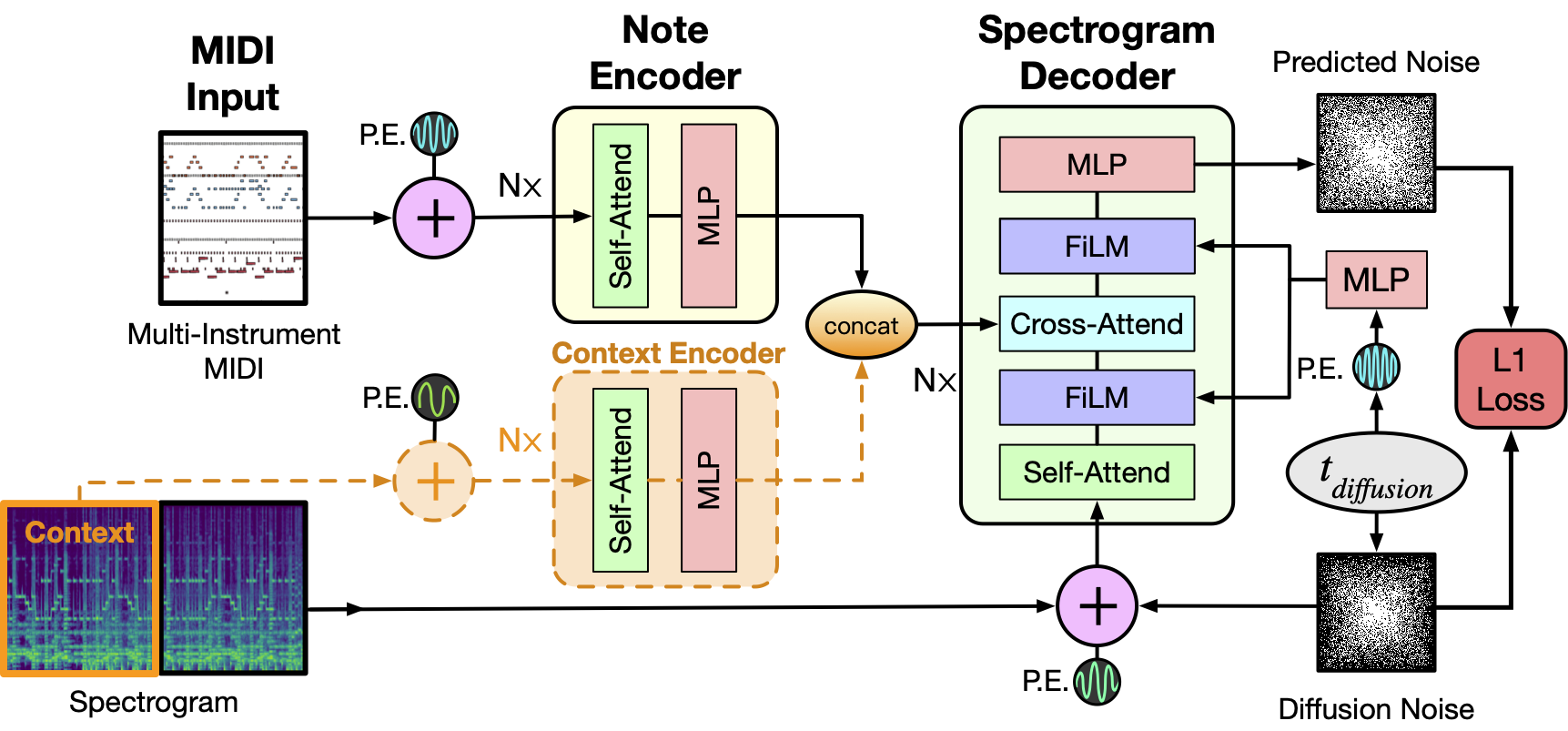
|
||||
|
||||
As depicted above the model takes as input a MIDI file and tokenizes it into a sequence of 5 second intervals. Each tokenized interval then together with positional encodings is passed through the Note Encoder and its representation is concatenated with the previous window's generated spectrogram representation obtained via the Context Encoder. For the initial 5 second window this is set to zero. The resulting context is then used as conditioning to sample the denoised Spectrogram from the MIDI window and we concatenate this spectrogram to the final output as well as use it for the context of the next MIDI window. The process repeats till we have gone over all the MIDI inputs. Finally a MelGAN decoder converts the potentially long spectrogram to audio which is the final result of this pipeline.
|
||||
|
||||
## Available Pipelines:
|
||||
|
||||
| Pipeline | Tasks | Colab
|
||||
|---|---|:---:|
|
||||
| [pipeline_spectrogram_diffusion.py](https://github.com/huggingface/diffusers/blob/main/src/diffusers/pipelines/spectrogram_diffusion/pipeline_spectrogram_diffusion.py) | *Unconditional Audio Generation* | - |
|
||||
|
||||
|
||||
## Example usage
|
||||
|
||||
```python
|
||||
from diffusers import SpectrogramDiffusionPipeline, MidiProcessor
|
||||
|
||||
pipe = SpectrogramDiffusionPipeline.from_pretrained("google/music-spectrogram-diffusion")
|
||||
pipe = pipe.to("cuda")
|
||||
processor = MidiProcessor()
|
||||
|
||||
# Download MIDI from: wget http://www.piano-midi.de/midis/beethoven/beethoven_hammerklavier_2.mid
|
||||
output = pipe(processor("beethoven_hammerklavier_2.mid"))
|
||||
|
||||
audio = output.audios[0]
|
||||
```
|
||||
|
||||
## SpectrogramDiffusionPipeline
|
||||
[[autodoc]] SpectrogramDiffusionPipeline
|
||||
- all
|
||||
- __call__
|
||||
@@ -32,7 +32,7 @@ Resources
|
||||
|
||||
| Pipeline | Tasks | Colab | Demo
|
||||
|---|---|:---:|:---:|
|
||||
| [pipeline_semantic_stable_diffusion_attend_and_excite.py](https://github.com/huggingface/diffusers/blob/main/src/diffusers/pipelines/stable_diffusion/pipeline_semantic_stable_diffusion_attend_and_excite) | *Text-to-Image Generation* | - | -
|
||||
| [pipeline_semantic_stable_diffusion_attend_and_excite.py](https://github.com/huggingface/diffusers/blob/main/src/diffusers/pipelines/stable_diffusion/pipeline_semantic_stable_diffusion_attend_and_excite) | *Text-to-Image Generation* | - | https://huggingface.co/spaces/AttendAndExcite/Attend-and-Excite
|
||||
|
||||
|
||||
### Usage example
|
||||
|
||||
336
docs/source/en/api/pipelines/stable_diffusion/controlnet.mdx
Normal file
336
docs/source/en/api/pipelines/stable_diffusion/controlnet.mdx
Normal file
@@ -0,0 +1,336 @@
|
||||
<!--Copyright 2023 The HuggingFace Team. All rights reserved.
|
||||
|
||||
Licensed under the Apache License, Version 2.0 (the "License"); you may not use this file except in compliance with
|
||||
the License. You may obtain a copy of the License at
|
||||
|
||||
http://www.apache.org/licenses/LICENSE-2.0
|
||||
|
||||
Unless required by applicable law or agreed to in writing, software distributed under the License is distributed on
|
||||
an "AS IS" BASIS, WITHOUT WARRANTIES OR CONDITIONS OF ANY KIND, either express or implied. See the License for the
|
||||
specific language governing permissions and limitations under the License.
|
||||
-->
|
||||
|
||||
# Text-to-Image Generation with ControlNet Conditioning
|
||||
|
||||
## Overview
|
||||
|
||||
[Adding Conditional Control to Text-to-Image Diffusion Models](https://arxiv.org/abs/2302.05543) by Lvmin Zhang and Maneesh Agrawala.
|
||||
|
||||
Using the pretrained models we can provide control images (for example, a depth map) to control Stable Diffusion text-to-image generation so that it follows the structure of the depth image and fills in the details.
|
||||
|
||||
The abstract of the paper is the following:
|
||||
|
||||
*We present a neural network structure, ControlNet, to control pretrained large diffusion models to support additional input conditions. The ControlNet learns task-specific conditions in an end-to-end way, and the learning is robust even when the training dataset is small (< 50k). Moreover, training a ControlNet is as fast as fine-tuning a diffusion model, and the model can be trained on a personal devices. Alternatively, if powerful computation clusters are available, the model can scale to large amounts (millions to billions) of data. We report that large diffusion models like Stable Diffusion can be augmented with ControlNets to enable conditional inputs like edge maps, segmentation maps, keypoints, etc. This may enrich the methods to control large diffusion models and further facilitate related applications.*
|
||||
|
||||
This model was contributed by the amazing community contributor [takuma104](https://huggingface.co/takuma104) ❤️ .
|
||||
|
||||
Resources:
|
||||
|
||||
* [Paper](https://arxiv.org/abs/2302.05543)
|
||||
* [Original Code](https://github.com/lllyasviel/ControlNet)
|
||||
|
||||
## Available Pipelines:
|
||||
|
||||
| Pipeline | Tasks | Demo
|
||||
|---|---|:---:|
|
||||
| [StableDiffusionControlNetPipeline](https://github.com/huggingface/diffusers/blob/main/src/diffusers/pipelines/stable_diffusion/pipeline_stable_diffusion_controlnet.py) | *Text-to-Image Generation with ControlNet Conditioning* | [Colab Example](https://colab.research.google.com/github/huggingface/notebooks/blob/main/diffusers/controlnet.ipynb)
|
||||
|
||||
## Usage example
|
||||
|
||||
In the following we give a simple example of how to use a *ControlNet* checkpoint with Diffusers for inference.
|
||||
The inference pipeline is the same for all pipelines:
|
||||
|
||||
* 1. Take an image and run it through a pre-conditioning processor.
|
||||
* 2. Run the pre-processed image through the [`StableDiffusionControlNetPipeline`].
|
||||
|
||||
Let's have a look at a simple example using the [Canny Edge ControlNet](https://huggingface.co/lllyasviel/sd-controlnet-canny).
|
||||
|
||||
```python
|
||||
from diffusers import StableDiffusionControlNetPipeline
|
||||
from diffusers.utils import load_image
|
||||
|
||||
# Let's load the popular vermeer image
|
||||
image = load_image(
|
||||
"https://hf.co/datasets/huggingface/documentation-images/resolve/main/diffusers/input_image_vermeer.png"
|
||||
)
|
||||
```
|
||||
|
||||
|
||||
|
||||
Next, we process the image to get the canny image. This is step *1.* - running the pre-conditioning processor. The pre-conditioning processor is different for every ControlNet. Please see the model cards of the [official checkpoints](#controlnet-with-stable-diffusion-1.5) for more information about other models.
|
||||
|
||||
First, we need to install opencv:
|
||||
|
||||
```
|
||||
pip install opencv-contrib-python
|
||||
```
|
||||
|
||||
Next, let's also install all required Hugging Face libraries:
|
||||
|
||||
```
|
||||
pip install diffusers transformers git+https://github.com/huggingface/accelerate.git
|
||||
```
|
||||
|
||||
Then we can retrieve the canny edges of the image.
|
||||
|
||||
```python
|
||||
import cv2
|
||||
from PIL import Image
|
||||
import numpy as np
|
||||
|
||||
image = np.array(image)
|
||||
|
||||
low_threshold = 100
|
||||
high_threshold = 200
|
||||
|
||||
image = cv2.Canny(image, low_threshold, high_threshold)
|
||||
image = image[:, :, None]
|
||||
image = np.concatenate([image, image, image], axis=2)
|
||||
canny_image = Image.fromarray(image)
|
||||
```
|
||||
|
||||
Let's take a look at the processed image.
|
||||
|
||||
|
||||
|
||||
Now, we load the official [Stable Diffusion 1.5 Model](runwayml/stable-diffusion-v1-5) as well as the ControlNet for canny edges.
|
||||
|
||||
```py
|
||||
from diffusers import StableDiffusionControlNetPipeline, ControlNetModel
|
||||
import torch
|
||||
|
||||
controlnet = ControlNetModel.from_pretrained("lllyasviel/sd-controlnet-canny", torch_dtype=torch.float16)
|
||||
pipe = StableDiffusionControlNetPipeline.from_pretrained(
|
||||
"runwayml/stable-diffusion-v1-5", controlnet=controlnet, torch_dtype=torch.float16
|
||||
)
|
||||
```
|
||||
|
||||
To speed-up things and reduce memory, let's enable model offloading and use the fast [`UniPCMultistepScheduler`].
|
||||
|
||||
```py
|
||||
from diffusers import UniPCMultistepScheduler
|
||||
|
||||
pipe.scheduler = UniPCMultistepScheduler.from_config(pipe.scheduler.config)
|
||||
|
||||
# this command loads the individual model components on GPU on-demand.
|
||||
pipe.enable_model_cpu_offload()
|
||||
```
|
||||
|
||||
Finally, we can run the pipeline:
|
||||
|
||||
```py
|
||||
generator = torch.manual_seed(0)
|
||||
|
||||
out_image = pipe(
|
||||
"disco dancer with colorful lights", num_inference_steps=20, generator=generator, image=canny_image
|
||||
).images[0]
|
||||
```
|
||||
|
||||
This should take only around 3-4 seconds on GPU (depending on hardware). The output image then looks as follows:
|
||||
|
||||
|
||||
|
||||
|
||||
**Note**: To see how to run all other ControlNet checkpoints, please have a look at [ControlNet with Stable Diffusion 1.5](#controlnet-with-stable-diffusion-1.5).
|
||||
|
||||
<!-- TODO: add space -->
|
||||
|
||||
## Combining multiple conditionings
|
||||
|
||||
Multiple ControlNet conditionings can be combined for a single image generation. Pass a list of ControlNets to the pipeline's constructor and a corresponding list of conditionings to `__call__`.
|
||||
|
||||
When combining conditionings, it is helpful to mask conditionings such that they do not overlap. In the example, we mask the middle of the canny map where the pose conditioning is located.
|
||||
|
||||
It can also be helpful to vary the `controlnet_conditioning_scales` to emphasize one conditioning over the other.
|
||||
|
||||
### Canny conditioning
|
||||
|
||||
The original image:
|
||||
|
||||
<img src="https://huggingface.co/datasets/huggingface/documentation-images/resolve/main/diffusers/landscape.png"/>
|
||||
|
||||
Prepare the conditioning:
|
||||
|
||||
```python
|
||||
from diffusers.utils import load_image
|
||||
from PIL import Image
|
||||
import cv2
|
||||
import numpy as np
|
||||
from diffusers.utils import load_image
|
||||
|
||||
canny_image = load_image(
|
||||
"https://huggingface.co/datasets/huggingface/documentation-images/resolve/main/diffusers/landscape.png"
|
||||
)
|
||||
canny_image = np.array(canny_image)
|
||||
|
||||
low_threshold = 100
|
||||
high_threshold = 200
|
||||
|
||||
canny_image = cv2.Canny(canny_image, low_threshold, high_threshold)
|
||||
|
||||
# zero out middle columns of image where pose will be overlayed
|
||||
zero_start = canny_image.shape[1] // 4
|
||||
zero_end = zero_start + canny_image.shape[1] // 2
|
||||
canny_image[:, zero_start:zero_end] = 0
|
||||
|
||||
canny_image = canny_image[:, :, None]
|
||||
canny_image = np.concatenate([canny_image, canny_image, canny_image], axis=2)
|
||||
canny_image = Image.fromarray(canny_image)
|
||||
```
|
||||
|
||||
<img src="https://huggingface.co/datasets/huggingface/documentation-images/resolve/main/blog/controlnet/landscape_canny_masked.png"/>
|
||||
|
||||
### Openpose conditioning
|
||||
|
||||
The original image:
|
||||
|
||||
<img src="https://huggingface.co/datasets/huggingface/documentation-images/resolve/main/diffusers/person.png" width=600/>
|
||||
|
||||
Prepare the conditioning:
|
||||
|
||||
```python
|
||||
from controlnet_aux import OpenposeDetector
|
||||
from diffusers.utils import load_image
|
||||
|
||||
openpose = OpenposeDetector.from_pretrained("lllyasviel/ControlNet")
|
||||
|
||||
openpose_image = load_image(
|
||||
"https://huggingface.co/datasets/huggingface/documentation-images/resolve/main/diffusers/person.png"
|
||||
)
|
||||
openpose_image = openpose(openpose_image)
|
||||
```
|
||||
|
||||
<img src="https://huggingface.co/datasets/huggingface/documentation-images/resolve/main/blog/controlnet/person_pose.png" width=600/>
|
||||
|
||||
### Running ControlNet with multiple conditionings
|
||||
|
||||
```python
|
||||
from diffusers import StableDiffusionControlNetPipeline, ControlNetModel, UniPCMultistepScheduler
|
||||
import torch
|
||||
|
||||
controlnet = [
|
||||
ControlNetModel.from_pretrained("lllyasviel/sd-controlnet-openpose", torch_dtype=torch.float16),
|
||||
ControlNetModel.from_pretrained("lllyasviel/sd-controlnet-canny", torch_dtype=torch.float16),
|
||||
]
|
||||
|
||||
pipe = StableDiffusionControlNetPipeline.from_pretrained(
|
||||
"runwayml/stable-diffusion-v1-5", controlnet=controlnet, torch_dtype=torch.float16
|
||||
)
|
||||
pipe.scheduler = UniPCMultistepScheduler.from_config(pipe.scheduler.config)
|
||||
|
||||
pipe.enable_xformers_memory_efficient_attention()
|
||||
pipe.enable_model_cpu_offload()
|
||||
|
||||
prompt = "a giant standing in a fantasy landscape, best quality"
|
||||
negative_prompt = "monochrome, lowres, bad anatomy, worst quality, low quality"
|
||||
|
||||
generator = torch.Generator(device="cpu").manual_seed(1)
|
||||
|
||||
images = [openpose_image, canny_image]
|
||||
|
||||
image = pipe(
|
||||
prompt,
|
||||
images,
|
||||
num_inference_steps=20,
|
||||
generator=generator,
|
||||
negative_prompt=negative_prompt,
|
||||
controlnet_conditioning_scale=[1.0, 0.8],
|
||||
).images[0]
|
||||
|
||||
image.save("./multi_controlnet_output.png")
|
||||
```
|
||||
|
||||
<img src="https://huggingface.co/datasets/huggingface/documentation-images/resolve/main/blog/controlnet/multi_controlnet_output.png" width=600/>
|
||||
|
||||
### Guess Mode
|
||||
|
||||
Guess Mode is [a ControlNet feature that was implemented](https://github.com/lllyasviel/ControlNet#guess-mode--non-prompt-mode) after the publication of [the paper](https://arxiv.org/abs/2302.05543). The description states:
|
||||
|
||||
>In this mode, the ControlNet encoder will try best to recognize the content of the input control map, like depth map, edge map, scribbles, etc, even if you remove all prompts.
|
||||
|
||||
#### The core implementation:
|
||||
|
||||
It adjusts the scale of the output residuals from ControlNet by a fixed ratio depending on the block depth. The shallowest DownBlock corresponds to `0.1`. As the blocks get deeper, the scale increases exponentially, and the scale for the output of the MidBlock becomes `1.0`.
|
||||
|
||||
Since the core implementation is just this, **it does not have any impact on prompt conditioning**. While it is common to use it without specifying any prompts, it is also possible to provide prompts if desired.
|
||||
|
||||
#### Usage:
|
||||
|
||||
Just specify `guess_mode=True` in the pipe() function. A `guidance_scale` between 3.0 and 5.0 is [recommended](https://github.com/lllyasviel/ControlNet#guess-mode--non-prompt-mode).
|
||||
```py
|
||||
from diffusers import StableDiffusionControlNetPipeline, ControlNetModel
|
||||
import torch
|
||||
|
||||
controlnet = ControlNetModel.from_pretrained("lllyasviel/sd-controlnet-canny")
|
||||
pipe = StableDiffusionControlNetPipeline.from_pretrained("runwayml/stable-diffusion-v1-5", controlnet=controlnet).to(
|
||||
"cuda"
|
||||
)
|
||||
image = pipe("", image=canny_image, guess_mode=True, guidance_scale=3.0).images[0]
|
||||
image.save("guess_mode_generated.png")
|
||||
```
|
||||
|
||||
#### Output image comparison:
|
||||
Canny Control Example
|
||||
|
||||
|no guess_mode with prompt|guess_mode without prompt|
|
||||
|---|---|
|
||||
|<a href="https://huggingface.co/takuma104/controlnet_dev/resolve/main/gen_compare_guess_mode/output_images/diffusers/output_bird_canny_0.png"><img width="128" src="https://huggingface.co/takuma104/controlnet_dev/resolve/main/gen_compare_guess_mode/output_images/diffusers/output_bird_canny_0.png"/></a>|<a href="https://huggingface.co/takuma104/controlnet_dev/resolve/main/gen_compare_guess_mode/output_images/diffusers/output_bird_canny_0_gm.png"><img width="128" src="https://huggingface.co/takuma104/controlnet_dev/resolve/main/gen_compare_guess_mode/output_images/diffusers/output_bird_canny_0_gm.png"/></a>|
|
||||
|
||||
|
||||
## Available checkpoints
|
||||
|
||||
ControlNet requires a *control image* in addition to the text-to-image *prompt*.
|
||||
Each pretrained model is trained using a different conditioning method that requires different images for conditioning the generated outputs. For example, Canny edge conditioning requires the control image to be the output of a Canny filter, while depth conditioning requires the control image to be a depth map. See the overview and image examples below to know more.
|
||||
|
||||
All checkpoints can be found under the authors' namespace [lllyasviel](https://huggingface.co/lllyasviel).
|
||||
|
||||
**13.04.2024 Update**: The author has released improved controlnet checkpoints v1.1 - see [here](#controlnet-v1.1).
|
||||
|
||||
### ControlNet v1.0
|
||||
|
||||
| Model Name | Control Image Overview| Control Image Example | Generated Image Example |
|
||||
|---|---|---|---|
|
||||
|[lllyasviel/sd-controlnet-canny](https://huggingface.co/lllyasviel/sd-controlnet-canny)<br/> *Trained with canny edge detection* | A monochrome image with white edges on a black background.|<a href="https://huggingface.co/takuma104/controlnet_dev/blob/main/gen_compare/control_images/converted/control_bird_canny.png"><img width="64" style="margin:0;padding:0;" src="https://huggingface.co/takuma104/controlnet_dev/resolve/main/gen_compare/control_images/converted/control_bird_canny.png"/></a>|<a href="https://huggingface.co/takuma104/controlnet_dev/resolve/main/gen_compare/output_images/diffusers/output_bird_canny_1.png"><img width="64" src="https://huggingface.co/takuma104/controlnet_dev/resolve/main/gen_compare/output_images/diffusers/output_bird_canny_1.png"/></a>|
|
||||
|[lllyasviel/sd-controlnet-depth](https://huggingface.co/lllyasviel/sd-controlnet-depth)<br/> *Trained with Midas depth estimation* |A grayscale image with black representing deep areas and white representing shallow areas.|<a href="https://huggingface.co/takuma104/controlnet_dev/blob/main/gen_compare/control_images/converted/control_vermeer_depth.png"><img width="64" src="https://huggingface.co/takuma104/controlnet_dev/resolve/main/gen_compare/control_images/converted/control_vermeer_depth.png"/></a>|<a href="https://huggingface.co/takuma104/controlnet_dev/resolve/main/gen_compare/output_images/diffusers/output_vermeer_depth_2.png"><img width="64" src="https://huggingface.co/takuma104/controlnet_dev/resolve/main/gen_compare/output_images/diffusers/output_vermeer_depth_2.png"/></a>|
|
||||
|[lllyasviel/sd-controlnet-hed](https://huggingface.co/lllyasviel/sd-controlnet-hed)<br/> *Trained with HED edge detection (soft edge)* |A monochrome image with white soft edges on a black background.|<a href="https://huggingface.co/takuma104/controlnet_dev/blob/main/gen_compare/control_images/converted/control_bird_hed.png"><img width="64" src="https://huggingface.co/takuma104/controlnet_dev/resolve/main/gen_compare/control_images/converted/control_bird_hed.png"/></a>|<a href="https://huggingface.co/takuma104/controlnet_dev/resolve/main/gen_compare/output_images/diffusers/output_bird_hed_1.png"><img width="64" src="https://huggingface.co/takuma104/controlnet_dev/resolve/main/gen_compare/output_images/diffusers/output_bird_hed_1.png"/></a> |
|
||||
|[lllyasviel/sd-controlnet-mlsd](https://huggingface.co/lllyasviel/sd-controlnet-mlsd)<br/> *Trained with M-LSD line detection* |A monochrome image composed only of white straight lines on a black background.|<a href="https://huggingface.co/takuma104/controlnet_dev/blob/main/gen_compare/control_images/converted/control_room_mlsd.png"><img width="64" src="https://huggingface.co/takuma104/controlnet_dev/resolve/main/gen_compare/control_images/converted/control_room_mlsd.png"/></a>|<a href="https://huggingface.co/takuma104/controlnet_dev/resolve/main/gen_compare/output_images/diffusers/output_room_mlsd_0.png"><img width="64" src="https://huggingface.co/takuma104/controlnet_dev/resolve/main/gen_compare/output_images/diffusers/output_room_mlsd_0.png"/></a>|
|
||||
|[lllyasviel/sd-controlnet-normal](https://huggingface.co/lllyasviel/sd-controlnet-normal)<br/> *Trained with normal map* |A [normal mapped](https://en.wikipedia.org/wiki/Normal_mapping) image.|<a href="https://huggingface.co/takuma104/controlnet_dev/blob/main/gen_compare/control_images/converted/control_human_normal.png"><img width="64" src="https://huggingface.co/takuma104/controlnet_dev/resolve/main/gen_compare/control_images/converted/control_human_normal.png"/></a>|<a href="https://huggingface.co/takuma104/controlnet_dev/resolve/main/gen_compare/output_images/diffusers/output_human_normal_1.png"><img width="64" src="https://huggingface.co/takuma104/controlnet_dev/resolve/main/gen_compare/output_images/diffusers/output_human_normal_1.png"/></a>|
|
||||
|[lllyasviel/sd-controlnet-openpose](https://huggingface.co/lllyasviel/sd-controlnet_openpose)<br/> *Trained with OpenPose bone image* |A [OpenPose bone](https://github.com/CMU-Perceptual-Computing-Lab/openpose) image.|<a href="https://huggingface.co/takuma104/controlnet_dev/blob/main/gen_compare/control_images/converted/control_human_openpose.png"><img width="64" src="https://huggingface.co/takuma104/controlnet_dev/resolve/main/gen_compare/control_images/converted/control_human_openpose.png"/></a>|<a href="https://huggingface.co/takuma104/controlnet_dev/resolve/main/gen_compare/output_images/diffusers/output_human_openpose_0.png"><img width="64" src="https://huggingface.co/takuma104/controlnet_dev/resolve/main/gen_compare/output_images/diffusers/output_human_openpose_0.png"/></a>|
|
||||
|[lllyasviel/sd-controlnet-scribble](https://huggingface.co/lllyasviel/sd-controlnet_scribble)<br/> *Trained with human scribbles* |A hand-drawn monochrome image with white outlines on a black background.|<a href="https://huggingface.co/takuma104/controlnet_dev/blob/main/gen_compare/control_images/converted/control_vermeer_scribble.png"><img width="64" src="https://huggingface.co/takuma104/controlnet_dev/resolve/main/gen_compare/control_images/converted/control_vermeer_scribble.png"/></a>|<a href="https://huggingface.co/takuma104/controlnet_dev/resolve/main/gen_compare/output_images/diffusers/output_vermeer_scribble_0.png"><img width="64" src="https://huggingface.co/takuma104/controlnet_dev/resolve/main/gen_compare/output_images/diffusers/output_vermeer_scribble_0.png"/></a> |
|
||||
|[lllyasviel/sd-controlnet-seg](https://huggingface.co/lllyasviel/sd-controlnet_seg)<br/>*Trained with semantic segmentation* |An [ADE20K](https://groups.csail.mit.edu/vision/datasets/ADE20K/)'s segmentation protocol image.|<a href="https://huggingface.co/takuma104/controlnet_dev/blob/main/gen_compare/control_images/converted/control_room_seg.png"><img width="64" src="https://huggingface.co/takuma104/controlnet_dev/resolve/main/gen_compare/control_images/converted/control_room_seg.png"/></a>|<a href="https://huggingface.co/takuma104/controlnet_dev/resolve/main/gen_compare/output_images/diffusers/output_room_seg_1.png"><img width="64" src="https://huggingface.co/takuma104/controlnet_dev/resolve/main/gen_compare/output_images/diffusers/output_room_seg_1.png"/></a> |
|
||||
|
||||
### ControlNet v1.1
|
||||
|
||||
| Model Name | Control Image Overview| Control Image Example | Generated Image Example |
|
||||
|---|---|---|---|
|
||||
|[lllyasviel/control_v11p_sd15_canny](https://huggingface.co/lllyasviel/control_v11p_sd15_canny)<br/> *Trained with canny edge detection* | A monochrome image with white edges on a black background.|<a href="https://huggingface.co/lllyasviel/control_v11p_sd15_canny/resolve/main/images/control.png"><img width="64" style="margin:0;padding:0;" src="https://huggingface.co/lllyasviel/control_v11p_sd15_canny/resolve/main/images/control.png"/></a>|<a href="https://huggingface.co/lllyasviel/control_v11p_sd15_canny/resolve/main/images/image_out.png"><img width="64" src="https://huggingface.co/lllyasviel/control_v11p_sd15_canny/resolve/main/images/image_out.png"/></a>|
|
||||
|[lllyasviel/control_v11e_sd15_ip2p](https://huggingface.co/lllyasviel/control_v11e_sd15_ip2p)<br/> *Trained with pixel to pixel instruction* | No condition .|<a href="https://huggingface.co/lllyasviel/control_v11e_sd15_ip2p/resolve/main/images/control.png"><img width="64" style="margin:0;padding:0;" src="https://huggingface.co/lllyasviel/control_v11e_sd15_ip2p/resolve/main/images/control.png"/></a>|<a href="https://huggingface.co/lllyasviel/control_v11e_sd15_ip2p/resolve/main/images/image_out.png"><img width="64" src="https://huggingface.co/lllyasviel/control_v11e_sd15_ip2p/resolve/main/images/image_out.png"/></a>|
|
||||
|[lllyasviel/control_v11p_sd15_inpaint](https://huggingface.co/lllyasviel/control_v11p_sd15_inpaint)<br/> Trained with image inpainting | No condition.|<a href="https://huggingface.co/lllyasviel/control_v11p_sd15_inpaint/resolve/main/images/control.png"><img width="64" style="margin:0;padding:0;" src="https://huggingface.co/lllyasviel/control_v11p_sd15_inpaint/resolve/main/images/control.png"/></a>|<a href="https://huggingface.co/lllyasviel/control_v11p_sd15_inpaint/resolve/main/images/output.png"><img width="64" src="https://huggingface.co/lllyasviel/control_v11p_sd15_inpaint/resolve/main/images/output.png"/></a>|
|
||||
|[lllyasviel/control_v11p_sd15_mlsd](https://huggingface.co/lllyasviel/control_v11p_sd15_mlsd)<br/> Trained with multi-level line segment detection | An image with annotated line segments.|<a href="https://huggingface.co/lllyasviel/control_v11p_sd15_mlsd/resolve/main/images/control.png"><img width="64" style="margin:0;padding:0;" src="https://huggingface.co/lllyasviel/control_v11p_sd15_mlsd/resolve/main/images/control.png"/></a>|<a href="https://huggingface.co/lllyasviel/control_v11p_sd15_mlsd/resolve/main/images/image_out.png"><img width="64" src="https://huggingface.co/lllyasviel/control_v11p_sd15_mlsd/resolve/main/images/image_out.png"/></a>|
|
||||
|[lllyasviel/control_v11f1p_sd15_depth](https://huggingface.co/lllyasviel/control_v11f1p_sd15_depth)<br/> Trained with depth estimation | An image with depth information, usually represented as a grayscale image.|<a href="https://huggingface.co/lllyasviel/control_v11f1p_sd15_depth/resolve/main/images/control.png"><img width="64" style="margin:0;padding:0;" src="https://huggingface.co/lllyasviel/control_v11f1p_sd15_depth/resolve/main/images/control.png"/></a>|<a href="https://huggingface.co/lllyasviel/control_v11f1p_sd15_depth/resolve/main/images/image_out.png"><img width="64" src="https://huggingface.co/lllyasviel/control_v11f1p_sd15_depth/resolve/main/images/image_out.png"/></a>|
|
||||
|[lllyasviel/control_v11p_sd15_normalbae](https://huggingface.co/lllyasviel/control_v11p_sd15_normalbae)<br/> Trained with surface normal estimation | An image with surface normal information, usually represented as a color-coded image.|<a href="https://huggingface.co/lllyasviel/control_v11p_sd15_normalbae/resolve/main/images/control.png"><img width="64" style="margin:0;padding:0;" src="https://huggingface.co/lllyasviel/control_v11p_sd15_normalbae/resolve/main/images/control.png"/></a>|<a href="https://huggingface.co/lllyasviel/control_v11p_sd15_normalbae/resolve/main/images/image_out.png"><img width="64" src="https://huggingface.co/lllyasviel/control_v11p_sd15_normalbae/resolve/main/images/image_out.png"/></a>|
|
||||
|[lllyasviel/control_v11p_sd15_seg](https://huggingface.co/lllyasviel/control_v11p_sd15_seg)<br/> Trained with image segmentation | An image with segmented regions, usually represented as a color-coded image.|<a href="https://huggingface.co/lllyasviel/control_v11p_sd15_seg/resolve/main/images/control.png"><img width="64" style="margin:0;padding:0;" src="https://huggingface.co/lllyasviel/control_v11p_sd15_seg/resolve/main/images/control.png"/></a>|<a href="https://huggingface.co/lllyasviel/control_v11p_sd15_seg/resolve/main/images/image_out.png"><img width="64" src="https://huggingface.co/lllyasviel/control_v11p_sd15_seg/resolve/main/images/image_out.png"/></a>|
|
||||
|[lllyasviel/control_v11p_sd15_lineart](https://huggingface.co/lllyasviel/control_v11p_sd15_lineart)<br/> Trained with line art generation | An image with line art, usually black lines on a white background.|<a href="https://huggingface.co/lllyasviel/control_v11p_sd15_lineart/resolve/main/images/control.png"><img width="64" style="margin:0;padding:0;" src="https://huggingface.co/lllyasviel/control_v11p_sd15_lineart/resolve/main/images/control.png"/></a>|<a href="https://huggingface.co/lllyasviel/control_v11p_sd15_lineart/resolve/main/images/image_out.png"><img width="64" src="https://huggingface.co/lllyasviel/control_v11p_sd15_lineart/resolve/main/images/image_out.png"/></a>|
|
||||
|[lllyasviel/control_v11p_sd15s2_lineart_anime](https://huggingface.co/lllyasviel/control_v11p_sd15s2_lineart_anime)<br/> Trained with anime line art generation | An image with anime-style line art.|<a href="https://huggingface.co/lllyasviel/control_v11p_sd15s2_lineart_anime/resolve/main/images/control.png"><img width="64" style="margin:0;padding:0;" src="https://huggingface.co/lllyasviel/control_v11p_sd15s2_lineart_anime/resolve/main/images/control.png"/></a>|<a href="https://huggingface.co/lllyasviel/control_v11p_sd15s2_lineart_anime/resolve/main/images/image_out.png"><img width="64" src="https://huggingface.co/lllyasviel/control_v11p_sd15s2_lineart_anime/resolve/main/images/image_out.png"/></a>|
|
||||
|[lllyasviel/control_v11p_sd15_openpose](https://huggingface.co/lllyasviel/control_v11p_sd15s2_lineart_anime)<br/> Trained with human pose estimation | An image with human poses, usually represented as a set of keypoints or skeletons.|<a href="https://huggingface.co/lllyasviel/control_v11p_sd15_openpose/resolve/main/images/control.png"><img width="64" style="margin:0;padding:0;" src="https://huggingface.co/lllyasviel/control_v11p_sd15_openpose/resolve/main/images/control.png"/></a>|<a href="https://huggingface.co/lllyasviel/control_v11p_sd15_openpose/resolve/main/images/image_out.png"><img width="64" src="https://huggingface.co/lllyasviel/control_v11p_sd15_openpose/resolve/main/images/image_out.png"/></a>|
|
||||
|[lllyasviel/control_v11p_sd15_scribble](https://huggingface.co/lllyasviel/control_v11p_sd15_scribble)<br/> Trained with scribble-based image generation | An image with scribbles, usually random or user-drawn strokes.|<a href="https://huggingface.co/lllyasviel/control_v11p_sd15_scribble/resolve/main/images/control.png"><img width="64" style="margin:0;padding:0;" src="https://huggingface.co/lllyasviel/control_v11p_sd15_scribble/resolve/main/images/control.png"/></a>|<a href="https://huggingface.co/lllyasviel/control_v11p_sd15_scribble/resolve/main/images/image_out.png"><img width="64" src="https://huggingface.co/lllyasviel/control_v11p_sd15_scribble/resolve/main/images/image_out.png"/></a>|
|
||||
|[lllyasviel/control_v11p_sd15_softedge](https://huggingface.co/lllyasviel/control_v11p_sd15_softedge)<br/> Trained with soft edge image generation | An image with soft edges, usually to create a more painterly or artistic effect.|<a href="https://huggingface.co/lllyasviel/control_v11p_sd15_softedge/resolve/main/images/control.png"><img width="64" style="margin:0;padding:0;" src="https://huggingface.co/lllyasviel/control_v11p_sd15_softedge/resolve/main/images/control.png"/></a>|<a href="https://huggingface.co/lllyasviel/control_v11p_sd15_softedge/resolve/main/images/image_out.png"><img width="64" src="https://huggingface.co/lllyasviel/control_v11p_sd15_softedge/resolve/main/images/image_out.png"/></a>|
|
||||
|[lllyasviel/control_v11e_sd15_shuffle](https://huggingface.co/lllyasviel/control_v11e_sd15_shuffle)<br/> Trained with image shuffling | An image with shuffled patches or regions.|<a href="https://huggingface.co/lllyasviel/control_v11e_sd15_shuffle/resolve/main/images/control.png"><img width="64" style="margin:0;padding:0;" src="https://huggingface.co/lllyasviel/control_v11e_sd15_shuffle/resolve/main/images/control.png"/></a>|<a href="https://huggingface.co/lllyasviel/control_v11e_sd15_shuffle/resolve/main/images/image_out.png"><img width="64" src="https://huggingface.co/lllyasviel/control_v11e_sd15_shuffle/resolve/main/images/image_out.png"/></a>|
|
||||
|
||||
## StableDiffusionControlNetPipeline
|
||||
[[autodoc]] StableDiffusionControlNetPipeline
|
||||
- all
|
||||
- __call__
|
||||
- enable_attention_slicing
|
||||
- disable_attention_slicing
|
||||
- enable_vae_slicing
|
||||
- disable_vae_slicing
|
||||
- enable_xformers_memory_efficient_attention
|
||||
- disable_xformers_memory_efficient_attention
|
||||
- load_textual_inversion
|
||||
|
||||
## FlaxStableDiffusionControlNetPipeline
|
||||
[[autodoc]] FlaxStableDiffusionControlNetPipeline
|
||||
- all
|
||||
- __call__
|
||||
|
||||
@@ -1,4 +1,4 @@
|
||||
<!--Copyright 2022 The HuggingFace Team. All rights reserved.
|
||||
<!--Copyright 2023 The HuggingFace Team. All rights reserved.
|
||||
|
||||
Licensed under the Apache License, Version 2.0 (the "License"); you may not use this file except in compliance with
|
||||
the License. You may obtain a copy of the License at
|
||||
@@ -30,4 +30,7 @@ Available Checkpoints are:
|
||||
- enable_attention_slicing
|
||||
- disable_attention_slicing
|
||||
- enable_xformers_memory_efficient_attention
|
||||
- disable_xformers_memory_efficient_attention
|
||||
- disable_xformers_memory_efficient_attention
|
||||
- load_textual_inversion
|
||||
- load_lora_weights
|
||||
- save_lora_weights
|
||||
|
||||
@@ -1,4 +1,4 @@
|
||||
<!--Copyright 2022 The HuggingFace Team. All rights reserved.
|
||||
<!--Copyright 2023 The HuggingFace Team. All rights reserved.
|
||||
|
||||
Licensed under the Apache License, Version 2.0 (the "License"); you may not use this file except in compliance with
|
||||
the License. You may obtain a copy of the License at
|
||||
@@ -14,7 +14,7 @@ specific language governing permissions and limitations under the License.
|
||||
|
||||
## StableDiffusionImageVariationPipeline
|
||||
|
||||
[`StableDiffusionImageVariationPipeline`] lets you generate variations from an input image using Stable Diffusion. It uses a fine-tuned version of Stable Diffusion model, trained by [Justin Pinkney](https://www.justinpinkney.com/) (@Buntworthy) at [Lambda](https://lambdalabs.com/)
|
||||
[`StableDiffusionImageVariationPipeline`] lets you generate variations from an input image using Stable Diffusion. It uses a fine-tuned version of Stable Diffusion model, trained by [Justin Pinkney](https://www.justinpinkney.com/) (@Buntworthy) at [Lambda](https://lambdalabs.com/).
|
||||
|
||||
The original codebase can be found here:
|
||||
[Stable Diffusion Image Variations](https://github.com/LambdaLabsML/lambda-diffusers#stable-diffusion-image-variations)
|
||||
@@ -28,4 +28,4 @@ Available Checkpoints are:
|
||||
- enable_attention_slicing
|
||||
- disable_attention_slicing
|
||||
- enable_xformers_memory_efficient_attention
|
||||
- disable_xformers_memory_efficient_attention
|
||||
- disable_xformers_memory_efficient_attention
|
||||
|
||||
@@ -1,4 +1,4 @@
|
||||
<!--Copyright 2022 The HuggingFace Team. All rights reserved.
|
||||
<!--Copyright 2023 The HuggingFace Team. All rights reserved.
|
||||
|
||||
Licensed under the Apache License, Version 2.0 (the "License"); you may not use this file except in compliance with
|
||||
the License. You may obtain a copy of the License at
|
||||
@@ -20,10 +20,21 @@ The original codebase can be found here: [CampVis/stable-diffusion](https://gith
|
||||
|
||||
[`StableDiffusionImg2ImgPipeline`] is compatible with all Stable Diffusion checkpoints for [Text-to-Image](./text2img)
|
||||
|
||||
The pipeline uses the diffusion-denoising mechanism proposed by SDEdit ([SDEdit: Guided Image Synthesis and Editing with Stochastic Differential Equations](https://arxiv.org/abs/2108.01073)
|
||||
proposed by Chenlin Meng, Yutong He, Yang Song, Jiaming Song, Jiajun Wu, Jun-Yan Zhu, Stefano Ermon).
|
||||
|
||||
[[autodoc]] StableDiffusionImg2ImgPipeline
|
||||
- all
|
||||
- __call__
|
||||
- enable_attention_slicing
|
||||
- disable_attention_slicing
|
||||
- enable_xformers_memory_efficient_attention
|
||||
- disable_xformers_memory_efficient_attention
|
||||
- disable_xformers_memory_efficient_attention
|
||||
- load_textual_inversion
|
||||
- from_ckpt
|
||||
- load_lora_weights
|
||||
- save_lora_weights
|
||||
|
||||
[[autodoc]] FlaxStableDiffusionImg2ImgPipeline
|
||||
- all
|
||||
- __call__
|
||||
|
||||
@@ -1,4 +1,4 @@
|
||||
<!--Copyright 2022 The HuggingFace Team. All rights reserved.
|
||||
<!--Copyright 2023 The HuggingFace Team. All rights reserved.
|
||||
|
||||
Licensed under the Apache License, Version 2.0 (the "License"); you may not use this file except in compliance with
|
||||
the License. You may obtain a copy of the License at
|
||||
@@ -30,4 +30,11 @@ Available checkpoints are:
|
||||
- enable_attention_slicing
|
||||
- disable_attention_slicing
|
||||
- enable_xformers_memory_efficient_attention
|
||||
- disable_xformers_memory_efficient_attention
|
||||
- disable_xformers_memory_efficient_attention
|
||||
- load_textual_inversion
|
||||
- load_lora_weights
|
||||
- save_lora_weights
|
||||
|
||||
[[autodoc]] FlaxStableDiffusionInpaintPipeline
|
||||
- all
|
||||
- __call__
|
||||
|
||||
@@ -0,0 +1,61 @@
|
||||
<!--Copyright 2023 The HuggingFace Team. All rights reserved.
|
||||
|
||||
Licensed under the Apache License, Version 2.0 (the "License"); you may not use this file except in compliance with
|
||||
the License. You may obtain a copy of the License at
|
||||
|
||||
http://www.apache.org/licenses/LICENSE-2.0
|
||||
|
||||
Unless required by applicable law or agreed to in writing, software distributed under the License is distributed on
|
||||
an "AS IS" BASIS, WITHOUT WARRANTIES OR CONDITIONS OF ANY KIND, either express or implied. See the License for the
|
||||
specific language governing permissions and limitations under the License.
|
||||
-->
|
||||
|
||||
# Editing Implicit Assumptions in Text-to-Image Diffusion Models
|
||||
|
||||
## Overview
|
||||
|
||||
[Editing Implicit Assumptions in Text-to-Image Diffusion Models](https://arxiv.org/abs/2303.08084) by Hadas Orgad, Bahjat Kawar, and Yonatan Belinkov.
|
||||
|
||||
The abstract of the paper is the following:
|
||||
|
||||
*Text-to-image diffusion models often make implicit assumptions about the world when generating images. While some assumptions are useful (e.g., the sky is blue), they can also be outdated, incorrect, or reflective of social biases present in the training data. Thus, there is a need to control these assumptions without requiring explicit user input or costly re-training. In this work, we aim to edit a given implicit assumption in a pre-trained diffusion model. Our Text-to-Image Model Editing method, TIME for short, receives a pair of inputs: a "source" under-specified prompt for which the model makes an implicit assumption (e.g., "a pack of roses"), and a "destination" prompt that describes the same setting, but with a specified desired attribute (e.g., "a pack of blue roses"). TIME then updates the model's cross-attention layers, as these layers assign visual meaning to textual tokens. We edit the projection matrices in these layers such that the source prompt is projected close to the destination prompt. Our method is highly efficient, as it modifies a mere 2.2% of the model's parameters in under one second. To evaluate model editing approaches, we introduce TIMED (TIME Dataset), containing 147 source and destination prompt pairs from various domains. Our experiments (using Stable Diffusion) show that TIME is successful in model editing, generalizes well for related prompts unseen during editing, and imposes minimal effect on unrelated generations.*
|
||||
|
||||
Resources:
|
||||
|
||||
* [Project Page](https://time-diffusion.github.io/).
|
||||
* [Paper](https://arxiv.org/abs/2303.08084).
|
||||
* [Original Code](https://github.com/bahjat-kawar/time-diffusion).
|
||||
* [Demo](https://huggingface.co/spaces/bahjat-kawar/time-diffusion).
|
||||
|
||||
## Available Pipelines:
|
||||
|
||||
| Pipeline | Tasks | Demo
|
||||
|---|---|:---:|
|
||||
| [StableDiffusionModelEditingPipeline](https://github.com/huggingface/diffusers/blob/main/src/diffusers/pipelines/stable_diffusion/pipeline_stable_diffusion_model_editing.py) | *Text-to-Image Model Editing* | [🤗 Space](https://huggingface.co/spaces/bahjat-kawar/time-diffusion)) |
|
||||
|
||||
This pipeline enables editing the diffusion model weights, such that its assumptions on a given concept are changed. The resulting change is expected to take effect in all prompt generations pertaining to the edited concept.
|
||||
|
||||
## Usage example
|
||||
|
||||
```python
|
||||
import torch
|
||||
from diffusers import StableDiffusionModelEditingPipeline
|
||||
|
||||
model_ckpt = "CompVis/stable-diffusion-v1-4"
|
||||
pipe = StableDiffusionModelEditingPipeline.from_pretrained(model_ckpt)
|
||||
|
||||
pipe = pipe.to("cuda")
|
||||
|
||||
source_prompt = "A pack of roses"
|
||||
destination_prompt = "A pack of blue roses"
|
||||
pipe.edit_model(source_prompt, destination_prompt)
|
||||
|
||||
prompt = "A field of roses"
|
||||
image = pipe(prompt).images[0]
|
||||
image.save("field_of_roses.png")
|
||||
```
|
||||
|
||||
## StableDiffusionModelEditingPipeline
|
||||
[[autodoc]] StableDiffusionModelEditingPipeline
|
||||
- __call__
|
||||
- all
|
||||
@@ -1,4 +1,4 @@
|
||||
<!--Copyright 2022 The HuggingFace Team. All rights reserved.
|
||||
<!--Copyright 2023 The HuggingFace Team. All rights reserved.
|
||||
|
||||
Licensed under the Apache License, Version 2.0 (the "License"); you may not use this file except in compliance with
|
||||
the License. You may obtain a copy of the License at
|
||||
@@ -35,6 +35,7 @@ For more details about how Stable Diffusion works and how it differs from the ba
|
||||
| [StableDiffusionInstructPix2PixPipeline](./pix2pix) | **Experimental** – *Text-Based Image Editing * | | [InstructPix2Pix: Learning to Follow Image Editing Instructions](https://huggingface.co/spaces/timbrooks/instruct-pix2pix)
|
||||
| [StableDiffusionAttendAndExcitePipeline](./attend_and_excite) | **Experimental** – *Text-to-Image Generation * | | [Attend-and-Excite: Attention-Based Semantic Guidance for Text-to-Image Diffusion Models](https://huggingface.co/spaces/AttendAndExcite/Attend-and-Excite)
|
||||
| [StableDiffusionPix2PixZeroPipeline](./pix2pix_zero) | **Experimental** – *Text-Based Image Editing * | | [Zero-shot Image-to-Image Translation](https://arxiv.org/abs/2302.03027)
|
||||
| [StableDiffusionModelEditingPipeline](./model_editing) | **Experimental** – *Text-to-Image Model Editing * | | [Editing Implicit Assumptions in Text-to-Image Diffusion Models](https://arxiv.org/abs/2303.08084)
|
||||
|
||||
|
||||
|
||||
|
||||
@@ -25,12 +25,13 @@ Resources:
|
||||
* [Project Page](https://multidiffusion.github.io/).
|
||||
* [Paper](https://arxiv.org/abs/2302.08113).
|
||||
* [Original Code](https://github.com/omerbt/MultiDiffusion).
|
||||
* [Demo](https://huggingface.co/spaces/weizmannscience/MultiDiffusion).
|
||||
|
||||
## Available Pipelines:
|
||||
|
||||
| Pipeline | Tasks
|
||||
|---|---|
|
||||
| [StableDiffusionPanoramaPipeline](https://github.com/huggingface/diffusers/blob/main/src/diffusers/pipelines/stable_diffusion/pipeline_stable_diffusion_panorama.py) | *Text-Guided Panorama View Generation* |
|
||||
| Pipeline | Tasks | Demo
|
||||
|---|---|:---:|
|
||||
| [StableDiffusionPanoramaPipeline](https://github.com/huggingface/diffusers/blob/main/src/diffusers/pipelines/stable_diffusion/pipeline_stable_diffusion_panorama.py) | *Text-Guided Panorama View Generation* | [🤗 Space](https://huggingface.co/spaces/weizmannscience/MultiDiffusion)) |
|
||||
|
||||
<!-- TODO: add Colab -->
|
||||
|
||||
|
||||
@@ -60,7 +60,7 @@ def download_image(url):
|
||||
image = download_image(url)
|
||||
|
||||
prompt = "make the mountains snowy"
|
||||
edit = pipe(prompt, image=image, num_inference_steps=20, image_guidance_scale=1.5, guidance_scale=7).images[0]
|
||||
images = pipe(prompt, image=image, num_inference_steps=20, image_guidance_scale=1.5, guidance_scale=7).images
|
||||
images[0].save("snowy_mountains.png")
|
||||
```
|
||||
|
||||
@@ -68,3 +68,6 @@ images[0].save("snowy_mountains.png")
|
||||
[[autodoc]] StableDiffusionInstructPix2PixPipeline
|
||||
- __call__
|
||||
- all
|
||||
- load_textual_inversion
|
||||
- load_lora_weights
|
||||
- save_lora_weights
|
||||
|
||||
@@ -14,7 +14,7 @@ specific language governing permissions and limitations under the License.
|
||||
|
||||
## Overview
|
||||
|
||||
[Zero-shot Image-to-Image Translation](https://arxiv.org/abs/2302.03027) by Gaurav Parmar, Krishna Kumar Singh, Richard Zhang, Yijun Li, Jingwan Lu, and Jun-Yan Zhu.
|
||||
[Zero-shot Image-to-Image Translation](https://arxiv.org/abs/2302.03027).
|
||||
|
||||
The abstract of the paper is the following:
|
||||
|
||||
@@ -25,6 +25,7 @@ Resources:
|
||||
* [Project Page](https://pix2pixzero.github.io/).
|
||||
* [Paper](https://arxiv.org/abs/2302.03027).
|
||||
* [Original Code](https://github.com/pix2pixzero/pix2pix-zero).
|
||||
* [Demo](https://huggingface.co/spaces/pix2pix-zero-library/pix2pix-zero-demo).
|
||||
|
||||
## Tips
|
||||
|
||||
@@ -41,12 +42,13 @@ the above example, a valid input prompt would be: "a high resolution painting of
|
||||
* Change the input prompt to include "dog".
|
||||
* To learn more about how the source and target embeddings are generated, refer to the [original
|
||||
paper](https://arxiv.org/abs/2302.03027). Below, we also provide some directions on how to generate the embeddings.
|
||||
* Note that the quality of the outputs generated with this pipeline is dependent on how good the `source_embeds` and `target_embeds` are. Please, refer to [this discussion](#generating-source-and-target-embeddings) for some suggestions on the topic.
|
||||
|
||||
## Available Pipelines:
|
||||
|
||||
| Pipeline | Tasks | Demo
|
||||
|---|---|:---:|
|
||||
| [StableDiffusionPix2PixZeroPipeline](https://github.com/huggingface/diffusers/blob/main/src/diffusers/pipelines/stable_diffusion/pipeline_stable_diffusion_pix2pix_zero.py) | *Text-Based Image Editing* | [🤗 Space] (soon) |
|
||||
| [StableDiffusionPix2PixZeroPipeline](https://github.com/huggingface/diffusers/blob/main/src/diffusers/pipelines/stable_diffusion/pipeline_stable_diffusion_pix2pix_zero.py) | *Text-Based Image Editing* | [🤗 Space](https://huggingface.co/spaces/pix2pix-zero-library/pix2pix-zero-demo) |
|
||||
|
||||
<!-- TODO: add Colab -->
|
||||
|
||||
@@ -74,7 +76,7 @@ pipeline = StableDiffusionPix2PixZeroPipeline.from_pretrained(
|
||||
pipeline.scheduler = DDIMScheduler.from_config(pipeline.scheduler.config)
|
||||
pipeline.to("cuda")
|
||||
|
||||
prompt = "a high resolution painting of a cat in the style of van gough"
|
||||
prompt = "a high resolution painting of a cat in the style of van gogh"
|
||||
src_embs_url = "https://github.com/pix2pixzero/pix2pix-zero/raw/main/assets/embeddings_sd_1.4/cat.pt"
|
||||
target_embs_url = "https://github.com/pix2pixzero/pix2pix-zero/raw/main/assets/embeddings_sd_1.4/dog.pt"
|
||||
|
||||
|
||||
@@ -14,25 +14,26 @@ specific language governing permissions and limitations under the License.
|
||||
|
||||
## Overview
|
||||
|
||||
[Self-Attention Guidance](https://arxiv.org/abs/2210.00939) by Susung Hong et al.
|
||||
[Improving Sample Quality of Diffusion Models Using Self-Attention Guidance](https://arxiv.org/abs/2210.00939) by Susung Hong et al.
|
||||
|
||||
The abstract of the paper is the following:
|
||||
|
||||
*Denoising diffusion models (DDMs) have been drawing much attention for their appreciable sample quality and diversity. Despite their remarkable performance, DDMs remain black boxes on which further study is necessary to take a profound step. Motivated by this, we delve into the design of conventional U-shaped diffusion models. More specifically, we investigate the self-attention modules within these models through carefully designed experiments and explore their characteristics. In addition, inspired by the studies that substantiate the effectiveness of the guidance schemes, we present plug-and-play diffusion guidance, namely Self-Attention Guidance (SAG), that can drastically boost the performance of existing diffusion models. Our method, SAG, extracts the intermediate attention map from a diffusion model at every iteration and selects tokens above a certain attention score for masking and blurring to obtain a partially blurred input. Subsequently, we measure the dissimilarity between the predicted noises obtained from feeding the blurred and original input to the diffusion model and leverage it as guidance. With this guidance, we observe apparent improvements in a wide range of diffusion models, e.g., ADM, IDDPM, and Stable Diffusion, and show that the results further improve by combining our method with the conventional guidance scheme. We provide extensive ablation studies to verify our choices.*
|
||||
*Denoising diffusion models (DDMs) have attracted attention for their exceptional generation quality and diversity. This success is largely attributed to the use of class- or text-conditional diffusion guidance methods, such as classifier and classifier-free guidance. In this paper, we present a more comprehensive perspective that goes beyond the traditional guidance methods. From this generalized perspective, we introduce novel condition- and training-free strategies to enhance the quality of generated images. As a simple solution, blur guidance improves the suitability of intermediate samples for their fine-scale information and structures, enabling diffusion models to generate higher quality samples with a moderate guidance scale. Improving upon this, Self-Attention Guidance (SAG) uses the intermediate self-attention maps of diffusion models to enhance their stability and efficacy. Specifically, SAG adversarially blurs only the regions that diffusion models attend to at each iteration and guides them accordingly. Our experimental results show that our SAG improves the performance of various diffusion models, including ADM, IDDPM, Stable Diffusion, and DiT. Moreover, combining SAG with conventional guidance methods leads to further improvement.*
|
||||
|
||||
Resources:
|
||||
|
||||
* [Project Page](https://ku-cvlab.github.io/Self-Attention-Guidance).
|
||||
* [Paper](https://arxiv.org/abs/2210.00939).
|
||||
* [Original Code](https://github.com/KU-CVLAB/Self-Attention-Guidance).
|
||||
* [Demo](https://colab.research.google.com/github/SusungHong/Self-Attention-Guidance/blob/main/SAG_Stable.ipynb).
|
||||
* [Hugging Face Demo](https://huggingface.co/spaces/susunghong/Self-Attention-Guidance).
|
||||
* [Colab Demo](https://colab.research.google.com/github/SusungHong/Self-Attention-Guidance/blob/main/SAG_Stable.ipynb).
|
||||
|
||||
|
||||
## Available Pipelines:
|
||||
|
||||
| Pipeline | Tasks | Demo
|
||||
|---|---|:---:|
|
||||
| [StableDiffusionSAGPipeline](https://github.com/huggingface/diffusers/blob/main/src/diffusers/pipelines/stable_diffusion/pipeline_stable_diffusion_sag.py) | *Text-to-Image Generation* | [Colab](https://colab.research.google.com/github/SusungHong/Self-Attention-Guidance/blob/main/SAG_Stable.ipynb) |
|
||||
| [StableDiffusionSAGPipeline](https://github.com/huggingface/diffusers/blob/main/src/diffusers/pipelines/stable_diffusion/pipeline_stable_diffusion_sag.py) | *Text-to-Image Generation* | [🤗 Space](https://huggingface.co/spaces/susunghong/Self-Attention-Guidance) |
|
||||
|
||||
## Usage example
|
||||
|
||||
|
||||
@@ -1,4 +1,4 @@
|
||||
<!--Copyright 2022 The HuggingFace Team. All rights reserved.
|
||||
<!--Copyright 2023 The HuggingFace Team. All rights reserved.
|
||||
|
||||
Licensed under the Apache License, Version 2.0 (the "License"); you may not use this file except in compliance with
|
||||
the License. You may obtain a copy of the License at
|
||||
@@ -36,4 +36,14 @@ Available Checkpoints are:
|
||||
- enable_vae_slicing
|
||||
- disable_vae_slicing
|
||||
- enable_xformers_memory_efficient_attention
|
||||
- disable_xformers_memory_efficient_attention
|
||||
- disable_xformers_memory_efficient_attention
|
||||
- enable_vae_tiling
|
||||
- disable_vae_tiling
|
||||
- load_textual_inversion
|
||||
- from_ckpt
|
||||
- load_lora_weights
|
||||
- save_lora_weights
|
||||
|
||||
[[autodoc]] FlaxStableDiffusionPipeline
|
||||
- all
|
||||
- __call__
|
||||
|
||||
@@ -1,4 +1,4 @@
|
||||
<!--Copyright 2022 The HuggingFace Team. All rights reserved.
|
||||
<!--Copyright 2023 The HuggingFace Team. All rights reserved.
|
||||
|
||||
Licensed under the Apache License, Version 2.0 (the "License"); you may not use this file except in compliance with
|
||||
the License. You may obtain a copy of the License at
|
||||
|
||||
@@ -1,4 +1,4 @@
|
||||
<!--Copyright 2022 The HuggingFace Team. All rights reserved.
|
||||
<!--Copyright 2023 The HuggingFace Team. All rights reserved.
|
||||
|
||||
Licensed under the Apache License, Version 2.0 (the "License"); you may not use this file except in compliance with
|
||||
the License. You may obtain a copy of the License at
|
||||
|
||||
@@ -1,4 +1,4 @@
|
||||
<!--Copyright 2022 The HuggingFace Team. All rights reserved.
|
||||
<!--Copyright 2023 The HuggingFace Team. All rights reserved.
|
||||
|
||||
Licensed under the Apache License, Version 2.0 (the "License"); you may not use this file except in compliance with
|
||||
the License. You may obtain a copy of the License at
|
||||
@@ -28,15 +28,15 @@ The abstract of the paper is the following:
|
||||
|
||||
## Tips
|
||||
|
||||
- Safe Stable Diffusion may also be used with weights of [Stable Diffusion](./api/pipelines/stable_diffusion/text2img).
|
||||
- Safe Stable Diffusion may also be used with weights of [Stable Diffusion](./stable_diffusion/text2img).
|
||||
|
||||
### Run Safe Stable Diffusion
|
||||
|
||||
Safe Stable Diffusion can be tested very easily with the [`StableDiffusionPipelineSafe`], and the `"AIML-TUDA/stable-diffusion-safe"` checkpoint exactly in the same way it is shown in the [Conditional Image Generation Guide](./using-diffusers/conditional_image_generation).
|
||||
Safe Stable Diffusion can be tested very easily with the [`StableDiffusionPipelineSafe`], and the `"AIML-TUDA/stable-diffusion-safe"` checkpoint exactly in the same way it is shown in the [Conditional Image Generation Guide](../../using-diffusers/conditional_image_generation).
|
||||
|
||||
### Interacting with the Safety Concept
|
||||
|
||||
To check and edit the currently used safety concept, use the `safety_concept` property of [`StableDiffusionPipelineSafe`]
|
||||
To check and edit the currently used safety concept, use the `safety_concept` property of [`StableDiffusionPipelineSafe`]:
|
||||
```python
|
||||
>>> from diffusers import StableDiffusionPipelineSafe
|
||||
|
||||
@@ -60,7 +60,7 @@ You may use the 4 configurations defined in the [Safe Latent Diffusion paper](ht
|
||||
|
||||
The following configurations are available: `SafetyConfig.WEAK`, `SafetyConfig.MEDIUM`, `SafetyConfig.STRONG`, and `SafetyConfig.MAX`.
|
||||
|
||||
### How to load and use different schedulers.
|
||||
### How to load and use different schedulers
|
||||
|
||||
The safe stable diffusion pipeline uses [`PNDMScheduler`] scheduler by default. But `diffusers` provides many other schedulers that can be used with the stable diffusion pipeline such as [`DDIMScheduler`], [`LMSDiscreteScheduler`], [`EulerDiscreteScheduler`], [`EulerAncestralDiscreteScheduler`] etc.
|
||||
To use a different scheduler, you can either change it via the [`ConfigMixin.from_config`] method or pass the `scheduler` argument to the `from_pretrained` method of the pipeline. For example, to use the [`EulerDiscreteScheduler`], you can do the following:
|
||||
|
||||
@@ -1,4 +1,4 @@
|
||||
<!--Copyright 2022 The HuggingFace Team. All rights reserved.
|
||||
<!--Copyright 2023 The HuggingFace Team. All rights reserved.
|
||||
|
||||
Licensed under the Apache License, Version 2.0 (the "License"); you may not use this file except in compliance with
|
||||
the License. You may obtain a copy of the License at
|
||||
@@ -16,6 +16,10 @@ Stable unCLIP checkpoints are finetuned from [stable diffusion 2.1](./stable_dif
|
||||
Stable unCLIP also still conditions on text embeddings. Given the two separate conditionings, stable unCLIP can be used
|
||||
for text guided image variation. When combined with an unCLIP prior, it can also be used for full text to image generation.
|
||||
|
||||
To know more about the unCLIP process, check out the following paper:
|
||||
|
||||
[Hierarchical Text-Conditional Image Generation with CLIP Latents](https://arxiv.org/abs/2204.06125) by Aditya Ramesh, Prafulla Dhariwal, Alex Nichol, Casey Chu, Mark Chen.
|
||||
|
||||
## Tips
|
||||
|
||||
Stable unCLIP takes a `noise_level` as input during inference. `noise_level` determines how much noise is added
|
||||
@@ -24,50 +28,124 @@ we do not add any additional noise to the image embeddings i.e. `noise_level = 0
|
||||
|
||||
### Available checkpoints:
|
||||
|
||||
TODO
|
||||
* Image variation
|
||||
* [stabilityai/stable-diffusion-2-1-unclip](https://hf.co/stabilityai/stable-diffusion-2-1-unclip)
|
||||
* [stabilityai/stable-diffusion-2-1-unclip-small](https://hf.co/stabilityai/stable-diffusion-2-1-unclip-small)
|
||||
* Text-to-image
|
||||
* [stabilityai/stable-diffusion-2-1-unclip-small](https://hf.co/stabilityai/stable-diffusion-2-1-unclip-small)
|
||||
|
||||
### Text-to-Image Generation
|
||||
Stable unCLIP can be leveraged for text-to-image generation by pipelining it with the prior model of KakaoBrain's open source DALL-E 2 replication [Karlo](https://huggingface.co/kakaobrain/karlo-v1-alpha)
|
||||
|
||||
```python
|
||||
import torch
|
||||
from diffusers import StableUnCLIPPipeline
|
||||
from diffusers import UnCLIPScheduler, DDPMScheduler, StableUnCLIPPipeline
|
||||
from diffusers.models import PriorTransformer
|
||||
from transformers import CLIPTokenizer, CLIPTextModelWithProjection
|
||||
|
||||
prior_model_id = "kakaobrain/karlo-v1-alpha"
|
||||
data_type = torch.float16
|
||||
prior = PriorTransformer.from_pretrained(prior_model_id, subfolder="prior", torch_dtype=data_type)
|
||||
|
||||
prior_text_model_id = "openai/clip-vit-large-patch14"
|
||||
prior_tokenizer = CLIPTokenizer.from_pretrained(prior_text_model_id)
|
||||
prior_text_model = CLIPTextModelWithProjection.from_pretrained(prior_text_model_id, torch_dtype=data_type)
|
||||
prior_scheduler = UnCLIPScheduler.from_pretrained(prior_model_id, subfolder="prior_scheduler")
|
||||
prior_scheduler = DDPMScheduler.from_config(prior_scheduler.config)
|
||||
|
||||
stable_unclip_model_id = "stabilityai/stable-diffusion-2-1-unclip-small"
|
||||
|
||||
pipe = StableUnCLIPPipeline.from_pretrained(
|
||||
"fusing/stable-unclip-2-1-l", torch_dtype=torch.float16
|
||||
) # TODO update model path
|
||||
stable_unclip_model_id,
|
||||
torch_dtype=data_type,
|
||||
variant="fp16",
|
||||
prior_tokenizer=prior_tokenizer,
|
||||
prior_text_encoder=prior_text_model,
|
||||
prior=prior,
|
||||
prior_scheduler=prior_scheduler,
|
||||
)
|
||||
|
||||
pipe = pipe.to("cuda")
|
||||
wave_prompt = "dramatic wave, the Oceans roar, Strong wave spiral across the oceans as the waves unfurl into roaring crests; perfect wave form; perfect wave shape; dramatic wave shape; wave shape unbelievable; wave; wave shape spectacular"
|
||||
|
||||
prompt = "a photo of an astronaut riding a horse on mars"
|
||||
images = pipe(prompt).images
|
||||
images[0].save("astronaut_horse.png")
|
||||
images = pipe(prompt=wave_prompt).images
|
||||
images[0].save("waves.png")
|
||||
```
|
||||
<Tip warning={true}>
|
||||
|
||||
For text-to-image we use `stabilityai/stable-diffusion-2-1-unclip-small` as it was trained on CLIP ViT-L/14 embedding, the same as the Karlo model prior. [stabilityai/stable-diffusion-2-1-unclip](https://hf.co/stabilityai/stable-diffusion-2-1-unclip) was trained on OpenCLIP ViT-H, so we don't recommend its use.
|
||||
|
||||
</Tip>
|
||||
|
||||
### Text guided Image-to-Image Variation
|
||||
|
||||
```python
|
||||
import requests
|
||||
import torch
|
||||
from PIL import Image
|
||||
from io import BytesIO
|
||||
|
||||
from diffusers import StableUnCLIPImg2ImgPipeline
|
||||
from diffusers.utils import load_image
|
||||
import torch
|
||||
|
||||
pipe = StableUnCLIPImg2ImgPipeline.from_pretrained(
|
||||
"fusing/stable-unclip-2-1-l-img2img", torch_dtype=torch.float16
|
||||
) # TODO update model path
|
||||
"stabilityai/stable-diffusion-2-1-unclip", torch_dtype=torch.float16, variation="fp16"
|
||||
)
|
||||
pipe = pipe.to("cuda")
|
||||
|
||||
url = "https://raw.githubusercontent.com/CompVis/stable-diffusion/main/assets/stable-samples/img2img/sketch-mountains-input.jpg"
|
||||
url = "https://huggingface.co/datasets/hf-internal-testing/diffusers-images/resolve/main/stable_unclip/tarsila_do_amaral.png"
|
||||
init_image = load_image(url)
|
||||
|
||||
response = requests.get(url)
|
||||
init_image = Image.open(BytesIO(response.content)).convert("RGB")
|
||||
init_image = init_image.resize((768, 512))
|
||||
images = pipe(init_image).images
|
||||
images[0].save("variation_image.png")
|
||||
```
|
||||
|
||||
Optionally, you can also pass a prompt to `pipe` such as:
|
||||
|
||||
```python
|
||||
prompt = "A fantasy landscape, trending on artstation"
|
||||
|
||||
images = pipe(prompt, init_image).images
|
||||
images[0].save("fantasy_landscape.png")
|
||||
images = pipe(init_image, prompt=prompt).images
|
||||
images[0].save("variation_image_two.png")
|
||||
```
|
||||
|
||||
### Memory optimization
|
||||
|
||||
If you are short on GPU memory, you can enable smart CPU offloading so that models that are not needed
|
||||
immediately for a computation can be offloaded to CPU:
|
||||
|
||||
```python
|
||||
from diffusers import StableUnCLIPImg2ImgPipeline
|
||||
from diffusers.utils import load_image
|
||||
import torch
|
||||
|
||||
pipe = StableUnCLIPImg2ImgPipeline.from_pretrained(
|
||||
"stabilityai/stable-diffusion-2-1-unclip", torch_dtype=torch.float16, variation="fp16"
|
||||
)
|
||||
# Offload to CPU.
|
||||
pipe.enable_model_cpu_offload()
|
||||
|
||||
url = "https://huggingface.co/datasets/hf-internal-testing/diffusers-images/resolve/main/stable_unclip/tarsila_do_amaral.png"
|
||||
init_image = load_image(url)
|
||||
|
||||
images = pipe(init_image).images
|
||||
images[0]
|
||||
```
|
||||
|
||||
Further memory optimizations are possible by enabling VAE slicing on the pipeline:
|
||||
|
||||
```python
|
||||
from diffusers import StableUnCLIPImg2ImgPipeline
|
||||
from diffusers.utils import load_image
|
||||
import torch
|
||||
|
||||
pipe = StableUnCLIPImg2ImgPipeline.from_pretrained(
|
||||
"stabilityai/stable-diffusion-2-1-unclip", torch_dtype=torch.float16, variation="fp16"
|
||||
)
|
||||
pipe.enable_model_cpu_offload()
|
||||
pipe.enable_vae_slicing()
|
||||
|
||||
url = "https://huggingface.co/datasets/hf-internal-testing/diffusers-images/resolve/main/stable_unclip/tarsila_do_amaral.png"
|
||||
init_image = load_image(url)
|
||||
|
||||
images = pipe(init_image).images
|
||||
images[0]
|
||||
```
|
||||
|
||||
### StableUnCLIPPipeline
|
||||
|
||||
@@ -1,4 +1,4 @@
|
||||
<!--Copyright 2022 The HuggingFace Team. All rights reserved.
|
||||
<!--Copyright 2023 The HuggingFace Team. All rights reserved.
|
||||
|
||||
Licensed under the Apache License, Version 2.0 (the "License"); you may not use this file except in compliance with
|
||||
the License. You may obtain a copy of the License at
|
||||
|
||||
130
docs/source/en/api/pipelines/text_to_video.mdx
Normal file
130
docs/source/en/api/pipelines/text_to_video.mdx
Normal file
@@ -0,0 +1,130 @@
|
||||
<!--Copyright 2023 The HuggingFace Team. All rights reserved.
|
||||
|
||||
Licensed under the Apache License, Version 2.0 (the "License"); you may not use this file except in compliance with
|
||||
the License. You may obtain a copy of the License at
|
||||
|
||||
http://www.apache.org/licenses/LICENSE-2.0
|
||||
|
||||
Unless required by applicable law or agreed to in writing, software distributed under the License is distributed on
|
||||
an "AS IS" BASIS, WITHOUT WARRANTIES OR CONDITIONS OF ANY KIND, either express or implied. See the License for the
|
||||
specific language governing permissions and limitations under the License.
|
||||
-->
|
||||
|
||||
<Tip warning={true}>
|
||||
|
||||
This pipeline is for research purposes only.
|
||||
|
||||
</Tip>
|
||||
|
||||
# Text-to-video synthesis
|
||||
|
||||
## Overview
|
||||
|
||||
[VideoFusion: Decomposed Diffusion Models for High-Quality Video Generation](https://arxiv.org/abs/2303.08320) by Zhengxiong Luo, Dayou Chen, Yingya Zhang, Yan Huang, Liang Wang, Yujun Shen, Deli Zhao, Jingren Zhou, Tieniu Tan.
|
||||
|
||||
The abstract of the paper is the following:
|
||||
|
||||
*A diffusion probabilistic model (DPM), which constructs a forward diffusion process by gradually adding noise to data points and learns the reverse denoising process to generate new samples, has been shown to handle complex data distribution. Despite its recent success in image synthesis, applying DPMs to video generation is still challenging due to high-dimensional data spaces. Previous methods usually adopt a standard diffusion process, where frames in the same video clip are destroyed with independent noises, ignoring the content redundancy and temporal correlation. This work presents a decomposed diffusion process via resolving the per-frame noise into a base noise that is shared among all frames and a residual noise that varies along the time axis. The denoising pipeline employs two jointly-learned networks to match the noise decomposition accordingly. Experiments on various datasets confirm that our approach, termed as VideoFusion, surpasses both GAN-based and diffusion-based alternatives in high-quality video generation. We further show that our decomposed formulation can benefit from pre-trained image diffusion models and well-support text-conditioned video creation.*
|
||||
|
||||
Resources:
|
||||
|
||||
* [Website](https://modelscope.cn/models/damo/text-to-video-synthesis/summary)
|
||||
* [GitHub repository](https://github.com/modelscope/modelscope/)
|
||||
* [🤗 Spaces](https://huggingface.co/spaces/damo-vilab/modelscope-text-to-video-synthesis)
|
||||
|
||||
## Available Pipelines:
|
||||
|
||||
| Pipeline | Tasks | Demo
|
||||
|---|---|:---:|
|
||||
| [TextToVideoSDPipeline](https://github.com/huggingface/diffusers/blob/main/src/diffusers/pipelines/text_to_video_synthesis/pipeline_text_to_video_synth.py) | *Text-to-Video Generation* | [🤗 Spaces](https://huggingface.co/spaces/damo-vilab/modelscope-text-to-video-synthesis)
|
||||
|
||||
## Usage example
|
||||
|
||||
Let's start by generating a short video with the default length of 16 frames (2s at 8 fps):
|
||||
|
||||
```python
|
||||
import torch
|
||||
from diffusers import DiffusionPipeline
|
||||
from diffusers.utils import export_to_video
|
||||
|
||||
pipe = DiffusionPipeline.from_pretrained("damo-vilab/text-to-video-ms-1.7b", torch_dtype=torch.float16, variant="fp16")
|
||||
pipe = pipe.to("cuda")
|
||||
|
||||
prompt = "Spiderman is surfing"
|
||||
video_frames = pipe(prompt).frames
|
||||
video_path = export_to_video(video_frames)
|
||||
video_path
|
||||
```
|
||||
|
||||
Diffusers supports different optimization techniques to improve the latency
|
||||
and memory footprint of a pipeline. Since videos are often more memory-heavy than images,
|
||||
we can enable CPU offloading and VAE slicing to keep the memory footprint at bay.
|
||||
|
||||
Let's generate a video of 8 seconds (64 frames) on the same GPU using CPU offloading and VAE slicing:
|
||||
|
||||
```python
|
||||
import torch
|
||||
from diffusers import DiffusionPipeline
|
||||
from diffusers.utils import export_to_video
|
||||
|
||||
pipe = DiffusionPipeline.from_pretrained("damo-vilab/text-to-video-ms-1.7b", torch_dtype=torch.float16, variant="fp16")
|
||||
pipe.enable_model_cpu_offload()
|
||||
|
||||
# memory optimization
|
||||
pipe.enable_vae_slicing()
|
||||
|
||||
prompt = "Darth Vader surfing a wave"
|
||||
video_frames = pipe(prompt, num_frames=64).frames
|
||||
video_path = export_to_video(video_frames)
|
||||
video_path
|
||||
```
|
||||
|
||||
It just takes **7 GBs of GPU memory** to generate the 64 video frames using PyTorch 2.0, "fp16" precision and the techniques mentioned above.
|
||||
|
||||
We can also use a different scheduler easily, using the same method we'd use for Stable Diffusion:
|
||||
|
||||
```python
|
||||
import torch
|
||||
from diffusers import DiffusionPipeline, DPMSolverMultistepScheduler
|
||||
from diffusers.utils import export_to_video
|
||||
|
||||
pipe = DiffusionPipeline.from_pretrained("damo-vilab/text-to-video-ms-1.7b", torch_dtype=torch.float16, variant="fp16")
|
||||
pipe.scheduler = DPMSolverMultistepScheduler.from_config(pipe.scheduler.config)
|
||||
pipe.enable_model_cpu_offload()
|
||||
|
||||
prompt = "Spiderman is surfing"
|
||||
video_frames = pipe(prompt, num_inference_steps=25).frames
|
||||
video_path = export_to_video(video_frames)
|
||||
video_path
|
||||
```
|
||||
|
||||
Here are some sample outputs:
|
||||
|
||||
<table>
|
||||
<tr>
|
||||
<td><center>
|
||||
An astronaut riding a horse.
|
||||
<br>
|
||||
<img src="https://huggingface.co/datasets/huggingface/documentation-images/resolve/main/diffusers/astr.gif"
|
||||
alt="An astronaut riding a horse."
|
||||
style="width: 300px;" />
|
||||
</center></td>
|
||||
<td ><center>
|
||||
Darth vader surfing in waves.
|
||||
<br>
|
||||
<img src="https://huggingface.co/datasets/huggingface/documentation-images/resolve/main/diffusers/vader.gif"
|
||||
alt="Darth vader surfing in waves."
|
||||
style="width: 300px;" />
|
||||
</center></td>
|
||||
</tr>
|
||||
</table>
|
||||
|
||||
## Available checkpoints
|
||||
|
||||
* [damo-vilab/text-to-video-ms-1.7b](https://huggingface.co/damo-vilab/text-to-video-ms-1.7b/)
|
||||
* [damo-vilab/text-to-video-ms-1.7b-legacy](https://huggingface.co/damo-vilab/text-to-video-ms-1.7b-legacy)
|
||||
|
||||
## TextToVideoSDPipeline
|
||||
[[autodoc]] TextToVideoSDPipeline
|
||||
- all
|
||||
- __call__
|
||||
240
docs/source/en/api/pipelines/text_to_video_zero.mdx
Normal file
240
docs/source/en/api/pipelines/text_to_video_zero.mdx
Normal file
@@ -0,0 +1,240 @@
|
||||
<!--Copyright 2023 The HuggingFace Team. All rights reserved.
|
||||
|
||||
Licensed under the Apache License, Version 2.0 (the "License"); you may not use this file except in compliance with
|
||||
the License. You may obtain a copy of the License at
|
||||
|
||||
http://www.apache.org/licenses/LICENSE-2.0
|
||||
|
||||
Unless required by applicable law or agreed to in writing, software distributed under the License is distributed on
|
||||
an "AS IS" BASIS, WITHOUT WARRANTIES OR CONDITIONS OF ANY KIND, either express or implied. See the License for the
|
||||
specific language governing permissions and limitations under the License.
|
||||
-->
|
||||
|
||||
# Zero-Shot Text-to-Video Generation
|
||||
|
||||
## Overview
|
||||
|
||||
|
||||
[Text2Video-Zero: Text-to-Image Diffusion Models are Zero-Shot Video Generators](https://arxiv.org/abs/2303.13439) by
|
||||
Levon Khachatryan,
|
||||
Andranik Movsisyan,
|
||||
Vahram Tadevosyan,
|
||||
Roberto Henschel,
|
||||
[Zhangyang Wang](https://www.ece.utexas.edu/people/faculty/atlas-wang), Shant Navasardyan, [Humphrey Shi](https://www.humphreyshi.com).
|
||||
|
||||
Our method Text2Video-Zero enables zero-shot video generation using either
|
||||
1. A textual prompt, or
|
||||
2. A prompt combined with guidance from poses or edges, or
|
||||
3. Video Instruct-Pix2Pix, i.e., instruction-guided video editing.
|
||||
|
||||
Results are temporally consistent and follow closely the guidance and textual prompts.
|
||||
|
||||
|
||||
|
||||
The abstract of the paper is the following:
|
||||
|
||||
*Recent text-to-video generation approaches rely on computationally heavy training and require large-scale video datasets. In this paper, we introduce a new task of zero-shot text-to-video generation and propose a low-cost approach (without any training or optimization) by leveraging the power of existing text-to-image synthesis methods (e.g., Stable Diffusion), making them suitable for the video domain.
|
||||
Our key modifications include (i) enriching the latent codes of the generated frames with motion dynamics to keep the global scene and the background time consistent; and (ii) reprogramming frame-level self-attention using a new cross-frame attention of each frame on the first frame, to preserve the context, appearance, and identity of the foreground object.
|
||||
Experiments show that this leads to low overhead, yet high-quality and remarkably consistent video generation. Moreover, our approach is not limited to text-to-video synthesis but is also applicable to other tasks such as conditional and content-specialized video generation, and Video Instruct-Pix2Pix, i.e., instruction-guided video editing.
|
||||
As experiments show, our method performs comparably or sometimes better than recent approaches, despite not being trained on additional video data.*
|
||||
|
||||
|
||||
|
||||
Resources:
|
||||
|
||||
* [Project Page](https://text2video-zero.github.io/)
|
||||
* [Paper](https://arxiv.org/abs/2303.13439)
|
||||
* [Original Code](https://github.com/Picsart-AI-Research/Text2Video-Zero)
|
||||
|
||||
|
||||
## Available Pipelines:
|
||||
|
||||
| Pipeline | Tasks | Demo
|
||||
|---|---|:---:|
|
||||
| [TextToVideoZeroPipeline](https://github.com/huggingface/diffusers/blob/main/src/diffusers/pipelines/text_to_video_synthesis/pipeline_text_to_video_zero.py) | *Zero-shot Text-to-Video Generation* | [🤗 Space](https://huggingface.co/spaces/PAIR/Text2Video-Zero)
|
||||
|
||||
|
||||
## Usage example
|
||||
|
||||
### Text-To-Video
|
||||
|
||||
To generate a video from prompt, run the following python command
|
||||
```python
|
||||
import torch
|
||||
import imageio
|
||||
from diffusers import TextToVideoZeroPipeline
|
||||
|
||||
model_id = "runwayml/stable-diffusion-v1-5"
|
||||
pipe = TextToVideoZeroPipeline.from_pretrained(model_id, torch_dtype=torch.float16).to("cuda")
|
||||
|
||||
prompt = "A panda is playing guitar on times square"
|
||||
result = pipe(prompt=prompt).images
|
||||
result = [(r * 255).astype("uint8") for r in result]
|
||||
imageio.mimsave("video.mp4", result, fps=4)
|
||||
```
|
||||
You can change these parameters in the pipeline call:
|
||||
* Motion field strength (see the [paper](https://arxiv.org/abs/2303.13439), Sect. 3.3.1):
|
||||
* `motion_field_strength_x` and `motion_field_strength_y`. Default: `motion_field_strength_x=12`, `motion_field_strength_y=12`
|
||||
* `T` and `T'` (see the [paper](https://arxiv.org/abs/2303.13439), Sect. 3.3.1)
|
||||
* `t0` and `t1` in the range `{0, ..., num_inference_steps}`. Default: `t0=45`, `t1=48`
|
||||
* Video length:
|
||||
* `video_length`, the number of frames video_length to be generated. Default: `video_length=8`
|
||||
|
||||
|
||||
### Text-To-Video with Pose Control
|
||||
To generate a video from prompt with additional pose control
|
||||
|
||||
1. Download a demo video
|
||||
|
||||
```python
|
||||
from huggingface_hub import hf_hub_download
|
||||
|
||||
filename = "__assets__/poses_skeleton_gifs/dance1_corr.mp4"
|
||||
repo_id = "PAIR/Text2Video-Zero"
|
||||
video_path = hf_hub_download(repo_type="space", repo_id=repo_id, filename=filename)
|
||||
```
|
||||
|
||||
|
||||
2. Read video containing extracted pose images
|
||||
```python
|
||||
from PIL import Image
|
||||
import imageio
|
||||
|
||||
reader = imageio.get_reader(video_path, "ffmpeg")
|
||||
frame_count = 8
|
||||
pose_images = [Image.fromarray(reader.get_data(i)) for i in range(frame_count)]
|
||||
```
|
||||
To extract pose from actual video, read [ControlNet documentation](./stable_diffusion/controlnet).
|
||||
|
||||
3. Run `StableDiffusionControlNetPipeline` with our custom attention processor
|
||||
|
||||
```python
|
||||
import torch
|
||||
from diffusers import StableDiffusionControlNetPipeline, ControlNetModel
|
||||
from diffusers.pipelines.text_to_video_synthesis.pipeline_text_to_video_zero import CrossFrameAttnProcessor
|
||||
|
||||
model_id = "runwayml/stable-diffusion-v1-5"
|
||||
controlnet = ControlNetModel.from_pretrained("lllyasviel/sd-controlnet-openpose", torch_dtype=torch.float16)
|
||||
pipe = StableDiffusionControlNetPipeline.from_pretrained(
|
||||
model_id, controlnet=controlnet, torch_dtype=torch.float16
|
||||
).to("cuda")
|
||||
|
||||
# Set the attention processor
|
||||
pipe.unet.set_attn_processor(CrossFrameAttnProcessor(batch_size=2))
|
||||
pipe.controlnet.set_attn_processor(CrossFrameAttnProcessor(batch_size=2))
|
||||
|
||||
# fix latents for all frames
|
||||
latents = torch.randn((1, 4, 64, 64), device="cuda", dtype=torch.float16).repeat(len(pose_images), 1, 1, 1)
|
||||
|
||||
prompt = "Darth Vader dancing in a desert"
|
||||
result = pipe(prompt=[prompt] * len(pose_images), image=pose_images, latents=latents).images
|
||||
imageio.mimsave("video.mp4", result, fps=4)
|
||||
```
|
||||
|
||||
|
||||
### Text-To-Video with Edge Control
|
||||
|
||||
To generate a video from prompt with additional pose control,
|
||||
follow the steps described above for pose-guided generation using [Canny edge ControlNet model](https://huggingface.co/lllyasviel/sd-controlnet-canny).
|
||||
|
||||
|
||||
### Video Instruct-Pix2Pix
|
||||
|
||||
To perform text-guided video editing (with [InstructPix2Pix](./stable_diffusion/pix2pix)):
|
||||
|
||||
1. Download a demo video
|
||||
|
||||
```python
|
||||
from huggingface_hub import hf_hub_download
|
||||
|
||||
filename = "__assets__/pix2pix video/camel.mp4"
|
||||
repo_id = "PAIR/Text2Video-Zero"
|
||||
video_path = hf_hub_download(repo_type="space", repo_id=repo_id, filename=filename)
|
||||
```
|
||||
|
||||
2. Read video from path
|
||||
```python
|
||||
from PIL import Image
|
||||
import imageio
|
||||
|
||||
reader = imageio.get_reader(video_path, "ffmpeg")
|
||||
frame_count = 8
|
||||
video = [Image.fromarray(reader.get_data(i)) for i in range(frame_count)]
|
||||
```
|
||||
|
||||
3. Run `StableDiffusionInstructPix2PixPipeline` with our custom attention processor
|
||||
```python
|
||||
import torch
|
||||
from diffusers import StableDiffusionInstructPix2PixPipeline
|
||||
from diffusers.pipelines.text_to_video_synthesis.pipeline_text_to_video_zero import CrossFrameAttnProcessor
|
||||
|
||||
model_id = "timbrooks/instruct-pix2pix"
|
||||
pipe = StableDiffusionInstructPix2PixPipeline.from_pretrained(model_id, torch_dtype=torch.float16).to("cuda")
|
||||
pipe.unet.set_attn_processor(CrossFrameAttnProcessor(batch_size=3))
|
||||
|
||||
prompt = "make it Van Gogh Starry Night style"
|
||||
result = pipe(prompt=[prompt] * len(video), image=video).images
|
||||
imageio.mimsave("edited_video.mp4", result, fps=4)
|
||||
```
|
||||
|
||||
|
||||
### DreamBooth specialization
|
||||
|
||||
Methods **Text-To-Video**, **Text-To-Video with Pose Control** and **Text-To-Video with Edge Control**
|
||||
can run with custom [DreamBooth](../training/dreambooth) models, as shown below for
|
||||
[Canny edge ControlNet model](https://huggingface.co/lllyasviel/sd-controlnet-canny) and
|
||||
[Avatar style DreamBooth](https://huggingface.co/PAIR/text2video-zero-controlnet-canny-avatar) model
|
||||
|
||||
1. Download a demo video
|
||||
|
||||
```python
|
||||
from huggingface_hub import hf_hub_download
|
||||
|
||||
filename = "__assets__/canny_videos_mp4/girl_turning.mp4"
|
||||
repo_id = "PAIR/Text2Video-Zero"
|
||||
video_path = hf_hub_download(repo_type="space", repo_id=repo_id, filename=filename)
|
||||
```
|
||||
|
||||
2. Read video from path
|
||||
```python
|
||||
from PIL import Image
|
||||
import imageio
|
||||
|
||||
reader = imageio.get_reader(video_path, "ffmpeg")
|
||||
frame_count = 8
|
||||
video = [Image.fromarray(reader.get_data(i)) for i in range(frame_count)]
|
||||
```
|
||||
|
||||
3. Run `StableDiffusionControlNetPipeline` with custom trained DreamBooth model
|
||||
```python
|
||||
import torch
|
||||
from diffusers import StableDiffusionControlNetPipeline, ControlNetModel
|
||||
from diffusers.pipelines.text_to_video_synthesis.pipeline_text_to_video_zero import CrossFrameAttnProcessor
|
||||
|
||||
# set model id to custom model
|
||||
model_id = "PAIR/text2video-zero-controlnet-canny-avatar"
|
||||
controlnet = ControlNetModel.from_pretrained("lllyasviel/sd-controlnet-canny", torch_dtype=torch.float16)
|
||||
pipe = StableDiffusionControlNetPipeline.from_pretrained(
|
||||
model_id, controlnet=controlnet, torch_dtype=torch.float16
|
||||
).to("cuda")
|
||||
|
||||
# Set the attention processor
|
||||
pipe.unet.set_attn_processor(CrossFrameAttnProcessor(batch_size=2))
|
||||
pipe.controlnet.set_attn_processor(CrossFrameAttnProcessor(batch_size=2))
|
||||
|
||||
# fix latents for all frames
|
||||
latents = torch.randn((1, 4, 64, 64), device="cuda", dtype=torch.float16).repeat(len(pose_images), 1, 1, 1)
|
||||
|
||||
prompt = "oil painting of a beautiful girl avatar style"
|
||||
result = pipe(prompt=[prompt] * len(pose_images), image=pose_images, latents=latents).images
|
||||
imageio.mimsave("video.mp4", result, fps=4)
|
||||
```
|
||||
|
||||
You can filter out some available DreamBooth-trained models with [this link](https://huggingface.co/models?search=dreambooth).
|
||||
|
||||
|
||||
|
||||
## TextToVideoZeroPipeline
|
||||
[[autodoc]] TextToVideoZeroPipeline
|
||||
- all
|
||||
- __call__
|
||||
@@ -1,4 +1,4 @@
|
||||
<!--Copyright 2022 The HuggingFace Team. All rights reserved.
|
||||
<!--Copyright 2023 The HuggingFace Team. All rights reserved.
|
||||
Licensed under the Apache License, Version 2.0 (the "License"); you may not use this file except in compliance with
|
||||
the License. You may obtain a copy of the License at
|
||||
http://www.apache.org/licenses/LICENSE-2.0
|
||||
|
||||
@@ -1,4 +1,4 @@
|
||||
<!--Copyright 2022 The HuggingFace Team. All rights reserved.
|
||||
<!--Copyright 2023 The HuggingFace Team. All rights reserved.
|
||||
|
||||
Licensed under the Apache License, Version 2.0 (the "License"); you may not use this file except in compliance with
|
||||
the License. You may obtain a copy of the License at
|
||||
@@ -20,7 +20,7 @@ The abstract of the paper is the following:
|
||||
|
||||
## Tips
|
||||
|
||||
- VersatileDiffusion is conceptually very similar as [Stable Diffusion](./api/pipelines/stable_diffusion/overview), but instead of providing just a image data stream conditioned on text, VersatileDiffusion provides both a image and text data stream and can be conditioned on both text and image.
|
||||
- VersatileDiffusion is conceptually very similar as [Stable Diffusion](./stable_diffusion/overview), but instead of providing just a image data stream conditioned on text, VersatileDiffusion provides both a image and text data stream and can be conditioned on both text and image.
|
||||
|
||||
### *Run VersatileDiffusion*
|
||||
|
||||
|
||||
@@ -1,4 +1,4 @@
|
||||
<!--Copyright 2022 The HuggingFace Team. All rights reserved.
|
||||
<!--Copyright 2023 The HuggingFace Team. All rights reserved.
|
||||
|
||||
Licensed under the Apache License, Version 2.0 (the "License"); you may not use this file except in compliance with
|
||||
the License. You may obtain a copy of the License at
|
||||
|
||||
@@ -1,4 +1,4 @@
|
||||
<!--Copyright 2022 The HuggingFace Team. All rights reserved.
|
||||
<!--Copyright 2023 The HuggingFace Team. All rights reserved.
|
||||
|
||||
Licensed under the Apache License, Version 2.0 (the "License"); you may not use this file except in compliance with
|
||||
the License. You may obtain a copy of the License at
|
||||
@@ -10,7 +10,7 @@ an "AS IS" BASIS, WITHOUT WARRANTIES OR CONDITIONS OF ANY KIND, either express o
|
||||
specific language governing permissions and limitations under the License.
|
||||
-->
|
||||
|
||||
# Denoising diffusion implicit models (DDIM)
|
||||
# Denoising Diffusion Implicit Models (DDIM)
|
||||
|
||||
## Overview
|
||||
|
||||
@@ -24,4 +24,4 @@ The original codebase of this paper can be found here: [ermongroup/ddim](https:/
|
||||
For questions, feel free to contact the author on [tsong.me](https://tsong.me/).
|
||||
|
||||
## DDIMScheduler
|
||||
[[autodoc]] DDIMScheduler
|
||||
[[autodoc]] DDIMScheduler
|
||||
|
||||
@@ -1,4 +1,4 @@
|
||||
<!--Copyright 2022 The HuggingFace Team. All rights reserved.
|
||||
<!--Copyright 2023 The HuggingFace Team. All rights reserved.
|
||||
|
||||
Licensed under the Apache License, Version 2.0 (the "License"); you may not use this file except in compliance with
|
||||
the License. You may obtain a copy of the License at
|
||||
@@ -10,7 +10,7 @@ an "AS IS" BASIS, WITHOUT WARRANTIES OR CONDITIONS OF ANY KIND, either express o
|
||||
specific language governing permissions and limitations under the License.
|
||||
-->
|
||||
|
||||
# Denoising diffusion probabilistic models (DDPM)
|
||||
# Denoising Diffusion Probabilistic Models (DDPM)
|
||||
|
||||
## Overview
|
||||
|
||||
@@ -24,4 +24,4 @@ We present high quality image synthesis results using diffusion probabilistic mo
|
||||
The original paper can be found [here](https://arxiv.org/abs/2010.02502).
|
||||
|
||||
## DDPMScheduler
|
||||
[[autodoc]] DDPMScheduler
|
||||
[[autodoc]] DDPMScheduler
|
||||
|
||||
@@ -1,4 +1,4 @@
|
||||
<!--Copyright 2022 The HuggingFace Team. All rights reserved.
|
||||
<!--Copyright 2023 The HuggingFace Team. All rights reserved.
|
||||
|
||||
Licensed under the Apache License, Version 2.0 (the "License"); you may not use this file except in compliance with
|
||||
the License. You may obtain a copy of the License at
|
||||
|
||||
@@ -1,4 +1,4 @@
|
||||
<!--Copyright 2022 The HuggingFace Team. All rights reserved.
|
||||
<!--Copyright 2023 The HuggingFace Team. All rights reserved.
|
||||
|
||||
Licensed under the Apache License, Version 2.0 (the "License"); you may not use this file except in compliance with
|
||||
the License. You may obtain a copy of the License at
|
||||
|
||||
@@ -1,4 +1,4 @@
|
||||
<!--Copyright 2022 The HuggingFace Team. All rights reserved.
|
||||
<!--Copyright 2023 The HuggingFace Team. All rights reserved.
|
||||
|
||||
Licensed under the Apache License, Version 2.0 (the "License"); you may not use this file except in compliance with
|
||||
the License. You may obtain a copy of the License at
|
||||
|
||||
@@ -1,4 +1,4 @@
|
||||
<!--Copyright 2022 The HuggingFace Team. All rights reserved.
|
||||
<!--Copyright 2023 The HuggingFace Team. All rights reserved.
|
||||
|
||||
Licensed under the Apache License, Version 2.0 (the "License"); you may not use this file except in compliance with
|
||||
the License. You may obtain a copy of the License at
|
||||
|
||||
@@ -1,4 +1,4 @@
|
||||
<!--Copyright 2022 The HuggingFace Team. All rights reserved.
|
||||
<!--Copyright 2023 The HuggingFace Team. All rights reserved.
|
||||
|
||||
Licensed under the Apache License, Version 2.0 (the "License"); you may not use this file except in compliance with
|
||||
the License. You may obtain a copy of the License at
|
||||
@@ -14,8 +14,8 @@ specific language governing permissions and limitations under the License.
|
||||
|
||||
## Overview
|
||||
|
||||
Ancestral sampling with Euler method steps. Based on the original (k-diffusion)[https://github.com/crowsonkb/k-diffusion/blob/481677d114f6ea445aa009cf5bd7a9cdee909e47/k_diffusion/sampling.py#L72] implementation by Katherine Crowson.
|
||||
Ancestral sampling with Euler method steps. Based on the original [k-diffusion](https://github.com/crowsonkb/k-diffusion/blob/481677d114f6ea445aa009cf5bd7a9cdee909e47/k_diffusion/sampling.py#L72) implementation by Katherine Crowson.
|
||||
Fast scheduler which often times generates good outputs with 20-30 steps.
|
||||
|
||||
## EulerAncestralDiscreteScheduler
|
||||
[[autodoc]] EulerAncestralDiscreteScheduler
|
||||
[[autodoc]] EulerAncestralDiscreteScheduler
|
||||
|
||||
@@ -1,4 +1,4 @@
|
||||
<!--Copyright 2022 The HuggingFace Team. All rights reserved.
|
||||
<!--Copyright 2023 The HuggingFace Team. All rights reserved.
|
||||
|
||||
Licensed under the Apache License, Version 2.0 (the "License"); you may not use this file except in compliance with
|
||||
the License. You may obtain a copy of the License at
|
||||
|
||||
@@ -1,4 +1,4 @@
|
||||
<!--Copyright 2022 The HuggingFace Team. All rights reserved.
|
||||
<!--Copyright 2023 The HuggingFace Team. All rights reserved.
|
||||
|
||||
Licensed under the Apache License, Version 2.0 (the "License"); you may not use this file except in compliance with
|
||||
the License. You may obtain a copy of the License at
|
||||
|
||||
@@ -1,4 +1,4 @@
|
||||
<!--Copyright 2022 The HuggingFace Team. All rights reserved.
|
||||
<!--Copyright 2023 The HuggingFace Team. All rights reserved.
|
||||
|
||||
Licensed under the Apache License, Version 2.0 (the "License"); you may not use this file except in compliance with
|
||||
the License. You may obtain a copy of the License at
|
||||
|
||||
@@ -1,4 +1,4 @@
|
||||
<!--Copyright 2022 The HuggingFace Team. All rights reserved.
|
||||
<!--Copyright 2023 The HuggingFace Team. All rights reserved.
|
||||
|
||||
Licensed under the Apache License, Version 2.0 (the "License"); you may not use this file except in compliance with
|
||||
the License. You may obtain a copy of the License at
|
||||
|
||||
@@ -1,4 +1,4 @@
|
||||
<!--Copyright 2022 The HuggingFace Team. All rights reserved.
|
||||
<!--Copyright 2023 The HuggingFace Team. All rights reserved.
|
||||
|
||||
Licensed under the Apache License, Version 2.0 (the "License"); you may not use this file except in compliance with
|
||||
the License. You may obtain a copy of the License at
|
||||
|
||||
@@ -1,4 +1,4 @@
|
||||
<!--Copyright 2022 The HuggingFace Team. All rights reserved.
|
||||
<!--Copyright 2023 The HuggingFace Team. All rights reserved.
|
||||
|
||||
Licensed under the Apache License, Version 2.0 (the "License"); you may not use this file except in compliance with
|
||||
the License. You may obtain a copy of the License at
|
||||
|
||||
@@ -1,4 +1,4 @@
|
||||
<!--Copyright 2022 The HuggingFace Team. All rights reserved.
|
||||
<!--Copyright 2023 The HuggingFace Team. All rights reserved.
|
||||
|
||||
Licensed under the Apache License, Version 2.0 (the "License"); you may not use this file except in compliance with
|
||||
the License. You may obtain a copy of the License at
|
||||
|
||||
@@ -1,4 +1,4 @@
|
||||
<!--Copyright 2022 The HuggingFace Team. All rights reserved.
|
||||
<!--Copyright 2023 The HuggingFace Team. All rights reserved.
|
||||
|
||||
Licensed under the Apache License, Version 2.0 (the "License"); you may not use this file except in compliance with
|
||||
the License. You may obtain a copy of the License at
|
||||
@@ -10,11 +10,11 @@ an "AS IS" BASIS, WITHOUT WARRANTIES OR CONDITIONS OF ANY KIND, either express o
|
||||
specific language governing permissions and limitations under the License.
|
||||
-->
|
||||
|
||||
# variance exploding stochastic differential equation (VE-SDE) scheduler
|
||||
# Variance Exploding Stochastic Differential Equation (VE-SDE) scheduler
|
||||
|
||||
## Overview
|
||||
|
||||
Original paper can be found [here](https://arxiv.org/abs/2011.13456).
|
||||
|
||||
## ScoreSdeVeScheduler
|
||||
[[autodoc]] ScoreSdeVeScheduler
|
||||
[[autodoc]] ScoreSdeVeScheduler
|
||||
|
||||
@@ -1,4 +1,4 @@
|
||||
<!--Copyright 2022 The HuggingFace Team. All rights reserved.
|
||||
<!--Copyright 2023 The HuggingFace Team. All rights reserved.
|
||||
|
||||
Licensed under the Apache License, Version 2.0 (the "License"); you may not use this file except in compliance with
|
||||
the License. You may obtain a copy of the License at
|
||||
@@ -10,7 +10,7 @@ an "AS IS" BASIS, WITHOUT WARRANTIES OR CONDITIONS OF ANY KIND, either express o
|
||||
specific language governing permissions and limitations under the License.
|
||||
-->
|
||||
|
||||
# Variance preserving stochastic differential equation (VP-SDE) scheduler
|
||||
# Variance Preserving Stochastic Differential Equation (VP-SDE) scheduler
|
||||
|
||||
## Overview
|
||||
|
||||
@@ -23,4 +23,4 @@ Score SDE-VP is under construction.
|
||||
</Tip>
|
||||
|
||||
## ScoreSdeVpScheduler
|
||||
[[autodoc]] schedulers.scheduling_sde_vp.ScoreSdeVpScheduler
|
||||
[[autodoc]] schedulers.scheduling_sde_vp.ScoreSdeVpScheduler
|
||||
|
||||
@@ -1,4 +1,4 @@
|
||||
<!--Copyright 2022 The HuggingFace Team. All rights reserved.
|
||||
<!--Copyright 2023 The HuggingFace Team. All rights reserved.
|
||||
|
||||
Licensed under the Apache License, Version 2.0 (the "License"); you may not use this file except in compliance with
|
||||
the License. You may obtain a copy of the License at
|
||||
|
||||
@@ -1,4 +1,4 @@
|
||||
<!--Copyright 2022 The HuggingFace Team. All rights reserved.
|
||||
<!--Copyright 2023 The HuggingFace Team. All rights reserved.
|
||||
|
||||
Licensed under the Apache License, Version 2.0 (the "License"); you may not use this file except in compliance with
|
||||
the License. You may obtain a copy of the License at
|
||||
|
||||
@@ -1,4 +1,4 @@
|
||||
<!--Copyright 2022 The HuggingFace Team. All rights reserved.
|
||||
<!--Copyright 2023 The HuggingFace Team. All rights reserved.
|
||||
|
||||
Licensed under the Apache License, Version 2.0 (the "License"); you may not use this file except in compliance with
|
||||
the License. You may obtain a copy of the License at
|
||||
@@ -16,7 +16,7 @@ specific language governing permissions and limitations under the License.
|
||||
|
||||
UniPC is a training-free framework designed for the fast sampling of diffusion models, which consists of a corrector (UniC) and a predictor (UniP) that share a unified analytical form and support arbitrary orders.
|
||||
|
||||
For more details about the method, please refer to the [[paper]](https://arxiv.org/abs/2302.04867) and the [[code]](https://github.com/wl-zhao/UniPC).
|
||||
For more details about the method, please refer to the [paper](https://arxiv.org/abs/2302.04867) and the [code](https://github.com/wl-zhao/UniPC).
|
||||
|
||||
Fast Sampling of Diffusion Models with Exponential Integrator.
|
||||
|
||||
|
||||
@@ -1,4 +1,4 @@
|
||||
<!--Copyright 2022 The HuggingFace Team. All rights reserved.
|
||||
<!--Copyright 2023 The HuggingFace Team. All rights reserved.
|
||||
|
||||
Licensed under the Apache License, Version 2.0 (the "License"); you may not use this file except in compliance with
|
||||
the License. You may obtain a copy of the License at
|
||||
|
||||
@@ -1,4 +1,4 @@
|
||||
<!--Copyright 2022 The HuggingFace Team. All rights reserved.
|
||||
<!--Copyright 2023 The HuggingFace Team. All rights reserved.
|
||||
|
||||
Licensed under the Apache License, Version 2.0 (the "License"); you may not use this file except in compliance with
|
||||
the License. You may obtain a copy of the License at
|
||||
@@ -12,83 +12,339 @@ specific language governing permissions and limitations under the License.
|
||||
|
||||
# How to contribute to Diffusers 🧨
|
||||
|
||||
We ❤️ contributions from the open-source community! Everyone is welcome, and all types of participation –not just code– are valued and appreciated. Answering questions, helping others, reaching out and improving the documentation are all immensely valuable to the community, so don't be afraid and get involved if you're up for it!
|
||||
We ❤️ contributions from the open-source community! Everyone is welcome, and all types of participation –not just code– are valued and appreciated. Answering questions, helping others, reaching out, and improving the documentation are all immensely valuable to the community, so don't be afraid and get involved if you're up for it!
|
||||
|
||||
It also helps us if you spread the word: reference the library from blog posts
|
||||
on the awesome projects it made possible, shout out on Twitter every time it has
|
||||
helped you, or simply star the repo to say "thank you".
|
||||
Everyone is encouraged to start by saying 👋 in our public Discord channel. We discuss the latest trends in diffusion models, ask questions, show off personal projects, help each other with contributions, or just hang out ☕. <a href="https://Discord.gg/G7tWnz98XR"><img alt="Join us on Discord" src="https://img.shields.io/Discord/823813159592001537?color=5865F2&logo=Discord&logoColor=white"></a>
|
||||
|
||||
We encourage everyone to start by saying 👋 in our public Discord channel. We discuss the hottest trends about diffusion models, ask questions, show-off personal projects, help each other with contributions, or just hang out ☕. <a href="https://discord.gg/G7tWnz98XR"><img alt="Join us on Discord" src="https://img.shields.io/discord/823813159592001537?color=5865F2&logo=discord&logoColor=white"></a>
|
||||
|
||||
Whichever way you choose to contribute, we strive to be part of an open, welcoming and kind community. Please, read our [code of conduct](https://github.com/huggingface/diffusers/blob/main/CODE_OF_CONDUCT.md) and be mindful to respect it during your interactions.
|
||||
Whichever way you choose to contribute, we strive to be part of an open, welcoming, and kind community. Please, read our [code of conduct](https://github.com/huggingface/diffusers/blob/main/CODE_OF_CONDUCT.md) and be mindful to respect it during your interactions. We also recommend you become familiar with the [ethical guidelines](https://huggingface.co/docs/diffusers/conceptual/ethical_guidelines) that guide our project and ask you to adhere to the same principles of transparency and responsibility.
|
||||
|
||||
We enormously value feedback from the community, so please do not be afraid to speak up if you believe you have valuable feedback that can help improve the library - every message, comment, issue, and pull request (PR) is read and considered.
|
||||
|
||||
## Overview
|
||||
|
||||
You can contribute in so many ways! Just to name a few:
|
||||
You can contribute in many ways ranging from answering questions on issues to adding new diffusion models to
|
||||
the core library.
|
||||
|
||||
* Fixing outstanding issues with the existing code.
|
||||
* Implementing [new diffusion pipelines](https://github.com/huggingface/diffusers/tree/main/src/diffusers/pipelines#contribution), [new schedulers](https://github.com/huggingface/diffusers/tree/main/src/diffusers/schedulers) or [new models](https://github.com/huggingface/diffusers/tree/main/src/diffusers/models).
|
||||
* [Contributing to the examples](https://github.com/huggingface/diffusers/tree/main/examples).
|
||||
* [Contributing to the documentation](https://github.com/huggingface/diffusers/tree/main/docs/source).
|
||||
* Submitting issues related to bugs or desired new features.
|
||||
In the following, we give an overview of different ways to contribute, ranked by difficulty in ascending order. All of them are valuable to the community.
|
||||
|
||||
*All are equally valuable to the community.*
|
||||
* 1. Asking and answering questions on [the Diffusers discussion forum](https://discuss.huggingface.co/c/discussion-related-to-httpsgithubcomhuggingfacediffusers) or on [Discord](https://discord.gg/G7tWnz98XR).
|
||||
* 2. Opening new issues on [the GitHub Issues tab](https://github.com/huggingface/diffusers/issues/new/choose)
|
||||
* 3. Answering issues on [the GitHub Issues tab](https://github.com/huggingface/diffusers/issues)
|
||||
* 4. Fix a simple issue, marked by the "Good first issue" label, see [here](https://github.com/huggingface/diffusers/issues?q=is%3Aopen+is%3Aissue+label%3A%22good+first+issue%22).
|
||||
* 5. Contribute to the [documentation](https://github.com/huggingface/diffusers/tree/main/docs/source).
|
||||
* 6. Contribute a [Community Pipeline](https://github.com/huggingface/diffusers/issues?q=is%3Aopen+is%3Aissue+label%3Acommunity-examples)
|
||||
* 7. Contribute to the [examples](https://github.com/huggingface/diffusers/tree/main/examples).
|
||||
* 8. Fix a more difficult issue, marked by the "Good second issue" label, see [here](https://github.com/huggingface/diffusers/issues?q=is%3Aopen+is%3Aissue+label%3A%22Good+second+issue%22).
|
||||
* 9. Add a new pipeline, model, or scheduler, see ["New Pipeline/Model"](https://github.com/huggingface/diffusers/issues?q=is%3Aopen+is%3Aissue+label%3A%22New+pipeline%2Fmodel%22) and ["New scheduler"](https://github.com/huggingface/diffusers/issues?q=is%3Aopen+is%3Aissue+label%3A%22New+scheduler%22) issues. For this contribution, please have a look at [Design Philosophy](https://github.com/huggingface/diffusers/blob/main/PHILOSOPHY.md).
|
||||
|
||||
### Browse GitHub issues for suggestions
|
||||
As said before, **all contributions are valuable to the community**.
|
||||
In the following, we will explain each contribution a bit more in detail.
|
||||
|
||||
If you need inspiration, you can look out for [issues](https://github.com/huggingface/diffusers/issues) you'd like to tackle to contribute to the library. There are a few filters that can be helpful:
|
||||
For all contributions 4.-9. you will need to open a PR. It is explained in detail how to do so in [Opening a pull requst](#how-to-open-a-pr)
|
||||
|
||||
- See [Good first issues](https://github.com/huggingface/diffusers/issues?q=is%3Aopen+is%3Aissue+label%3A%22good+first+issue%22) for general opportunities to contribute and getting started with the codebase.
|
||||
- See [New pipeline/model](https://github.com/huggingface/diffusers/issues?q=is%3Aopen+is%3Aissue+label%3A%22New+pipeline%2Fmodel%22) to contribute exciting new diffusion models or diffusion pipelines.
|
||||
- See [New scheduler](https://github.com/huggingface/diffusers/issues?q=is%3Aopen+is%3Aissue+label%3A%22New+scheduler%22) to work on new samplers and schedulers.
|
||||
### 1. Asking and answering questions on the Diffusers discussion forum or on the Diffusers Discord
|
||||
|
||||
Any question or comment related to the Diffusers library can be asked on the [discussion forum](https://discuss.huggingface.co/c/discussion-related-to-httpsgithubcomhuggingfacediffusers/) or on [Discord](https://discord.gg/G7tWnz98XR). Such questions and comments include (but are not limited to):
|
||||
- Reports of training or inference experiments in an attempt to share knowledge
|
||||
- Presentation of personal projects
|
||||
- Questions to non-official training examples
|
||||
- Project proposals
|
||||
- General feedback
|
||||
- Paper summaries
|
||||
- Asking for help on personal projects that build on top of the Diffusers library
|
||||
- General questions
|
||||
- Ethical questions regarding diffusion models
|
||||
- ...
|
||||
|
||||
## Submitting a new issue or feature request
|
||||
Every question that is asked on the forum or on Discord actively encourages the community to publicly
|
||||
share knowledge and might very well help a beginner in the future that has the same question you're
|
||||
having. Please do pose any questions you might have.
|
||||
In the same spirit, you are of immense help to the community by answering such questions because this way you are publicly documenting knowledge for everybody to learn from.
|
||||
|
||||
Do your best to follow these guidelines when submitting an issue or a feature
|
||||
request. It will make it easier for us to come back to you quickly and with good
|
||||
feedback.
|
||||
**Please** keep in mind that the more effort you put into asking or answering a question, the higher
|
||||
the quality of the publicly documented knowledge. In the same way, well-posed and well-answered questions create a high-quality knowledge database accessible to everybody, while badly posed questions or answers reduce the overall quality of the public knowledge database.
|
||||
In short, a high quality question or answer is *precise*, *concise*, *relevant*, *easy-to-understand*, *accesible*, and *well-formated/well-posed*. For more information, please have a look through the [How to write a good issue](#how-to-write-a-good-issue) section.
|
||||
|
||||
### Did you find a bug?
|
||||
**NOTE about channels**:
|
||||
[*The forum*](https://discuss.huggingface.co/c/discussion-related-to-httpsgithubcomhuggingfacediffusers/63) is much better indexed by search engines, such as Google. Posts are ranked by popularity rather than chronologically. Hence, it's easier to look up questions and answers that we posted some time ago.
|
||||
In addition, questions and answers posted in the forum can easily be linked to.
|
||||
In contrast, *Discord* has a chat-like format that invites fast back-and-forth communication.
|
||||
While it will most likely take less time for you to get an answer to your question on Discord, your
|
||||
question won't be visible anymore over time. Also, it's much harder to find information that was posted a while back on Discord. We therefore strongly recommend using the forum for high-quality questions and answers in an attempt to create long-lasting knowledge for the community. If discussions on Discord lead to very interesting answers and conclusions, we recommend posting the results on the forum to make the information more available for future readers.
|
||||
|
||||
### 2. Opening new issues on the GitHub issues tab
|
||||
|
||||
The 🧨 Diffusers library is robust and reliable thanks to the users who notify us of
|
||||
the problems they encounter. So thank you for reporting an issue.
|
||||
|
||||
First, we would really appreciate it if you could **make sure the bug was not
|
||||
already reported** (use the search bar on GitHub under Issues).
|
||||
Remember, GitHub issues are reserved for technical questions directly related to the Diffusers library, bug reports, feature requests, or feedback on the library design.
|
||||
|
||||
### Do you want to implement a new diffusion pipeline / diffusion model?
|
||||
In a nutshell, this means that everything that is **not** related to the **code of the Diffusers library** (including the documentation) should **not** be asked on GitHub, but rather on either the [forum](https://discuss.huggingface.co/c/discussion-related-to-httpsgithubcomhuggingfacediffusers/63) or [Discord](https://discord.gg/G7tWnz98XR).
|
||||
|
||||
Awesome! Please provide the following information:
|
||||
**Please consider the following guidelines when opening a new issue**:
|
||||
- Make sure you have searched whether your issue has already been asked before (use the search bar on GitHub under Issues).
|
||||
- Please never report a new issue on another (related) issue. If another issue is highly related, please
|
||||
open a new issue nevertheless and link to the related issue.
|
||||
- Make sure your issue is written in English. Please use one of the great, free online translation services, such as [DeepL](https://www.deepl.com/translator) to translate from your native language to English if you are not comfortable in English.
|
||||
- Check whether your issue might be solved by updating to the newest Diffusers version. Before posting your issue, please make sure that `python -c "import diffusers; print(diffusers.__version__)"` is higher or matches the latest Diffusers version.
|
||||
- Remember that the more effort you put into opening a new issue, the higher the quality of your answer will be and the better the overall quality of the Diffusers issues.
|
||||
|
||||
* Short description of the diffusion pipeline and link to the paper;
|
||||
* Link to the implementation if it is open-source;
|
||||
* Link to the model weights if they are available.
|
||||
New issues usually include the following.
|
||||
|
||||
If you are willing to contribute the model yourself, let us know so we can best
|
||||
guide you.
|
||||
#### 2.1. Reproducible, minimal bug reports.
|
||||
|
||||
### Do you want a new feature (that is not a model)?
|
||||
A bug report should always have a reproducible code snippet and be as minimal and concise as possible.
|
||||
This means in more detail:
|
||||
- Narrow the bug down as much as you can, **do not just dump your whole code file**
|
||||
- Format your code
|
||||
- Do not include any external libraries except for Diffusers depending on them.
|
||||
- **Always** provide all necessary information about your environment; for this, you can run: `diffusers-cli env` in your shell and copy-paste the displayed information to the issue.
|
||||
- Explain the issue. If the reader doesn't know what the issue is and why it is an issue, she cannot solve it.
|
||||
- **Always** make sure the reader can reproduce your issue with as little effort as possible. If your code snippet cannot be run because of missing libraries or undefined variables, the reader cannot help you. Make sure your reproducible code snippet is as minimal as possible and can be copy-pasted into a simple Python shell.
|
||||
- If in order to reproduce your issue a model and/or dataset is required, make sure the reader has access to that model or dataset. You can always upload your model or dataset to the [Hub](https://huggingface.co) to make it easily downloadable. Try to keep your model and dataset as small as possible, to make the reproduction of your issue as effortless as possible.
|
||||
|
||||
For more information, please have a look through the [How to write a good issue](#how-to-write-a-good-issue) section.
|
||||
|
||||
You can open a bug report [here](https://github.com/huggingface/diffusers/issues/new/choose).
|
||||
|
||||
#### 2.2. Feature requests.
|
||||
|
||||
A world-class feature request addresses the following points:
|
||||
|
||||
1. Motivation first:
|
||||
* Is it related to a problem/frustration with the library? If so, please explain
|
||||
why. Providing a code snippet that demonstrates the problem is best.
|
||||
* Is it related to something you would need for a project? We'd love to hear
|
||||
about it!
|
||||
* Is it something you worked on and think could benefit the community?
|
||||
Awesome! Tell us what problem it solved for you.
|
||||
* Is it related to a problem/frustration with the library? If so, please explain
|
||||
why. Providing a code snippet that demonstrates the problem is best.
|
||||
* Is it related to something you would need for a project? We'd love to hear
|
||||
about it!
|
||||
* Is it something you worked on and think could benefit the community?
|
||||
Awesome! Tell us what problem it solved for you.
|
||||
2. Write a *full paragraph* describing the feature;
|
||||
3. Provide a **code snippet** that demonstrates its future use;
|
||||
4. In case this is related to a paper, please attach a link;
|
||||
5. Attach any additional information (drawings, screenshots, etc.) you think may help.
|
||||
|
||||
If your issue is well written we're already 80% of the way there by the time you
|
||||
post it.
|
||||
You can open a feature request [here](https://github.com/huggingface/diffusers/issues/new?assignees=&labels=&template=feature_request.md&title=).
|
||||
|
||||
## Start contributing! (Pull Requests)
|
||||
#### 2.3 Feedback.
|
||||
|
||||
Feedback about the library design and why it is good or not good helps the core maintainers immensely to build a user-friendly library. To understand the philosophy behind the current design philosophy, please have a look [here](https://huggingface.co/docs/diffusers/conceptual/philosophy). If you feel like a certain design choice does not fit with the current design philosophy, please explain why and how it should be changed. If a certain design choice follows the design philosophy too much, hence restricting use cases, explain why and how it should be changed.
|
||||
If a certain design choice is very useful for you, please also leave a note as this is great feedback for future design decisions.
|
||||
|
||||
You can open an issue about feedback [here](https://github.com/huggingface/diffusers/issues/new?assignees=&labels=&template=feedback.md&title=).
|
||||
|
||||
#### 2.4 Technical questions.
|
||||
|
||||
Technical questions are mainly about why certain code of the library was written in a certain way, or what a certain part of the code does. Please make sure to link to the code in question and please provide detail on
|
||||
why this part of the code is difficult to understand.
|
||||
|
||||
You can open an issue about a technical question [here](https://github.com/huggingface/diffusers/issues/new?assignees=&labels=bug&template=bug-report.yml).
|
||||
|
||||
#### 2.5 Proposal to add a new model, scheduler, or pipeline.
|
||||
|
||||
If the diffusion model community released a new model, pipeline, or scheduler that you would like to see in the Diffusers library, please provide the following information:
|
||||
|
||||
* Short description of the diffusion pipeline, model, or scheduler and link to the paper or public release.
|
||||
* Link to any of its open-source implementation.
|
||||
* Link to the model weights if they are available.
|
||||
|
||||
If you are willing to contribute to the model yourself, let us know so we can best guide you. Also, don't forget
|
||||
to tag the original author of the component (model, scheduler, pipeline, etc.) by GitHub handle if you can find it.
|
||||
|
||||
You can open a request for a model/pipeline/scheduler [here](https://github.com/huggingface/diffusers/issues/new?assignees=&labels=New+model%2Fpipeline%2Fscheduler&template=new-model-addition.yml).
|
||||
|
||||
### 3. Answering issues on the GitHub issues tab
|
||||
|
||||
Answering issues on GitHub might require some technical knowledge of Diffusers, but we encourage everybody to give it a try even if you are not 100% certain that your answer is correct.
|
||||
Some tips to give a high-quality answer to an issue:
|
||||
- Be as concise and minimal as possible
|
||||
- Stay on topic. An answer to the issue should concern the issue and only the issue.
|
||||
- Provide links to code, papers, or other sources that prove or encourage your point.
|
||||
- Answer in code. If a simple code snippet is the answer to the issue or shows how the issue can be solved, please provide a fully reproducible code snippet.
|
||||
|
||||
Also, many issues tend to be simply off-topic, duplicates of other issues, or irrelevant. It is of great
|
||||
help to the maintainers if you can answer such issues, encouraging the author of the issue to be
|
||||
more precise, provide the link to a duplicated issue or redirect them to [the forum](https://discuss.huggingface.co/c/discussion-related-to-httpsgithubcomhuggingfacediffusers/63) or [Discord](https://discord.gg/G7tWnz98XR)
|
||||
|
||||
If you have verified that the issued bug report is correct and requires a correction in the source code,
|
||||
please have a look at the next sections.
|
||||
|
||||
For all of the following contributions, you will need to open a PR. It is explained in detail how to do so in the [Opening a pull requst](#how-to-open-a-pr) section.
|
||||
|
||||
### 4. Fixing a `Good first issue`
|
||||
|
||||
*Good first issues* are marked by the [Good first issue](https://github.com/huggingface/diffusers/issues?q=is%3Aopen+is%3Aissue+label%3A%22good+first+issue%22) label. Usually, the issue already
|
||||
explains how a potential solution should look so that it is easier to fix.
|
||||
If the issue hasn't been closed and you would like to try to fix this issue, you can just leave a message "I would like to try this issue.". There are usually three scenarios:
|
||||
- a.) The issue description already proposes a fix. In this case and if the solution makes sense to you, you can open a PR or draft PR to fix it.
|
||||
- b.) The issue description does not propose a fix. In this case, you can ask what a proposed fix could look like and someone from the Diffusers team should answer shortly. If you have a good idea of how to fix it, feel free to directly open a PR.
|
||||
- c.) There is already an open PR to fix the issue, but the issue hasn't been closed yet. If the PR has gone stale, you can simply open a new PR and link to the stale PR. PRs often go stale if the original contributor who wanted to fix the issue suddenly cannot find the time anymore to proceed. This often happens in open-source and is very normal. In this case, the community will be very happy if you give it a new try and leverage the knowledge of the existing PR. If there is already a PR and it is active, you can help the author by giving suggestions, reviewing the PR or even asking whether you can contribute to the PR.
|
||||
|
||||
|
||||
### 5. Contribute to the documentation
|
||||
|
||||
A good library **always** has good documentation! The official documentation is often one of the first points of contact for new users of the library, and therefore contributing to the documentation is a **highly
|
||||
valuable contribution**.
|
||||
|
||||
Contributing to the library can have many forms:
|
||||
|
||||
- Correcting spelling or grammatical errors.
|
||||
- Correct incorrect formatting of the docstring. If you see that the official documentation is weirdly displayed or a link is broken, we are very happy if you take some time to correct it.
|
||||
- Correct the shape or dimensions of a docstring input or output tensor.
|
||||
- Clarify documentation that is hard to understand or incorrect.
|
||||
- Update outdated code examples.
|
||||
- Translating the documentation to another language.
|
||||
|
||||
Anything displayed on [the official Diffusers doc page](https://huggingface.co/docs/diffusers/index) is part of the official documentation and can be corrected, adjusted in the respective [documentation source](https://github.com/huggingface/diffusers/tree/main/docs/source).
|
||||
|
||||
Please have a look at [this page](https://github.com/huggingface/diffusers/tree/main/docs) on how to verify changes made to the documentation locally.
|
||||
|
||||
|
||||
### 6. Contribute a community pipeline
|
||||
|
||||
[Pipelines](https://huggingface.co/docs/diffusers/api/pipelines/overview) are usually the first point of contact between the Diffusers library and the user.
|
||||
Pipelines are examples of how to use Diffusers [models](https://huggingface.co/docs/diffusers/api/models) and [schedulers](https://huggingface.co/docs/diffusers/api/schedulers/overview).
|
||||
We support two types of pipelines:
|
||||
|
||||
- Official Pipelines
|
||||
- Community Pipelines
|
||||
|
||||
Both official and community pipelines follow the same design and consist of the same type of components.
|
||||
|
||||
Official pipelines are tested and maintained by the core maintainers of Diffusers. Their code
|
||||
resides in [src/diffusers/pipelines](https://github.com/huggingface/diffusers/tree/main/src/diffusers/pipelines).
|
||||
In contrast, community pipelines are contributed and maintained purely by the **community** and are **not** tested.
|
||||
They reside in [examples/community](https://github.com/huggingface/diffusers/tree/main/examples/community) and while they can be accessed via the [PyPI diffusers package](https://pypi.org/project/diffusers/), their code is not part of the PyPI distribution.
|
||||
|
||||
The reason for the distinction is that the core maintainers of the Diffusers library cannot maintain and test all
|
||||
possible ways diffusion models can be used for inference, but some of them may be of interest to the community.
|
||||
Officially released diffusion pipelines,
|
||||
such as Stable Diffusion are added to the core src/diffusers/pipelines package which ensures
|
||||
high quality of maintenance, no backward-breaking code changes, and testing.
|
||||
More bleeding edge pipelines should be added as community pipelines. If usage for a community pipeline is high, the pipeline can be moved to the official pipelines upon request from the community. This is one of the ways we strive to be a community-driven library.
|
||||
|
||||
To add a community pipeline, one should add a <name-of-the-community>.py file to [examples/community](https://github.com/huggingface/diffusers/tree/main/examples/community) and adapt the [examples/community/README.md](https://github.com/huggingface/diffusers/tree/main/examples/community/README.md) to include an example of the new pipeline.
|
||||
|
||||
An example can be seen [here](https://github.com/huggingface/diffusers/pull/2400).
|
||||
|
||||
Community pipeline PRs are only checked at a superficial level and ideally they should be maintained by their original authors.
|
||||
|
||||
Contributing a community pipeline is a great way to understand how Diffusers models and schedulers work. Having contributed a community pipeline is usually the first stepping stone to contributing an official pipeline to the
|
||||
core package.
|
||||
|
||||
### 7. Contribute to training examples
|
||||
|
||||
Diffusers examples are a collection of training scripts that reside in [examples](https://github.com/huggingface/diffusers/tree/main/examples).
|
||||
|
||||
We support two types of training examples:
|
||||
|
||||
- Official training examples
|
||||
- Research training examples
|
||||
|
||||
Research training examples are located in [examples/research_projects](https://github.com/huggingface/diffusers/tree/main/examples/research_projects) whereas official training examples include all folders under [examples](https://github.com/huggingface/diffusers/tree/main/examples) except the `research_projects` and `community` folders.
|
||||
The official training examples are maintained by the Diffusers' core maintainers whereas the research training examples are maintained by the community.
|
||||
This is because of the same reasons put forward in [6. Contribute a community pipeline](#contribute-a-community-pipeline) for official pipelines vs. community pipelines: It is not feasible for the core maintainers to maintain all possible training methods for diffusion models.
|
||||
If the Diffusers core maintainers and the community consider a certain training paradigm to be too experimental or not popular enough, the corresponding training code should be put in the `research_projects` folder and maintained by the author.
|
||||
|
||||
Both official training and research examples consist of a directory that contains one or more training scripts, a requirements.txt file, and a README.md file. In order for the user to make use of the
|
||||
training examples, it is required to clone the repository:
|
||||
|
||||
```
|
||||
git clone https://github.com/huggingface/diffusers
|
||||
```
|
||||
|
||||
as well as to install all additional dependencies required for training:
|
||||
|
||||
```
|
||||
pip install -r /examples/<your-example-folder>/requirements.txt
|
||||
```
|
||||
|
||||
Therefore when adding an example, the `requirements.txt` file shall define all pip dependencies required for your training example so that once all those are installed, the user can run the example's training script. See, for example, the [DreamBooth `requirements.txt` file](https://github.com/huggingface/diffusers/blob/main/examples/dreambooth/requirements.txt).
|
||||
|
||||
Training examples of the Diffusers library should adhere to the following philosophy:
|
||||
- All the code necessary to run the examples should be found in a single Python file
|
||||
- One should be able to run the example from the command line with `python <your-example>.py --args`
|
||||
- Examples should be kept simple and serve as **an example** on how to use Diffusers for training. The purpose of example scripts is **not** to create state-of-the-art diffusion models, but rather to reproduce known training schemes without adding too much custom logic. As a byproduct of this point, our examples also strive to serve as good educational materials.
|
||||
|
||||
To contribute an example, it is highly recommended to look at already existing examples such as [dreambooth](https://github.com/huggingface/diffusers/blob/main/examples/dreambooth/train_dreambooth.py) to get an idea of how they should look like.
|
||||
We strongly advise contributors to make use of the [Accelerate library](https://github.com/huggingface/accelerate) as it's tightly integrated
|
||||
with Diffusers.
|
||||
Once an example script works, please make sure to add a comprehensive `README.md` that states how to use the example exactly. This README should include:
|
||||
- An example command on how to run the example script as shown [here e.g.](https://github.com/huggingface/diffusers/tree/main/examples/dreambooth#running-locally-with-pytorch).
|
||||
- A link to some training results (logs, models, ...) that show what the user can expect as shown [here e.g.](https://api.wandb.ai/report/patrickvonplaten/xm6cd5q5).
|
||||
- If you are adding a non-official/research training example, **please don't forget** to add a sentence that you are maintaining this training example which includes your git handle as shown [here](https://github.com/huggingface/diffusers/tree/main/examples/research_projects/intel_opts#diffusers-examples-with-intel-optimizations).
|
||||
|
||||
If you are contributing to the official training examples, please also make sure to add a test to [examples/test_examples.py](https://github.com/huggingface/diffusers/blob/main/examples/test_examples.py). This is not necessary for non-official training examples.
|
||||
|
||||
### 8. Fixing a `Good second issue`
|
||||
|
||||
*Good second issues* are marked by the [Good second issue](https://github.com/huggingface/diffusers/issues?q=is%3Aopen+is%3Aissue+label%3A%22Good+second+issue%22) label. Good second issues are
|
||||
usually more complicated to solve than [Good first issues](https://github.com/huggingface/diffusers/issues?q=is%3Aopen+is%3Aissue+label%3A%22good+first+issue%22).
|
||||
The issue description usually gives less guidance on how to fix the issue and requires
|
||||
a decent understanding of the library by the interested contributor.
|
||||
If you are interested in tackling a second good issue, feel free to open a PR to fix it and link the PR to the issue. If you see that a PR has already been opened for this issue but did not get merged, have a look to understand why it wasn't merged and try to open an improved PR.
|
||||
Good second issues are usually more difficult to get merged compared to good first issues, so don't hesitate to ask for help from the core maintainers. If your PR is almost finished the core maintainers can also jump into your PR and commit to it in order to get it merged.
|
||||
|
||||
### 9. Adding pipelines, models, schedulers
|
||||
|
||||
Pipelines, models, and schedulers are the most important pieces of the Diffusers library.
|
||||
They provide easy access to state-of-the-art diffusion technologies and thus allow the community to
|
||||
build powerful generative AI applications.
|
||||
|
||||
By adding a new model, pipeline, or scheduler you might enable a new powerful use case for any of the user interfaces relying on Diffusers which can be of immense value for the whole generative AI ecosystem.
|
||||
|
||||
Diffusers has a couple of open feature requests for all three components - feel free to gloss over them
|
||||
if you don't know yet what specific component you would like to add:
|
||||
- [Model or pipeline](https://github.com/huggingface/diffusers/issues?q=is%3Aopen+is%3Aissue+label%3A%22New+pipeline%2Fmodel%22)
|
||||
- [Scheduler](https://github.com/huggingface/diffusers/issues?q=is%3Aopen+is%3Aissue+label%3A%22New+scheduler%22)
|
||||
|
||||
Before adding any of the three components, it is strongly recommended that you give the [Philosophy guide](https://github.com/huggingface/diffusers/issues?q=is%3Aopen+is%3Aissue+label%3A%22Good+second+issue%22) a read to better understand the design of any of the three components. Please be aware that
|
||||
we cannot merge model, scheduler, or pipeline additions that strongly diverge from our design philosophy
|
||||
as it will lead to API inconsistencies. If you fundamentally disagree with a design choice, please
|
||||
open a [Feedback issue](https://github.com/huggingface/diffusers/issues/new?assignees=&labels=&template=feedback.md&title=) instead so that it can be discussed whether a certain design
|
||||
pattern/design choice shall be changed everywhere in the library and whether we shall update our design philosophy. Consistency across the library is very important for us.
|
||||
|
||||
Please make sure to add links to the original codebase/paper to the PR and ideally also ping the
|
||||
original author directly on the PR so that they can follow the progress and potentially help with questions.
|
||||
|
||||
If you are unsure or stuck in the PR, don't hesitate to leave a message to ask for a first review or help.
|
||||
|
||||
## How to write a good issue
|
||||
|
||||
**The better your issue is written, the higher the chances that it will be quickly resolved.**
|
||||
|
||||
1. Make sure that you've used the correct template for your issue. You can pick between *Bug Report*, *Feature Request*, *Feedback about API Design*, *New model/pipeline/scheduler addition*, *Forum*, or a blank issue. Make sure to pick the correct one when opening [a new issue](https://github.com/huggingface/diffusers/issues/new/choose).
|
||||
2. **Be precise**: Give your issue a fitting title. Try to formulate your issue description as simple as possible. The more precise you are when submitting an issue, the less time it takes to understand the issue and potentially solve it. Make sure to open an issue for one issue only and not for multiple issues. If you found multiple issues, simply open multiple issues. If your issue is a bug, try to be as precise as possible about what bug it is - you should not just write "Error in diffusers".
|
||||
3. **Reproducibility**: No reproducible code snippet == no solution. If you encounter a bug, maintainers **have to be able to reproduce** it. Make sure that you include a code snippet that can be copy-pasted into a Python interpreter to reproduce the issue. Make sure that your code snippet works, *i.e.* that there are no missing imports or missing links to images, ... Your issue should contain an error message **and** a code snippet that can be copy-pasted without any changes to reproduce the exact same error message. If your issue is using local model weights or local data that cannot be accessed by the reader, the issue cannot be solved. If you cannot share your data or model, try to make a dummy model or dummy data.
|
||||
4. **Minimalistic**: Try to help the reader as much as you can to understand the issue as quickly as possible by staying as concise as possible. Remove all code / all information that is irrelevant to the issue. If you have found a bug, try to create the easiest code example you can to demonstrate your issue, do not just dump your whole workflow into the issue as soon as you have found a bug. E.g., if you train a model and get an error at some point during the training, you should first try to understand what part of the training code is responsible for the error and try to reproduce it with a couple of lines. Try to use dummy data instead of full datasets.
|
||||
5. Add links. If you are referring to a certain naming, method, or model make sure to provide a link so that the reader can better understand what you mean. If you are referring to a specific PR or issue, make sure to link it to your issue. Do not assume that the reader knows what you are talking about. The more links you add to your issue the better.
|
||||
6. Formatting. Make sure to nicely format your issue by formatting code into Python code syntax, and error messages into normal code syntax. See the [official GitHub formatting docs](https://docs.github.com/en/get-started/writing-on-github/getting-started-with-writing-and-formatting-on-github/basic-writing-and-formatting-syntax) for more information.
|
||||
7. Think of your issue not as a ticket to be solved, but rather as a beautiful entry to a well-written encyclopedia. Every added issue is a contribution to publicly available knowledge. By adding a nicely written issue you not only make it easier for maintainers to solve your issue, but you are helping the whole community to better understand a certain aspect of the library.
|
||||
|
||||
## How to write a good PR
|
||||
|
||||
1. Be a chameleon. Understand existing design patterns and syntax and make sure your code additions flow seamlessly into the existing code base. Pull requests that significantly diverge from existing design patterns or user interfaces will not be merged.
|
||||
2. Be laser focused. A pull request should solve one problem and one problem only. Make sure to not fall into the trap of "also fixing another problem while we're adding it". It is much more difficult to review pull requests that solve multiple, unrelated problems at once.
|
||||
3. If helpful, try to add a code snippet that displays an example of how your addition can be used.
|
||||
4. The title of your pull request should be a summary of its contribution.
|
||||
5. If your pull request addresses an issue, please mention the issue number in
|
||||
the pull request description to make sure they are linked (and people
|
||||
consulting the issue know you are working on it);
|
||||
6. To indicate a work in progress please prefix the title with `[WIP]`. These
|
||||
are useful to avoid duplicated work, and to differentiate it from PRs ready
|
||||
to be merged;
|
||||
7. Try to formulate and format your text as explained in [How to write a good issue](#how-to-write-a-good-issue).
|
||||
8. Make sure existing tests pass;
|
||||
9. Add high-coverage tests. No quality testing = no merge.
|
||||
- If you are adding new `@slow` tests, make sure they pass using
|
||||
`RUN_SLOW=1 python -m pytest tests/test_my_new_model.py`.
|
||||
CircleCI does not run the slow tests, but GitHub actions does every night!
|
||||
10. All public methods must have informative docstrings that work nicely with markdown. See `[pipeline_latent_diffusion.py](https://github.com/huggingface/diffusers/blob/main/src/diffusers/pipelines/latent_diffusion/pipeline_latent_diffusion.py)` for an example.
|
||||
11. Due to the rapidly growing repository, it is important to make sure that no files that would significantly weigh down the repository are added. This includes images, videos, and other non-text files. We prefer to leverage a hf.co hosted `dataset` like
|
||||
[`hf-internal-testing`](https://huggingface.co/hf-internal-testing) or [huggingface/documentation-images](https://huggingface.co/datasets/huggingface/documentation-images) to place these files.
|
||||
If an external contribution, feel free to add the images to your PR and ask a Hugging Face member to migrate your images
|
||||
to this dataset.
|
||||
|
||||
## How to open a PR
|
||||
|
||||
Before writing code, we strongly advise you to search through the existing PRs or
|
||||
issues to make sure that nobody is already working on the same thing. If you are
|
||||
@@ -99,144 +355,98 @@ You will need basic `git` proficiency to be able to contribute to
|
||||
manual. Type `git --help` in a shell and enjoy. If you prefer books, [Pro
|
||||
Git](https://git-scm.com/book/en/v2) is a very good reference.
|
||||
|
||||
Follow these steps to start contributing ([supported Python versions](https://github.com/huggingface/diffusers/blob/main/setup.py#L212)):
|
||||
Follow these steps to start contributing ([supported Python versions](https://github.com/huggingface/diffusers/blob/main/setup.py#L244)):
|
||||
|
||||
1. Fork the [repository](https://github.com/huggingface/diffusers) by
|
||||
clicking on the 'Fork' button on the repository's page. This creates a copy of the code
|
||||
under your GitHub user account.
|
||||
clicking on the 'Fork' button on the repository's page. This creates a copy of the code
|
||||
under your GitHub user account.
|
||||
|
||||
2. Clone your fork to your local disk, and add the base repository as a remote:
|
||||
|
||||
```bash
|
||||
$ git clone git@github.com:<your Github handle>/diffusers.git
|
||||
$ cd diffusers
|
||||
$ git remote add upstream https://github.com/huggingface/diffusers.git
|
||||
```
|
||||
```bash
|
||||
$ git clone git@github.com:<your Github handle>/diffusers.git
|
||||
$ cd diffusers
|
||||
$ git remote add upstream https://github.com/huggingface/diffusers.git
|
||||
```
|
||||
|
||||
3. Create a new branch to hold your development changes:
|
||||
|
||||
```bash
|
||||
$ git checkout -b a-descriptive-name-for-my-changes
|
||||
```
|
||||
```bash
|
||||
$ git checkout -b a-descriptive-name-for-my-changes
|
||||
```
|
||||
|
||||
**Do not** work on the `main` branch.
|
||||
**Do not** work on the `main` branch.
|
||||
|
||||
4. Set up a development environment by running the following command in a virtual environment:
|
||||
|
||||
```bash
|
||||
$ pip install -e ".[dev]"
|
||||
```
|
||||
```bash
|
||||
$ pip install -e ".[dev]"
|
||||
```
|
||||
|
||||
(If Diffusers was already installed in the virtual environment, remove
|
||||
it with `pip uninstall diffusers` before reinstalling it in editable
|
||||
mode with the `-e` flag.)
|
||||
|
||||
To run the full test suite, you might need the additional dependency on `transformers` and `datasets` which requires a separate source
|
||||
install:
|
||||
|
||||
```bash
|
||||
$ git clone https://github.com/huggingface/transformers
|
||||
$ cd transformers
|
||||
$ pip install -e .
|
||||
```
|
||||
|
||||
```bash
|
||||
$ git clone https://github.com/huggingface/datasets
|
||||
$ cd datasets
|
||||
$ pip install -e .
|
||||
```
|
||||
|
||||
If you have already cloned that repo, you might need to `git pull` to get the most recent changes in the `datasets`
|
||||
library.
|
||||
If you have already cloned the repo, you might need to `git pull` to get the most recent changes in the
|
||||
library.
|
||||
|
||||
5. Develop the features on your branch.
|
||||
|
||||
As you work on the features, you should make sure that the test suite
|
||||
passes. You should run the tests impacted by your changes like this:
|
||||
As you work on the features, you should make sure that the test suite
|
||||
passes. You should run the tests impacted by your changes like this:
|
||||
|
||||
```bash
|
||||
$ pytest tests/<TEST_TO_RUN>.py
|
||||
```
|
||||
```bash
|
||||
$ pytest tests/<TEST_TO_RUN>.py
|
||||
```
|
||||
|
||||
You can also run the full suite with the following command, but it takes
|
||||
a beefy machine to produce a result in a decent amount of time now that
|
||||
Diffusers has grown a lot. Here is the command for it:
|
||||
You can also run the full suite with the following command, but it takes
|
||||
a beefy machine to produce a result in a decent amount of time now that
|
||||
Diffusers has grown a lot. Here is the command for it:
|
||||
|
||||
```bash
|
||||
$ make test
|
||||
```
|
||||
```bash
|
||||
$ make test
|
||||
```
|
||||
|
||||
For more information about tests, check out the
|
||||
[dedicated documentation](https://huggingface.co/docs/diffusers/testing)
|
||||
🧨 Diffusers relies on `black` and `isort` to format its source code
|
||||
consistently. After you make changes, apply automatic style corrections and code verifications
|
||||
that can't be automated in one go with:
|
||||
|
||||
🧨 Diffusers relies on `black` and `isort` to format its source code
|
||||
consistently. After you make changes, apply automatic style corrections and code verifications
|
||||
that can't be automated in one go with:
|
||||
```bash
|
||||
$ make style
|
||||
```
|
||||
|
||||
```bash
|
||||
$ make style
|
||||
```
|
||||
🧨 Diffusers also uses `ruff` and a few custom scripts to check for coding mistakes. Quality
|
||||
control runs in CI, however, you can also run the same checks with:
|
||||
|
||||
🧨 Diffusers also uses `ruff` and a few custom scripts to check for coding mistakes. Quality
|
||||
control runs in CI, however you can also run the same checks with:
|
||||
```bash
|
||||
$ make quality
|
||||
```
|
||||
|
||||
```bash
|
||||
$ make quality
|
||||
```
|
||||
Once you're happy with your changes, add changed files using `git add` and
|
||||
make a commit with `git commit` to record your changes locally:
|
||||
|
||||
Once you're happy with your changes, add changed files using `git add` and
|
||||
make a commit with `git commit` to record your changes locally:
|
||||
```bash
|
||||
$ git add modified_file.py
|
||||
$ git commit
|
||||
```
|
||||
|
||||
```bash
|
||||
$ git add modified_file.py
|
||||
$ git commit
|
||||
```
|
||||
It is a good idea to sync your copy of the code with the original
|
||||
repository regularly. This way you can quickly account for changes:
|
||||
|
||||
It is a good idea to sync your copy of the code with the original
|
||||
repository regularly. This way you can quickly account for changes:
|
||||
```bash
|
||||
$ git pull upstream main
|
||||
```
|
||||
|
||||
```bash
|
||||
$ git fetch upstream
|
||||
$ git rebase upstream/main
|
||||
```
|
||||
Push the changes to your account using:
|
||||
|
||||
Push the changes to your account using:
|
||||
```bash
|
||||
$ git push -u origin a-descriptive-name-for-my-changes
|
||||
```
|
||||
|
||||
```bash
|
||||
$ git push -u origin a-descriptive-name-for-my-changes
|
||||
```
|
||||
|
||||
6. Once you are satisfied (**and the checklist below is happy too**), go to the
|
||||
webpage of your fork on GitHub. Click on 'Pull request' to send your changes
|
||||
to the project maintainers for review.
|
||||
6. Once you are satisfied, go to the
|
||||
webpage of your fork on GitHub. Click on 'Pull request' to send your changes
|
||||
to the project maintainers for review.
|
||||
|
||||
7. It's ok if maintainers ask you for changes. It happens to core contributors
|
||||
too! So everyone can see the changes in the Pull request, work in your local
|
||||
branch and push the changes to your fork. They will automatically appear in
|
||||
the pull request.
|
||||
|
||||
|
||||
### Checklist
|
||||
|
||||
1. The title of your pull request should be a summary of its contribution;
|
||||
2. If your pull request addresses an issue, please mention the issue number in
|
||||
the pull request description to make sure they are linked (and people
|
||||
consulting the issue know you are working on it);
|
||||
3. To indicate a work in progress please prefix the title with `[WIP]`. These
|
||||
are useful to avoid duplicated work, and to differentiate it from PRs ready
|
||||
to be merged;
|
||||
4. Make sure existing tests pass;
|
||||
5. Add high-coverage tests. No quality testing = no merge.
|
||||
- If you are adding new `@slow` tests, make sure they pass using
|
||||
`RUN_SLOW=1 python -m pytest tests/test_my_new_model.py`.
|
||||
- If you are adding a new tokenizer, write tests, and make sure
|
||||
`RUN_SLOW=1 python -m pytest tests/test_tokenization_{your_model_name}.py` passes.
|
||||
CircleCI does not run the slow tests, but GitHub actions does every night!
|
||||
6. All public methods must have informative docstrings that work nicely with sphinx. See `[pipeline_latent_diffusion.py](https://github.com/huggingface/diffusers/blob/main/src/diffusers/pipelines/latent_diffusion/pipeline_latent_diffusion.py)` for an example.
|
||||
7. Due to the rapidly growing repository, it is important to make sure that no files that would significantly weigh down the repository are added. This includes images, videos and other non-text files. We prefer to leverage a hf.co hosted `dataset` like
|
||||
the ones hosted on [`hf-internal-testing`](https://huggingface.co/hf-internal-testing) in which to place these files and reference or [huggingface/documentation-images](https://huggingface.co/datasets/huggingface/documentation-images).
|
||||
If an external contribution, feel free to add the images to your PR and ask a Hugging Face member to migrate your images
|
||||
to this dataset.
|
||||
too! So everyone can see the changes in the Pull request, work in your local
|
||||
branch and push the changes to your fork. They will automatically appear in
|
||||
the pull request.
|
||||
|
||||
### Tests
|
||||
|
||||
@@ -286,6 +496,3 @@ $ git push --set-upstream origin your-branch-for-syncing
|
||||
### Style guide
|
||||
|
||||
For documentation strings, 🧨 Diffusers follows the [google style](https://google.github.io/styleguide/pyguide.html).
|
||||
|
||||
|
||||
**This guide was heavily inspired by the awesome [scikit-learn guide to contributing](https://github.com/scikit-learn/scikit-learn/blob/main/CONTRIBUTING.md).**
|
||||
|
||||
@@ -44,6 +44,8 @@ The team works daily to make the technical and non-technical tools available to
|
||||
|
||||
- [**Safe Stable Diffusion**](https://huggingface.co/docs/diffusers/main/en/api/pipelines/stable_diffusion_safe): It mitigates the well-known issue that models, like Stable Diffusion, that are trained on unfiltered, web-crawled datasets tend to suffer from inappropriate degeneration. Related paper: [Safe Latent Diffusion: Mitigating Inappropriate Degeneration in Diffusion Models](https://arxiv.org/abs/2211.05105).
|
||||
|
||||
- [**Safety Checker**](https://github.com/huggingface/diffusers/blob/main/src/diffusers/pipelines/stable_diffusion/safety_checker.py): It checks and compares the class probability of a set of hard-coded harmful concepts in the embedding space against an image after it has been generated. The harmful concepts are intentionally hidden to prevent reverse engineering of the checker.
|
||||
|
||||
- **Staged released on the Hub**: in particularly sensitive situations, access to some repositories should be restricted. This staged release is an intermediary step that allows the repository’s authors to have more control over its use.
|
||||
|
||||
- **Licensing**: [OpenRAILs](https://huggingface.co/blog/open_rail), a new type of licensing, allow us to ensure free access while having a set of restrictions that ensure more responsible use.
|
||||
|
||||
565
docs/source/en/conceptual/evaluation.mdx
Normal file
565
docs/source/en/conceptual/evaluation.mdx
Normal file
@@ -0,0 +1,565 @@
|
||||
<!--Copyright 2023 The HuggingFace Team. All rights reserved.
|
||||
|
||||
Licensed under the Apache License, Version 2.0 (the "License"); you may not use this file except in compliance with
|
||||
the License. You may obtain a copy of the License at
|
||||
|
||||
http://www.apache.org/licenses/LICENSE-2.0
|
||||
|
||||
Unless required by applicable law or agreed to in writing, software distributed under the License is distributed on
|
||||
an "AS IS" BASIS, WITHOUT WARRANTIES OR CONDITIONS OF ANY KIND, either express or implied. See the License for the
|
||||
specific language governing permissions and limitations under the License.
|
||||
-->
|
||||
|
||||
# Evaluating Diffusion Models
|
||||
|
||||
<a target="_blank" href="https://colab.research.google.com/github/huggingface/notebooks/blob/main/diffusers/evaluation.ipynb">
|
||||
<img src="https://colab.research.google.com/assets/colab-badge.svg" alt="Open In Colab"/>
|
||||
</a>
|
||||
|
||||
Evaluation of generative models like [Stable Diffusion](https://huggingface.co/docs/diffusers/stable_diffusion) is subjective in nature. But as practitioners and researchers, we often have to make careful choices amongst many different possibilities. So, when working with different generative models (like GANs, Diffusion, etc.), how do we choose one over the other?
|
||||
|
||||
Qualitative evaluation of such models can be error-prone and might incorrectly influence a decision.
|
||||
However, quantitative metrics don't necessarily correspond to image quality. So, usually, a combination
|
||||
of both qualitative and quantitative evaluations provides a stronger signal when choosing one model
|
||||
over the other.
|
||||
|
||||
In this document, we provide a non-exhaustive overview of qualitative and quantitative methods to evaluate Diffusion models. For quantitative methods, we specifically focus on how to implement them alongside `diffusers`.
|
||||
|
||||
The methods shown in this document can also be used to evaluate different [noise schedulers](https://huggingface.co/docs/diffusers/main/en/api/schedulers/overview) keeping the underlying generation model fixed.
|
||||
|
||||
## Scenarios
|
||||
|
||||
We cover Diffusion models with the following pipelines:
|
||||
|
||||
- Text-guided image generation (such as the [`StableDiffusionPipeline`](https://huggingface.co/docs/diffusers/main/en/api/pipelines/stable_diffusion/text2img)).
|
||||
- Text-guided image generation, additionally conditioned on an input image (such as the [`StableDiffusionImg2ImgPipeline`](https://huggingface.co/docs/diffusers/main/en/api/pipelines/stable_diffusion/img2img), and [`StableDiffusionInstructPix2PixPipeline`](https://huggingface.co/docs/diffusers/main/en/api/pipelines/stable_diffusion/pix2pix)).
|
||||
- Class-conditioned image generation models (such as the [`DiTPipeline`](https://huggingface.co/docs/diffusers/main/en/api/pipelines/dit)).
|
||||
|
||||
## Qualitative Evaluation
|
||||
|
||||
Qualitative evaluation typically involves human assessment of generated images. Quality is measured across aspects such as compositionality, image-text alignment, and spatial relations. Common prompts provide a degree of uniformity for subjective metrics. DrawBench and PartiPrompts are prompt datasets used for qualitative benchmarking. DrawBench and PartiPrompts were introduced by [Imagen](https://imagen.research.google/) and [Parti](https://parti.research.google/) respectively.
|
||||
|
||||
From the [official Parti website](https://parti.research.google/):
|
||||
|
||||
> PartiPrompts (P2) is a rich set of over 1600 prompts in English that we release as part of this work. P2 can be used to measure model capabilities across various categories and challenge aspects.
|
||||
|
||||
|
||||
|
||||
PartiPrompts has the following columns:
|
||||
|
||||
- Prompt
|
||||
- Category of the prompt (such as “Abstract”, “World Knowledge”, etc.)
|
||||
- Challenge reflecting the difficulty (such as “Basic”, “Complex”, “Writing & Symbols”, etc.)
|
||||
|
||||
These benchmarks allow for side-by-side human evaluation of different image generation models. Let’s see how we can use `diffusers` on a couple of PartiPrompts.
|
||||
|
||||
Below we show some prompts sampled across different challenges: Basic, Complex, Linguistic Structures, Imagination, and Writing & Symbols. Here we are using PartiPrompts as a [dataset](https://huggingface.co/datasets/nateraw/parti-prompts).
|
||||
|
||||
```python
|
||||
from datasets import load_dataset
|
||||
|
||||
# prompts = load_dataset("nateraw/parti-prompts", split="train")
|
||||
# prompts = prompts.shuffle()
|
||||
# sample_prompts = [prompts[i]["Prompt"] for i in range(5)]
|
||||
|
||||
# Fixing these sample prompts in the interest of reproducibility.
|
||||
sample_prompts = [
|
||||
"a corgi",
|
||||
"a hot air balloon with a yin-yang symbol, with the moon visible in the daytime sky",
|
||||
"a car with no windows",
|
||||
"a cube made of porcupine",
|
||||
'The saying "BE EXCELLENT TO EACH OTHER" written on a red brick wall with a graffiti image of a green alien wearing a tuxedo. A yellow fire hydrant is on a sidewalk in the foreground.',
|
||||
]
|
||||
```
|
||||
|
||||
Now we can use these prompts to generate some images using Stable Diffusion ([v1-4 checkpoint](https://huggingface.co/CompVis/stable-diffusion-v1-4)):
|
||||
|
||||
```python
|
||||
import torch
|
||||
|
||||
seed = 0
|
||||
generator = torch.manual_seed(seed)
|
||||
|
||||
images = sd_pipeline(sample_prompts, num_images_per_prompt=1, generator=generator, output_type="numpy").images
|
||||
```
|
||||
|
||||

|
||||
|
||||
We can also set `num_images_per_prompt` accordingly to compare different images for the same prompt. Running the same pipeline but with a different checkpoint ([v1-5](https://huggingface.co/runwayml/stable-diffusion-v1-5)), yields:
|
||||
|
||||

|
||||
|
||||
Once several images are generated from all the prompts using multiple models (under evaluation), these results are presented to human evaluators for scoring. For
|
||||
more details on the DrawBench and PartiPrompts benchmarks, refer to their respective papers.
|
||||
|
||||
<Tip>
|
||||
|
||||
It is useful to look at some inference samples while a model is training to measure the
|
||||
training progress. In our [training scripts](https://github.com/huggingface/diffusers/tree/main/examples/), we support this utility with additional support for
|
||||
logging to TensorBoard and Weights & Biases.
|
||||
|
||||
</Tip>
|
||||
|
||||
## Quantitative Evaluation
|
||||
|
||||
In this section, we will walk you through how to evaluate three different diffusion pipelines using:
|
||||
|
||||
- CLIP score
|
||||
- CLIP directional similarity
|
||||
- FID
|
||||
|
||||
### Text-guided image generation
|
||||
|
||||
[CLIP score](https://arxiv.org/abs/2104.08718) measures the compatibility of image-caption pairs. Higher CLIP scores imply higher compatibility 🔼. The CLIP score is a quantitative measurement of the qualitative concept "compatibility". Image-caption pair compatibility can also be thought of as the semantic similarity between the image and the caption. CLIP score was found to have high correlation with human judgement.
|
||||
|
||||
Let's first load a [`StableDiffusionPipeline`]:
|
||||
|
||||
```python
|
||||
from diffusers import StableDiffusionPipeline
|
||||
import torch
|
||||
|
||||
model_ckpt = "CompVis/stable-diffusion-v1-4"
|
||||
sd_pipeline = StableDiffusionPipeline.from_pretrained(model_ckpt, torch_dtype=torch.float16).to("cuda")
|
||||
```
|
||||
|
||||
Generate some images with multiple prompts:
|
||||
|
||||
```python
|
||||
prompts = [
|
||||
"a photo of an astronaut riding a horse on mars",
|
||||
"A high tech solarpunk utopia in the Amazon rainforest",
|
||||
"A pikachu fine dining with a view to the Eiffel Tower",
|
||||
"A mecha robot in a favela in expressionist style",
|
||||
"an insect robot preparing a delicious meal",
|
||||
"A small cabin on top of a snowy mountain in the style of Disney, artstation",
|
||||
]
|
||||
|
||||
images = sd_pipeline(prompts, num_images_per_prompt=1, output_type="numpy").images
|
||||
|
||||
print(images.shape)
|
||||
# (6, 512, 512, 3)
|
||||
```
|
||||
|
||||
And then, we calculate the CLIP score.
|
||||
|
||||
```python
|
||||
from torchmetrics.functional.multimodal import clip_score
|
||||
from functools import partial
|
||||
|
||||
clip_score_fn = partial(clip_score, model_name_or_path="openai/clip-vit-base-patch16")
|
||||
|
||||
|
||||
def calculate_clip_score(images, prompts):
|
||||
images_int = (images * 255).astype("uint8")
|
||||
clip_score = clip_score_fn(torch.from_numpy(images_int).permute(0, 3, 1, 2), prompts).detach()
|
||||
return round(float(clip_score), 4)
|
||||
|
||||
|
||||
sd_clip_score = calculate_clip_score(images, prompts)
|
||||
print(f"CLIP score: {sd_clip_score}")
|
||||
# CLIP score: 35.7038
|
||||
```
|
||||
|
||||
In the above example, we generated one image per prompt. If we generated multiple images per prompt, we would have to take the average score from the generated images per prompt.
|
||||
|
||||
Now, if we wanted to compare two checkpoints compatible with the [`StableDiffusionPipeline`] we should pass a generator while calling the pipeline. First, we generate images with a
|
||||
fixed seed with the [v1-4 Stable Diffusion checkpoint](https://huggingface.co/CompVis/stable-diffusion-v1-4):
|
||||
|
||||
```python
|
||||
seed = 0
|
||||
generator = torch.manual_seed(seed)
|
||||
|
||||
images = sd_pipeline(prompts, num_images_per_prompt=1, generator=generator, output_type="numpy").images
|
||||
```
|
||||
|
||||
Then we load the [v1-5 checkpoint](https://huggingface.co/runwayml/stable-diffusion-v1-5) to generate images:
|
||||
|
||||
```python
|
||||
model_ckpt_1_5 = "runwayml/stable-diffusion-v1-5"
|
||||
sd_pipeline_1_5 = StableDiffusionPipeline.from_pretrained(model_ckpt_1_5, torch_dtype=weight_dtype).to(device)
|
||||
|
||||
images_1_5 = sd_pipeline_1_5(prompts, num_images_per_prompt=1, generator=generator, output_type="numpy").images
|
||||
```
|
||||
|
||||
And finally, we compare their CLIP scores:
|
||||
|
||||
```python
|
||||
sd_clip_score_1_4 = calculate_clip_score(images, prompts)
|
||||
print(f"CLIP Score with v-1-4: {sd_clip_score_1_4}")
|
||||
# CLIP Score with v-1-4: 34.9102
|
||||
|
||||
sd_clip_score_1_5 = calculate_clip_score(images_1_5, prompts)
|
||||
print(f"CLIP Score with v-1-5: {sd_clip_score_1_5}")
|
||||
# CLIP Score with v-1-5: 36.2137
|
||||
```
|
||||
|
||||
It seems like the [v1-5](https://huggingface.co/runwayml/stable-diffusion-v1-5) checkpoint performs better than its predecessor. Note, however, that the number of prompts we used to compute the CLIP scores is quite low. For a more practical evaluation, this number should be way higher, and the prompts should be diverse.
|
||||
|
||||
<Tip warning={true}>
|
||||
|
||||
By construction, there are some limitations in this score. The captions in the training dataset
|
||||
were crawled from the web and extracted from `alt` and similar tags associated an image on the internet.
|
||||
They are not necessarily representative of what a human being would use to describe an image. Hence we
|
||||
had to "engineer" some prompts here.
|
||||
|
||||
</Tip>
|
||||
|
||||
### Image-conditioned text-to-image generation
|
||||
|
||||
In this case, we condition the generation pipeline with an input image as well as a text prompt. Let's take the [`StableDiffusionInstructPix2PixPipeline`], as an example. It takes an edit instruction as an input prompt and an input image to be edited.
|
||||
|
||||
Here is one example:
|
||||
|
||||
|
||||
|
||||
One strategy to evaluate such a model is to measure the consistency of the change between the two images (in [CLIP](https://huggingface.co/docs/transformers/model_doc/clip) space) with the change between the two image captions (as shown in [CLIP-Guided Domain Adaptation of Image Generators](https://arxiv.org/abs/2108.00946)). This is referred to as the "**CLIP directional similarity**".
|
||||
|
||||
- Caption 1 corresponds to the input image (image 1) that is to be edited.
|
||||
- Caption 2 corresponds to the edited image (image 2). It should reflect the edit instruction.
|
||||
|
||||
Following is a pictorial overview:
|
||||
|
||||
|
||||
|
||||
We have prepared a mini dataset to implement this metric. Let's first load the dataset.
|
||||
|
||||
```python
|
||||
from datasets import load_dataset
|
||||
|
||||
dataset = load_dataset("sayakpaul/instructpix2pix-demo", split="train")
|
||||
dataset.features
|
||||
```
|
||||
|
||||
```bash
|
||||
{'input': Value(dtype='string', id=None),
|
||||
'edit': Value(dtype='string', id=None),
|
||||
'output': Value(dtype='string', id=None),
|
||||
'image': Image(decode=True, id=None)}
|
||||
```
|
||||
|
||||
Here we have:
|
||||
|
||||
- `input` is a caption corresponding to the `image`.
|
||||
- `edit` denotes the edit instruction.
|
||||
- `output` denotes the modified caption reflecting the `edit` instruction.
|
||||
|
||||
Let's take a look at a sample.
|
||||
|
||||
```python
|
||||
idx = 0
|
||||
print(f"Original caption: {dataset[idx]['input']}")
|
||||
print(f"Edit instruction: {dataset[idx]['edit']}")
|
||||
print(f"Modified caption: {dataset[idx]['output']}")
|
||||
```
|
||||
|
||||
```bash
|
||||
Original caption: 2. FAROE ISLANDS: An archipelago of 18 mountainous isles in the North Atlantic Ocean between Norway and Iceland, the Faroe Islands has 'everything you could hope for', according to Big 7 Travel. It boasts 'crystal clear waterfalls, rocky cliffs that seem to jut out of nowhere and velvety green hills'
|
||||
Edit instruction: make the isles all white marble
|
||||
Modified caption: 2. WHITE MARBLE ISLANDS: An archipelago of 18 mountainous white marble isles in the North Atlantic Ocean between Norway and Iceland, the White Marble Islands has 'everything you could hope for', according to Big 7 Travel. It boasts 'crystal clear waterfalls, rocky cliffs that seem to jut out of nowhere and velvety green hills'
|
||||
```
|
||||
|
||||
And here is the image:
|
||||
|
||||
```python
|
||||
dataset[idx]["image"]
|
||||
```
|
||||
|
||||
|
||||
|
||||
We will first edit the images of our dataset with the edit instruction and compute the directional similarity.
|
||||
|
||||
Let's first load the [`StableDiffusionInstructPix2PixPipeline`]:
|
||||
|
||||
```python
|
||||
from diffusers import StableDiffusionInstructPix2PixPipeline
|
||||
|
||||
instruct_pix2pix_pipeline = StableDiffusionInstructPix2PixPipeline.from_pretrained(
|
||||
"timbrooks/instruct-pix2pix", torch_dtype=torch.float16
|
||||
).to(device)
|
||||
```
|
||||
|
||||
Now, we perform the edits:
|
||||
|
||||
```python
|
||||
import numpy as np
|
||||
|
||||
|
||||
def edit_image(input_image, instruction):
|
||||
image = instruct_pix2pix_pipeline(
|
||||
instruction,
|
||||
image=input_image,
|
||||
output_type="numpy",
|
||||
generator=generator,
|
||||
).images[0]
|
||||
return image
|
||||
|
||||
|
||||
input_images = []
|
||||
original_captions = []
|
||||
modified_captions = []
|
||||
edited_images = []
|
||||
|
||||
for idx in range(len(dataset)):
|
||||
input_image = dataset[idx]["image"]
|
||||
edit_instruction = dataset[idx]["edit"]
|
||||
edited_image = edit_image(input_image, edit_instruction)
|
||||
|
||||
input_images.append(np.array(input_image))
|
||||
original_captions.append(dataset[idx]["input"])
|
||||
modified_captions.append(dataset[idx]["output"])
|
||||
edited_images.append(edited_image)
|
||||
```
|
||||
|
||||
To measure the directional similarity, we first load CLIP's image and text encoders:
|
||||
|
||||
```python
|
||||
from transformers import (
|
||||
CLIPTokenizer,
|
||||
CLIPTextModelWithProjection,
|
||||
CLIPVisionModelWithProjection,
|
||||
CLIPImageProcessor,
|
||||
)
|
||||
|
||||
clip_id = "openai/clip-vit-large-patch14"
|
||||
tokenizer = CLIPTokenizer.from_pretrained(clip_id)
|
||||
text_encoder = CLIPTextModelWithProjection.from_pretrained(clip_id).to(device)
|
||||
image_processor = CLIPImageProcessor.from_pretrained(clip_id)
|
||||
image_encoder = CLIPVisionModelWithProjection.from_pretrained(clip_id).to(device)
|
||||
```
|
||||
|
||||
Notice that we are using a particular CLIP checkpoint, i.e., `openai/clip-vit-large-patch14`. This is because the Stable Diffusion pre-training was performed with this CLIP variant. For more details, refer to the [documentation](https://huggingface.co/docs/diffusers/main/en/api/pipelines/stable_diffusion/pix2pix#diffusers.StableDiffusionInstructPix2PixPipeline.text_encoder).
|
||||
|
||||
Next, we prepare a PyTorch `nn.Module` to compute directional similarity:
|
||||
|
||||
```python
|
||||
import torch.nn as nn
|
||||
import torch.nn.functional as F
|
||||
|
||||
|
||||
class DirectionalSimilarity(nn.Module):
|
||||
def __init__(self, tokenizer, text_encoder, image_processor, image_encoder):
|
||||
super().__init__()
|
||||
self.tokenizer = tokenizer
|
||||
self.text_encoder = text_encoder
|
||||
self.image_processor = image_processor
|
||||
self.image_encoder = image_encoder
|
||||
|
||||
def preprocess_image(self, image):
|
||||
image = self.image_processor(image, return_tensors="pt")["pixel_values"]
|
||||
return {"pixel_values": image.to(device)}
|
||||
|
||||
def tokenize_text(self, text):
|
||||
inputs = self.tokenizer(
|
||||
text,
|
||||
max_length=self.tokenizer.model_max_length,
|
||||
padding="max_length",
|
||||
truncation=True,
|
||||
return_tensors="pt",
|
||||
)
|
||||
return {"input_ids": inputs.input_ids.to(device)}
|
||||
|
||||
def encode_image(self, image):
|
||||
preprocessed_image = self.preprocess_image(image)
|
||||
image_features = self.image_encoder(**preprocessed_image).image_embeds
|
||||
image_features = image_features / image_features.norm(dim=1, keepdim=True)
|
||||
return image_features
|
||||
|
||||
def encode_text(self, text):
|
||||
tokenized_text = self.tokenize_text(text)
|
||||
text_features = self.text_encoder(**tokenized_text).text_embeds
|
||||
text_features = text_features / text_features.norm(dim=1, keepdim=True)
|
||||
return text_features
|
||||
|
||||
def compute_directional_similarity(self, img_feat_one, img_feat_two, text_feat_one, text_feat_two):
|
||||
sim_direction = F.cosine_similarity(img_feat_two - img_feat_one, text_feat_two - text_feat_one)
|
||||
return sim_direction
|
||||
|
||||
def forward(self, image_one, image_two, caption_one, caption_two):
|
||||
img_feat_one = self.encode_image(image_one)
|
||||
img_feat_two = self.encode_image(image_two)
|
||||
text_feat_one = self.encode_text(caption_one)
|
||||
text_feat_two = self.encode_text(caption_two)
|
||||
directional_similarity = self.compute_directional_similarity(
|
||||
img_feat_one, img_feat_two, text_feat_one, text_feat_two
|
||||
)
|
||||
return directional_similarity
|
||||
```
|
||||
|
||||
Let's put `DirectionalSimilarity` to use now.
|
||||
|
||||
```python
|
||||
dir_similarity = DirectionalSimilarity(tokenizer, text_encoder, image_processor, image_encoder)
|
||||
scores = []
|
||||
|
||||
for i in range(len(input_images)):
|
||||
original_image = input_images[i]
|
||||
original_caption = original_captions[i]
|
||||
edited_image = edited_images[i]
|
||||
modified_caption = modified_captions[i]
|
||||
|
||||
similarity_score = dir_similarity(original_image, edited_image, original_caption, modified_caption)
|
||||
scores.append(float(similarity_score.detach().cpu()))
|
||||
|
||||
print(f"CLIP directional similarity: {np.mean(scores)}")
|
||||
# CLIP directional similarity: 0.0797976553440094
|
||||
```
|
||||
|
||||
Like the CLIP Score, the higher the CLIP directional similarity, the better it is.
|
||||
|
||||
It should be noted that the `StableDiffusionInstructPix2PixPipeline` exposes two arguments, namely, `image_guidance_scale` and `guidance_scale` that let you control the quality of the final edited image. We encourage you to experiment with these two arguments and see the impact of that on the directional similarity.
|
||||
|
||||
We can extend the idea of this metric to measure how similar the original image and edited version are. To do that, we can just do `F.cosine_similarity(img_feat_two, img_feat_one)`. For these kinds of edits, we would still want the primary semantics of the images to be preserved as much as possible, i.e., a high similarity score.
|
||||
|
||||
We can use these metrics for similar pipelines such as the [`StableDiffusionPix2PixZeroPipeline`](https://huggingface.co/docs/diffusers/main/en/api/pipelines/stable_diffusion/pix2pix_zero#diffusers.StableDiffusionPix2PixZeroPipeline).
|
||||
|
||||
<Tip>
|
||||
|
||||
Both CLIP score and CLIP direction similarity rely on the CLIP model, which can make the evaluations biased.
|
||||
|
||||
</Tip>
|
||||
|
||||
***Extending metrics like IS, FID (discussed later), or KID can be difficult*** when the model under evaluation was pre-trained on a large image-captioning dataset (such as the [LAION-5B dataset](https://laion.ai/blog/laion-5b/)). This is because underlying these metrics is an InceptionNet (pre-trained on the ImageNet-1k dataset) used for extracting intermediate image features. The pre-training dataset of Stable Diffusion may have limited overlap with the pre-training dataset of InceptionNet, so it is not a good candidate here for feature extraction.
|
||||
|
||||
***Using the above metrics helps evaluate models that are class-conditioned. For example, [DiT](https://huggingface.co/docs/diffusers/main/en/api/pipelines/stable_diffusion/overview). It was pre-trained being conditioned on the ImageNet-1k classes.***
|
||||
|
||||
### Class-conditioned image generation
|
||||
|
||||
Class-conditioned generative models are usually pre-trained on a class-labeled dataset such as [ImageNet-1k](https://huggingface.co/datasets/imagenet-1k). Popular metrics for evaluating these models include Fréchet Inception Distance (FID), Kernel Inception Distance (KID), and Inception Score (IS). In this document, we focus on FID ([Heusel et al.](https://arxiv.org/abs/1706.08500)). We show how to compute it with the [`DiTPipeline`](https://huggingface.co/docs/diffusers/api/pipelines/dit), which uses the [DiT model](https://arxiv.org/abs/2212.09748) under the hood.
|
||||
|
||||
FID aims to measure how similar are two datasets of images. As per [this resource](https://mmgeneration.readthedocs.io/en/latest/quick_run.html#fid):
|
||||
|
||||
> Fréchet Inception Distance is a measure of similarity between two datasets of images. It was shown to correlate well with the human judgment of visual quality and is most often used to evaluate the quality of samples of Generative Adversarial Networks. FID is calculated by computing the Fréchet distance between two Gaussians fitted to feature representations of the Inception network.
|
||||
|
||||
These two datasets are essentially the dataset of real images and the dataset of fake images (generated images in our case). FID is usually calculated with two large datasets. However, for this document, we will work with two mini datasets.
|
||||
|
||||
Let's first download a few images from the ImageNet-1k training set:
|
||||
|
||||
```python
|
||||
from zipfile import ZipFile
|
||||
import requests
|
||||
|
||||
|
||||
def download(url, local_filepath):
|
||||
r = requests.get(url)
|
||||
with open(local_filepath, "wb") as f:
|
||||
f.write(r.content)
|
||||
return local_filepath
|
||||
|
||||
|
||||
dummy_dataset_url = "https://hf.co/datasets/sayakpaul/sample-datasets/resolve/main/sample-imagenet-images.zip"
|
||||
local_filepath = download(dummy_dataset_url, dummy_dataset_url.split("/")[-1])
|
||||
|
||||
with ZipFile(local_filepath, "r") as zipper:
|
||||
zipper.extractall(".")
|
||||
```
|
||||
|
||||
```python
|
||||
from PIL import Image
|
||||
import os
|
||||
|
||||
dataset_path = "sample-imagenet-images"
|
||||
image_paths = sorted([os.path.join(dataset_path, x) for x in os.listdir(dataset_path)])
|
||||
|
||||
real_images = [np.array(Image.open(path).convert("RGB")) for path in image_paths]
|
||||
```
|
||||
|
||||
These are 10 images from the following Imagenet-1k classes: "cassette_player", "chain_saw" (x2), "church", "gas_pump" (x3), "parachute" (x2), and "tench".
|
||||
|
||||
<p align="center">
|
||||
<img src="https://huggingface.co/datasets/diffusers/docs-images/resolve/main/evaluation_diffusion_models/real-images.png" alt="real-images"><br>
|
||||
<em>Real images.</em>
|
||||
</p>
|
||||
|
||||
Now that the images are loaded, let's apply some lightweight pre-processing on them to use them for FID calculation.
|
||||
|
||||
```python
|
||||
from torchvision.transforms import functional as F
|
||||
|
||||
|
||||
def preprocess_image(image):
|
||||
image = torch.tensor(image).unsqueeze(0)
|
||||
image = image.permute(0, 3, 1, 2) / 255.0
|
||||
return F.center_crop(image, (256, 256))
|
||||
|
||||
|
||||
real_images = torch.cat([preprocess_image(image) for image in real_images])
|
||||
print(real_images.shape)
|
||||
# torch.Size([10, 3, 256, 256])
|
||||
```
|
||||
|
||||
We now load the [`DiTPipeline`](https://huggingface.co/docs/diffusers/api/pipelines/dit) to generate images conditioned on the above-mentioned classes.
|
||||
|
||||
```python
|
||||
from diffusers import DiTPipeline, DPMSolverMultistepScheduler
|
||||
|
||||
dit_pipeline = DiTPipeline.from_pretrained("facebook/DiT-XL-2-256", torch_dtype=torch.float16)
|
||||
dit_pipeline.scheduler = DPMSolverMultistepScheduler.from_config(dit_pipeline.scheduler.config)
|
||||
dit_pipeline = dit_pipeline.to("cuda")
|
||||
|
||||
words = [
|
||||
"cassette player",
|
||||
"chainsaw",
|
||||
"chainsaw",
|
||||
"church",
|
||||
"gas pump",
|
||||
"gas pump",
|
||||
"gas pump",
|
||||
"parachute",
|
||||
"parachute",
|
||||
"tench",
|
||||
]
|
||||
|
||||
class_ids = dit_pipeline.get_label_ids(words)
|
||||
output = dit_pipeline(class_labels=class_ids, generator=generator, output_type="numpy")
|
||||
|
||||
fake_images = output.images
|
||||
fake_images = torch.tensor(fake_images)
|
||||
fake_images = fake_images.permute(0, 3, 1, 2)
|
||||
print(fake_images.shape)
|
||||
# torch.Size([10, 3, 256, 256])
|
||||
```
|
||||
|
||||
Now, we can compute the FID using [`torchmetrics`](https://torchmetrics.readthedocs.io/).
|
||||
|
||||
```python
|
||||
from torchmetrics.image.fid import FrechetInceptionDistance
|
||||
|
||||
fid = FrechetInceptionDistance(normalize=True)
|
||||
fid.update(real_images, real=True)
|
||||
fid.update(fake_images, real=False)
|
||||
|
||||
print(f"FID: {float(fid.compute())}")
|
||||
# FID: 177.7147216796875
|
||||
```
|
||||
|
||||
The lower the FID, the better it is. Several things can influence FID here:
|
||||
|
||||
- Number of images (both real and fake)
|
||||
- Randomness induced in the diffusion process
|
||||
- Number of inference steps in the diffusion process
|
||||
- The scheduler being used in the diffusion process
|
||||
|
||||
For the last two points, it is, therefore, a good practice to run the evaluation across different seeds and inference steps, and then report an average result.
|
||||
|
||||
<Tip warning={true}>
|
||||
|
||||
FID results tend to be fragile as they depend on a lot of factors:
|
||||
|
||||
* The specific Inception model used during computation.
|
||||
* The implementation accuracy of the computation.
|
||||
* The image format (not the same if we start from PNGs vs JPGs).
|
||||
|
||||
Keeping that in mind, FID is often most useful when comparing similar runs, but it is
|
||||
hard to reproduce paper results unless the authors carefully disclose the FID
|
||||
measurement code.
|
||||
|
||||
These points apply to other related metrics too, such as KID and IS.
|
||||
|
||||
</Tip>
|
||||
|
||||
As a final step, let's visually inspect the `fake_images`.
|
||||
|
||||
<p align="center">
|
||||
<img src="https://huggingface.co/datasets/diffusers/docs-images/resolve/main/evaluation_diffusion_models/fake-images.png" alt="fake-images"><br>
|
||||
<em>Fake images.</em>
|
||||
</p>
|
||||
@@ -1,4 +1,4 @@
|
||||
<!--Copyright 2022 The HuggingFace Team. All rights reserved.
|
||||
<!--Copyright 2023 The HuggingFace Team. All rights reserved.
|
||||
|
||||
Licensed under the Apache License, Version 2.0 (the "License"); you may not use this file except in compliance with
|
||||
the License. You may obtain a copy of the License at
|
||||
@@ -60,17 +60,17 @@ Let's walk through more in-detail design decisions for each class.
|
||||
|
||||
### Pipelines
|
||||
|
||||
Pipelines are designed to be easy to use (therefore do not follow [*Simple over easy*](#simple-over-easy) 100%)), are not feature complete, and should loosely be seen as examples of how to use [models](#models) and [schedulers](#schedulers) for inference.
|
||||
Pipelines are designed to be easy to use (therefore do not follow [*Simple over easy*](#simple-over-easy) 100%), are not feature complete, and should loosely be seen as examples of how to use [models](#models) and [schedulers](#schedulers) for inference.
|
||||
|
||||
The following design principles are followed:
|
||||
- Pipelines follow the single-file policy. All pipelines can be found in individual directories under src/diffusers/pipelines. One pipeline folder corresponds to one diffusion paper/project/release. Multiple pipeline files can be gathered in one pipeline folder, as it’s done for [`src/diffusers/pipelines/stable-diffusion`](https://github.com/huggingface/diffusers/tree/main/src/diffusers/pipelines/stable_diffusion). If pipelines share similar functionality, one can make use of the [#Copied from mechanism](https://github.com/huggingface/diffusers/blob/125d783076e5bd9785beb05367a2d2566843a271/src/diffusers/pipelines/stable_diffusion/pipeline_stable_diffusion_img2img.py#L251).
|
||||
- Pipelines all inherit from [`DiffusionPipeline`]
|
||||
- Pipelines all inherit from [`DiffusionPipeline`].
|
||||
- Every pipeline consists of different model and scheduler components, that are documented in the [`model_index.json` file](https://huggingface.co/runwayml/stable-diffusion-v1-5/blob/main/model_index.json), are accessible under the same name as attributes of the pipeline and can be shared between pipelines with [`DiffusionPipeline.components`](https://huggingface.co/docs/diffusers/main/en/api/diffusion_pipeline#diffusers.DiffusionPipeline.components) function.
|
||||
- Every pipeline should be loadable via the [`DiffusionPipeline.from_pretrained`](https://huggingface.co/docs/diffusers/main/en/api/diffusion_pipeline#diffusers.DiffusionPipeline.from_pretrained) function.
|
||||
- Pipelines should be used **only** for inference.
|
||||
- Pipelines should be very readable, self-explanatory, and easy to tweak.
|
||||
- Pipelines should be designed to build on top of each other and be easy to integrate into higher-level APIs.
|
||||
- Pipelines are **not** intended to be feature-complete user interfaces. For future complete user interfaces one should rather have a look at [InvokeAI](https://github.com/invoke-ai/InvokeAI), [Diffuzers](https://github.com/abhishekkrthakur/diffuzers), and [lama-cleaner](https://github.com/Sanster/lama-cleaner)
|
||||
- Pipelines are **not** intended to be feature-complete user interfaces. For future complete user interfaces one should rather have a look at [InvokeAI](https://github.com/invoke-ai/InvokeAI), [Diffuzers](https://github.com/abhishekkrthakur/diffuzers), and [lama-cleaner](https://github.com/Sanster/lama-cleaner).
|
||||
- Every pipeline should have one and only one way to run it via a `__call__` method. The naming of the `__call__` arguments should be shared across all pipelines.
|
||||
- Pipelines should be named after the task they are intended to solve.
|
||||
- In almost all cases, novel diffusion pipelines shall be implemented in a new pipeline folder/file.
|
||||
@@ -104,7 +104,7 @@ The following design principles are followed:
|
||||
- Schedulers all inherit from `SchedulerMixin` and `ConfigMixin`.
|
||||
- Schedulers can be easily swapped out with the [`ConfigMixin.from_config`](https://huggingface.co/docs/diffusers/main/en/api/configuration#diffusers.ConfigMixin.from_config) method as explained in detail [here](./using-diffusers/schedulers.mdx).
|
||||
- Every scheduler has to have a `set_num_inference_steps`, and a `step` function. `set_num_inference_steps(...)` has to be called before every denoising process, *i.e.* before `step(...)` is called.
|
||||
- Every scheduler exposes the timesteps to be "looped over" via a `timesteps` attribute, which is an array of timesteps the model will be called upon
|
||||
- Every scheduler exposes the timesteps to be "looped over" via a `timesteps` attribute, which is an array of timesteps the model will be called upon.
|
||||
- The `step(...)` function takes a predicted model output and the "current" sample (x_t) and returns the "previous", slightly more denoised sample (x_t-1).
|
||||
- Given the complexity of diffusion schedulers, the `step` function does not expose all the complexity and can be a bit of a "black box".
|
||||
- In almost all cases, novel schedulers shall be implemented in a new scheduling file.
|
||||
|
||||
@@ -1,4 +1,4 @@
|
||||
<!--Copyright 2022 The HuggingFace Team. All rights reserved.
|
||||
<!--Copyright 2023 The HuggingFace Team. All rights reserved.
|
||||
|
||||
Licensed under the Apache License, Version 2.0 (the "License"); you may not use this file except in compliance with
|
||||
the License. You may obtain a copy of the License at
|
||||
@@ -16,60 +16,81 @@ specific language governing permissions and limitations under the License.
|
||||
<br>
|
||||
</p>
|
||||
|
||||
# 🧨 Diffusers
|
||||
# Diffusers
|
||||
|
||||
🤗 Diffusers provides pretrained vision and audio diffusion models, and serves as a modular toolbox for inference and training.
|
||||
🤗 Diffusers is the go-to library for state-of-the-art pretrained diffusion models for generating images, audio, and even 3D structures of molecules. Whether you're looking for a simple inference solution or want to train your own diffusion model, 🤗 Diffusers is a modular toolbox that supports both. Our library is designed with a focus on [usability over performance](conceptual/philosophy#usability-over-performance), [simple over easy](conceptual/philosophy#simple-over-easy), and [customizability over abstractions](conceptual/philosophy#tweakable-contributorfriendly-over-abstraction).
|
||||
|
||||
More precisely, 🤗 Diffusers offers:
|
||||
The library has three main components:
|
||||
|
||||
- State-of-the-art diffusion pipelines that can be run in inference with just a couple of lines of code (see [**Using Diffusers**](./using-diffusers/conditional_image_generation)) or have a look at [**Pipelines**](#pipelines) to get an overview of all supported pipelines and their corresponding papers.
|
||||
- Various noise schedulers that can be used interchangeably for the preferred speed vs. quality trade-off in inference. For more information see [**Schedulers**](./api/schedulers/overview).
|
||||
- Multiple types of models, such as UNet, can be used as building blocks in an end-to-end diffusion system. See [**Models**](./api/models) for more details
|
||||
- Training examples to show how to train the most popular diffusion model tasks. For more information see [**Training**](./training/overview).
|
||||
- State-of-the-art [diffusion pipelines](api/pipelines/overview) for inference with just a few lines of code.
|
||||
- Interchangeable [noise schedulers](api/schedulers/overview) for balancing trade-offs between generation speed and quality.
|
||||
- Pretrained [models](api/models) that can be used as building blocks, and combined with schedulers, for creating your own end-to-end diffusion systems.
|
||||
|
||||
## 🧨 Diffusers Pipelines
|
||||
<div class="mt-10">
|
||||
<div class="w-full flex flex-col space-y-4 md:space-y-0 md:grid md:grid-cols-2 md:gap-y-4 md:gap-x-5">
|
||||
<a class="!no-underline border dark:border-gray-700 p-5 rounded-lg shadow hover:shadow-lg" href="./tutorials/tutorial_overview"
|
||||
><div class="w-full text-center bg-gradient-to-br from-blue-400 to-blue-500 rounded-lg py-1.5 font-semibold mb-5 text-white text-lg leading-relaxed">Tutorials</div>
|
||||
<p class="text-gray-700">Learn the fundamental skills you need to start generating outputs, build your own diffusion system, and train a diffusion model. We recommend starting here if you're using 🤗 Diffusers for the first time!</p>
|
||||
</a>
|
||||
<a class="!no-underline border dark:border-gray-700 p-5 rounded-lg shadow hover:shadow-lg" href="./using-diffusers/loading_overview"
|
||||
><div class="w-full text-center bg-gradient-to-br from-indigo-400 to-indigo-500 rounded-lg py-1.5 font-semibold mb-5 text-white text-lg leading-relaxed">How-to guides</div>
|
||||
<p class="text-gray-700">Practical guides for helping you load pipelines, models, and schedulers. You'll also learn how to use pipelines for specific tasks, control how outputs are generated, optimize for inference speed, and different training techniques.</p>
|
||||
</a>
|
||||
<a class="!no-underline border dark:border-gray-700 p-5 rounded-lg shadow hover:shadow-lg" href="./conceptual/philosophy"
|
||||
><div class="w-full text-center bg-gradient-to-br from-pink-400 to-pink-500 rounded-lg py-1.5 font-semibold mb-5 text-white text-lg leading-relaxed">Conceptual guides</div>
|
||||
<p class="text-gray-700">Understand why the library was designed the way it was, and learn more about the ethical guidelines and safety implementations for using the library.</p>
|
||||
</a>
|
||||
<a class="!no-underline border dark:border-gray-700 p-5 rounded-lg shadow hover:shadow-lg" href="./api/models"
|
||||
><div class="w-full text-center bg-gradient-to-br from-purple-400 to-purple-500 rounded-lg py-1.5 font-semibold mb-5 text-white text-lg leading-relaxed">Reference</div>
|
||||
<p class="text-gray-700">Technical descriptions of how 🤗 Diffusers classes and methods work.</p>
|
||||
</a>
|
||||
</div>
|
||||
</div>
|
||||
|
||||
The following table summarizes all officially supported pipelines, their corresponding paper, and if
|
||||
available a colab notebook to directly try them out.
|
||||
## Supported pipelines
|
||||
|
||||
| Pipeline | Paper | Tasks | Colab
|
||||
|---|---|:---:|:---:|
|
||||
| [alt_diffusion](./api/pipelines/alt_diffusion) | [**AltDiffusion**](https://arxiv.org/abs/2211.06679) | Image-to-Image Text-Guided Generation |
|
||||
| [audio_diffusion](./api/pipelines/audio_diffusion) | [**Audio Diffusion**](https://github.com/teticio/audio-diffusion.git) | Unconditional Audio Generation | [](https://colab.research.google.com/github/teticio/audio-diffusion/blob/master/notebooks/audio_diffusion_pipeline.ipynb)
|
||||
| [cycle_diffusion](./api/pipelines/cycle_diffusion) | [**Cycle Diffusion**](https://arxiv.org/abs/2210.05559) | Image-to-Image Text-Guided Generation |
|
||||
| [dance_diffusion](./api/pipelines/dance_diffusion) | [**Dance Diffusion**](https://github.com/williamberman/diffusers.git) | Unconditional Audio Generation |
|
||||
| [ddpm](./api/pipelines/ddpm) | [**Denoising Diffusion Probabilistic Models**](https://arxiv.org/abs/2006.11239) | Unconditional Image Generation |
|
||||
| [ddim](./api/pipelines/ddim) | [**Denoising Diffusion Implicit Models**](https://arxiv.org/abs/2010.02502) | Unconditional Image Generation |
|
||||
| [latent_diffusion](./api/pipelines/latent_diffusion) | [**High-Resolution Image Synthesis with Latent Diffusion Models**](https://arxiv.org/abs/2112.10752)| Text-to-Image Generation |
|
||||
| [latent_diffusion](./api/pipelines/latent_diffusion) | [**High-Resolution Image Synthesis with Latent Diffusion Models**](https://arxiv.org/abs/2112.10752)| Super Resolution Image-to-Image |
|
||||
| [latent_diffusion_uncond](./api/pipelines/latent_diffusion_uncond) | [**High-Resolution Image Synthesis with Latent Diffusion Models**](https://arxiv.org/abs/2112.10752) | Unconditional Image Generation |
|
||||
| [paint_by_example](./api/pipelines/paint_by_example) | [**Paint by Example: Exemplar-based Image Editing with Diffusion Models**](https://arxiv.org/abs/2211.13227) | Image-Guided Image Inpainting |
|
||||
| [pndm](./api/pipelines/pndm) | [**Pseudo Numerical Methods for Diffusion Models on Manifolds**](https://arxiv.org/abs/2202.09778) | Unconditional Image Generation |
|
||||
| [score_sde_ve](./api/pipelines/score_sde_ve) | [**Score-Based Generative Modeling through Stochastic Differential Equations**](https://openreview.net/forum?id=PxTIG12RRHS) | Unconditional Image Generation |
|
||||
| [score_sde_vp](./api/pipelines/score_sde_vp) | [**Score-Based Generative Modeling through Stochastic Differential Equations**](https://openreview.net/forum?id=PxTIG12RRHS) | Unconditional Image Generation |
|
||||
| [semantic_stable_diffusion](./api/pipelines/semantic_stable_diffusion) | [**Semantic Guidance**](https://arxiv.org/abs/2301.12247) | Text-Guided Generation | [](https://colab.research.google.com/github/ml-research/semantic-image-editing/blob/main/examples/SemanticGuidance.ipynb)
|
||||
| [stable_diffusion_text2img](./api/pipelines/stable_diffusion/text2img) | [**Stable Diffusion**](https://stability.ai/blog/stable-diffusion-public-release) | Text-to-Image Generation | [](https://colab.research.google.com/github/huggingface/notebooks/blob/main/diffusers/training_example.ipynb)
|
||||
| [stable_diffusion_img2img](./api/pipelines/stable_diffusion/img2img) | [**Stable Diffusion**](https://stability.ai/blog/stable-diffusion-public-release) | Image-to-Image Text-Guided Generation | [](https://colab.research.google.com/github/huggingface/notebooks/blob/main/diffusers/image_2_image_using_diffusers.ipynb)
|
||||
| [stable_diffusion_inpaint](./api/pipelines/stable_diffusion/inpaint) | [**Stable Diffusion**](https://stability.ai/blog/stable-diffusion-public-release) | Text-Guided Image Inpainting | [](https://colab.research.google.com/github/huggingface/notebooks/blob/main/diffusers/in_painting_with_stable_diffusion_using_diffusers.ipynb)
|
||||
| [stable_diffusion_panorama](./api/pipelines/stable_diffusion/panorama) | [**MultiDiffusion**](https://multidiffusion.github.io/) | Text-to-Panorama Generation |
|
||||
| [stable_diffusion_pix2pix](./api/pipelines/stable_diffusion/pix2pix) | [**InstructPix2Pix**](https://github.com/timothybrooks/instruct-pix2pix) | Text-Guided Image Editing|
|
||||
| [stable_diffusion_pix2pix_zero](./api/pipelines/stable_diffusion/pix2pix_zero) | [**Zero-shot Image-to-Image Translation**](https://pix2pixzero.github.io/) | Text-Guided Image Editing |
|
||||
| [stable_diffusion_attend_and_excite](./api/pipelines/stable_diffusion/attend_and_excite) | [**Attend and Excite for Stable Diffusion**](https://attendandexcite.github.io/Attend-and-Excite/) | Text-to-Image Generation |
|
||||
| [stable_diffusion_self_attention_guidance](./api/pipelines/stable_diffusion/self_attention_guidance) | [**Self-Attention Guidance**](https://ku-cvlab.github.io/Self-Attention-Guidance) | Text-to-Image Generation |
|
||||
| [stable_diffusion_image_variation](./stable_diffusion/image_variation) | [**Stable Diffusion Image Variations**](https://github.com/LambdaLabsML/lambda-diffusers#stable-diffusion-image-variations) | Image-to-Image Generation |
|
||||
| [stable_diffusion_latent_upscale](./stable_diffusion/latent_upscale) | [**Stable Diffusion Latent Upscaler**](https://twitter.com/StabilityAI/status/1590531958815064065) | Text-Guided Super Resolution Image-to-Image |
|
||||
| [stable_diffusion_2](./api/pipelines/stable_diffusion_2) | [**Stable Diffusion 2**](https://stability.ai/blog/stable-diffusion-v2-release) | Text-to-Image Generation |
|
||||
| [stable_diffusion_2](./api/pipelines/stable_diffusion_2) | [**Stable Diffusion 2**](https://stability.ai/blog/stable-diffusion-v2-release) | Text-Guided Image Inpainting |
|
||||
| [stable_diffusion_2](./api/pipelines/stable_diffusion_2) | [**Depth-Conditional Stable Diffusion**](https://github.com/Stability-AI/stablediffusion#depth-conditional-stable-diffusion) | Depth-to-Image Generation |
|
||||
| [stable_diffusion_2](./api/pipelines/stable_diffusion_2) | [**Stable Diffusion 2**](https://stability.ai/blog/stable-diffusion-v2-release) | Text-Guided Super Resolution Image-to-Image |
|
||||
| [stable_diffusion_safe](./api/pipelines/stable_diffusion_safe) | [**Safe Stable Diffusion**](https://arxiv.org/abs/2211.05105) | Text-Guided Generation | [](https://colab.research.google.com/github/ml-research/safe-latent-diffusion/blob/main/examples/Safe%20Latent%20Diffusion.ipynb)
|
||||
| [stable_unclip](./stable_unclip) | **Stable unCLIP** | Text-to-Image Generation |
|
||||
| [stable_unclip](./stable_unclip) | **Stable unCLIP** | Image-to-Image Text-Guided Generation |
|
||||
| [stochastic_karras_ve](./api/pipelines/stochastic_karras_ve) | [**Elucidating the Design Space of Diffusion-Based Generative Models**](https://arxiv.org/abs/2206.00364) | Unconditional Image Generation |
|
||||
| [unclip](./api/pipelines/unclip) | [Hierarchical Text-Conditional Image Generation with CLIP Latents](https://arxiv.org/abs/2204.06125) | Text-to-Image Generation |
|
||||
| [versatile_diffusion](./api/pipelines/versatile_diffusion) | [Versatile Diffusion: Text, Images and Variations All in One Diffusion Model](https://arxiv.org/abs/2211.08332) | Text-to-Image Generation |
|
||||
| [versatile_diffusion](./api/pipelines/versatile_diffusion) | [Versatile Diffusion: Text, Images and Variations All in One Diffusion Model](https://arxiv.org/abs/2211.08332) | Image Variations Generation |
|
||||
| [versatile_diffusion](./api/pipelines/versatile_diffusion) | [Versatile Diffusion: Text, Images and Variations All in One Diffusion Model](https://arxiv.org/abs/2211.08332) | Dual Image and Text Guided Generation |
|
||||
| [vq_diffusion](./api/pipelines/vq_diffusion) | [Vector Quantized Diffusion Model for Text-to-Image Synthesis](https://arxiv.org/abs/2111.14822) | Text-to-Image Generation |
|
||||
|
||||
**Note**: Pipelines are simple examples of how to play around with the diffusion systems as described in the corresponding papers.
|
||||
| Pipeline | Paper/Repository | Tasks |
|
||||
|---|---|:---:|
|
||||
| [alt_diffusion](./api/pipelines/alt_diffusion) | [AltCLIP: Altering the Language Encoder in CLIP for Extended Language Capabilities](https://arxiv.org/abs/2211.06679) | Image-to-Image Text-Guided Generation |
|
||||
| [audio_diffusion](./api/pipelines/audio_diffusion) | [Audio Diffusion](https://github.com/teticio/audio-diffusion.git) | Unconditional Audio Generation |
|
||||
| [controlnet](./api/pipelines/stable_diffusion/controlnet) | [Adding Conditional Control to Text-to-Image Diffusion Models](https://arxiv.org/abs/2302.05543) | Image-to-Image Text-Guided Generation |
|
||||
| [cycle_diffusion](./api/pipelines/cycle_diffusion) | [Unifying Diffusion Models' Latent Space, with Applications to CycleDiffusion and Guidance](https://arxiv.org/abs/2210.05559) | Image-to-Image Text-Guided Generation |
|
||||
| [dance_diffusion](./api/pipelines/dance_diffusion) | [Dance Diffusion](https://github.com/williamberman/diffusers.git) | Unconditional Audio Generation |
|
||||
| [ddpm](./api/pipelines/ddpm) | [Denoising Diffusion Probabilistic Models](https://arxiv.org/abs/2006.11239) | Unconditional Image Generation |
|
||||
| [ddim](./api/pipelines/ddim) | [Denoising Diffusion Implicit Models](https://arxiv.org/abs/2010.02502) | Unconditional Image Generation |
|
||||
| [if](./if) | [**IF**](./api/pipelines/if) | Image Generation |
|
||||
| [if_img2img](./if) | [**IF**](./api/pipelines/if) | Image-to-Image Generation |
|
||||
| [if_inpainting](./if) | [**IF**](./api/pipelines/if) | Image-to-Image Generation |
|
||||
| [latent_diffusion](./api/pipelines/latent_diffusion) | [High-Resolution Image Synthesis with Latent Diffusion Models](https://arxiv.org/abs/2112.10752)| Text-to-Image Generation |
|
||||
| [latent_diffusion](./api/pipelines/latent_diffusion) | [High-Resolution Image Synthesis with Latent Diffusion Models](https://arxiv.org/abs/2112.10752)| Super Resolution Image-to-Image |
|
||||
| [latent_diffusion_uncond](./api/pipelines/latent_diffusion_uncond) | [High-Resolution Image Synthesis with Latent Diffusion Models](https://arxiv.org/abs/2112.10752) | Unconditional Image Generation |
|
||||
| [paint_by_example](./api/pipelines/paint_by_example) | [Paint by Example: Exemplar-based Image Editing with Diffusion Models](https://arxiv.org/abs/2211.13227) | Image-Guided Image Inpainting |
|
||||
| [pndm](./api/pipelines/pndm) | [Pseudo Numerical Methods for Diffusion Models on Manifolds](https://arxiv.org/abs/2202.09778) | Unconditional Image Generation |
|
||||
| [score_sde_ve](./api/pipelines/score_sde_ve) | [Score-Based Generative Modeling through Stochastic Differential Equations](https://openreview.net/forum?id=PxTIG12RRHS) | Unconditional Image Generation |
|
||||
| [score_sde_vp](./api/pipelines/score_sde_vp) | [Score-Based Generative Modeling through Stochastic Differential Equations](https://openreview.net/forum?id=PxTIG12RRHS) | Unconditional Image Generation |
|
||||
| [semantic_stable_diffusion](./api/pipelines/semantic_stable_diffusion) | [Semantic Guidance](https://arxiv.org/abs/2301.12247) | Text-Guided Generation |
|
||||
| [stable_diffusion_text2img](./api/pipelines/stable_diffusion/text2img) | [Stable Diffusion](https://stability.ai/blog/stable-diffusion-public-release) | Text-to-Image Generation |
|
||||
| [stable_diffusion_img2img](./api/pipelines/stable_diffusion/img2img) | [Stable Diffusion](https://stability.ai/blog/stable-diffusion-public-release) | Image-to-Image Text-Guided Generation |
|
||||
| [stable_diffusion_inpaint](./api/pipelines/stable_diffusion/inpaint) | [Stable Diffusion](https://stability.ai/blog/stable-diffusion-public-release) | Text-Guided Image Inpainting |
|
||||
| [stable_diffusion_panorama](./api/pipelines/stable_diffusion/panorama) | [MultiDiffusion](https://multidiffusion.github.io/) | Text-to-Panorama Generation |
|
||||
| [stable_diffusion_pix2pix](./api/pipelines/stable_diffusion/pix2pix) | [InstructPix2Pix: Learning to Follow Image Editing Instructions](https://arxiv.org/abs/2211.09800) | Text-Guided Image Editing|
|
||||
| [stable_diffusion_pix2pix_zero](./api/pipelines/stable_diffusion/pix2pix_zero) | [Zero-shot Image-to-Image Translation](https://pix2pixzero.github.io/) | Text-Guided Image Editing |
|
||||
| [stable_diffusion_attend_and_excite](./api/pipelines/stable_diffusion/attend_and_excite) | [Attend-and-Excite: Attention-Based Semantic Guidance for Text-to-Image Diffusion Models](https://arxiv.org/abs/2301.13826) | Text-to-Image Generation |
|
||||
| [stable_diffusion_self_attention_guidance](./api/pipelines/stable_diffusion/self_attention_guidance) | [Improving Sample Quality of Diffusion Models Using Self-Attention Guidance](https://arxiv.org/abs/2210.00939) | Text-to-Image Generation Unconditional Image Generation |
|
||||
| [stable_diffusion_image_variation](./stable_diffusion/image_variation) | [Stable Diffusion Image Variations](https://github.com/LambdaLabsML/lambda-diffusers#stable-diffusion-image-variations) | Image-to-Image Generation |
|
||||
| [stable_diffusion_latent_upscale](./stable_diffusion/latent_upscale) | [Stable Diffusion Latent Upscaler](https://twitter.com/StabilityAI/status/1590531958815064065) | Text-Guided Super Resolution Image-to-Image |
|
||||
| [stable_diffusion_model_editing](./api/pipelines/stable_diffusion/model_editing) | [Editing Implicit Assumptions in Text-to-Image Diffusion Models](https://time-diffusion.github.io/) | Text-to-Image Model Editing |
|
||||
| [stable_diffusion_2](./api/pipelines/stable_diffusion_2) | [Stable Diffusion 2](https://stability.ai/blog/stable-diffusion-v2-release) | Text-to-Image Generation |
|
||||
| [stable_diffusion_2](./api/pipelines/stable_diffusion_2) | [Stable Diffusion 2](https://stability.ai/blog/stable-diffusion-v2-release) | Text-Guided Image Inpainting |
|
||||
| [stable_diffusion_2](./api/pipelines/stable_diffusion_2) | [Depth-Conditional Stable Diffusion](https://github.com/Stability-AI/stablediffusion#depth-conditional-stable-diffusion) | Depth-to-Image Generation |
|
||||
| [stable_diffusion_2](./api/pipelines/stable_diffusion_2) | [Stable Diffusion 2](https://stability.ai/blog/stable-diffusion-v2-release) | Text-Guided Super Resolution Image-to-Image |
|
||||
| [stable_diffusion_safe](./api/pipelines/stable_diffusion_safe) | [Safe Stable Diffusion](https://arxiv.org/abs/2211.05105) | Text-Guided Generation |
|
||||
| [stable_unclip](./stable_unclip) | Stable unCLIP | Text-to-Image Generation |
|
||||
| [stable_unclip](./stable_unclip) | Stable unCLIP | Image-to-Image Text-Guided Generation |
|
||||
| [stochastic_karras_ve](./api/pipelines/stochastic_karras_ve) | [Elucidating the Design Space of Diffusion-Based Generative Models](https://arxiv.org/abs/2206.00364) | Unconditional Image Generation |
|
||||
| [text_to_video_sd](./api/pipelines/text_to_video) | [Modelscope's Text-to-video-synthesis Model in Open Domain](https://modelscope.cn/models/damo/text-to-video-synthesis/summary) | Text-to-Video Generation |
|
||||
| [unclip](./api/pipelines/unclip) | [Hierarchical Text-Conditional Image Generation with CLIP Latents](https://arxiv.org/abs/2204.06125)(implementation by [kakaobrain](https://github.com/kakaobrain/karlo)) | Text-to-Image Generation |
|
||||
| [versatile_diffusion](./api/pipelines/versatile_diffusion) | [Versatile Diffusion: Text, Images and Variations All in One Diffusion Model](https://arxiv.org/abs/2211.08332) | Text-to-Image Generation |
|
||||
| [versatile_diffusion](./api/pipelines/versatile_diffusion) | [Versatile Diffusion: Text, Images and Variations All in One Diffusion Model](https://arxiv.org/abs/2211.08332) | Image Variations Generation |
|
||||
| [versatile_diffusion](./api/pipelines/versatile_diffusion) | [Versatile Diffusion: Text, Images and Variations All in One Diffusion Model](https://arxiv.org/abs/2211.08332) | Dual Image and Text Guided Generation |
|
||||
| [vq_diffusion](./api/pipelines/vq_diffusion) | [Vector Quantized Diffusion Model for Text-to-Image Synthesis](https://arxiv.org/abs/2111.14822) | Text-to-Image Generation |
|
||||
|
||||
@@ -1,4 +1,4 @@
|
||||
<!--Copyright 2022 The HuggingFace Team. All rights reserved.
|
||||
<!--Copyright 2023 The HuggingFace Team. All rights reserved.
|
||||
|
||||
Licensed under the Apache License, Version 2.0 (the "License"); you may not use this file except in compliance with
|
||||
the License. You may obtain a copy of the License at
|
||||
|
||||
167
docs/source/en/optimization/coreml.mdx
Normal file
167
docs/source/en/optimization/coreml.mdx
Normal file
@@ -0,0 +1,167 @@
|
||||
<!--Copyright 2023 The HuggingFace Team. All rights reserved.
|
||||
|
||||
Licensed under the Apache License, Version 2.0 (the "License"); you may not use this file except in compliance with
|
||||
the License. You may obtain a copy of the License at
|
||||
|
||||
http://www.apache.org/licenses/LICENSE-2.0
|
||||
|
||||
Unless required by applicable law or agreed to in writing, software distributed under the License is distributed on
|
||||
an "AS IS" BASIS, WITHOUT WARRANTIES OR CONDITIONS OF ANY KIND, either express or implied. See the License for the
|
||||
specific language governing permissions and limitations under the License.
|
||||
-->
|
||||
|
||||
# How to run Stable Diffusion with Core ML
|
||||
|
||||
[Core ML](https://developer.apple.com/documentation/coreml) is the model format and machine learning library supported by Apple frameworks. If you are interested in running Stable Diffusion models inside your macOS or iOS/iPadOS apps, this guide will show you how to convert existing PyTorch checkpoints into the Core ML format and use them for inference with Python or Swift.
|
||||
|
||||
Core ML models can leverage all the compute engines available in Apple devices: the CPU, the GPU, and the Apple Neural Engine (or ANE, a tensor-optimized accelerator available in Apple Silicon Macs and modern iPhones/iPads). Depending on the model and the device it's running on, Core ML can mix and match compute engines too, so some portions of the model may run on the CPU while others run on GPU, for example.
|
||||
|
||||
<Tip>
|
||||
|
||||
You can also run the `diffusers` Python codebase on Apple Silicon Macs using the `mps` accelerator built into PyTorch. This approach is explained in depth in [the mps guide](mps), but it is not compatible with native apps.
|
||||
|
||||
</Tip>
|
||||
|
||||
## Stable Diffusion Core ML Checkpoints
|
||||
|
||||
Stable Diffusion weights (or checkpoints) are stored in the PyTorch format, so you need to convert them to the Core ML format before we can use them inside native apps.
|
||||
|
||||
Thankfully, Apple engineers developed [a conversion tool](https://github.com/apple/ml-stable-diffusion#-converting-models-to-core-ml) based on `diffusers` to convert the PyTorch checkpoints to Core ML.
|
||||
|
||||
Before you convert a model, though, take a moment to explore the Hugging Face Hub – chances are the model you're interested in is already available in Core ML format:
|
||||
|
||||
- the [Apple](https://huggingface.co/apple) organization includes Stable Diffusion versions 1.4, 1.5, 2.0 base, and 2.1 base
|
||||
- [coreml](https://huggingface.co/coreml) organization includes custom DreamBoothed and finetuned models
|
||||
- use this [filter](https://huggingface.co/models?pipeline_tag=text-to-image&library=coreml&p=2&sort=likes) to return all available Core ML checkpoints
|
||||
|
||||
If you can't find the model you're interested in, we recommend you follow the instructions for [Converting Models to Core ML](https://github.com/apple/ml-stable-diffusion#-converting-models-to-core-ml) by Apple.
|
||||
|
||||
## Selecting the Core ML Variant to Use
|
||||
|
||||
Stable Diffusion models can be converted to different Core ML variants intended for different purposes:
|
||||
|
||||
- The type of attention blocks used. The attention operation is used to "pay attention" to the relationship between different areas in the image representations and to understand how the image and text representations are related. Attention is compute- and memory-intensive, so different implementations exist that consider the hardware characteristics of different devices. For Core ML Stable Diffusion models, there are two attention variants:
|
||||
* `split_einsum` ([introduced by Apple](https://machinelearning.apple.com/research/neural-engine-transformers)) is optimized for ANE devices, which is available in modern iPhones, iPads and M-series computers.
|
||||
* The "original" attention (the base implementation used in `diffusers`) is only compatible with CPU/GPU and not ANE. It can be *faster* to run your model on CPU + GPU using `original` attention than ANE. See [this performance benchmark](https://huggingface.co/blog/fast-mac-diffusers#performance-benchmarks) as well as some [additional measures provided by the community](https://github.com/huggingface/swift-coreml-diffusers/issues/31) for additional details.
|
||||
|
||||
- The supported inference framework.
|
||||
* `packages` are suitable for Python inference. This can be used to test converted Core ML models before attempting to integrate them inside native apps, or if you want to explore Core ML performance but don't need to support native apps. For example, an application with a web UI could perfectly use a Python Core ML backend.
|
||||
* `compiled` models are required for Swift code. The `compiled` models in the Hub split the large UNet model weights into several files for compatibility with iOS and iPadOS devices. This corresponds to the [`--chunk-unet` conversion option](https://github.com/apple/ml-stable-diffusion#-converting-models-to-core-ml). If you want to support native apps, then you need to select the `compiled` variant.
|
||||
|
||||
The official Core ML Stable Diffusion [models](https://huggingface.co/apple/coreml-stable-diffusion-v1-4/tree/main) include these variants, but the community ones may vary:
|
||||
|
||||
```
|
||||
coreml-stable-diffusion-v1-4
|
||||
├── README.md
|
||||
├── original
|
||||
│ ├── compiled
|
||||
│ └── packages
|
||||
└── split_einsum
|
||||
├── compiled
|
||||
└── packages
|
||||
```
|
||||
|
||||
You can download and use the variant you need as shown below.
|
||||
|
||||
## Core ML Inference in Python
|
||||
|
||||
Install the following libraries to run Core ML inference in Python:
|
||||
|
||||
```bash
|
||||
pip install huggingface_hub
|
||||
pip install git+https://github.com/apple/ml-stable-diffusion
|
||||
```
|
||||
|
||||
### Download the Model Checkpoints
|
||||
|
||||
To run inference in Python, use one of the versions stored in the `packages` folders because the `compiled` ones are only compatible with Swift. You may choose whether you want to use `original` or `split_einsum` attention.
|
||||
|
||||
This is how you'd download the `original` attention variant from the Hub to a directory called `models`:
|
||||
|
||||
```Python
|
||||
from huggingface_hub import snapshot_download
|
||||
from pathlib import Path
|
||||
|
||||
repo_id = "apple/coreml-stable-diffusion-v1-4"
|
||||
variant = "original/packages"
|
||||
|
||||
model_path = Path("./models") / (repo_id.split("/")[-1] + "_" + variant.replace("/", "_"))
|
||||
snapshot_download(repo_id, allow_patterns=f"{variant}/*", local_dir=model_path, local_dir_use_symlinks=False)
|
||||
print(f"Model downloaded at {model_path}")
|
||||
```
|
||||
|
||||
|
||||
### Inference[[python-inference]]
|
||||
|
||||
Once you have downloaded a snapshot of the model, you can test it using Apple's Python script.
|
||||
|
||||
```shell
|
||||
python -m python_coreml_stable_diffusion.pipeline --prompt "a photo of an astronaut riding a horse on mars" -i models/coreml-stable-diffusion-v1-4_original_packages -o </path/to/output/image> --compute-unit CPU_AND_GPU --seed 93
|
||||
```
|
||||
|
||||
`<output-mlpackages-directory>` should point to the checkpoint you downloaded in the step above, and `--compute-unit` indicates the hardware you want to allow for inference. It must be one of the following options: `ALL`, `CPU_AND_GPU`, `CPU_ONLY`, `CPU_AND_NE`. You may also provide an optional output path, and a seed for reproducibility.
|
||||
|
||||
The inference script assumes you're using the original version of the Stable Diffusion model, `CompVis/stable-diffusion-v1-4`. If you use another model, you *have* to specify its Hub id in the inference command line, using the `--model-version` option. This works for models already supported and custom models you trained or fine-tuned yourself.
|
||||
|
||||
For example, if you want to use [`runwayml/stable-diffusion-v1-5`](https://huggingface.co/runwayml/stable-diffusion-v1-5):
|
||||
|
||||
```shell
|
||||
python -m python_coreml_stable_diffusion.pipeline --prompt "a photo of an astronaut riding a horse on mars" --compute-unit ALL -o output --seed 93 -i models/coreml-stable-diffusion-v1-5_original_packages --model-version runwayml/stable-diffusion-v1-5
|
||||
```
|
||||
|
||||
|
||||
## Core ML inference in Swift
|
||||
|
||||
Running inference in Swift is slightly faster than in Python because the models are already compiled in the `mlmodelc` format. This is noticeable on app startup when the model is loaded but shouldn’t be noticeable if you run several generations afterward.
|
||||
|
||||
### Download
|
||||
|
||||
To run inference in Swift on your Mac, you need one of the `compiled` checkpoint versions. We recommend you download them locally using Python code similar to the previous example, but with one of the `compiled` variants:
|
||||
|
||||
```Python
|
||||
from huggingface_hub import snapshot_download
|
||||
from pathlib import Path
|
||||
|
||||
repo_id = "apple/coreml-stable-diffusion-v1-4"
|
||||
variant = "original/compiled"
|
||||
|
||||
model_path = Path("./models") / (repo_id.split("/")[-1] + "_" + variant.replace("/", "_"))
|
||||
snapshot_download(repo_id, allow_patterns=f"{variant}/*", local_dir=model_path, local_dir_use_symlinks=False)
|
||||
print(f"Model downloaded at {model_path}")
|
||||
```
|
||||
|
||||
### Inference[[swift-inference]]
|
||||
|
||||
To run inference, please clone Apple's repo:
|
||||
|
||||
```bash
|
||||
git clone https://github.com/apple/ml-stable-diffusion
|
||||
cd ml-stable-diffusion
|
||||
```
|
||||
|
||||
And then use Apple's command line tool, [Swift Package Manager](https://www.swift.org/package-manager/#):
|
||||
|
||||
```bash
|
||||
swift run StableDiffusionSample --resource-path models/coreml-stable-diffusion-v1-4_original_compiled --compute-units all "a photo of an astronaut riding a horse on mars"
|
||||
```
|
||||
|
||||
You have to specify in `--resource-path` one of the checkpoints downloaded in the previous step, so please make sure it contains compiled Core ML bundles with the extension `.mlmodelc`. The `--compute-units` has to be one of these values: `all`, `cpuOnly`, `cpuAndGPU`, `cpuAndNeuralEngine`.
|
||||
|
||||
For more details, please refer to the [instructions in Apple's repo](https://github.com/apple/ml-stable-diffusion).
|
||||
|
||||
|
||||
## Supported Diffusers Features
|
||||
|
||||
The Core ML models and inference code don't support many of the features, options, and flexibility of 🧨 Diffusers. These are some of the limitations to keep in mind:
|
||||
|
||||
- Core ML models are only suitable for inference. They can't be used for training or fine-tuning.
|
||||
- Only two schedulers have been ported to Swift, the default one used by Stable Diffusion and `DPMSolverMultistepScheduler`, which we ported to Swift from our `diffusers` implementation. We recommend you use `DPMSolverMultistepScheduler`, since it produces the same quality in about half the steps.
|
||||
- Negative prompts, classifier-free guidance scale, and image-to-image tasks are available in the inference code. Advanced features such as depth guidance, ControlNet, and latent upscalers are not available yet.
|
||||
|
||||
Apple's [conversion and inference repo](https://github.com/apple/ml-stable-diffusion) and our own [swift-coreml-diffusers](https://github.com/huggingface/swift-coreml-diffusers) repos are intended as technology demonstrators to enable other developers to build upon.
|
||||
|
||||
If you feel strongly about any missing features, please feel free to open a feature request or, better yet, a contribution PR :)
|
||||
|
||||
## Native Diffusers Swift app
|
||||
|
||||
One easy way to run Stable Diffusion on your own Apple hardware is to use [our open-source Swift repo](https://github.com/huggingface/swift-coreml-diffusers), based on `diffusers` and Apple's conversion and inference repo. You can study the code, compile it with [Xcode](https://developer.apple.com/xcode/) and adapt it for your own needs. For your convenience, there's also a [standalone Mac app in the App Store](https://apps.apple.com/app/diffusers/id1666309574), so you can play with it without having to deal with the code or IDE. If you are a developer and have determined that Core ML is the best solution to build your Stable Diffusion app, then you can use the rest of this guide to get started with your project. We can't wait to see what you'll build :)
|
||||
@@ -1,4 +1,4 @@
|
||||
<!--Copyright 2022 The HuggingFace Team. All rights reserved.
|
||||
<!--Copyright 2023 The HuggingFace Team. All rights reserved.
|
||||
|
||||
Licensed under the Apache License, Version 2.0 (the "License"); you may not use this file except in compliance with
|
||||
the License. You may obtain a copy of the License at
|
||||
@@ -19,7 +19,6 @@ We'll discuss how the following settings impact performance and memory.
|
||||
| | Latency | Speedup |
|
||||
| ---------------- | ------- | ------- |
|
||||
| original | 9.50s | x1 |
|
||||
| cuDNN auto-tuner | 9.37s | x1.01 |
|
||||
| fp16 | 3.61s | x2.63 |
|
||||
| channels last | 3.30s | x2.88 |
|
||||
| traced UNet | 3.21s | x2.96 |
|
||||
@@ -31,18 +30,6 @@ We'll discuss how the following settings impact performance and memory.
|
||||
steps.
|
||||
</em>
|
||||
|
||||
## Enable cuDNN auto-tuner
|
||||
|
||||
[NVIDIA cuDNN](https://developer.nvidia.com/cudnn) supports many algorithms to compute a convolution. Autotuner runs a short benchmark and selects the kernel with the best performance on a given hardware for a given input size.
|
||||
|
||||
Since we’re using **convolutional networks** (other types currently not supported), we can enable cuDNN autotuner before launching the inference by setting:
|
||||
|
||||
```python
|
||||
import torch
|
||||
|
||||
torch.backends.cudnn.benchmark = True
|
||||
```
|
||||
|
||||
### Use tf32 instead of fp32 (on Ampere and later CUDA devices)
|
||||
|
||||
On Ampere and later CUDA devices matrix multiplications and convolutions can use the TensorFloat32 (TF32) mode for faster but slightly less accurate computations. By default PyTorch enables TF32 mode for convolutions but not matrix multiplications, and unless a network requires full float32 precision we recommend enabling this setting for matrix multiplications, too. It can significantly speed up computations with typically negligible loss of numerical accuracy. You can read more about it [here](https://huggingface.co/docs/transformers/v4.18.0/en/performance#tf32). All you need to do is to add this before your inference:
|
||||
@@ -58,7 +45,10 @@ torch.backends.cuda.matmul.allow_tf32 = True
|
||||
To save more GPU memory and get more speed, you can load and run the model weights directly in half precision. This involves loading the float16 version of the weights, which was saved to a branch named `fp16`, and telling PyTorch to use the `float16` type when loading them:
|
||||
|
||||
```Python
|
||||
pipe = StableDiffusionPipeline.from_pretrained(
|
||||
import torch
|
||||
from diffusers import DiffusionPipeline
|
||||
|
||||
pipe = DiffusionPipeline.from_pretrained(
|
||||
"runwayml/stable-diffusion-v1-5",
|
||||
|
||||
torch_dtype=torch.float16,
|
||||
@@ -85,13 +75,13 @@ For even additional memory savings, you can use a sliced version of attention th
|
||||
each head which can save a significant amount of memory.
|
||||
</Tip>
|
||||
|
||||
To perform the attention computation sequentially over each head, you only need to invoke [`~StableDiffusionPipeline.enable_attention_slicing`] in your pipeline before inference, like here:
|
||||
To perform the attention computation sequentially over each head, you only need to invoke [`~DiffusionPipeline.enable_attention_slicing`] in your pipeline before inference, like here:
|
||||
|
||||
```Python
|
||||
import torch
|
||||
from diffusers import StableDiffusionPipeline
|
||||
from diffusers import DiffusionPipeline
|
||||
|
||||
pipe = StableDiffusionPipeline.from_pretrained(
|
||||
pipe = DiffusionPipeline.from_pretrained(
|
||||
"runwayml/stable-diffusion-v1-5",
|
||||
|
||||
torch_dtype=torch.float16,
|
||||
@@ -133,6 +123,34 @@ images = pipe([prompt] * 32).images
|
||||
You may see a small performance boost in VAE decode on multi-image batches. There should be no performance impact on single-image batches.
|
||||
|
||||
|
||||
## Tiled VAE decode and encode for large images
|
||||
|
||||
Tiled VAE processing makes it possible to work with large images on limited VRAM. For example, generating 4k images in 8GB of VRAM. Tiled VAE decoder splits the image into overlapping tiles, decodes the tiles, and blends the outputs to make the final image.
|
||||
|
||||
You want to couple this with [`~StableDiffusionPipeline.enable_attention_slicing`] or [`~StableDiffusionPipeline.enable_xformers_memory_efficient_attention`] to further minimize memory use.
|
||||
|
||||
To use tiled VAE processing, invoke [`~StableDiffusionPipeline.enable_vae_tiling`] in your pipeline before inference. For example:
|
||||
|
||||
```python
|
||||
import torch
|
||||
from diffusers import StableDiffusionPipeline, UniPCMultistepScheduler
|
||||
|
||||
pipe = StableDiffusionPipeline.from_pretrained(
|
||||
"runwayml/stable-diffusion-v1-5",
|
||||
torch_dtype=torch.float16,
|
||||
)
|
||||
pipe.scheduler = UniPCMultistepScheduler.from_config(pipe.scheduler.config)
|
||||
pipe = pipe.to("cuda")
|
||||
prompt = "a beautiful landscape photograph"
|
||||
pipe.enable_vae_tiling()
|
||||
pipe.enable_xformers_memory_efficient_attention()
|
||||
|
||||
image = pipe([prompt], width=3840, height=2224, num_inference_steps=20).images[0]
|
||||
```
|
||||
|
||||
The output image will have some tile-to-tile tone variation from the tiles having separate decoders, but you shouldn't see sharp seams between the tiles. The tiling is turned off for images that are 512x512 or smaller.
|
||||
|
||||
|
||||
<a name="sequential_offloading"></a>
|
||||
## Offloading to CPU with accelerate for memory savings
|
||||
|
||||
@@ -193,7 +211,7 @@ image = pipe(prompt).images[0]
|
||||
Full-model offloading is an alternative that moves whole models to the GPU, instead of handling each model's constituent _modules_. This results in a negligible impact on inference time (compared with moving the pipeline to `cuda`), while still providing some memory savings.
|
||||
|
||||
In this scenario, only one of the main components of the pipeline (typically: text encoder, unet and vae)
|
||||
will be in the GPU while the others wait in the CPU. Compoments like the UNet that run for multiple iterations will stay on GPU until they are no longer needed.
|
||||
will be in the GPU while the others wait in the CPU. Components like the UNet that run for multiple iterations will stay on GPU until they are no longer needed.
|
||||
|
||||
This feature can be enabled by invoking `enable_model_cpu_offload()` on the pipeline, as shown below.
|
||||
|
||||
@@ -387,10 +405,10 @@ To leverage it just make sure you have:
|
||||
- Cuda available
|
||||
- [Installed the xformers library](xformers).
|
||||
```python
|
||||
from diffusers import StableDiffusionPipeline
|
||||
from diffusers import DiffusionPipeline
|
||||
import torch
|
||||
|
||||
pipe = StableDiffusionPipeline.from_pretrained(
|
||||
pipe = DiffusionPipeline.from_pretrained(
|
||||
"runwayml/stable-diffusion-v1-5",
|
||||
torch_dtype=torch.float16,
|
||||
).to("cuda")
|
||||
|
||||
@@ -1,4 +1,4 @@
|
||||
<!--Copyright 2022 The HuggingFace Team. All rights reserved.
|
||||
<!--Copyright 2023 The HuggingFace Team. All rights reserved.
|
||||
|
||||
Licensed under the Apache License, Version 2.0 (the "License"); you may not use this file except in compliance with
|
||||
the License. You may obtain a copy of the License at
|
||||
@@ -16,8 +16,8 @@ specific language governing permissions and limitations under the License.
|
||||
|
||||
## Requirements
|
||||
|
||||
- Optimum Habana 1.3 or later, [here](https://huggingface.co/docs/optimum/habana/installation) is how to install it.
|
||||
- SynapseAI 1.7.
|
||||
- Optimum Habana 1.5 or later, [here](https://huggingface.co/docs/optimum/habana/installation) is how to install it.
|
||||
- SynapseAI 1.9.
|
||||
|
||||
|
||||
## Inference Pipeline
|
||||
@@ -62,9 +62,18 @@ For more information, check out Optimum Habana's [documentation](https://hugging
|
||||
|
||||
## Benchmark
|
||||
|
||||
Here are the latencies for Habana Gaudi 1 and Gaudi 2 with the [Habana/stable-diffusion](https://huggingface.co/Habana/stable-diffusion) Gaudi configuration (mixed precision bf16/fp32):
|
||||
Here are the latencies for Habana first-generation Gaudi and Gaudi2 with the [Habana/stable-diffusion](https://huggingface.co/Habana/stable-diffusion) Gaudi configuration (mixed precision bf16/fp32):
|
||||
|
||||
| | Latency | Batch size |
|
||||
| ------- |:-------:|:----------:|
|
||||
| Gaudi 1 | 4.37s | 4/8 |
|
||||
| Gaudi 2 | 1.19s | 4/8 |
|
||||
- [Stable Diffusion v1.5](https://huggingface.co/runwayml/stable-diffusion-v1-5) (512x512 resolution):
|
||||
|
||||
| | Latency (batch size = 1) | Throughput (batch size = 8) |
|
||||
| ---------------------- |:------------------------:|:---------------------------:|
|
||||
| first-generation Gaudi | 4.22s | 0.29 images/s |
|
||||
| Gaudi2 | 1.70s | 0.925 images/s |
|
||||
|
||||
- [Stable Diffusion v2.1](https://huggingface.co/stabilityai/stable-diffusion-2-1) (768x768 resolution):
|
||||
|
||||
| | Latency (batch size = 1) | Throughput |
|
||||
| ---------------------- |:------------------------:|:-------------------------------:|
|
||||
| first-generation Gaudi | 23.3s | 0.045 images/s (batch size = 2) |
|
||||
| Gaudi2 | 7.75s | 0.14 images/s (batch size = 5) |
|
||||
|
||||
@@ -1,4 +1,4 @@
|
||||
<!--Copyright 2022 The HuggingFace Team. All rights reserved.
|
||||
<!--Copyright 2023 The HuggingFace Team. All rights reserved.
|
||||
|
||||
Licensed under the Apache License, Version 2.0 (the "License"); you may not use this file except in compliance with
|
||||
the License. You may obtain a copy of the License at
|
||||
@@ -19,20 +19,25 @@ specific language governing permissions and limitations under the License.
|
||||
- Mac computer with Apple silicon (M1/M2) hardware.
|
||||
- macOS 12.6 or later (13.0 or later recommended).
|
||||
- arm64 version of Python.
|
||||
- PyTorch 1.13. You can install it with `pip` or `conda` using the instructions in https://pytorch.org/get-started/locally/.
|
||||
- PyTorch 2.0 (recommended) or 1.13 (minimum version supported for `mps`). You can install it with `pip` or `conda` using the instructions in https://pytorch.org/get-started/locally/.
|
||||
|
||||
|
||||
## Inference Pipeline
|
||||
|
||||
The snippet below demonstrates how to use the `mps` backend using the familiar `to()` interface to move the Stable Diffusion pipeline to your M1 or M2 device.
|
||||
|
||||
We recommend to "prime" the pipeline using an additional one-time pass through it. This is a temporary workaround for a weird issue we have detected: the first inference pass produces slightly different results than subsequent ones. You only need to do this pass once, and it's ok to use just one inference step and discard the result.
|
||||
<Tip warning={true}>
|
||||
|
||||
**If you are using PyTorch 1.13** you need to "prime" the pipeline using an additional one-time pass through it. This is a temporary workaround for a weird issue we detected: the first inference pass produces slightly different results than subsequent ones. You only need to do this pass once, and it's ok to use just one inference step and discard the result.
|
||||
|
||||
</Tip>
|
||||
|
||||
We strongly recommend you use PyTorch 2 or better, as it solves a number of problems like the one described in the previous tip.
|
||||
|
||||
```python
|
||||
# make sure you're logged in with `huggingface-cli login`
|
||||
from diffusers import StableDiffusionPipeline
|
||||
from diffusers import DiffusionPipeline
|
||||
|
||||
pipe = StableDiffusionPipeline.from_pretrained("runwayml/stable-diffusion-v1-5")
|
||||
pipe = DiffusionPipeline.from_pretrained("runwayml/stable-diffusion-v1-5")
|
||||
pipe = pipe.to("mps")
|
||||
|
||||
# Recommended if your computer has < 64 GB of RAM
|
||||
@@ -40,7 +45,7 @@ pipe.enable_attention_slicing()
|
||||
|
||||
prompt = "a photo of an astronaut riding a horse on mars"
|
||||
|
||||
# First-time "warmup" pass (see explanation above)
|
||||
# First-time "warmup" pass if PyTorch version is 1.13 (see explanation above)
|
||||
_ = pipe(prompt, num_inference_steps=1)
|
||||
|
||||
# Results match those from the CPU device after the warmup pass.
|
||||
@@ -51,7 +56,7 @@ image = pipe(prompt).images[0]
|
||||
|
||||
M1/M2 performance is very sensitive to memory pressure. The system will automatically swap if it needs to, but performance will degrade significantly when it does.
|
||||
|
||||
We recommend you use _attention slicing_ to reduce memory pressure during inference and prevent swapping, particularly if your computer has lass than 64 GB of system RAM, or if you generate images at non-standard resolutions larger than 512 × 512 pixels. Attention slicing performs the costly attention operation in multiple steps instead of all at once. It usually has a performance impact of ~20% in computers without universal memory, but we have observed _better performance_ in most Apple Silicon computers, unless you have 64 GB or more.
|
||||
We recommend you use _attention slicing_ to reduce memory pressure during inference and prevent swapping, particularly if your computer has less than 64 GB of system RAM, or if you generate images at non-standard resolutions larger than 512 × 512 pixels. Attention slicing performs the costly attention operation in multiple steps instead of all at once. It usually has a performance impact of ~20% in computers without universal memory, but we have observed _better performance_ in most Apple Silicon computers, unless you have 64 GB or more.
|
||||
|
||||
```python
|
||||
pipeline.enable_attention_slicing()
|
||||
@@ -59,5 +64,4 @@ pipeline.enable_attention_slicing()
|
||||
|
||||
## Known Issues
|
||||
|
||||
- As mentioned above, we are investigating a strange [first-time inference issue](https://github.com/huggingface/diffusers/issues/372).
|
||||
- Generating multiple prompts in a batch [crashes or doesn't work reliably](https://github.com/huggingface/diffusers/issues/363). We believe this is related to the [`mps` backend in PyTorch](https://github.com/pytorch/pytorch/issues/84039). This is being resolved, but for now we recommend to iterate instead of batching.
|
||||
|
||||
@@ -1,4 +1,4 @@
|
||||
<!--Copyright 2022 The HuggingFace Team. All rights reserved.
|
||||
<!--Copyright 2023 The HuggingFace Team. All rights reserved.
|
||||
|
||||
Licensed under the Apache License, Version 2.0 (the "License"); you may not use this file except in compliance with
|
||||
the License. You may obtain a copy of the License at
|
||||
@@ -13,30 +13,53 @@ specific language governing permissions and limitations under the License.
|
||||
|
||||
# How to use the ONNX Runtime for inference
|
||||
|
||||
🤗 Diffusers provides a Stable Diffusion pipeline compatible with the ONNX Runtime. This allows you to run Stable Diffusion on any hardware that supports ONNX (including CPUs), and where an accelerated version of PyTorch is not available.
|
||||
🤗 [Optimum](https://github.com/huggingface/optimum) provides a Stable Diffusion pipeline compatible with ONNX Runtime.
|
||||
|
||||
## Installation
|
||||
|
||||
- TODO
|
||||
Install 🤗 Optimum with the following command for ONNX Runtime support:
|
||||
|
||||
```
|
||||
pip install optimum["onnxruntime"]
|
||||
```
|
||||
|
||||
## Stable Diffusion Inference
|
||||
|
||||
The snippet below demonstrates how to use the ONNX runtime. You need to use `StableDiffusionOnnxPipeline` instead of `StableDiffusionPipeline`. You also need to download the weights from the `onnx` branch of the repository, and indicate the runtime provider you want to use.
|
||||
To load an ONNX model and run inference with the ONNX Runtime, you need to replace [`StableDiffusionPipeline`] with `ORTStableDiffusionPipeline`. In case you want to load
|
||||
a PyTorch model and convert it to the ONNX format on-the-fly, you can set `export=True`.
|
||||
|
||||
```python
|
||||
# make sure you're logged in with `huggingface-cli login`
|
||||
from diffusers import StableDiffusionOnnxPipeline
|
||||
|
||||
pipe = StableDiffusionOnnxPipeline.from_pretrained(
|
||||
"runwayml/stable-diffusion-v1-5",
|
||||
revision="onnx",
|
||||
provider="CUDAExecutionProvider",
|
||||
)
|
||||
from optimum.onnxruntime import ORTStableDiffusionPipeline
|
||||
|
||||
model_id = "runwayml/stable-diffusion-v1-5"
|
||||
pipe = ORTStableDiffusionPipeline.from_pretrained(model_id, export=True)
|
||||
prompt = "a photo of an astronaut riding a horse on mars"
|
||||
image = pipe(prompt).images[0]
|
||||
images = pipe(prompt).images[0]
|
||||
pipe.save_pretrained("./onnx-stable-diffusion-v1-5")
|
||||
```
|
||||
|
||||
If you want to export the pipeline in the ONNX format offline and later use it for inference,
|
||||
you can use the [`optimum-cli export`](https://huggingface.co/docs/optimum/main/en/exporters/onnx/usage_guides/export_a_model#exporting-a-model-to-onnx-using-the-cli) command:
|
||||
|
||||
```bash
|
||||
optimum-cli export onnx --model runwayml/stable-diffusion-v1-5 sd_v15_onnx/
|
||||
```
|
||||
|
||||
Then perform inference:
|
||||
|
||||
```python
|
||||
from optimum.onnxruntime import ORTStableDiffusionPipeline
|
||||
|
||||
model_id = "sd_v15_onnx"
|
||||
pipe = ORTStableDiffusionPipeline.from_pretrained(model_id)
|
||||
prompt = "a photo of an astronaut riding a horse on mars"
|
||||
images = pipe(prompt).images[0]
|
||||
```
|
||||
|
||||
Notice that we didn't have to specify `export=True` above.
|
||||
|
||||
You can find more examples in [optimum documentation](https://huggingface.co/docs/optimum/).
|
||||
|
||||
## Known Issues
|
||||
|
||||
- Generating multiple prompts in a batch seems to take too much memory. While we look into it, you may need to iterate instead of batching.
|
||||
|
||||
@@ -1,4 +1,4 @@
|
||||
<!--Copyright 2022 The HuggingFace Team. All rights reserved.
|
||||
<!--Copyright 2023 The HuggingFace Team. All rights reserved.
|
||||
|
||||
Licensed under the Apache License, Version 2.0 (the "License"); you may not use this file except in compliance with
|
||||
the License. You may obtain a copy of the License at
|
||||
@@ -10,6 +10,30 @@ an "AS IS" BASIS, WITHOUT WARRANTIES OR CONDITIONS OF ANY KIND, either express o
|
||||
specific language governing permissions and limitations under the License.
|
||||
-->
|
||||
|
||||
# OpenVINO
|
||||
|
||||
Under construction 🚧
|
||||
# How to use OpenVINO for inference
|
||||
|
||||
🤗 [Optimum](https://github.com/huggingface/optimum-intel) provides a Stable Diffusion pipeline compatible with OpenVINO. You can now easily perform inference with OpenVINO Runtime on a variety of Intel processors ([see](https://docs.openvino.ai/latest/openvino_docs_OV_UG_supported_plugins_Supported_Devices.html) the full list of supported devices).
|
||||
|
||||
## Installation
|
||||
|
||||
Install 🤗 Optimum Intel with the following command:
|
||||
|
||||
```
|
||||
pip install optimum["openvino"]
|
||||
```
|
||||
|
||||
## Stable Diffusion Inference
|
||||
|
||||
To load an OpenVINO model and run inference with OpenVINO Runtime, you need to replace `StableDiffusionPipeline` with `OVStableDiffusionPipeline`. In case you want to load a PyTorch model and convert it to the OpenVINO format on-the-fly, you can set `export=True`.
|
||||
|
||||
```python
|
||||
from optimum.intel.openvino import OVStableDiffusionPipeline
|
||||
|
||||
model_id = "runwayml/stable-diffusion-v1-5"
|
||||
pipe = OVStableDiffusionPipeline.from_pretrained(model_id, export=True)
|
||||
prompt = "a photo of an astronaut riding a horse on mars"
|
||||
images = pipe(prompt).images[0]
|
||||
```
|
||||
|
||||
You can find more examples (such as static reshaping and model compilation) in [optimum documentation](https://huggingface.co/docs/optimum/intel/inference#export-and-inference-of-stable-diffusion-models).
|
||||
|
||||
17
docs/source/en/optimization/opt_overview.mdx
Normal file
17
docs/source/en/optimization/opt_overview.mdx
Normal file
@@ -0,0 +1,17 @@
|
||||
<!--Copyright 2023 The HuggingFace Team. All rights reserved.
|
||||
|
||||
Licensed under the Apache License, Version 2.0 (the "License"); you may not use this file except in compliance with
|
||||
the License. You may obtain a copy of the License at
|
||||
|
||||
http://www.apache.org/licenses/LICENSE-2.0
|
||||
|
||||
Unless required by applicable law or agreed to in writing, software distributed under the License is distributed on
|
||||
an "AS IS" BASIS, WITHOUT WARRANTIES OR CONDITIONS OF ANY KIND, either express or implied. See the License for the
|
||||
specific language governing permissions and limitations under the License.
|
||||
-->
|
||||
|
||||
# Overview
|
||||
|
||||
Generating high-quality outputs is computationally intensive, especially during each iterative step where you go from a noisy output to a less noisy output. One of 🧨 Diffuser's goal is to make this technology widely accessible to everyone, which includes enabling fast inference on consumer and specialized hardware.
|
||||
|
||||
This section will cover tips and tricks - like half-precision weights and sliced attention - for optimizing inference speed and reducing memory-consumption. You can also learn how to speed up your PyTorch code with [`torch.compile`](https://pytorch.org/tutorials/intermediate/torch_compile_tutorial.html) or [ONNX Runtime](https://onnxruntime.ai/docs/), and enable memory-efficient attention with [xFormers](https://facebookresearch.github.io/xformers/). There are also guides for running inference on specific hardware like Apple Silicon, and Intel or Habana processors.
|
||||
116
docs/source/en/optimization/tome.mdx
Normal file
116
docs/source/en/optimization/tome.mdx
Normal file
@@ -0,0 +1,116 @@
|
||||
<!--Copyright 2023 The HuggingFace Team. All rights reserved.
|
||||
|
||||
Licensed under the Apache License, Version 2.0 (the "License"); you may not use this file except in compliance with
|
||||
the License. You may obtain a copy of the License at
|
||||
|
||||
http://www.apache.org/licenses/LICENSE-2.0
|
||||
|
||||
Unless required by applicable law or agreed to in writing, software distributed under the License is distributed on
|
||||
an "AS IS" BASIS, WITHOUT WARRANTIES OR CONDITIONS OF ANY KIND, either express or implied. See the License for the
|
||||
specific language governing permissions and limitations under the License.
|
||||
-->
|
||||
|
||||
# Token Merging
|
||||
|
||||
Token Merging (introduced in [Token Merging: Your ViT But Faster](https://arxiv.org/abs/2210.09461)) works by merging the redundant tokens / patches progressively in the forward pass of a Transformer-based network. It can speed up the inference latency of the underlying network.
|
||||
|
||||
After Token Merging (ToMe) was released, the authors released [Token Merging for Fast Stable Diffusion](https://arxiv.org/abs/2303.17604), which introduced a version of ToMe which is more compatible with Stable Diffusion. We can use ToMe to gracefully speed up the inference latency of a [`DiffusionPipeline`]. This doc discusses how to apply ToMe to the [`StableDiffusionPipeline`], the expected speedups, and the qualitative aspects of using ToMe on the [`StableDiffusionPipeline`].
|
||||
|
||||
## Using ToMe
|
||||
|
||||
The authors of ToMe released a convenient Python library called [`tomesd`](https://github.com/dbolya/tomesd) that lets us apply ToMe to a [`DiffusionPipeline`] like so:
|
||||
|
||||
```diff
|
||||
from diffusers import StableDiffusionPipeline
|
||||
import tomesd
|
||||
|
||||
pipeline = StableDiffusionPipeline.from_pretrained(
|
||||
"runwayml/stable-diffusion-v1-5", torch_dtype=torch.float16
|
||||
).to("cuda")
|
||||
+ tomesd.apply_patch(pipeline, ratio=0.5)
|
||||
|
||||
image = pipeline("a photo of an astronaut riding a horse on mars").images[0]
|
||||
```
|
||||
|
||||
And that’s it!
|
||||
|
||||
`tomesd.apply_patch()` exposes [a number of arguments](https://github.com/dbolya/tomesd#usage) to let us strike a balance between the pipeline inference speed and the quality of the generated tokens. Amongst those arguments, the most important one is `ratio`. `ratio` controls the number of tokens that will be merged during the forward pass. For more details on `tomesd`, please refer to the original repository https://github.com/dbolya/tomesd and [the paper](https://arxiv.org/abs/2303.17604).
|
||||
|
||||
## Benchmarking `tomesd` with `StableDiffusionPipeline`
|
||||
|
||||
We benchmarked the impact of using `tomesd` on [`StableDiffusionPipeline`] along with [xformers](https://huggingface.co/docs/diffusers/optimization/xformers) across different image resolutions. We used A100 and V100 as our test GPU devices with the following development environment (with Python 3.8.5):
|
||||
|
||||
```bash
|
||||
- `diffusers` version: 0.15.1
|
||||
- Python version: 3.8.16
|
||||
- PyTorch version (GPU?): 1.13.1+cu116 (True)
|
||||
- Huggingface_hub version: 0.13.2
|
||||
- Transformers version: 4.27.2
|
||||
- Accelerate version: 0.18.0
|
||||
- xFormers version: 0.0.16
|
||||
- tomesd version: 0.1.2
|
||||
```
|
||||
|
||||
We used this script for benchmarking: [https://gist.github.com/sayakpaul/27aec6bca7eb7b0e0aa4112205850335](https://gist.github.com/sayakpaul/27aec6bca7eb7b0e0aa4112205850335). Following are our findings:
|
||||
|
||||
### A100
|
||||
|
||||
| Resolution | Batch size | Vanilla | ToMe | ToMe + xFormers | ToMe speedup (%) | ToMe + xFormers speedup (%) |
|
||||
| --- | --- | --- | --- | --- | --- | --- |
|
||||
| 512 | 10 | 6.88 | 5.26 | 4.69 | 23.54651163 | 31.83139535 |
|
||||
| | | | | | | |
|
||||
| 768 | 10 | OOM | 14.71 | 11 | | |
|
||||
| | 8 | OOM | 11.56 | 8.84 | | |
|
||||
| | 4 | OOM | 5.98 | 4.66 | | |
|
||||
| | 2 | 4.99 | 3.24 | 3.1 | 35.07014028 | 37.8757515 |
|
||||
| | 1 | 3.29 | 2.24 | 2.03 | 31.91489362 | 38.29787234 |
|
||||
| | | | | | | |
|
||||
| 1024 | 10 | OOM | OOM | OOM | | |
|
||||
| | 8 | OOM | OOM | OOM | | |
|
||||
| | 4 | OOM | 12.51 | 9.09 | | |
|
||||
| | 2 | OOM | 6.52 | 4.96 | | |
|
||||
| | 1 | 6.4 | 3.61 | 2.81 | 43.59375 | 56.09375 |
|
||||
|
||||
***The timings reported here are in seconds. Speedups are calculated over the `Vanilla` timings.***
|
||||
|
||||
### V100
|
||||
|
||||
| Resolution | Batch size | Vanilla | ToMe | ToMe + xFormers | ToMe speedup (%) | ToMe + xFormers speedup (%) |
|
||||
| --- | --- | --- | --- | --- | --- | --- |
|
||||
| 512 | 10 | OOM | 10.03 | 9.29 | | |
|
||||
| | 8 | OOM | 8.05 | 7.47 | | |
|
||||
| | 4 | 5.7 | 4.3 | 3.98 | 24.56140351 | 30.1754386 |
|
||||
| | 2 | 3.14 | 2.43 | 2.27 | 22.61146497 | 27.70700637 |
|
||||
| | 1 | 1.88 | 1.57 | 1.57 | 16.4893617 | 16.4893617 |
|
||||
| | | | | | | |
|
||||
| 768 | 10 | OOM | OOM | 23.67 | | |
|
||||
| | 8 | OOM | OOM | 18.81 | | |
|
||||
| | 4 | OOM | 11.81 | 9.7 | | |
|
||||
| | 2 | OOM | 6.27 | 5.2 | | |
|
||||
| | 1 | 5.43 | 3.38 | 2.82 | 37.75322284 | 48.06629834 |
|
||||
| | | | | | | |
|
||||
| 1024 | 10 | OOM | OOM | OOM | | |
|
||||
| | 8 | OOM | OOM | OOM | | |
|
||||
| | 4 | OOM | OOM | 19.35 | | |
|
||||
| | 2 | OOM | 13 | 10.78 | | |
|
||||
| | 1 | OOM | 6.66 | 5.54 | | |
|
||||
|
||||
As seen in the tables above, the speedup with `tomesd` becomes more pronounced for larger image resolutions. It is also interesting to note that with `tomesd`, it becomes possible to run the pipeline on a higher resolution, like 1024x1024.
|
||||
|
||||
It might be possible to speed up inference even further with [`torch.compile()`](https://huggingface.co/docs/diffusers/optimization/torch2.0).
|
||||
|
||||
## Quality
|
||||
|
||||
As reported in [the paper](https://arxiv.org/abs/2303.17604), ToMe can preserve the quality of the generated images to a great extent while speeding up inference. By increasing the `ratio`, it is possible to further speed up inference, but that might come at the cost of a deterioration in the image quality.
|
||||
|
||||
To test the quality of the generated samples using our setup, we sampled a few prompts from the “Parti Prompts” (introduced in [Parti](https://parti.research.google/)) and performed inference with the [`StableDiffusionPipeline`] in the following settings:
|
||||
|
||||
- Vanilla [`StableDiffusionPipeline`]
|
||||
- [`StableDiffusionPipeline`] + ToMe
|
||||
- [`StableDiffusionPipeline`] + ToMe + xformers
|
||||
|
||||
We didn’t notice any significant decrease in the quality of the generated samples. Here are samples:
|
||||
|
||||
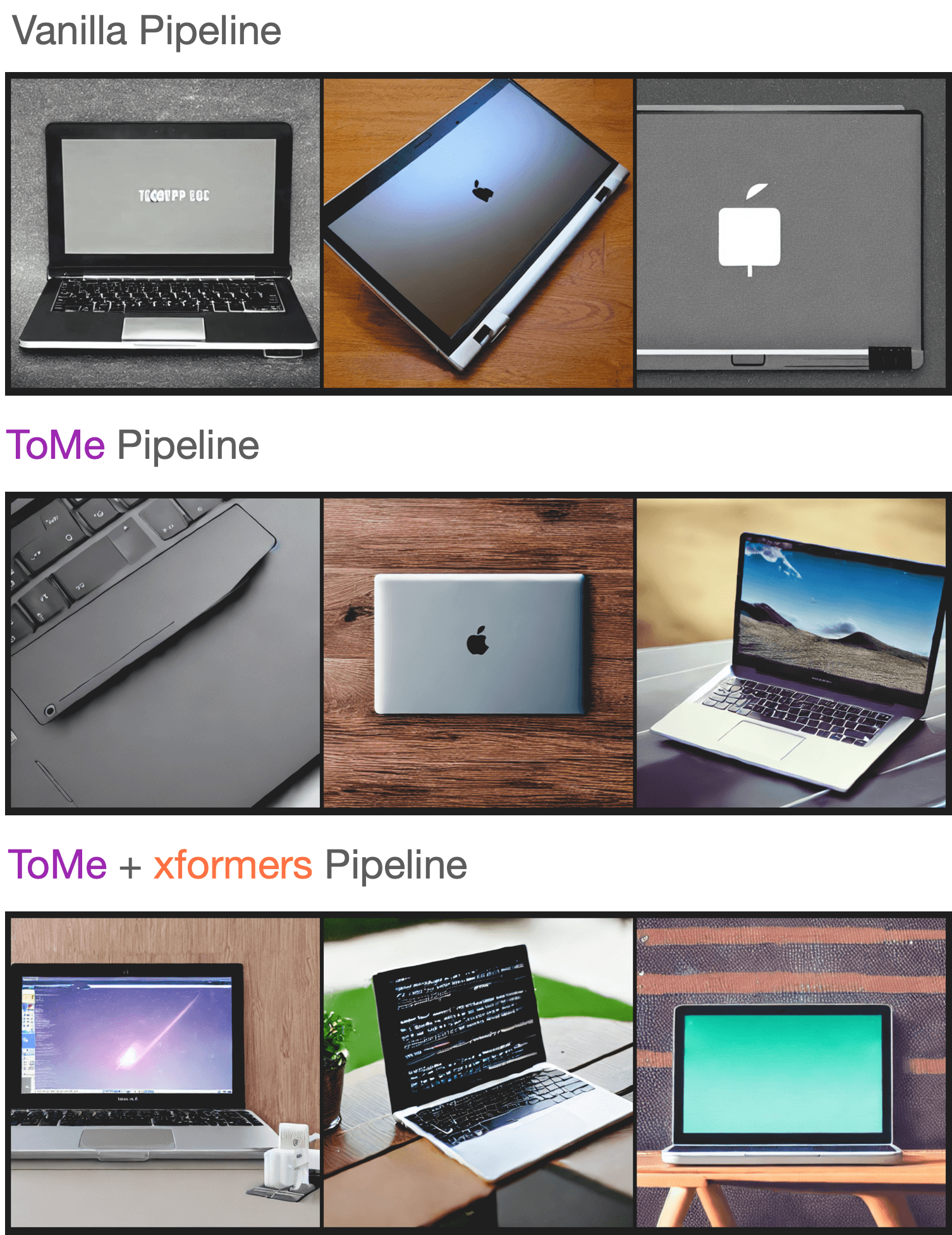
|
||||
|
||||
You can check out the generated samples [here](https://wandb.ai/sayakpaul/tomesd-results/runs/23j4bj3i?workspace=). We used [this script](https://gist.github.com/sayakpaul/8cac98d7f22399085a060992f411ecbd) for conducting this experiment.
|
||||
@@ -10,35 +10,34 @@ an "AS IS" BASIS, WITHOUT WARRANTIES OR CONDITIONS OF ANY KIND, either express o
|
||||
specific language governing permissions and limitations under the License.
|
||||
-->
|
||||
|
||||
# Torch2.0 support in Diffusers
|
||||
# Accelerated PyTorch 2.0 support in Diffusers
|
||||
|
||||
Starting from version `0.13.0`, Diffusers supports the latest optimization from the upcoming [PyTorch 2.0](https://pytorch.org/get-started/pytorch-2.0/) release. These include:
|
||||
1. Support for native flash and memory-efficient attention without any extra dependencies.
|
||||
2. [torch.compile](https://pytorch.org/tutorials/intermediate/torch_compile_tutorial.html) support for compiling individual models for extra performance boost.
|
||||
1. Support for accelerated transformers implementation with memory-efficient attention – no extra dependencies required.
|
||||
2. [torch.compile](https://pytorch.org/tutorials/intermediate/torch_compile_tutorial.html) support for extra performance boost when individual models are compiled.
|
||||
|
||||
|
||||
## Installation
|
||||
To benefit from the native efficient attention and `torch.compile`, we will need to install the nightly version of PyTorch as the stable version is yet to be released. The first step is to install CUDA11.7 or CUDA11.8,
|
||||
as torch2.0 does not support the previous versions. Once CUDA is installed, torch nightly can be installed using:
|
||||
To benefit from the accelerated attention implementation and `torch.compile`, you just need to install the latest versions of PyTorch 2.0 from `pip`, and make sure you are on diffusers 0.13.0 or later. As explained below, `diffusers` automatically uses the attention optimizations (but not `torch.compile`) when available.
|
||||
|
||||
```bash
|
||||
pip install --pre torch torchvision --index-url https://download.pytorch.org/whl/nightly/cu117
|
||||
pip install --upgrade torch torchvision diffusers
|
||||
```
|
||||
|
||||
## Using efficient attention and torch.compile.
|
||||
## Using accelerated transformers and torch.compile.
|
||||
|
||||
|
||||
1. **Efficient Attention**
|
||||
1. **Accelerated Transformers implementation**
|
||||
|
||||
Efficient attention is implemented via the [`torch.nn.functional.scaled_dot_product_attention`](https://pytorch.org/docs/master/generated/torch.nn.functional.scaled_dot_product_attention) function, which automatically enables flash/memory efficient attention, depending on the input and the GPU type. This is the same as the `memory_efficient_attention` from [xFormers](https://github.com/facebookresearch/xformers) but built natively into PyTorch.
|
||||
PyTorch 2.0 includes an optimized and memory-efficient attention implementation through the [`torch.nn.functional.scaled_dot_product_attention`](https://pytorch.org/docs/master/generated/torch.nn.functional.scaled_dot_product_attention) function, which automatically enables several optimizations depending on the inputs and the GPU type. This is similar to the `memory_efficient_attention` from [xFormers](https://github.com/facebookresearch/xformers), but built natively into PyTorch.
|
||||
|
||||
Efficient attention will be enabled by default in Diffusers if torch2.0 is installed and if `torch.nn.functional.scaled_dot_product_attention` is available. To use it, you can install torch2.0 as suggested above and use the pipeline. For example:
|
||||
These optimizations will be enabled by default in Diffusers if PyTorch 2.0 is installed and if `torch.nn.functional.scaled_dot_product_attention` is available. To use it, just install `torch 2.0` as suggested above and simply use the pipeline. For example:
|
||||
|
||||
```Python
|
||||
import torch
|
||||
from diffusers import StableDiffusionPipeline
|
||||
from diffusers import DiffusionPipeline
|
||||
|
||||
pipe = StableDiffusionPipeline.from_pretrained("runwayml/stable-diffusion-v1-5", torch_dtype=torch.float16)
|
||||
pipe = DiffusionPipeline.from_pretrained("runwayml/stable-diffusion-v1-5", torch_dtype=torch.float16)
|
||||
pipe = pipe.to("cuda")
|
||||
|
||||
prompt = "a photo of an astronaut riding a horse on mars"
|
||||
@@ -49,31 +48,29 @@ pip install --pre torch torchvision --index-url https://download.pytorch.org/whl
|
||||
|
||||
```Python
|
||||
import torch
|
||||
from diffusers import StableDiffusionPipeline
|
||||
from diffusers.models.cross_attention import AttnProcessor2_0
|
||||
from diffusers import DiffusionPipeline
|
||||
from diffusers.models.attention_processor import AttnProcessor2_0
|
||||
|
||||
pipe = StableDiffusionPipeline.from_pretrained("runwayml/stable-diffusion-v1-5", torch_dtype=torch.float16).to("cuda")
|
||||
pipe = DiffusionPipeline.from_pretrained("runwayml/stable-diffusion-v1-5", torch_dtype=torch.float16).to("cuda")
|
||||
pipe.unet.set_attn_processor(AttnProcessor2_0())
|
||||
|
||||
prompt = "a photo of an astronaut riding a horse on mars"
|
||||
image = pipe(prompt).images[0]
|
||||
```
|
||||
|
||||
This should be as fast and memory efficient as `xFormers`.
|
||||
This should be as fast and memory efficient as `xFormers`. More details [in our benchmark](#benchmark).
|
||||
|
||||
|
||||
2. **torch.compile**
|
||||
|
||||
To get an additional speedup, we can use the new `torch.compile` feature. To do so, we wrap our `unet` with `torch.compile`. For more information and different options, refer to the
|
||||
To get an additional speedup, we can use the new `torch.compile` feature. To do so, we simply wrap our `unet` with `torch.compile`. For more information and different options, refer to the
|
||||
[torch compile docs](https://pytorch.org/tutorials/intermediate/torch_compile_tutorial.html).
|
||||
|
||||
```python
|
||||
import torch
|
||||
from diffusers import StableDiffusionPipeline
|
||||
from diffusers import DiffusionPipeline
|
||||
|
||||
pipe = StableDiffusionPipeline.from_pretrained("runwayml/stable-diffusion-v1-5", torch_dtype=torch.float16).to(
|
||||
"cuda"
|
||||
)
|
||||
pipe = DiffusionPipeline.from_pretrained("runwayml/stable-diffusion-v1-5", torch_dtype=torch.float16).to("cuda")
|
||||
pipe.unet = torch.compile(pipe.unet)
|
||||
|
||||
batch_size = 10
|
||||
@@ -81,31 +78,35 @@ pip install --pre torch torchvision --index-url https://download.pytorch.org/whl
|
||||
images = pipe(prompt, num_inference_steps=steps, num_images_per_prompt=batch_size).images
|
||||
```
|
||||
|
||||
Depending on the type of GPU it can give between 2-9% speed-up over efficient attention. But note that as of now the speed-up is mostly noticeable on the more recent GPU architectures, such as in the A100.
|
||||
Depending on the type of GPU, `compile()` can yield between 2-9% of _additional speed-up_ over the accelerated transformer optimizations. Note, however, that compilation is able to squeeze more performance improvements in more recent GPU architectures such as Ampere (A100, 3090), Ada (4090) and Hopper (H100).
|
||||
|
||||
Note that compilation will also take some time to complete, so it is best suited for situations where you need to prepare your pipeline once and then perform the same type of inference operations multiple times.
|
||||
Compilation takes some time to complete, so it is best suited for situations where you need to prepare your pipeline once and then perform the same type of inference operations multiple times.
|
||||
|
||||
|
||||
## Benchmark
|
||||
|
||||
We conducted a simple benchmark on different GPUs to compare vanilla attention, xFormers, `torch.nn.functional.scaled_dot_product_attention` and `torch.compile+torch.nn.functional.scaled_dot_product_attention`.
|
||||
For the benchmark we used the the [stable-diffusion-v1-4](https://huggingface.co/CompVis/stable-diffusion-v1-4) model with 50 steps. `xFormers` benchmark is done using the `torch==1.13.1` version. The table below summarizes the result that we got.
|
||||
The `Speed over xformers` columns denotes the speed-up gained over `xFormers` using the `torch.compile+torch.nn.functional.scaled_dot_product_attention`.
|
||||
For the benchmark we used the [stable-diffusion-v1-4](https://huggingface.co/CompVis/stable-diffusion-v1-4) model with 50 steps. The `xFormers` benchmark is done using the `torch==1.13.1` version, while the accelerated transformers optimizations are tested using nightly versions of PyTorch 2.0. The tables below summarize the results we got.
|
||||
|
||||
Please refer to [our featured blog post in the PyTorch site](https://pytorch.org/blog/accelerated-diffusers-pt-20/) for more details.
|
||||
|
||||
### FP16 benchmark
|
||||
|
||||
The table below shows the benchmark results for inference using `fp16`. As we can see, `torch.nn.functional.scaled_dot_product_attention` is as fast as `xFormers` (sometimes slightly faster/slower) on all the GPUs we tested.
|
||||
And using `torch.compile` gives further speed-up up to 10% over `xFormers`, but it's mostly noticeable on the A100 GPU.
|
||||
And using `torch.compile` gives further speed-up of up of 10% over `xFormers`, but it's mostly noticeable on the A100 GPU.
|
||||
|
||||
___The time reported is in seconds.___
|
||||
|
||||
| GPU | Batch Size | Vanilla Attention | xFormers | PyTorch2.0 SDPA | SDPA + torch.compile | Speed over xformers (%) |
|
||||
| --- | --- | --- | --- | --- | --- | --- |
|
||||
| A100 | 10 | 12.02 | 8.7 | 8.79 | 7.89 | 9.31 |
|
||||
| A100 | 16 | 18.95 | 13.57 | 13.67 | 12.25 | 9.73 |
|
||||
| A100 | 32 (1) | OOM | 26.56 | 26.68 | 24.08 | 9.34 |
|
||||
| A100 | 64(2) | | 52.51 | 53.03 | 47.81 | 8.95 |
|
||||
| A100 | 1 | 2.69 | 2.7 | 1.98 | 2.47 | 8.52 |
|
||||
| A100 | 2 | 3.21 | 3.04 | 2.38 | 2.78 | 8.55 |
|
||||
| A100 | 4 | 5.27 | 3.91 | 3.89 | 3.53 | 9.72 |
|
||||
| A100 | 8 | 9.74 | 7.03 | 7.04 | 6.62 | 5.83 |
|
||||
| A100 | 10 | 12.02 | 8.7 | 8.67 | 8.45 | 2.87 |
|
||||
| A100 | 16 | 18.95 | 13.57 | 13.55 | 13.20 | 2.73 |
|
||||
| A100 | 32 (1) | OOM | 26.56 | 26.68 | 25.85 | 2.67 |
|
||||
| A100 | 64 | | 52.51 | 53.03 | 50.93 | 3.01 |
|
||||
| | | | | | | |
|
||||
| A10 | 4 | 13.94 | 9.81 | 10.01 | 9.35 | 4.69 |
|
||||
| A10 | 8 | 27.09 | 19 | 19.53 | 18.33 | 3.53 |
|
||||
@@ -124,34 +125,46 @@ ___The time reported is in seconds.___
|
||||
| V100 | 10 | OOM | 19.52 | 19.28 | 18.18 | 6.86 |
|
||||
| V100 | 16 | OOM | 30.29 | 29.84 | 28.22 | 6.83 |
|
||||
| | | | | | | |
|
||||
| 3090 | 4 | 10.04 | 7.82 | 7.89 | 7.47 | 4.48 |
|
||||
| 3090 | 8 | 19.27 | 14.97 | 15.04 | 14.22 | 5.01 |
|
||||
| 3090 | 10| 24.08 | 18.7 | 18.7 | 17.69 | 5.40 |
|
||||
| 3090 | 16 | OOM | 29.06 | 29.06 | 28.2 | 2.96 |
|
||||
| 3090 | 32 (1) | | 58.05 | 58 | 54.88 | 5.46 |
|
||||
| 3090 | 64 (1) | | 126.54 | 126.03 | 117.33 | 7.28 |
|
||||
| 3090 | 1 | 2.94 | 2.5 | 2.42 | 2.33 | 6.80 |
|
||||
| 3090 | 4 | 10.04 | 7.82 | 7.72 | 7.38 | 5.63 |
|
||||
| 3090 | 8 | 19.27 | 14.97 | 14.88 | 14.15 | 5.48 |
|
||||
| 3090 | 10| 24.08 | 18.7 | 18.62 | 18.12 | 3.10 |
|
||||
| 3090 | 16 | OOM | 29.06 | 28.88 | 28.2 | 2.96 |
|
||||
| 3090 | 32 (1) | | 58.05 | 57.42 | 56.28 | 3.05 |
|
||||
| 3090 | 64 (1) | | 126.54 | 114.27 | 112.21 | 11.32 |
|
||||
| | | | | | | |
|
||||
| 3090 Ti | 4 | 9.07 | 7.14 | 7.15 | 6.81 | 4.62 |
|
||||
| 3090 Ti | 8 | 17.51 | 13.65 | 13.72 | 12.99 | 4.84 |
|
||||
| 3090 Ti | 10 (2) | 21.79 | 16.85 | 16.93 | 16.02 | 4.93 |
|
||||
| 3090 Ti | 16 | OOM | 26.1 | 26.28 | 25.46 | 2.45 |
|
||||
| 3090 Ti | 32 (1) | | 51.78 | 52.04 | 49.15 | 5.08 |
|
||||
| 3090 Ti | 64 (1) | | 112.02 | 112.33 | 103.91 | 7.24 |
|
||||
| 3090 Ti | 1 | 2.7 | 2.26 | 2.19 | 2.12 | 6.19 |
|
||||
| 3090 Ti | 4 | 9.07 | 7.14 | 7.00 | 6.71 | 6.02 |
|
||||
| 3090 Ti | 8 | 17.51 | 13.65 | 13.53 | 12.94 | 5.20 |
|
||||
| 3090 Ti | 10 (2) | 21.79 | 16.85 | 16.77 | 16.44 | 2.43 |
|
||||
| 3090 Ti | 16 | OOM | 26.1 | 26.04 | 25.53 | 2.18 |
|
||||
| 3090 Ti | 32 (1) | | 51.78 | 51.71 | 50.91 | 1.68 |
|
||||
| 3090 Ti | 64 (1) | | 112.02 | 102.78 | 100.89 | 9.94 |
|
||||
| | | | | | | |
|
||||
| 4090 | 1 | 4.47 | 3.98 | 1.28 | 1.21 | 69.60 |
|
||||
| 4090 | 4 | 10.48 | 8.37 | 3.76 | 3.56 | 57.47 |
|
||||
| 4090 | 8 | 14.33 | 10.22 | 7.43 | 6.99 | 31.60 |
|
||||
| 4090 | 16 | | 17.07 | 14.98 | 14.58 | 14.59 |
|
||||
| 4090 | 32 (1) | | 39.03 | 30.18 | 29.49 | 24.44 |
|
||||
| 4090 | 64 (1) | | 77.29 | 61.34 | 59.96 | 22.42 |
|
||||
|
||||
|
||||
|
||||
### FP32 benchmark
|
||||
|
||||
The table below shows the benchmark results for inference using `fp32`. As we can see, `torch.nn.functional.scaled_dot_product_attention` is as fast as `xFormers` (sometimes slightly faster/slower) on all the GPUs we tested.
|
||||
Using `torch.compile` with efficient attention gives up to 18% performance improvement over `xFormers` in Ampere cards, and up to 20% over vanilla attention.
|
||||
The table below shows the benchmark results for inference using `fp32`. In this case, `torch.nn.functional.scaled_dot_product_attention` is faster than `xFormers` on all the GPUs we tested.
|
||||
|
||||
Using `torch.compile` in addition to the accelerated transformers implementation can yield up to 19% performance improvement over `xFormers` in Ampere and Ada cards, and up to 20% (Ampere) or 28% (Ada) over vanilla attention.
|
||||
|
||||
| GPU | Batch Size | Vanilla Attention | xFormers | PyTorch2.0 SDPA | SDPA + torch.compile | Speed over xformers (%) | Speed over vanilla (%) |
|
||||
| --- | --- | --- | --- | --- | --- | --- | --- |
|
||||
| A100 | 4 | 16.56 | 12.42 | 12.2 | 11.84 | 4.67 | 28.50 |
|
||||
| A100 | 10 | OOM | 29.93 | 29.44 | 28.5 | 4.78 | |
|
||||
| A100 | 16 | | 47.08 | 46.27 | 44.8 | 4.84 | |
|
||||
| A100 | 32 | | 92.89 | 91.34 | 88.35 | 4.89 | |
|
||||
| A100 | 64 | | 185.3 | 182.71 | 176.48 | 4.76 | |
|
||||
| A100 | 1 | 4.97 | 3.86 | 2.6 | 2.86 | 25.91 | 42.45 |
|
||||
| A100 | 2 | 9.03 | 6.76 | 4.41 | 4.21 | 37.72 | 53.38 |
|
||||
| A100 | 4 | 16.70 | 12.42 | 7.94 | 7.54 | 39.29 | 54.85 |
|
||||
| A100 | 10 | OOM | 29.93 | 18.70 | 18.46 | 38.32 | |
|
||||
| A100 | 16 | | 47.08 | 29.41 | 29.04 | 38.32 | |
|
||||
| A100 | 32 | | 92.89 | 57.55 | 56.67 | 38.99 | |
|
||||
| A100 | 64 | | 185.3 | 114.8 | 112.98 | 39.03 | |
|
||||
| | | | | | | |
|
||||
| A10 | 1 | 10.59 | 8.81 | 7.51 | 7.35 | 16.57 | 30.59 |
|
||||
| A10 | 4 | 34.77 | 27.63 | 22.77 | 22.07 | 20.12 | 36.53 |
|
||||
@@ -171,30 +184,27 @@ Using `torch.compile` with efficient attention gives up to 18% performance impro
|
||||
| V100 | 8 | | 43.95 | 43.37 | 42.25 | 3.87 | |
|
||||
| V100 | 16 | | 84.99 | 84.73 | 82.55 | 2.87 | |
|
||||
| | | | | | | |
|
||||
| 3090 | 1 | 7.09 | 6.78 | 6.11 | 6.03 | 11.06 | 14.95 |
|
||||
| 3090 | 4 | 22.69 | 21.45 | 18.67 | 18.09 | 15.66 | 20.27 |
|
||||
| 3090 | 8 (2) | | 42.59 | 36.75 | 35.59 | 16.44 | |
|
||||
| 3090 | 16 | | 85.35 | 72.37 | 70.25 | 17.69 | |
|
||||
| 3090 | 32 (1) | | 162.05 | 138.99 | 134.53 | 16.98 | |
|
||||
| 3090 | 48 | | 241.91 | 207.75 | | 14.12 | |
|
||||
| 3090 | 1 | 7.09 | 6.78 | 5.34 | 5.35 | 21.09 | 24.54 |
|
||||
| 3090 | 4 | 22.69 | 21.45 | 18.56 | 18.18 | 15.24 | 19.88 |
|
||||
| 3090 | 8 | | 42.59 | 36.68 | 35.61 | 16.39 | |
|
||||
| 3090 | 16 | | 85.35 | 72.93 | 70.18 | 17.77 | |
|
||||
| 3090 | 32 (1) | | 162.05 | 143.46 | 138.67 | 14.43 | |
|
||||
| | | | | | | |
|
||||
| 3090 Ti | 1 | 6.45 | 6.19 | 5.64 | 5.49 | 11.31 | 14.88 |
|
||||
| 3090 Ti | 4 | 20.32 | 19.31 | 16.9 | 16.37 | 15.23 | 19.44 |
|
||||
| 3090 Ti | 8 (2) | | 37.93 | 33.05 | 31.99 | 15.66 | |
|
||||
| 3090 Ti | 16 | | 75.37 | 65.25 | 64.32 | 14.66 | |
|
||||
| 3090 Ti | 32 (1) | | 142.55 | 124.44 | 120.74 | 15.30 | |
|
||||
| 3090 Ti | 48 | | 213.19 | 186.55 | | 12.50 | |
|
||||
| 3090 Ti | 1 | 6.45 | 6.19 | 4.99 | 4.89 | 21.00 | 24.19 |
|
||||
| 3090 Ti | 4 | 20.32 | 19.31 | 17.02 | 16.48 | 14.66 | 18.90 |
|
||||
| 3090 Ti | 8 | | 37.93 | 33.21 | 32.24 | 15.00 | |
|
||||
| 3090 Ti | 16 | | 75.37 | 66.63 | 64.5 | 14.42 | |
|
||||
| 3090 Ti | 32 (1) | | 142.55 | 128.89 | 124.92 | 12.37 | |
|
||||
| | | | | | | |
|
||||
| 4090 | 1 | 5.54 | 4.99 | 4.51 | | | |
|
||||
| 4090 | 4 | 13.67 | 11.4 | 10.3 | | | |
|
||||
| 4090 | 8 (2) | | 19.79 | 17.13 | | | |
|
||||
| 4090 | 16 | | 38.62 | 33.14 | | | |
|
||||
| 4090 | 32 (1) | | 76.57 | 65.96 | | | |
|
||||
| 4090 | 48 | | 114.44 | 98.78 | | | |
|
||||
| 4090 | 1 | 5.54 | 4.99 | 2.66 | 2.58 | 48.30 | 53.43 |
|
||||
| 4090 | 4 | 13.67 | 11.4 | 8.81 | 8.46 | 25.79 | 38.11 |
|
||||
| 4090 | 8 | | 19.79 | 17.55 | 16.62 | 16.02 | |
|
||||
| 4090 | 16 | | 38.62 | 35.65 | 34.07 | 11.78 | |
|
||||
| 4090 | 32 (1) | | 76.57 | 69.48 | 65.35 | 14.65 | |
|
||||
| 4090 | 48 | | 114.44 | 106.3 | | 7.11 | |
|
||||
|
||||
|
||||
(1) Batch Size >= 32 requires enable_vae_slicing() because of https://github.com/pytorch/pytorch/issues/81665.
|
||||
This is required for PyTorch 1.13.1, and also for PyTorch 2.0 and large batch sizes.
|
||||
|
||||
(1) Batch Size >= 32 requires enable_vae_slicing() because of https://github.com/pytorch/pytorch/issues/81665
|
||||
This is required for PyTorch 1.13.1, and also for PyTorch 2.0 and batch size of 64
|
||||
|
||||
For more details about how this benchmark was run, please refer to [this PR](https://github.com/huggingface/diffusers/pull/2303).
|
||||
For more details about how this benchmark was run, please refer to [this PR](https://github.com/huggingface/diffusers/pull/2303) and to [the blog post](https://pytorch.org/blog/accelerated-diffusers-pt-20/).
|
||||
|
||||
@@ -1,4 +1,4 @@
|
||||
<!--Copyright 2022 The HuggingFace Team. All rights reserved.
|
||||
<!--Copyright 2023 The HuggingFace Team. All rights reserved.
|
||||
|
||||
Licensed under the Apache License, Version 2.0 (the "License"); you may not use this file except in compliance with
|
||||
the License. You may obtain a copy of the License at
|
||||
|
||||
@@ -1,4 +1,4 @@
|
||||
<!--Copyright 2022 The HuggingFace Team. All rights reserved.
|
||||
<!--Copyright 2023 The HuggingFace Team. All rights reserved.
|
||||
|
||||
Licensed under the Apache License, Version 2.0 (the "License"); you may not use this file except in compliance with
|
||||
the License. You may obtain a copy of the License at
|
||||
@@ -10,10 +10,25 @@ an "AS IS" BASIS, WITHOUT WARRANTIES OR CONDITIONS OF ANY KIND, either express o
|
||||
specific language governing permissions and limitations under the License.
|
||||
-->
|
||||
|
||||
[[open-in-colab]]
|
||||
|
||||
# Quicktour
|
||||
|
||||
Get up and running with 🧨 Diffusers quickly!
|
||||
Whether you're a developer or an everyday user, this quick tour will help you get started and show you how to use [`DiffusionPipeline`] for inference.
|
||||
Diffusion models are trained to denoise random Gaussian noise step-by-step to generate a sample of interest, such as an image or audio. This has sparked a tremendous amount of interest in generative AI, and you have probably seen examples of diffusion generated images on the internet. 🧨 Diffusers is a library aimed at making diffusion models widely accessible to everyone.
|
||||
|
||||
Whether you're a developer or an everyday user, this quicktour will introduce you to 🧨 Diffusers and help you get up and generating quickly! There are three main components of the library to know about:
|
||||
|
||||
* The [`DiffusionPipeline`] is a high-level end-to-end class designed to rapidly generate samples from pretrained diffusion models for inference.
|
||||
* Popular pretrained [model](./api/models) architectures and modules that can be used as building blocks for creating diffusion systems.
|
||||
* Many different [schedulers](./api/schedulers/overview) - algorithms that control how noise is added for training, and how to generate denoised images during inference.
|
||||
|
||||
The quicktour will show you how to use the [`DiffusionPipeline`] for inference, and then walk you through how to combine a model and scheduler to replicate what's happening inside the [`DiffusionPipeline`].
|
||||
|
||||
<Tip>
|
||||
|
||||
The quicktour is a simplified version of the introductory 🧨 Diffusers [notebook](https://colab.research.google.com/github/huggingface/notebooks/blob/main/diffusers/diffusers_intro.ipynb) to help you get started quickly. If you want to learn more about 🧨 Diffusers goal, design philosophy, and additional details about it's core API, check out the notebook!
|
||||
|
||||
</Tip>
|
||||
|
||||
Before you begin, make sure you have all the necessary libraries installed:
|
||||
|
||||
@@ -21,32 +36,32 @@ Before you begin, make sure you have all the necessary libraries installed:
|
||||
pip install --upgrade diffusers accelerate transformers
|
||||
```
|
||||
|
||||
- [`accelerate`](https://huggingface.co/docs/accelerate/index) speeds up model loading for inference and training
|
||||
- [`transformers`](https://huggingface.co/docs/transformers/index) is required to run the most popular diffusion models, such as [Stable Diffusion](https://huggingface.co/docs/diffusers/api/pipelines/stable_diffusion/overview)
|
||||
- [🤗 Accelerate](https://huggingface.co/docs/accelerate/index) speeds up model loading for inference and training.
|
||||
- [🤗 Transformers](https://huggingface.co/docs/transformers/index) is required to run the most popular diffusion models, such as [Stable Diffusion](https://huggingface.co/docs/diffusers/api/pipelines/stable_diffusion/overview).
|
||||
|
||||
## DiffusionPipeline
|
||||
|
||||
The [`DiffusionPipeline`] is the easiest way to use a pre-trained diffusion system for inference. You can use the [`DiffusionPipeline`] out-of-the-box for many tasks across different modalities. Take a look at the table below for some supported tasks:
|
||||
The [`DiffusionPipeline`] is the easiest way to use a pretrained diffusion system for inference. It is an end-to-end system containing the model and the scheduler. You can use the [`DiffusionPipeline`] out-of-the-box for many tasks. Take a look at the table below for some supported tasks, and for a complete list of supported tasks, check out the [🧨 Diffusers Summary](./api/pipelines/overview#diffusers-summary) table.
|
||||
|
||||
| **Task** | **Description** | **Pipeline**
|
||||
|------------------------------|--------------------------------------------------------------------------------------------------------------|-----------------|
|
||||
| Unconditional Image Generation | generate an image from gaussian noise | [unconditional_image_generation](./using-diffusers/unconditional_image_generation) |
|
||||
| Unconditional Image Generation | generate an image from Gaussian noise | [unconditional_image_generation](./using-diffusers/unconditional_image_generation) |
|
||||
| Text-Guided Image Generation | generate an image given a text prompt | [conditional_image_generation](./using-diffusers/conditional_image_generation) |
|
||||
| Text-Guided Image-to-Image Translation | adapt an image guided by a text prompt | [img2img](./using-diffusers/img2img) |
|
||||
| Text-Guided Image-Inpainting | fill the masked part of an image given the image, the mask and a text prompt | [inpaint](./using-diffusers/inpaint) |
|
||||
| Text-Guided Depth-to-Image Translation | adapt parts of an image guided by a text prompt while preserving structure via depth estimation | [depth2img](./using-diffusers/depth2img) |
|
||||
|
||||
For more in-detail information on how diffusion pipelines function for the different tasks, please have a look at the [**Using Diffusers**](./using-diffusers/overview) section.
|
||||
Start by creating an instance of a [`DiffusionPipeline`] and specify which pipeline checkpoint you would like to download.
|
||||
You can use the [`DiffusionPipeline`] for any [checkpoint](https://huggingface.co/models?library=diffusers&sort=downloads) stored on the Hugging Face Hub.
|
||||
In this quicktour, you'll load the [`stable-diffusion-v1-5`](https://huggingface.co/runwayml/stable-diffusion-v1-5) checkpoint for text-to-image generation.
|
||||
|
||||
As an example, start by creating an instance of [`DiffusionPipeline`] and specify which pipeline checkpoint you would like to download.
|
||||
You can use the [`DiffusionPipeline`] for any [Diffusers' checkpoint](https://huggingface.co/models?library=diffusers&sort=downloads).
|
||||
In this guide though, you'll use [`DiffusionPipeline`] for text-to-image generation with [Stable Diffusion](https://huggingface.co/CompVis/stable-diffusion).
|
||||
<Tip warning={true}>
|
||||
|
||||
For [Stable Diffusion](https://huggingface.co/CompVis/stable-diffusion), please carefully read its [license](https://huggingface.co/spaces/CompVis/stable-diffusion-license) before running the model.
|
||||
This is due to the improved image generation capabilities of the model and the potentially harmful content that could be produced with it.
|
||||
Please, head over to your stable diffusion model of choice, *e.g.* [`runwayml/stable-diffusion-v1-5`](https://huggingface.co/runwayml/stable-diffusion-v1-5), and read the license.
|
||||
For [Stable Diffusion](https://huggingface.co/CompVis/stable-diffusion) models, please carefully read the [license](https://huggingface.co/spaces/CompVis/stable-diffusion-license) first before running the model. 🧨 Diffusers implements a [`safety_checker`](https://github.com/huggingface/diffusers/blob/main/src/diffusers/pipelines/stable_diffusion/safety_checker.py) to prevent offensive or harmful content, but the model's improved image generation capabilities can still produce potentially harmful content.
|
||||
|
||||
You can load the model as follows:
|
||||
</Tip>
|
||||
|
||||
Load the model with the [`~DiffusionPipeline.from_pretrained`] method:
|
||||
|
||||
```python
|
||||
>>> from diffusers import DiffusionPipeline
|
||||
@@ -54,77 +69,245 @@ You can load the model as follows:
|
||||
>>> pipeline = DiffusionPipeline.from_pretrained("runwayml/stable-diffusion-v1-5")
|
||||
```
|
||||
|
||||
The [`DiffusionPipeline`] downloads and caches all modeling, tokenization, and scheduling components.
|
||||
Because the model consists of roughly 1.4 billion parameters, we strongly recommend running it on GPU.
|
||||
You can move the generator object to GPU, just like you would in PyTorch.
|
||||
The [`DiffusionPipeline`] downloads and caches all modeling, tokenization, and scheduling components. You'll see that the Stable Diffusion pipeline is composed of the [`UNet2DConditionModel`] and [`PNDMScheduler`] among other things:
|
||||
|
||||
```py
|
||||
>>> pipeline
|
||||
StableDiffusionPipeline {
|
||||
"_class_name": "StableDiffusionPipeline",
|
||||
"_diffusers_version": "0.13.1",
|
||||
...,
|
||||
"scheduler": [
|
||||
"diffusers",
|
||||
"PNDMScheduler"
|
||||
],
|
||||
...,
|
||||
"unet": [
|
||||
"diffusers",
|
||||
"UNet2DConditionModel"
|
||||
],
|
||||
"vae": [
|
||||
"diffusers",
|
||||
"AutoencoderKL"
|
||||
]
|
||||
}
|
||||
```
|
||||
|
||||
We strongly recommend running the pipeline on a GPU because the model consists of roughly 1.4 billion parameters.
|
||||
You can move the generator object to a GPU, just like you would in PyTorch:
|
||||
|
||||
```python
|
||||
>>> pipeline.to("cuda")
|
||||
```
|
||||
|
||||
Now you can use the `pipeline` on your text prompt:
|
||||
Now you can pass a text prompt to the `pipeline` to generate an image, and then access the denoised image. By default, the image output is wrapped in a [`PIL.Image`](https://pillow.readthedocs.io/en/stable/reference/Image.html?highlight=image#the-image-class) object.
|
||||
|
||||
```python
|
||||
>>> image = pipeline("An image of a squirrel in Picasso style").images[0]
|
||||
>>> image
|
||||
```
|
||||
|
||||
The output is by default wrapped into a [PIL Image object](https://pillow.readthedocs.io/en/stable/reference/Image.html?highlight=image#the-image-class).
|
||||
<div class="flex justify-center">
|
||||
<img src="https://huggingface.co/datasets/huggingface/documentation-images/resolve/main/image_of_squirrel_painting.png"/>
|
||||
</div>
|
||||
|
||||
You can save the image by simply calling:
|
||||
Save the image by calling `save`:
|
||||
|
||||
```python
|
||||
>>> image.save("image_of_squirrel_painting.png")
|
||||
```
|
||||
|
||||
**Note**: You can also use the pipeline locally by downloading the weights via:
|
||||
### Local pipeline
|
||||
|
||||
You can also use the pipeline locally. The only difference is you need to download the weights first:
|
||||
|
||||
```
|
||||
git lfs install
|
||||
git clone https://huggingface.co/runwayml/stable-diffusion-v1-5
|
||||
```
|
||||
|
||||
and then loading the saved weights into the pipeline.
|
||||
Then load the saved weights into the pipeline:
|
||||
|
||||
```python
|
||||
>>> pipeline = DiffusionPipeline.from_pretrained("./stable-diffusion-v1-5")
|
||||
```
|
||||
|
||||
Running the pipeline is then identical to the code above as it's the same model architecture.
|
||||
Now you can run the pipeline as you would in the section above.
|
||||
|
||||
```python
|
||||
>>> generator.to("cuda")
|
||||
>>> image = generator("An image of a squirrel in Picasso style").images[0]
|
||||
>>> image.save("image_of_squirrel_painting.png")
|
||||
```
|
||||
### Swapping schedulers
|
||||
|
||||
Diffusion systems can be used with multiple different [schedulers](./api/schedulers/overview) each with their
|
||||
pros and cons. By default, Stable Diffusion runs with [`PNDMScheduler`], but it's very simple to
|
||||
use a different scheduler. *E.g.* if you would instead like to use the [`EulerDiscreteScheduler`] scheduler,
|
||||
you could use it as follows:
|
||||
Different schedulers come with different denoising speeds and quality trade-offs. The best way to find out which one works best for you is to try them out! One of the main features of 🧨 Diffusers is to allow you to easily switch between schedulers. For example, to replace the default [`PNDMScheduler`] with the [`EulerDiscreteScheduler`], load it with the [`~diffusers.ConfigMixin.from_config`] method:
|
||||
|
||||
```python
|
||||
```py
|
||||
>>> from diffusers import EulerDiscreteScheduler
|
||||
|
||||
>>> pipeline = StableDiffusionPipeline.from_pretrained("runwayml/stable-diffusion-v1-5")
|
||||
|
||||
>>> # change scheduler to Euler
|
||||
>>> pipeline = DiffusionPipeline.from_pretrained("runwayml/stable-diffusion-v1-5")
|
||||
>>> pipeline.scheduler = EulerDiscreteScheduler.from_config(pipeline.scheduler.config)
|
||||
```
|
||||
|
||||
For more in-detail information on how to change between schedulers, please refer to the [Using Schedulers](./using-diffusers/schedulers) guide.
|
||||
Try generating an image with the new scheduler and see if you notice a difference!
|
||||
|
||||
[Stability AI's](https://stability.ai/) Stable Diffusion model is an impressive image generation model
|
||||
and can do much more than just generating images from text. We have dedicated a whole documentation page,
|
||||
just for Stable Diffusion [here](./conceptual/stable_diffusion).
|
||||
In the next section, you'll take a closer look at the components - the model and scheduler - that make up the [`DiffusionPipeline`] and learn how to use these components to generate an image of a cat.
|
||||
|
||||
If you want to know how to optimize Stable Diffusion to run on less memory, higher inference speeds, on specific hardware, such as Mac, or with [ONNX Runtime](https://onnxruntime.ai/), please have a look at our
|
||||
optimization pages:
|
||||
## Models
|
||||
|
||||
- [Optimized PyTorch on GPU](./optimization/fp16)
|
||||
- [Mac OS with PyTorch](./optimization/mps)
|
||||
- [ONNX](./optimization/onnx)
|
||||
- [OpenVINO](./optimization/open_vino)
|
||||
Most models take a noisy sample, and at each timestep it predicts the *noise residual* (other models learn to predict the previous sample directly or the velocity or [`v-prediction`](https://github.com/huggingface/diffusers/blob/5e5ce13e2f89ac45a0066cb3f369462a3cf1d9ef/src/diffusers/schedulers/scheduling_ddim.py#L110)), the difference between a less noisy image and the input image. You can mix and match models to create other diffusion systems.
|
||||
|
||||
If you want to fine-tune or train your diffusion model, please have a look at the [**training section**](./training/overview)
|
||||
Models are initiated with the [`~ModelMixin.from_pretrained`] method which also locally caches the model weights so it is faster the next time you load the model. For the quicktour, you'll load the [`UNet2DModel`], a basic unconditional image generation model with a checkpoint trained on cat images:
|
||||
|
||||
Finally, please be considerate when distributing generated images publicly 🤗.
|
||||
```py
|
||||
>>> from diffusers import UNet2DModel
|
||||
|
||||
>>> repo_id = "google/ddpm-cat-256"
|
||||
>>> model = UNet2DModel.from_pretrained(repo_id)
|
||||
```
|
||||
|
||||
To access the model parameters, call `model.config`:
|
||||
|
||||
```py
|
||||
>>> model.config
|
||||
```
|
||||
|
||||
The model configuration is a 🧊 frozen 🧊 dictionary, which means those parameters can't be changed after the model is created. This is intentional and ensures that the parameters used to define the model architecture at the start remain the same, while other parameters can still be adjusted during inference.
|
||||
|
||||
Some of the most important parameters are:
|
||||
|
||||
* `sample_size`: the height and width dimension of the input sample.
|
||||
* `in_channels`: the number of input channels of the input sample.
|
||||
* `down_block_types` and `up_block_types`: the type of down- and upsampling blocks used to create the UNet architecture.
|
||||
* `block_out_channels`: the number of output channels of the downsampling blocks; also used in reverse order for the number of input channels of the upsampling blocks.
|
||||
* `layers_per_block`: the number of ResNet blocks present in each UNet block.
|
||||
|
||||
To use the model for inference, create the image shape with random Gaussian noise. It should have a `batch` axis because the model can receive multiple random noises, a `channel` axis corresponding to the number of input channels, and a `sample_size` axis for the height and width of the image:
|
||||
|
||||
```py
|
||||
>>> import torch
|
||||
|
||||
>>> torch.manual_seed(0)
|
||||
|
||||
>>> noisy_sample = torch.randn(1, model.config.in_channels, model.config.sample_size, model.config.sample_size)
|
||||
>>> noisy_sample.shape
|
||||
torch.Size([1, 3, 256, 256])
|
||||
```
|
||||
|
||||
For inference, pass the noisy image to the model and a `timestep`. The `timestep` indicates how noisy the input image is, with more noise at the beginning and less at the end. This helps the model determine its position in the diffusion process, whether it is closer to the start or the end. Use the `sample` method to get the model output:
|
||||
|
||||
```py
|
||||
>>> with torch.no_grad():
|
||||
... noisy_residual = model(sample=noisy_sample, timestep=2).sample
|
||||
```
|
||||
|
||||
To generate actual examples though, you'll need a scheduler to guide the denoising process. In the next section, you'll learn how to couple a model with a scheduler.
|
||||
|
||||
## Schedulers
|
||||
|
||||
Schedulers manage going from a noisy sample to a less noisy sample given the model output - in this case, it is the `noisy_residual`.
|
||||
|
||||
<Tip>
|
||||
|
||||
🧨 Diffusers is a toolbox for building diffusion systems. While the [`DiffusionPipeline`] is a convenient way to get started with a pre-built diffusion system, you can also choose your own model and scheduler components separately to build a custom diffusion system.
|
||||
|
||||
</Tip>
|
||||
|
||||
For the quicktour, you'll instantiate the [`DDPMScheduler`] with it's [`~diffusers.ConfigMixin.from_config`] method:
|
||||
|
||||
```py
|
||||
>>> from diffusers import DDPMScheduler
|
||||
|
||||
>>> scheduler = DDPMScheduler.from_config(repo_id)
|
||||
>>> scheduler
|
||||
DDPMScheduler {
|
||||
"_class_name": "DDPMScheduler",
|
||||
"_diffusers_version": "0.13.1",
|
||||
"beta_end": 0.02,
|
||||
"beta_schedule": "linear",
|
||||
"beta_start": 0.0001,
|
||||
"clip_sample": true,
|
||||
"clip_sample_range": 1.0,
|
||||
"num_train_timesteps": 1000,
|
||||
"prediction_type": "epsilon",
|
||||
"trained_betas": null,
|
||||
"variance_type": "fixed_small"
|
||||
}
|
||||
```
|
||||
|
||||
<Tip>
|
||||
|
||||
💡 Notice how the scheduler is instantiated from a configuration. Unlike a model, a scheduler does not have trainable weights and is parameter-free!
|
||||
|
||||
</Tip>
|
||||
|
||||
Some of the most important parameters are:
|
||||
|
||||
* `num_train_timesteps`: the length of the denoising process or in other words, the number of timesteps required to process random Gaussian noise into a data sample.
|
||||
* `beta_schedule`: the type of noise schedule to use for inference and training.
|
||||
* `beta_start` and `beta_end`: the start and end noise values for the noise schedule.
|
||||
|
||||
To predict a slightly less noisy image, pass the following to the scheduler's [`~diffusers.DDPMScheduler.step`] method: model output, `timestep`, and current `sample`.
|
||||
|
||||
```py
|
||||
>>> less_noisy_sample = scheduler.step(model_output=noisy_residual, timestep=2, sample=noisy_sample).prev_sample
|
||||
>>> less_noisy_sample.shape
|
||||
```
|
||||
|
||||
The `less_noisy_sample` can be passed to the next `timestep` where it'll get even less noisier! Let's bring it all together now and visualize the entire denoising process.
|
||||
|
||||
First, create a function that postprocesses and displays the denoised image as a `PIL.Image`:
|
||||
|
||||
```py
|
||||
>>> import PIL.Image
|
||||
>>> import numpy as np
|
||||
|
||||
|
||||
>>> def display_sample(sample, i):
|
||||
... image_processed = sample.cpu().permute(0, 2, 3, 1)
|
||||
... image_processed = (image_processed + 1.0) * 127.5
|
||||
... image_processed = image_processed.numpy().astype(np.uint8)
|
||||
|
||||
... image_pil = PIL.Image.fromarray(image_processed[0])
|
||||
... display(f"Image at step {i}")
|
||||
... display(image_pil)
|
||||
```
|
||||
|
||||
To speed up the denoising process, move the input and model to a GPU:
|
||||
|
||||
```py
|
||||
>>> model.to("cuda")
|
||||
>>> noisy_sample = noisy_sample.to("cuda")
|
||||
```
|
||||
|
||||
Now create a denoising loop that predicts the residual of the less noisy sample, and computes the less noisy sample with the scheduler:
|
||||
|
||||
```py
|
||||
>>> import tqdm
|
||||
|
||||
>>> sample = noisy_sample
|
||||
|
||||
>>> for i, t in enumerate(tqdm.tqdm(scheduler.timesteps)):
|
||||
... # 1. predict noise residual
|
||||
... with torch.no_grad():
|
||||
... residual = model(sample, t).sample
|
||||
|
||||
... # 2. compute less noisy image and set x_t -> x_t-1
|
||||
... sample = scheduler.step(residual, t, sample).prev_sample
|
||||
|
||||
... # 3. optionally look at image
|
||||
... if (i + 1) % 50 == 0:
|
||||
... display_sample(sample, i + 1)
|
||||
```
|
||||
|
||||
Sit back and watch as a cat is generated from nothing but noise! 😻
|
||||
|
||||
<div class="flex justify-center">
|
||||
<img src="https://huggingface.co/datasets/huggingface/documentation-images/resolve/main/diffusers/diffusion-quicktour.png"/>
|
||||
</div>
|
||||
|
||||
## Next steps
|
||||
|
||||
Hopefully you generated some cool images with 🧨 Diffusers in this quicktour! For your next steps, you can:
|
||||
|
||||
* Train or finetune a model to generate your own images in the [training](./tutorials/basic_training) tutorial.
|
||||
* See example official and community [training or finetuning scripts](https://github.com/huggingface/diffusers/tree/main/examples#-diffusers-examples) for a variety of use cases.
|
||||
* Learn more about loading, accessing, changing and comparing schedulers in the [Using different Schedulers](./using-diffusers/schedulers) guide.
|
||||
* Explore prompt engineering, speed and memory optimizations, and tips and tricks for generating higher quality images with the [Stable Diffusion](./stable_diffusion) guide.
|
||||
* Dive deeper into speeding up 🧨 Diffusers with guides on [optimized PyTorch on a GPU](./optimization/fp16), and inference guides for running [Stable Diffusion on Apple Silicon (M1/M2)](./optimization/mps) and [ONNX Runtime](./optimization/onnx).
|
||||
|
||||
@@ -1,333 +1,271 @@
|
||||
<!--Copyright 2022 The HuggingFace Team. All rights reserved.
|
||||
|
||||
Licensed under the Apache License, Version 2.0 (the "License"); you may not use this file except in compliance with
|
||||
the License. You may obtain a copy of the License at
|
||||
|
||||
http://www.apache.org/licenses/LICENSE-2.0
|
||||
|
||||
Unless required by applicable law or agreed to in writing, software distributed under the License is distributed on
|
||||
an "AS IS" BASIS, WITHOUT WARRANTIES OR CONDITIONS OF ANY KIND, either express or implied. See the License for the
|
||||
specific language governing permissions and limitations under the License.
|
||||
-->
|
||||
|
||||
# The Stable Diffusion Guide 🎨
|
||||
<a target="_blank" href="https://colab.research.google.com/github/huggingface/notebooks/blob/main/diffusers/sd_101_guide.ipynb">
|
||||
<img src="https://colab.research.google.com/assets/colab-badge.svg" alt="Open In Colab"/>
|
||||
</a>
|
||||
|
||||
## Intro
|
||||
|
||||
Stable Diffusion is a [Latent Diffusion model](https://github.com/CompVis/latent-diffusion) developed by researchers from the Machine Vision and Learning group at LMU Munich, *a.k.a* CompVis.
|
||||
Model checkpoints were publicly released at the end of August 2022 by a collaboration of Stability AI, CompVis, and Runway with support from EleutherAI and LAION. For more information, you can check out [the official blog post](https://stability.ai/blog/stable-diffusion-public-release).
|
||||
|
||||
Since its public release the community has done an incredible job at working together to make the stable diffusion checkpoints **faster**, **more memory efficient**, and **more performant**.
|
||||
|
||||
🧨 Diffusers offers a simple API to run stable diffusion with all memory, computing, and quality improvements.
|
||||
|
||||
This notebook walks you through the improvements one-by-one so you can best leverage [`StableDiffusionPipeline`] for **inference**.
|
||||
|
||||
## Prompt Engineering 🎨
|
||||
|
||||
When running *Stable Diffusion* in inference, we usually want to generate a certain type, or style of image and then improve upon it. Improving upon a previously generated image means running inference over and over again with a different prompt and potentially a different seed until we are happy with our generation.
|
||||
|
||||
So to begin with, it is most important to speed up stable diffusion as much as possible to generate as many pictures as possible in a given amount of time.
|
||||
|
||||
This can be done by both improving the **computational efficiency** (speed) and the **memory efficiency** (GPU RAM).
|
||||
|
||||
Let's start by looking into computational efficiency first.
|
||||
|
||||
Throughout the notebook, we will focus on [runwayml/stable-diffusion-v1-5](https://huggingface.co/runwayml/stable-diffusion-v1-5):
|
||||
|
||||
``` python
|
||||
model_id = "runwayml/stable-diffusion-v1-5"
|
||||
```
|
||||
|
||||
Let's load the pipeline.
|
||||
|
||||
## Speed Optimization
|
||||
|
||||
``` python
|
||||
from diffusers import StableDiffusionPipeline
|
||||
|
||||
pipe = StableDiffusionPipeline.from_pretrained(model_id)
|
||||
```
|
||||
|
||||
We aim at generating a beautiful photograph of an *old warrior chief* and will later try to find the best prompt to generate such a photograph. For now, let's keep the prompt simple:
|
||||
|
||||
``` python
|
||||
prompt = "portrait photo of a old warrior chief"
|
||||
```
|
||||
|
||||
To begin with, we should make sure we run inference on GPU, so let's move the pipeline to GPU, just like you would with any PyTorch module.
|
||||
|
||||
``` python
|
||||
pipe = pipe.to("cuda")
|
||||
```
|
||||
|
||||
To generate an image, you should use the [~`StableDiffusionPipeline.__call__`] method.
|
||||
|
||||
To make sure we can reproduce more or less the same image in every call, let's make use of the generator. See the documentation on reproducibility [here](./conceptual/reproducibility) for more information.
|
||||
|
||||
``` python
|
||||
generator = torch.Generator("cuda").manual_seed(0)
|
||||
```
|
||||
|
||||
Now, let's take a spin on it.
|
||||
|
||||
``` python
|
||||
image = pipe(prompt, generator=generator).images[0]
|
||||
image
|
||||
```
|
||||
|
||||

|
||||
|
||||
Cool, this now took roughly 30 seconds on a T4 GPU (you might see faster inference if your allocated GPU is better than a T4).
|
||||
|
||||
The default run we did above used full float32 precision and ran the default number of inference steps (50). The easiest speed-ups come from switching to float16 (or half) precision and simply running fewer inference steps. Let's load the model now in float16 instead.
|
||||
|
||||
``` python
|
||||
import torch
|
||||
|
||||
pipe = StableDiffusionPipeline.from_pretrained(model_id, torch_dtype=torch.float16)
|
||||
pipe = pipe.to("cuda")
|
||||
```
|
||||
|
||||
And we can again call the pipeline to generate an image.
|
||||
|
||||
``` python
|
||||
generator = torch.Generator("cuda").manual_seed(0)
|
||||
|
||||
image = pipe(prompt, generator=generator).images[0]
|
||||
image
|
||||
```
|
||||

|
||||
|
||||
Cool, this is almost three times as fast for arguably the same image quality.
|
||||
|
||||
We strongly suggest always running your pipelines in float16 as so far we have very rarely seen degradations in quality because of it.
|
||||
|
||||
Next, let's see if we need to use 50 inference steps or whether we could use significantly fewer. The number of inference steps is associated with the denoising scheduler we use. Choosing a more efficient scheduler could help us decrease the number of steps.
|
||||
|
||||
Let's have a look at all the schedulers the stable diffusion pipeline is compatible with.
|
||||
|
||||
``` python
|
||||
pipe.scheduler.compatibles
|
||||
```
|
||||
|
||||
```
|
||||
[diffusers.schedulers.scheduling_dpmsolver_singlestep.DPMSolverSinglestepScheduler,
|
||||
diffusers.schedulers.scheduling_lms_discrete.LMSDiscreteScheduler,
|
||||
diffusers.schedulers.scheduling_heun_discrete.HeunDiscreteScheduler,
|
||||
diffusers.schedulers.scheduling_pndm.PNDMScheduler,
|
||||
diffusers.schedulers.scheduling_euler_discrete.EulerDiscreteScheduler,
|
||||
diffusers.schedulers.scheduling_euler_ancestral_discrete.EulerAncestralDiscreteScheduler,
|
||||
diffusers.schedulers.scheduling_dpmsolver_multistep.DPMSolverMultistepScheduler,
|
||||
diffusers.schedulers.scheduling_ddpm.DDPMScheduler,
|
||||
diffusers.schedulers.scheduling_ddim.DDIMScheduler]
|
||||
```
|
||||
|
||||
Cool, that's a lot of schedulers.
|
||||
|
||||
🧨 Diffusers is constantly adding a bunch of novel schedulers/samplers that can be used with Stable Diffusion. For more information, we recommend taking a look at the official documentation [here](https://huggingface.co/docs/diffusers/main/en/api/schedulers/overview).
|
||||
|
||||
Alright, right now Stable Diffusion is using the `PNDMScheduler` which usually requires around 50 inference steps. However, other schedulers such as `DPMSolverMultistepScheduler` or `DPMSolverSinglestepScheduler` seem to get away with just 20 to 25 inference steps. Let's try them out.
|
||||
|
||||
You can set a new scheduler by making use of the [from_config](https://huggingface.co/docs/diffusers/main/en/api/configuration#diffusers.ConfigMixin.from_config) function.
|
||||
|
||||
``` python
|
||||
from diffusers import DPMSolverMultistepScheduler
|
||||
|
||||
pipe.scheduler = DPMSolverMultistepScheduler.from_config(pipe.scheduler.config)
|
||||
```
|
||||
|
||||
Now, let's try to reduce the number of inference steps to just 20.
|
||||
|
||||
``` python
|
||||
generator = torch.Generator("cuda").manual_seed(0)
|
||||
|
||||
image = pipe(prompt, generator=generator, num_inference_steps=20).images[0]
|
||||
image
|
||||
```
|
||||
|
||||
|
||||
|
||||
The image now does look a little different, but it's arguably still of equally high quality. We now cut inference time to just 4 seconds though 😍.
|
||||
|
||||
## Memory Optimization
|
||||
<!--Copyright 2023 The HuggingFace Team. All rights reserved.
|
||||
|
||||
Less memory used in generation indirectly implies more speed, since we're often trying to maximize how many images we can generate per second. Usually, the more images per inference run, the more images per second too.
|
||||
Licensed under the Apache License, Version 2.0 (the "License"); you may not use this file except in compliance with
|
||||
the License. You may obtain a copy of the License at
|
||||
|
||||
The easiest way to see how many images we can generate at once is to simply try it out, and see when we get a *"Out-of-memory (OOM)"* error.
|
||||
http://www.apache.org/licenses/LICENSE-2.0
|
||||
|
||||
We can run batched inference by simply passing a list of prompts and generators. Let's define a quick function that generates a batch for us.
|
||||
Unless required by applicable law or agreed to in writing, software distributed under the License is distributed on
|
||||
an "AS IS" BASIS, WITHOUT WARRANTIES OR CONDITIONS OF ANY KIND, either express or implied. See the License for the
|
||||
specific language governing permissions and limitations under the License.
|
||||
-->
|
||||
|
||||
# Effective and efficient diffusion
|
||||
|
||||
``` python
|
||||
def get_inputs(batch_size=1):
|
||||
generator = [torch.Generator("cuda").manual_seed(i) for i in range(batch_size)]
|
||||
prompts = batch_size * [prompt]
|
||||
num_inference_steps = 20
|
||||
[[open-in-colab]]
|
||||
|
||||
return {"prompt": prompts, "generator": generator, "num_inference_steps": num_inference_steps}
|
||||
```
|
||||
This function returns a list of prompts and a list of generators, so we can reuse the generator that produced a result we like.
|
||||
Getting the [`DiffusionPipeline`] to generate images in a certain style or include what you want can be tricky. Often times, you have to run the [`DiffusionPipeline`] several times before you end up with an image you're happy with. But generating something out of nothing is a computationally intensive process, especially if you're running inference over and over again.
|
||||
|
||||
We also need a method that allows us to easily display a batch of images.
|
||||
This is why it's important to get the most *computational* (speed) and *memory* (GPU RAM) efficiency from the pipeline to reduce the time between inference cycles so you can iterate faster.
|
||||
|
||||
``` python
|
||||
from PIL import Image
|
||||
This tutorial walks you through how to generate faster and better with the [`DiffusionPipeline`].
|
||||
|
||||
def image_grid(imgs, rows=2, cols=2):
|
||||
w, h = imgs[0].size
|
||||
grid = Image.new('RGB', size=(cols*w, rows*h))
|
||||
|
||||
for i, img in enumerate(imgs):
|
||||
grid.paste(img, box=(i%cols*w, i//cols*h))
|
||||
return grid
|
||||
```
|
||||
Begin by loading the [`runwayml/stable-diffusion-v1-5`](https://huggingface.co/runwayml/stable-diffusion-v1-5) model:
|
||||
|
||||
Cool, let's see how much memory we can use starting with `batch_size=4`.
|
||||
```python
|
||||
from diffusers import DiffusionPipeline
|
||||
|
||||
``` python
|
||||
images = pipe(**get_inputs(batch_size=4)).images
|
||||
image_grid(images)
|
||||
```
|
||||
model_id = "runwayml/stable-diffusion-v1-5"
|
||||
pipeline = DiffusionPipeline.from_pretrained(model_id)
|
||||
```
|
||||
|
||||
|
||||
The example prompt you'll use is a portrait of an old warrior chief, but feel free to use your own prompt:
|
||||
|
||||
Going over a batch_size of 4 will error out in this notebook (assuming we are running it on a T4 GPU). Also, we can see we only generate slightly more images per second (3.75s/image) compared to 4s/image previously.
|
||||
```python
|
||||
prompt = "portrait photo of a old warrior chief"
|
||||
```
|
||||
|
||||
However, the community has found some nice tricks to improve the memory constraints further. After stable diffusion was released, the community found improvements within days and shared them freely over GitHub - open-source at its finest! I believe the original idea came from [this](https://github.com/basujindal/stable-diffusion/pull/117) GitHub thread.
|
||||
## Speed
|
||||
|
||||
By far most of the memory is taken up by the cross-attention layers. Instead of running this operation in batch, one can run it sequentially to save a significant amount of memory.
|
||||
<Tip>
|
||||
|
||||
It can easily be enabled by calling `enable_attention_slicing` as is documented [here](https://huggingface.co/docs/diffusers/main/en/api/pipelines/stable_diffusion/text2img#diffusers.StableDiffusionPipeline.enable_attention_slicing).
|
||||
💡 If you don't have access to a GPU, you can use one for free from a GPU provider like [Colab](https://colab.research.google.com/)!
|
||||
|
||||
``` python
|
||||
pipe.enable_attention_slicing()
|
||||
```
|
||||
</Tip>
|
||||
|
||||
Great, now that attention slicing is enabled, let's try to double the batch size again, going for `batch_size=8`.
|
||||
One of the simplest ways to speed up inference is to place the pipeline on a GPU the same way you would with any PyTorch module:
|
||||
|
||||
``` python
|
||||
images = pipe(**get_inputs(batch_size=8)).images
|
||||
image_grid(images, rows=2, cols=4)
|
||||
```
|
||||
```python
|
||||
pipeline = pipeline.to("cuda")
|
||||
```
|
||||
|
||||
|
||||
To make sure you can use the same image and improve on it, use a [`Generator`](https://pytorch.org/docs/stable/generated/torch.Generator.html) and set a seed for [reproducibility](./using-diffusers/reproducibility):
|
||||
|
||||
Nice, it works. However, the speed gain is again not very big (it might however be much more significant on other GPUs).
|
||||
```python
|
||||
generator = torch.Generator("cuda").manual_seed(0)
|
||||
```
|
||||
|
||||
We're at roughly 3.5 seconds per image 🔥 which is probably the fastest we can be with a simple T4 without sacrificing quality.
|
||||
Now you can generate an image:
|
||||
|
||||
Next, let's look into how to improve the quality!
|
||||
```python
|
||||
image = pipeline(prompt, generator=generator).images[0]
|
||||
image
|
||||
```
|
||||
|
||||
## Quality Improvements
|
||||
<div class="flex justify-center">
|
||||
<img src="https://huggingface.co/datasets/diffusers/docs-images/resolve/main/stable_diffusion_101/sd_101_1.png">
|
||||
</div>
|
||||
|
||||
Now that our image generation pipeline is blazing fast, let's try to get maximum image quality.
|
||||
This process took ~30 seconds on a T4 GPU (it might be faster if your allocated GPU is better than a T4). By default, the [`DiffusionPipeline`] runs inference with full `float32` precision for 50 inference steps. You can speed this up by switching to a lower precision like `float16` or running fewer inference steps.
|
||||
|
||||
First of all, image quality is extremely subjective, so it's difficult to make general claims here.
|
||||
Let's start by loading the model in `float16` and generate an image:
|
||||
|
||||
The most obvious step to take to improve quality is to use *better checkpoints*. Since the release of Stable Diffusion, many improved versions have been released, which are summarized here:
|
||||
```python
|
||||
import torch
|
||||
|
||||
- *Official Release - 22 Aug 2022*: [Stable-Diffusion 1.4](https://huggingface.co/CompVis/stable-diffusion-v1-4)
|
||||
- *20 October 2022*: [Stable-Diffusion 1.5](https://huggingface.co/runwayml/stable-diffusion-v1-5)
|
||||
- *24 Nov 2022*: [Stable-Diffusion 2.0](https://huggingface.co/stabilityai/stable-diffusion-2-0)
|
||||
- *7 Dec 2022*: [Stable-Diffusion 2.1](https://huggingface.co/stabilityai/stable-diffusion-2-1)
|
||||
pipeline = DiffusionPipeline.from_pretrained(model_id, torch_dtype=torch.float16)
|
||||
pipeline = pipeline.to("cuda")
|
||||
generator = torch.Generator("cuda").manual_seed(0)
|
||||
image = pipeline(prompt, generator=generator).images[0]
|
||||
image
|
||||
```
|
||||
|
||||
Newer versions don't necessarily mean better image quality with the same parameters. People mentioned that *2.0* is slightly worse than *1.5* for certain prompts, but given the right prompt engineering *2.0* and *2.1* seem to be better.
|
||||
<div class="flex justify-center">
|
||||
<img src="https://huggingface.co/datasets/diffusers/docs-images/resolve/main/stable_diffusion_101/sd_101_2.png">
|
||||
</div>
|
||||
|
||||
Overall, we strongly recommend just trying the models out and reading up on advice online (e.g. it has been shown that using negative prompts is very important for 2.0 and 2.1 to get the highest possible quality. See for example [this nice blog post](https://minimaxir.com/2022/11/stable-diffusion-negative-prompt/).
|
||||
This time, it only took ~11 seconds to generate the image, which is almost 3x faster than before!
|
||||
|
||||
Additionally, the community has started fine-tuning many of the above versions on certain styles with some of them having an extremely high quality and gaining a lot of traction.
|
||||
<Tip>
|
||||
|
||||
We recommend having a look at all [diffusers checkpoints sorted by downloads and trying out the different checkpoints](https://huggingface.co/models?library=diffusers).
|
||||
💡 We strongly suggest always running your pipelines in `float16`, and so far, we've rarely seen any degradation in output quality.
|
||||
|
||||
For the following, we will stick to v1.5 for simplicity.
|
||||
</Tip>
|
||||
|
||||
Next, we can also try to optimize single components of the pipeline, e.g. switching out the latent decoder. For more details on how the whole Stable Diffusion pipeline works, please have a look at [this blog post](https://huggingface.co/blog/stable_diffusion).
|
||||
Another option is to reduce the number of inference steps. Choosing a more efficient scheduler could help decrease the number of steps without sacrificing output quality. You can find which schedulers are compatible with the current model in the [`DiffusionPipeline`] by calling the `compatibles` method:
|
||||
|
||||
Let's load [stabilityai's newest auto-decoder](https://huggingface.co/stabilityai/stable-diffusion-2-1).
|
||||
```python
|
||||
pipeline.scheduler.compatibles
|
||||
[
|
||||
diffusers.schedulers.scheduling_lms_discrete.LMSDiscreteScheduler,
|
||||
diffusers.schedulers.scheduling_unipc_multistep.UniPCMultistepScheduler,
|
||||
diffusers.schedulers.scheduling_k_dpm_2_discrete.KDPM2DiscreteScheduler,
|
||||
diffusers.schedulers.scheduling_deis_multistep.DEISMultistepScheduler,
|
||||
diffusers.schedulers.scheduling_euler_discrete.EulerDiscreteScheduler,
|
||||
diffusers.schedulers.scheduling_dpmsolver_multistep.DPMSolverMultistepScheduler,
|
||||
diffusers.schedulers.scheduling_ddpm.DDPMScheduler,
|
||||
diffusers.schedulers.scheduling_dpmsolver_singlestep.DPMSolverSinglestepScheduler,
|
||||
diffusers.schedulers.scheduling_k_dpm_2_ancestral_discrete.KDPM2AncestralDiscreteScheduler,
|
||||
diffusers.schedulers.scheduling_heun_discrete.HeunDiscreteScheduler,
|
||||
diffusers.schedulers.scheduling_pndm.PNDMScheduler,
|
||||
diffusers.schedulers.scheduling_euler_ancestral_discrete.EulerAncestralDiscreteScheduler,
|
||||
diffusers.schedulers.scheduling_ddim.DDIMScheduler,
|
||||
]
|
||||
```
|
||||
|
||||
``` python
|
||||
from diffusers import AutoencoderKL
|
||||
The Stable Diffusion model uses the [`PNDMScheduler`] by default which usually requires ~50 inference steps, but more performant schedulers like [`DPMSolverMultistepScheduler`], require only ~20 or 25 inference steps. Use the [`ConfigMixin.from_config`] method to load a new scheduler:
|
||||
|
||||
vae = AutoencoderKL.from_pretrained("stabilityai/sd-vae-ft-mse", torch_dtype=torch.float16).to("cuda")
|
||||
```
|
||||
```python
|
||||
from diffusers import DPMSolverMultistepScheduler
|
||||
|
||||
Now we can set it to the vae of the pipeline to use it.
|
||||
pipeline.scheduler = DPMSolverMultistepScheduler.from_config(pipeline.scheduler.config)
|
||||
```
|
||||
|
||||
``` python
|
||||
pipe.vae = vae
|
||||
```
|
||||
Now set the `num_inference_steps` to 20:
|
||||
|
||||
Let's run the same prompt as before to compare quality.
|
||||
```python
|
||||
generator = torch.Generator("cuda").manual_seed(0)
|
||||
image = pipeline(prompt, generator=generator, num_inference_steps=20).images[0]
|
||||
image
|
||||
```
|
||||
|
||||
``` python
|
||||
images = pipe(**get_inputs(batch_size=8)).images
|
||||
image_grid(images, rows=2, cols=4)
|
||||
```
|
||||
<div class="flex justify-center">
|
||||
<img src="https://huggingface.co/datasets/diffusers/docs-images/resolve/main/stable_diffusion_101/sd_101_3.png">
|
||||
</div>
|
||||
|
||||

|
||||
Great, you've managed to cut the inference time to just 4 seconds! ⚡️
|
||||
|
||||
Seems like the difference is only very minor, but the new generations are arguably a bit *sharper*.
|
||||
## Memory
|
||||
|
||||
Cool, finally, let's look a bit into prompt engineering.
|
||||
The other key to improving pipeline performance is consuming less memory, which indirectly implies more speed, since you're often trying to maximize the number of images generated per second. The easiest way to see how many images you can generate at once is to try out different batch sizes until you get an `OutOfMemoryError` (OOM).
|
||||
|
||||
Our goal was to generate a photo of an old warrior chief. Let's now try to bring a bit more color into the photos and make the look more impressive.
|
||||
Create a function that'll generate a batch of images from a list of prompts and `Generators`. Make sure to assign each `Generator` a seed so you can reuse it if it produces a good result.
|
||||
|
||||
Originally our prompt was "*portrait photo of an old warrior chief*".
|
||||
```python
|
||||
def get_inputs(batch_size=1):
|
||||
generator = [torch.Generator("cuda").manual_seed(i) for i in range(batch_size)]
|
||||
prompts = batch_size * [prompt]
|
||||
num_inference_steps = 20
|
||||
|
||||
To improve the prompt, it often helps to add cues that could have been used online to save high-quality photos, as well as add more details.
|
||||
Essentially, when doing prompt engineering, one has to think:
|
||||
return {"prompt": prompts, "generator": generator, "num_inference_steps": num_inference_steps}
|
||||
```
|
||||
|
||||
- How was the photo or similar photos of the one I want probably stored on the internet?
|
||||
- What additional detail can I give that steers the models into the style that I want?
|
||||
You'll also need a function that'll display each batch of images:
|
||||
|
||||
Cool, let's add more details.
|
||||
```python
|
||||
from PIL import image
|
||||
|
||||
``` python
|
||||
prompt += ", tribal panther make up, blue on red, side profile, looking away, serious eyes"
|
||||
```
|
||||
|
||||
and let's also add some cues that usually help to generate higher quality images.
|
||||
def image_grid(imgs, rows=2, cols=2):
|
||||
w, h = imgs[0].size
|
||||
grid = Image.new("RGB", size=(cols * w, rows * h))
|
||||
|
||||
``` python
|
||||
prompt += " 50mm portrait photography, hard rim lighting photography--beta --ar 2:3 --beta --upbeta"
|
||||
prompt
|
||||
```
|
||||
for i, img in enumerate(imgs):
|
||||
grid.paste(img, box=(i % cols * w, i // cols * h))
|
||||
return grid
|
||||
```
|
||||
|
||||
Cool, let's now try this prompt.
|
||||
Start with `batch_size=4` and see how much memory you've consumed:
|
||||
|
||||
``` python
|
||||
images = pipe(**get_inputs(batch_size=8)).images
|
||||
image_grid(images, rows=2, cols=4)
|
||||
```
|
||||
```python
|
||||
images = pipeline(**get_inputs(batch_size=4)).images
|
||||
image_grid(images)
|
||||
```
|
||||
|
||||
|
||||
Unless you have a GPU with more RAM, the code above probably returned an `OOM` error! Most of the memory is taken up by the cross-attention layers. Instead of running this operation in a batch, you can run it sequentially to save a significant amount of memory. All you have to do is configure the pipeline to use the [`~DiffusionPipeline.enable_attention_slicing`] function:
|
||||
|
||||
Pretty impressive! We got some very high-quality image generations there. The 2nd image is my personal favorite, so I'll re-use this seed and see whether I can tweak the prompts slightly by using "oldest warrior", "old", "", and "young" instead of "old".
|
||||
```python
|
||||
pipeline.enable_attention_slicing()
|
||||
```
|
||||
|
||||
``` python
|
||||
prompts = [
|
||||
"portrait photo of the oldest warrior chief, tribal panther make up, blue on red, side profile, looking away, serious eyes 50mm portrait photography, hard rim lighting photography--beta --ar 2:3 --beta --upbeta",
|
||||
"portrait photo of a old warrior chief, tribal panther make up, blue on red, side profile, looking away, serious eyes 50mm portrait photography, hard rim lighting photography--beta --ar 2:3 --beta --upbeta",
|
||||
"portrait photo of a warrior chief, tribal panther make up, blue on red, side profile, looking away, serious eyes 50mm portrait photography, hard rim lighting photography--beta --ar 2:3 --beta --upbeta",
|
||||
"portrait photo of a young warrior chief, tribal panther make up, blue on red, side profile, looking away, serious eyes 50mm portrait photography, hard rim lighting photography--beta --ar 2:3 --beta --upbeta",
|
||||
]
|
||||
Now try increasing the `batch_size` to 8!
|
||||
|
||||
generator = [torch.Generator("cuda").manual_seed(1) for _ in range(len(prompts))] # 1 because we want the 2nd image
|
||||
```python
|
||||
images = pipeline(**get_inputs(batch_size=8)).images
|
||||
image_grid(images, rows=2, cols=4)
|
||||
```
|
||||
|
||||
images = pipe(prompt=prompts, generator=generator, num_inference_steps=25).images
|
||||
image_grid(images)
|
||||
```
|
||||
<div class="flex justify-center">
|
||||
<img src="https://huggingface.co/datasets/diffusers/docs-images/resolve/main/stable_diffusion_101/sd_101_5.png">
|
||||
</div>
|
||||
|
||||

|
||||
Whereas before you couldn't even generate a batch of 4 images, now you can generate a batch of 8 images at ~3.5 seconds per image! This is probably the fastest you can go on a T4 GPU without sacrificing quality.
|
||||
|
||||
The first picture looks nice! The eye movement slightly changed and looks nice. This finished up our 101-guide on how to use Stable Diffusion 🤗.
|
||||
## Quality
|
||||
|
||||
For more information on optimization or other guides, I recommend taking a look at the following:
|
||||
In the last two sections, you learned how to optimize the speed of your pipeline by using `fp16`, reducing the number of inference steps by using a more performant scheduler, and enabling attention slicing to reduce memory consumption. Now you're going to focus on how to improve the quality of generated images.
|
||||
|
||||
- [Blog post about Stable Diffusion](https://huggingface.co/blog/stable_diffusion): In-detail blog post explaining Stable Diffusion.
|
||||
- [FlashAttention](https://huggingface.co/docs/diffusers/optimization/xformers): XFormers flash attention can optimize your model even further with more speed and memory improvements.
|
||||
- [Dreambooth](https://huggingface.co/docs/diffusers/training/dreambooth) - Quickly customize the model by fine-tuning it.
|
||||
- [General info on Stable Diffusion](https://huggingface.co/docs/diffusers/main/en/api/pipelines/stable_diffusion/overview) - Info on other tasks that are powered by Stable Diffusion.
|
||||
### Better checkpoints
|
||||
|
||||
The most obvious step is to use better checkpoints. The Stable Diffusion model is a good starting point, and since its official launch, several improved versions have also been released. However, using a newer version doesn't automatically mean you'll get better results. You'll still have to experiment with different checkpoints yourself, and do a little research (such as using [negative prompts](https://minimaxir.com/2022/11/stable-diffusion-negative-prompt/)) to get the best results.
|
||||
|
||||
As the field grows, there are more and more high-quality checkpoints finetuned to produce certain styles. Try exploring the [Hub](https://huggingface.co/models?library=diffusers&sort=downloads) and [Diffusers Gallery](https://huggingface.co/spaces/huggingface-projects/diffusers-gallery) to find one you're interested in!
|
||||
|
||||
### Better pipeline components
|
||||
|
||||
You can also try replacing the current pipeline components with a newer version. Let's try loading the latest [autodecoder](https://huggingface.co/stabilityai/stable-diffusion-2-1/tree/main/vae) from Stability AI into the pipeline, and generate some images:
|
||||
|
||||
```python
|
||||
from diffusers import AutoencoderKL
|
||||
|
||||
vae = AutoencoderKL.from_pretrained("stabilityai/sd-vae-ft-mse", torch_dtype=torch.float16).to("cuda")
|
||||
pipeline.vae = vae
|
||||
images = pipeline(**get_inputs(batch_size=8)).images
|
||||
image_grid(images, rows=2, cols=4)
|
||||
```
|
||||
|
||||
<div class="flex justify-center">
|
||||
<img src="https://huggingface.co/datasets/diffusers/docs-images/resolve/main/stable_diffusion_101/sd_101_6.png">
|
||||
</div>
|
||||
|
||||
### Better prompt engineering
|
||||
|
||||
The text prompt you use to generate an image is super important, so much so that it is called *prompt engineering*. Some considerations to keep during prompt engineering are:
|
||||
|
||||
- How is the image or similar images of the one I want to generate stored on the internet?
|
||||
- What additional detail can I give that steers the model towards the style I want?
|
||||
|
||||
With this in mind, let's improve the prompt to include color and higher quality details:
|
||||
|
||||
```python
|
||||
prompt += ", tribal panther make up, blue on red, side profile, looking away, serious eyes"
|
||||
prompt += " 50mm portrait photography, hard rim lighting photography--beta --ar 2:3 --beta --upbeta"
|
||||
```
|
||||
|
||||
Generate a batch of images with the new prompt:
|
||||
|
||||
```python
|
||||
images = pipeline(**get_inputs(batch_size=8)).images
|
||||
image_grid(images, rows=2, cols=4)
|
||||
```
|
||||
|
||||
<div class="flex justify-center">
|
||||
<img src="https://huggingface.co/datasets/diffusers/docs-images/resolve/main/stable_diffusion_101/sd_101_7.png">
|
||||
</div>
|
||||
|
||||
Pretty impressive! Let's tweak the second image - corresponding to the `Generator` with a seed of `1` - a bit more by adding some text about the age of the subject:
|
||||
|
||||
```python
|
||||
prommpts = [
|
||||
"portrait photo of the oldest warrior chief, tribal panther make up, blue on red, side profile, looking away, serious eyes 50mm portrait photography, hard rim lighting photography--beta --ar 2:3 --beta --upbeta",
|
||||
"portrait photo of a old warrior chief, tribal panther make up, blue on red, side profile, looking away, serious eyes 50mm portrait photography, hard rim lighting photography--beta --ar 2:3 --beta --upbeta",
|
||||
"portrait photo of a warrior chief, tribal panther make up, blue on red, side profile, looking away, serious eyes 50mm portrait photography, hard rim lighting photography--beta --ar 2:3 --beta --upbeta",
|
||||
"portrait photo of a young warrior chief, tribal panther make up, blue on red, side profile, looking away, serious eyes 50mm portrait photography, hard rim lighting photography--beta --ar 2:3 --beta --upbeta",
|
||||
]
|
||||
|
||||
generator = [torch.Generator("cuda").manual_seed(1) for _ in range(len(prompts))]
|
||||
images = pipeline(prompt=prompts, generator=generator, num_inference_steps=25).images
|
||||
image_grid(images)
|
||||
```
|
||||
|
||||
<div class="flex justify-center">
|
||||
<img src="https://huggingface.co/datasets/diffusers/docs-images/resolve/main/stable_diffusion_101/sd_101_8.png">
|
||||
</div>
|
||||
|
||||
## Next steps
|
||||
|
||||
In this tutorial, you learned how to optimize a [`DiffusionPipeline`] for computational and memory efficiency as well as improving the quality of generated outputs. If you're interested in making your pipeline even faster, take a look at the following resources:
|
||||
|
||||
- Enable [xFormers](./optimization/xformers) memory efficient attention mechanism for faster speed and reduced memory consumption.
|
||||
- Learn how in [PyTorch 2.0](./optimization/torch2.0), [`torch.compile`](https://pytorch.org/docs/stable/generated/torch.compile.html) can yield 2-9% faster inference speed.
|
||||
- Many optimization techniques for inference are also included in this memory and speed [guide](./optimization/fp16), such as memory offloading.
|
||||
314
docs/source/en/training/controlnet.mdx
Normal file
314
docs/source/en/training/controlnet.mdx
Normal file
@@ -0,0 +1,314 @@
|
||||
<!--Copyright 2023 The HuggingFace Team. All rights reserved.
|
||||
|
||||
Licensed under the Apache License, Version 2.0 (the "License"); you may not use this file except in compliance with
|
||||
the License. You may obtain a copy of the License at
|
||||
|
||||
http://www.apache.org/licenses/LICENSE-2.0
|
||||
|
||||
Unless required by applicable law or agreed to in writing, software distributed under the License is distributed on
|
||||
an "AS IS" BASIS, WITHOUT WARRANTIES OR CONDITIONS OF ANY KIND, either express or implied. See the License for the
|
||||
specific language governing permissions and limitations under the License.
|
||||
-->
|
||||
|
||||
# ControlNet
|
||||
|
||||
[Adding Conditional Control to Text-to-Image Diffusion Models](https://arxiv.org/abs/2302.05543) (ControlNet) by Lvmin Zhang and Maneesh Agrawala.
|
||||
|
||||
This example is based on the [training example in the original ControlNet repository](https://github.com/lllyasviel/ControlNet/blob/main/docs/train.md). It trains a ControlNet to fill circles using a [small synthetic dataset](https://huggingface.co/datasets/fusing/fill50k).
|
||||
|
||||
## Installing the dependencies
|
||||
|
||||
Before running the scripts, make sure to install the library's training dependencies.
|
||||
|
||||
<Tip warning={true}>
|
||||
|
||||
To successfully run the latest versions of the example scripts, we highly recommend **installing from source** and keeping the installation up to date. We update the example scripts frequently and install example-specific requirements.
|
||||
|
||||
</Tip>
|
||||
|
||||
To do this, execute the following steps in a new virtual environment:
|
||||
```bash
|
||||
git clone https://github.com/huggingface/diffusers
|
||||
cd diffusers
|
||||
pip install -e .
|
||||
```
|
||||
|
||||
Then navigate into the example folder and run:
|
||||
```bash
|
||||
pip install -r requirements.txt
|
||||
```
|
||||
|
||||
And initialize an [🤗Accelerate](https://github.com/huggingface/accelerate/) environment with:
|
||||
|
||||
```bash
|
||||
accelerate config
|
||||
```
|
||||
|
||||
Or for a default 🤗Accelerate configuration without answering questions about your environment:
|
||||
|
||||
```bash
|
||||
accelerate config default
|
||||
```
|
||||
|
||||
Or if your environment doesn't support an interactive shell like a notebook:
|
||||
|
||||
```python
|
||||
from accelerate.utils import write_basic_config
|
||||
|
||||
write_basic_config()
|
||||
```
|
||||
|
||||
## Circle filling dataset
|
||||
|
||||
The original dataset is hosted in the ControlNet [repo](https://huggingface.co/lllyasviel/ControlNet/blob/main/training/fill50k.zip), but we re-uploaded it [here](https://huggingface.co/datasets/fusing/fill50k) to be compatible with 🤗 Datasets so that it can handle the data loading within the training script.
|
||||
|
||||
Our training examples use [`runwayml/stable-diffusion-v1-5`](https://huggingface.co/runwayml/stable-diffusion-v1-5) because that is what the original set of ControlNet models was trained on. However, ControlNet can be trained to augment any compatible Stable Diffusion model (such as [`CompVis/stable-diffusion-v1-4`](https://huggingface.co/CompVis/stable-diffusion-v1-4)) or [`stabilityai/stable-diffusion-2-1`](https://huggingface.co/stabilityai/stable-diffusion-2-1).
|
||||
|
||||
## Training
|
||||
|
||||
Download the following images to condition our training with:
|
||||
|
||||
```sh
|
||||
wget https://huggingface.co/datasets/huggingface/documentation-images/resolve/main/diffusers/controlnet_training/conditioning_image_1.png
|
||||
|
||||
wget https://huggingface.co/datasets/huggingface/documentation-images/resolve/main/diffusers/controlnet_training/conditioning_image_2.png
|
||||
```
|
||||
|
||||
Specify the `MODEL_NAME` environment variable (either a Hub model repository id or a path to the directory containing the model weights) and pass it to the [`~diffusers.DiffusionPipeline.from_pretrained.pretrained_model_name_or_path`] argument.
|
||||
|
||||
```bash
|
||||
export MODEL_DIR="runwayml/stable-diffusion-v1-5"
|
||||
export OUTPUT_DIR="path to save model"
|
||||
|
||||
accelerate launch train_controlnet.py \
|
||||
--pretrained_model_name_or_path=$MODEL_DIR \
|
||||
--output_dir=$OUTPUT_DIR \
|
||||
--dataset_name=fusing/fill50k \
|
||||
--resolution=512 \
|
||||
--learning_rate=1e-5 \
|
||||
--validation_image "./conditioning_image_1.png" "./conditioning_image_2.png" \
|
||||
--validation_prompt "red circle with blue background" "cyan circle with brown floral background" \
|
||||
--train_batch_size=4
|
||||
```
|
||||
|
||||
This default configuration requires ~38GB VRAM.
|
||||
|
||||
By default, the training script logs outputs to tensorboard. Pass `--report_to wandb` to use Weights &
|
||||
Biases.
|
||||
|
||||
Gradient accumulation with a smaller batch size can be used to reduce training requirements to ~20 GB VRAM.
|
||||
|
||||
```bash
|
||||
export MODEL_DIR="runwayml/stable-diffusion-v1-5"
|
||||
export OUTPUT_DIR="path to save model"
|
||||
|
||||
accelerate launch train_controlnet.py \
|
||||
--pretrained_model_name_or_path=$MODEL_DIR \
|
||||
--output_dir=$OUTPUT_DIR \
|
||||
--dataset_name=fusing/fill50k \
|
||||
--resolution=512 \
|
||||
--learning_rate=1e-5 \
|
||||
--validation_image "./conditioning_image_1.png" "./conditioning_image_2.png" \
|
||||
--validation_prompt "red circle with blue background" "cyan circle with brown floral background" \
|
||||
--train_batch_size=1 \
|
||||
--gradient_accumulation_steps=4
|
||||
```
|
||||
|
||||
## Training with multiple GPUs
|
||||
|
||||
`accelerate` allows for seamless multi-GPU training. Follow the instructions [here](https://huggingface.co/docs/accelerate/basic_tutorials/launch)
|
||||
for running distributed training with `accelerate`. Here is an example command:
|
||||
|
||||
```bash
|
||||
export MODEL_DIR="runwayml/stable-diffusion-v1-5"
|
||||
export OUTPUT_DIR="path to save model"
|
||||
|
||||
accelerate launch --mixed_precision="fp16" --multi_gpu train_controlnet.py \
|
||||
--pretrained_model_name_or_path=$MODEL_DIR \
|
||||
--output_dir=$OUTPUT_DIR \
|
||||
--dataset_name=fusing/fill50k \
|
||||
--resolution=512 \
|
||||
--learning_rate=1e-5 \
|
||||
--validation_image "./conditioning_image_1.png" "./conditioning_image_2.png" \
|
||||
--validation_prompt "red circle with blue background" "cyan circle with brown floral background" \
|
||||
--train_batch_size=4 \
|
||||
--mixed_precision="fp16" \
|
||||
--tracker_project_name="controlnet-demo" \
|
||||
--report_to=wandb
|
||||
```
|
||||
|
||||
## Example results
|
||||
|
||||
#### After 300 steps with batch size 8
|
||||
|
||||
| | |
|
||||
|-------------------|:-------------------------:|
|
||||
| | red circle with blue background |
|
||||
 |  |
|
||||
| | cyan circle with brown floral background |
|
||||
 |  |
|
||||
|
||||
|
||||
#### After 6000 steps with batch size 8:
|
||||
|
||||
| | |
|
||||
|-------------------|:-------------------------:|
|
||||
| | red circle with blue background |
|
||||
 |  |
|
||||
| | cyan circle with brown floral background |
|
||||
 |  |
|
||||
|
||||
## Training on a 16 GB GPU
|
||||
|
||||
Enable the following optimizations to train on a 16GB GPU:
|
||||
|
||||
- Gradient checkpointing
|
||||
- bitsandbyte's 8-bit optimizer (take a look at the [installation]((https://github.com/TimDettmers/bitsandbytes#requirements--installation) instructions if you don't already have it installed)
|
||||
|
||||
Now you can launch the training script:
|
||||
|
||||
```bash
|
||||
export MODEL_DIR="runwayml/stable-diffusion-v1-5"
|
||||
export OUTPUT_DIR="path to save model"
|
||||
|
||||
accelerate launch train_controlnet.py \
|
||||
--pretrained_model_name_or_path=$MODEL_DIR \
|
||||
--output_dir=$OUTPUT_DIR \
|
||||
--dataset_name=fusing/fill50k \
|
||||
--resolution=512 \
|
||||
--learning_rate=1e-5 \
|
||||
--validation_image "./conditioning_image_1.png" "./conditioning_image_2.png" \
|
||||
--validation_prompt "red circle with blue background" "cyan circle with brown floral background" \
|
||||
--train_batch_size=1 \
|
||||
--gradient_accumulation_steps=4 \
|
||||
--gradient_checkpointing \
|
||||
--use_8bit_adam
|
||||
```
|
||||
|
||||
## Training on a 12 GB GPU
|
||||
|
||||
Enable the following optimizations to train on a 12GB GPU:
|
||||
- Gradient checkpointing
|
||||
- bitsandbyte's 8-bit optimizer (take a look at the [installation]((https://github.com/TimDettmers/bitsandbytes#requirements--installation) instructions if you don't already have it installed)
|
||||
- xFormers (take a look at the [installation](https://huggingface.co/docs/diffusers/training/optimization/xformers) instructions if you don't already have it installed)
|
||||
- set gradients to `None`
|
||||
|
||||
```bash
|
||||
export MODEL_DIR="runwayml/stable-diffusion-v1-5"
|
||||
export OUTPUT_DIR="path to save model"
|
||||
|
||||
accelerate launch train_controlnet.py \
|
||||
--pretrained_model_name_or_path=$MODEL_DIR \
|
||||
--output_dir=$OUTPUT_DIR \
|
||||
--dataset_name=fusing/fill50k \
|
||||
--resolution=512 \
|
||||
--learning_rate=1e-5 \
|
||||
--validation_image "./conditioning_image_1.png" "./conditioning_image_2.png" \
|
||||
--validation_prompt "red circle with blue background" "cyan circle with brown floral background" \
|
||||
--train_batch_size=1 \
|
||||
--gradient_accumulation_steps=4 \
|
||||
--gradient_checkpointing \
|
||||
--use_8bit_adam \
|
||||
--enable_xformers_memory_efficient_attention \
|
||||
--set_grads_to_none
|
||||
```
|
||||
|
||||
When using `enable_xformers_memory_efficient_attention`, please make sure to install `xformers` by `pip install xformers`.
|
||||
|
||||
## Training on an 8 GB GPU
|
||||
|
||||
We have not exhaustively tested DeepSpeed support for ControlNet. While the configuration does
|
||||
save memory, we have not confirmed whether the configuration trains successfully. You will very likely
|
||||
have to make changes to the config to have a successful training run.
|
||||
|
||||
Enable the following optimizations to train on a 8GB GPU:
|
||||
- Gradient checkpointing
|
||||
- bitsandbyte's 8-bit optimizer (take a look at the [installation]((https://github.com/TimDettmers/bitsandbytes#requirements--installation) instructions if you don't already have it installed)
|
||||
- xFormers (take a look at the [installation](https://huggingface.co/docs/diffusers/training/optimization/xformers) instructions if you don't already have it installed)
|
||||
- set gradients to `None`
|
||||
- DeepSpeed stage 2 with parameter and optimizer offloading
|
||||
- fp16 mixed precision
|
||||
|
||||
[DeepSpeed](https://www.deepspeed.ai/) can offload tensors from VRAM to either
|
||||
CPU or NVME. This requires significantly more RAM (about 25 GB).
|
||||
|
||||
You'll have to configure your environment with `accelerate config` to enable DeepSpeed stage 2.
|
||||
|
||||
The configuration file should look like this:
|
||||
|
||||
```yaml
|
||||
compute_environment: LOCAL_MACHINE
|
||||
deepspeed_config:
|
||||
gradient_accumulation_steps: 4
|
||||
offload_optimizer_device: cpu
|
||||
offload_param_device: cpu
|
||||
zero3_init_flag: false
|
||||
zero_stage: 2
|
||||
distributed_type: DEEPSPEED
|
||||
```
|
||||
|
||||
<Tip>
|
||||
|
||||
See [documentation](https://huggingface.co/docs/accelerate/usage_guides/deepspeed) for more DeepSpeed configuration options.
|
||||
|
||||
<Tip>
|
||||
|
||||
Changing the default Adam optimizer to DeepSpeed's Adam
|
||||
`deepspeed.ops.adam.DeepSpeedCPUAdam` gives a substantial speedup but
|
||||
it requires a CUDA toolchain with the same version as PyTorch. 8-bit optimizer
|
||||
does not seem to be compatible with DeepSpeed at the moment.
|
||||
|
||||
```bash
|
||||
export MODEL_DIR="runwayml/stable-diffusion-v1-5"
|
||||
export OUTPUT_DIR="path to save model"
|
||||
|
||||
accelerate launch train_controlnet.py \
|
||||
--pretrained_model_name_or_path=$MODEL_DIR \
|
||||
--output_dir=$OUTPUT_DIR \
|
||||
--dataset_name=fusing/fill50k \
|
||||
--resolution=512 \
|
||||
--validation_image "./conditioning_image_1.png" "./conditioning_image_2.png" \
|
||||
--validation_prompt "red circle with blue background" "cyan circle with brown floral background" \
|
||||
--train_batch_size=1 \
|
||||
--gradient_accumulation_steps=4 \
|
||||
--gradient_checkpointing \
|
||||
--enable_xformers_memory_efficient_attention \
|
||||
--set_grads_to_none \
|
||||
--mixed_precision fp16
|
||||
```
|
||||
|
||||
## Inference
|
||||
|
||||
The trained model can be run with the [`StableDiffusionControlNetPipeline`].
|
||||
Set `base_model_path` and `controlnet_path` to the values `--pretrained_model_name_or_path` and
|
||||
`--output_dir` were respectively set to in the training script.
|
||||
|
||||
```py
|
||||
from diffusers import StableDiffusionControlNetPipeline, ControlNetModel, UniPCMultistepScheduler
|
||||
from diffusers.utils import load_image
|
||||
import torch
|
||||
|
||||
base_model_path = "path to model"
|
||||
controlnet_path = "path to controlnet"
|
||||
|
||||
controlnet = ControlNetModel.from_pretrained(controlnet_path, torch_dtype=torch.float16)
|
||||
pipe = StableDiffusionControlNetPipeline.from_pretrained(
|
||||
base_model_path, controlnet=controlnet, torch_dtype=torch.float16
|
||||
)
|
||||
|
||||
# speed up diffusion process with faster scheduler and memory optimization
|
||||
pipe.scheduler = UniPCMultistepScheduler.from_config(pipe.scheduler.config)
|
||||
# remove following line if xformers is not installed
|
||||
pipe.enable_xformers_memory_efficient_attention()
|
||||
|
||||
pipe.enable_model_cpu_offload()
|
||||
|
||||
control_image = load_image("./conditioning_image_1.png")
|
||||
prompt = "pale golden rod circle with old lace background"
|
||||
|
||||
# generate image
|
||||
generator = torch.manual_seed(0)
|
||||
image = pipe(prompt, num_inference_steps=20, generator=generator, image=control_image).images[0]
|
||||
|
||||
image.save("./output.png")
|
||||
```
|
||||
Some files were not shown because too many files have changed in this diff Show More
Reference in New Issue
Block a user